
CHAPTER 10 Measuring GDP and Economic Growth After
- Slides: 45
CHAPTER 10 Measuring GDP and Economic Growth
After studying this chapter you will be able to: u Define GDP and explain why it equals aggregate expenditure and aggregate income u Explain the two methods used by the Office for National Statistics to measure UK GDP u Describe how GDP is used and explain its limitations © Pearson Education 2012
Gross Domestic Product GDP Defined GDP or gross domestic product is the market value of all final goods and services produced in a country in a given time period. This definition has four parts: Market value Final goods and services Produced within a country In a given time period © Pearson Education 2012
Gross Domestic Product Market Value GDP is a market value – goods and services are valued at their market prices. To add apples and oranges, computers and popcorn, we add the market values so we have a total value of output in pounds. © Pearson Education 2012
Gross Domestic Product Final Goods and Services GDP is the value of the final goods and services produced. A final good (or service) is an item bought by its final user during a specified time period. A final good contrasts with an intermediate good, which is an item that is produced by one firm, bought by another firm, and used as a component of a final good or service. Excluding intermediate goods and services avoids double counting. © Pearson Education 2012
Gross Domestic Product Produced Within a Country GDP measures production within a country – domestic production. In a Given Time Period GDP measures production during a specific time period, normally a year or a quarter of a year. © Pearson Education 2012
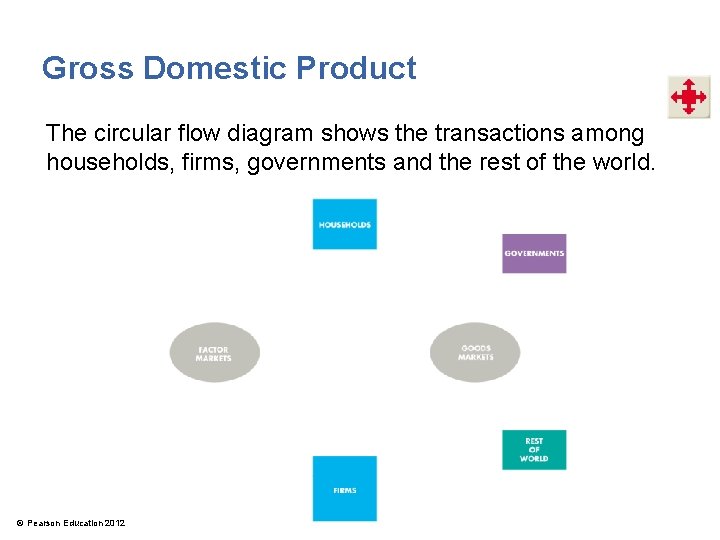
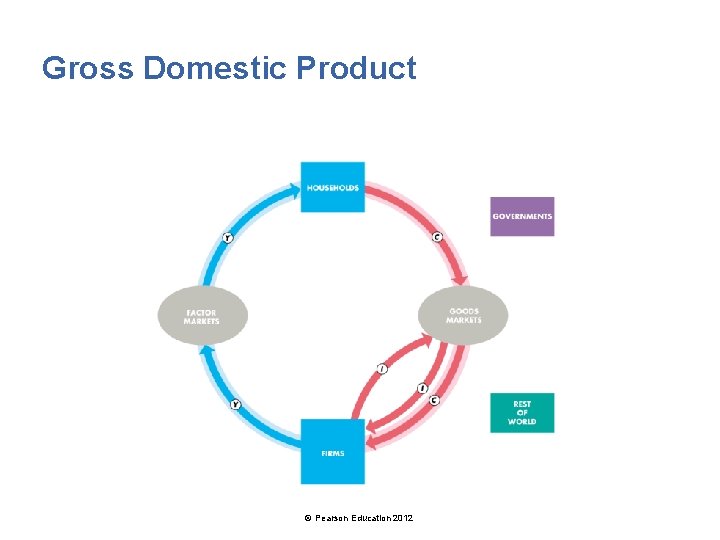
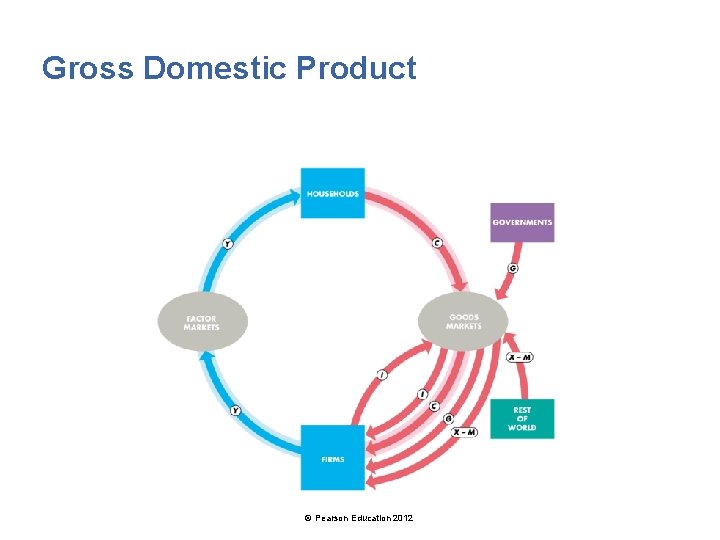
Gross Domestic Product GDP and the Circular Flow of Expenditure and Income GDP measures the value of production, which also equals total expenditure on final goods and total income. The equality of income and output shows the direct link between productivity and living standards. The circular flow diagram in Figure 10. 1 illustrates the equality of income, expenditure, and the value of production. © Pearson Education 2012
Gross Domestic Product The circular flow diagram shows the transactions among households, firms, governments and the rest of the world. © Pearson Education 2012
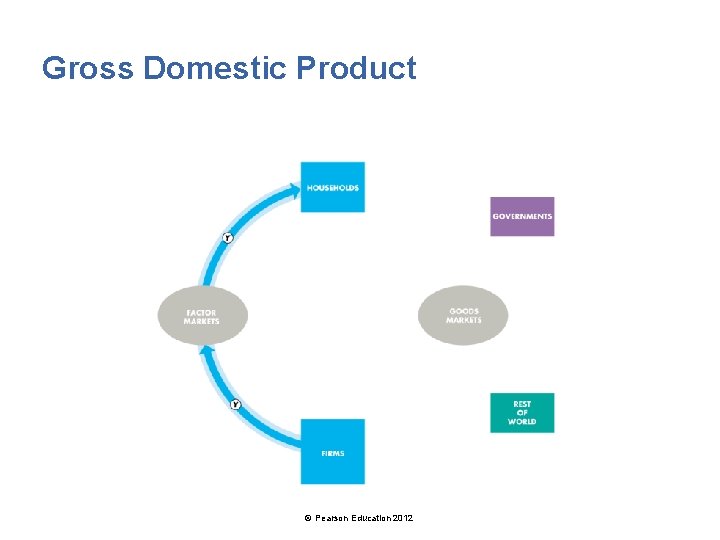
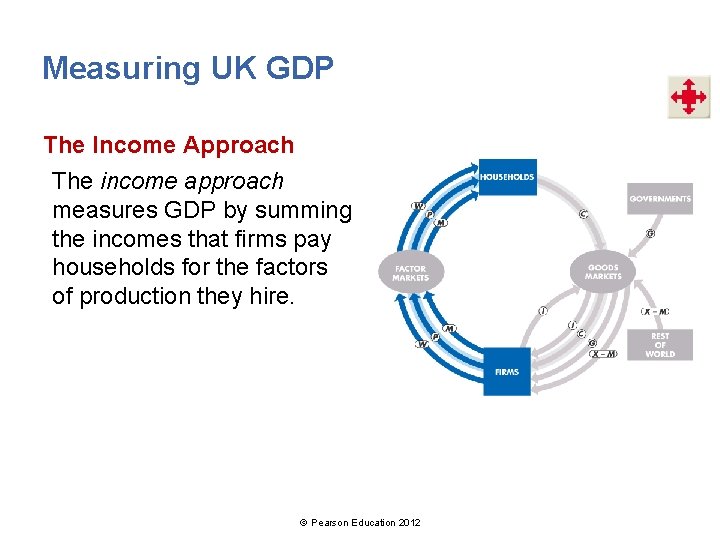
Gross Domestic Product Households and Firms Households sell and firms buy the services of labour, capital, and land in factor markets. For these factor services, firms pay income to households: wages for labour services, interest for the use of capital, and rent for the use of land. A fourth factor of production, entrepreneurship, receives profit. In the figure, the blue flow, Y, shows total income paid by firms to households. © Pearson Education 2012
Gross Domestic Product © Pearson Education 2012
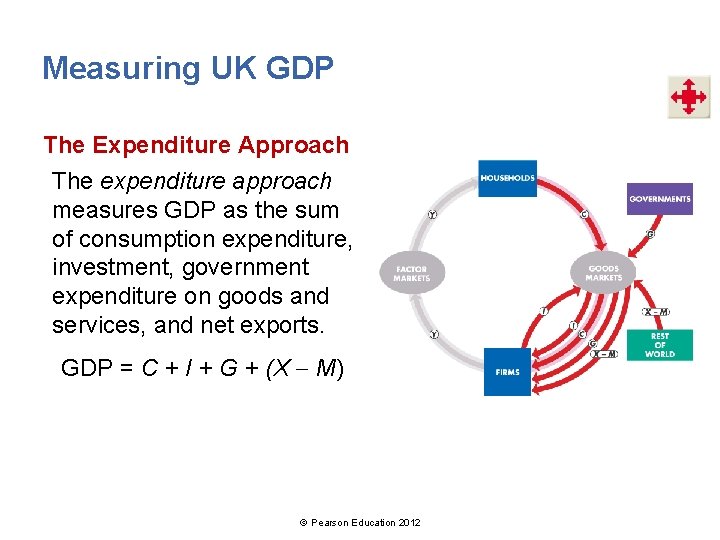
Gross Domestic Product Firms sell and households buy consumer goods and services in the goods market. Consumption expenditure is the total payment for consumer goods and services, shown by the red flow labelled C. Firms buy and sell new capital equipment in the goods market and put unsold output into inventory. The purchase of new plant, equipment, and buildings and the additions to inventories are investment, shown by the red flow labelled I. © Pearson Education 2012
Gross Domestic Product © Pearson Education 2012
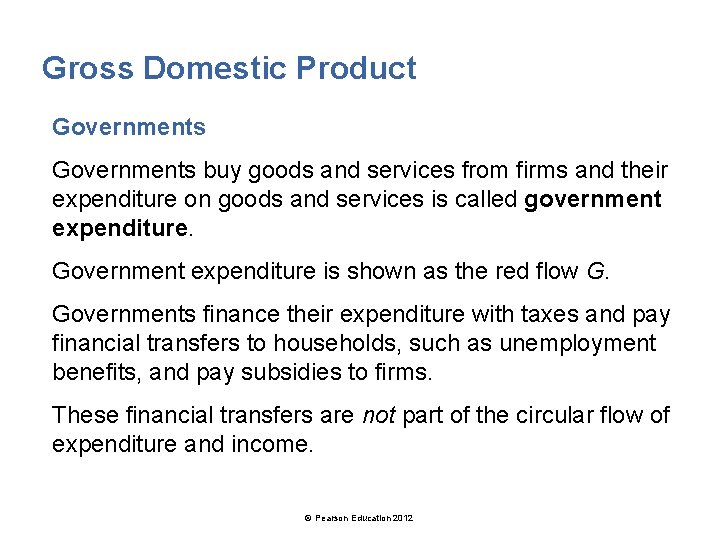
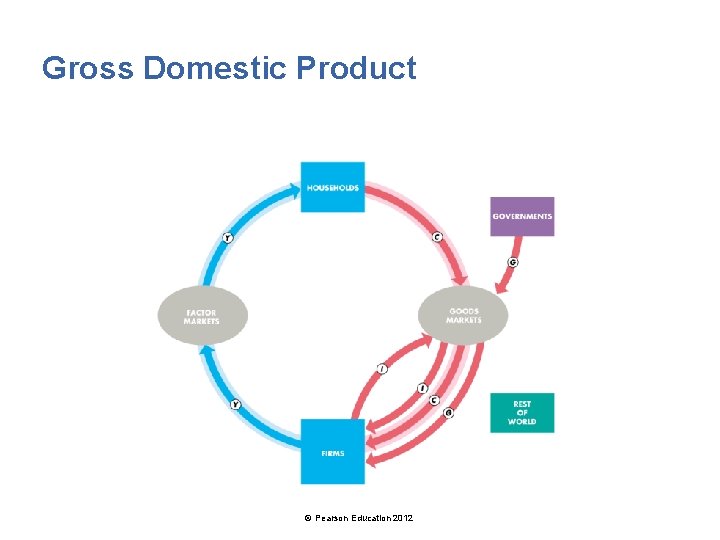
Gross Domestic Product Governments buy goods and services from firms and their expenditure on goods and services is called government expenditure. Government expenditure is shown as the red flow G. Governments finance their expenditure with taxes and pay financial transfers to households, such as unemployment benefits, and pay subsidies to firms. These financial transfers are not part of the circular flow of expenditure and income. © Pearson Education 2012
Gross Domestic Product © Pearson Education 2012
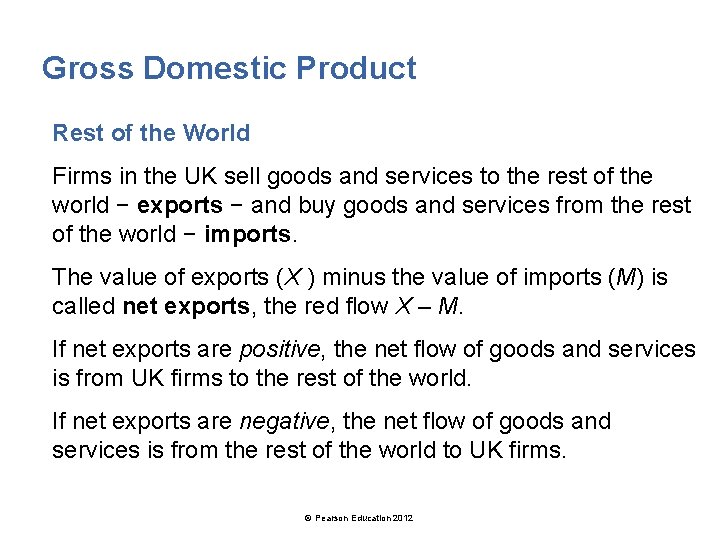
Gross Domestic Product Rest of the World Firms in the UK sell goods and services to the rest of the world − exports − and buy goods and services from the rest of the world − imports. The value of exports (X ) minus the value of imports (M) is called net exports, the red flow X – M. If net exports are positive, the net flow of goods and services is from UK firms to the rest of the world. If net exports are negative, the net flow of goods and services is from the rest of the world to UK firms. © Pearson Education 2012
Gross Domestic Product © Pearson Education 2012
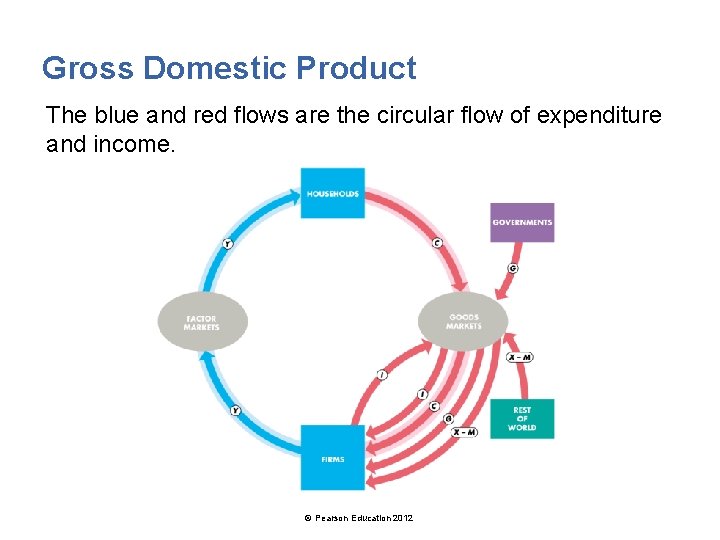
Gross Domestic Product The blue and red flows are the circular flow of expenditure and income. © Pearson Education 2012
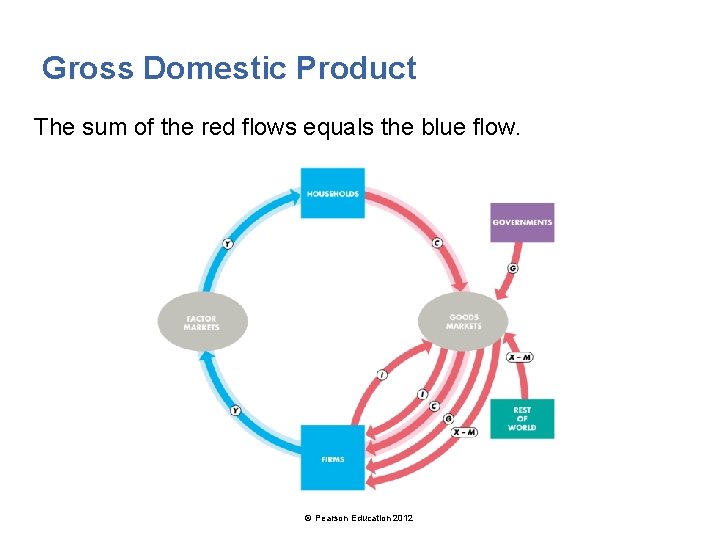
Gross Domestic Product The sum of the red flows equals the blue flow. © Pearson Education 2012
Gross Domestic Product The circular flow demonstrates how GDP can be measured in two ways. Aggregate expenditure Total expenditure on final goods and services, equals the value of output of final goods and services, which is GDP. Total expenditure = C + I + G + (X – M) © Pearson Education 2012
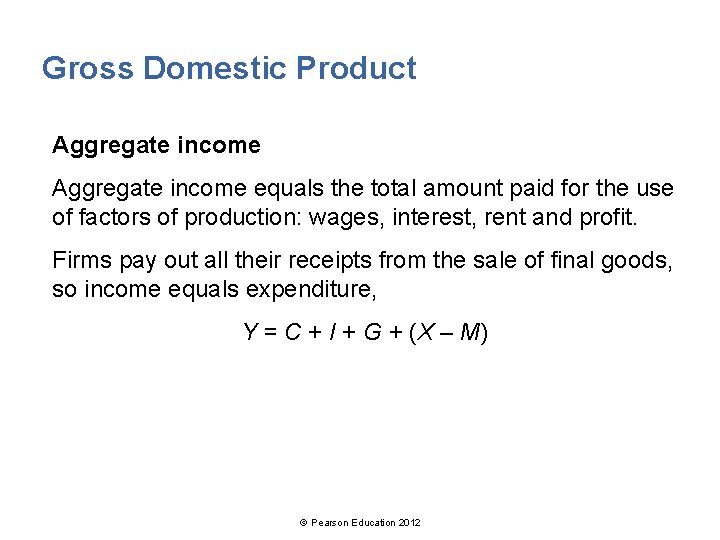
Gross Domestic Product Aggregate income equals the total amount paid for the use of factors of production: wages, interest, rent and profit. Firms pay out all their receipts from the sale of final goods, so income equals expenditure, Y = C + I + G + (X – M) © Pearson Education 2012
Gross Domestic Product Why Is Domestic Product ‘Gross’? ‘Gross’ means before deducting the depreciation of capital. The opposite of gross is net. ‘Net’ means after deducting the depreciation of capital. © Pearson Education 2012
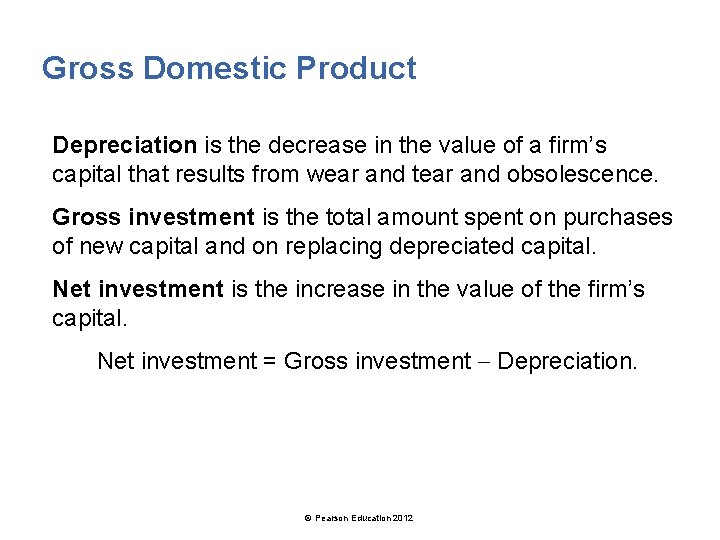
Gross Domestic Product Depreciation is the decrease in the value of a firm’s capital that results from wear and tear and obsolescence. Gross investment is the total amount spent on purchases of new capital and on replacing depreciated capital. Net investment is the increase in the value of the firm’s capital. Net investment = Gross investment Depreciation. © Pearson Education 2012
Gross Domestic Product Gross investment is one of the expenditures included in the expenditure approach to measuring GDP. So aggregate expenditure is a gross measure. Gross profit, which is a firm’s profit before subtracting depreciation, is one of the incomes included in the income approach to measuring GDP. So aggregate income is a gross measure. © Pearson Education 2012
Measuring UK GDP The Office for National Statistics uses two approaches to measure GDP: The expenditure approach The income approach © Pearson Education 2012
Measuring UK GDP The Expenditure Approach The expenditure approach measures GDP as the sum of consumption expenditure, investment, government expenditure on goods and services, and net exports. GDP = C + I + G + (X M) © Pearson Education 2012
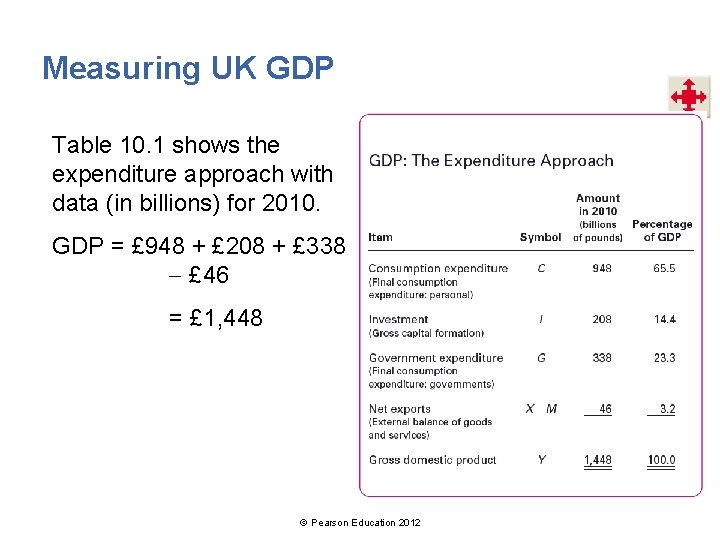
Measuring UK GDP Table 10. 1 shows the expenditure approach with data (in billions) for 2010. GDP = £ 948 + £ 208 + £ 338 £ 46 = £ 1, 448 © Pearson Education 2012
Measuring UK GDP The Income Approach The income approach measures GDP by summing the incomes that firms pay households for the factors of production they hire. © Pearson Education 2012
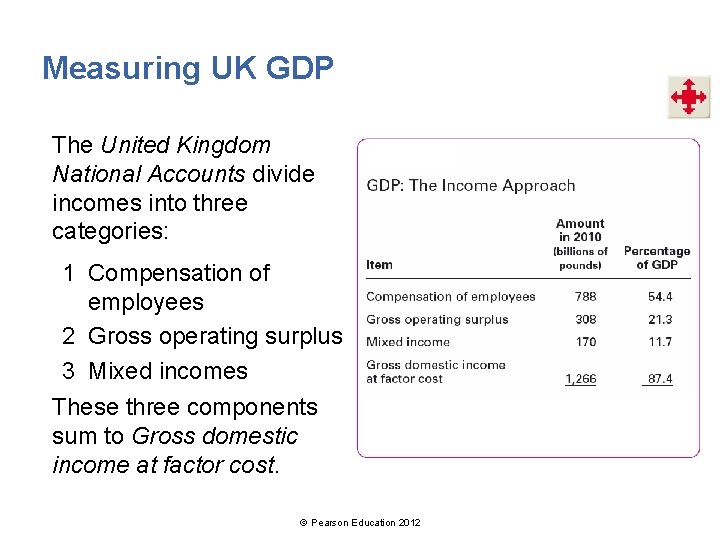
Measuring UK GDP The United Kingdom National Accounts divide incomes into three categories: 1 Compensation of employees 2 Gross operating surplus 3 Mixed incomes These three components sum to Gross domestic income at factor cost. © Pearson Education 2012
Measuring UK GDP Nominal GDP and Real GDP is the value of final goods and services produced in a given year when valued at the prices of a reference base year. Currently, the reference base year is 2006 and we describe real GDP as measured in 2006 pounds. Nominal GDP is the value of goods and services produced during a given year valued at the prices that prevailed in that same year. Nominal GDP is just a more precise name for GDP. © Pearson Education 2012
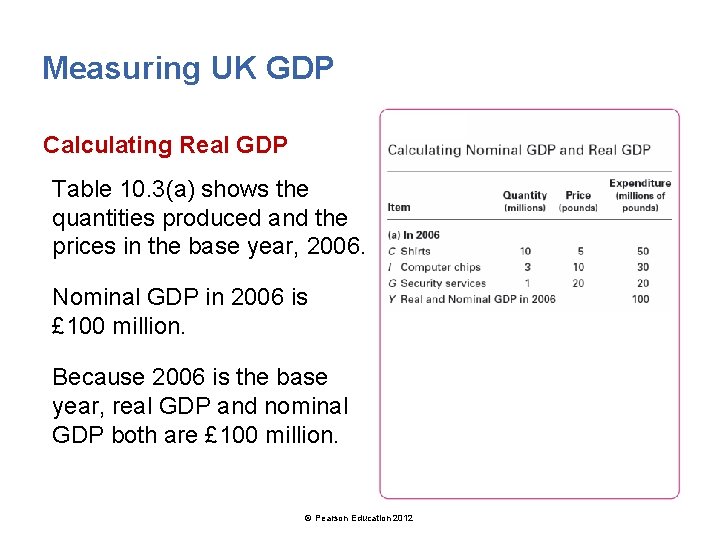
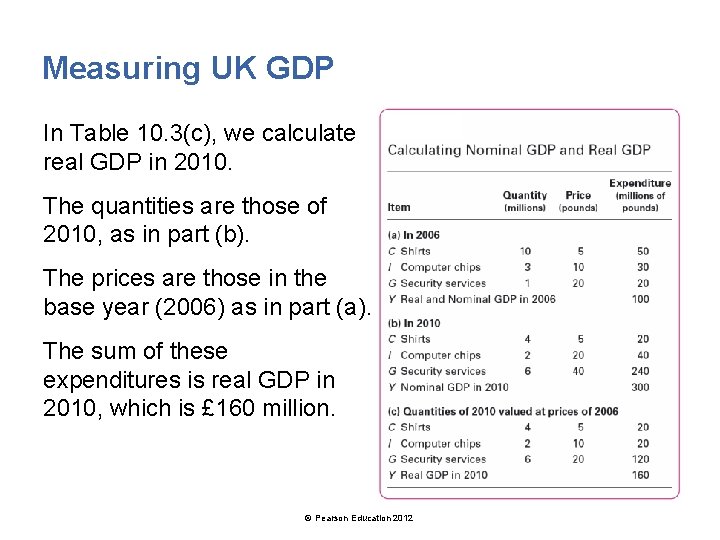
Measuring UK GDP Calculating Real GDP Table 10. 3(a) shows the quantities produced and the prices in the base year, 2006. Nominal GDP in 2006 is £ 100 million. Because 2006 is the base year, real GDP and nominal GDP both are £ 100 million. © Pearson Education 2012
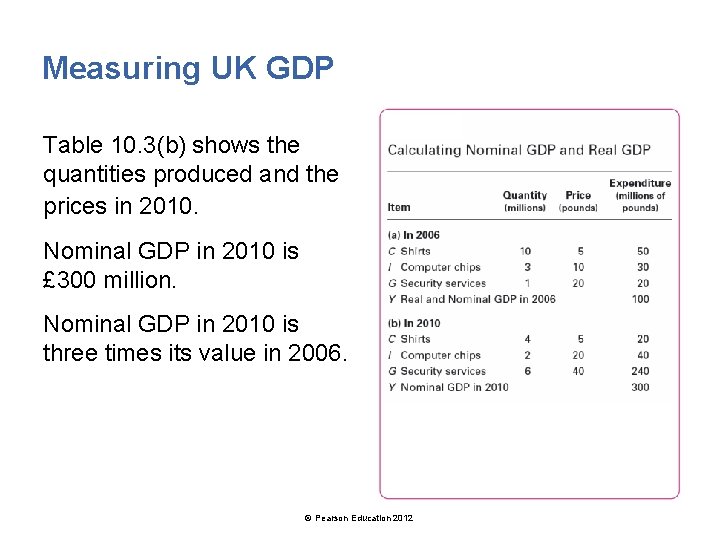
Measuring UK GDP Table 10. 3(b) shows the quantities produced and the prices in 2010. Nominal GDP in 2010 is £ 300 million. Nominal GDP in 2010 is three times its value in 2006. © Pearson Education 2012
Measuring UK GDP In Table 10. 3(c), we calculate real GDP in 2010. The quantities are those of 2010, as in part (b). The prices are those in the base year (2006) as in part (a). The sum of these expenditures is real GDP in 2010, which is £ 160 million. © Pearson Education 2012
The Uses and Limitations of Real GDP Economists use estimates of real GDP for two main purposes: To compare the standard of living over time To compare the standard of living across countries © Pearson Education 2012
The Uses and Limitations of Real GDP The Standard of Living Over Time Real GDP person is real GDP divided by the population. Real GDP person tells us the value of goods and services that the average person can enjoy. By using real GDP, we remove any influence that rising prices and a rising cost of living might have had on our comparison. © Pearson Education 2012
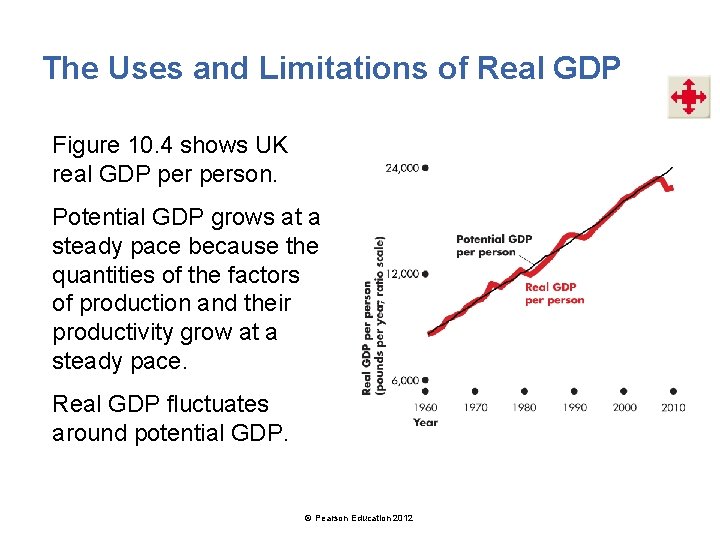
The Uses and Limitations of Real GDP Long-term Trend A handy way of comparing real GDP person over time is to express it as a ratio of some reference year. For example, in 1960, real GDP person was £ 8, 070 and in 2010, it was £ 21, 216. So real GDP person in 2010 was 2. 6 times its 1960 level − that is, £ 21, 216 ÷ £ 8, 070 = 2. 6. © Pearson Education 2012
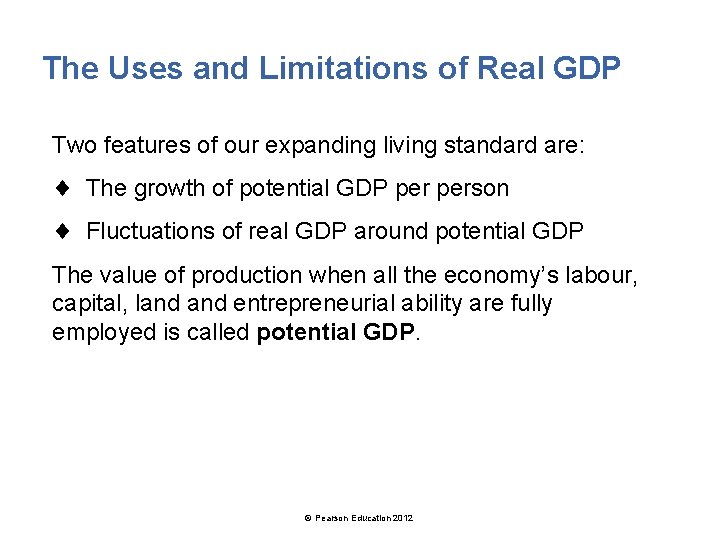
The Uses and Limitations of Real GDP Two features of our expanding living standard are: The growth of potential GDP person Fluctuations of real GDP around potential GDP The value of production when all the economy’s labour, capital, land entrepreneurial ability are fully employed is called potential GDP. © Pearson Education 2012
The Uses and Limitations of Real GDP Figure 10. 4 shows UK real GDP person. Potential GDP grows at a steady pace because the quantities of the factors of production and their productivity grow at a steady pace. Real GDP fluctuates around potential GDP. © Pearson Education 2012
The Uses and Limitations of Real GDP Fluctuations − The Business Cycle A business cycle is a periodic but irregular up-and-down movement of total production and other measures of economic activity. Every cycle has two phases: 1 Expansion 2 Recession and two turning points: 1 Peak 2 Trough
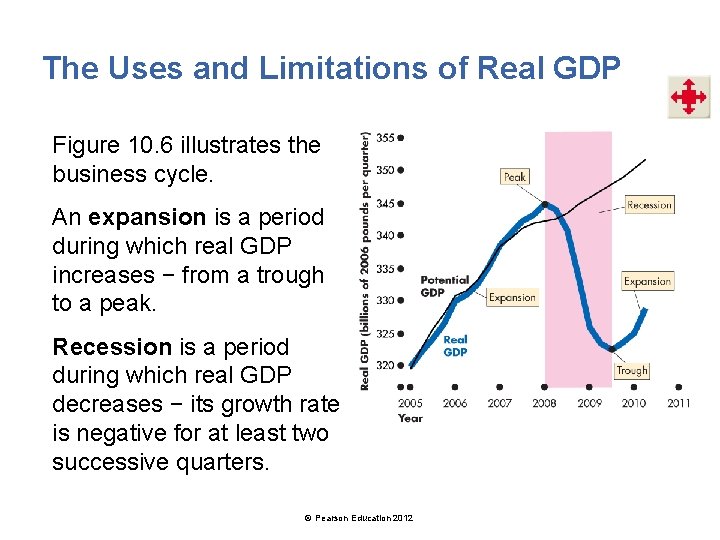
The Uses and Limitations of Real GDP Figure 10. 6 illustrates the business cycle. An expansion is a period during which real GDP increases − from a trough to a peak. Recession is a period during which real GDP decreases − its growth rate is negative for at least two successive quarters. © Pearson Education 2012
The Uses and Limitations of Real GDP The Standard of Living Across Countries Two problems arise in using real GDP to compare living standards across countries: 1 The real GDP of one country must be converted into the same currency units as the real GDP of the other country. 2 The goods and services in both countries must be valued at the same prices. © Pearson Education 2012
The Uses and Limitations of Real GDP Using the exchange rate to compare GDP in one country with GDP in another country is problematic because … prices of particular products in one country may be much less or much more than in the other country. For example, using the market exchange rate to value Chinese GDP in US dollars leads to an estimate that in 2010, US real GDP person was 15 times Chinese real GDP person. © Pearson Education 2012
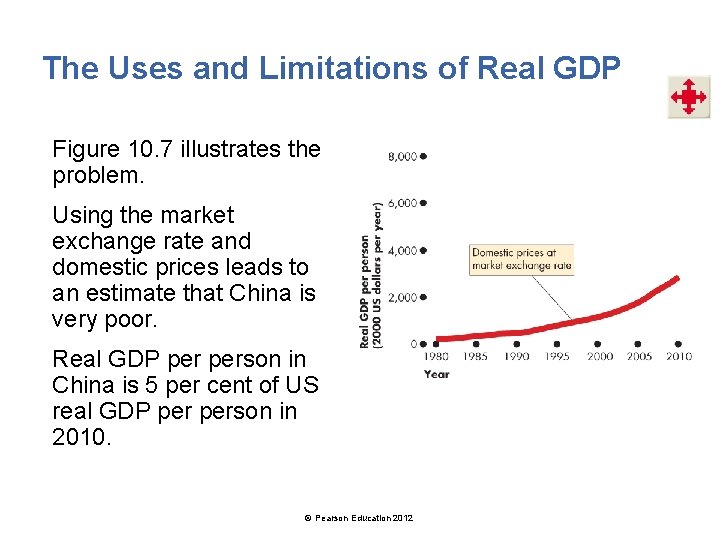
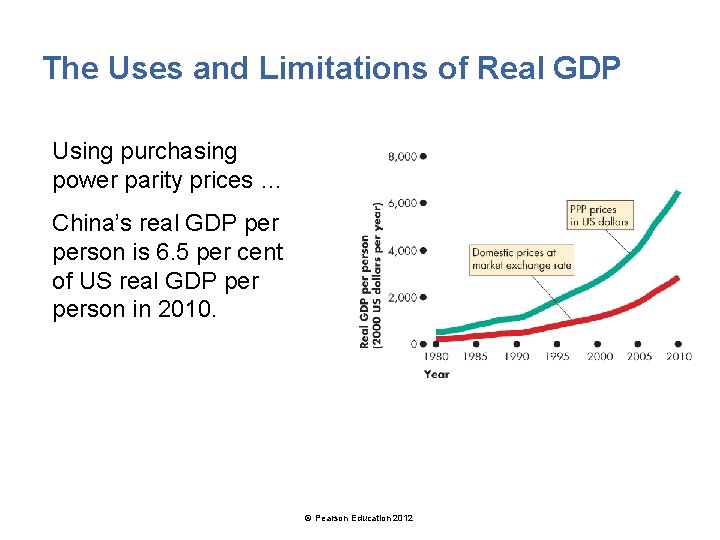
The Uses and Limitations of Real GDP Figure 10. 7 illustrates the problem. Using the market exchange rate and domestic prices leads to an estimate that China is very poor. Real GDP person in China is 5 per cent of US real GDP person in 2010. © Pearson Education 2012
The Uses and Limitations of Real GDP Using purchasing power parity prices … China’s real GDP person is 6. 5 per cent of US real GDP person in 2010. © Pearson Education 2012
The Uses and Limitations of Real GDP measures the value of goods and services that are bought in markets. Some of the factors that influence the standard of living and that are not part of GDP are Household production Underground economic activity Health and life expectancy Leisure time Environmental quality Political freedom and social justice © Pearson Education 2012