
Chapter 10 Managing Student Behavior and Promoting Social
Chapter 10 Managing Student Behavior and Promoting Social Acceptance Copyright © 2007 by Allyn & Bacon
Basic Principles of Managing Student Behavior l l Look for the positive Using Positive and Negative Reinforcers Copyright © 2007 by Allyn & Bacon
Hierarchy of Reinforcers (Larivee, 2005) l l l l Consumable (raisins, peanuts, jelly beans) Tangible (school supplies, toys) Token (stickers, checks, coupons) Activity (computer time, free time) Privilege (errands, line leader) Peer recognition (peer acceptance, approval) Teacher approval (recognition, praise) Self-satisfaction (motivation, seeing one’s accomplishments) Copyright © 2007 by Allyn & Bacon
Environmental Supports (Mckee-Higgins, 1996) l l Focus on instructional techniques to improve behavior Motivate students by establishing a supportive atmosphere Establish procedures that are dynamic in their response to students’ changing behaviors Encourage other teachers to use a positive approach Copyright © 2007 by Allyn & Bacon
When Implementing a Token System (Ayllon, 1999) l Clearly identify behavior you want to change l Make tokens available and easy to administer l Identify items, activities, or reinforcers that are highly rewarding l Give regular opportunities to exchange tokens Copyright © 2007 by Allyn & Bacon

Establishing a Few Clear Rules with Known Consequences l l Procedures are classroom routines that occur at specified times and allow the classroom to run effectively. Rules provide structure for acceptable and unacceptable classroom behaviors. Copyright © 2007 by Allyn & Bacon

Helping Students to Change Inappropriate Behavior l l Planned ignoring Time-out Copyright © 2007 by Allyn & Bacon

Punishment l l l Often ineffective in long run Often causes undesirable emotional side effects (fear, aggression, resentment) Provides little information about what to do Person administers punishment is viewed as harsh or negative Fear of punishment often leads to escape behavior Copyright © 2007 by Allyn & Bacon
Punishment is used because l Unfamiliarity with consequences of punishment l Inability to implement a more positive approach l Reinforcing to the person who administers it Copyright © 2007 by Allyn & Bacon

Recognizing Students’ Mistaken Goals l l l Students are social beings and their behaviors are attempts to be liked and accepted Students can control their own behavior Students display inappropriate behavior of mistaken goals Copyright © 2007 by Allyn & Bacon
Mistaken Goals (Dreikurs, 2004) l l Attention Revenge or getting even Power or control Display of inadequacy Copyright © 2007 by Allyn & Bacon
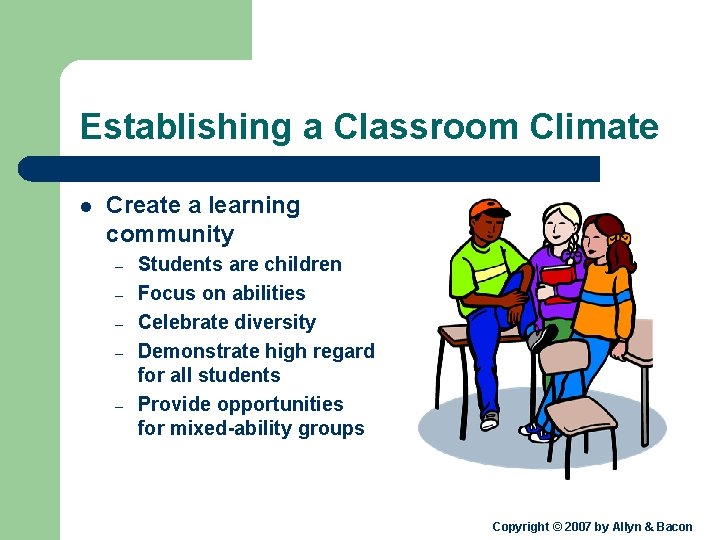
Establishing a Classroom Climate l Create a learning community – – – Students are children Focus on abilities Celebrate diversity Demonstrate high regard for all students Provide opportunities for mixed-ability groups Copyright © 2007 by Allyn & Bacon
Using Class Meetings l Teachers can use class meetings to prevent problems, identify potential or occurring problems, teach problem solving, and foster class responsibility for the cohesion and functioning of the classroom. Copyright © 2007 by Allyn & Bacon
Increasing Social Acceptance of Students with Disabilities and Exceptional Learners Teachers can use the following techniques to ensure acceptance of all students in the classroom: l All students are treated with respect l Students are taught concern for one another l Students’ abilities are pointed out Copyright © 2007 by Allyn & Bacon
Positive Behavior Supports (PBS) l PBS is a model of behavior management that places emphasis on “proactive strategies for defining, teaching, and supporting appropriate students behaviors to create positive school environments” (OSEP, 2005) Copyright © 2007 by Allyn & Bacon
Positive Behavioral Supports: Behavior Support Plans l Behavior Support Plans – – – Learn how student percieves events Invest in preventing occurrences of behavior Teaching is most powerful support strategy Avoid rewarding problem behaviors Reward positive behaviors Know what to do in a difficult situation Copyright © 2007 by Allyn & Bacon
PBS and School-wide Applications l l l Develop programs that consider behavioral issues for all students Consider whether the behavioral practices recommended are empirically validated Consider the connections between academic and behavioral success Approach behavior management from a prevention perspective Involve all key stakeholders in the school, home, and community in developing team-building and behavioral problems-solving skills Copyright © 2007 by Allyn & Bacon
Developing a Functional Behavioral Assessment (Shippen, Simpson, and Crites, 2003) l l l Define the target behavior in behavioral terms Collect and monitor the target behaviors through ongoing data collection Record the events behaviors that preceded and follow the target behavior Develop a hypothesis of the conditions under which the target behavior occurs Develop an intervention plan that considers the antecedents and reinforces and is built to test the hypothesis Copyright © 2007 by Allyn & Bacon
Preventing Violence (Skiba & Peterson, 2000; Sprague & Walker, 2000) l l l l Conflict resolution and social instruction Classroom strategies for disruptive behavior Parent involvement Early warning signs and screening School and district-wide data systems Crisis and security planning Design, use, and supervision of space Administrators who are accessible and interested Copyright © 2007 by Allyn & Bacon
Enhancing Self-Concepts l Hold all students to high standards l Discover and recognize students’ talents, abilities, or interests l Provide opportunties for success in nonacademic ways l Recognize difficulties in learning and explain them in a way that’s easy to understand l Remember teachers’ important role in influencing selfconcepts Copyright © 2007 by Allyn & Bacon
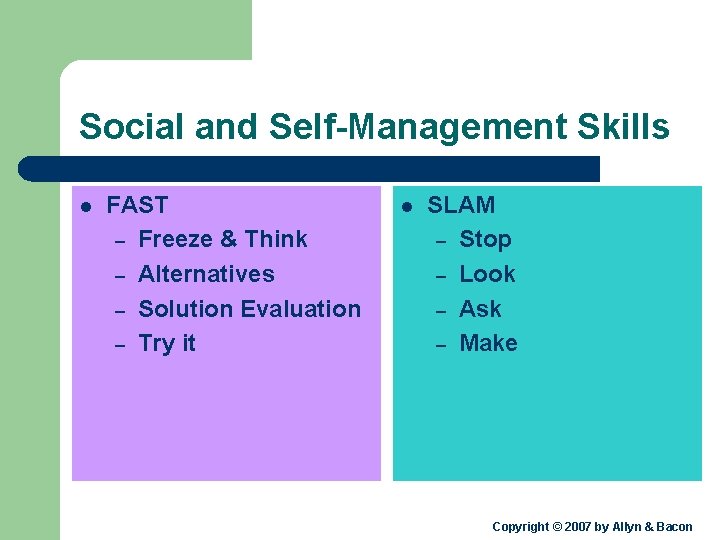
Social and Self-Management Skills l FAST – Freeze & Think – Alternatives – Solution Evaluation – Try it l SLAM – Stop – Look – Ask – Make Copyright © 2007 by Allyn & Bacon
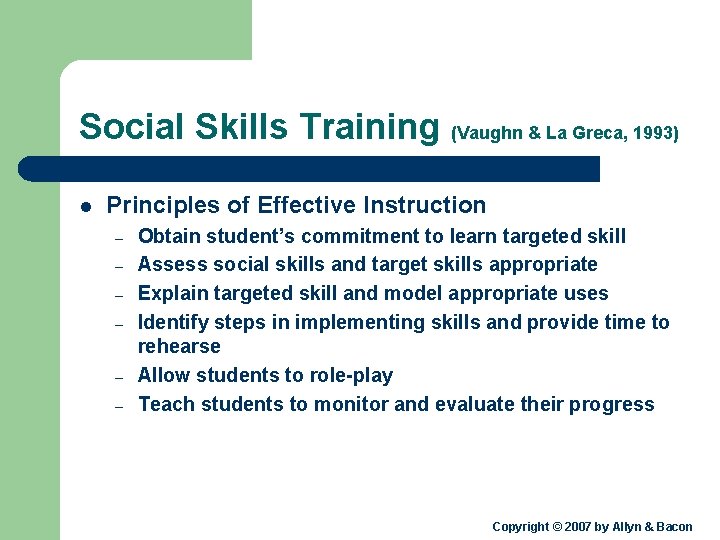
Social Skills Training (Vaughn & La Greca, 1993) l Principles of Effective Instruction – – – Obtain student’s commitment to learn targeted skill Assess social skills and target skills appropriate Explain targeted skill and model appropriate uses Identify steps in implementing skills and provide time to rehearse Allow students to role-play Teach students to monitor and evaluate their progress Copyright © 2007 by Allyn & Bacon
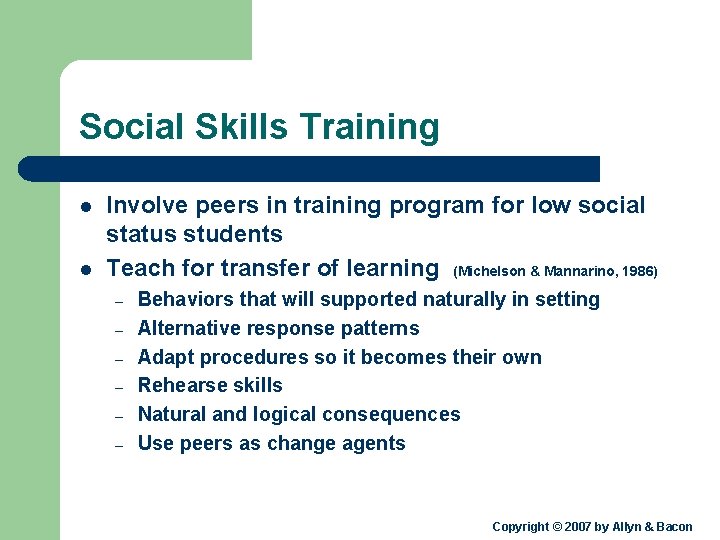
Social Skills Training l l Involve peers in training program for low social status students Teach for transfer of learning (Michelson & Mannarino, 1986) – – – Behaviors that will supported naturally in setting Alternative response patterns Adapt procedures so it becomes their own Rehearse skills Natural and logical consequences Use peers as change agents Copyright © 2007 by Allyn & Bacon
- Slides: 23