
Chapter 10 Liabilities Section 4 Use Table of
Chapter 10 Liabilities Section 4 Use Table of Contents to go to an individual slide Slide 10 -1
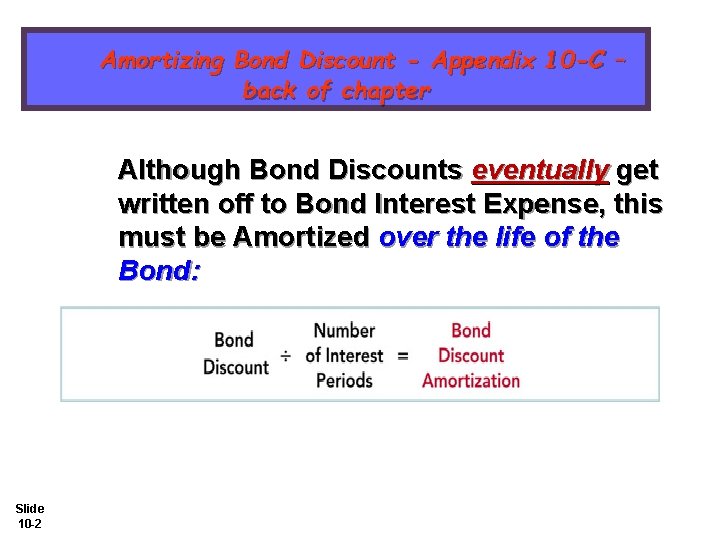
Amortizing Bond Discount - Appendix 10 -C – back of chapter Although Bond Discounts eventually get written off to Bond Interest Expense, this must be Amortized over the life of the Bond: Slide 10 -2
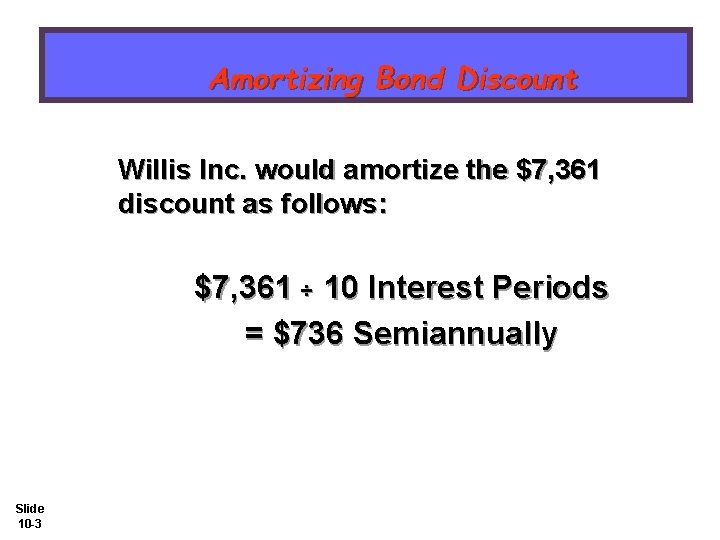
Amortizing Bond Discount Willis Inc. would amortize the $7, 361 discount as follows: $7, 361 ÷ 10 Interest Periods = $736 Semiannually Slide 10 -3
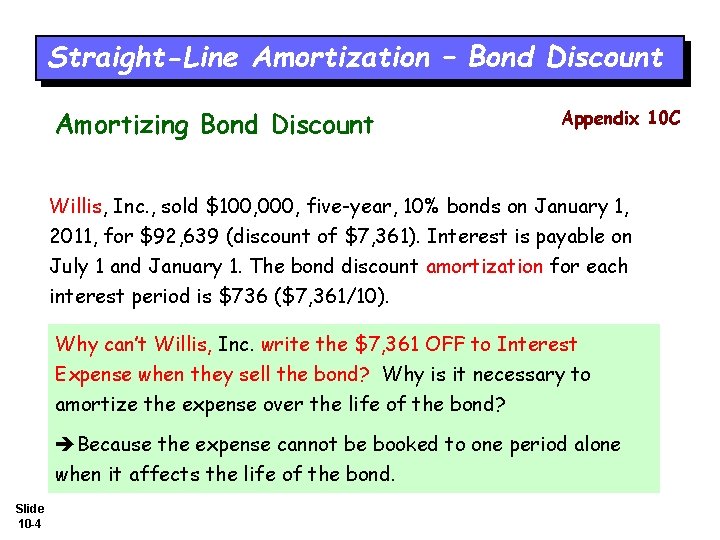
Straight-Line Amortization – Bond Discount Amortizing Bond Discount Appendix 10 C Willis, Inc. , sold $100, 000, five-year, 10% bonds on January 1, 2011, for $92, 639 (discount of $7, 361). Interest is payable on July 1 and January 1. The bond discount amortization for each interest period is $736 ($7, 361/10). Why can’t Willis, Inc. write the $7, 361 OFF to Interest Expense when they sell the bond? Why is it necessary to amortize the expense over the life of the bond? Because the expense cannot be booked to one period alone when it affects the life of the bond. Slide 10 -4
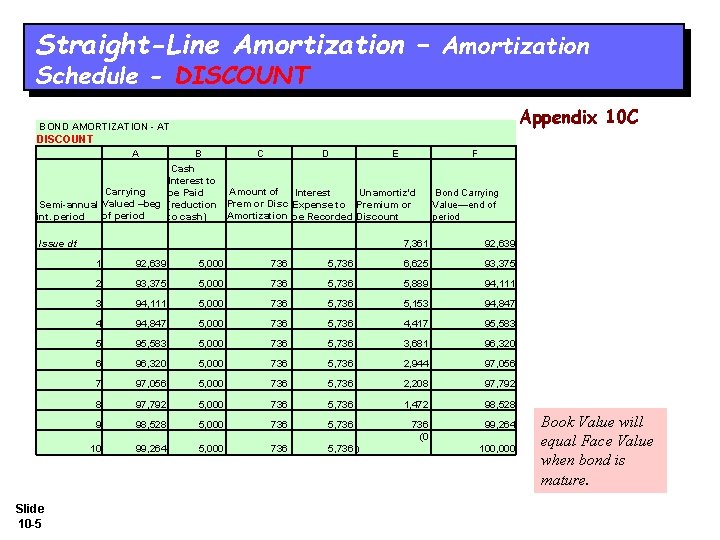
Straight-Line Amortization – Amortization Schedule - DISCOUNT Appendix 10 C BOND AMORTIZATION - AT DISCOUNT A B C D E F Cash Interest to Carrying Amount of Interest Unamortiz'd be Paid Valued –beg Prem or Disc Expense to Premium or Semi-annual (reduction of period Amortization be Recorded Discount int. period to cash) Issue dt Slide 10 -5 Bond Carrying Value—end of period 7, 361 92, 639 5, 000 736 5, 736 6, 625 93, 375 2 93, 375 5, 000 736 5, 889 94, 111 3 94, 111 5, 000 736 5, 153 94, 847 4 94, 847 5, 000 736 5, 736 4, 417 95, 583 5, 000 736 5, 736 3, 681 96, 320 6 96, 320 5, 000 736 5, 736 2, 944 97, 056 7 97, 056 5, 000 736 5, 736 2, 208 97, 792 5, 000 736 5, 736 1, 472 98, 528 9 98, 528 5, 000 736 5, 736 (0 99, 264 10 99, 264 5, 000 736 5, 736 ) 100, 000 Book Value will equal Face Value when bond is mature.
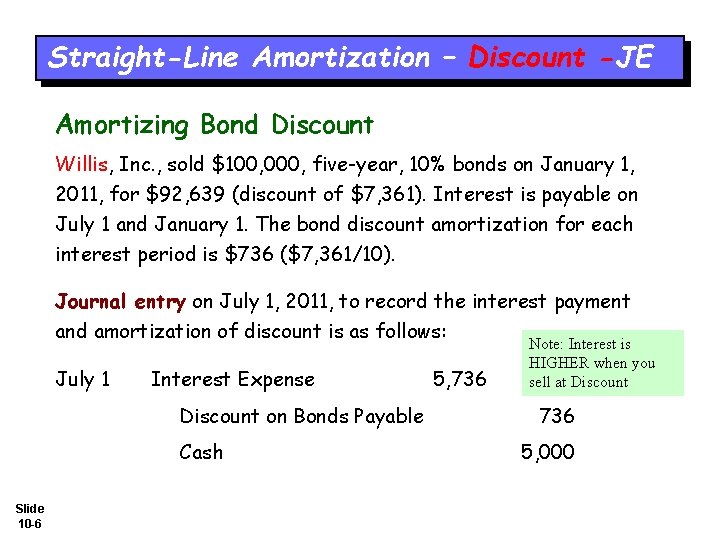
Straight-Line Amortization – Discount -JE Amortizing Bond Discount Willis, Inc. , sold $100, 000, five-year, 10% bonds on January 1, 2011, for $92, 639 (discount of $7, 361). Interest is payable on July 1 and January 1. The bond discount amortization for each interest period is $736 ($7, 361/10). Journal entry on July 1, 2011, to record the interest payment and amortization of discount is as follows: July 1 Interest Expense Discount on Bonds Payable Cash Slide 10 -6 5, 736 Note: Interest is HIGHER when you sell at Discount 736 5, 000
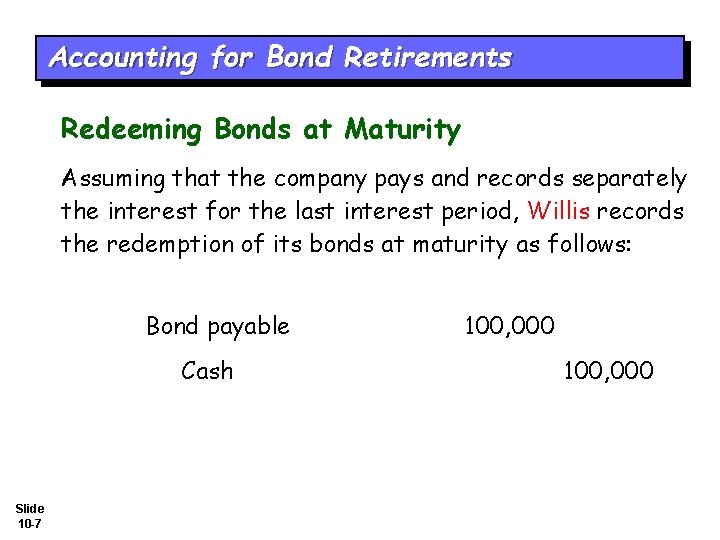
Accounting for Bond Retirements Redeeming Bonds at Maturity Assuming that the company pays and records separately the interest for the last interest period, Willis records the redemption of its bonds at maturity as follows: Bond payable Cash Slide 10 -7 100, 000
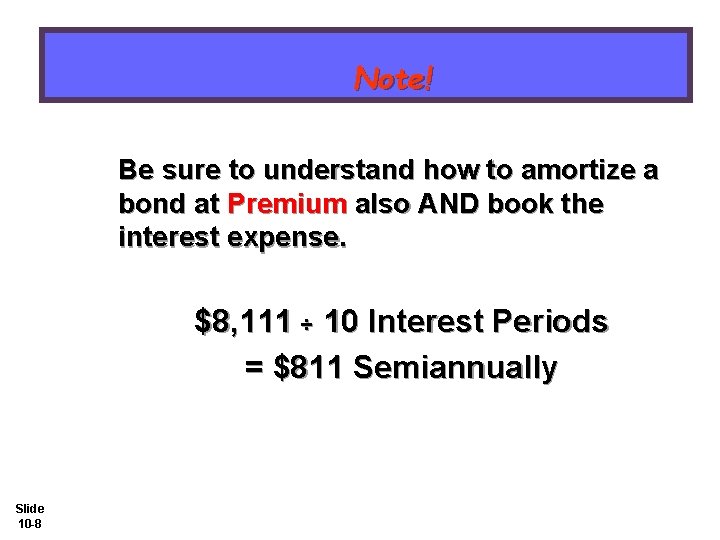
Note! Be sure to understand how to amortize a bond at Premium also AND book the interest expense. $8, 111 ÷ 10 Interest Periods = $811 Semiannually Slide 10 -8
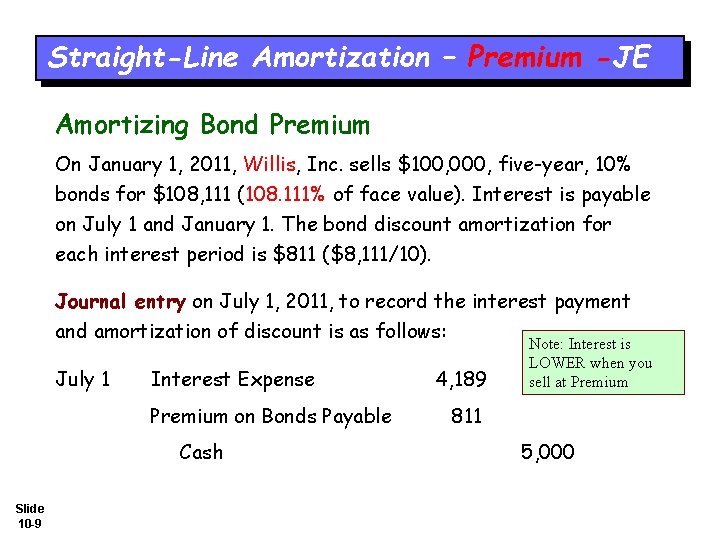
Straight-Line Amortization – Premium -JE Amortizing Bond Premium On January 1, 2011, Willis, Inc. sells $100, 000, five-year, 10% bonds for $108, 111 (108. 111% of face value). Interest is payable on July 1 and January 1. The bond discount amortization for each interest period is $811 ($8, 111/10). Journal entry on July 1, 2011, to record the interest payment and amortization of discount is as follows: July 1 Interest Expense Premium on Bonds Payable Cash Slide 10 -9 4, 189 Note: Interest is LOWER when you sell at Premium 811 5, 000
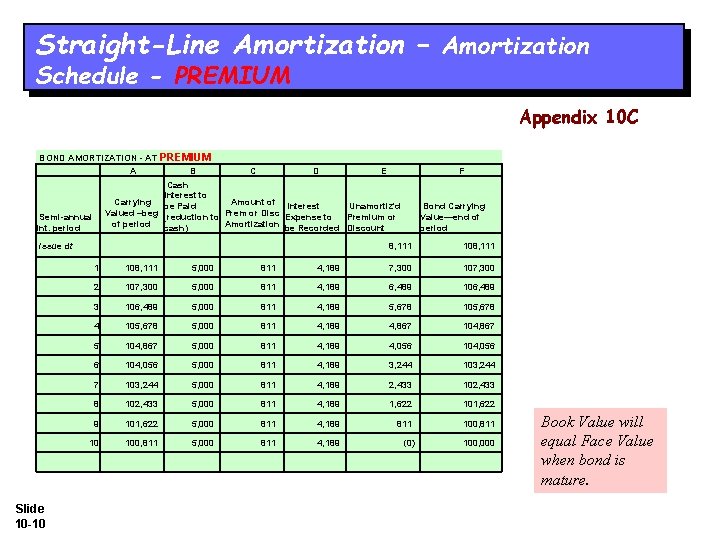
Straight-Line Amortization – Amortization Schedule - PREMIUM Appendix 10 C BOND AMORTIZATION - AT PREMIUM A B C D E Cash Interest to Carrying be Paid Amount of Interest Unamortiz'd Premium or Semi-annual Valued –beg (reduction to Prem or Disc Expense to of period cash) Amortization be Recorded Discount int. period Issue dt Slide 10 -10 F Bond Carrying Value—end of period 8, 111 108, 111 5, 000 811 4, 189 7, 300 107, 300 2 107, 300 5, 000 811 4, 189 6, 489 106, 489 3 106, 489 5, 000 811 4, 189 5, 678 105, 678 4 105, 678 5, 000 811 4, 189 4, 867 104, 867 5, 000 811 4, 189 4, 056 104, 056 5, 000 811 4, 189 3, 244 103, 244 7 103, 244 5, 000 811 4, 189 2, 433 102, 433 8 102, 433 5, 000 811 4, 189 1, 622 101, 622 9 101, 622 5, 000 811 4, 189 811 100, 811 10 100, 811 5, 000 811 4, 189 (0) 100, 000 Book Value will equal Face Value when bond is mature.
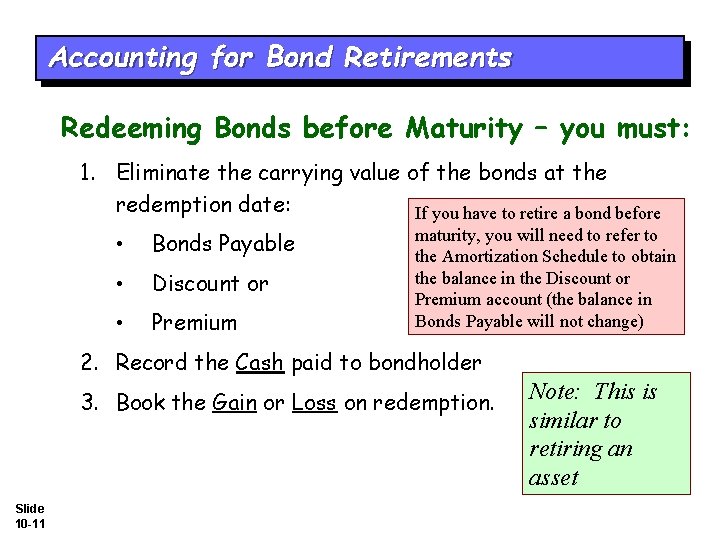
Accounting for Bond Retirements Redeeming Bonds before Maturity – you must: 1. Eliminate the carrying value of the bonds at the redemption date: If you have to retire a bond before • Bonds Payable • Discount or • Premium maturity, you will need to refer to the Amortization Schedule to obtain the balance in the Discount or Premium account (the balance in Bonds Payable will not change) 2. Record the Cash paid to bondholder 3. Book the Gain or Loss on redemption. Slide 10 -11 Note: This is similar to retiring an asset
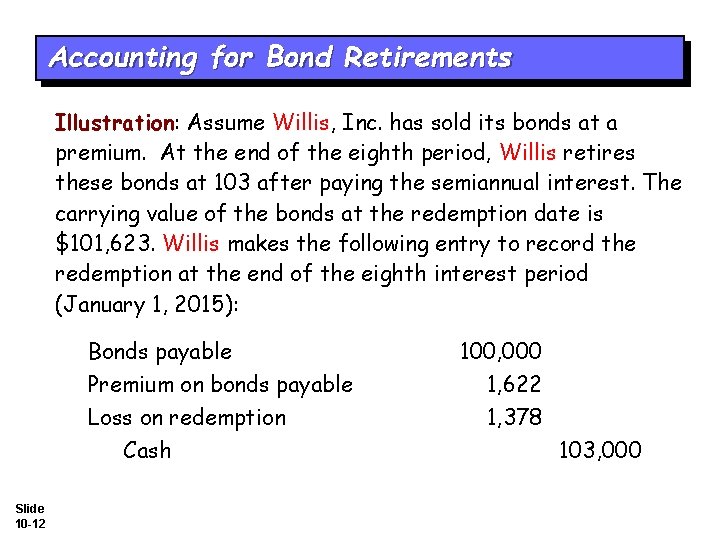
Accounting for Bond Retirements Illustration: Assume Willis, Inc. has sold its bonds at a premium. At the end of the eighth period, Willis retires these bonds at 103 after paying the semiannual interest. The carrying value of the bonds at the redemption date is $101, 623. Willis makes the following entry to record the redemption at the end of the eighth interest period (January 1, 2015): Bonds payable Premium on bonds payable Loss on redemption Cash Slide 10 -12 100, 000 1, 622 1, 378 103, 000
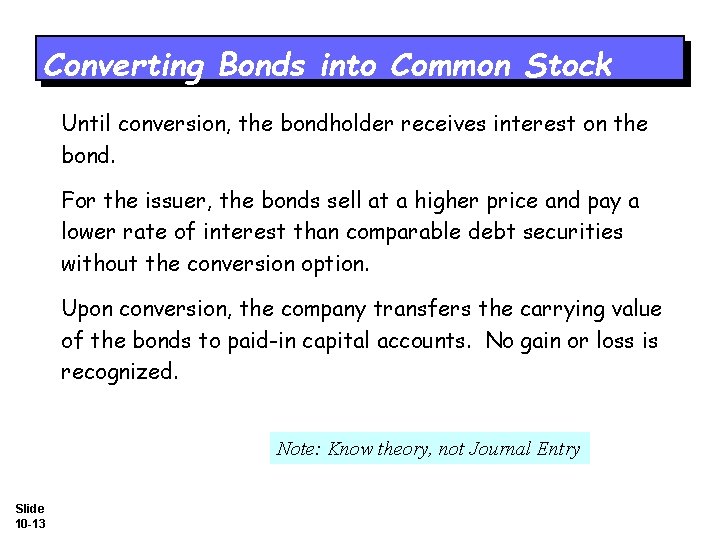
Converting Bonds into Common Stock Until conversion, the bondholder receives interest on the bond. For the issuer, the bonds sell at a higher price and pay a lower rate of interest than comparable debt securities without the conversion option. Upon conversion, the company transfers the carrying value of the bonds to paid-in capital accounts. No gain or loss is recognized. Note: Know theory, not Journal Entry Slide 10 -13
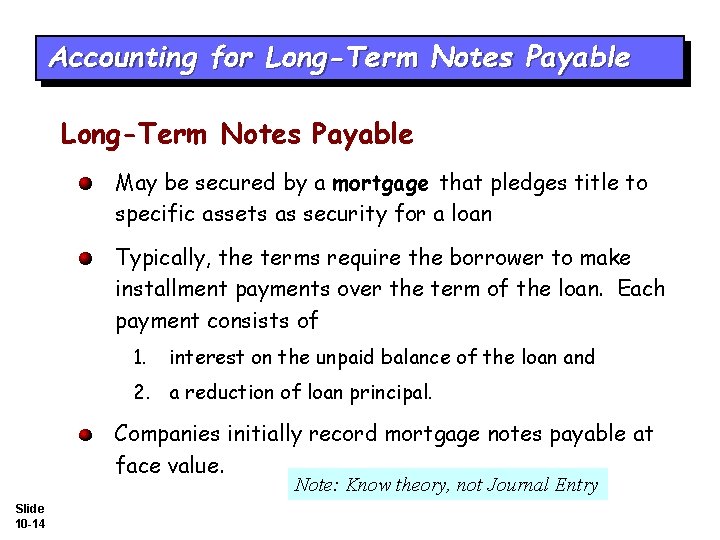
Accounting for Long-Term Notes Payable May be secured by a mortgage that pledges title to specific assets as security for a loan Typically, the terms require the borrower to make installment payments over the term of the loan. Each payment consists of 1. interest on the unpaid balance of the loan and 2. a reduction of loan principal. Companies initially record mortgage notes payable at face value. Note: Know theory, not Journal Entry Slide 10 -14
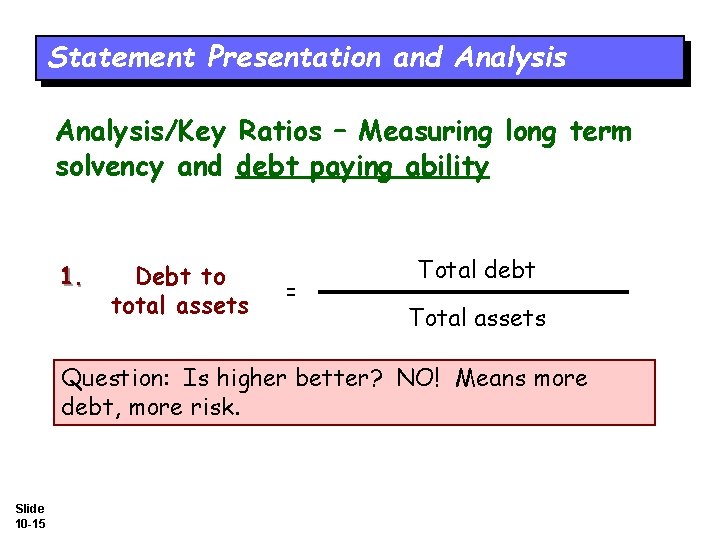
Statement Presentation and Analysis/Key Ratios – Measuring long term solvency and debt paying ability 1. Debt to total assets = Total debt Total assets Question: Is higher better? NO! Means more debt, more risk. Slide 10 -15
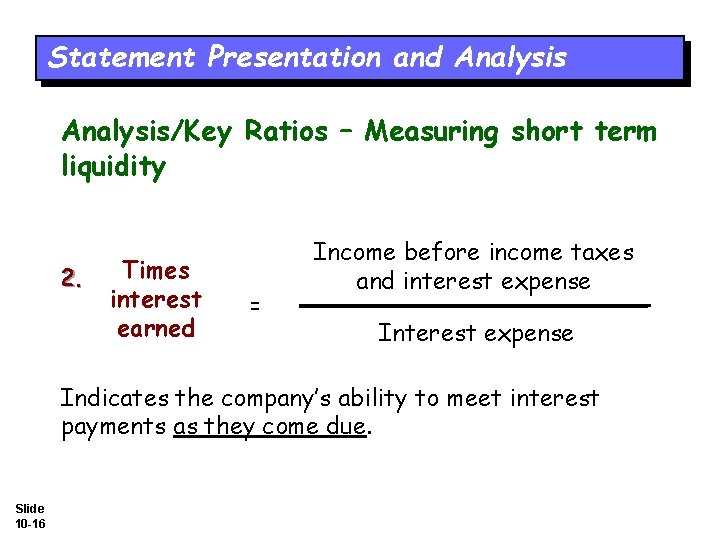
Statement Presentation and Analysis/Key Ratios – Measuring short term liquidity 2. Times interest earned = Income before income taxes and interest expense Indicates the company’s ability to meet interest payments as they come due. Slide 10 -16
Advantages of Bond Financing over Common Stock, an illustration l Stockholder l Tax control expense l Earnings per share Slide 10 -17
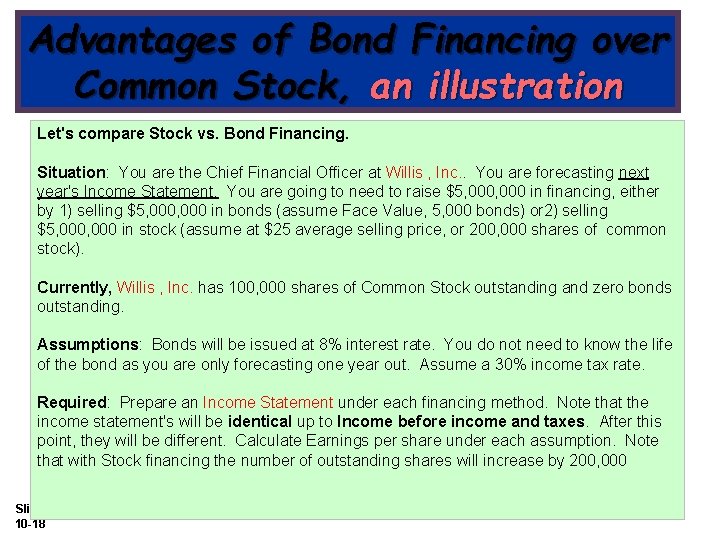
Advantages of Bond Financing over Common Stock, an illustration Let's compare Stock vs. Bond Financing. Situation: You are the Chief Financial Officer at Willis , Inc. . You are forecasting next year's Income Statement. You are going to need to raise $5, 000 in financing, either by 1) selling $5, 000 in bonds (assume Face Value, 5, 000 bonds) or 2) selling $5, 000 in stock (assume at $25 average selling price, or 200, 000 shares of common stock). Currently, Willis , Inc. has 100, 000 shares of Common Stock outstanding and zero bonds outstanding. Assumptions: Bonds will be issued at 8% interest rate. You do not need to know the life of the bond as you are only forecasting one year out. Assume a 30% income tax rate. Required: Prepare an Income Statement under each financing method. Note that the income statement's will be identical up to Income before income and taxes. After this point, they will be different. Calculate Earnings per share under each assumption. Note that with Stock financing the number of outstanding shares will increase by 200, 000 Slide 10 -18
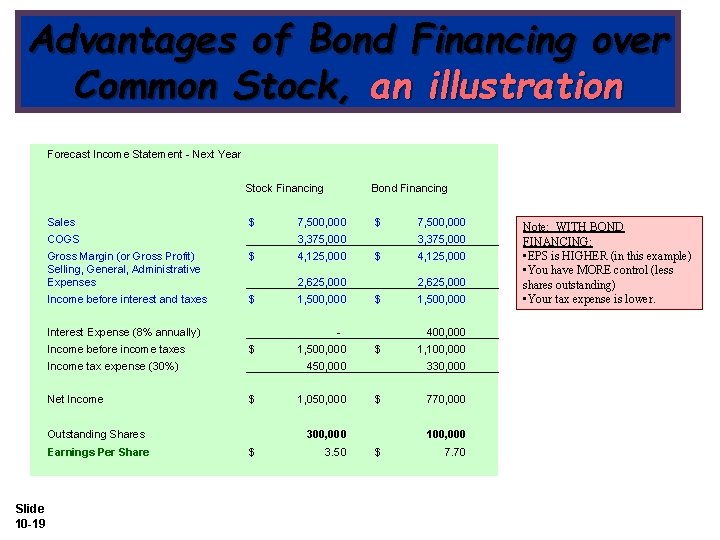
Advantages of Bond Financing over Common Stock, an illustration Forecast Income Statement - Next Year Sales Stock Financing Bond Financing $ $ COGS 3, 375, 000 Gross Margin (or Gross Profit) Selling, General, Administrative Expenses $ Income before interest and taxes $ $ Slide 10 -19 1, 500, 000 $ 1, 050, 000 $ 3. 50 1, 500, 000 400, 000 $ 1, 100, 000 330, 000 $ 300, 000 $ 4, 125, 000 2, 625, 000 450, 000 Outstanding Shares Earnings Per Share $ - Income tax expense (30%) Net Income 4, 125, 000 7, 500, 000 3, 375, 000 2, 625, 000 Interest Expense (8% annually) Income before income taxes 7, 500, 000 770, 000 100, 000 $ 7. 70 Note: WITH BOND FINANCING: • EPS is HIGHER (in this example) • You have MORE control (less shares outstanding) • Your tax expense is lower.
- Slides: 19