
Chapter 10 Liabilities Section 1 Slide 10 1
Chapter 10 Liabilities Section 1 Slide 10 -1
Learning Objectives Slide 10 -2 1. Explain a current liability, and identify the major types of current liabilities. 2. Describe the accounting for notes payable. 3. Explain the accounting for other current liabilities. 4. Explain why bonds are issued, and identify the types of bonds. 5. Prepare the entries for the issuance of bonds and interest expense. 6. Describe the entries when bonds are redeemed or converted. 7. Describe the accounting for long-term notes payable (theory only) 8. Identify the methods for the presentation and analysis of long-term liabilities (theory only) 9. (not covered – Appendix 10 -A) 10. (not covered – Appendix 10 -B 11. Apply the straight line method of amortizing bond discount and bond premium (Appendix 10 -C)
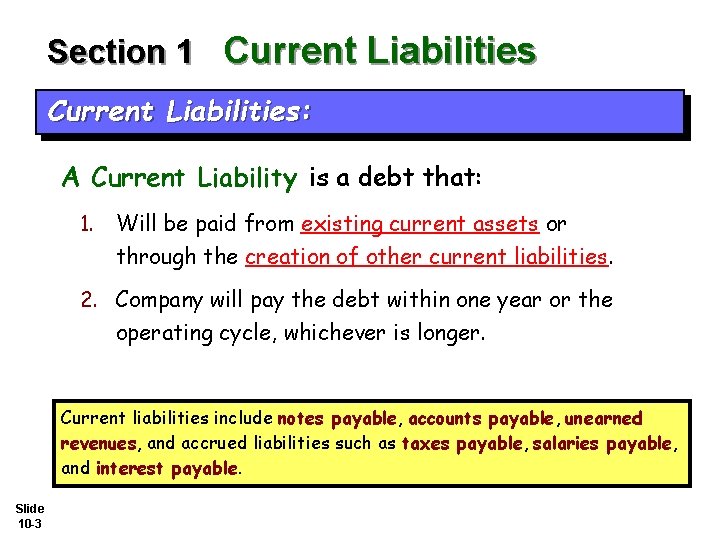
Section 1 Current Liabilities: A Current Liability is a debt that: 1. Will be paid from existing current assets or through the creation of other current liabilities. 2. Company will pay the debt within one year or the operating cycle, whichever is longer. Current liabilities include notes payable, accounts payable, unearned revenues, and accrued liabilities such as taxes payable, salaries payable, and interest payable. Slide 10 -3
Current Liability – NOTES PAYABLE Notes Payable Written promissory note. Require the borrower to pay interest. Issued for varying periods. Slide 10 -4

NOTES PAYABLE - EXAMPLE Illustration: On March 1, 2011, Jorge Estevez borrows $100, 000 from First National Bank on a 4 -month, 12% note. Instructions a) Prepare the entry on March 1. b) Prepare the adjusting entry on June 30, assuming monthly adjusting entries have not been made. c) Prepare the entry at maturity (July 1). Slide 10 -5
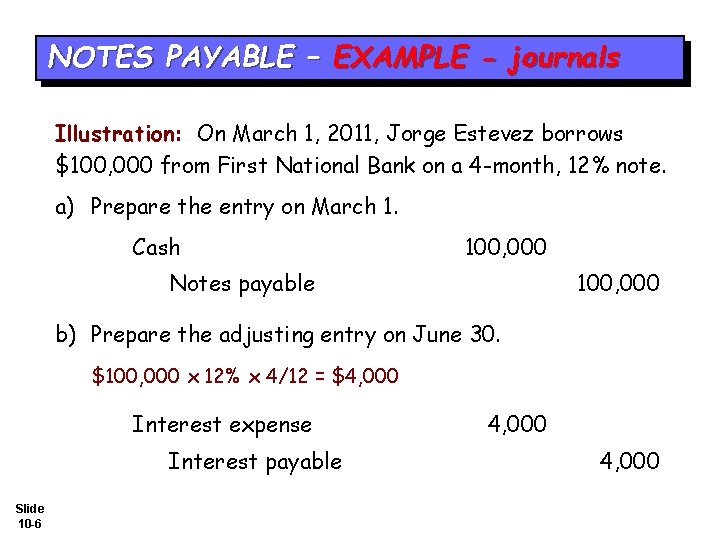
NOTES PAYABLE – EXAMPLE - journals Illustration: On March 1, 2011, Jorge Estevez borrows $100, 000 from First National Bank on a 4 -month, 12% note. a) Prepare the entry on March 1. Cash 100, 000 Notes payable 100, 000 b) Prepare the adjusting entry on June 30. $100, 000 x 12% x 4/12 = $4, 000 Interest expense Interest payable Slide 10 -6 4, 000
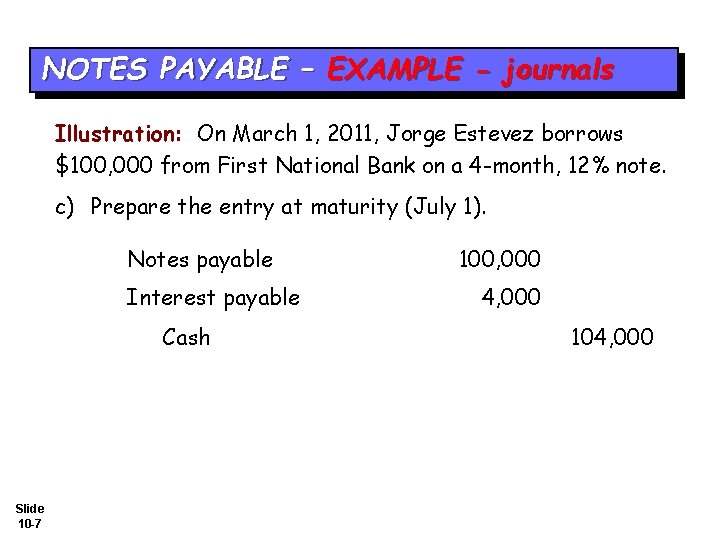
NOTES PAYABLE – EXAMPLE - journals Illustration: On March 1, 2011, Jorge Estevez borrows $100, 000 from First National Bank on a 4 -month, 12% note. c) Prepare the entry at maturity (July 1). Notes payable Interest payable Cash Slide 10 -7 100, 000 4, 000 104, 000
SALES TAX PAYABLE Sales Tax Payable Sales taxes are expressed as a stated percentage of the sales price. Either rung up separately or included in total receipts. Retailer collects tax from the customer. Retailer remits the collections to the state’s department of revenue. Slide 10 -8
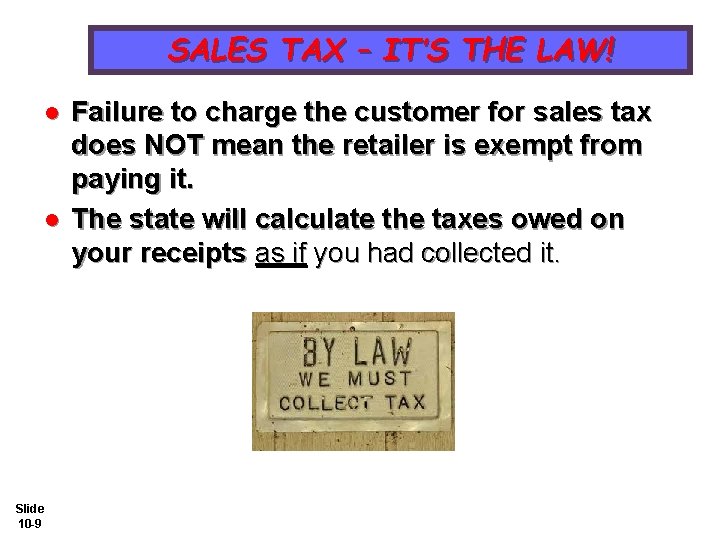
SALES TAX – IT’S THE LAW! l l Slide 10 -9 Failure to charge the customer for sales tax does NOT mean the retailer is exempt from paying it. The state will calculate the taxes owed on your receipts as if you had collected it.
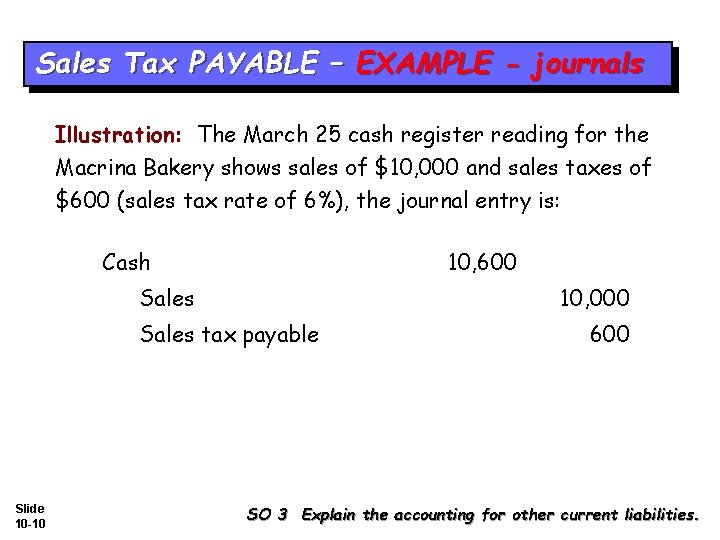
Sales Tax PAYABLE – EXAMPLE - journals Illustration: The March 25 cash register reading for the Macrina Bakery shows sales of $10, 000 and sales taxes of $600 (sales tax rate of 6%), the journal entry is: Cash 10, 600 Sales 10, 000 Sales tax payable Slide 10 -10 600 SO 3 Explain the accounting for other current liabilities.
PAYROLL TAXES PAYABLE Payroll and Payroll Taxes Payable Salaries - managerial, administrative, and sales personnel (monthly or yearly rate). OR Wages - store clerks, factory employees, and manual laborers (rate per hour). Determining the payroll involves computing three amounts: (1) gross earnings, (2) payroll deductions, and (3) net pay (WE CALL IT “TAKE HOME PAY”). Slide 10 -11
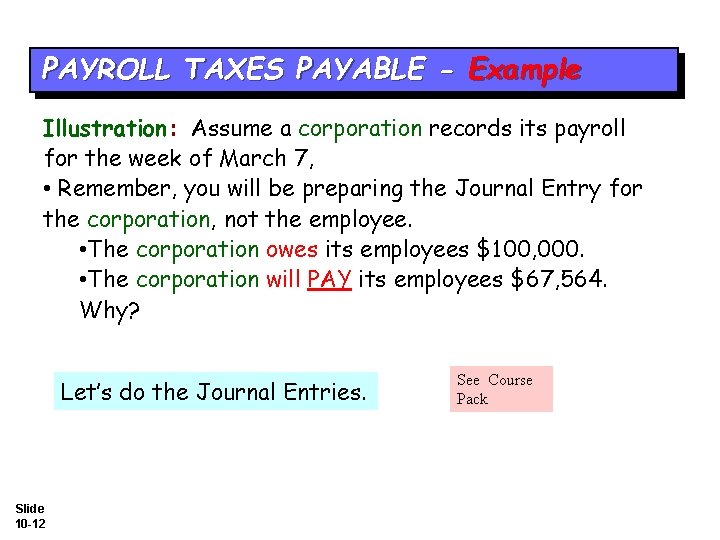
PAYROLL TAXES PAYABLE - Example Illustration: Assume a corporation records its payroll for the week of March 7, • Remember, you will be preparing the Journal Entry for the corporation, not the employee. • The corporation owes its employees $100, 000. • The corporation will PAY its employees $67, 564. Why? Let’s do the Journal Entries. Slide 10 -12 See Course Pack
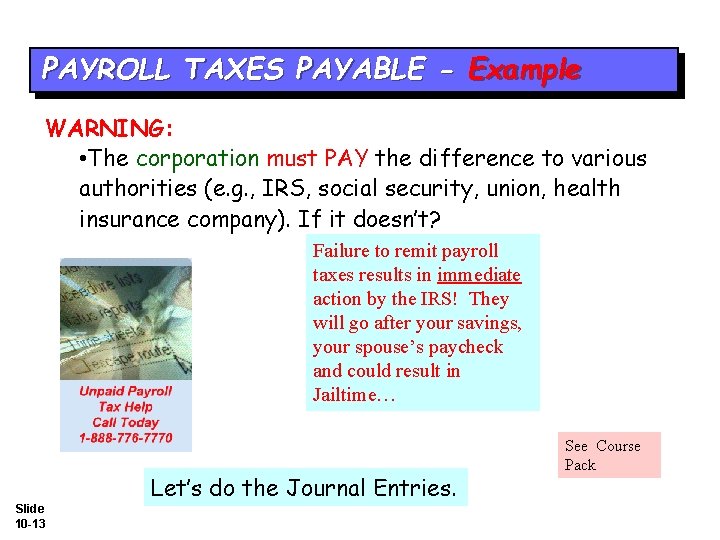
PAYROLL TAXES PAYABLE - Example WARNING: • The corporation must PAY the difference to various authorities (e. g. , IRS, social security, union, health insurance company). If it doesn’t? Failure to remit payroll taxes results in immediate action by the IRS! They will go after your savings, your spouse’s paycheck and could result in Jailtime… Let’s do the Journal Entries. Slide 10 -13 See Course Pack
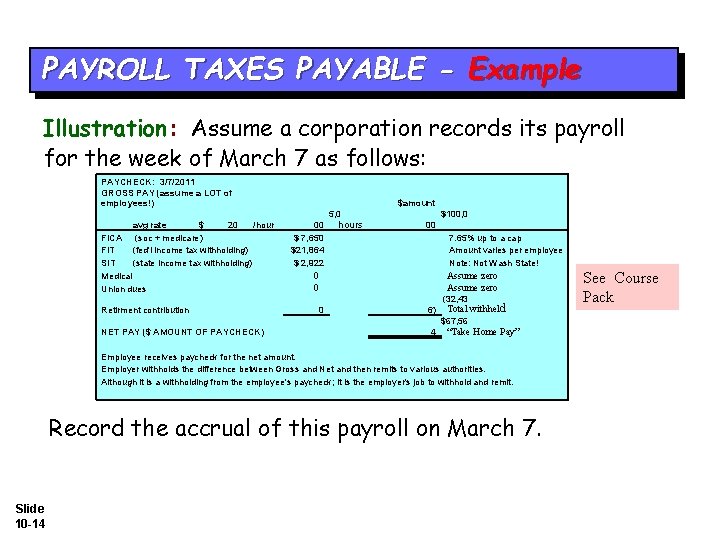
PAYROLL TAXES PAYABLE - Example Illustration: Assume a corporation records its payroll for the week of March 7 as follows: PAYCHECK: 3/7/2011 GROSS PAY (assume a LOT of employees!) $amount 5, 0 avg rate $ 20 /hour (soc + medicare) (fed'l income tax withholding) (state income tax withholding) FICA FIT SIT Medical Union dues 00 $ 7, 650 $21, 864 $ 2, 922 hours $100, 0 00 7. 65% up to a cap Amount varies per employee Note: Not Wash State! 0 0 Assume zero (32, 43 Retirment contribution 0 6) Total withheld $67, 56 NET PAY ($ AMOUNT OF PAYCHECK) 4 “Take Home Pay” Employee receives paycheck for the net amount. Employer withholds the difference between Gross and Net and then remits to various authorities. Although it is a withholding from the employee's paycheck; it is the employer's job to withhold and remit. Record the accrual of this payroll on March 7. Slide 10 -14 See Course Pack
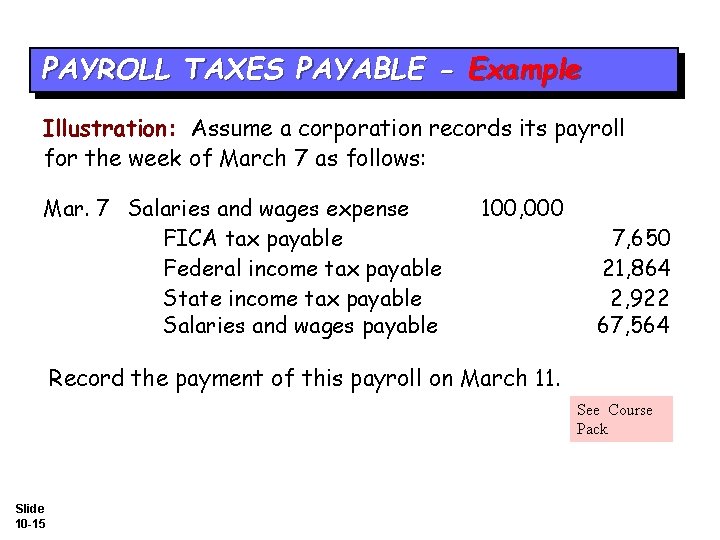
PAYROLL TAXES PAYABLE - Example Illustration: Assume a corporation records its payroll for the week of March 7 as follows: Mar. 7 Salaries and wages expense FICA tax payable Federal income tax payable State income tax payable Salaries and wages payable 100, 000 7, 650 21, 864 2, 922 67, 564 Record the payment of this payroll on March 11. See Course Pack Slide 10 -15
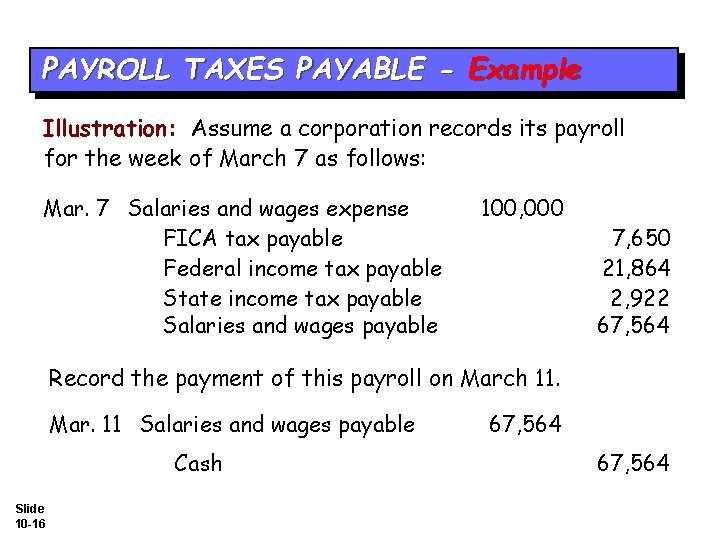
PAYROLL TAXES PAYABLE - Example Illustration: Assume a corporation records its payroll for the week of March 7 as follows: Mar. 7 Salaries and wages expense FICA tax payable Federal income tax payable State income tax payable Salaries and wages payable 100, 000 7, 650 21, 864 2, 922 67, 564 Record the payment of this payroll on March 11. Mar. 11 Salaries and wages payable Cash Slide 10 -16 67, 564
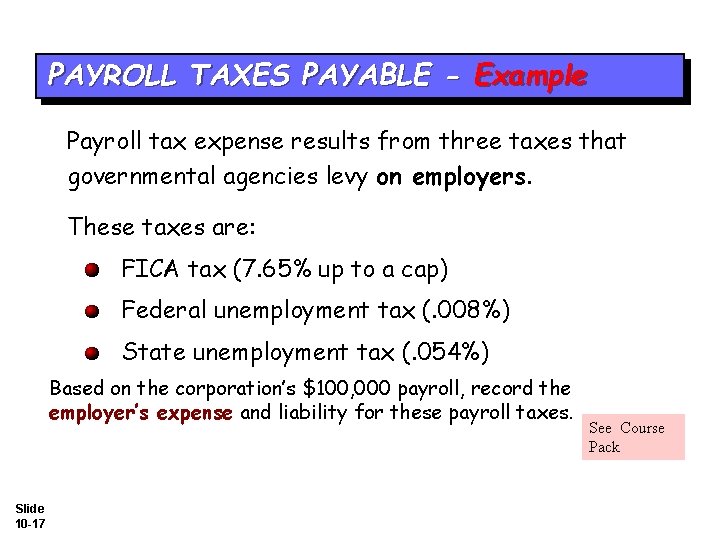
PAYROLL TAXES PAYABLE - Example Payroll tax expense results from three taxes that governmental agencies levy on employers. These taxes are: FICA tax (7. 65% up to a cap) Federal unemployment tax (. 008%) State unemployment tax (. 054%) Based on the corporation’s $100, 000 payroll, record the employer’s expense and liability for these payroll taxes. Slide 10 -17 See Course Pack
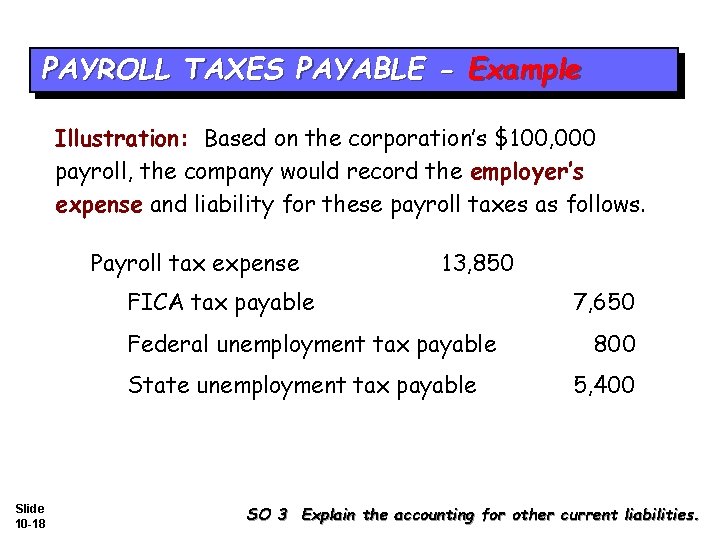
PAYROLL TAXES PAYABLE - Example Illustration: Based on the corporation’s $100, 000 payroll, the company would record the employer’s expense and liability for these payroll taxes as follows. Payroll tax expense 13, 850 FICA tax payable Federal unemployment tax payable State unemployment tax payable Slide 10 -18 7, 650 800 5, 400 SO 3 Explain the accounting for other current liabilities.
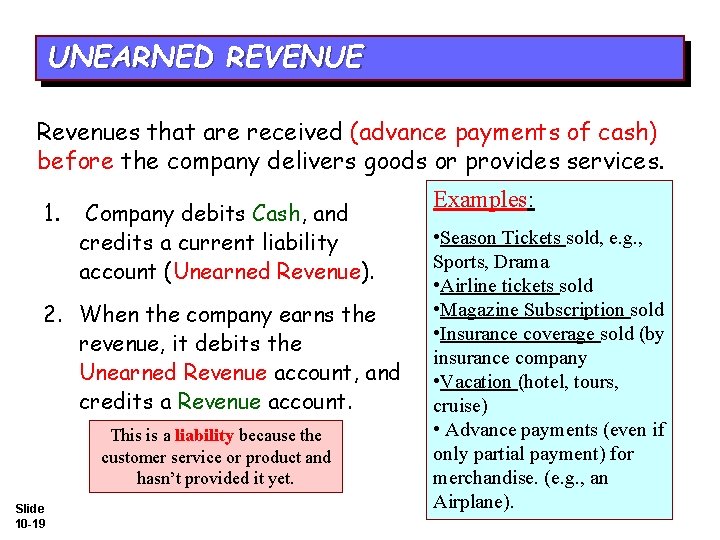
UNEARNED REVENUE Revenues that are received (advance payments of cash) before the company delivers goods or provides services. 1. Company debits Cash, and credits a current liability account (Unearned Revenue). 2. When the company earns the revenue, it debits the Unearned Revenue account, and credits a Revenue account. This is a liability because the customer service or product and hasn’t provided it yet. Slide 10 -19 Examples: • Season Tickets sold, e. g. , Sports, Drama • Airline tickets sold • Magazine Subscription sold • Insurance coverage sold (by insurance company • Vacation (hotel, tours, cruise) • Advance payments (even if only partial payment) for merchandise. (e. g. , an Airplane).
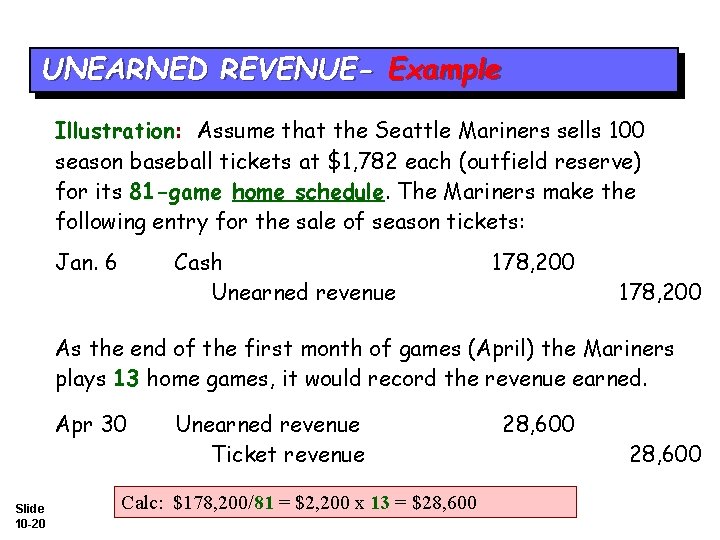
UNEARNED REVENUE- Example Illustration: Assume that the Seattle Mariners sells 100 season baseball tickets at $1, 782 each (outfield reserve) for its 81 -game home schedule. The Mariners make the following entry for the sale of season tickets: Jan. 6 Cash Unearned revenue 178, 200 As the end of the first month of games (April) the Mariners plays 13 home games, it would record the revenue earned. Apr 30 Slide 10 -20 Unearned revenue Ticket revenue Calc: $178, 200/81 = $2, 200 x 13 = $28, 600
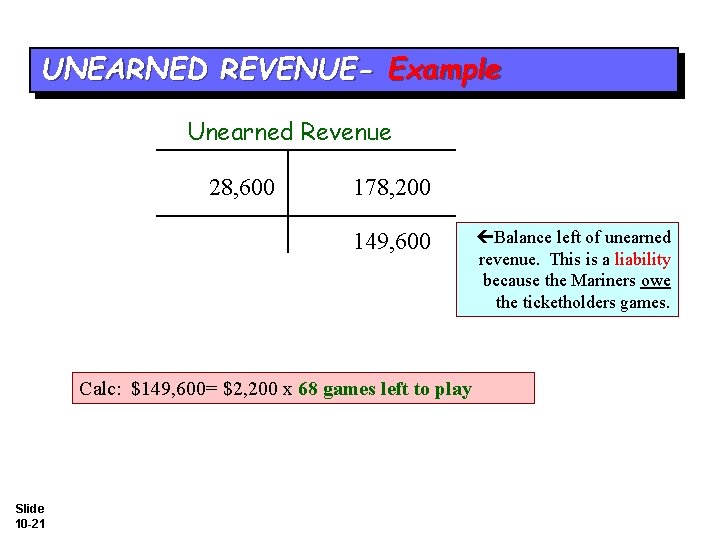
UNEARNED REVENUE- Example Unearned Revenue 28, 600 178, 200 149, 600 Calc: $149, 600= $2, 200 x 68 games left to play Slide 10 -21 Balance left of unearned revenue. This is a liability because the Mariners owe the ticketholders games.
Current Maturities of Long-Term Debt Portion of long-term debt that comes due in the current year. No adjusting entry required. Slide 10 -22
Warranties… l Companies must ESTIMATE their Liability. l Product warranty expense l l Then when the ACTUAL warranty costs come in, book them to the l Slide 10 -23 Estimated Liab for prod warranty l Inventory
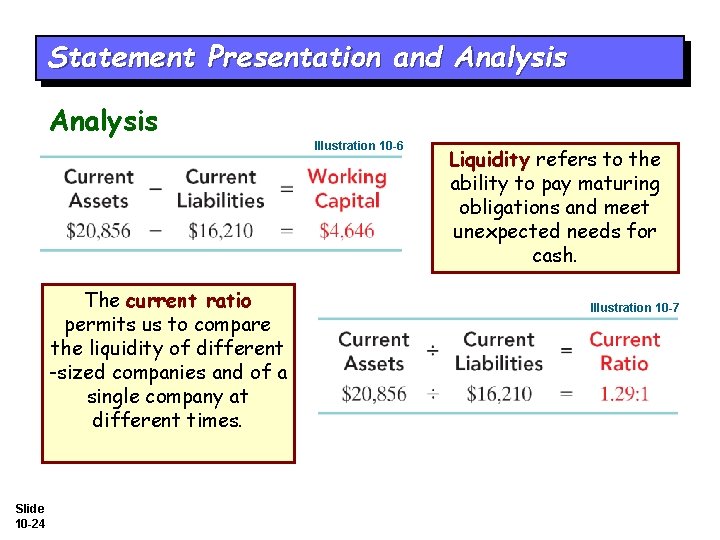
Statement Presentation and Analysis Illustration 10 -6 The current ratio permits us to compare the liquidity of different -sized companies and of a single company at different times. Slide 10 -24 Liquidity refers to the ability to pay maturing obligations and meet unexpected needs for cash. Illustration 10 -7
End of Section 1 Go on to Section 2 Slide 10 -25
Chapter 10 Liabilities Section 2 (of 4) Use Table of Contents to go to different slides Slide 10 -26
Study Objectives Slide 10 -27 1. Explain a current liability, and identify the major types of current liabilities. 2. Describe the accounting for notes payable. 3. Explain the accounting for other current liabilities. 4. Explain why bonds are issued, and identify the types of bonds. 5. Prepare the entries for the issuance of bonds and interest expense. 6. Describe the entries when bonds are redeemed or converted. 7. Describe the accounting for long-term notes payable (theory only) 8. Identify the methods for the presentation and analysis of long-term liabilities (theory only) 9. (not covered – Appendix 10 -A) 10. (not covered – Appendix 10 -B 11. Apply the straight line method of amortizing bond discount and bond premium (Appendix 10 -C)
Section 2 Long-Term Liabilities Bond Basics WHAT IS A BOND? Bonds are long-term debt agreements, a form of LONG TERM interest bearing Notes Payable. The Company borrows money and issues the lender a bond (or bonds). The Company pays the bond holder interest. The contractual agreement specifies: v A series of either annual or semi-annual interest payments (INTEREST EXPENSE) v A lump sum payment (face value) (PAYING BACK THE PRINCIPAL) Slide 10 -28

No, not this Bond. . Slide 10 -29
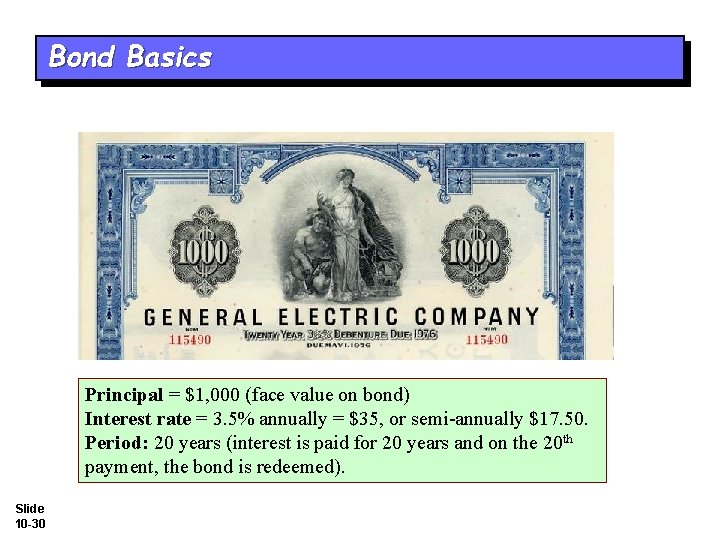
Bond Basics Principal = $1, 000 (face value on bond) Interest rate = 3. 5% annually = $35, or semi-annually $17. 50. Period: 20 years (interest is paid for 20 years and on the 20 th payment, the bond is redeemed). Slide 10 -30
Why issue Bonds and not Common Stock? Three advantages of Bond Financing (debt) over selling additional shares of stock, Stock Financing (equity): 1. Stockholder control is not affected 2. Tax savings result 3. Earnings per share may be higher Slide 10 -31
Advantages of Bond Financing over Common Stock l Stockholder control Issuing Bonds brings money into the company (via debt) but does NOT bring more owners into the company. More voters mean more votes. More votes mean loss of Control…. so Bond Financing is better than Stock Financing which increases the # of voters. Slide 10 -32
Advantages of Bond Financing over Common Stock l Tax expense (hence a deduction!!) Interest Expense is deductible. By the way, dividends (currently) are NOT deductible. )…. so Bond Financing is better than Stock Financing because it gives the company a deduction, which effectively reduces the cost of the debt. Slide 10 -33
Advantages of Bond Financing over Common Stock l Earnings per share Having debtors does NOT increase the number of shareholders. Hence, does not affect the EPS…. so Bond Financing is better than Stock Financing which DOES increase # shareholders and can reduce EPS Slide 10 -34 Earnings Per Share = Net Income # Shares outstanding The more Shares outstanding, the LOWER the EPS
Bond Basics Types of Bonds Secured and Unsecured (debenture) bonds. Term and Serial bonds. Registered and Bearer (or coupon) bonds. Convertible and Callable bonds. Slide 10 -35
Secured Bonds. . . Have specific assets of the issuer pledged as collateral for bonds, e. g. , real estate, or sinking fund Slide 10 -36
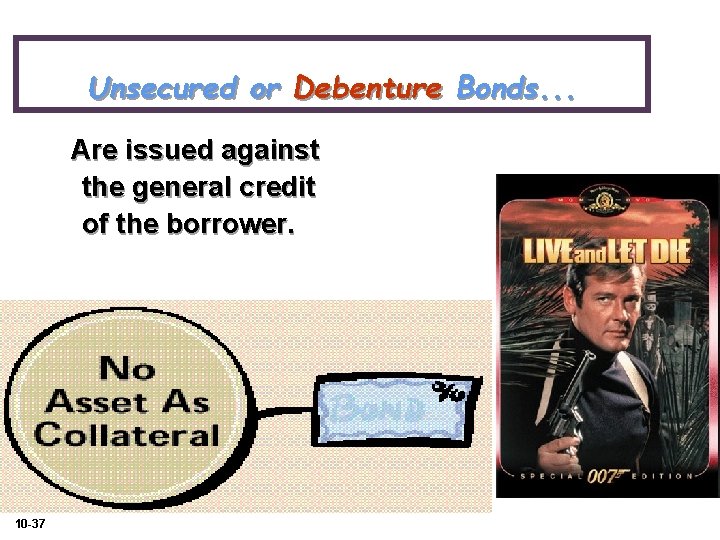
Unsecured or Debenture Bonds. . . Are issued against the general credit of the borrower. Slide 10 -37
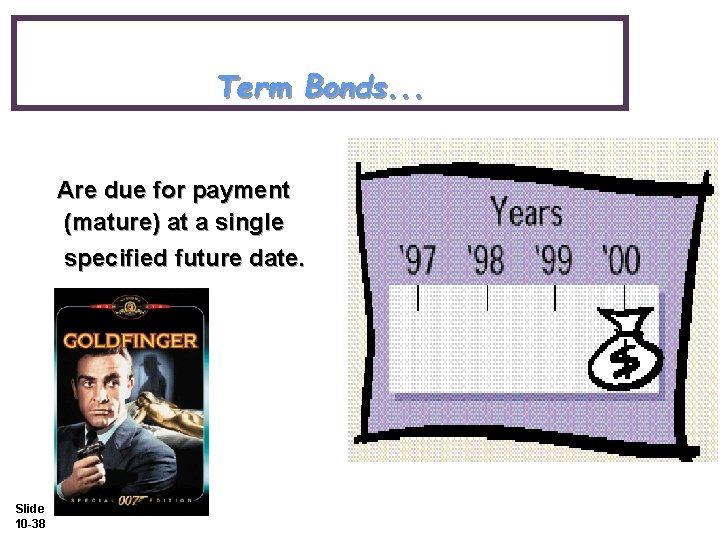
Term Bonds. . . Are due for payment (mature) at a single specified future date. Slide 10 -38
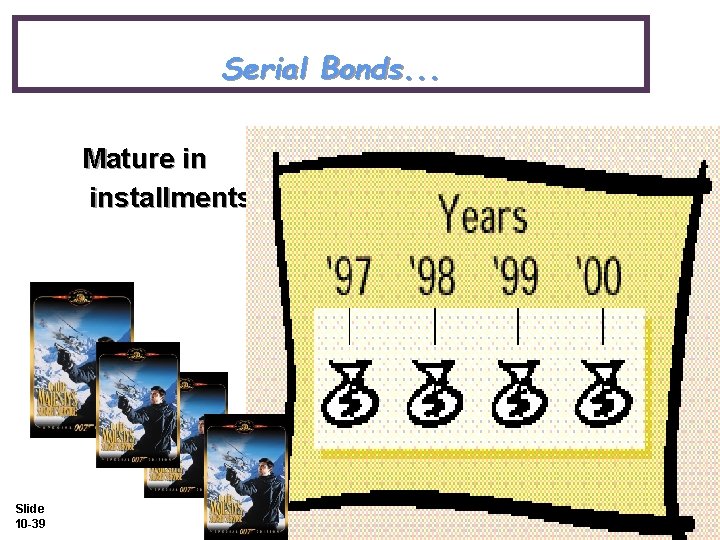
Serial Bonds. . . Mature in installments. Slide 10 -39
Registered & Bearer Bonds. . . Registered Bonds are issued in the name of the owner. Bearer Bonds are unregistered. Also called Coupon Bonds Slide 10 -40
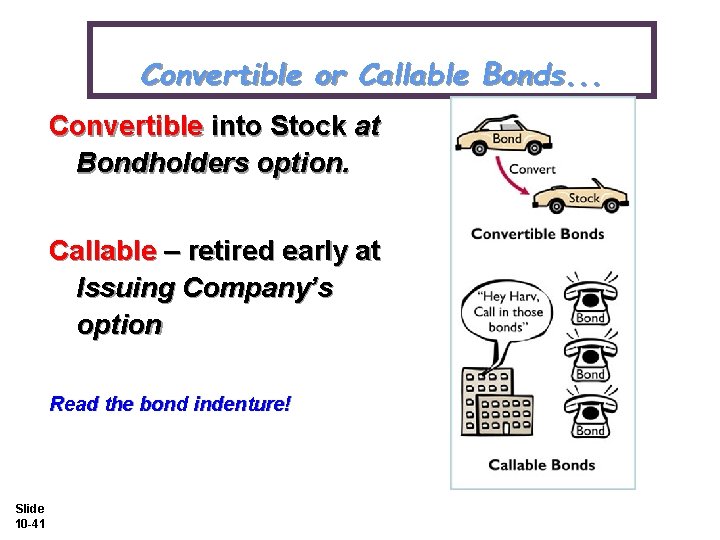
Convertible or Callable Bonds. . . Convertible into Stock at Bondholders option. Callable – retired early at Issuing Company’s option Read the bond indenture! Slide 10 -41
Bond Basics The Bond Contract… Known as a the Bond Indenture. The Board of Directors approves new Bond Issuances -(If the Company is trying to raise $5, 000 in bonds, they would authorize issuing 5, 000 bonds (at $1, 000 par value). The Bond Indenture includes the terms of the Bond Terms include: (1) Face Value of total issuance e. g. , $5, 000 (2) Interest rate, also called the “contractual (stated) rate on the maturity amount (face value). (3) Life of bond (3, 5, 7 years, etc. ) Slide 10 -42
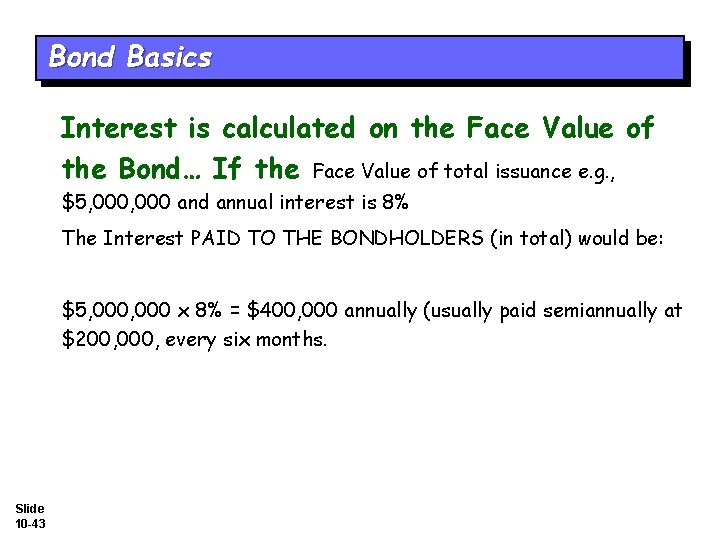
Bond Basics Interest is calculated on the Face Value of the Bond… If the Face Value of total issuance e. g. , $5, 000 and annual interest is 8% The Interest PAID TO THE BONDHOLDERS (in total) would be: $5, 000 x 8% = $400, 000 annually (usually paid semiannually at $200, 000, every six months. Slide 10 -43
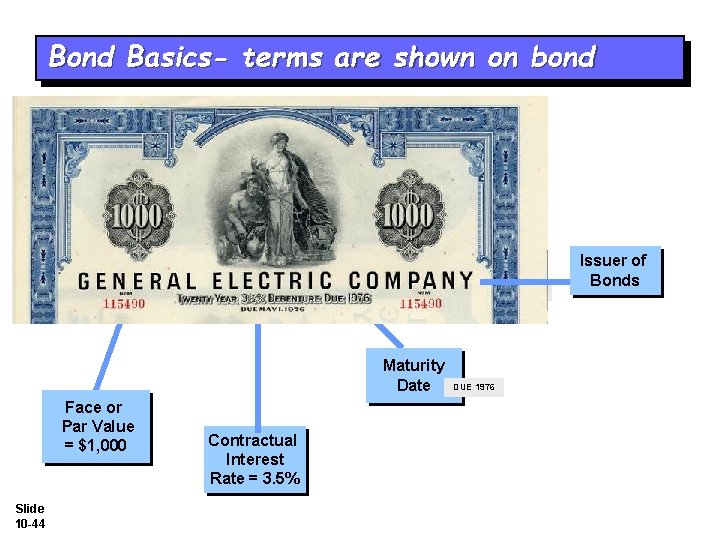
Bond Basics- terms are shown on bond 2013 DUE 2013 Maturity Date Face or Par Value = $1, 000 Slide 10 -44 Contractual Interest Rate = 3. 5% DUE 1976 Issuer of Bonds
How do you keep them straight? l l Slide 10 -45 Indenture? – Bond Contract Debenture? – Type of bond (issued on general credit of company)
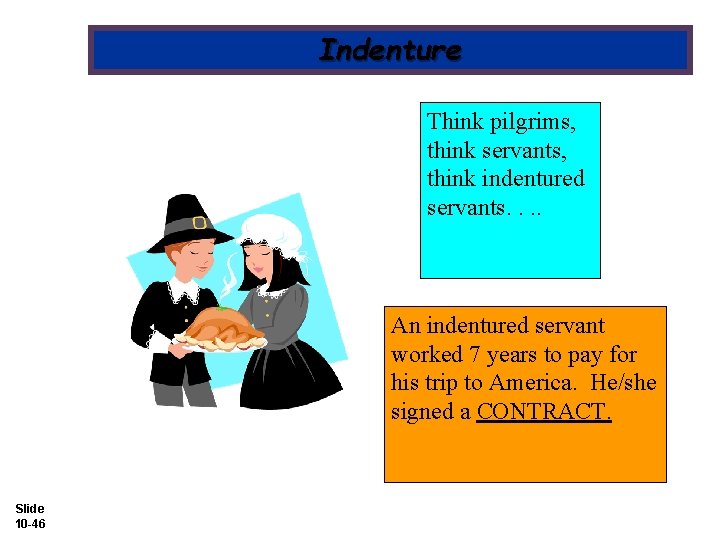
Indenture Think pilgrims, think servants, think indentured servants. . An indentured servant worked 7 years to pay for his trip to America. He/she signed a CONTRACT. Slide 10 -46
DEBENTURE – DIE HARD l Open the Safe! Okay, maybe you didn’t see the movie, but they robbed the safe of millions of dollars worth of bonds, debenture bonds…. . Slide 10 -47
End of Section 2 Go on to Section 3 Slide 10 -48
Chapter 10 Liabilities Section 3 (of 4) Use Table of Contents to go to an individual slide Slide 10 -49
Study Objectives Slide 10 -50 1. Explain a current liability, and identify the major types of current liabilities. 2. Describe the accounting for notes payable. 3. Explain the accounting for other current liabilities. 4. Explain why bonds are issued, and identify the types of bonds. 5. Prepare the entries for the issuance of bonds and interest expense. 6. Describe the entries when bonds are redeemed or converted. 7. Describe the accounting for long-term notes payable (theory only) 8. Identify the methods for the presentation and analysis of long-term liabilities (theory only) 9. (not covered – Appendix 10 -A) 10. (not covered – Appendix 10 -B 11. Apply the straight line method of amortizing bond discount and bond premium (Appendix 10 -C)
Section 3: Accounting for Bond Issues JOURNAL ENTRIES: Issuing Bonds Paying semi annual interest Accruing semi annual interest Retiring Bonds See Course Pack for summary on bond and journal entries Slide 10 -51
Face Value. . . The amount of principal due at maturity date. Contractual Interest Rate. . . (Face Interest Rate) Is the rate used to determine the amount of cash interest the borrower pays and investor receives. Slide 10 -52
Market Interest Rate. . . The rate that investors demand for loaning funds. Not the same as contract (bond indenture) rate. Slide 10 -53
Accounting for Bond Issues Bonds may be issued at: l Face value – (e. g. , 10% contract rate) l Below face value-discount or (e. g, market is 12%) l Above face value-premium (e. g. , market is 8%) Slide 10 -54
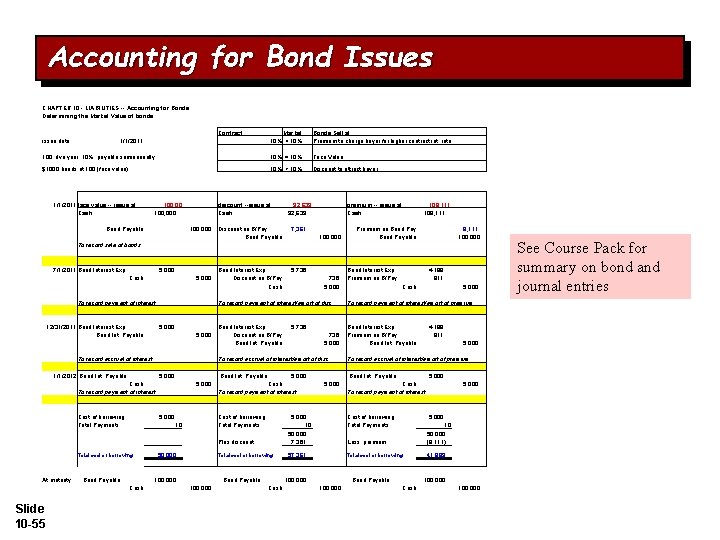
Accounting for Bond Issues CHAPTER 10 - LIABILITIES -- Accounting for Bonds Determining the Market Value of bonds Contract Market 10% < 10% Bonds Sell at: Premium to charge buyer for higher contract int. rate 100 five year, 10%, payable semiannually 10% = 10% Face Value $1000 bonds at 100 (face value) 10% > 10% Discount to attract buyer issue date: 1/1/2011 face value -- issue at: Cash 100. 00 100, 000 Bond Payable discount --issue at: Cash 100, 000 92. 639 92, 639 Discount on B/Pay Bond Payable 7, 361 Bond Interest Exp. Discount on B/Pay Cash 5, 736 premium -- issue at: Cash 100, 000 108. 111 108, 111 Premium on Bond Payable 8, 111 100, 000 To record sale of bonds 7/1/2011 Bond Interest Exp. 5, 000 Cash 5, 000 To record payment of interest 12/31/2011 Bond Interest Exp. Bond Int. Payable 5, 000 To record accrual of interest 1/1/2012 Bond Int. Payable 5, 000 Cash To record payment of interest Cost of borrowing: Total Payments 5, 000 Bond Payable 100, 000 Cash Slide 10 -55 50, 000 4, 189 811 Cash 5, 000 To record payment of interest/amort of premium Bond Interest Exp. Discount on B/Pay Bond Int. Payable Bond Interest Exp. Premium on B/Pay Bond Int. Payable 5, 736 5, 000 4, 189 811 5, 000 To record accrual of interest/amort of disc. To record accrual of interest/amort of premium Bond Int. Payable 5, 000 Cash To record payment of interest 5, 000 Cost of borrowing: Total Payments Plus discount 5, 000 10 50, 000 7, 361 Less: premium 10 50, 000 (8, 111) Total cost of borrowing 57, 361 Total cost of borrowing 41, 889 Bond Payable 100, 000 Bond Interest Exp. Premium on B/Pay To record payment of interest/amort of disc. Cost of borrowing: Total Payments 10 Total cost of borrowing At maturity 5, 000 736 5, 000 100, 000 Cash 5, 000 Bond Payable 100, 000 Cash 100, 000 See Course Pack for summary on bond and journal entries
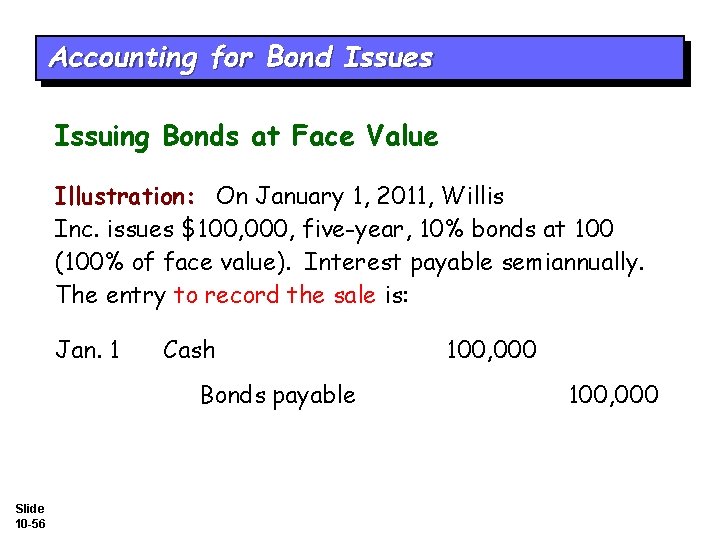
Accounting for Bond Issues Issuing Bonds at Face Value Illustration: On January 1, 2011, Willis Inc. issues $100, 000, five-year, 10% bonds at 100 (100% of face value). Interest payable semiannually. The entry to record the sale is: Jan. 1 Cash Bonds payable Slide 10 -56 100, 000
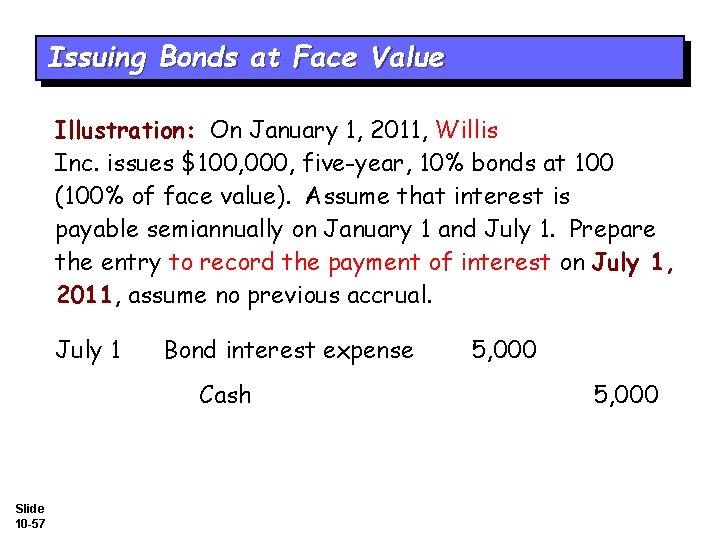
Issuing Bonds at Face Value Illustration: On January 1, 2011, Willis Inc. issues $100, 000, five-year, 10% bonds at 100 (100% of face value). Assume that interest is payable semiannually on January 1 and July 1. Prepare the entry to record the payment of interest on July 1, 2011, assume no previous accrual. July 1 Bond interest expense Cash Slide 10 -57 5, 000
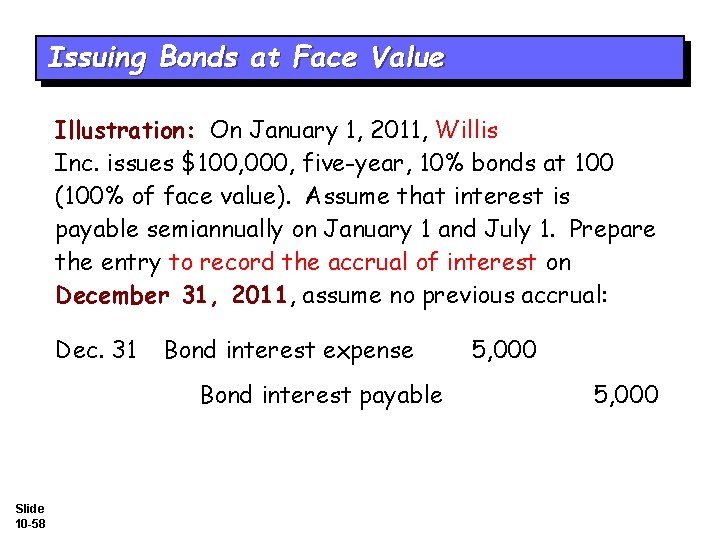
Issuing Bonds at Face Value Illustration: On January 1, 2011, Willis Inc. issues $100, 000, five-year, 10% bonds at 100 (100% of face value). Assume that interest is payable semiannually on January 1 and July 1. Prepare the entry to record the accrual of interest on December 31, 2011, assume no previous accrual: Dec. 31 Bond interest expense Bond interest payable Slide 10 -58 5, 000
Issuing Bonds at Face Value Question: What is the TOTAL cost of borrowing? $5, 000 x 10 periods = $50, 000 Bond interest expense Slide 10 -59
Bond Basics Determining the Market Value of Bonds Market value is a function of the three factors that determine : 1. The selling price when the bond was sold 2. The life of the bond (in # of interest payments ) 3. The market rate of interest for bonds of similar risk Note: whether a bond is callable, convertible, restricted, etc, can also affect the market value of the bond Slide 10 -60
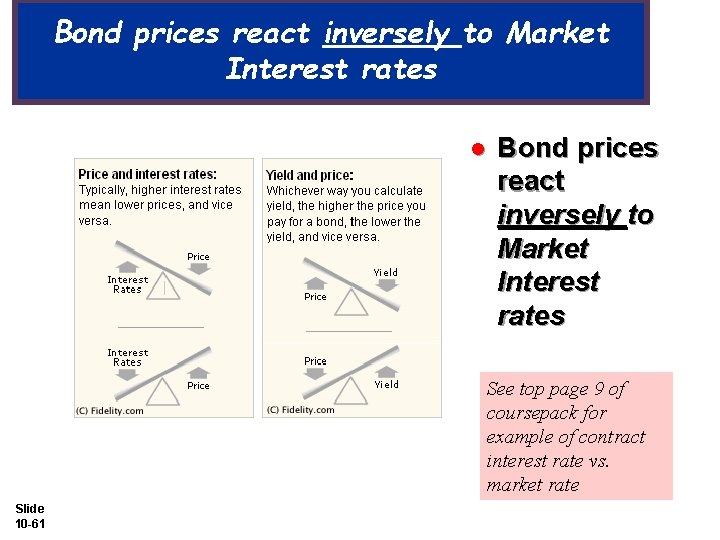
Bond prices react inversely to Market Interest rates l Bond prices react inversely to Market Interest rates See top page 9 of coursepack for example of contract interest rate vs. market rate Slide 10 -61
Bond Discount. . . When the Market Rate is HIGHER than the Bond contract rate, the bond is sold for less than its face value. WHY? To adjust the contractual interest to the market interest rate. Slide 10 -62
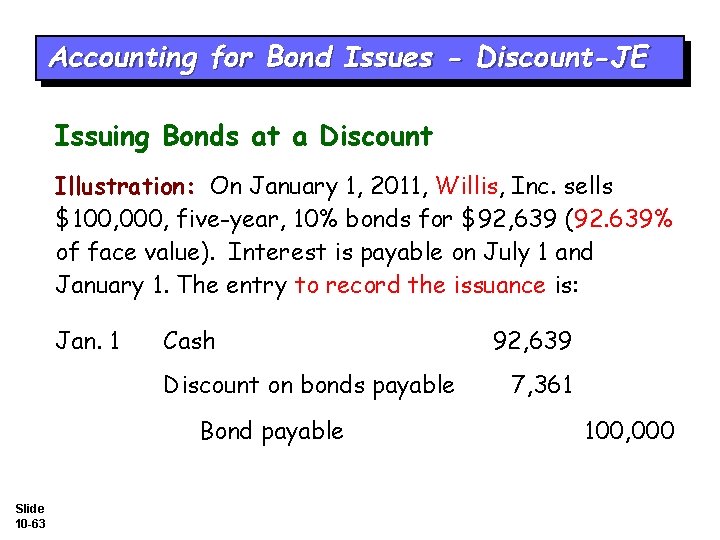
Accounting for Bond Issues - Discount-JE Issuing Bonds at a Discount Illustration: On January 1, 2011, Willis, Inc. sells $100, 000, five-year, 10% bonds for $92, 639 (92. 639% of face value). Interest is payable on July 1 and January 1. The entry to record the issuance is: Jan. 1 Cash Discount on bonds payable Bond payable Slide 10 -63 92, 639 7, 361 100, 000
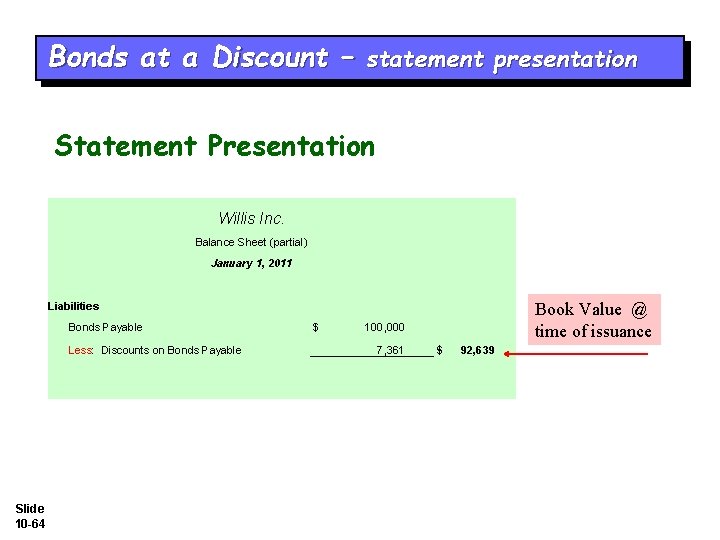
Bonds at a Discount – statement presentation Statement Presentation Willis Inc. Balance Sheet (partial) January 1, 2011 Book Value @ time of issuance Liabilities Bonds Payable Less: Discounts on Bonds Payable Slide 10 -64 $ 100, 000 7, 361 $ 92, 639
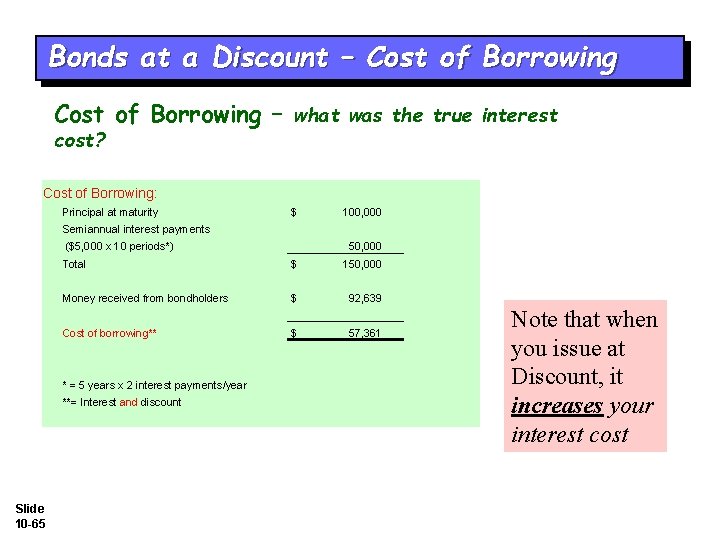
Bonds at a Discount – Cost of Borrowing – what was the true interest cost? Cost of Borrowing: Principal at maturity $ 100, 000 Semiannual interest payments ($5, 000 x 10 periods*) Total $ 150, 000 Money received from bondholders $ 92, 639 Cost of borrowing** $ 57, 361 * = 5 years x 2 interest payments/year **= Interest and discount Slide 10 -65 50, 000 Note that when you issue at Discount, it increases your interest cost
Bond Premium. . . When the Market Rate is LOWER than the Bond contract rate, the bond is sold for MORE than its face value. WHY? To adjust the contractual interest to the market interest rate. Slide 10 -66
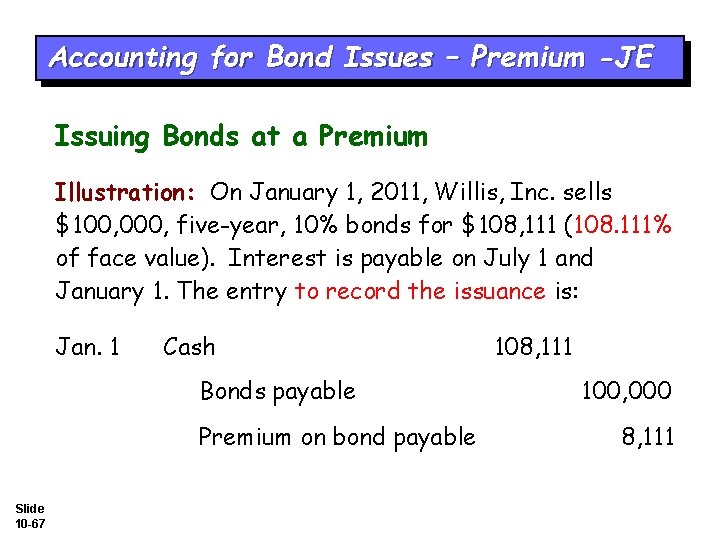
Accounting for Bond Issues – Premium -JE Issuing Bonds at a Premium Illustration: On January 1, 2011, Willis, Inc. sells $100, 000, five-year, 10% bonds for $108, 111 (108. 111% of face value). Interest is payable on July 1 and January 1. The entry to record the issuance is: Jan. 1 Cash Bonds payable Premium on bond payable Slide 10 -67 108, 111 100, 000 8, 111
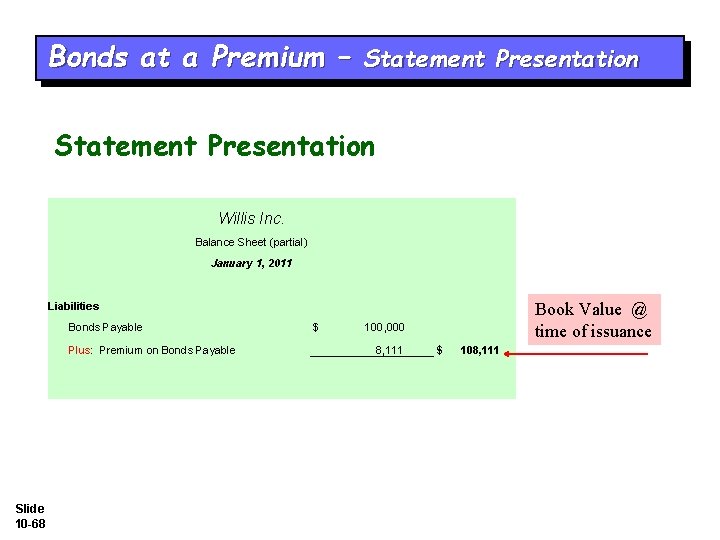
Bonds at a Premium – Statement Presentation Willis Inc. Balance Sheet (partial) January 1, 2011 Book Value @ time of issuance Liabilities Bonds Payable Plus: Premium on Bonds Payable Slide 10 -68 $ 100, 000 8, 111 $ 108, 111
Why aren’t all bonds issued at Face Value? It’s a timing issue. By the time a company prints the bond certificates and markets the bonds, it would be highly unusual if the market rate and the contractual rate are the same. Slide 10 -69
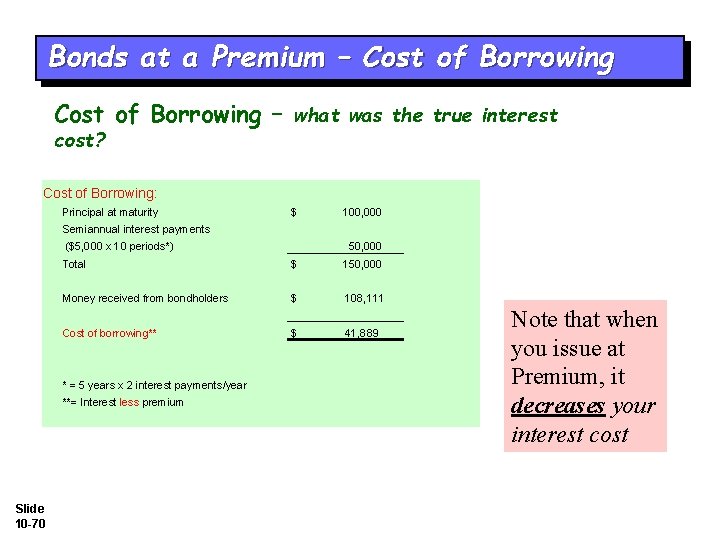
Bonds at a Premium – Cost of Borrowing – what was the true interest cost? Cost of Borrowing: Principal at maturity $ 100, 000 Semiannual interest payments ($5, 000 x 10 periods*) Total $ 150, 000 Money received from bondholders $ 108, 111 Cost of borrowing** $ 41, 889 * = 5 years x 2 interest payments/year **= Interest less premium Slide 10 -70 50, 000 Note that when you issue at Premium, it decreases your interest cost
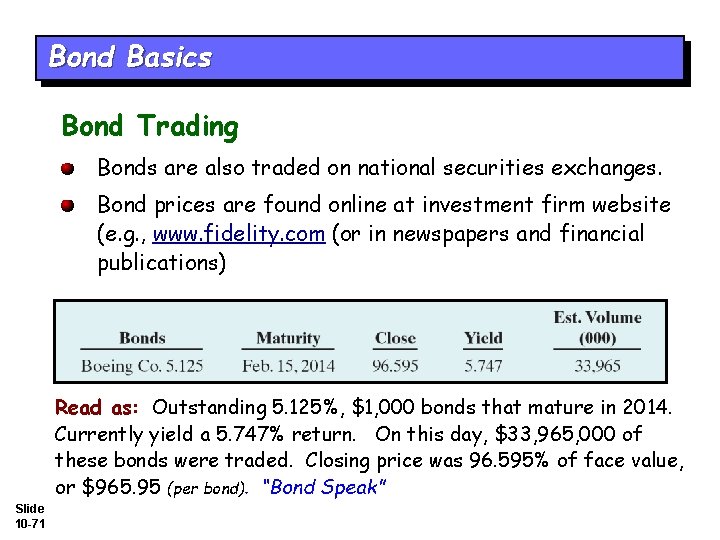
Bond Basics Bond Trading Bonds are also traded on national securities exchanges. Bond prices are found online at investment firm website (e. g. , www. fidelity. com (or in newspapers and financial publications) Read as: Outstanding 5. 125%, $1, 000 bonds that mature in 2014. Currently yield a 5. 747% return. On this day, $33, 965, 000 of these bonds were traded. Closing price was 96. 595% of face value, or $965. 95 (per bond). “Bond Speak” Slide 10 -71
End of Chapter 10 –Part 3 Go on to Part 4 Slide 10 -72
Chapter 10 Liabilities Section 4 Use Table of Contents to go to an individual slide Slide 10 -73
l ACCOUNTING FOR BONDS ISSUED AT: l DISCOUNT – COMPANY RECEIVED LESS THAN FACE VALUE (but will owe full amount of Bond issuance) Slide 10 -74
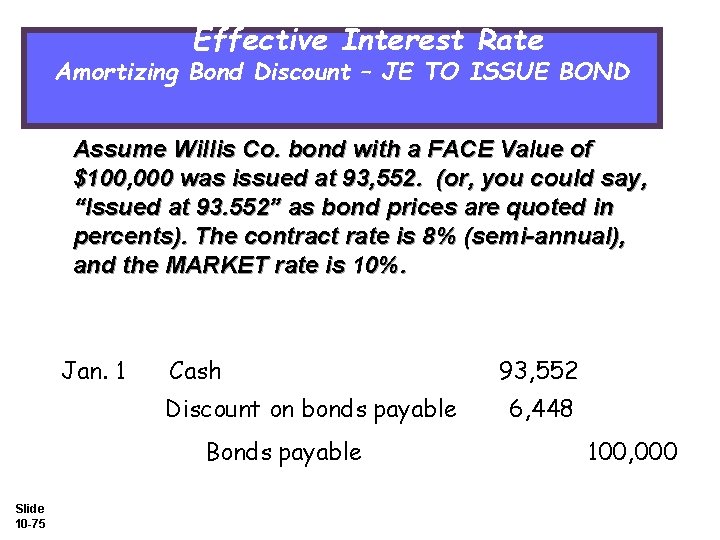
Effective Interest Rate Amortizing Bond Discount – JE TO ISSUE BOND Assume Willis Co. bond with a FACE Value of $100, 000 was issued at 93, 552. (or, you could say, “Issued at 93. 552” as bond prices are quoted in percents). The contract rate is 8% (semi-annual), and the MARKET rate is 10%. Jan. 1 Cash Discount on bonds payable Bonds payable Slide 10 -75 93, 552 6, 448 100, 000
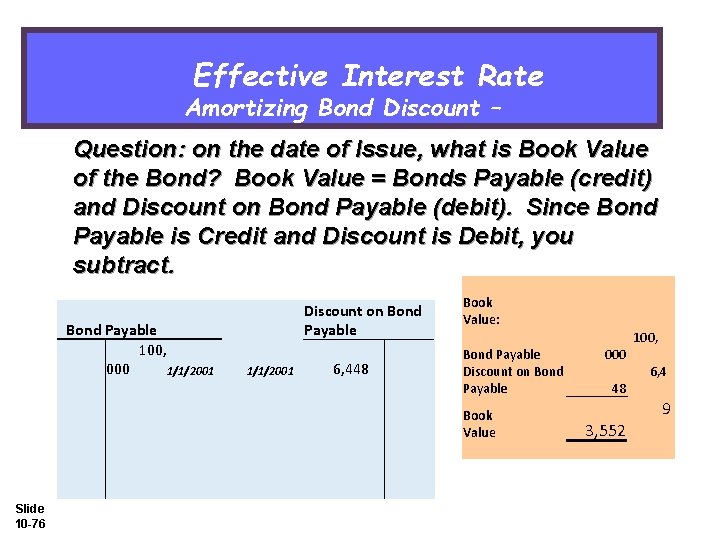
Effective Interest Rate Amortizing Bond Discount – Question: on the date of Issue, what is Book Value of the Bond? Book Value = Bonds Payable (credit) and Discount on Bond Payable (debit). Since Bond Payable is Credit and Discount is Debit, you subtract. Bond Payable 100, 000 1/1/2001 Discount on Bond Payable 1/1/2001 6, 448 Book Value: Bond Payable Discount on Bond Payable Book Value Slide 10 -76 000 48 3, 552 100, 6, 4 9
Effective Interest Rate Amortizing Bond Discount – Although Bond Discounts eventually get written off to Bond Interest Expense, this must be Amortized over the life of the Bond. Because the Discount has a debit balance, when you amortize it, you debit it, effectively increasing the Interest Expense. BUT YOU PAY THE BONDHOLDERS THE SAME AMOUNT, $4, 000 Slide 10 -77
Effective Interest Rate Amortizing Bond Discount – Slide 10 -78 Willis Inc. would recognize the INTEREST EXPENSE over the life of the bond, using the MARKET interest rate. To calculate Interest Expense, you multiply the Book Value of the Bond x Market Rate (divided by 2) Period 1: $93, 552 X 5% = $4, 678 ACTUAL INTEREST PAID = 100, 000 X 4% = $4, 000 The difference is what is amortized from the Discount.
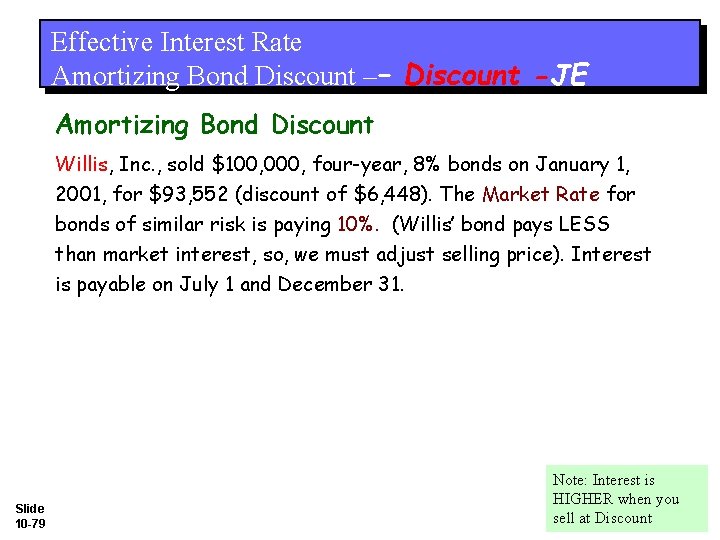
Effective Interest Rate Amortizing Bond Discount –– Discount -JE Amortizing Bond Discount Willis, Inc. , sold $100, 000, four-year, 8% bonds on January 1, 2001, for $93, 552 (discount of $6, 448). The Market Rate for bonds of similar risk is paying 10%. (Willis’ bond pays LESS than market interest, so, we must adjust selling price). Interest is payable on July 1 and December 31. Slide 10 -79 Note: Interest is HIGHER when you sell at Discount
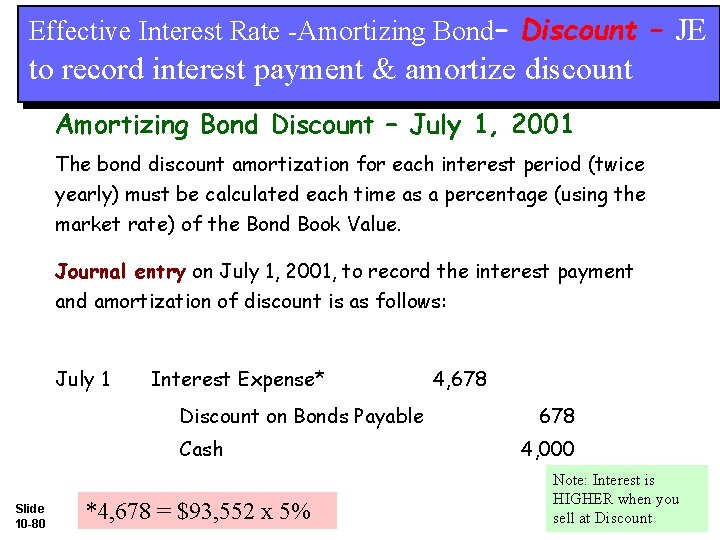
Effective Interest Rate -Amortizing Bond– Discount – JE to record interest payment & amortize discount Amortizing Bond Discount – July 1, 2001 The bond discount amortization for each interest period (twice yearly) must be calculated each time as a percentage (using the market rate) of the Bond Book Value. Journal entry on July 1, 2001, to record the interest payment and amortization of discount is as follows: July 1 Interest Expense* Discount on Bonds Payable Cash Slide 10 -80 *4, 678 = $93, 552 x 5% 4, 678 4, 000 Note: Interest is HIGHER when you sell at Discount
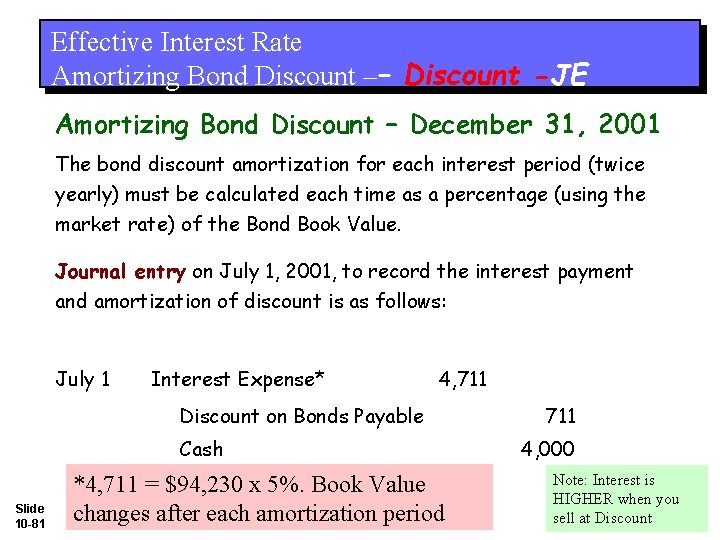
Effective Interest Rate Amortizing Bond Discount –– Discount -JE Amortizing Bond Discount – December 31, 2001 The bond discount amortization for each interest period (twice yearly) must be calculated each time as a percentage (using the market rate) of the Bond Book Value. Journal entry on July 1, 2001, to record the interest payment and amortization of discount is as follows: July 1 Interest Expense* 4, 711 Discount on Bonds Payable Cash Slide 10 -81 *4, 711 = $94, 230 x 5%. Book Value changes after each amortization period 711 4, 000 Note: Interest is HIGHER when you sell at Discount
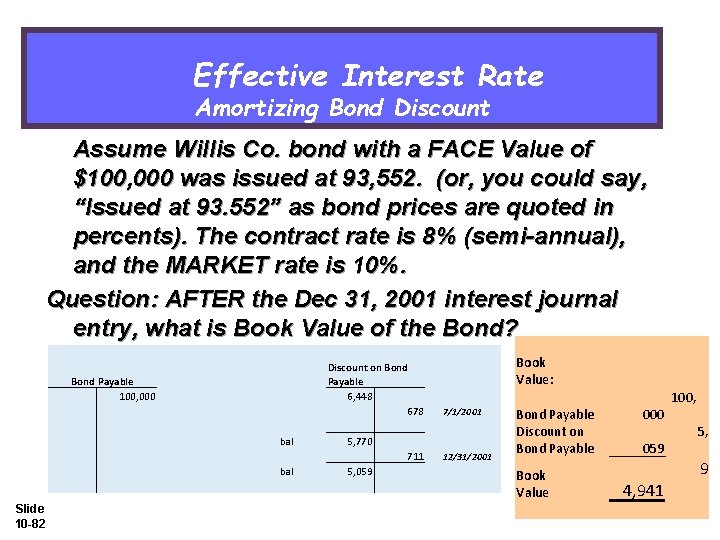
Effective Interest Rate Amortizing Bond Discount Assume Willis Co. bond with a FACE Value of $100, 000 was issued at 93, 552. (or, you could say, “Issued at 93. 552” as bond prices are quoted in percents). The contract rate is 8% (semi-annual), and the MARKET rate is 10%. Question: AFTER the Dec 31, 2001 interest journal entry, what is Book Value of the Bond? Discount on Bond Payable 6, 448 678 Bond Payable 100, 000 bal Slide 10 -82 7/1/2001 5, 770 711 bal Book Value: 5, 059 12/31/2001 Bond Payable Discount on Bond Payable Book Value 000 059 4, 941 100, 5, 9
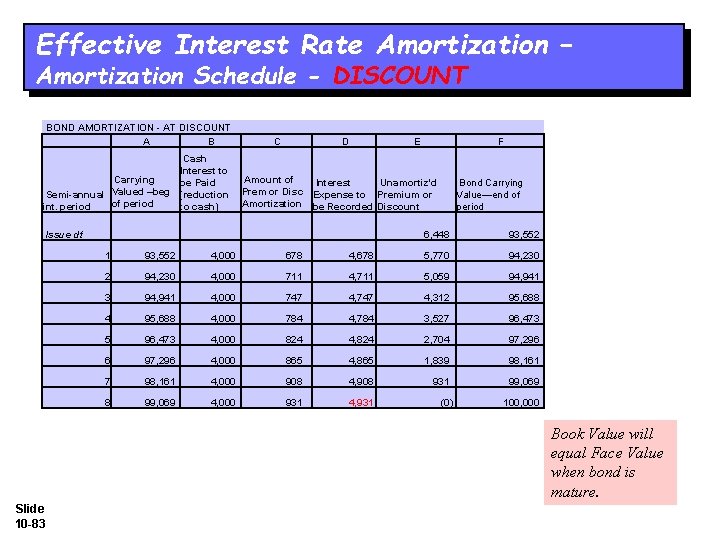
Effective Interest Rate Amortization – Amortization Schedule - DISCOUNT BOND AMORTIZATION - AT DISCOUNT A B Cash Interest to Carrying be Paid Valued –beg (reduction Semi-annual of period int. period to cash) C D E F Amount of Interest Unamortiz'd Prem or Disc Expense to Premium or Amortization be Recorded Discount Issue dt Bond Carrying Value—end of period 6, 448 93, 552 1 93, 552 4, 000 678 4, 678 5, 770 94, 230 2 94, 230 4, 000 711 4, 711 5, 059 94, 941 3 94, 941 4, 000 747 4, 312 95, 688 4, 000 784 4, 784 3, 527 96, 473 5 96, 473 4, 000 824 4, 824 2, 704 97, 296 6 97, 296 4, 000 865 4, 865 1, 839 98, 161 7 98, 161 4, 000 908 4, 908 931 99, 069 8 99, 069 4, 000 931 4, 931 (0) 100, 000 Book Value will equal Face Value when bond is mature. Slide 10 -83
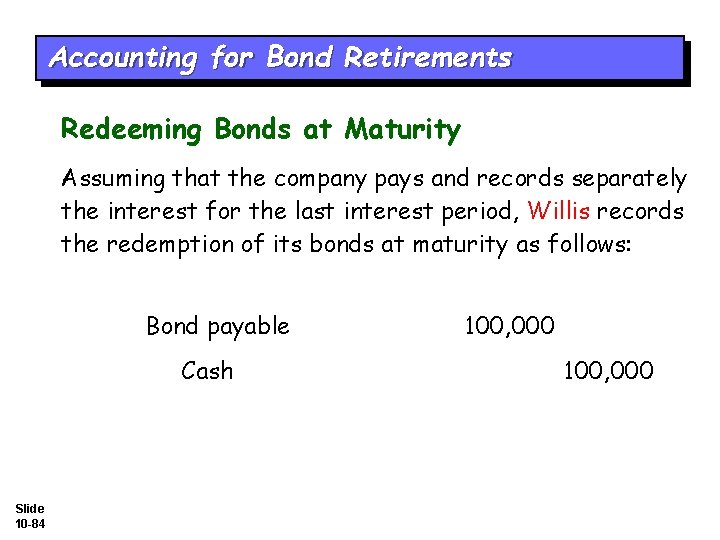
Accounting for Bond Retirements Redeeming Bonds at Maturity Assuming that the company pays and records separately the interest for the last interest period, Willis records the redemption of its bonds at maturity as follows: Bond payable Cash Slide 10 -84 100, 000
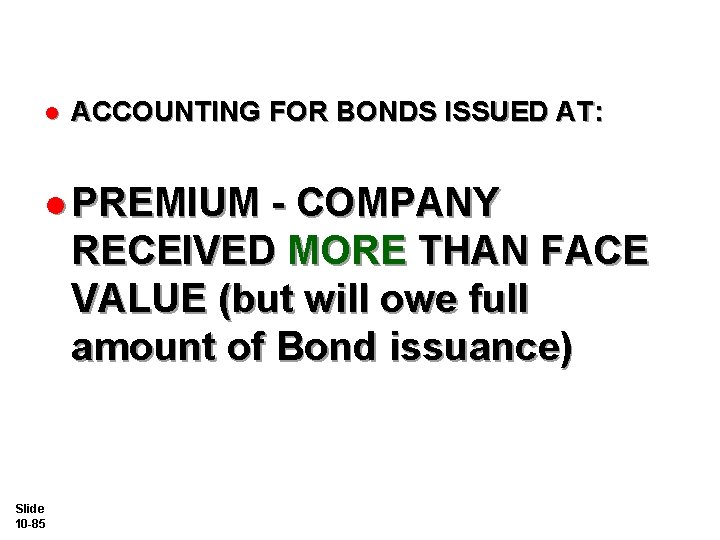
l ACCOUNTING FOR BONDS ISSUED AT: l PREMIUM - COMPANY RECEIVED MORE THAN FACE VALUE (but will owe full amount of Bond issuance) Slide 10 -85
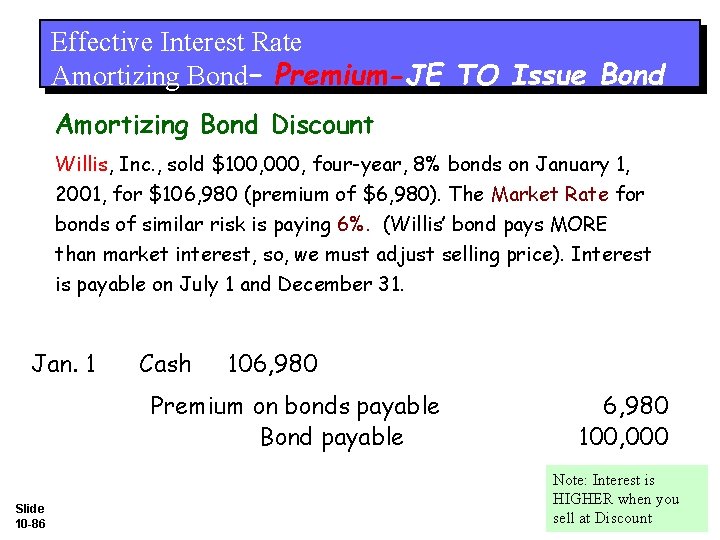
Effective Interest Rate Amortizing Bond– Premium-JE TO Issue Bond Amortizing Bond Discount Willis, Inc. , sold $100, 000, four-year, 8% bonds on January 1, 2001, for $106, 980 (premium of $6, 980). The Market Rate for bonds of similar risk is paying 6%. (Willis’ bond pays MORE than market interest, so, we must adjust selling price). Interest is payable on July 1 and December 31. Jan. 1 Cash 106, 980 Premium on bonds payable Bond payable Slide 10 -86 6, 980 100, 000 Note: Interest is HIGHER when you sell at Discount
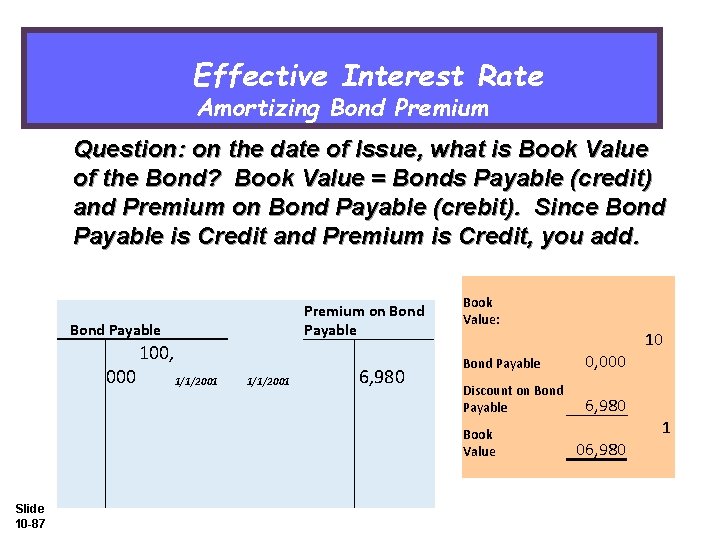
Effective Interest Rate Amortizing Bond Premium Question: on the date of Issue, what is Book Value of the Bond? Book Value = Bonds Payable (credit) and Premium on Bond Payable (crebit). Since Bond Payable is Credit and Premium is Credit, you add. Premium on Bond Payable 000 100, 1/1/2001 6, 980 Book Value: Bond Payable 0, 000 Discount on Bond Payable 6, 980 Book Value Slide 10 -87 06, 980 10 1
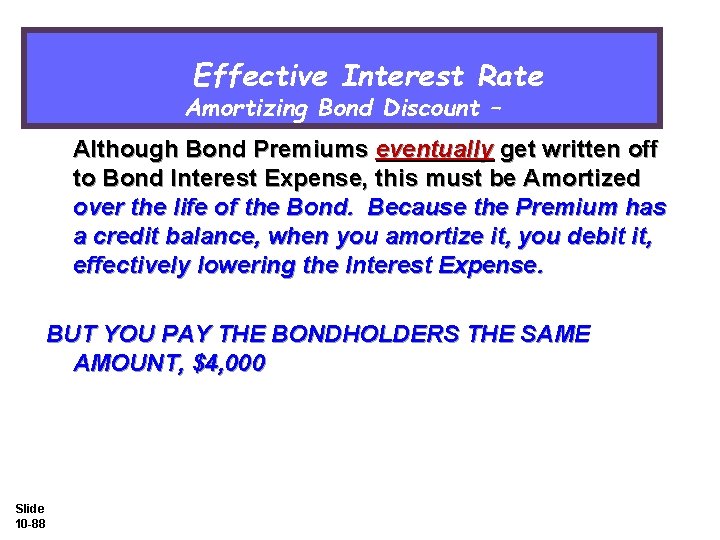
Effective Interest Rate Amortizing Bond Discount – Although Bond Premiums eventually get written off to Bond Interest Expense, this must be Amortized over the life of the Bond. Because the Premium has a credit balance, when you amortize it, you debit it, effectively lowering the Interest Expense. BUT YOU PAY THE BONDHOLDERS THE SAME AMOUNT, $4, 000 Slide 10 -88
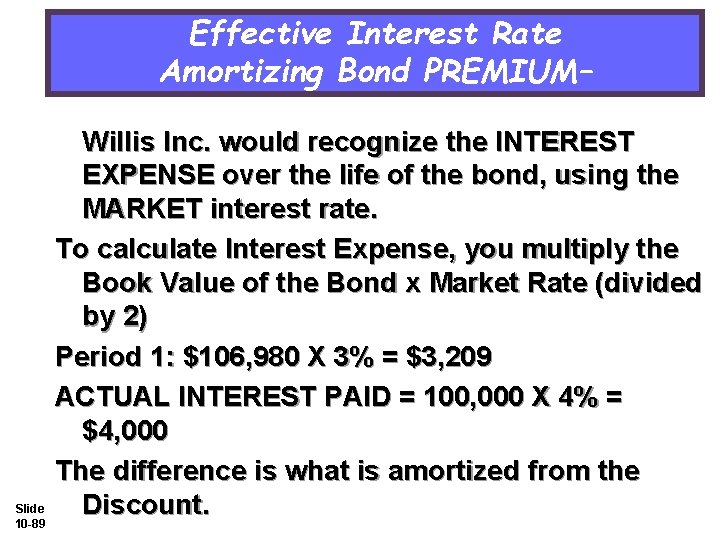
Effective Interest Rate Amortizing Bond PREMIUM– Slide 10 -89 Willis Inc. would recognize the INTEREST EXPENSE over the life of the bond, using the MARKET interest rate. To calculate Interest Expense, you multiply the Book Value of the Bond x Market Rate (divided by 2) Period 1: $106, 980 X 3% = $3, 209 ACTUAL INTEREST PAID = 100, 000 X 4% = $4, 000 The difference is what is amortized from the Discount.
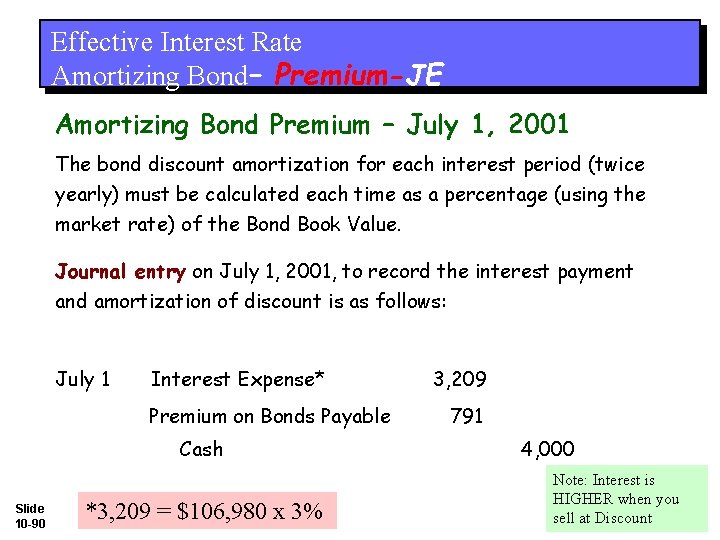
Effective Interest Rate Amortizing Bond– Premium-JE Amortizing Bond Premium – July 1, 2001 The bond discount amortization for each interest period (twice yearly) must be calculated each time as a percentage (using the market rate) of the Bond Book Value. Journal entry on July 1, 2001, to record the interest payment and amortization of discount is as follows: July 1 Interest Expense* Premium on Bonds Payable Cash Slide 10 -90 *3, 209 = $106, 980 x 3% 3, 209 791 4, 000 Note: Interest is HIGHER when you sell at Discount
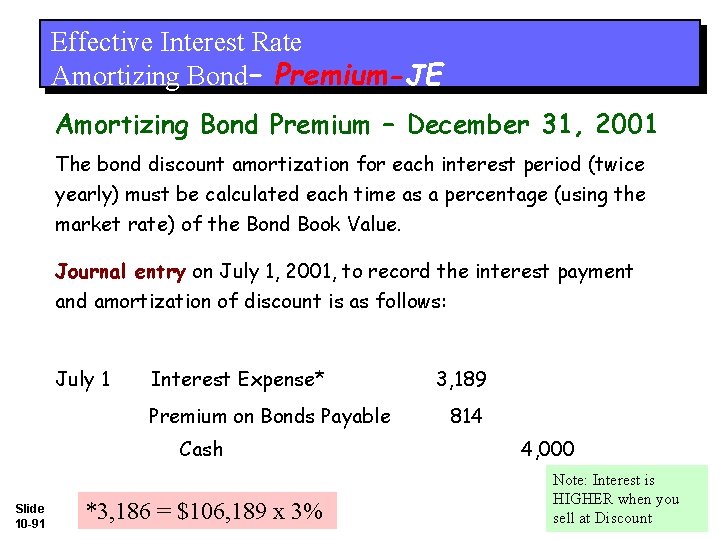
Effective Interest Rate Amortizing Bond– Premium-JE Amortizing Bond Premium – December 31, 2001 The bond discount amortization for each interest period (twice yearly) must be calculated each time as a percentage (using the market rate) of the Bond Book Value. Journal entry on July 1, 2001, to record the interest payment and amortization of discount is as follows: July 1 Interest Expense* Premium on Bonds Payable Cash Slide 10 -91 *3, 186 = $106, 189 x 3% 3, 189 814 4, 000 Note: Interest is HIGHER when you sell at Discount
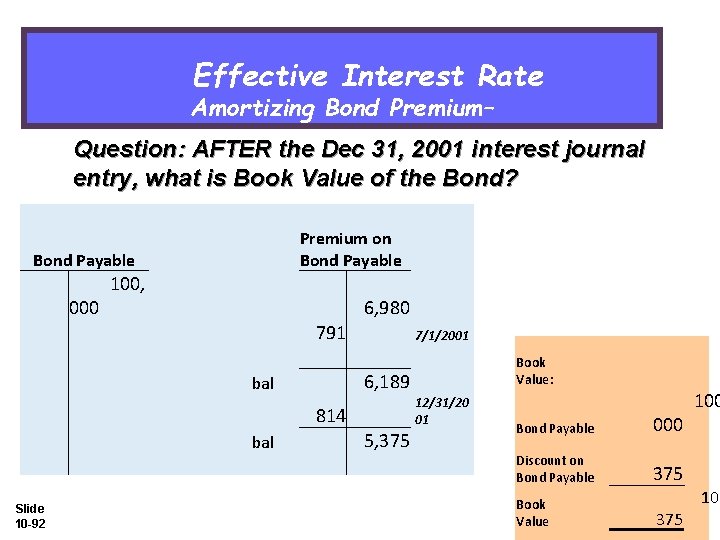
Effective Interest Rate Amortizing Bond Premium– Question: AFTER the Dec 31, 2001 interest journal entry, what is Book Value of the Bond? Premium on Bond Payable 000 100, 6, 980 791 7/1/2001 6, 189 bal 12/31/20 01 814 bal Slide 10 -92 Book Value: 5, 375 Bond Payable 000 Discount on Bond Payable 375 Book Value 375 100 105
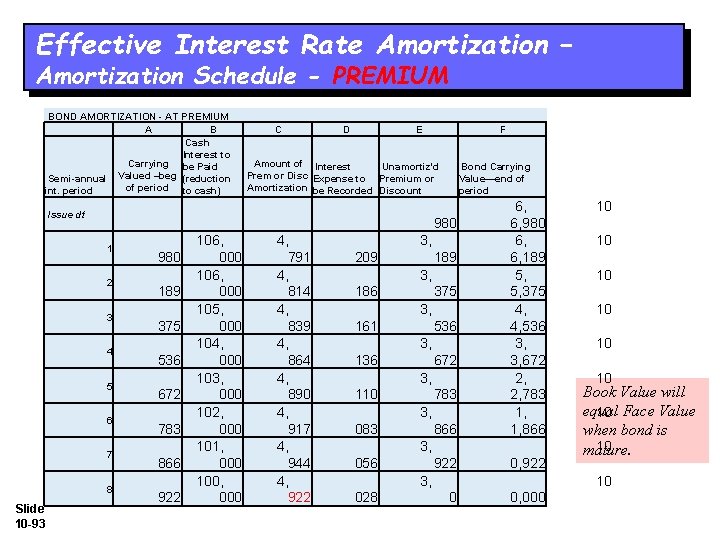
Effective Interest Rate Amortization – Amortization Schedule - PREMIUM BOND AMORTIZATION - AT PREMIUM A B Cash Interest to Carrying be Paid Semi-annual Valued –beg (reduction of period to cash) int. period C D E Amount of Interest Unamortiz'd Prem or Disc Expense to Premium or Amortization be Recorded Discount Issue dt Bond Carrying Value—end of period 866 6, 6, 980 6, 6, 189 5, 5, 375 4, 4, 536 3, 3, 672 2, 2, 783 1, 1, 866 922 0, 922 980 1 2 3 4 5 6 7 8 Slide 10 -93 F 980 189 375 536 672 783 866 922 106, 000 105, 000 104, 000 103, 000 102, 000 101, 000 100, 000 4, 791 4, 814 4, 839 4, 864 4, 890 4, 917 4, 944 4, 922 3, 209 189 3, 186 375 3, 161 536 3, 136 672 3, 110 783 3, 083 3, 056 3, 028 10 10 10 Book Value will equal 10 Face Value when bond is 10 mature. 10 0 0, 000
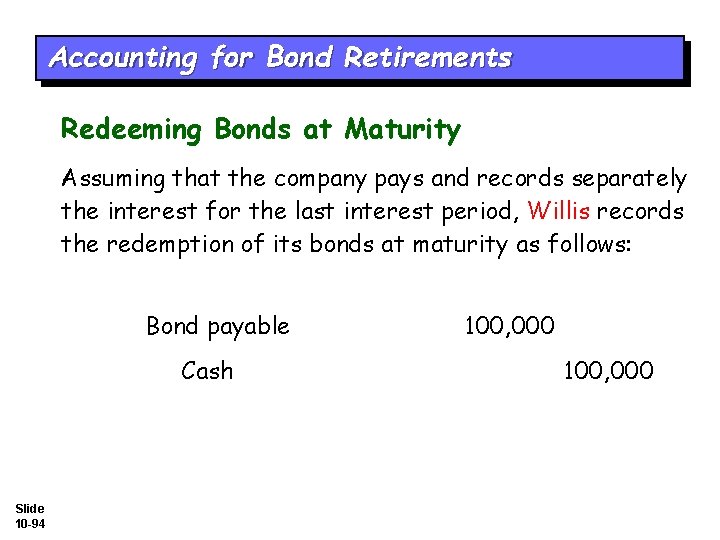
Accounting for Bond Retirements Redeeming Bonds at Maturity Assuming that the company pays and records separately the interest for the last interest period, Willis records the redemption of its bonds at maturity as follows: Bond payable Cash Slide 10 -94 100, 000
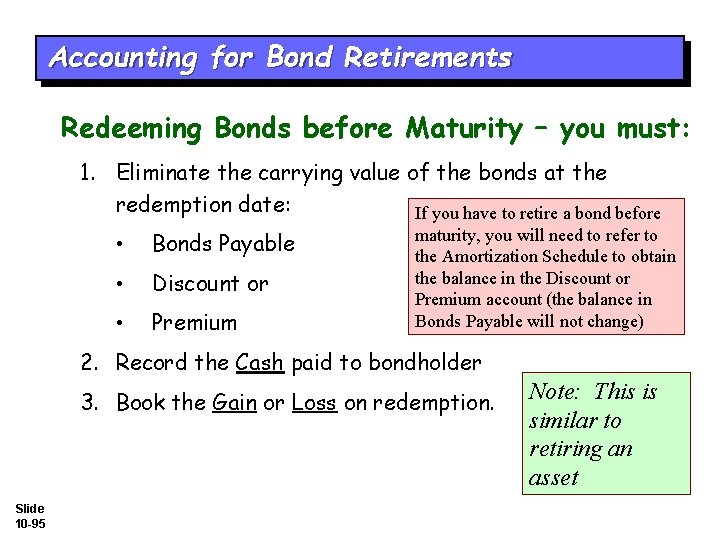
Accounting for Bond Retirements Redeeming Bonds before Maturity – you must: 1. Eliminate the carrying value of the bonds at the redemption date: If you have to retire a bond before • Bonds Payable • Discount or • Premium maturity, you will need to refer to the Amortization Schedule to obtain the balance in the Discount or Premium account (the balance in Bonds Payable will not change) 2. Record the Cash paid to bondholder 3. Book the Gain or Loss on redemption. Slide 10 -95 Note: This is similar to retiring an asset
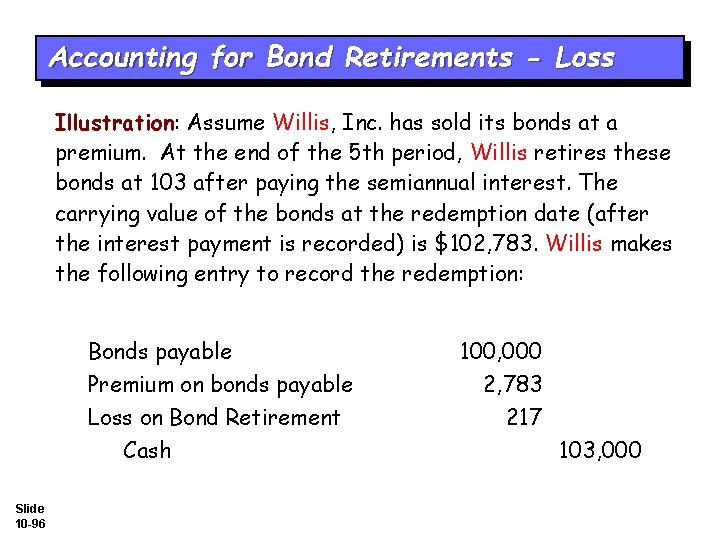
Accounting for Bond Retirements - Loss Illustration: Assume Willis, Inc. has sold its bonds at a premium. At the end of the 5 th period, Willis retires these bonds at 103 after paying the semiannual interest. The carrying value of the bonds at the redemption date (after the interest payment is recorded) is $102, 783. Willis makes the following entry to record the redemption: Bonds payable Premium on bonds payable Loss on Bond Retirement Cash Slide 10 -96 100, 000 2, 783 217 103, 000
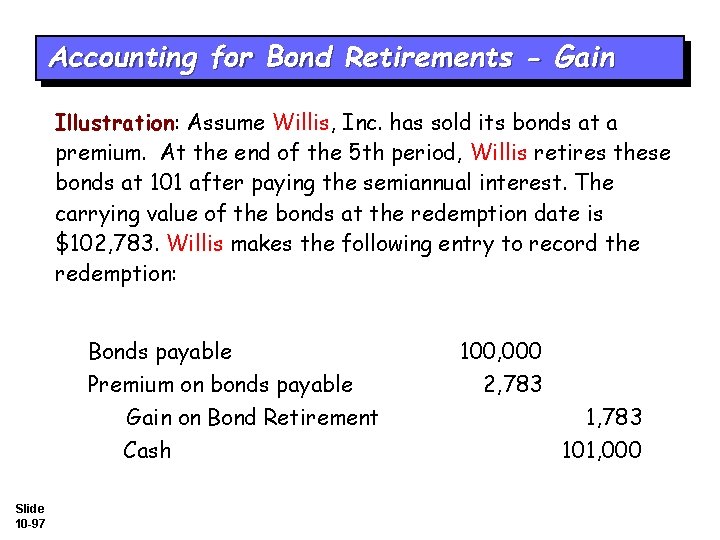
Accounting for Bond Retirements - Gain Illustration: Assume Willis, Inc. has sold its bonds at a premium. At the end of the 5 th period, Willis retires these bonds at 101 after paying the semiannual interest. The carrying value of the bonds at the redemption date is $102, 783. Willis makes the following entry to record the redemption: Bonds payable Premium on bonds payable Gain on Bond Retirement Cash Slide 10 -97 100, 000 2, 783 101, 000
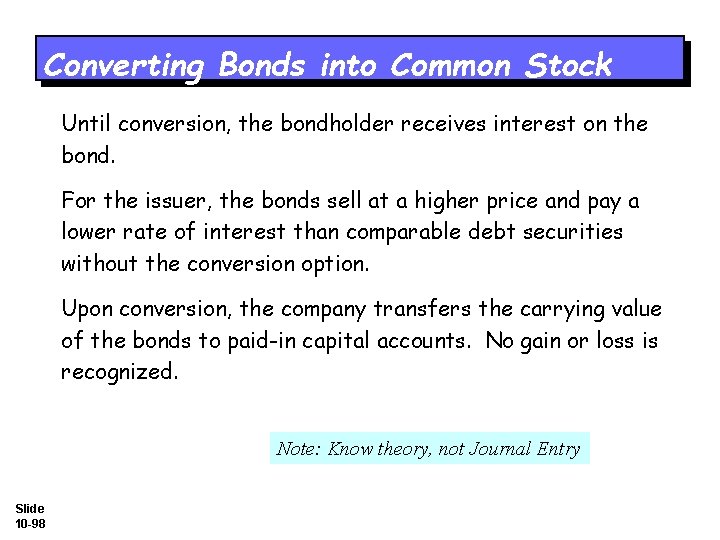
Converting Bonds into Common Stock Until conversion, the bondholder receives interest on the bond. For the issuer, the bonds sell at a higher price and pay a lower rate of interest than comparable debt securities without the conversion option. Upon conversion, the company transfers the carrying value of the bonds to paid-in capital accounts. No gain or loss is recognized. Note: Know theory, not Journal Entry Slide 10 -98
Accounting for Long-Term Notes Payable May be secured by a mortgage that pledges title to specific assets as security for a loan Typically, the terms require the borrower to make installment payments over the term of the loan. Each payment consists of 1. interest on the unpaid balance of the loan and 2. a reduction of loan principal. Companies initially record mortgage notes payable at face value. Note: Know theory, not Journal Entry Slide 10 -99
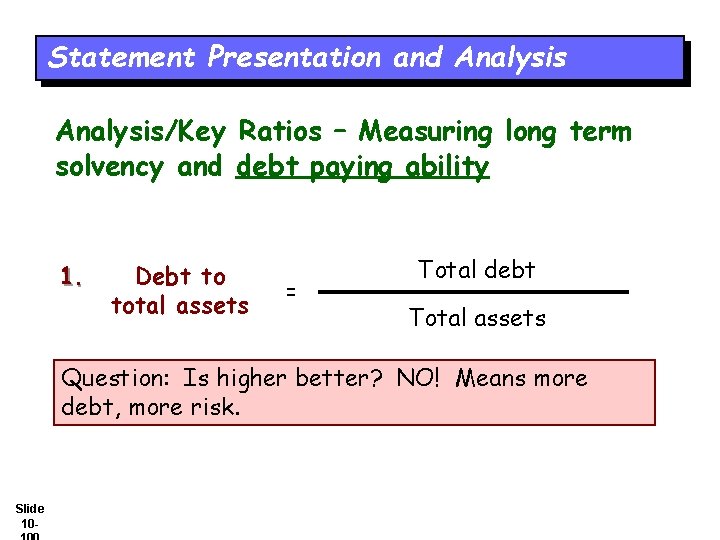
Statement Presentation and Analysis/Key Ratios – Measuring long term solvency and debt paying ability 1. Debt to total assets = Total debt Total assets Question: Is higher better? NO! Means more debt, more risk. Slide 10 -
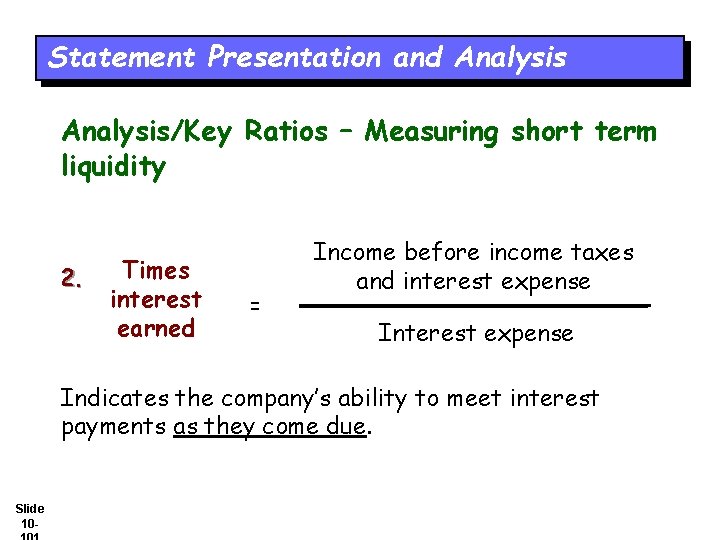
Statement Presentation and Analysis/Key Ratios – Measuring short term liquidity 2. Times interest earned = Income before income taxes and interest expense Indicates the company’s ability to meet interest payments as they come due. Slide 10 -
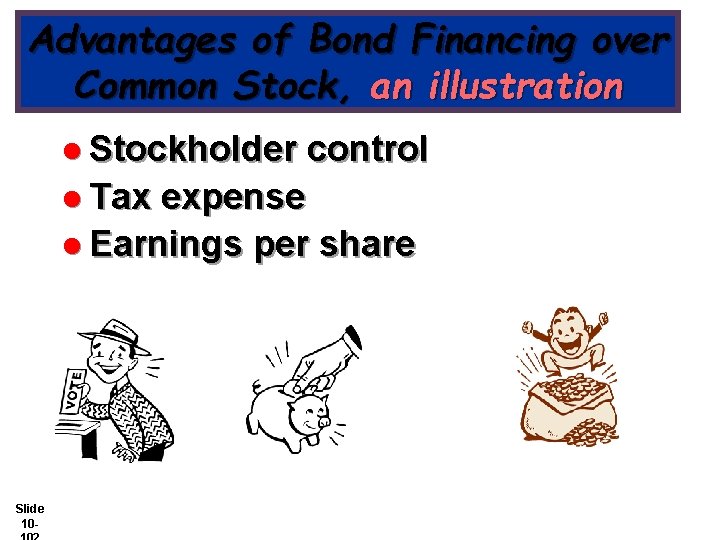
Advantages of Bond Financing over Common Stock, an illustration l Stockholder l Tax control expense l Earnings per share Slide 10 -
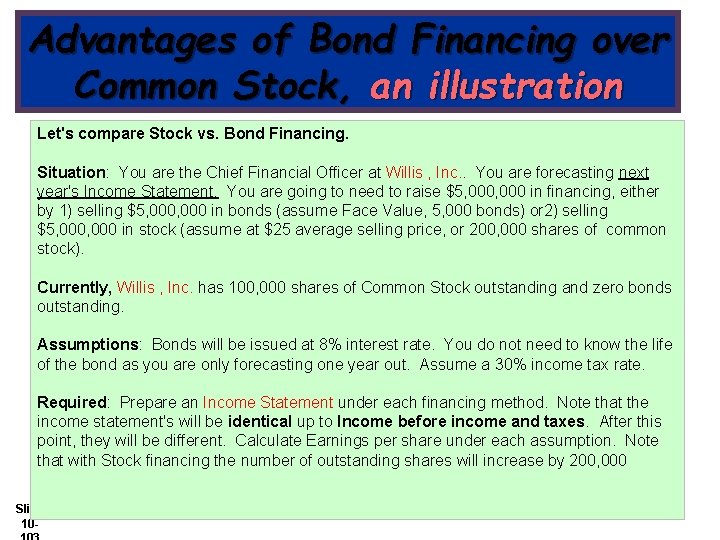
Advantages of Bond Financing over Common Stock, an illustration Let's compare Stock vs. Bond Financing. Situation: You are the Chief Financial Officer at Willis , Inc. . You are forecasting next year's Income Statement. You are going to need to raise $5, 000 in financing, either by 1) selling $5, 000 in bonds (assume Face Value, 5, 000 bonds) or 2) selling $5, 000 in stock (assume at $25 average selling price, or 200, 000 shares of common stock). Currently, Willis , Inc. has 100, 000 shares of Common Stock outstanding and zero bonds outstanding. Assumptions: Bonds will be issued at 8% interest rate. You do not need to know the life of the bond as you are only forecasting one year out. Assume a 30% income tax rate. Required: Prepare an Income Statement under each financing method. Note that the income statement's will be identical up to Income before income and taxes. After this point, they will be different. Calculate Earnings per share under each assumption. Note that with Stock financing the number of outstanding shares will increase by 200, 000 Slide 10 -
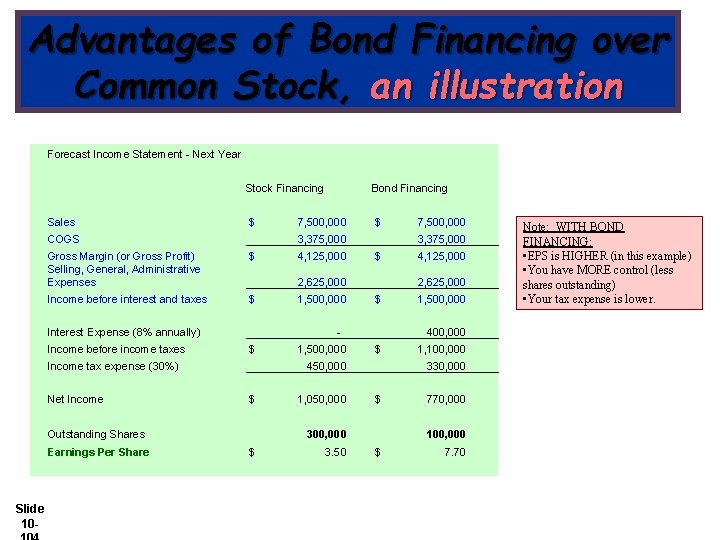
Advantages of Bond Financing over Common Stock, an illustration Forecast Income Statement - Next Year Sales Stock Financing Bond Financing $ $ COGS 3, 375, 000 Gross Margin (or Gross Profit) Selling, General, Administrative Expenses $ Income before interest and taxes $ $ Slide 10 - 1, 500, 000 $ 1, 050, 000 $ 3. 50 1, 500, 000 400, 000 $ 1, 100, 000 330, 000 $ 300, 000 $ 4, 125, 000 2, 625, 000 450, 000 Outstanding Shares Earnings Per Share $ - Income tax expense (30%) Net Income 4, 125, 000 7, 500, 000 3, 375, 000 2, 625, 000 Interest Expense (8% annually) Income before income taxes 7, 500, 000 770, 000 100, 000 $ 7. 70 Note: WITH BOND FINANCING: • EPS is HIGHER (in this example) • You have MORE control (less shares outstanding) • Your tax expense is lower.
End of Chapter 10 Good Bye and Good Luck! Solutions to Bond exercises next Slide 10 -
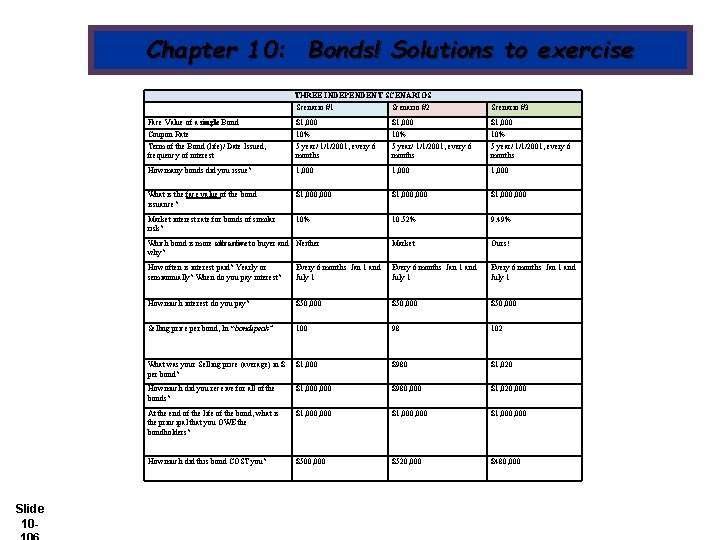
Chapter 10: Bonds! Solutions to exercise THREE INDEPENDENT SCENARIOS Slide 10 - Scenario #1 Scenario #2 Scenario #3 Face Value of a single Bond $1, 000 Coupon Rate 10% 10% Term of the Bond (life)/ Date Issued, frequency of interest 5 year/ 1/1/2001, every 6 months How many bonds did you issue? 1, 000 What is the face value of the bond issuance? $1, 000, 000 $1, 000 Market interest rate for bonds of similar risk? 10% 10. 52% 9. 49% Which bond is more attractive to buyer and Neither why? Market Ours! How often is interest paid? Yearly or semiannually? When do you pay interest? Every 6 months Jan 1 and July 1 How much interest do you pay? $50, 000 Selling price per bond, In “bondspeak” 100 98 102 What was your Selling price (average) in $ per bond? $1, 000 $980 $1, 020 How much did you receive for all of the bonds? $1, 000 $980, 000 $1, 020, 000 At the end of the life of the bond, what is the principal that you OWE the bondholders? $1, 000, 000 $1, 000 How much did this bond COST you? $500, 000 $520, 000 $480, 000
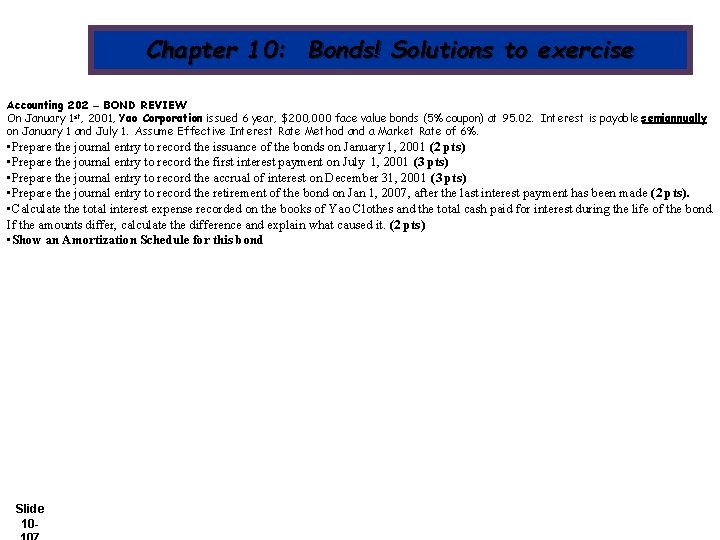
Chapter 10: Bonds! Solutions to exercise Accounting 202 – BOND REVIEW On January 1 st, 2001, Yao Corporation issued 6 year, $200, 000 face value bonds (5% coupon) at 95. 02. Interest is payable semiannually on January 1 and July 1. Assume Effective Interest Rate Method and a Market Rate of 6%. • Prepare the journal entry to record the issuance of the bonds on January 1, 2001 (2 pts) • Prepare the journal entry to record the first interest payment on July 1, 2001 (3 pts) • Prepare the journal entry to record the accrual of interest on December 31, 2001 (3 pts) • Prepare the journal entry to record the retirement of the bond on Jan 1, 2007, after the last interest payment has been made (2 pts). • Calculate the total interest expense recorded on the books of Yao Clothes and the total cash paid for interest during the life of the bond. If the amounts differ, calculate the difference and explain what caused it. (2 pts) • Show an Amortization Schedule for this bond Slide 10 -
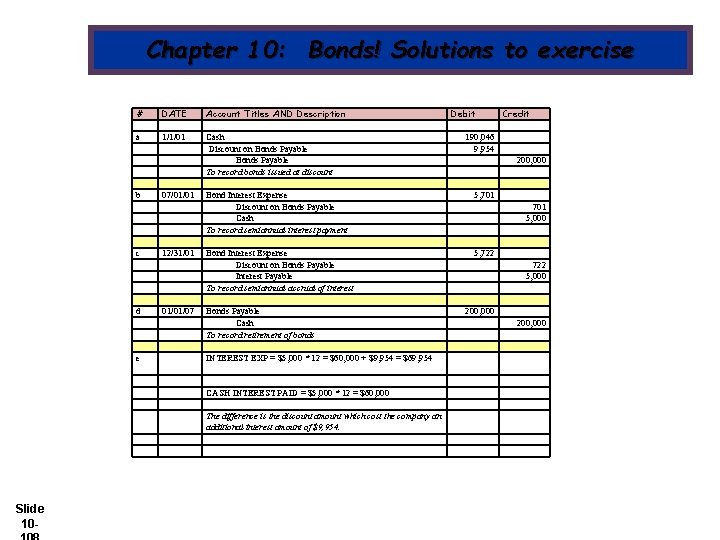
Chapter 10: Bonds! Solutions to exercise # DATE Account Titles AND Description a 1/1/01 Cash Discount on Bonds Payable To record bonds issued at discount b c d e 07/01/01 12/31/01 01/01/07 200, 000 5, 701 Bond Interest Expense Discount on Bonds Payable Interest Payable To record semiannual accrual of interest 5, 722 Bonds Payable Cash To record retirement of bonds INTEREST EXP = $5, 000 * 12 = $60, 000 + $9, 954 = $69, 954 The difference is the discount amount which cost the company an additional interest amount of $9, 954. Credit 190, 046 9, 954 Bond Interest Expense Discount on Bonds Payable Cash To record semiannual interest payment CASH INTEREST PAID = $5, 000 * 12 = $60, 000 Slide 10 - Debit 701 5, 000 722 5, 000 200, 000
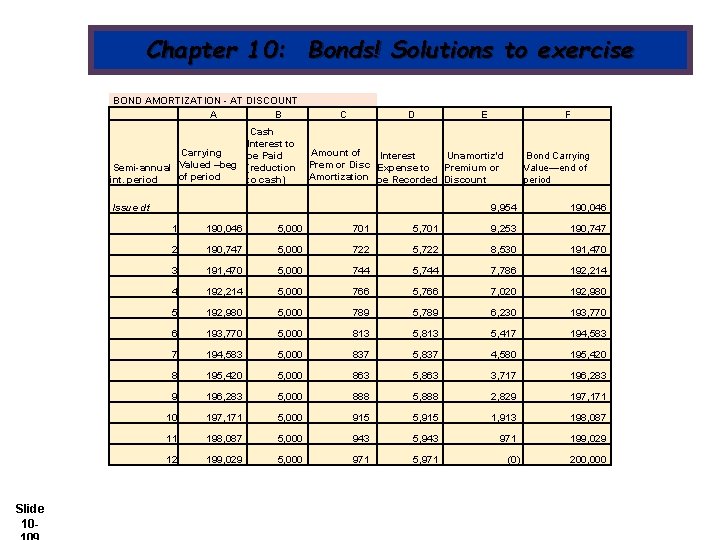
Chapter 10: Bonds! Solutions to exercise BOND AMORTIZATION - AT DISCOUNT A B Cash Interest to Carrying be Paid Valued –beg (reduction Semi-annual of period int. period to cash) C D F Amount of Interest Unamortiz'd Prem or Disc Expense to Premium or Amortization be Recorded Discount Issue dt Slide 10 - E Bond Carrying Value—end of period 9, 954 190, 046 1 190, 046 5, 000 701 5, 701 9, 253 190, 747 2 190, 747 5, 000 722 5, 722 8, 530 191, 470 3 191, 470 5, 000 744 5, 744 7, 786 192, 214 4 192, 214 5, 000 766 5, 766 7, 020 192, 980 5, 000 789 5, 789 6, 230 193, 770 6 193, 770 5, 000 813 5, 417 194, 583 5, 000 837 5, 837 4, 580 195, 420 8 195, 420 5, 000 863 5, 863 3, 717 196, 283 9 196, 283 5, 000 888 5, 888 2, 829 197, 171 10 197, 171 5, 000 915 5, 915 1, 913 198, 087 11 198, 087 5, 000 943 5, 943 971 199, 029 12 199, 029 5, 000 971 5, 971 (0) 200, 000
- Slides: 109