
Chapter 10 Lesson 2 Infectious Diseases Bellringer List
Chapter 10 Lesson 2 Infectious Diseases Bellringer List three common infectious diseases, and list the type of pathogen that causes each disease. Chapter menu Resources Copyright © by Holt, Rinehart and Winston. All rights reserved.
Chapter 10 Lesson 2 Infectious Diseases Objectives • Identify four causes of infectious diseases. • Explain how the spread of common infectious diseases can be prevented. Chapter menu Resources Copyright © by Holt, Rinehart and Winston. All rights reserved.
Chapter 10 Lesson 2 Infectious Diseases Start Off Write How can you keep from catching a cold? Chapter menu Resources Copyright © by Holt, Rinehart and Winston. All rights reserved.
Chapter 10 Lesson 2 Infectious Diseases Viruses • A virus is a tiny, disease-causing particle that invades a healthy cell and instructs that cell to make more viruses. • Viruses are known to cause many diseases including: 1. the flu 2. the common cold 3. AIDS 4. herpes Chapter menu Resources Copyright © by Holt, Rinehart and Winston. All rights reserved.
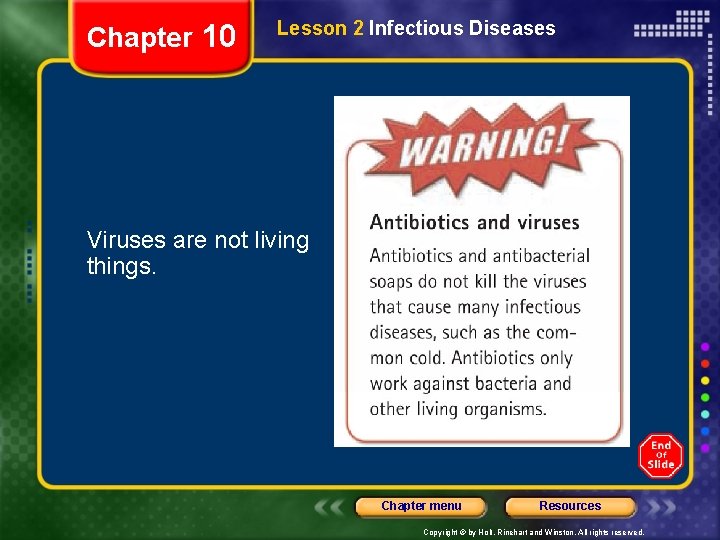
Chapter 10 Lesson 2 Infectious Diseases Viruses are not living things. Chapter menu Resources Copyright © by Holt, Rinehart and Winston. All rights reserved.
Chapter 10 Lesson 2 Infectious Diseases Bacteria • Bacteria are very simple single-celled microorganisms that do not have a nucleus. Bacteria are found everywhere. • Bacteria cause many kinds of diseases including: 1. whooping cough 2. cholera 3. anthrax 4. dental cavities Chapter menu Resources Copyright © by Holt, Rinehart and Winston. All rights reserved.
Chapter 10 Lesson 2 Infectious Diseases Protozoa and Parasites • Protozoa are small, single-celled organisms that have a nucleus. • Protozoa and other parasites cause many kinds of diseases including: 1. malaria 2. diarrhea 3. tapeworm infections Chapter menu Resources Copyright © by Holt, Rinehart and Winston. All rights reserved.
Chapter 10 Lesson 2 Infectious Diseases Fungi • Fungi are complex organisms that cannot make their own food. • Fungi cause many kinds of diseases including: 1. athlete’s foot 2. jock itch 3. yeast infections Chapter menu Resources Copyright © by Holt, Rinehart and Winston. All rights reserved.
Chapter 10 Lesson 3 Controlling Infectious Diseases Bellringer Why do you think some communities offer free or lowcost flu shots to their residents every year? Chapter menu Resources Copyright © by Holt, Rinehart and Winston. All rights reserved.
Chapter 10 Lesson 3 Controlling Infectious Diseases Objectives • Discuss two ways to protect yourself from infectious diseases. • Identify two ways to control the spread of infectious diseases. Chapter menu Resources Copyright © by Holt, Rinehart and Winston. All rights reserved.
Chapter 10 Lesson 3 Controlling Infectious Diseases Start Off Write Why should you know basic ways to stop the spread of infectious disease? Chapter menu Resources Copyright © by Holt, Rinehart and Winston. All rights reserved.
Chapter 10 Lesson 3 Controlling Infectious Diseases Protecting Yourself • Do the following things to protect yourself against infection: 1. Stay away from people who are sick. 2. Practice good hygiene. 3. Maintain a healthy diet. 4. Get plenty of rest and exercise. 5. Get vaccinated. Chapter menu Resources Copyright © by Holt, Rinehart and Winston. All rights reserved.
Chapter 10 Lesson 3 Controlling Infectious Diseases Protecting Yourself • The following diseases are commonly prevented by vaccines: 1. hepatitis B 2. diphtheria 3. poliomyelitis 4. measles, mumps, and rubella 5. flu Chapter menu Resources Copyright © by Holt, Rinehart and Winston. All rights reserved.
Chapter 10 Lesson 3 Controlling Infectious Diseases Protecting Others • The same steps you take to protect yourself from pathogens will also help protect other people. You can also: 1. Avoid contact with people when you are sick. 2. Get a flu vaccine every year. 3. Report any sightings of infected animals. Chapter menu Resources Copyright © by Holt, Rinehart and Winston. All rights reserved.
Quote of the Day “Keep you blood clean, your body lean, and your mind sharp. ” —Henry Rollins Chapter menu Resources Copyright © by Holt, Rinehart and Winston. All rights reserved.
- Slides: 15