
Chapter 10 Leading Teams 1 Team A unit

- Slides: 18
Chapter 10 Leading Teams 1
Team A unit of two or more people who interact and coordinate their work to accomplish a shared goal or purpose 2
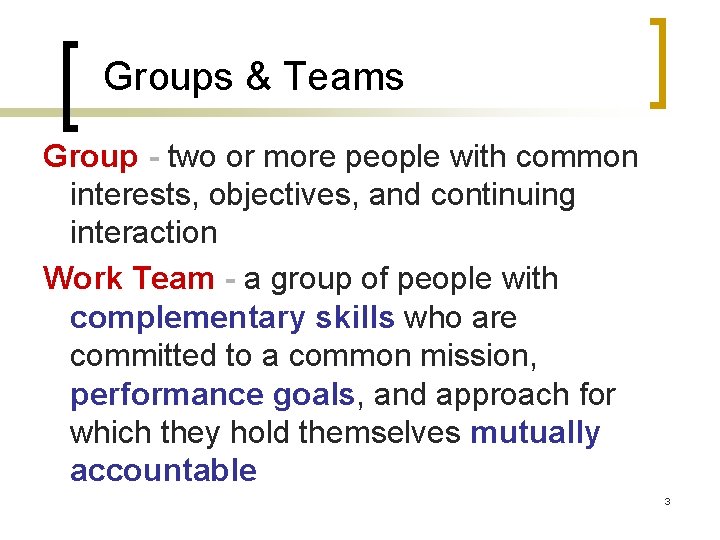
Groups & Teams Group - two or more people with common interests, objectives, and continuing interaction Work Team - a group of people with complementary skills who are committed to a common mission, performance goals, and approach for which they hold themselves mutually accountable 3
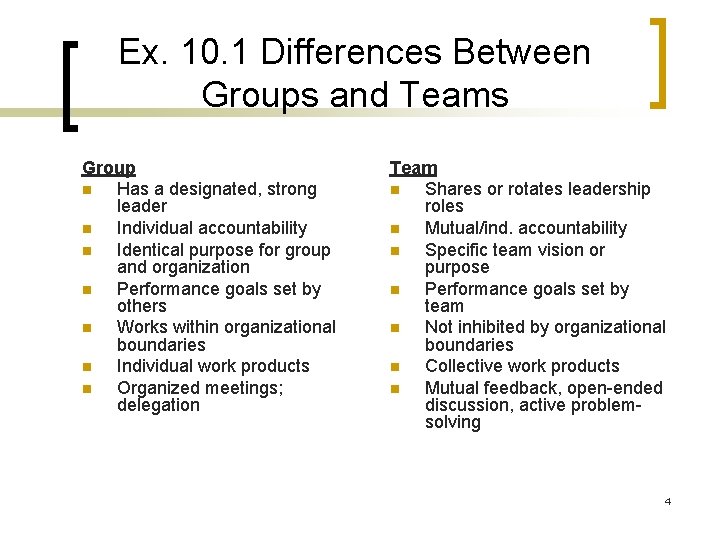
Ex. 10. 1 Differences Between Groups and Teams Group n Has a designated, strong leader n Individual accountability n Identical purpose for group and organization n Performance goals set by others n Works within organizational boundaries n Individual work products n Organized meetings; delegation Team n Shares or rotates leadership roles n Mutual/ind. accountability n Specific team vision or purpose n Performance goals set by team n Not inhibited by organizational boundaries n Collective work products n Mutual feedback, open-ended discussion, active problemsolving 4
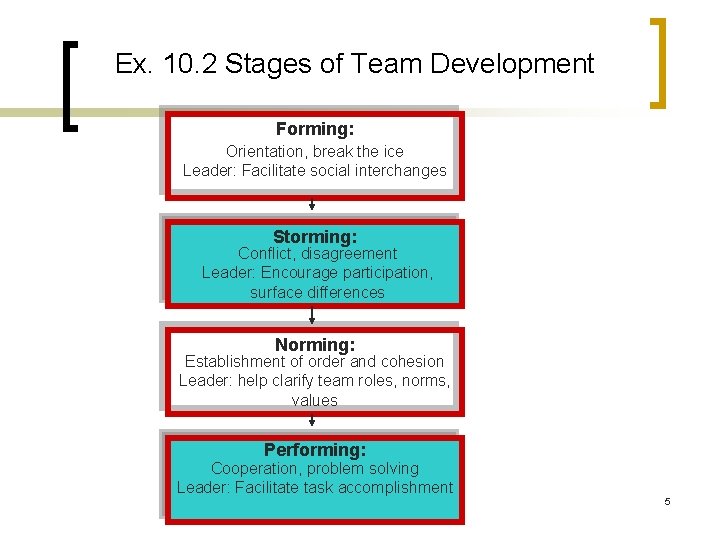
Ex. 10. 2 Stages of Team Development Forming: Orientation, break the ice Leader: Facilitate social interchanges Storming: Conflict, disagreement Leader: Encourage participation, surface differences Norming: Establishment of order and cohesion Leader: help clarify team roles, norms, values Performing: Cooperation, problem solving Leader: Facilitate task accomplishment 5
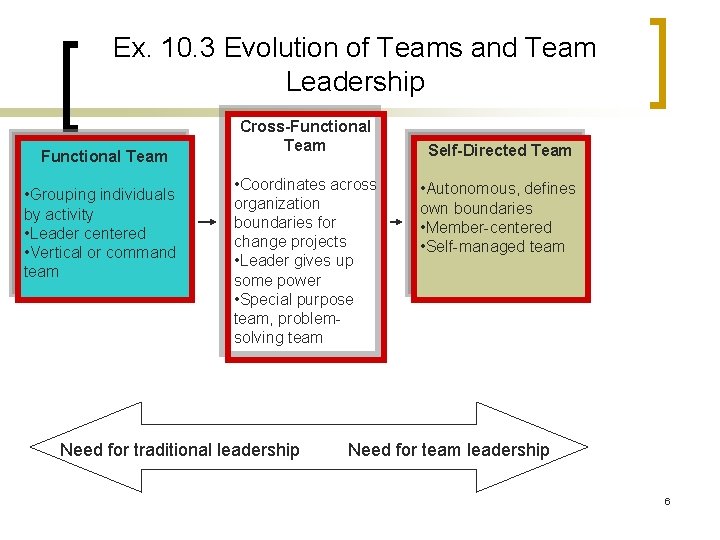
Ex. 10. 3 Evolution of Teams and Team Leadership Functional Team • Grouping individuals by activity • Leader centered • Vertical or command team Cross-Functional Team • Coordinates across organization boundaries for change projects • Leader gives up some power • Special purpose team, problemsolving team Need for traditional leadership Self-Directed Team • Autonomous, defines own boundaries • Member-centered • Self-managed team Need for team leadership 6
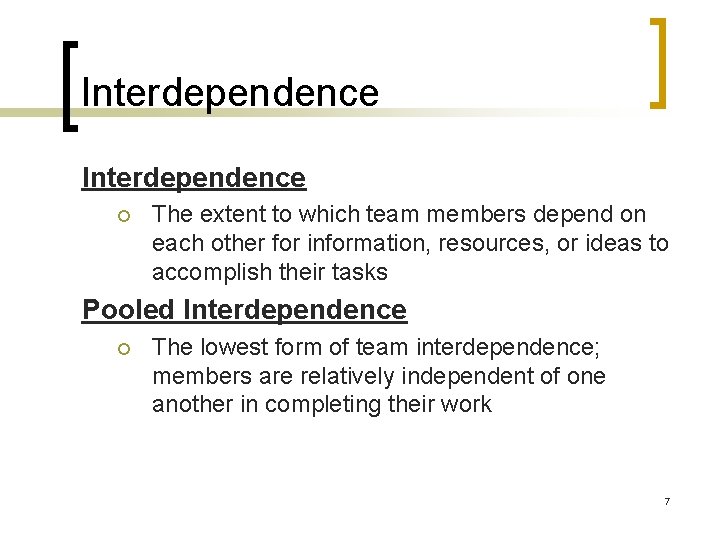
Interdependence ¡ The extent to which team members depend on each other for information, resources, or ideas to accomplish their tasks Pooled Interdependence ¡ The lowest form of team interdependence; members are relatively independent of one another in completing their work 7
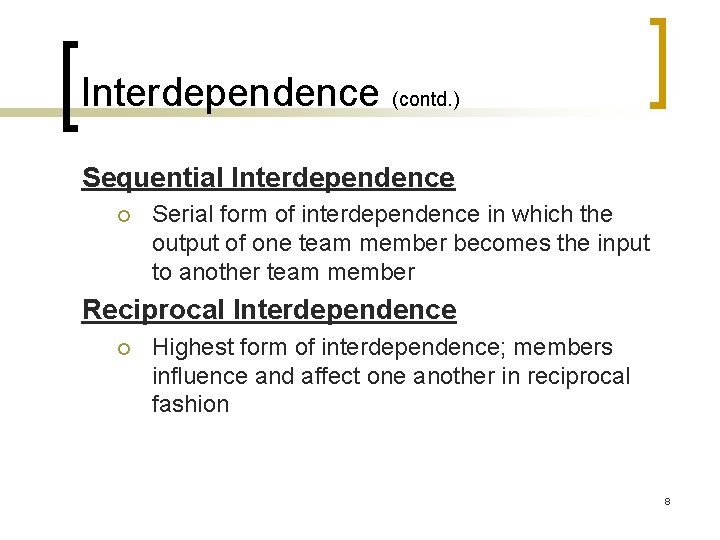
Interdependence (contd. ) Sequential Interdependence ¡ Serial form of interdependence in which the output of one team member becomes the input to another team member Reciprocal Interdependence ¡ Highest form of interdependence; members influence and affect one another in reciprocal fashion 8
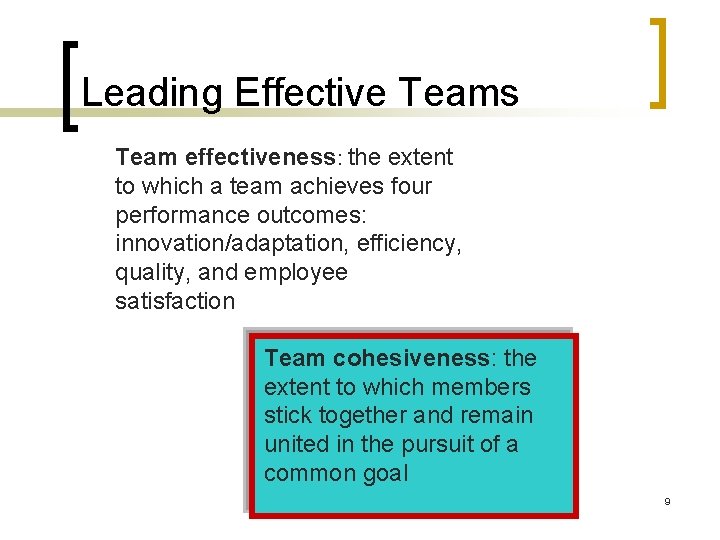
Leading Effective Teams Team effectiveness: the extent to which a team achieves four performance outcomes: innovation/adaptation, efficiency, quality, and employee satisfaction Team cohesiveness: the extent to which members stick together and remain united in the pursuit of a common goal 9
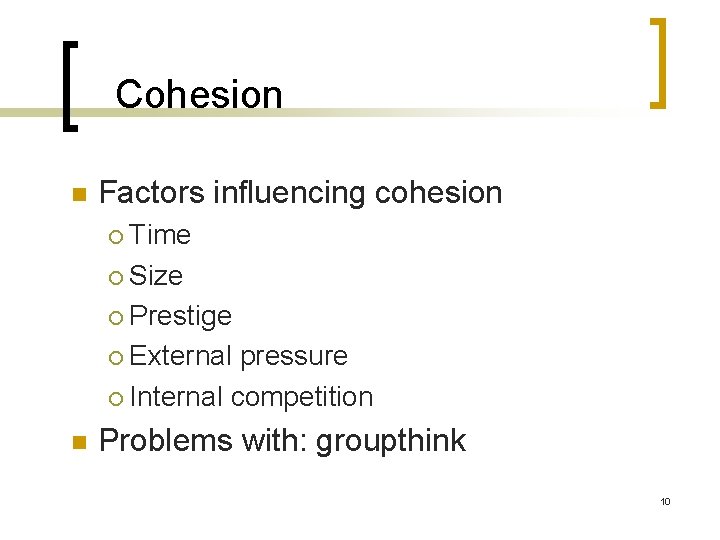
Cohesion n Factors influencing cohesion Time ¡ Size ¡ Prestige ¡ External pressure ¡ Internal competition ¡ n Problems with: groupthink 10
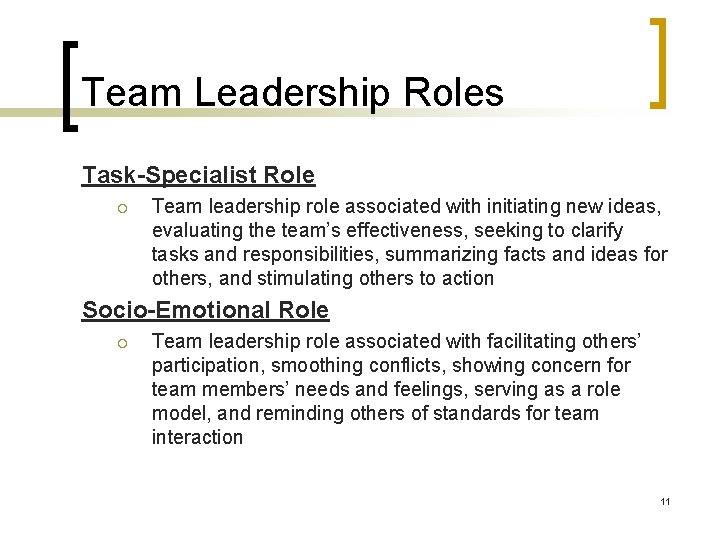
Team Leadership Roles Task-Specialist Role ¡ Team leadership role associated with initiating new ideas, evaluating the team’s effectiveness, seeking to clarify tasks and responsibilities, summarizing facts and ideas for others, and stimulating others to action Socio-Emotional Role ¡ Team leadership role associated with facilitating others’ participation, smoothing conflicts, showing concern for team members’ needs and feelings, serving as a role model, and reminding others of standards for team interaction 11
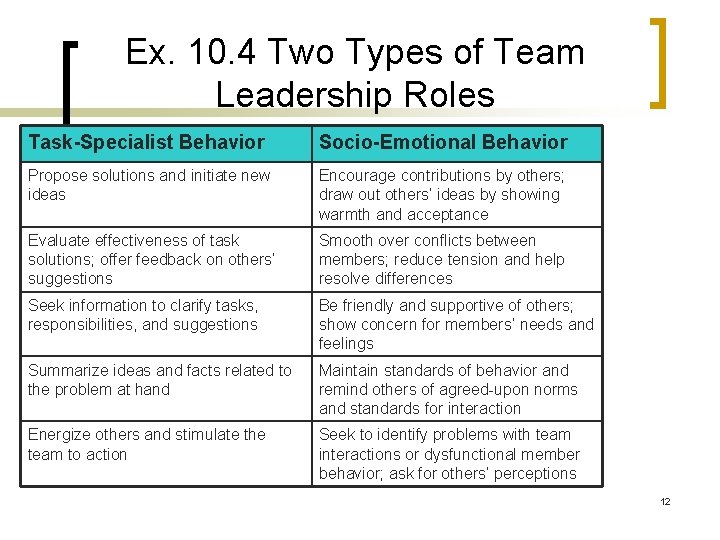
Ex. 10. 4 Two Types of Team Leadership Roles Task-Specialist Behavior Socio-Emotional Behavior Propose solutions and initiate new ideas Encourage contributions by others; draw out others’ ideas by showing warmth and acceptance Evaluate effectiveness of task solutions; offer feedback on others’ suggestions Smooth over conflicts between members; reduce tension and help resolve differences Seek information to clarify tasks, responsibilities, and suggestions Be friendly and supportive of others; show concern for members’ needs and feelings Summarize ideas and facts related to the problem at hand Maintain standards of behavior and remind others of agreed-upon norms and standards for interaction Energize others and stimulate the team to action Seek to identify problems with team interactions or dysfunctional member behavior; ask for others’ perceptions 12
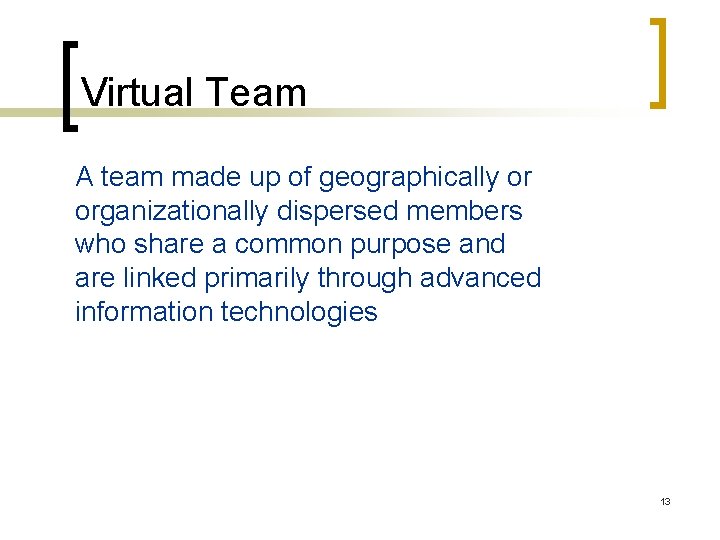
Virtual Team A team made up of geographically or organizationally dispersed members who share a common purpose and are linked primarily through advanced information technologies 13
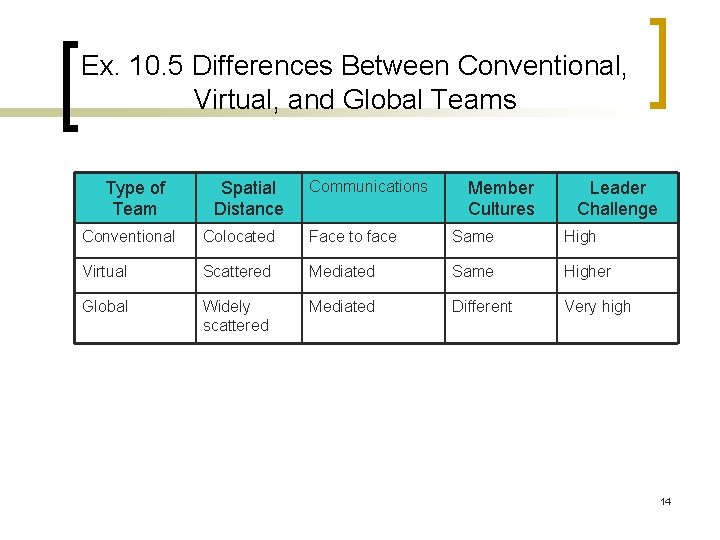
Ex. 10. 5 Differences Between Conventional, Virtual, and Global Teams Type of Team Spatial Distance Communications Member Cultures Leader Challenge Conventional Colocated Face to face Same High Virtual Scattered Mediated Same Higher Global Widely scattered Mediated Different Very high 14
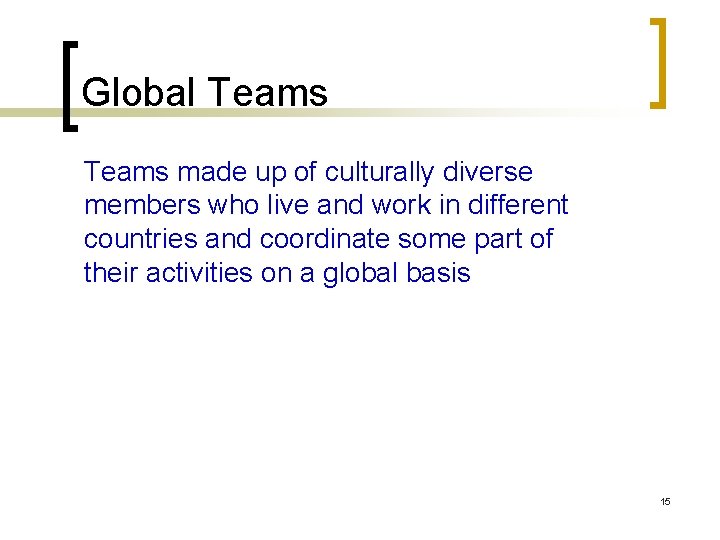
Global Teams made up of culturally diverse members who live and work in different countries and coordinate some part of their activities on a global basis 15
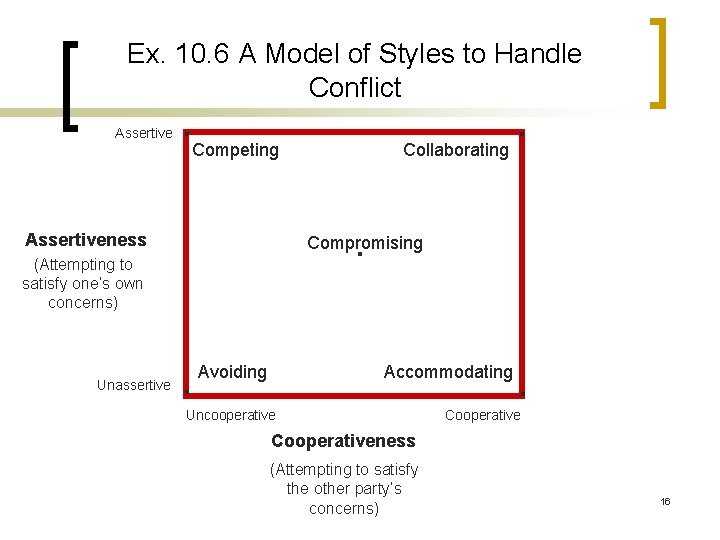
Ex. 10. 6 A Model of Styles to Handle Conflict Assertive . Competing . Assertiveness Compromising (Attempting to satisfy one’s own concerns) Unassertive . Collaborating . Avoiding Accommodating Uncooperative . Cooperativeness (Attempting to satisfy the other party’s concerns) 16
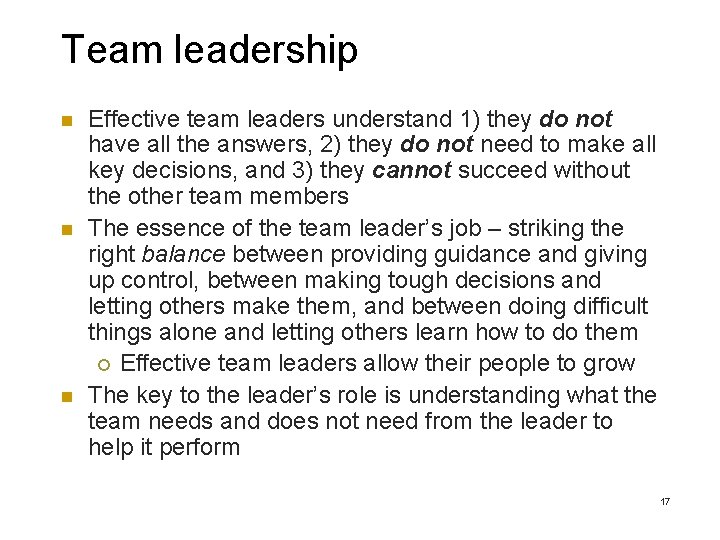
Team leadership n n n Effective team leaders understand 1) they do not have all the answers, 2) they do not need to make all key decisions, and 3) they cannot succeed without the other team members The essence of the team leader’s job – striking the right balance between providing guidance and giving up control, between making tough decisions and letting others make them, and between doing difficult things alone and letting others learn how to do them ¡ Effective team leaders allow their people to grow The key to the leader’s role is understanding what the team needs and does not need from the leader to help it perform 17
Extra: Six things necessary for good team leadership n n n Maintain perspective. Keep the purpose (why we are doing what we are doing), goals, and approach relevant and meaningful ¡ The team leader must do this for him/herself as well as for the team. If the leader looses perspective, the team members have a responsibility to keep the team on course and to reestablish leadership perspective Build commitment and confidence with positive and constructive reinforcement Strengthen the mix and level of skills of team members Manage relationships with outsiders, including removing obstacles Create opportunities for others Do real work. ¡ Demonstrates credibility and provides a role model 18