
CHAPTER 10 Leadership Leading for Performance Political context
- Slides: 24
CHAPTER 10 Leadership
Leading for Performance Political context, governance arrangements, strategic thinking, culture all impact performance. But, in practice, these are parts of the context in which the public sector manager has to operate. Performance management begins with leadership.
The Functions of Leadership in Organization The specification seems simple, but the reality of leadership is complex. Intrapersonal factors (i. e. , thoughts and emotions) interact with; Interpersonal processes (i. e. , attraction, communication, influence) to have effects on; A dynamic external environment.
The Organizational Functions of Leadership In an orderly, structured, and well-understood environment, the primary responsibilities are guidance and motivation. Assign people to tasks or responsibilities, to outline what is expected, and to facilitate and encourage goal attainment.
The Organizational Functions of Leadership In a less orderly environment calling for external adaptability, the crucial functions are problem solving and innovation. The leader must create the kind of atmosphere that encourages sensitivity, flexibility, and creativity. The leader must be a change agent.
Leading for Performance Leadership and management. Management involves power (usually formal authority) bestowed on the occupant of a position by a higher organizational authority. Responsibility and accountability. Leadership cannot be bestowed, it can only be demonstrated.
Leading for Performance…cont. Leadership and management. Legitimacy arises from position in an organization and most frequently describes managers. Charisma arises from personality and most frequently describes leaders. The three essential functions of leaders (Chester Barnard). To provide a system of communication; To promote the securing of essential efforts; and To formulate and define the purposes and goals of an organization (Vision).
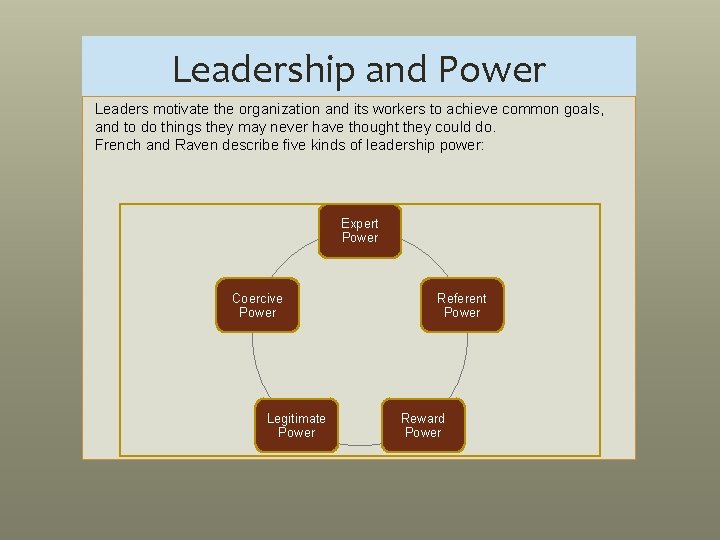
Leading for Performance Defining leadership. Leadership is the exercise of authority, whether formal or informal, in directing and coordinating the work of others. The best leaders use both formal and informal authority. Five major bases of power: Expert power – knowledge. Referent power – identification. Reward power – exchange. Legitimate power – authority. Coercive power – punishment.
Leadership and Power Leaders motivate the organization and its workers to achieve common goals, and to do things they may never have thought they could do. French and Raven describe five kinds of leadership power: Expert Power Coercive Power Legitimate Power Referent Power Reward Power
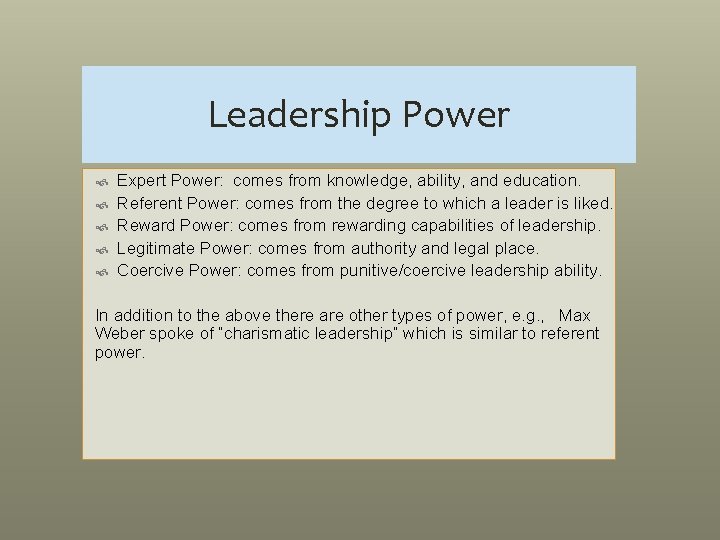
Leadership Power Expert Power: comes from knowledge, ability, and education. Referent Power: comes from the degree to which a leader is liked. Reward Power: comes from rewarding capabilities of leadership. Legitimate Power: comes from authority and legal place. Coercive Power: comes from punitive/coercive leadership ability. In addition to the above there are other types of power, e. g. , Max Weber spoke of “charismatic leadership” which is similar to referent power.
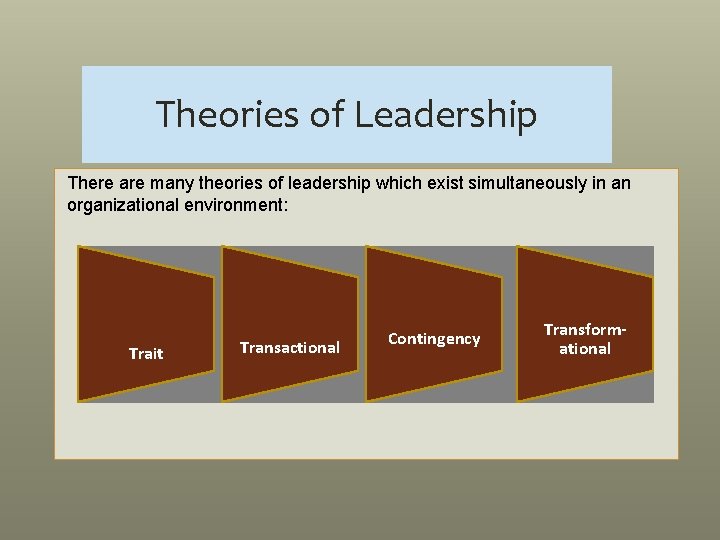
Theories of Leadership There are many theories of leadership which exist simultaneously in an organizational environment: Trait Transactional Contingency Transformational
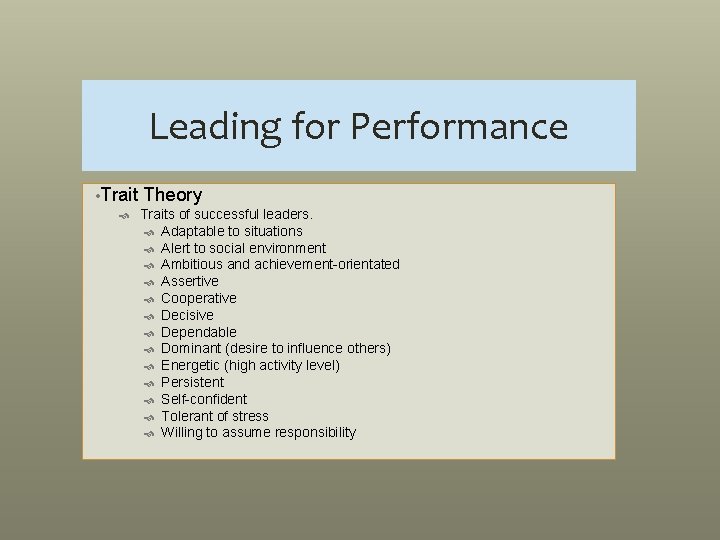
Trait Theory The trait perspective suggests that leaders have unique characteristics that are distinct from followers, and that leaders are born, not made. The trait theories of leadership, however, have fallen into disfavor because theorists could not identify what characteristics, or traits, make an effective leader.
Leading for Performance • Trait Theory Traits of successful leaders. Adaptable to situations Alert to social environment Ambitious and achievement-orientated Assertive Cooperative Decisive Dependable Dominant (desire to influence others) Energetic (high activity level) Persistent Self-confident Tolerant of stress Willing to assume responsibility
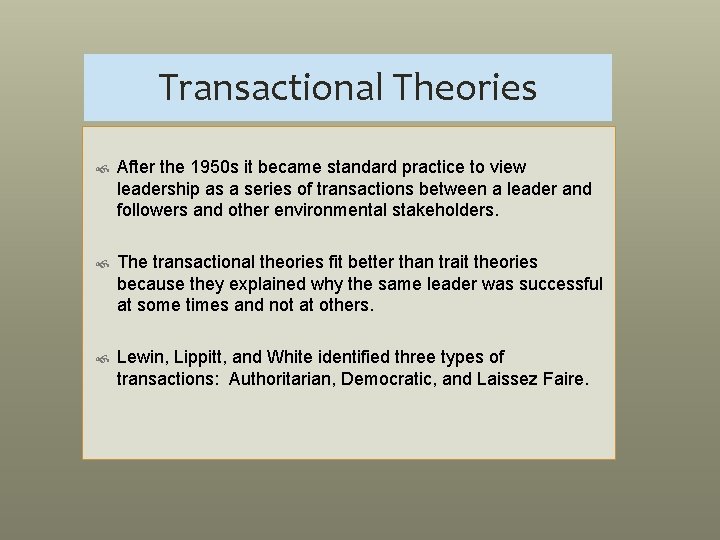
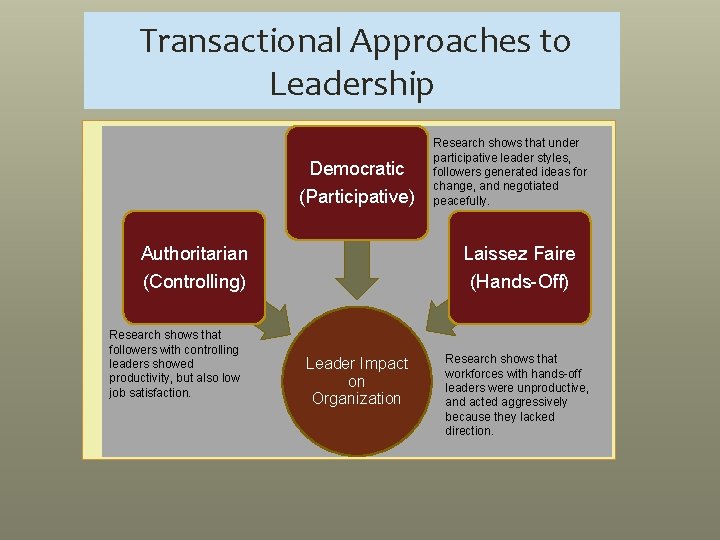
Transactional Theories After the 1950 s it became standard practice to view leadership as a series of transactions between a leader and followers and other environmental stakeholders. The transactional theories fit better than trait theories because they explained why the same leader was successful at some times and not at others. Lewin, Lippitt, and White identified three types of transactions: Authoritarian, Democratic, and Laissez Faire.
Transactional Approaches to Leadership Democratic (Participative) Research shows that under participative leader styles, followers generated ideas for change, and negotiated peacefully. Authoritarian Laissez Faire (Controlling) (Hands-Off) Research shows that followers with controlling leaders showed productivity, but also low job satisfaction. Leader Impact on Organization Research shows that workforces with hands-off leaders were unproductive, and acted aggressively because they lacked direction.
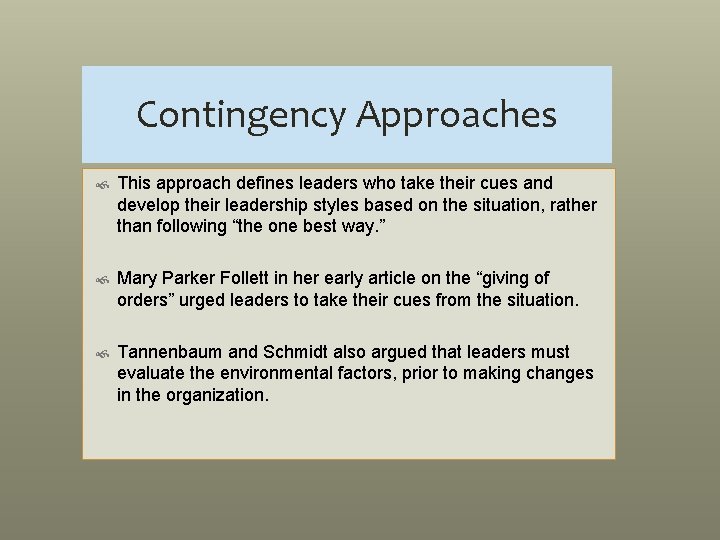
Contingency Approaches This approach defines leaders who take their cues and develop their leadership styles based on the situation, rather than following “the one best way. ” Mary Parker Follett in her early article on the “giving of orders” urged leaders to take their cues from the situation. Tannenbaum and Schmidt also argued that leaders must evaluate the environmental factors, prior to making changes in the organization.
What is “Too Much Leadership? ” Too much leadership can be an organizational pathology. There are two kinds—micromanagement and over-management. Micromanagement The term “micromanagement” has emerged to indicate situations where leaders supervise too closely and do not delegate. When this occurs, the professional and personal growth of subordinates is stifled.
What is “Too Much Leadership? ”…cont. Too much leadership can be an organizational pathology. There are two kinds—micromanagement and over management. Micromanagement can lead employees to extreme stress and even violence. It does not make an incompetent employee more competent, it only damages interpersonal relationships and distracts managers from overall long-term strategy for the unit and for the organization. Legislators at all levels of government tend to be micromanagers. They look too closely into rules and process often for partisan and special interest concerns.
Overmanagement Over management A variation of micromanagement is overmanagement—a situation where there are too many managers for the task. As computer-based systems have come into use, cutting across layers of management, those managers who are fearful of losing their jobs tend to create fiefdoms, and insert themselves into as many management situations as they can. This kind of turf-building, and its accompanying waste is “overmanagement. ”
Moral Leadership Moral leadership is when leaders are not only satisfied with good outcomes, but also are focused upon an operation’s ethics and values as a way to accomplish productivity. The voluntary acceptance of the workforce of moral values, visions, and beliefs, comes about through the respect and trust generated via charismatic and referent power of the leader.
Moral Leadership The Bully Pulpit. Great presidents have traditionally used their bully pulpit as “leaders of thought at times when certain historic ideas in the life of the nation had to be clarified. ” – FDR. Rhetorical leadership. Today’s presidents use speech-making to exhort the public to support policies to move public opinion.
Moral Leadership The Execucrats. Career executives/ bureaucrats who are neither elected nor appointed to office. Essential element in the policy process. Technical expertise is greater. Managers who must implement. Because of inherent disinterestedness, nonpartisanship, and technical authority, they often have moral authority than elected or appointed officials.
Moral Leadership The Execucrats. A function of their political and leadership skills interacting with a specific situation that their technical expertise and personality can influence.
Stogdill’s Assessment of Contingency Theory (1974) A successful leader in one type of organization may not be successful in another simply because it differs from the previous one—it will depend on the following: 1. The type, structure, size, and purpose of the organization. 2. The external environment in which the organization functions. 3. The orientation, values, goals, and expectations of the leader, his or her superiors, and subordinates. 4. The expert or professional knowledge required of the position.