
Chapter 10 Laser Oscillation Gain and Threshold Detailed
- Slides: 23
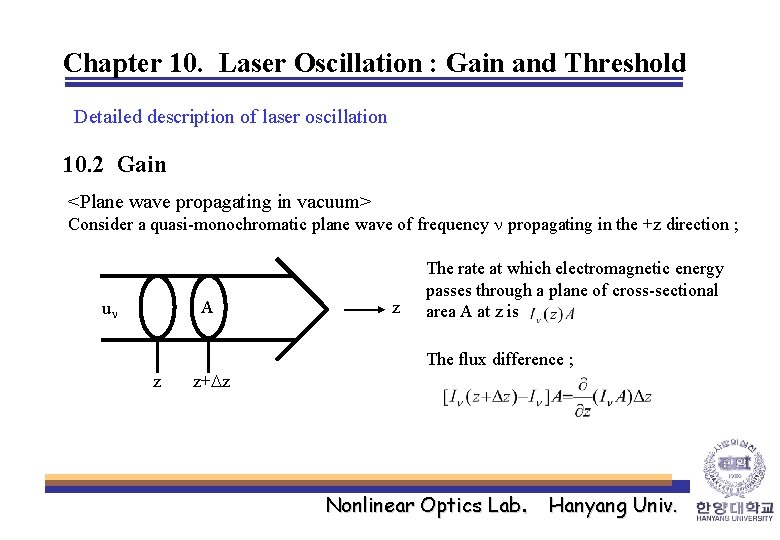
Chapter 10. Laser Oscillation : Gain and Threshold Detailed description of laser oscillation 10. 2 Gain <Plane wave propagating in vacuum> Consider a quasi-monochromatic plane wave of frequency n propagating in the +z direction ; A un z The rate at which electromagnetic energy passes through a plane of cross-sectional area A at z is The flux difference ; z z+Dz Nonlinear Optics Lab. Hanyang Univ.
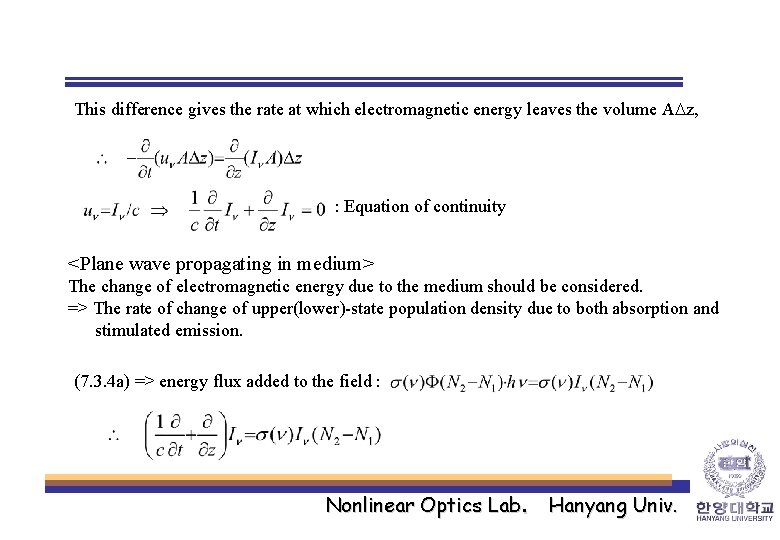
This difference gives the rate at which electromagnetic energy leaves the volume ADz, : Equation of continuity <Plane wave propagating in medium> The change of electromagnetic energy due to the medium should be considered. => The rate of change of upper(lower)-state population density due to both absorption and stimulated emission. (7. 3. 4 a) => energy flux added to the field : Nonlinear Optics Lab. Hanyang Univ.
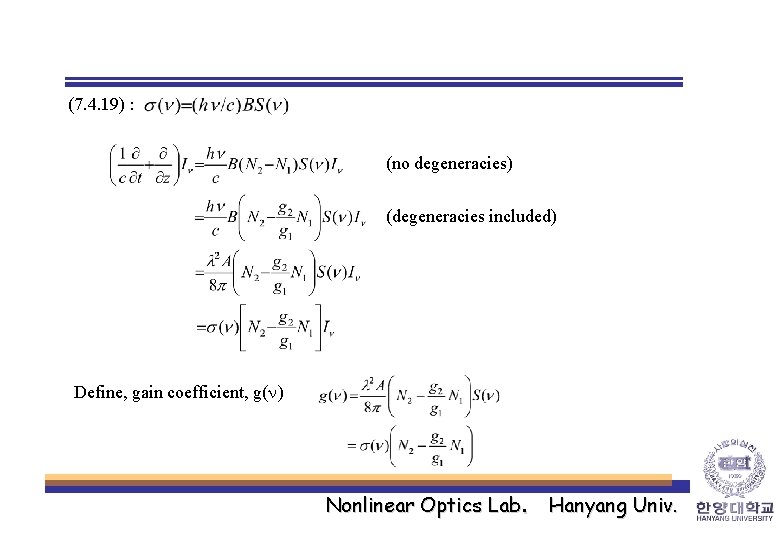
(7. 4. 19) : (no degeneracies) (degeneracies included) Define, gain coefficient, g(n) Nonlinear Optics Lab. Hanyang Univ.
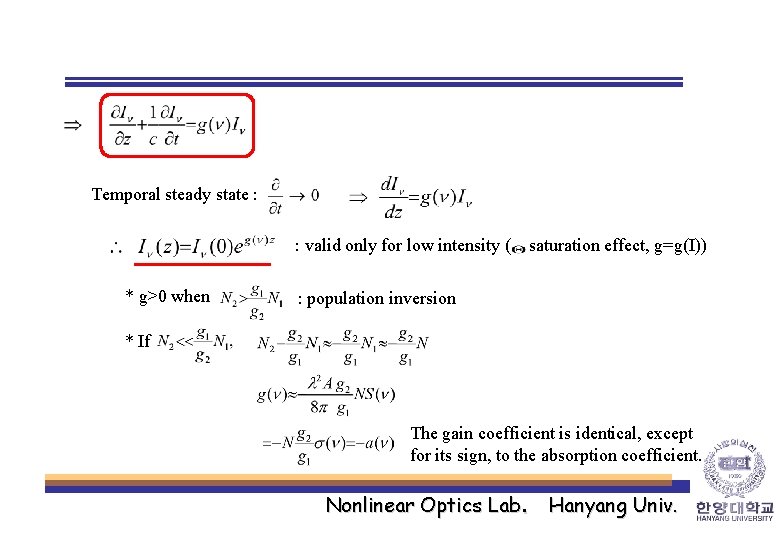
Temporal steady state : : valid only for low intensity ( * g>0 when saturation effect, g=g(I)) : population inversion * If The gain coefficient is identical, except for its sign, to the absorption coefficient. Nonlinear Optics Lab. Hanyang Univ.
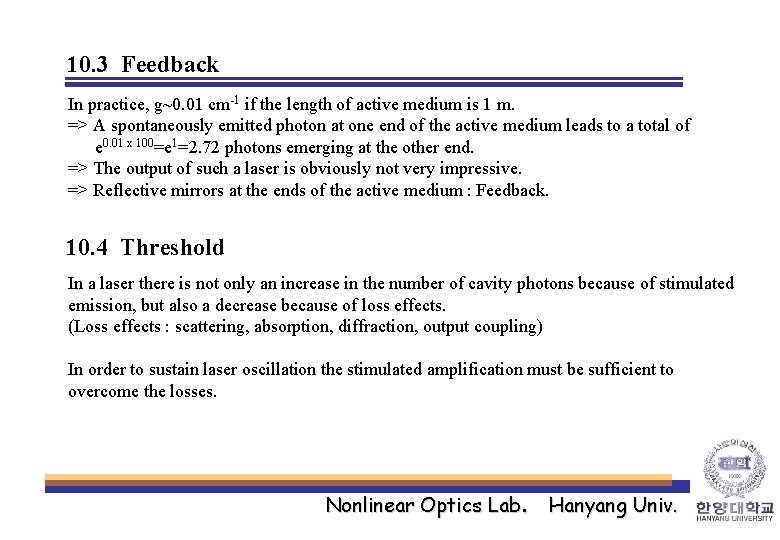
10. 3 Feedback In practice, g~0. 01 cm-1 if the length of active medium is 1 m. => A spontaneously emitted photon at one end of the active medium leads to a total of e 0. 01 x 100=e 1=2. 72 photons emerging at the other end. => The output of such a laser is obviously not very impressive. => Reflective mirrors at the ends of the active medium : Feedback. 10. 4 Threshold In a laser there is not only an increase in the number of cavity photons because of stimulated emission, but also a decrease because of loss effects. (Loss effects : scattering, absorption, diffraction, output coupling) In order to sustain laser oscillation the stimulated amplification must be sufficient to overcome the losses. Nonlinear Optics Lab. Hanyang Univ.
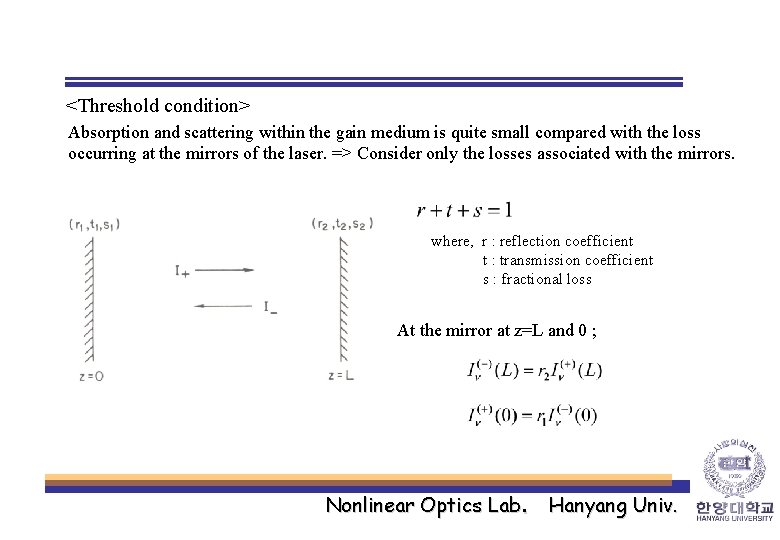
<Threshold condition> Absorption and scattering within the gain medium is quite small compared with the loss occurring at the mirrors of the laser. => Consider only the losses associated with the mirrors. where, r : reflection coefficient t : transmission coefficient s : fractional loss At the mirror at z=L and 0 ; Nonlinear Optics Lab. Hanyang Univ.
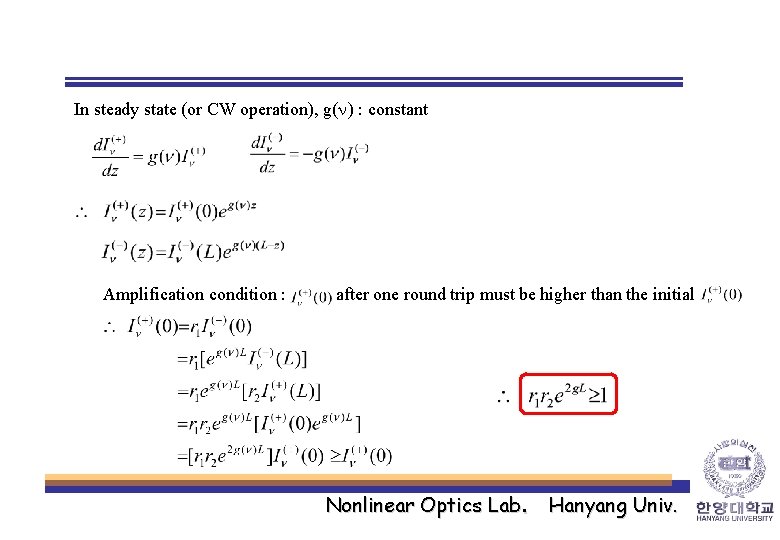
In steady state (or CW operation), g(n) : constant Amplification condition : after one round trip must be higher than the initial Nonlinear Optics Lab. Hanyang Univ.
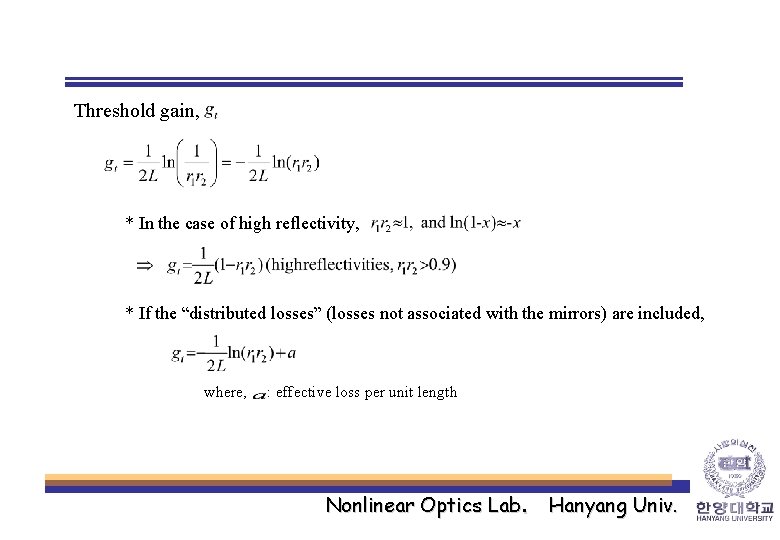
Threshold gain, * In the case of high reflectivity, * If the “distributed losses” (losses not associated with the mirrors) are included, where, : effective loss per unit length Nonlinear Optics Lab. Hanyang Univ.
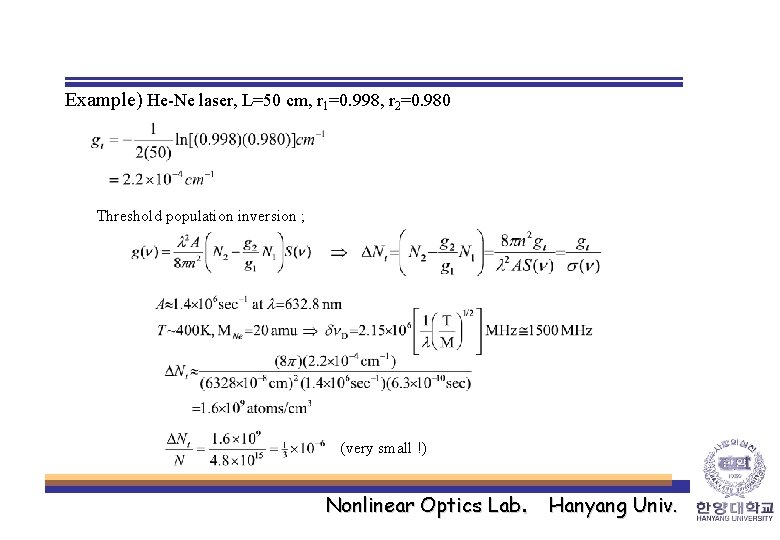
Example) He-Ne laser, L=50 cm, r 1=0. 998, r 2=0. 980 Threshold population inversion ; (very small !) Nonlinear Optics Lab. Hanyang Univ.
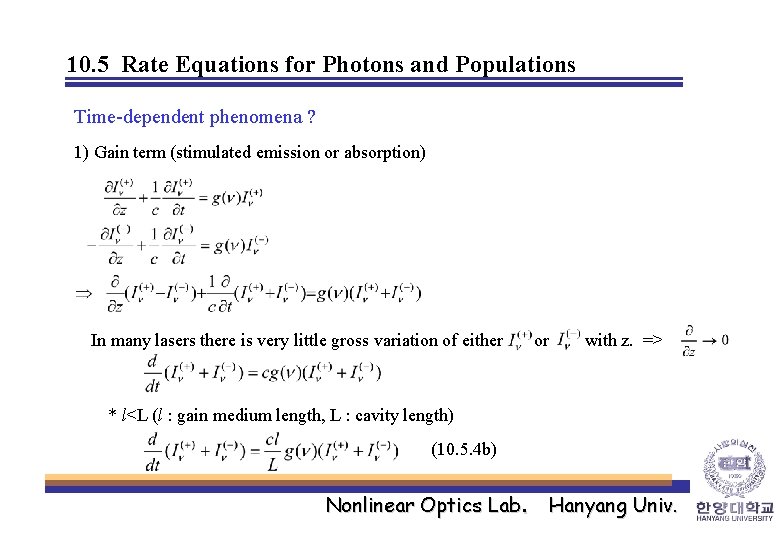
10. 5 Rate Equations for Photons and Populations Time-dependent phenomena ? 1) Gain term (stimulated emission or absorption) In many lasers there is very little gross variation of either or with z. => * l<L (l : gain medium length, L : cavity length) (10. 5. 4 b) Nonlinear Optics Lab. Hanyang Univ.
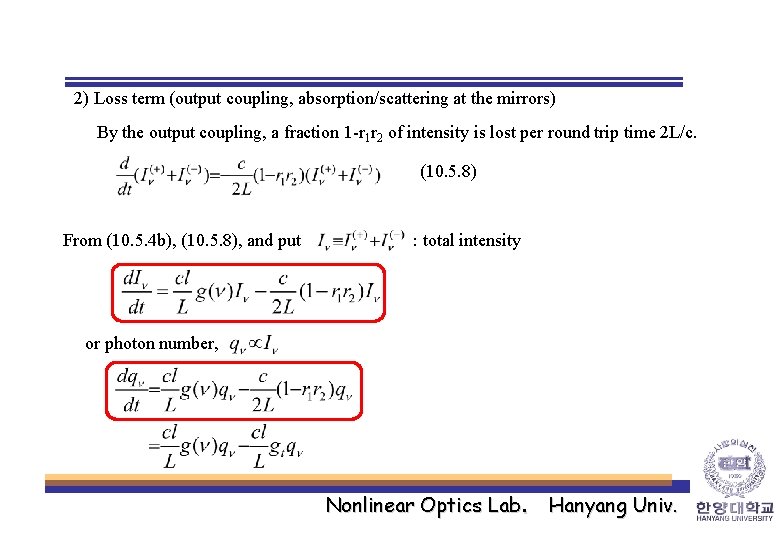
2) Loss term (output coupling, absorption/scattering at the mirrors) By the output coupling, a fraction 1 -r 1 r 2 of intensity is lost per round trip time 2 L/c. (10. 5. 8) From (10. 5. 4 b), (10. 5. 8), and put : total intensity or photon number, Nonlinear Optics Lab. Hanyang Univ.
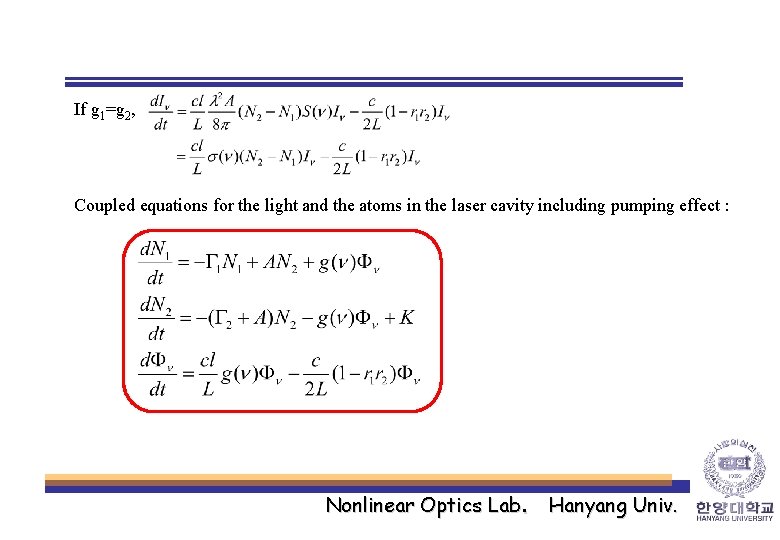
If g 1=g 2, Coupled equations for the light and the atoms in the laser cavity including pumping effect : Nonlinear Optics Lab. Hanyang Univ.
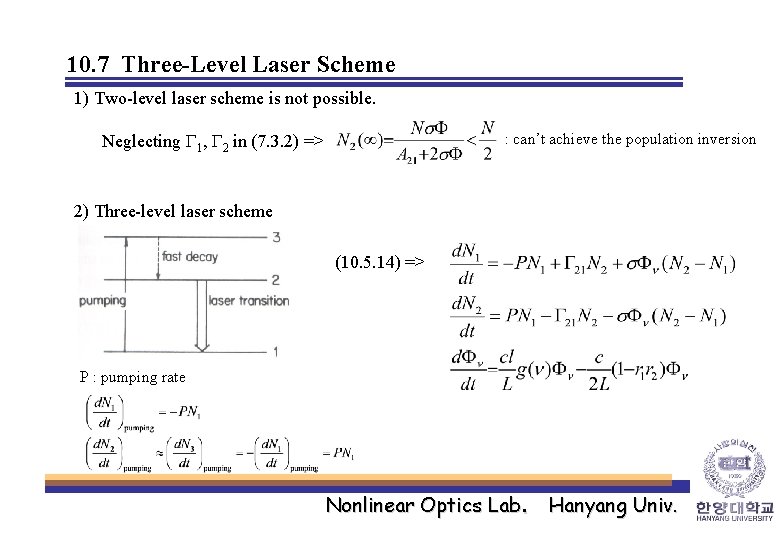
10. 7 Three-Level Laser Scheme 1) Two-level laser scheme is not possible. Neglecting G 1, G 2 in (7. 3. 2) => : can’t achieve the population inversion 2) Three-level laser scheme (10. 5. 14) => P : pumping rate Nonlinear Optics Lab. Hanyang Univ.
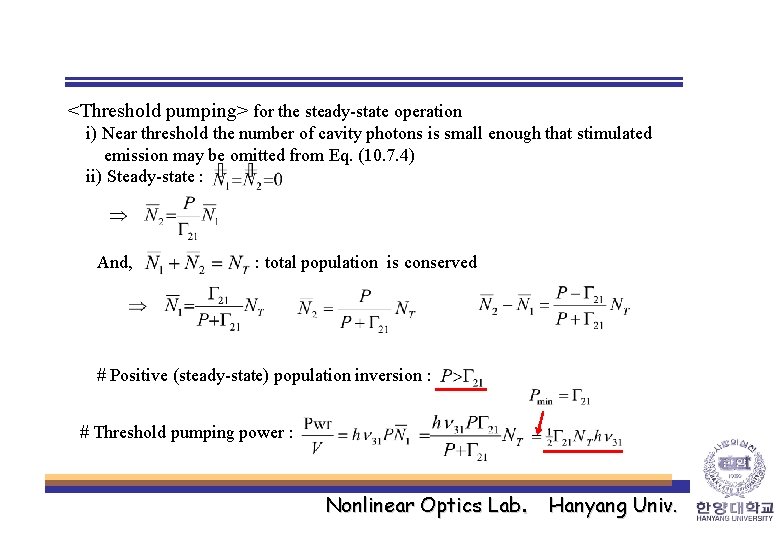
<Threshold pumping> for the steady-state operation i) Near threshold the number of cavity photons is small enough that stimulated emission may be omitted from Eq. (10. 7. 4) ii) Steady-state : And, : total population is conserved # Positive (steady-state) population inversion : # Threshold pumping power : Nonlinear Optics Lab. Hanyang Univ.
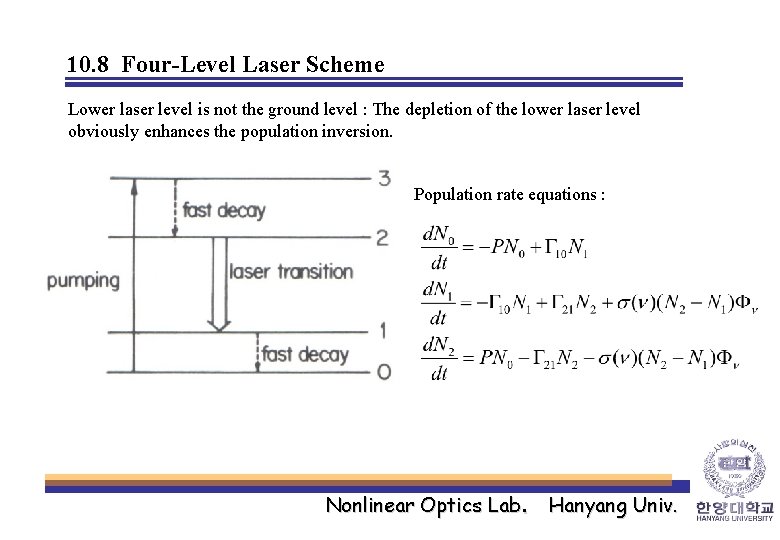
10. 8 Four-Level Laser Scheme Lower laser level is not the ground level : The depletion of the lower laser level obviously enhances the population inversion. Population rate equations : Nonlinear Optics Lab. Hanyang Univ.
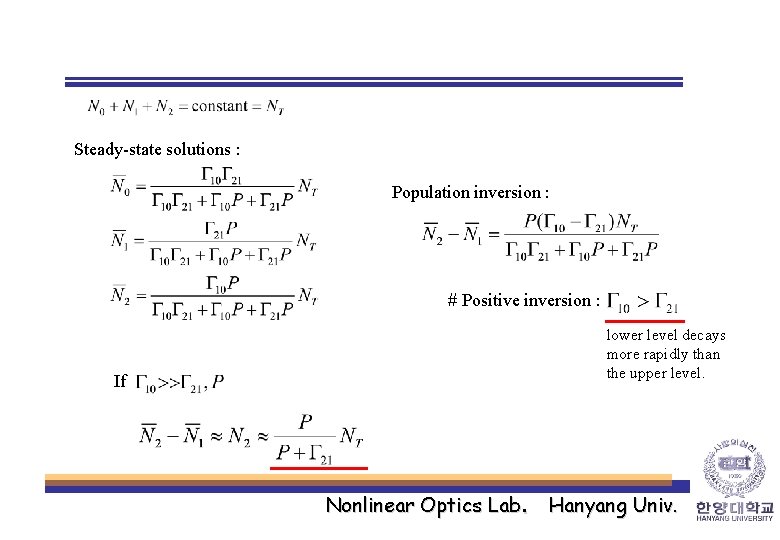
Steady-state solutions : Population inversion : # Positive inversion : lower level decays more rapidly than the upper level. If Nonlinear Optics Lab. Hanyang Univ.
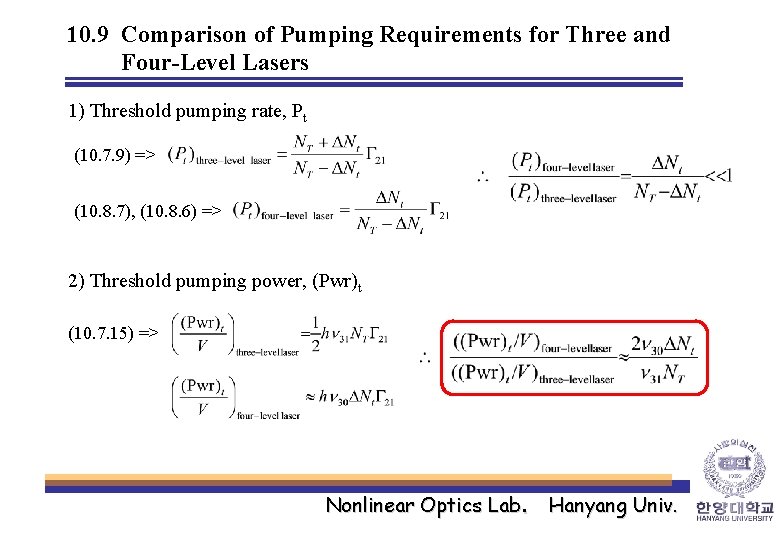
10. 9 Comparison of Pumping Requirements for Three and Four-Level Lasers 1) Threshold pumping rate, Pt (10. 7. 9) => (10. 8. 7), (10. 8. 6) => 2) Threshold pumping power, (Pwr)t (10. 7. 15) => Nonlinear Optics Lab. Hanyang Univ.
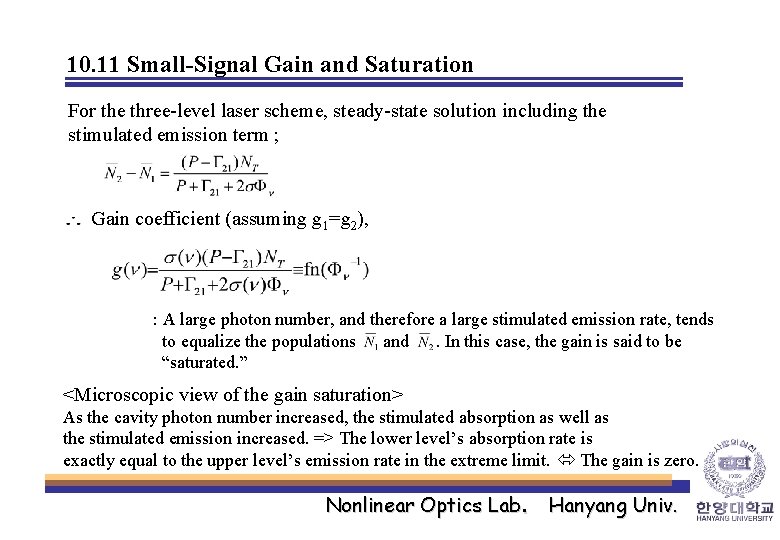
10. 11 Small-Signal Gain and Saturation For the three-level laser scheme, steady-state solution including the stimulated emission term ; Gain coefficient (assuming g 1=g 2), : A large photon number, and therefore a large stimulated emission rate, tends to equalize the populations and. In this case, the gain is said to be “saturated. ” <Microscopic view of the gain saturation> As the cavity photon number increased, the stimulated absorption as well as the stimulated emission increased. => The lower level’s absorption rate is exactly equal to the upper level’s emission rate in the extreme limit. The gain is zero. Nonlinear Optics Lab. Hanyang Univ.
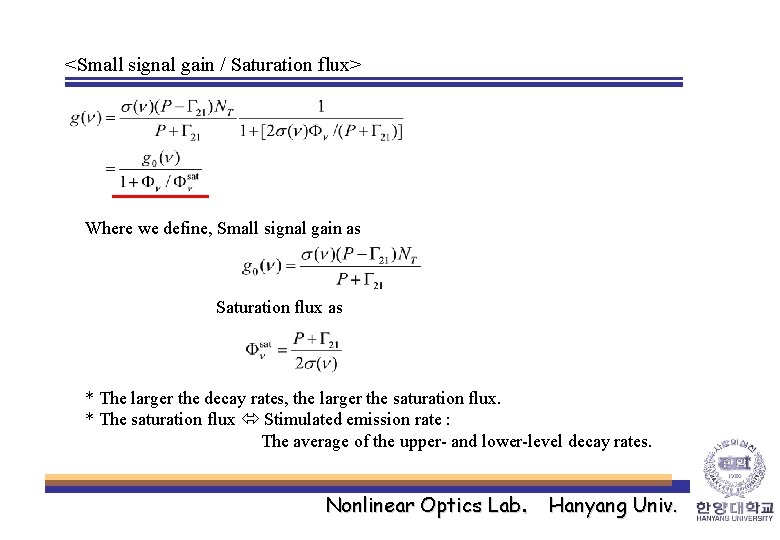
<Small signal gain / Saturation flux> Where we define, Small signal gain as Saturation flux as * The larger the decay rates, the larger the saturation flux. * The saturation flux Stimulated emission rate : The average of the upper- and lower-level decay rates. Nonlinear Optics Lab. Hanyang Univ.
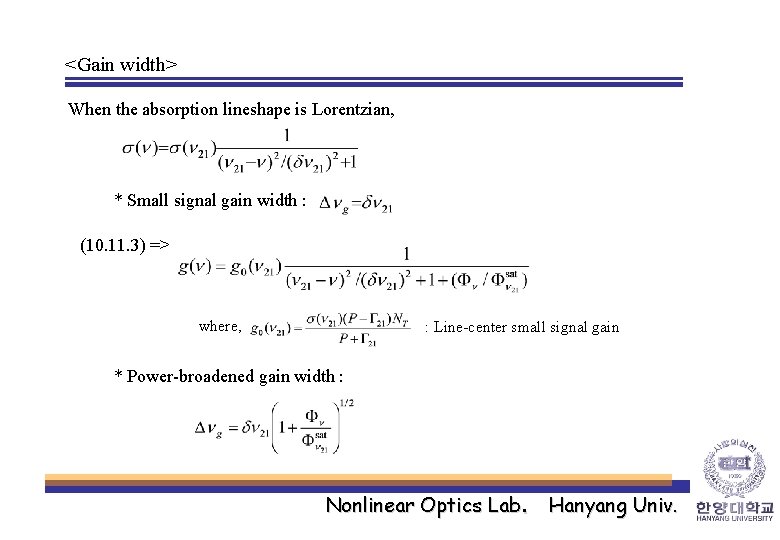
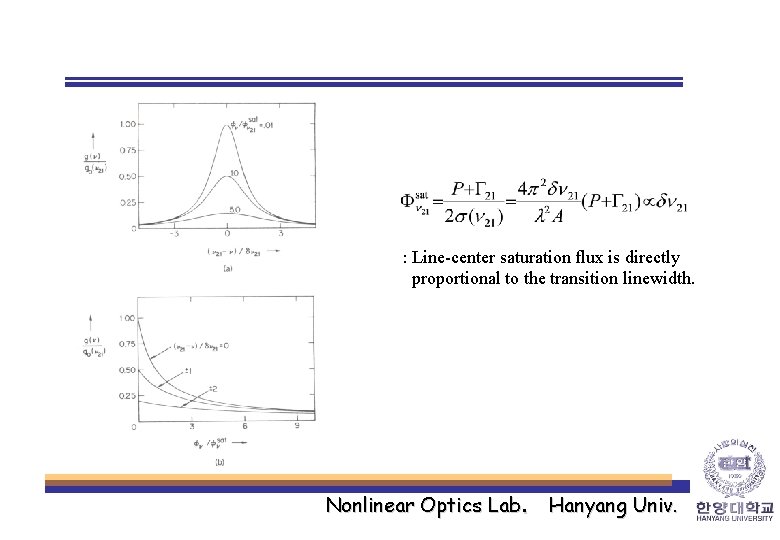
<Gain width> When the absorption lineshape is Lorentzian, * Small signal gain width : (10. 11. 3) => where, : Line-center small signal gain * Power-broadened gain width : Nonlinear Optics Lab. Hanyang Univ.
: Line-center saturation flux is directly proportional to the transition linewidth. Nonlinear Optics Lab. Hanyang Univ.
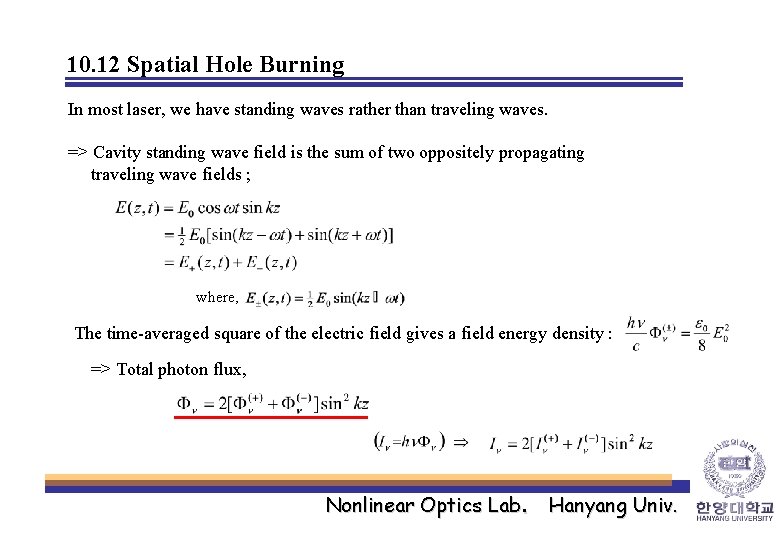
10. 12 Spatial Hole Burning In most laser, we have standing waves rather than traveling waves. => Cavity standing wave field is the sum of two oppositely propagating traveling wave fields ; where, The time-averaged square of the electric field gives a field energy density : => Total photon flux, Nonlinear Optics Lab. Hanyang Univ.
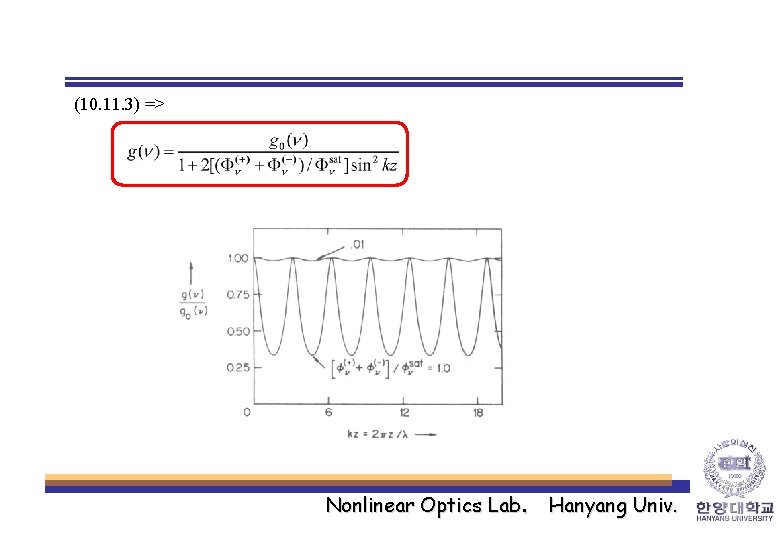
(10. 11. 3) => Nonlinear Optics Lab. Hanyang Univ.