
Chapter 10 Language Making Verbal Sense of Your
Chapter 10 Language: Making Verbal Sense of Your Message 1
What Will We Discuss… • Relationship between language and thought • Effects of diversity on language • Use of rhetorical devices = metaphors • Avoid marginalizing, totalizing, sexist, and stereotypic language • Use verbal immediacy and transitional devices 2
The Importance of Language • What role does language play in your life? Personal u Professional u You. Tube Up Speak u • How do you think words influence the way you see the world? u Internal perceptions = external words 3
Word Power • Language Rule-governed word system we use to verbally communicate u Linguistic relativity hypothesis: Language influences how we see the world u • Avoid being receiver-centric Don’t assume that everyone shares your meaning for a word u Example? u • Buon ano • Buon anno 4
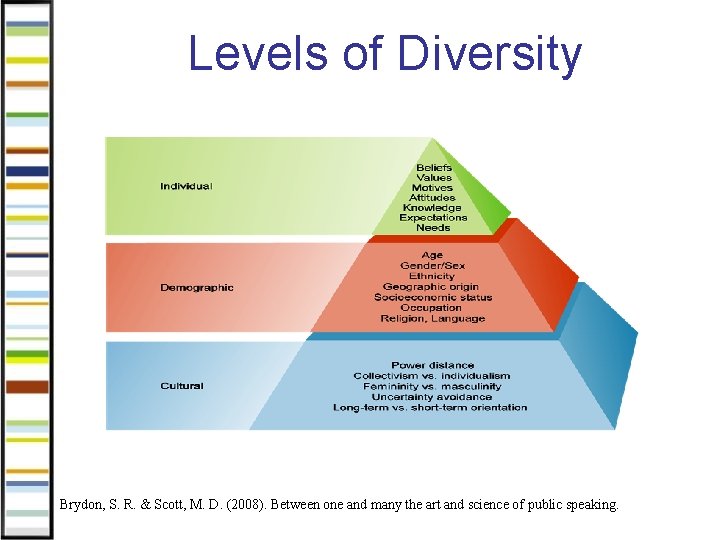
Levels of Diversity Brydon, S. R. & Scott, M. D. (2008). Between one and many the art and science of public speaking.
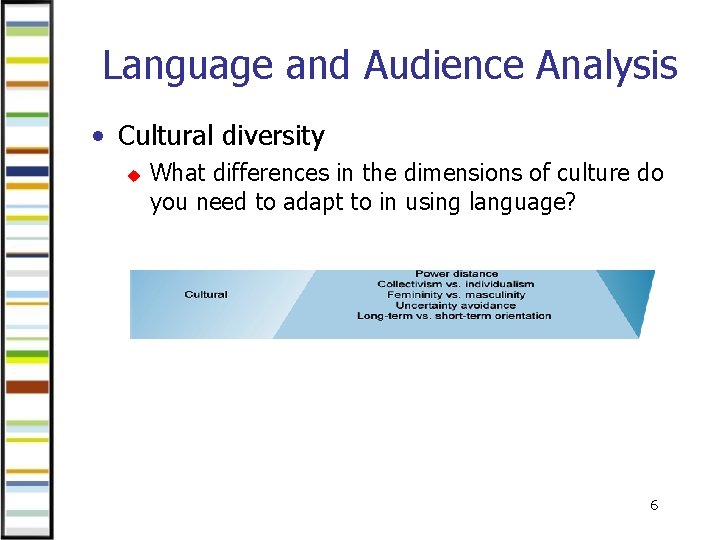
Language and Audience Analysis • Cultural diversity u What differences in the dimensions of culture do you need to adapt to in using language? 6
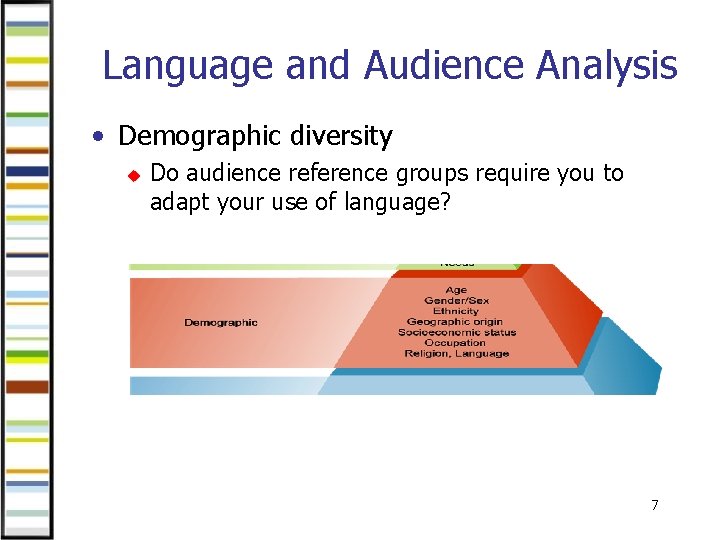
Language and Audience Analysis • Demographic diversity u Do audience reference groups require you to adapt your use of language? 7

Language and Audience Analysis • Individual diversity u Respect individual differences and learning styles in your use of language 8

Effective Language Use • Use language appropriate to the rhetorical situation • Use inclusive and immediate language Use we not me u Avoid marginalizing and totalizing language u • Use credibility-enhancing language Assertive and confidence-inspiring but not aggressive u Avoid verbal qualifiers u 9
Effective Language Use • Use correct grammar u Establish speaker credibility • Pronounce words correctly u Know correct pronunciation of topic words • Use words correctly u For example, “irregardless” is not a word; “regardless” should be used instead • Truthfulness u What you say should reflect what you do 10
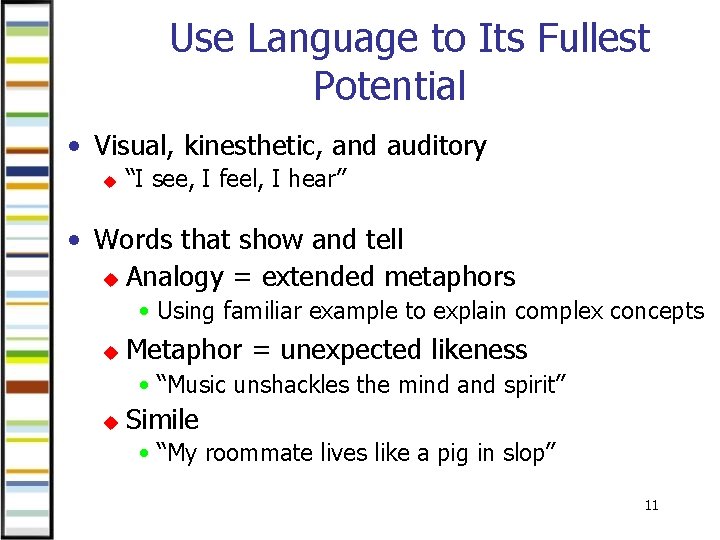
Use Language to Its Fullest Potential • Visual, kinesthetic, and auditory u “I see, I feel, I hear” • Words that show and tell u Analogy = extended metaphors • Using familiar example to explain complex concepts u Metaphor = unexpected likeness • “Music unshackles the mind and spirit” u Simile • “My roommate lives like a pig in slop” 11
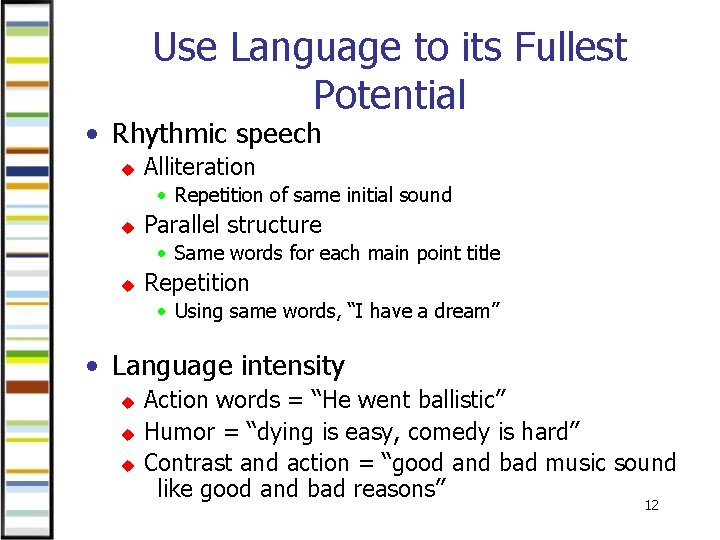
Use Language to its Fullest Potential • Rhythmic speech u Alliteration • Repetition of same initial sound u Parallel structure • Same words for each main point title u Repetition • Using same words, “I have a dream” • Language intensity u u u Action words = “He went ballistic” Humor = “dying is easy, comedy is hard” Contrast and action = “good and bad music sound like good and bad reasons” 12
Managing Language • • • Define your terms Be careful with colloquial words and idioms Use concrete words and phrases Keep it simple Use transitional words and phrases Be consistent 13
Language to Avoid • Stereotypes u All disabled persons… • “The Howard’s baby is physically challenged” • Sexist language = Stereotypes genders “All women are emotional” u “Men do not like to talk about feelings” u 14
Review • Relationship between language and thought • Effects of diversity on language • Use of rhetorical devices = metaphors • Avoid marginalizing, totalizing, sexist, and stereotypic language • Use verbal immediacy and transitional devices 15
Working Definition of Persuasion • Involves one or more persons who are engaged in the activity of • creating, • reinforcing, • modifying, or • extinguishing u u u beliefs, attitudes, intentions, motivations, and/or behaviors
- Slides: 16