
Chapter 10 Labor Markets and Income Distribution Key
Chapter 10 Labor Markets and Income Distribution • Key Concepts • Summary • Practice Quiz © 2004 Thomson/South-Western 1
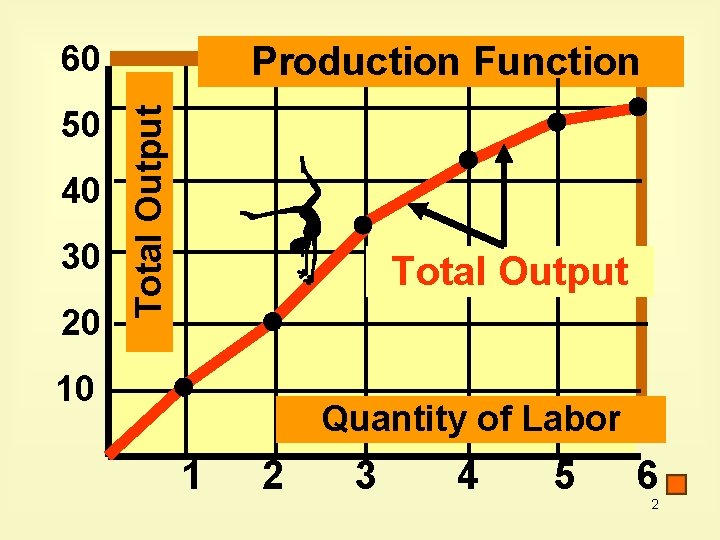
Production Function 50 40 30 20 Total Output 60 Total Output 10 Quantity of Labor 1 2 3 4 5 6 2
What does the demand curve for labor show? The different quantities of labor employers are willing to hire at different wage rates in a given time period, ceteris paribus 3
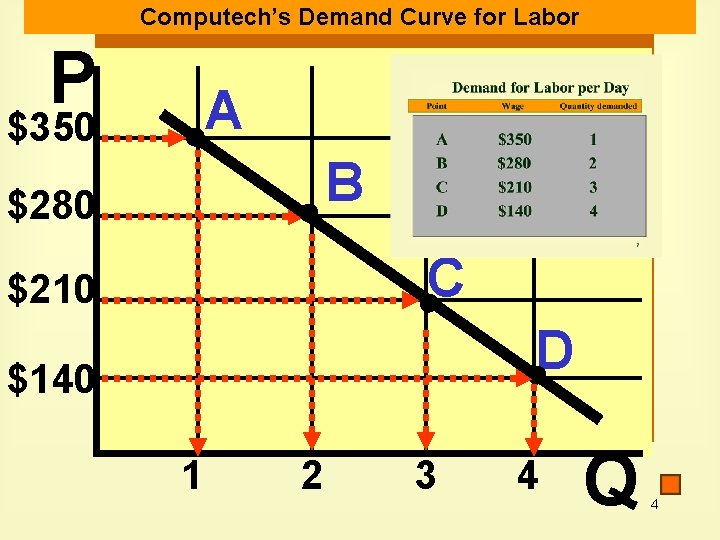
Computech’s Demand Curve for Labor P A $350 B $280 C $210 D $140 1 2 3 4 Q 4
What is the demand curve for labor equal to? It is equal to the marginal revenue product of labor 5
What is marginal revenue product? The increase in total revenue to a firm resulting from hiring an additional unit of labor or other variable resource 6
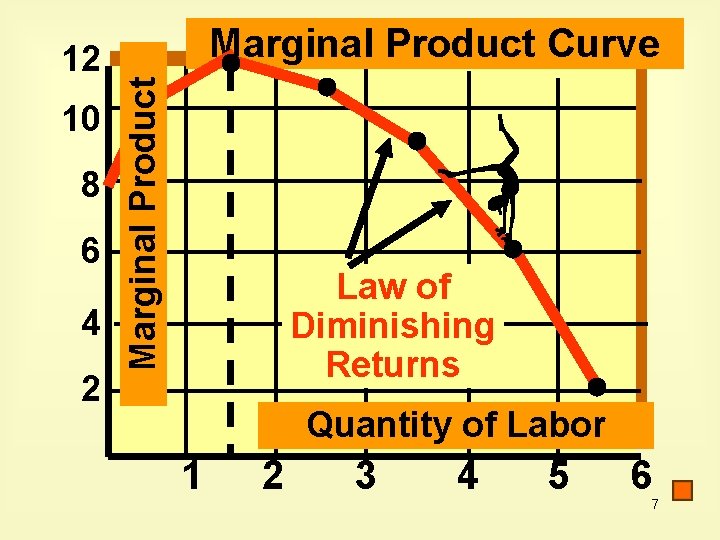
10 8 6 4 2 Marginal Product Curve Marginal Product 12 Law of Diminishing Returns Quantity of Labor 1 2 3 4 5 6 7
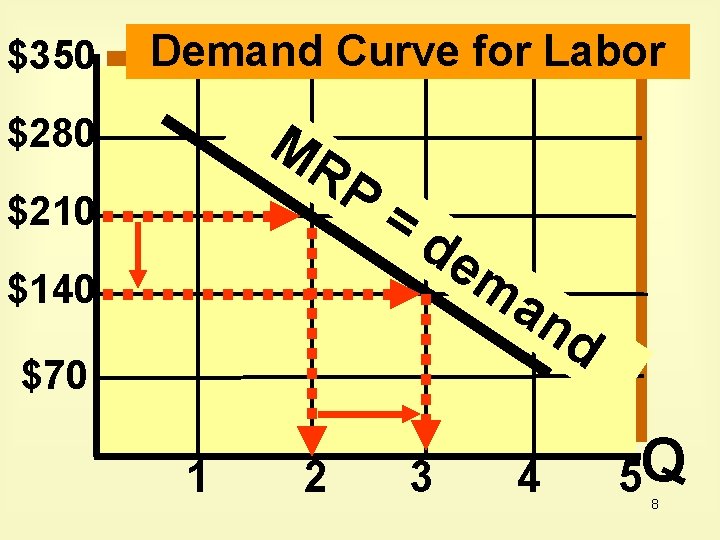
$350 Demand Curve for Labor MR P $280 $210 =d em $140 an d $70 1 2 3 4 5 Q 8
How do we measure MRP in perfect competition? A perfectly competitive firm’s marginal revenue product is equal to the marginal product of its labor times the price of its product 9
What is derived demand? The demand for labor and other factors of production that depends on the consumer demand for final goods and services the factors produce 10
What does the supply curve for labor show? The different quantities of labor workers are willing to offer employers at different wage rates in a given time period, ceteris paribus 11

Computech’s Supply Curve for Labor P $350 New wage rate $280 $210 $140 Initial wage rate A 10 20 30 S B 40 Q 12
In a perfectly competitive market, what determines the level of wages? The intersection of the demand for labor and the supply of labor 13
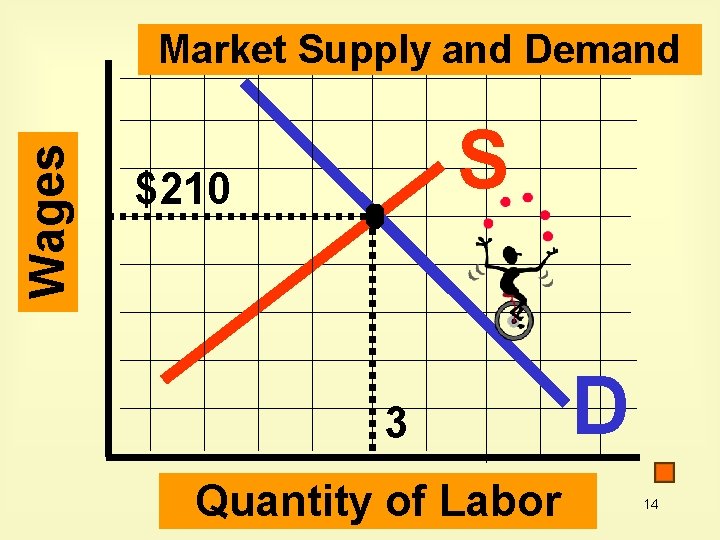
Wages Market Supply and Demand S $210 3 Quantity of Labor D 14

Does the perfectly competitive model apply to workers in unions? No 15
What are examples of unions? • Teamsters • United Auto Workers • National Education Assoc. • American Federation of Government Employees 16
How do unions attempt to raise wages? • Increase demand for labor • Decrease supply for labor • Power 17
What factors can cause a change in the demand for labor? • Unions • Prices of substitute goods • Demand for final products • Marginal product of labor 18
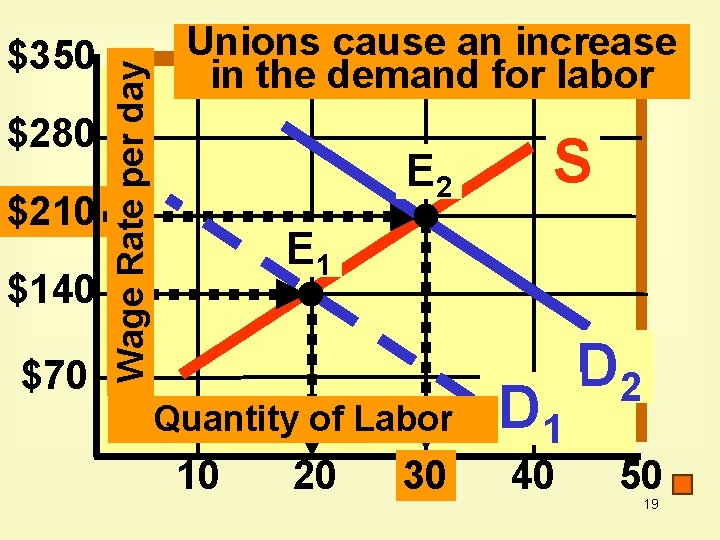
$280 $210 $140 $70 Wage Rate per day $350 Unions cause an increase in the demand for labor E 2 S E 1 Quantity of Labor 10 20 30 D 1 40 D 2 50 19
What factors can cause a change in the supply for labor? • Unions • Demographic trends • Expectations of future income • Changes in immigrations laws • Education and training 20
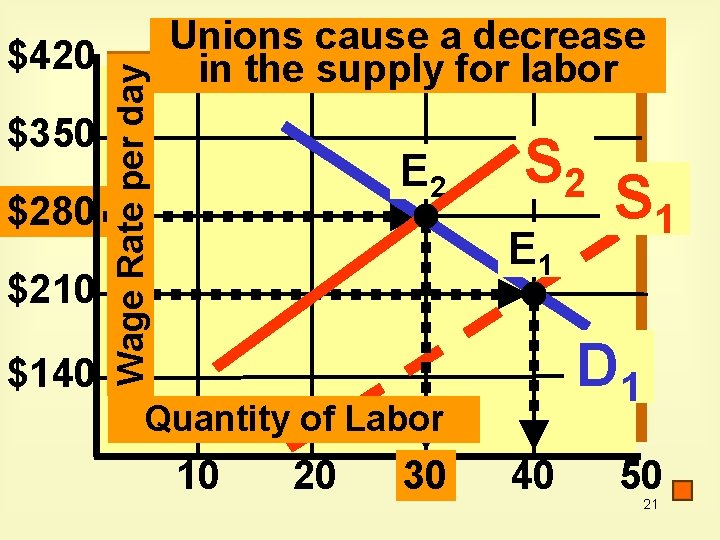
$350 $280 $210 $140 Wage Rate per day $420 Unions cause a decrease in the supply for labor E 2 S 2 E 1 D 1 Quantity of Labor 10 20 30 S 1 40 50 21
How else can unions raise wages? Collective bargaining 22
What is collective bargaining? The process of negotiations between the union and management over wages and working conditions 23
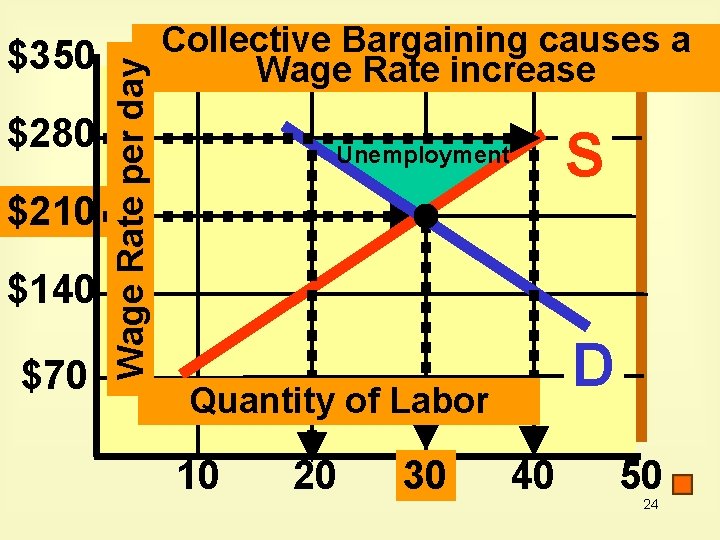
$280 $210 $140 $70 Wage Rate per day $350 Collective Bargaining causes a Wage Rate increase S Unemployment D Quantity of Labor 10 20 30 40 50 24
What factors can cause a change in the supply for labor? • Unions • Demographic trends • Expectations of future income • Changes in immigrations laws • Education and training 25
What has happened to union membership since WWII? Union power has declined 26
How does union membership in the U. S. compare to other countries? Union membership is far below that of other industrialized countries 27
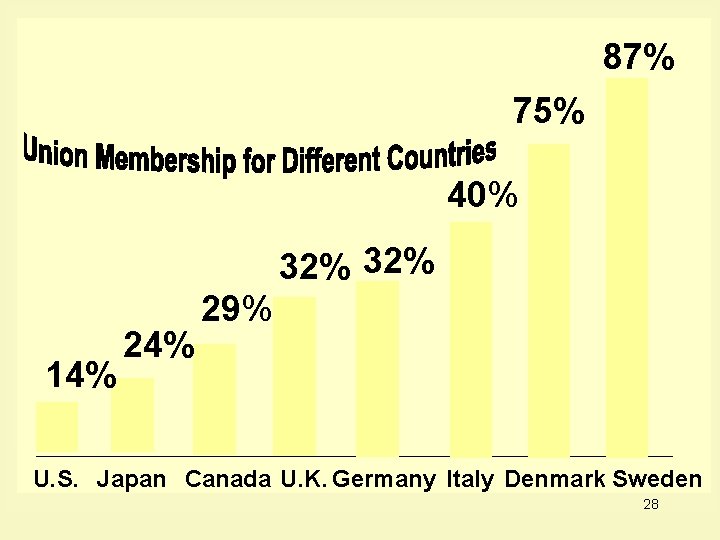
87% 75% 40% 32% 14% 29% U. S. Japan Canada U. K. Germany Italy Denmark Sweden 28
What has happened to real median income in the U. S. ? Since 1993 it has risen 29
What is poverty? There are two views 30
What is poverty in absolute terms? A dollar figure that represents some level of income per year required to purchase essential goods and services 31
What is poverty in relative terms? A level of income that places a family in, lets say, the lowest 20% of households 32
What is the poverty line? A level of income below which a person or a family is considered poor 33
How does the government help the poor? § By in-kind transfers § cash assistance 34
What is an in-kind transfer? Government payments in the form of goods and services, rather than cash 35

What are some examples of inkind transfers? § Food stamps § Medicaid § Housing assistance 36
What are some examples of cash assistance? § Social Security § Unemployment compensation § Temporary assistance to needy countries 37

Key Concepts 38
Key Concepts • In a perfectly competitive market, what determines the level of wages? • What is marginal revenue product? • What is the demand curve for labor equal to? • How do we measure mrp in perfect competition? • What does the supply curve for labor show? 39
Key Concepts cont. • How do unions attempt to raise wages? • What is collective bargaining? • What factors can cause a change in the demand for labor? • What factors can cause a change in the supply for labor? 40
Key Concepts cont. • What has happened to union membership since WWII? • How does union membership in the U. S. Compare to other countries? • What is poverty? • How does the government help the poor? 41
Summary 42
Marginal revenue product (MRP) is determined by a worker’s contribution to a firm’s total revenue. Algebraically, the MRP equals the price of the product times the worker’s marginal product (MP). 43
The demand curve for labor is the curve showing the quantities of labor a firm is willing to hire at different prices of labor. The marginal revenue product (MRP) of labor curve is the firm’s demand curve for labor. Summing individual demand for labor curves gives the market demand curve for labor. 44
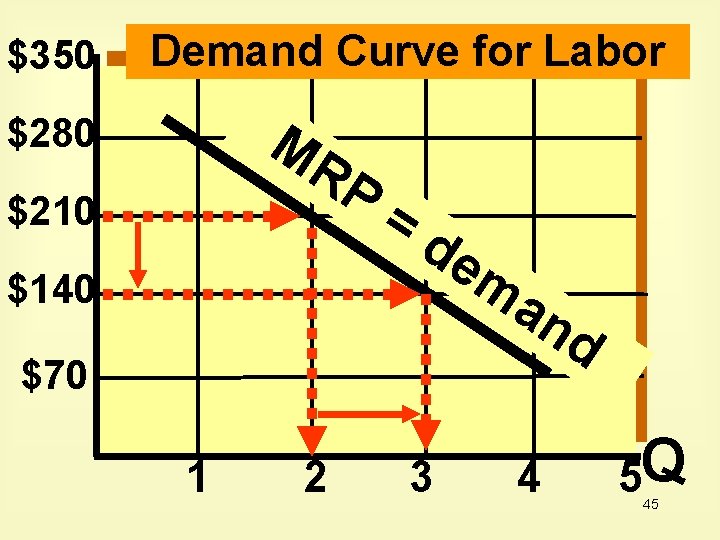
$350 Demand Curve for Labor MR P $280 $210 $140 =d em an d $70 1 2 3 4 5 Q 45
Derived demand means that a firm demands labor because labor is productive. Changes in consumer demand for a product cause changes in demand for labor and for other resources used to make the product. 46
The supply curve of labor is the curve showing the quantities of workers willing to work at different prices of labor. The market supply curve of labor is derived by adding the individual supply curves of labor. 47
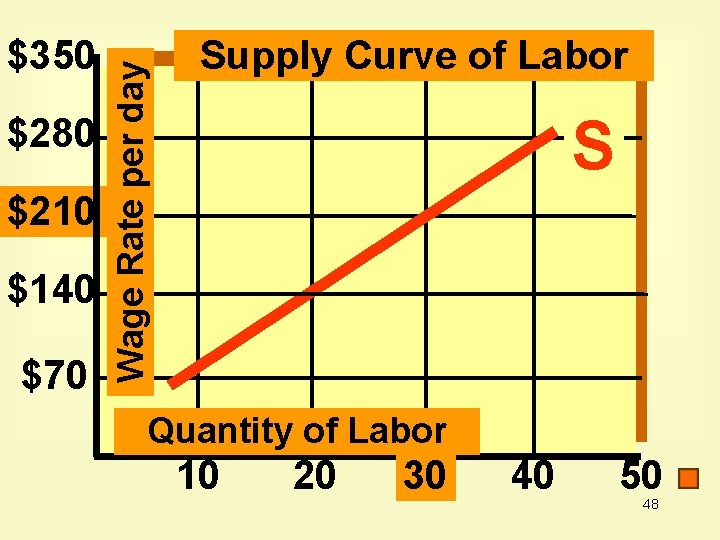
$280 $210 $140 $70 Wage Rate per day $350 Supply Curve of Labor S Quantity of Labor 10 20 30 40 50 48
Collective bargaining is the process through which a union and management negotiate a labor contract. 49
Poverty is absolute terms is a dollar figure that represents some level of income per year required to purchase essential goods and services 50
Poverty is relative terms is a level of income that places a family in, lets say, the lowest 20% of households 51

END 52
- Slides: 52