
Chapter 10 Intelligence Powerpoint presentation by Jim Foley
Chapter 10 Intelligence Powerpoint presentation by Jim Foley © 2013 Worth Publishers
“Definition” of Intelligence § Intelligence tests are a series of questions and other exercises which attempt to assess people’s mental abilities in a way that generates a numerical score, so that one person can be compared to another. § Intelligence can be defined as “whatever intelligence tests measure. ” § Your college entrance test measures how good you are at scoring well on that test.
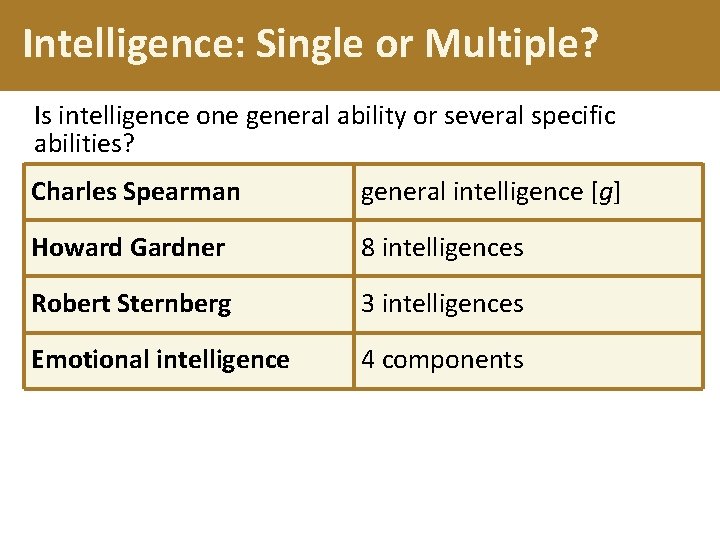
Intelligence: Single or Multiple? Is intelligence one general ability or several specific abilities? Charles Spearman general intelligence [g] Howard Gardner 8 intelligences Robert Sternberg 3 intelligences Emotional intelligence 4 components

General Intelligence, also known as g Charles Spearman (1863 -1945) performed a factor analysis* of different skills and found that people who did well in one area also did well in another. Spearman speculated that these people had a high “g” (general intelligence). *Factor analysis refers to a statistical technique that determines how different variables relate to each other; for example whether they form clusters that tend to vary together.
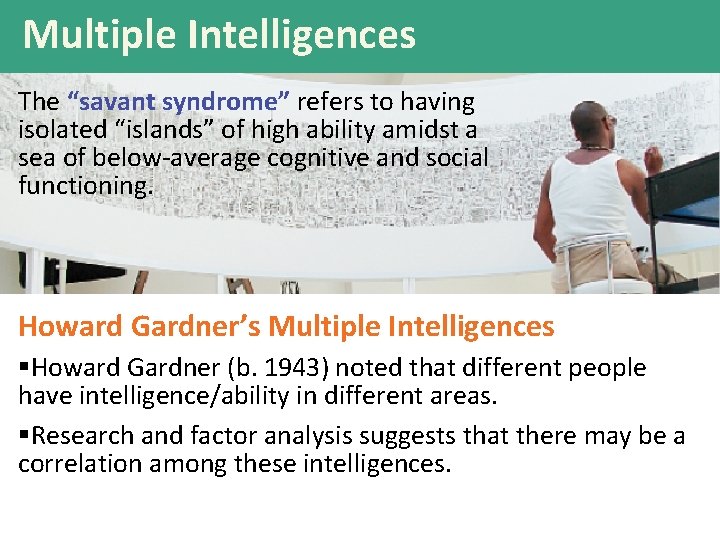
Multiple Intelligences The “savant syndrome” refers to having isolated “islands” of high ability amidst a sea of below-average cognitive and social functioning. Howard Gardner’s Multiple Intelligences §Howard Gardner (b. 1943) noted that different people have intelligence/ability in different areas. §Research and factor analysis suggests that there may be a correlation among these intelligences.

Howard Gardner’s Eight Intelligences
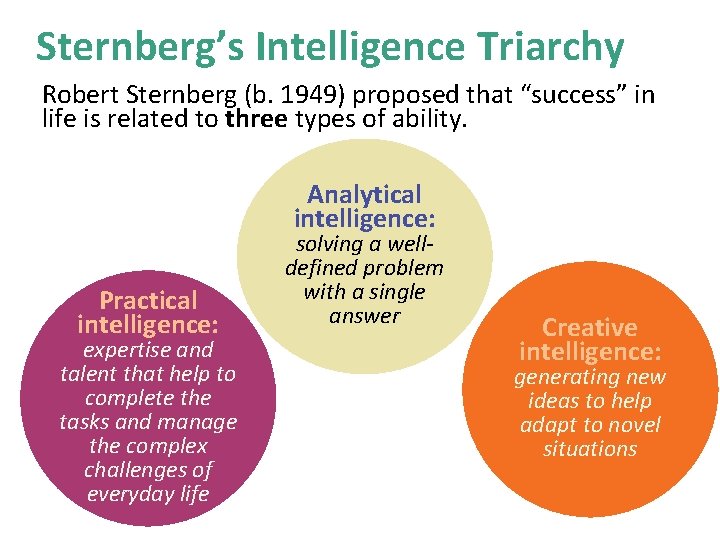
Sternberg’s Intelligence Triarchy Robert Sternberg (b. 1949) proposed that “success” in life is related to three types of ability. Analytical intelligence: Practical intelligence: expertise and talent that help to complete the tasks and manage the complex challenges of everyday life solving a welldefined problem with a single answer Creative intelligence: generating new ideas to help adapt to novel situations
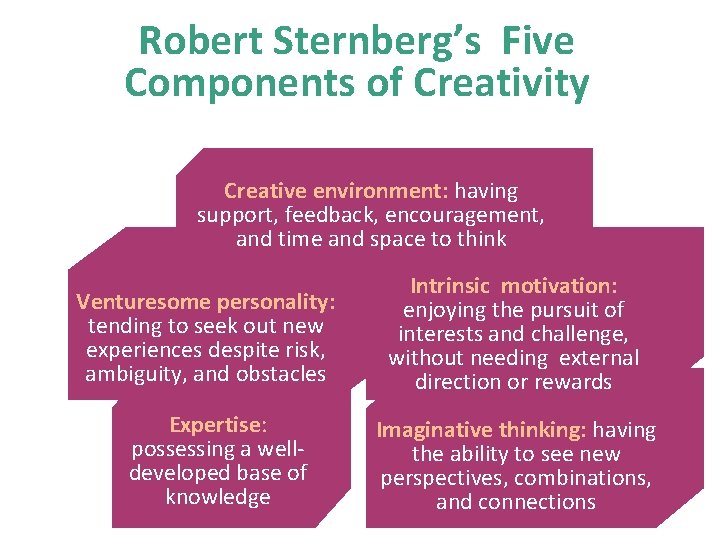
Robert Sternberg’s Five Components of Creativity Creative environment: having support, feedback, encouragement, and time and space to think Venturesome personality: tending to seek out new experiences despite risk, ambiguity, and obstacles Expertise: possessing a welldeveloped base of knowledge Intrinsic motivation: enjoying the pursuit of interests and challenge, without needing external direction or rewards Imaginative thinking: having the ability to see new perspectives, combinations, and connections
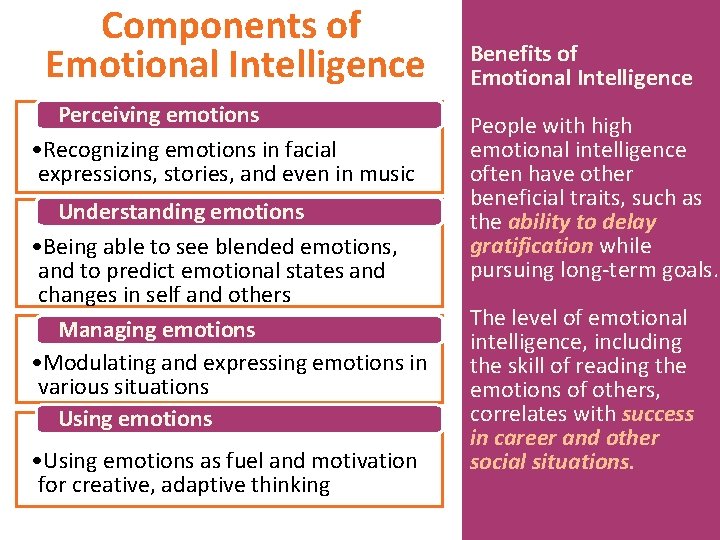
Components of Emotional Intelligence Perceiving emotions • Recognizing emotions in facial expressions, stories, and even in music Understanding emotions • Being able to see blended emotions, and to predict emotional states and changes in self and others Managing emotions • Modulating and expressing emotions in various situations Using emotions • Using emotions as fuel and motivation for creative, adaptive thinking Benefits of Emotional Intelligence People with high emotional intelligence often have other beneficial traits, such as the ability to delay gratification while pursuing long-term goals. The level of emotional intelligence, including the skill of reading the emotions of others, correlates with success in career and other social situations.

Intelligence and Brain Anatomy “Genius” seems to correlate with: §overall brain size. §the size of some brain regions such as the parietal lobe. §high brain activity in the frontal and parietal lobes. §extra gray matter (brain cell bodies, seen as more brain surface area/convolutions). §extra white matter (axons) leading to high connectivity among different regions. Intelligence and Brain Functioning Intelligence in action seems to involve: • activity of the front part of the frontal lobes to organize and coordinate information • “being in shape”; using less energy to solve problems than the brains of “normal” people.
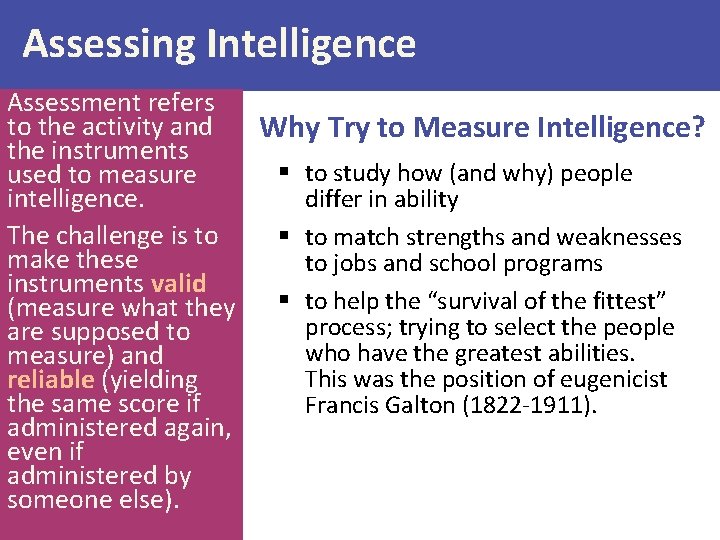
Assessing Intelligence Assessment refers to the activity and Why Try to Measure Intelligence? the instruments § to study how (and why) people used to measure differ in ability intelligence. The challenge is to § to match strengths and weaknesses make these to jobs and school programs instruments valid § to help the “survival of the fittest” (measure what they process; trying to select the people are supposed to who have the greatest abilities. measure) and This was the position of eugenicist reliable (yielding the same score if Francis Galton (1822 -1911). administered again, even if administered by someone else).
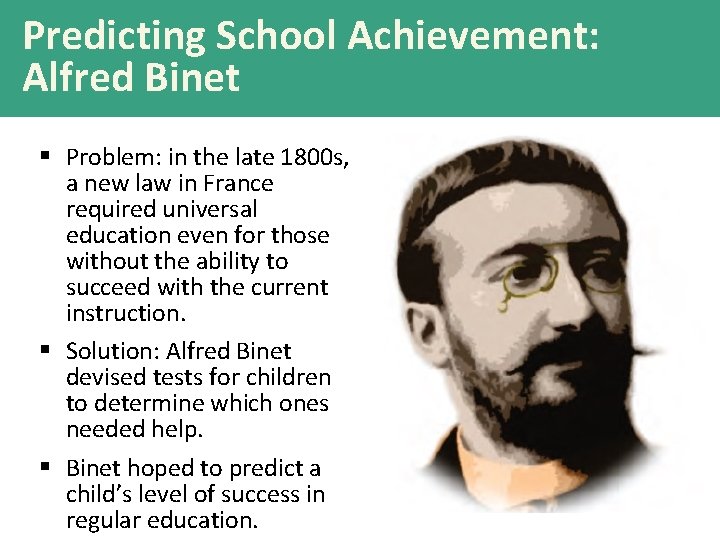
Predicting School Achievement: Alfred Binet § Problem: in the late 1800 s, a new law in France required universal education even for those without the ability to succeed with the current instruction. § Solution: Alfred Binet devised tests for children to determine which ones needed help. § Binet hoped to predict a child’s level of success in regular education.
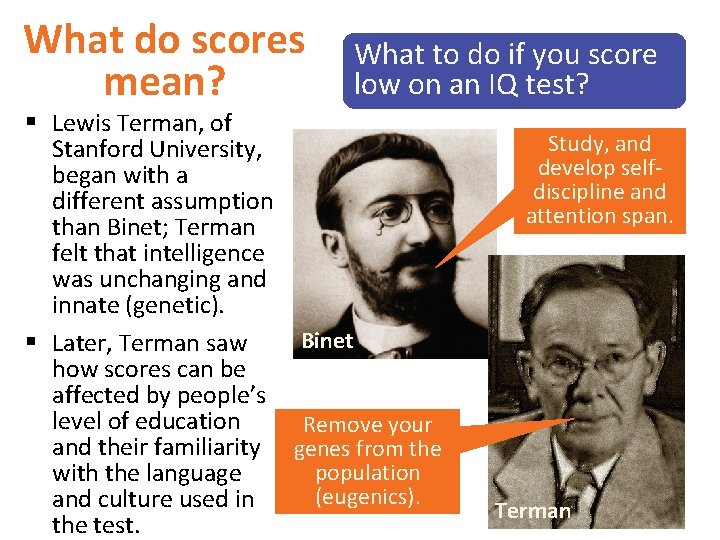
What do scores mean? What to do if you score low on an IQ test? § Lewis Terman, of Stanford University, began with a different assumption than Binet; Terman felt that intelligence was unchanging and innate (genetic). Binet § Later, Terman saw how scores can be affected by people’s level of education Remove your and their familiarity genes from the population with the language (eugenics). and culture used in the test. Study, and develop selfdiscipline and attention span. Terman
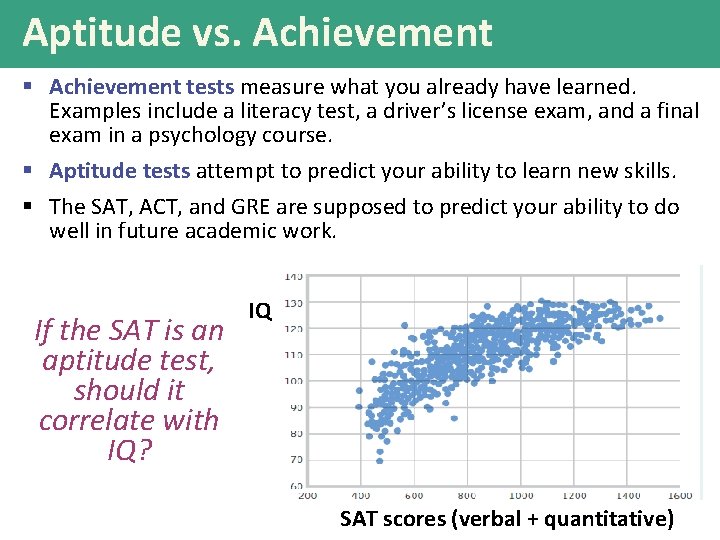
Aptitude vs. Achievement § Achievement tests measure what you already have learned. Examples include a literacy test, a driver’s license exam, and a final exam in a psychology course. § Aptitude tests attempt to predict your ability to learn new skills. § The SAT, ACT, and GRE are supposed to predict your ability to do well in future academic work. If the SAT is an aptitude test, should it correlate with IQ? IQ SAT scores (verbal + quantitative)
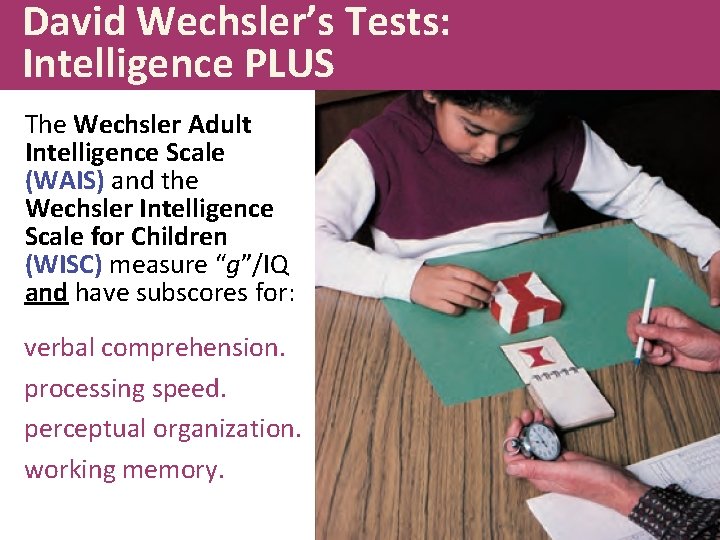
David Wechsler’s Tests: Intelligence PLUS The Wechsler Adult Intelligence Scale (WAIS) and the Wechsler Intelligence Scale for Children (WISC) measure “g”/IQ and have subscores for: verbal comprehension. processing speed. perceptual organization. working memory.
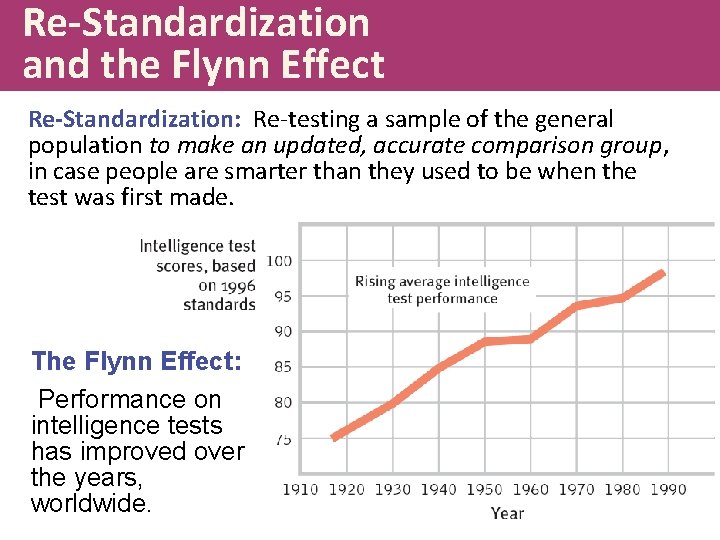
Re-Standardization and the Flynn Effect Re-Standardization: Re-testing a sample of the general population to make an updated, accurate comparison group, in case people are smarter than they used to be when the test was first made. The Flynn Effect: Performance on intelligence tests has improved over the years, worldwide.
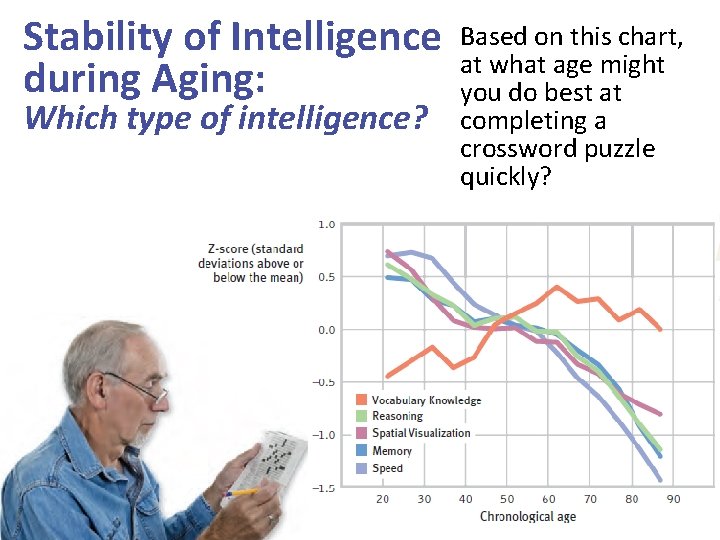
Stability of Intelligence during Aging: Which type of intelligence? Based on this chart, at what age might you do best at completing a crossword puzzle quickly?
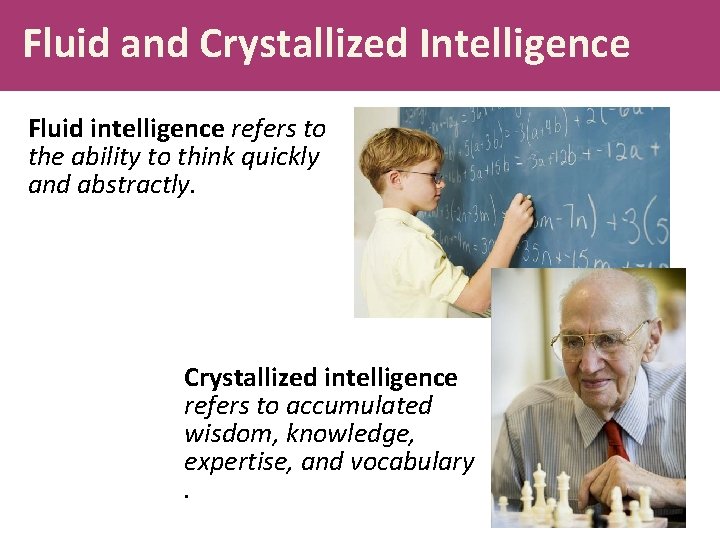
Fluid and Crystallized Intelligence Fluid intelligence refers to the ability to think quickly and abstractly. Crystallized intelligence refers to accumulated wisdom, knowledge, expertise, and vocabulary.
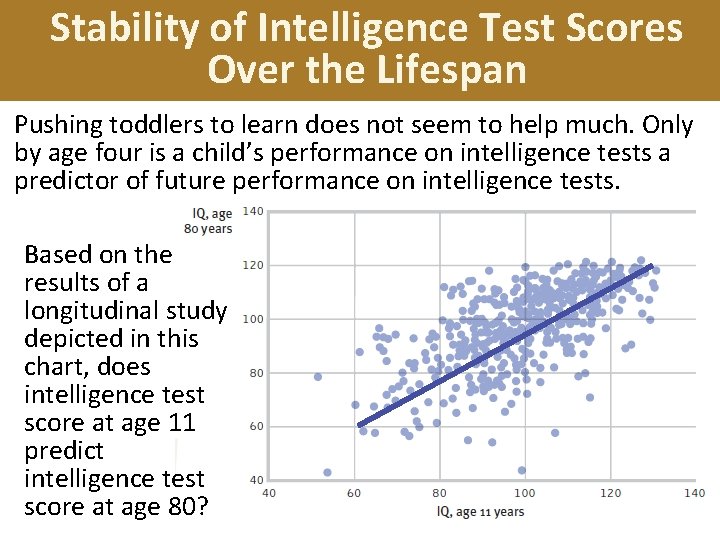
Stability of Intelligence Test Scores Over the Lifespan Pushing toddlers to learn does not seem to help much. Only by age four is a child’s performance on intelligence tests a predictor of future performance on intelligence tests. Based on the results of a longitudinal study depicted in this chart, does intelligence test score at age 11 predict intelligence test score at age 80?
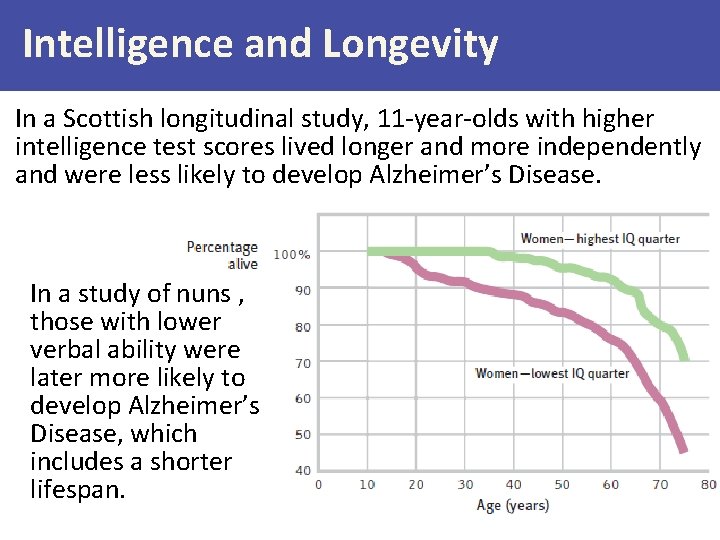
Intelligence and Longevity In a Scottish longitudinal study, 11 -year-olds with higher intelligence test scores lived longer and more independently and were less likely to develop Alzheimer’s Disease. In a study of nuns , those with lower verbal ability were later more likely to develop Alzheimer’s Disease, which includes a shorter lifespan.
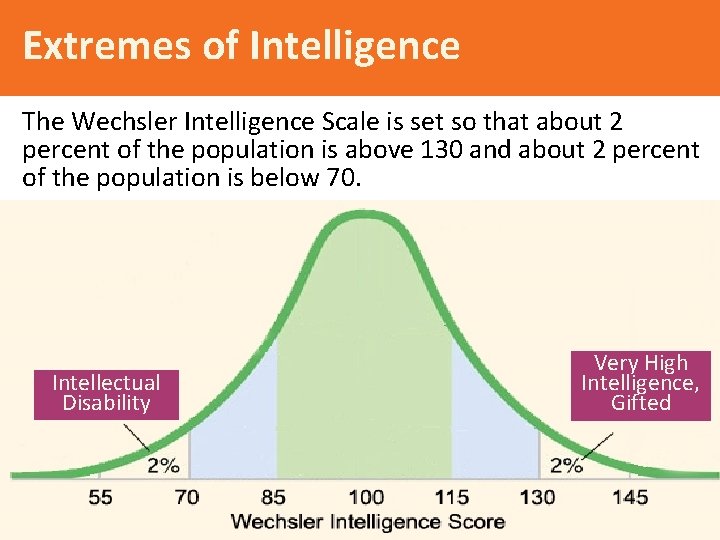
Extremes of Intelligence The Wechsler Intelligence Scale is set so that about 2 percent of the population is above 130 and about 2 percent of the population is below 70. Intellectual Disability Very High Intelligence, Gifted
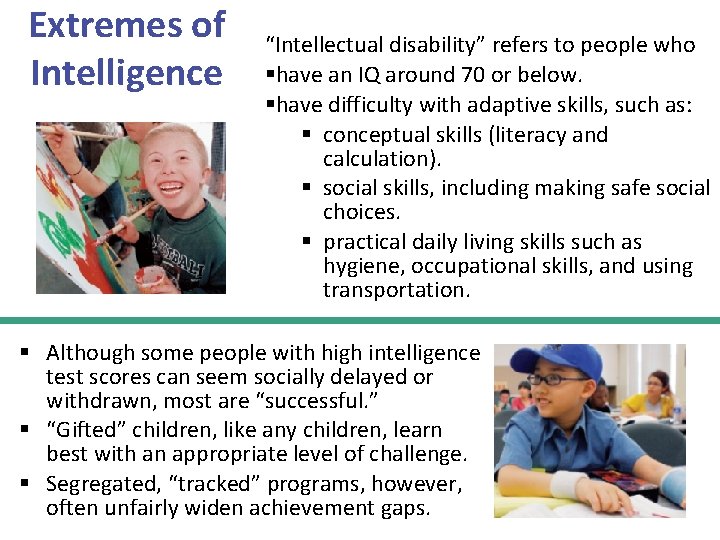
Extremes of Intelligence “Intellectual disability” refers to people who §have an IQ around 70 or below. §have difficulty with adaptive skills, such as: § conceptual skills (literacy and calculation). § social skills, including making safe social choices. § practical daily living skills such as hygiene, occupational skills, and using transportation. § Although some people with high intelligence test scores can seem socially delayed or withdrawn, most are “successful. ” § “Gifted” children, like any children, learn best with an appropriate level of challenge. § Segregated, “tracked” programs, however, often unfairly widen achievement gaps.
Male-Female Ability Differences § Girls tend to be better at spelling, locating objects, and detecting emotions. § Girls tend to be more verbally fluent, and more sensitive to touch, taste, and color. § Boys tend to be better at handling spatial reasoning and complex math problems. § It is a myth that boys generally do better in math than girls. Girls do at least as well as boys in overall math performance and especially in math computation.
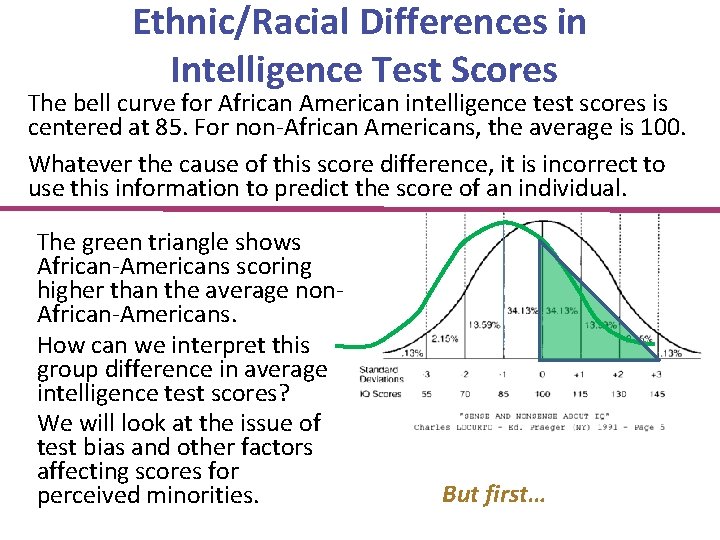
Ethnic/Racial Differences in Intelligence Test Scores The bell curve for African American intelligence test scores is centered at 85. For non-African Americans, the average is 100. Whatever the cause of this score difference, it is incorrect to use this information to predict the score of an individual. The green triangle shows African-Americans scoring higher than the average non. African-Americans. How can we interpret this group difference in average intelligence test scores? We will look at the issue of test bias and other factors affecting scores for perceived minorities. But first…
The “Racial” Intelligence Test Score Gap § Racial categories are not distinct genetically and are unscientific. § Both “whites” and “blacks” have higher intelligence test scores than “whites” of the 1930 s. § “Whites” may have more access to “fertile soil” for developing their potential, such as: § schools and educational opportunities. § wealth, nutrition, support, and educated mentors. § relative freedom from discrimination.
- Slides: 25