
Chapter 10 Identifying Market Segments and Selecting Target




- Slides: 34
Chapter 10 Identifying Market Segments and Selecting Target Markets by Power. Point by Milton M. Pressley University of New Orleans 1 Copyright © 2003 Prentice-Hall, Inc.
Kotler on Marketing “Don’t buy market share. Figure out how to earn it. ” 2 Copyright © 2003 Prentice-Hall, Inc.
Chapter Objectives § We focus on the following questions: § How can a company identify the segments that make up a market? § What criteria can a company use to choose the most attractive target markets? 3 Copyright © 2003 Prentice-Hall, Inc.
Target Marketing § Target marketing requires marketers to take three major steps: § Identify and profile distinct groups of buyers who differ in their needs and preferences (market segmentation). § Select one or more market segments to enter (market targeting). § For each target segment, establish and communicate the key distinctive benefit(s) of the company’s market offering (market positioning). 4 Copyright © 2003 Prentice-Hall, Inc.
Levels and Patterns of Market Segmentation § Levels of Market Segmentation § Mass marketing § Micromarketing § Segment marketing § Market segment § Sector § Flexible market offering § Naked solution § Discretionary options 5 Copyright © 2003 Prentice-Hall, Inc.
Levels and Patterns of Market Segmentation § Niche Marketing § Niche § Local Marketing § Individual Customer Marketing § Mass-customization § Choiceboard § Customerization § Segments § Individuals 6 Copyright © 2003 Prentice-Hall, Inc.
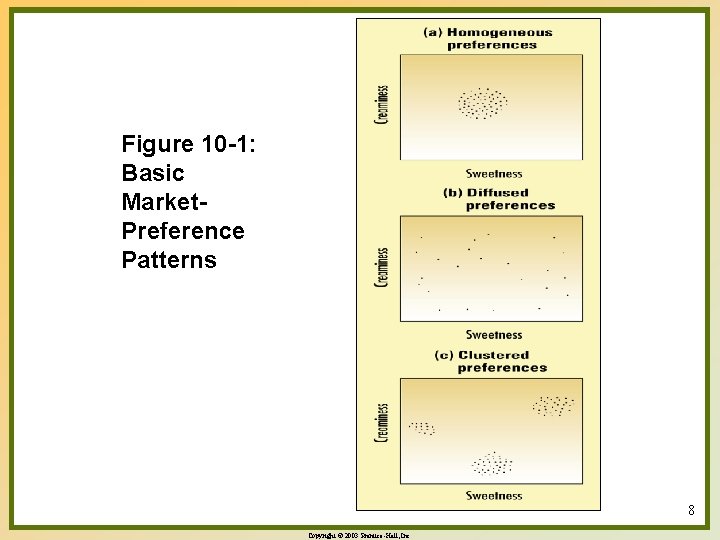
Levels and Patterns of Market Segmentation § Patterns for Market Segmentation § Preference segments § Homogeneous preferences § Diffused preferences § Clustered preferences § Natural market segments § Concentrated marketing 7 Copyright © 2003 Prentice-Hall, Inc.
Figure 10 -1: Basic Market. Preference Patterns 8 Copyright © 2003 Prentice-Hall, Inc.
Levels and Patterns of Market Segmentation § Market Segmentation Procedure § Needs-based market segmentation approach § Market partitioning § Brand-dominant hierarchy § Nation-dominant hierarchy 9 Copyright © 2003 Prentice-Hall, Inc.
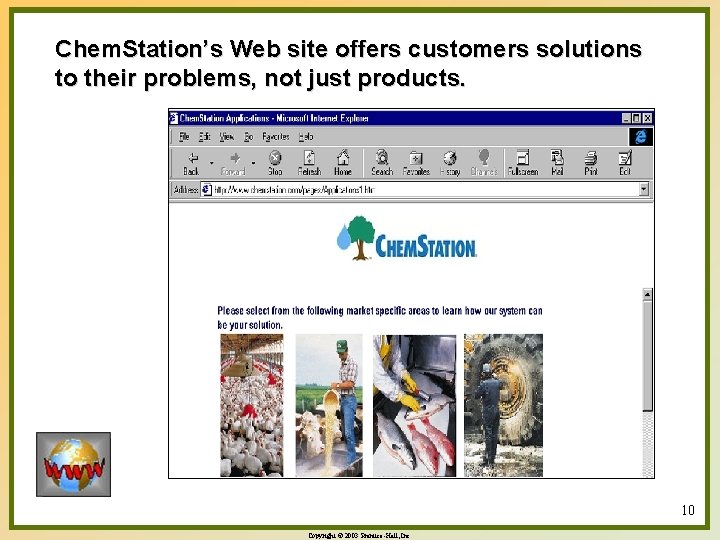
Chem. Station’s Web site offers customers solutions to their problems, not just products. 10 Copyright © 2003 Prentice-Hall, Inc.
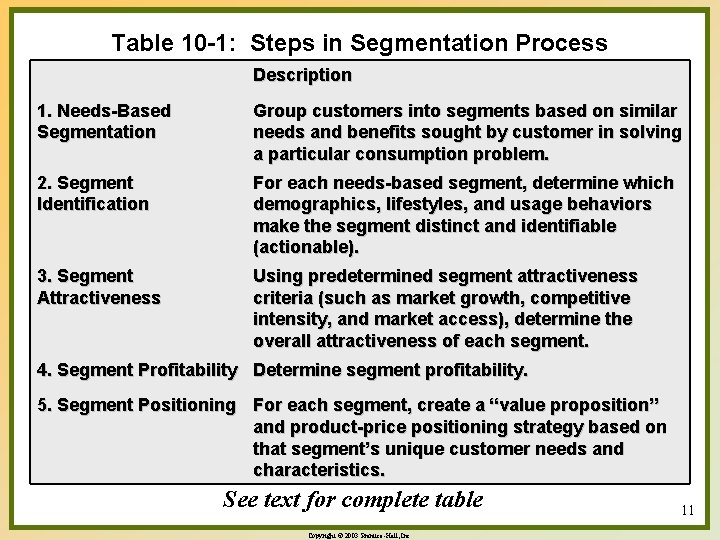
Table 10 -1: Steps in Segmentation Process Description 1. Needs-Based Segmentation Group customers into segments based on similar needs and benefits sought by customer in solving a particular consumption problem. 2. Segment Identification For each needs-based segment, determine which demographics, lifestyles, and usage behaviors make the segment distinct and identifiable (actionable). 3. Segment Attractiveness Using predetermined segment attractiveness criteria (such as market growth, competitive intensity, and market access), determine the overall attractiveness of each segment. 4. Segment Profitability Determine segment profitability. 5. Segment Positioning For each segment, create a “value proposition” and product-price positioning strategy based on that segment’s unique customer needs and characteristics. See text for complete table Copyright © 2003 Prentice-Hall, Inc. 11
Levels and Patterns of Market Segmentation § Effective Segmentation § Measurable § Substantial § Accessible § Differentiable § Actionable 12 Copyright © 2003 Prentice-Hall, Inc.
Segmenting Consumer and Business Markets § Bases for Segmenting Consumer Markets 13 Copyright © 2003 Prentice-Hall, Inc.
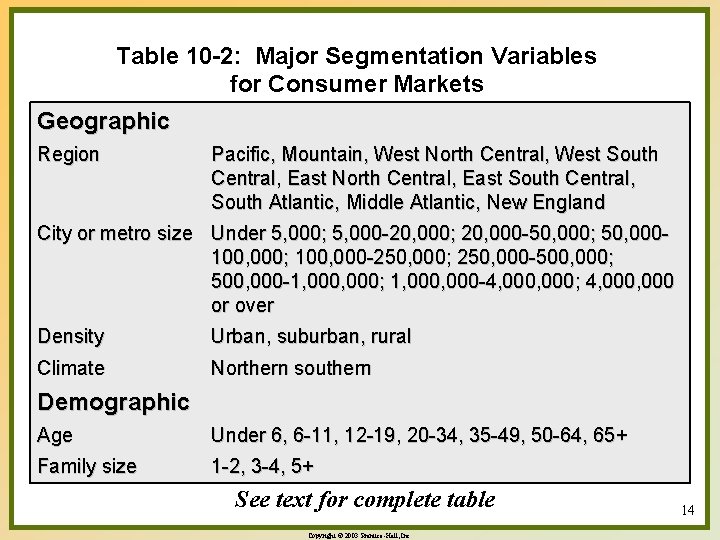
Table 10 -2: Major Segmentation Variables for Consumer Markets Geographic Region Pacific, Mountain, West North Central, West South Central, East North Central, East South Central, South Atlantic, Middle Atlantic, New England City or metro size Under 5, 000; 5, 000 -20, 000; 20, 000 -50, 000; 50, 000100, 000; 100, 000 -250, 000; 250, 000 -500, 000; 500, 000 -1, 000; 1, 000 -4, 000; 4, 000 or over Density Urban, suburban, rural Climate Northern southern Demographic Age Under 6, 6 -11, 12 -19, 20 -34, 35 -49, 50 -64, 65+ Family size 1 -2, 3 -4, 5+ See text for complete table Copyright © 2003 Prentice-Hall, Inc. 14
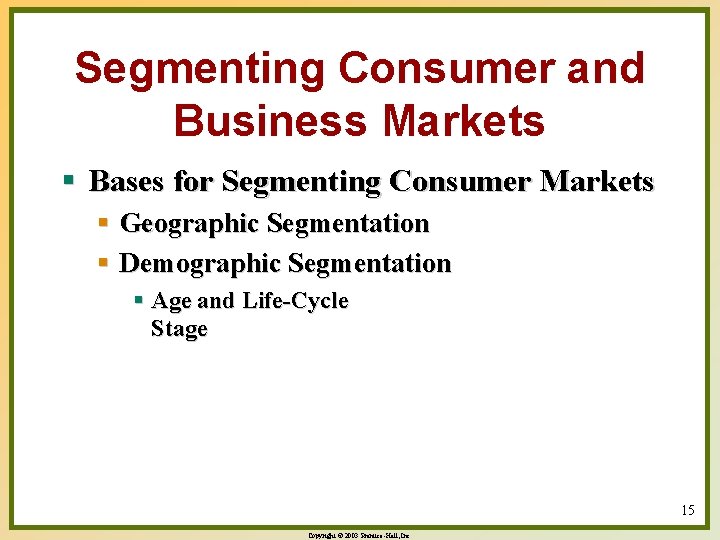
Segmenting Consumer and Business Markets § Bases for Segmenting Consumer Markets § Geographic Segmentation § Demographic Segmentation § Age and Life-Cycle Stage 15 Copyright © 2003 Prentice-Hall, Inc.
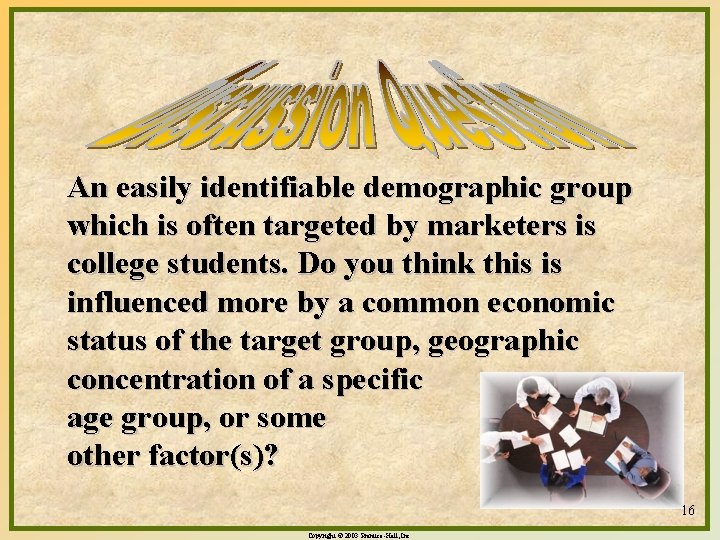
An easily identifiable demographic group which is often targeted by marketers is college students. Do you think this is influenced more by a common economic status of the target group, geographic concentration of a specific age group, or some other factor(s)? 16 Copyright © 2003 Prentice-Hall, Inc.
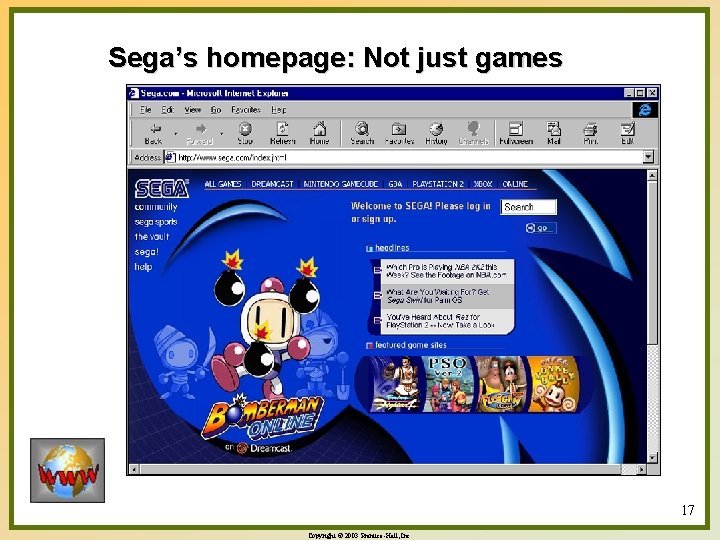
Sega’s homepage: Not just games 17 Copyright © 2003 Prentice-Hall, Inc.
Segmenting Consumer and Business Markets § Life Stage § Gender § Income § Generation § § The Depression Cohort The World War II Cohort The Post-War Cohort Leading-Edge Baby Boomer Cohort § Trailing-Edge Baby Boomer Cohort § Generation X Cohort § The Generation Y Cohort 18 Copyright © 2003 Prentice-Hall, Inc.
Segmenting Consumer and Business Markets § Lifestage Analytic Matrix § § Lifestages Physiographics Emotional effects Socioeconomics § Social Class § Psychographic Segmentation § Lifestyle § Time-constrained § multitasking § Money-constrained 19 Copyright © 2003 Prentice-Hall, Inc.
Improvements in both the average standard of living and in health care have had profound effects in the industrialized world during the last two generations. Other than an increase in the average life expectancy for both men and women, what effects has this trend toward longer and healthier lives in general had on the traditional life stage assumptions that marketers make? Copyright © 2003 Prentice-Hall, Inc. 20
Segmenting Consumer and Business Markets § Personality § “Brand personality” examples: § Sincere § Exciting § Competent § Sophisticated § Rugged § Values § Core values 21 Copyright © 2003 Prentice-Hall, Inc.
Segmenting Consumer and Business Markets § Behavioral Segmentation § Occasions § Critical life events or transitions § Benefits § Mobil has identified five segments and their sizes § Road Warriors 16% § Generation F 27% § True Blues 16% § Home Bodies 21% § Price Shoppers 20% 22 Copyright © 2003 Prentice-Hall, Inc.
Segmenting Consumer and Business Markets § User Status § Usage Rate § Loyalty Status § § Hard-core loyals Split loyals Shifting loyals Switchers § Buyer-Readiness Stage § Attitude 23 Copyright © 2003 Prentice-Hall, Inc.
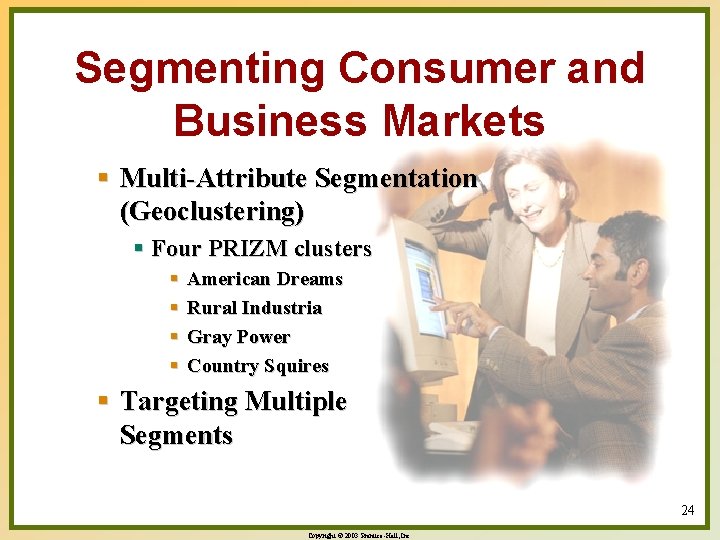
Segmenting Consumer and Business Markets § Multi-Attribute Segmentation (Geoclustering) § Four PRIZM clusters § § American Dreams Rural Industria Gray Power Country Squires § Targeting Multiple Segments 24 Copyright © 2003 Prentice-Hall, Inc.
Segmenting Consumer and Business Markets § Bases For Segmenting Business Markets 25 Copyright © 2003 Prentice-Hall, Inc.
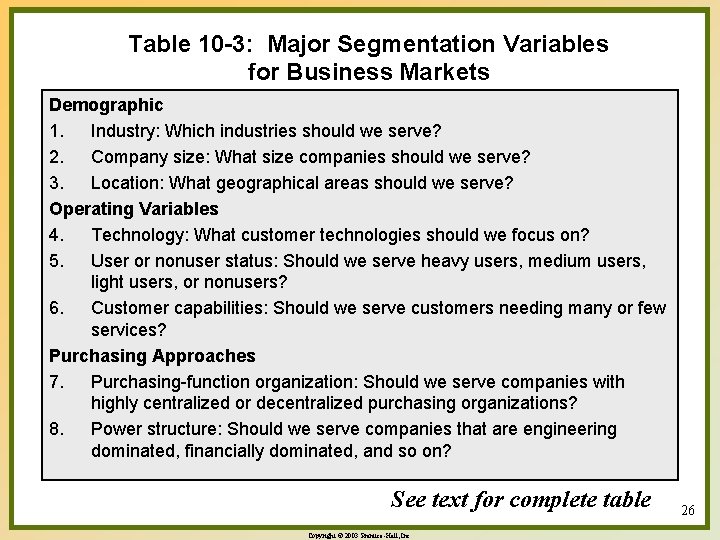
Table 10 -3: Major Segmentation Variables for Business Markets Demographic 1. Industry: Which industries should we serve? 2. Company size: What size companies should we serve? 3. Location: What geographical areas should we serve? Operating Variables 4. Technology: What customer technologies should we focus on? 5. User or nonuser status: Should we serve heavy users, medium users, light users, or nonusers? 6. Customer capabilities: Should we serve customers needing many or few services? Purchasing Approaches 7. Purchasing-function organization: Should we serve companies with highly centralized or decentralized purchasing organizations? 8. Power structure: Should we serve companies that are engineering dominated, financially dominated, and so on? See text for complete table Copyright © 2003 Prentice-Hall, Inc. 26
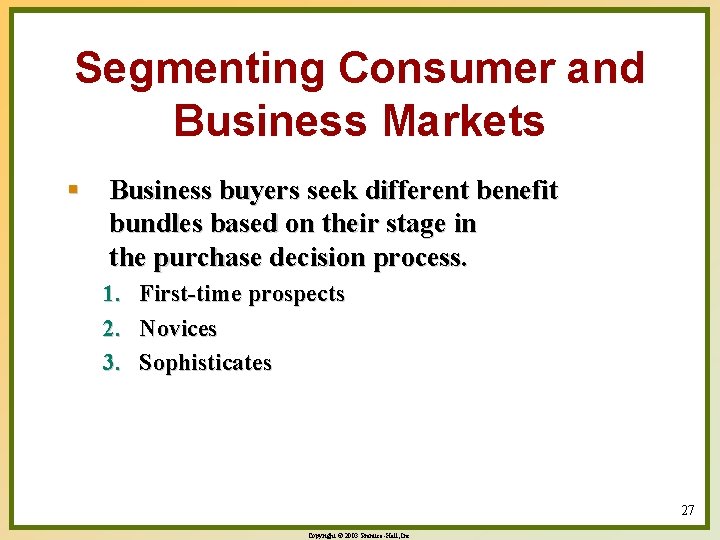
Segmenting Consumer and Business Markets § Business buyers seek different benefit bundles based on their stage in the purchase decision process. 1. 2. 3. First-time prospects Novices Sophisticates 27 Copyright © 2003 Prentice-Hall, Inc.
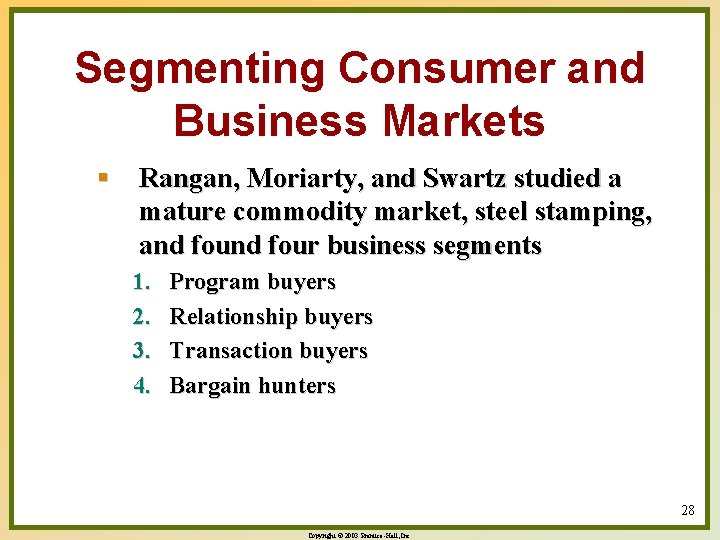
Segmenting Consumer and Business Markets § Rangan, Moriarty, and Swartz studied a mature commodity market, steel stamping, and four business segments 1. 2. 3. 4. Program buyers Relationship buyers Transaction buyers Bargain hunters 28 Copyright © 2003 Prentice-Hall, Inc.
Segmenting Consumer and Business Markets § Rackman and Vincentis proposed a segmentation scheme that classifies business buyers into three groups § Price-oriented customers (transactional selling) § Solution-oriented customers (consultative selling) § Strategic-value customers (enterprise selling) 29 Copyright © 2003 Prentice-Hall, Inc.
Market Targeting § Evaluating and Selecting the Market Segments § § § Single-Segment Concentration Selective Specialization Product Specialization Market Specialization Full Market Coverage § Undifferentiated marketing § Differentiated marketing 30 Copyright © 2003 Prentice-Hall, Inc.
Market Targeting § Higher costs using differentiated marketing include: § § § Product modification cost Manufacturing cost Administrative cost Inventory cost Promotion cost 31 Copyright © 2003 Prentice-Hall, Inc.
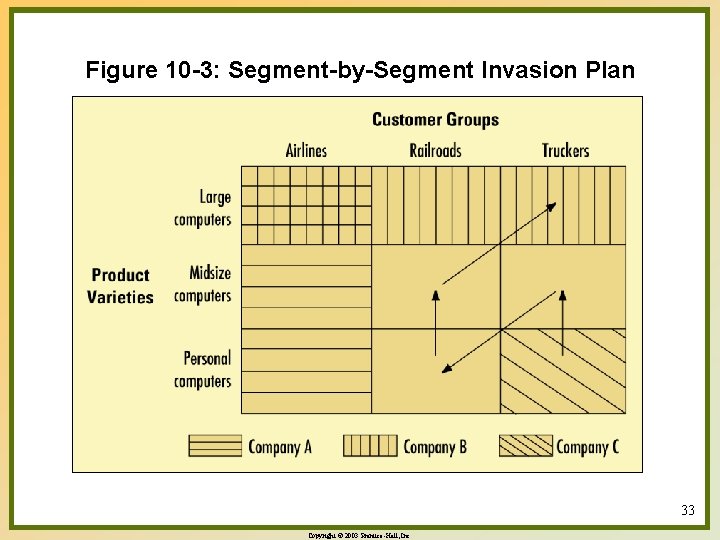
Market Targeting § Additional Considerations § Ethical Choice of Market Targets § Supersegment § Segment-By-Segment Invasion Plans 32 Copyright © 2003 Prentice-Hall, Inc.
Figure 10 -3: Segment-by-Segment Invasion Plan 33 Copyright © 2003 Prentice-Hall, Inc.
Market Targeting § Intersegment Cooperation 34 Copyright © 2003 Prentice-Hall, Inc.