
Chapter 10 Human Gene Mapping and Disease Gene
- Slides: 38
Chapter 10 Human Gene Mapping and Disease Gene Identificaton Paul Coucke Wouter Steyaert
Chapter 10 • The genetic landscape of the human genome • Mapping human genes by linkage analysis • Mapping of complex traits • From gene mapping to gene identification
Aims § The genetic landscape of the human genome 1. Independent assortement and homologous recombination in meiosis 2. Recombination frequency and map distance 3. Linkage equilibrium and disequilibrium 4. The hap. Map
Aims § Mapping human genes by linkage analysis Theory Practise 1. Interprete microsatellite results 2. Add genotypes to pedigrees 3. Create pedigree and genotype files 4. Calculate and interprete LOD-scores 5. Delineate linkage intervals
Importance of gene mapping : - Immediate clinical application as it can be used in prenatal diagnosis, presymptomatic diagnosis and carrier testing. - A first step in the identification of a disease gene (positional cloning). - An opportunity to characterize the disorder as to the extent for example of locus heterogeneity. -Makes it possible to characterize the gene itself and the mutations involved resulting in a better understanding of disease pathogenesis.
Importance of gene mapping : - Immediate clinical application as it can be used in prenatal diagnosis, presymptomatic diagnosis and carrier testing. - A first step in the identification of a disease gene (positional cloning). - An opportunity to characterize the disorder as to the extent for example of locus heterogeneity. -Makes it possible to characterize the gene itself and the mutations involved resulting in a better understanding of disease pathogenesis.
The genetic landscape of the human genome
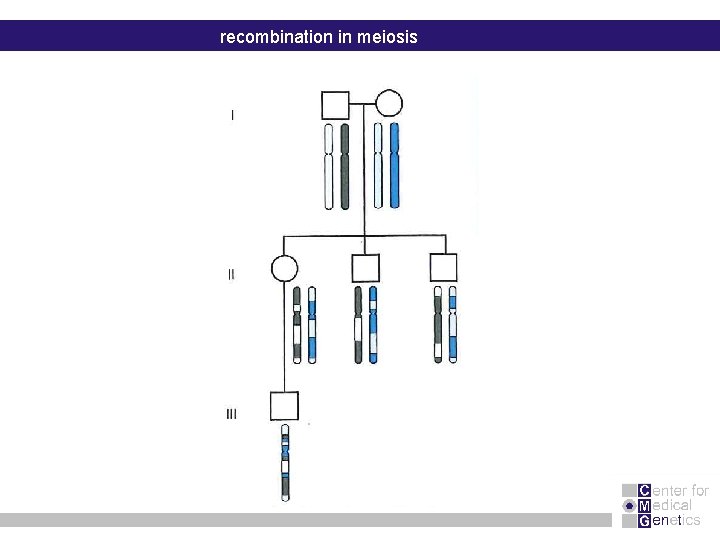
recombination in meiosis
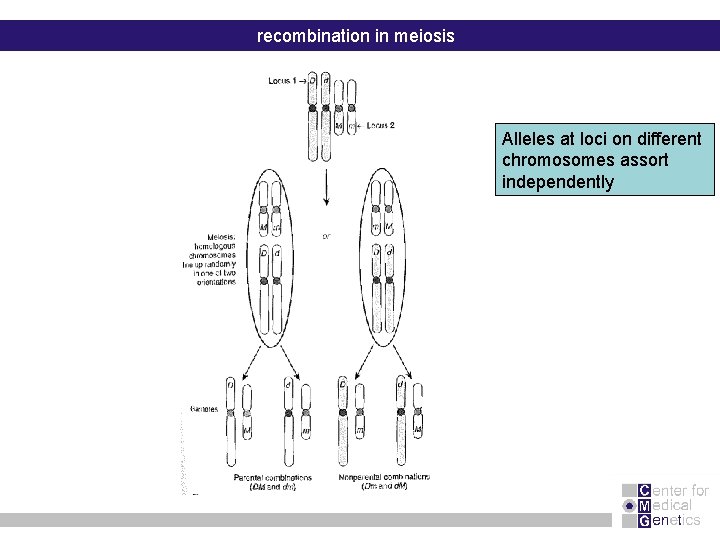
recombination in meiosis Alleles at loci on different chromosomes assort independently
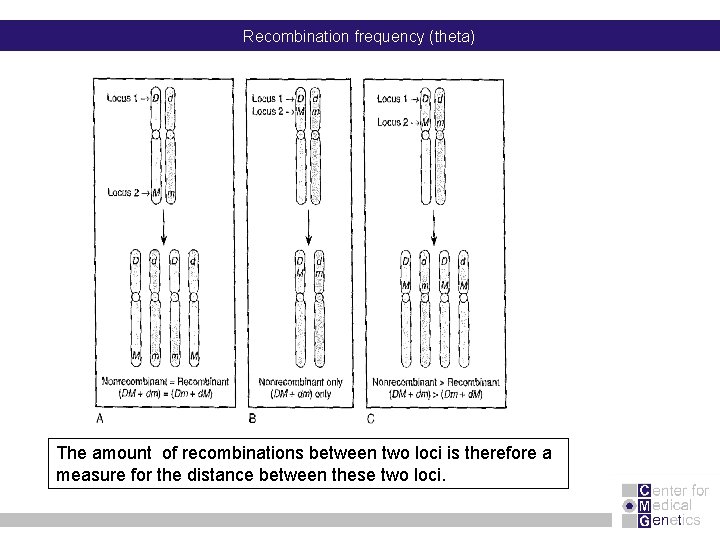
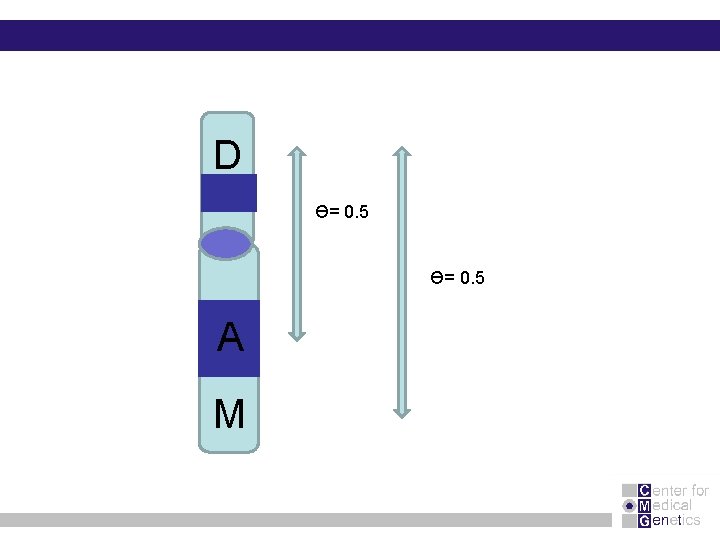
Recombination frequency (theta) The amount of recombinations between two loci is therefore a measure for the distance between these two loci.
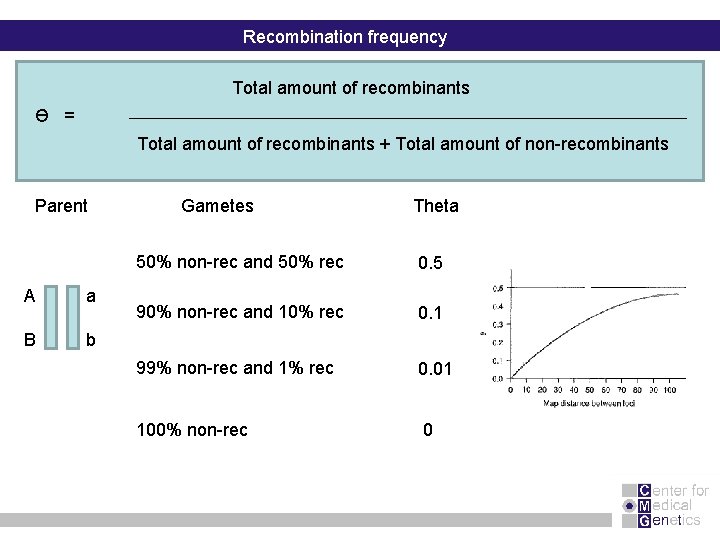
Recombination frequency Total amount of recombinants Ɵ = Total amount of recombinants + Total amount of non-recombinants Parent A a B b Gametes Theta 50% non-rec and 50% rec 0. 5 90% non-rec and 10% rec 0. 1 99% non-rec and 1% rec 0. 01 100% non-rec 0
D Ɵ= 0. 5 A A M
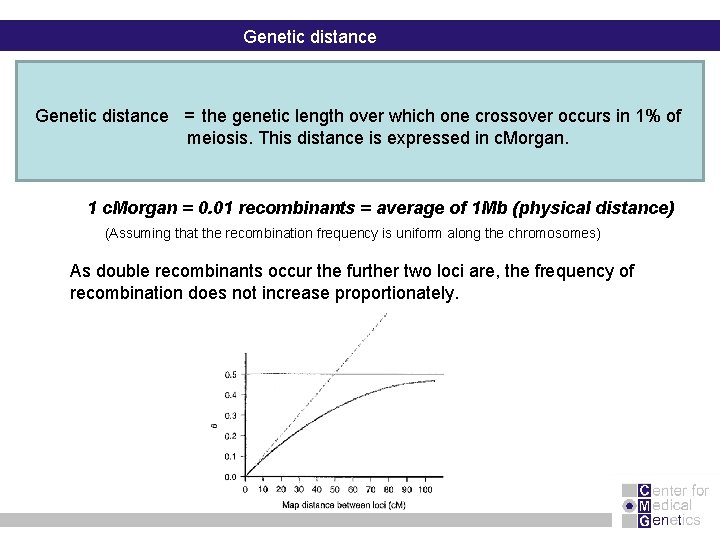
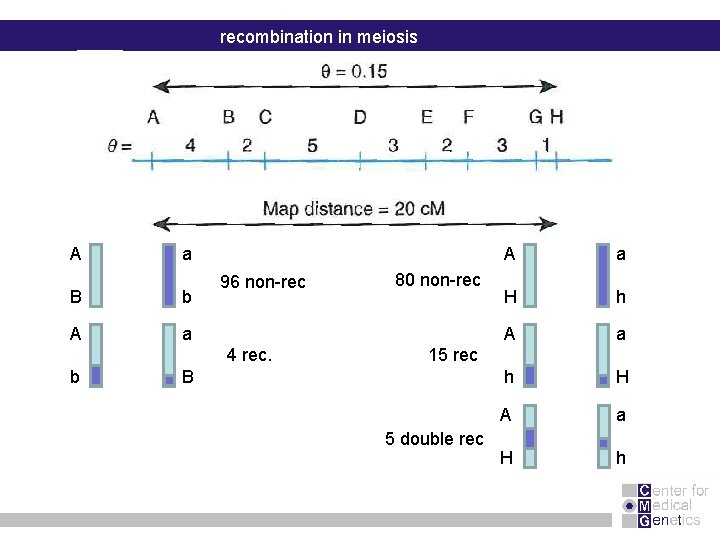
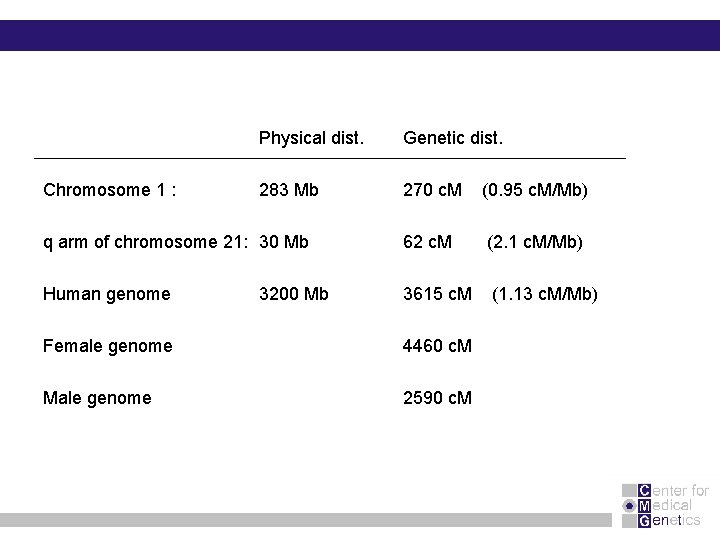
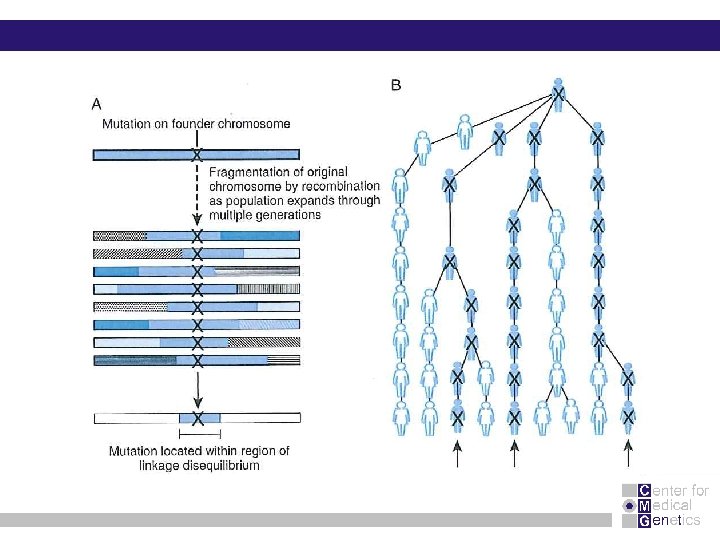
Genetic distance = the genetic length over which one crossover occurs in 1% of meiosis. This distance is expressed in c. Morgan. 1 c. Morgan = 0. 01 recombinants = average of 1 Mb (physical distance) (Assuming that the recombination frequency is uniform along the chromosomes) As double recombinants occur the further two loci are, the frequency of recombination does not increase proportionately.
recombination in meiosis A a B b A a 96 non-rec 4 rec. b 80 non-rec A a H h A a h H A a H h 15 rec B 5 double rec
Conclusion : Values of theta or genetic distance are only reliable if two loci are in the proximity of each other (max of 10 c. M)
Physical dist. Genetic dist. 283 Mb 270 c. M (0. 95 c. M/Mb) q arm of chromosome 21: 30 Mb 62 c. M (2. 1 c. M/Mb) Human genome 3615 c. M (1. 13 c. M/Mb) Chromosome 1 : 3200 Mb Female genome 4460 c. M Male genome 2590 c. M
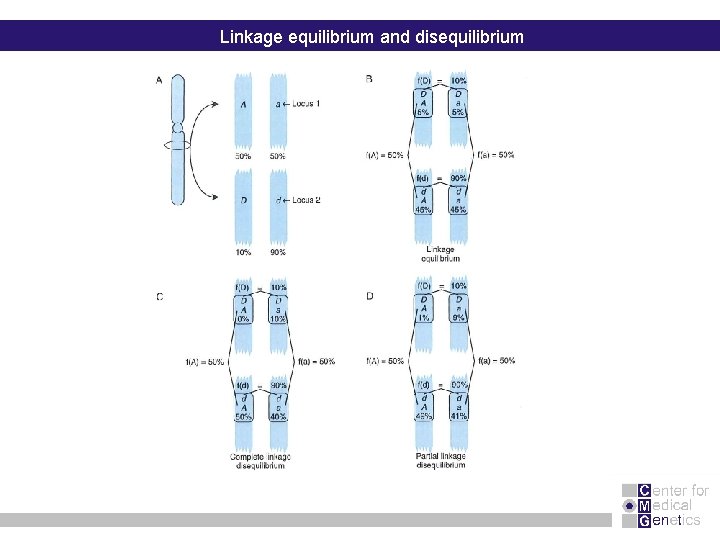
Linkage equilibrium and disequilibrium
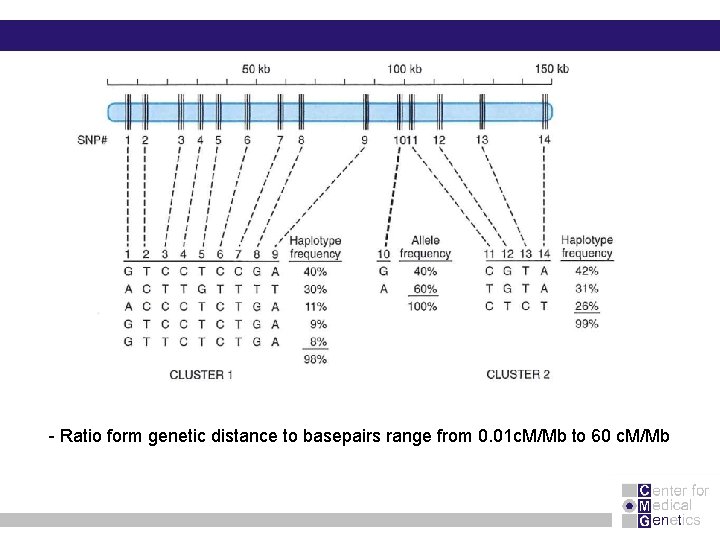
- Ratio form genetic distance to basepairs range from 0. 01 c. M/Mb to 60 c. M/Mb
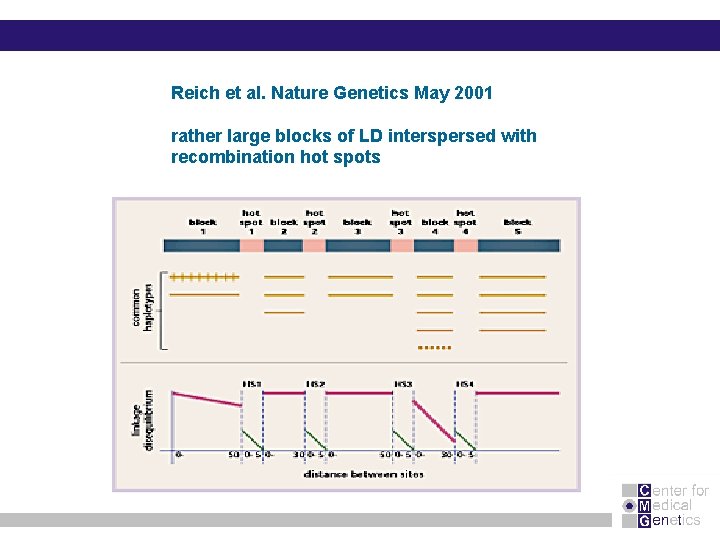
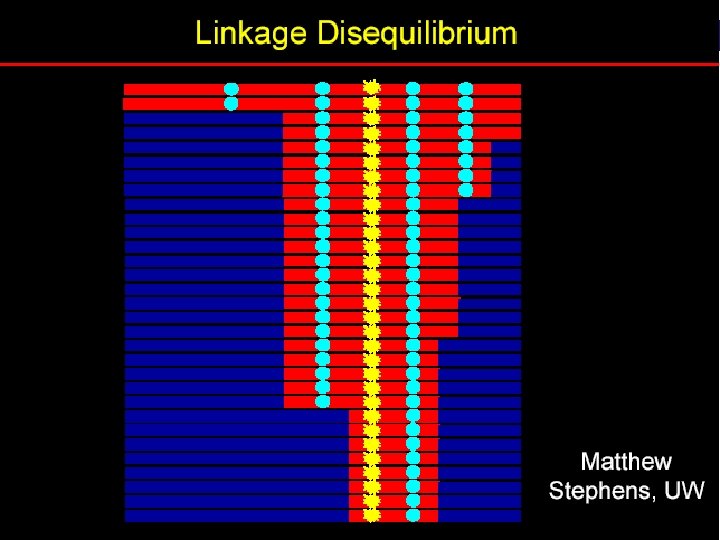
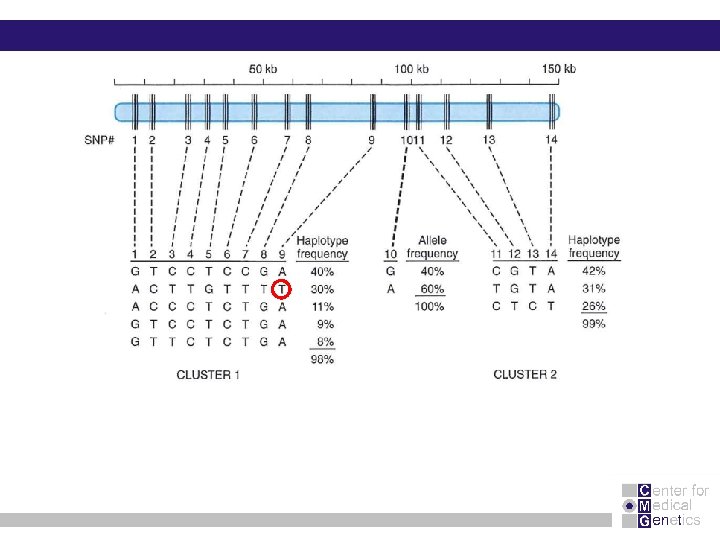
Reich et al. Nature Genetics May 2001 rather large blocks of LD interspersed with recombination hot spots
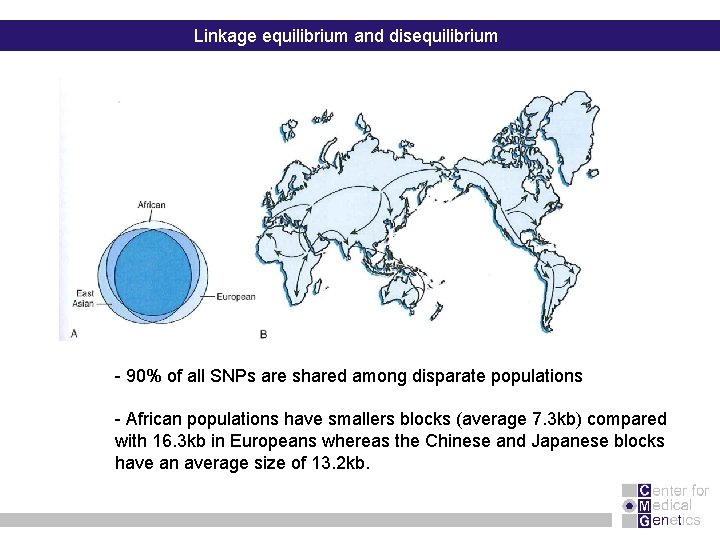
Linkage equilibrium and disequilibrium - 90% of all SNPs are shared among disparate populations - African populations have smallers blocks (average 7. 3 kb) compared with 16. 3 kb in Europeans whereas the Chinese and Japanese blocks have an average size of 13. 2 kb.
Mapping human genes by linkage analyisis
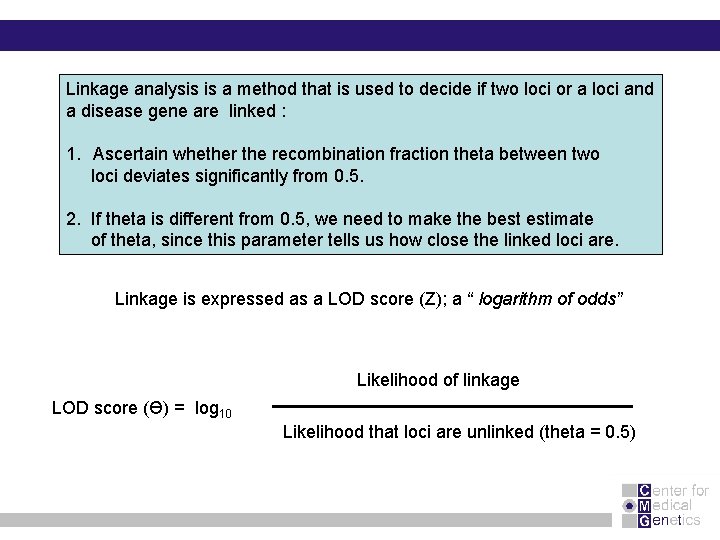
Linkage analysis is a method that is used to decide if two loci or a loci and a disease gene are linked : 1. Ascertain whether the recombination fraction theta between two loci deviates significantly from 0. 5. 2. If theta is different from 0. 5, we need to make the best estimate of theta, since this parameter tells us how close the linked loci are. Linkage is expressed as a LOD score (Z); a “ logarithm of odds” Likelihood of linkage LOD score (Ɵ) = log 10 Likelihood that loci are unlinked (theta = 0. 5)
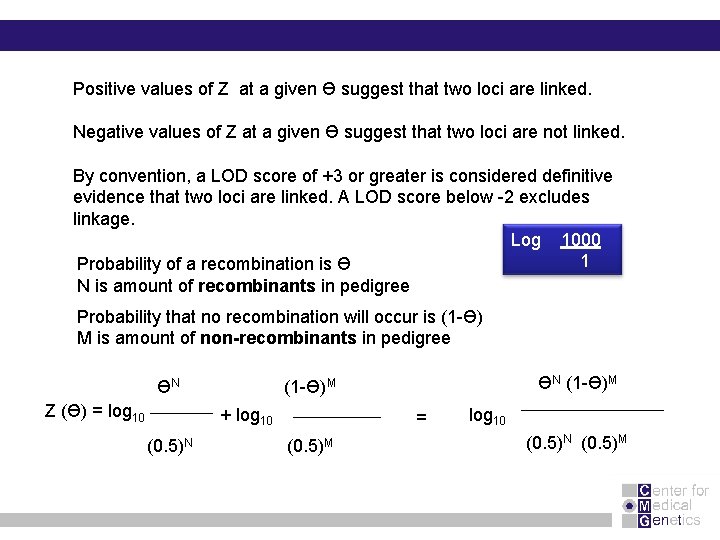
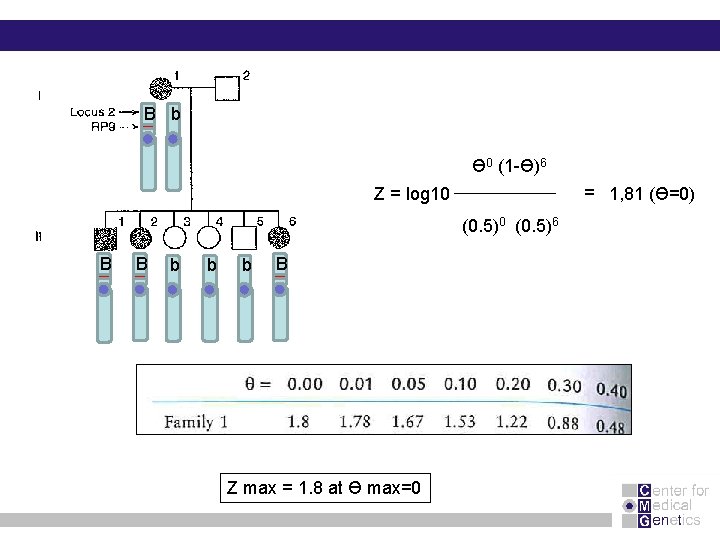
Positive values of Z at a given Ɵ suggest that two loci are linked. Negative values of Z at a given Ɵ suggest that two loci are not linked. By convention, a LOD score of +3 or greater is considered definitive evidence that two loci are linked. A LOD score below -2 excludes linkage. Log 1000 1 Probability of a recombination is Ɵ N is amount of recombinants in pedigree Probability that no recombination will occur is (1 -Ɵ) M is amount of non-recombinants in pedigree ƟN Z (Ɵ) = log 10 + log 10 (0. 5)N ƟN (1 -Ɵ)M = (0. 5)M log 10 (0. 5)N (0. 5)M
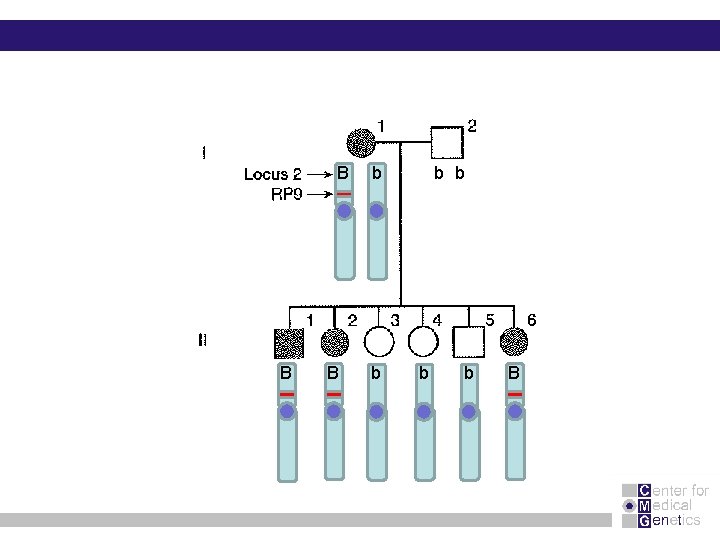
B B B b b b B
B b Ɵ 0 (1 -Ɵ)6 = 1, 81 (Ɵ=0) Z = log 10 (0. 5)6 B B b b b B Z max = 1. 8 at Ɵ max=0
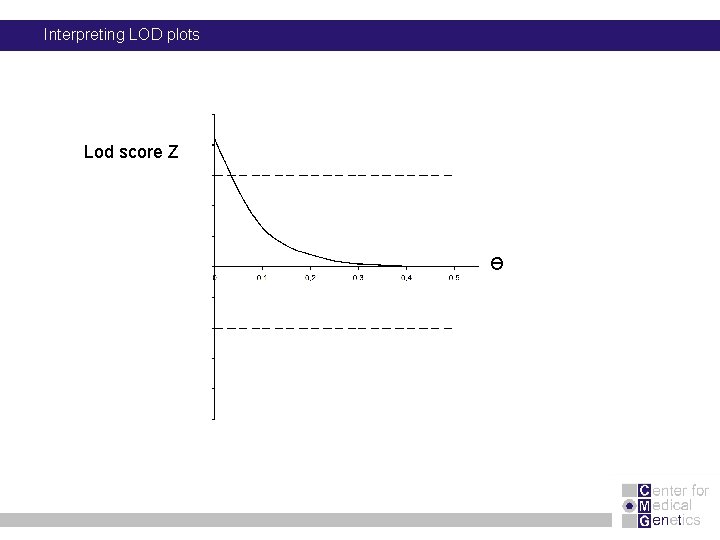
Interpreting LOD plots Lod score Z Ɵ
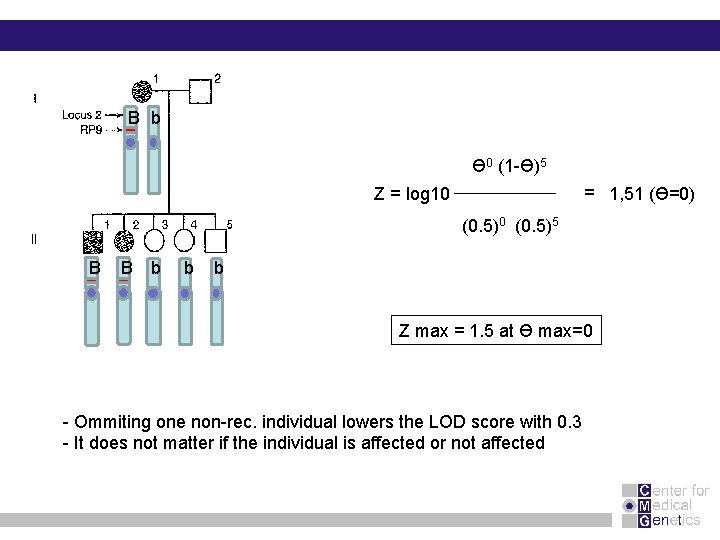
B b Ɵ 0 (1 -Ɵ)5 = 1, 51 (Ɵ=0) Z = log 10 (0. 5)5 B B b b b B Z max = 1. 5 at Ɵ max=0 - Ommiting one non-rec. individual lowers the LOD score with 0. 3 - It does not matter if the individual is affected or not affected
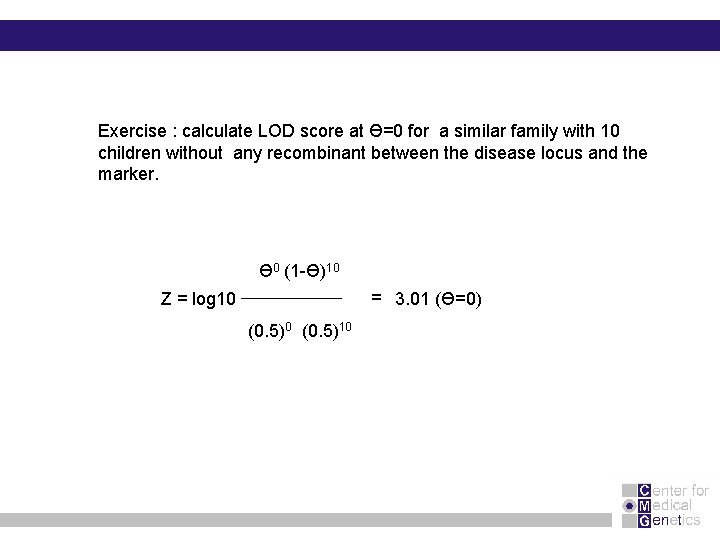
Exercise : calculate LOD score at Ө=0 for a similar family with 10 children without any recombinant between the disease locus and the marker. Ɵ 0 (1 -Ɵ)10 = 3. 01 (Ɵ=0) Z = log 10 (0. 5)10
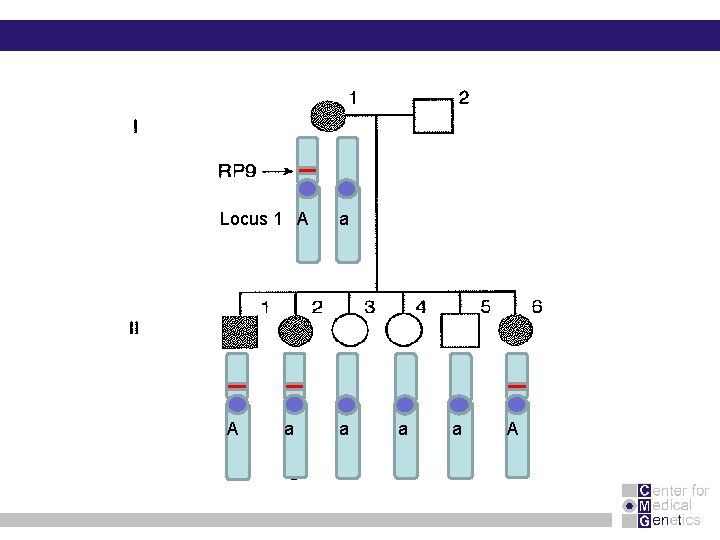
Locus 1 A A a a a A
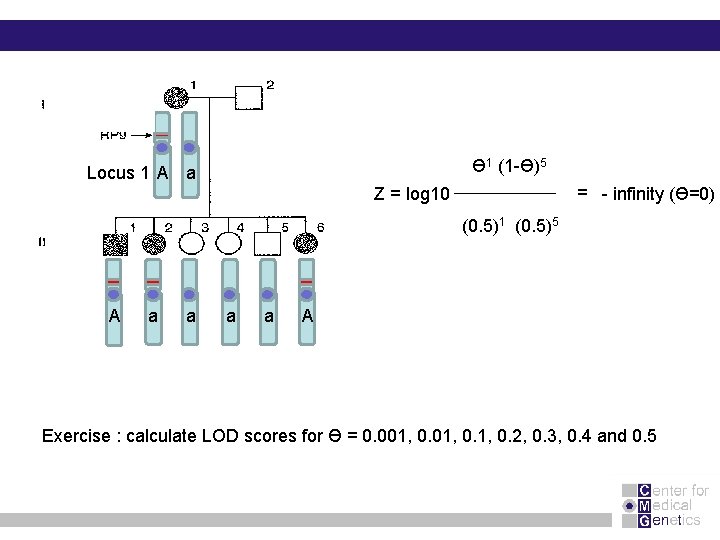
Ɵ 1 (1 -Ɵ)5 Locus 1 A a = - infinity (Ɵ=0) Z = log 10 (0. 5)1 (0. 5)5 A a a A Exercise : calculate LOD scores for Ө = 0. 001, 0. 2, 0. 3, 0. 4 and 0. 5
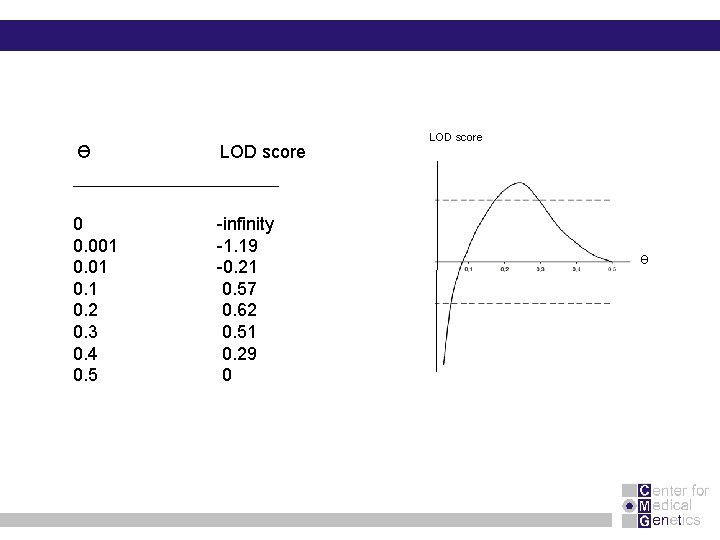
Ɵ LOD score 0 0. 001 0. 2 0. 3 0. 4 0. 5 -infinity -1. 19 -0. 21 0. 57 0. 62 0. 51 0. 29 0 LOD score Ɵ
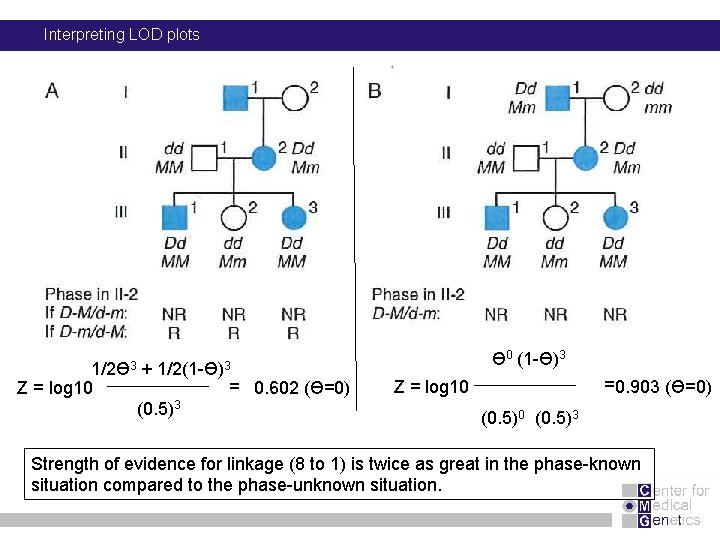
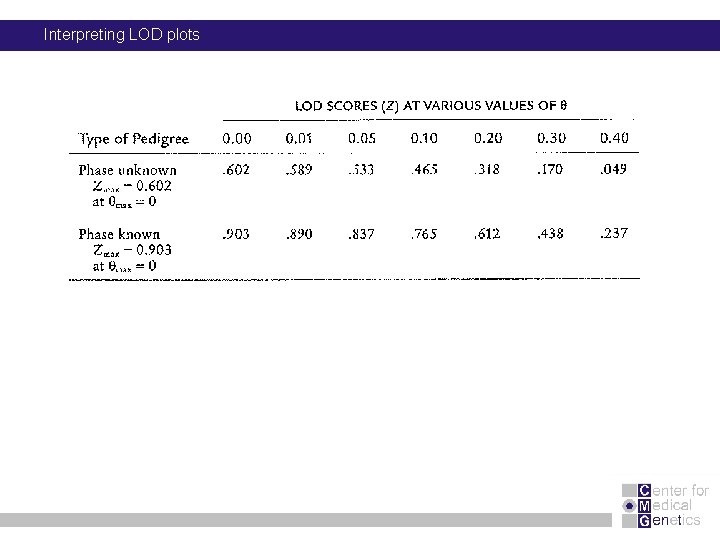
Interpreting LOD plots 1/2Ɵ 3 Z = log 10 + 1/2(1 -Ɵ)3 (0. 5)3 = 0. 602 (Ɵ=0) Ɵ 0 (1 -Ɵ)3 = 0. 903 (Ɵ=0) Z = log 10 (0. 5)3 Strength of evidence for linkage (8 to 1) is twice as great in the phase-known situation compared to the phase-unknown situation.
Interpreting LOD plots
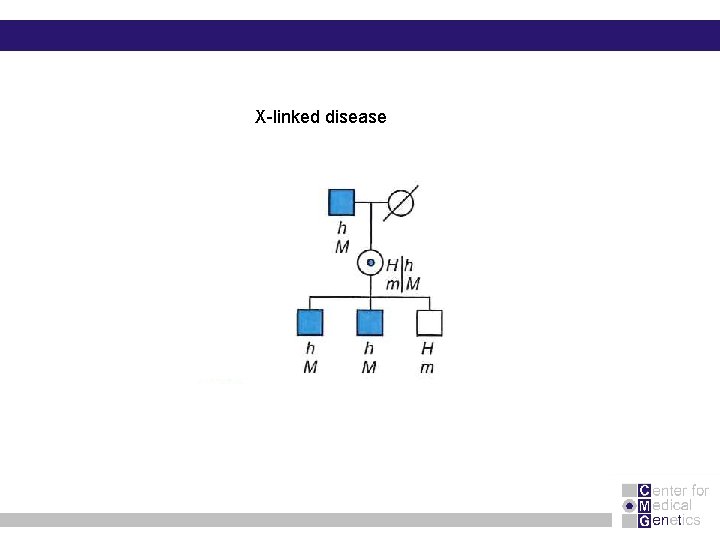
X-linked disease