
Chapter 10 Gathering Information Sources of Information l
- Slides: 16
Chapter 10 Gathering Information
Sources of Information l Identify the Main Points – Determine what you already know. – Personal knowledge is a good starting point. – Most of your research will use print and electronic media.
Print Sources l Books – Offer several advantages over electronic sources: l Book develop the topic in greater detail than a web article. l Books are more inclined to provide credible evidence. l Books are more readily accessible, permanent sources of information in hard copy.
Print Sources l Periodicals – Newspapers, magazines and journals – One advantage is that they are current. – Generally, they are respected as reliable sources of information.
Print Sources l Reference Materials – Contain more limited information in condensed form – Kept separate from shelved books – Cannot be removed from the library – Includes: l Dictionaries l Government documents l Statistical abstracts
Electronic Sources l Library Databases – Collection of indexed information that you can access on your computer – Includes a wide variety of newspapers, magazines and professional journals – Benefits: l Easily accessed l Credible
Electronic Sources l World Wide Web – Books, journals and other library resources have been evaluated by scholars, publishers and librarians – Assess the article with care – Consider the author and author’s credentials – Consider the organization
Electronic Sources l Tips for Good Web Searching – How reliable is the authority of the site? – What’s the purpose and objectivity of the site? – How is the content of the site? – How current is the website? – Does the website meet your needs
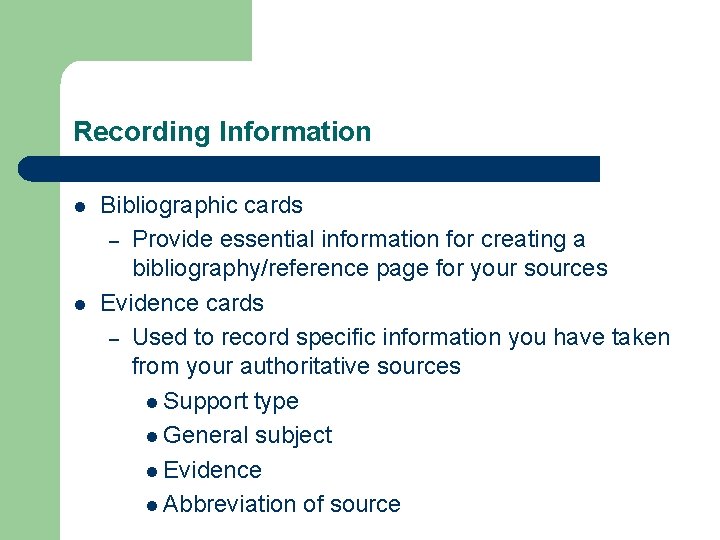
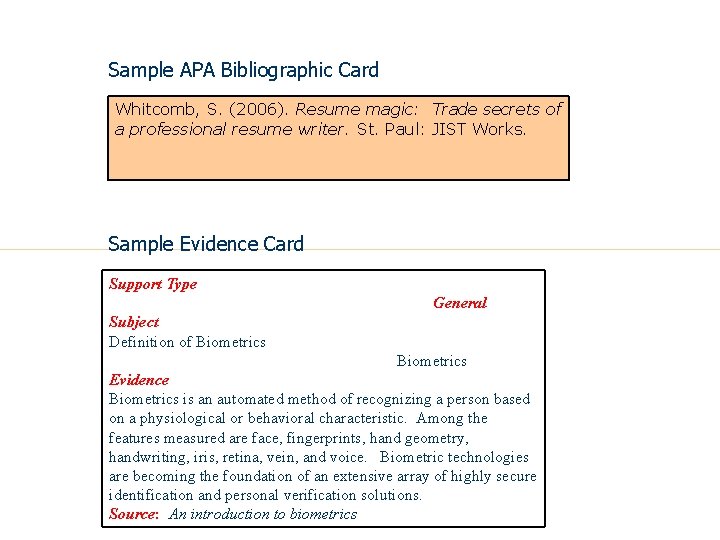
Recording Information l l Bibliographic cards – Provide essential information for creating a bibliography/reference page for your sources Evidence cards – Used to record specific information you have taken from your authoritative sources l Support type l General subject l Evidence l Abbreviation of source
Sample APA Bibliographic Card Whitcomb, S. (2006). Resume magic: Trade secrets of a professional resume writer. St. Paul: JIST Works. Sample Evidence Card Support Type General Subject Definition of Biometrics Evidence Biometrics is an automated method of recognizing a person based on a physiological or behavioral characteristic. Among the features measured are face, fingerprints, hand geometry, handwriting, iris, retina, vein, and voice. Biometric technologies are becoming the foundation of an extensive array of highly secure identification and personal verification solutions. Source: An introduction to biometrics
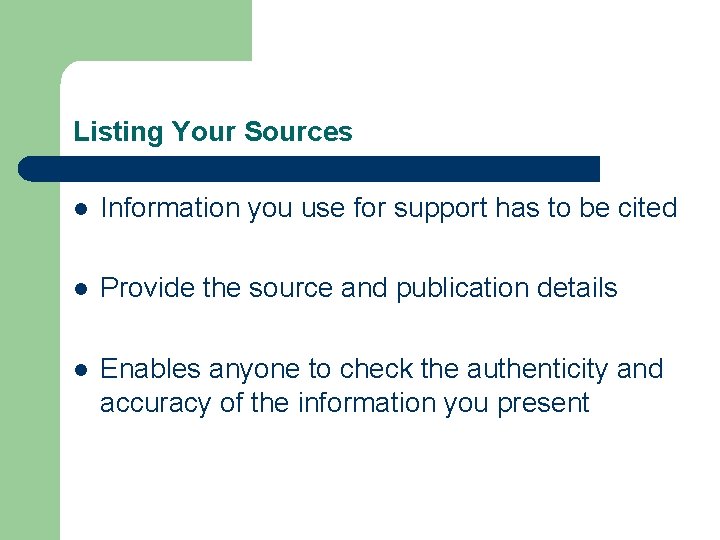
Listing Your Sources l Information you use for support has to be cited l Provide the source and publication details l Enables anyone to check the authenticity and accuracy of the information you present
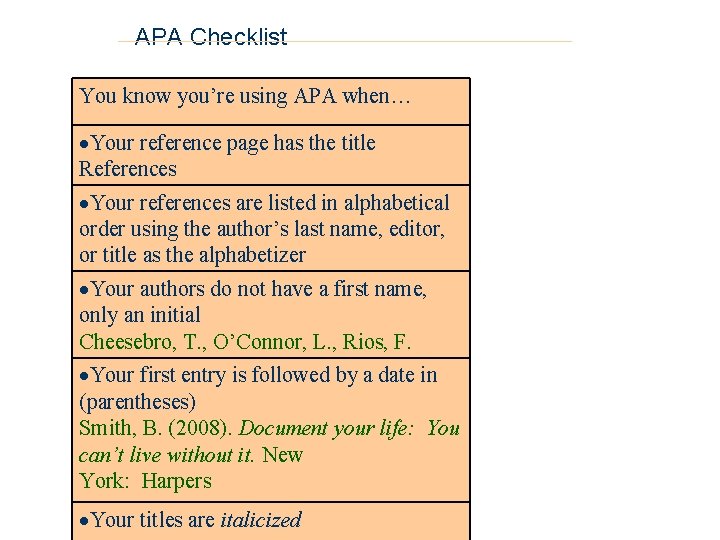
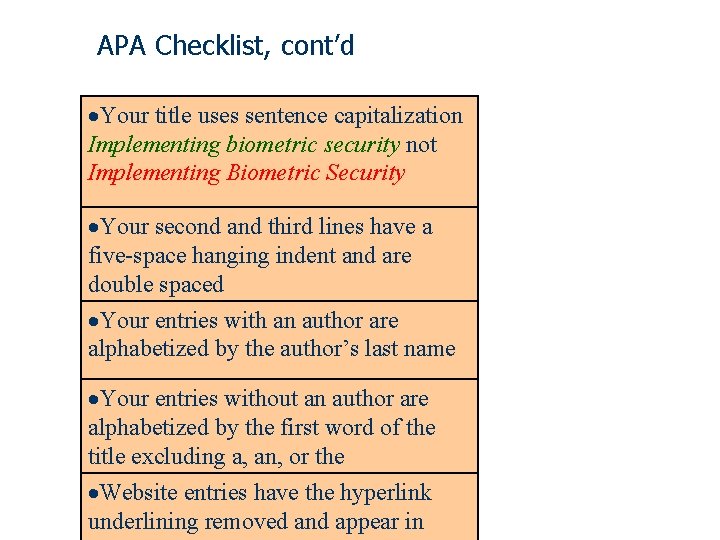
APA Checklist You know you’re using APA when… Your reference page has the title References Your references are listed in alphabetical order using the author’s last name, editor, or title as the alphabetizer Your authors do not have a first name, only an initial Cheesebro, T. , O’Connor, L. , Rios, F. Your first entry is followed by a date in (parentheses) Smith, B. (2008). Document your life: You can’t live without it. New York: Harpers Your titles are italicized
APA Checklist, cont’d Your title uses sentence capitalization Implementing biometric security not Implementing Biometric Security Your second and third lines have a five-space hanging indent and are double spaced Your entries with an author are alphabetized by the author’s last name Your entries without an author are alphabetized by the first word of the title excluding a, an, or the Website entries have the hyperlink underlining removed and appear in
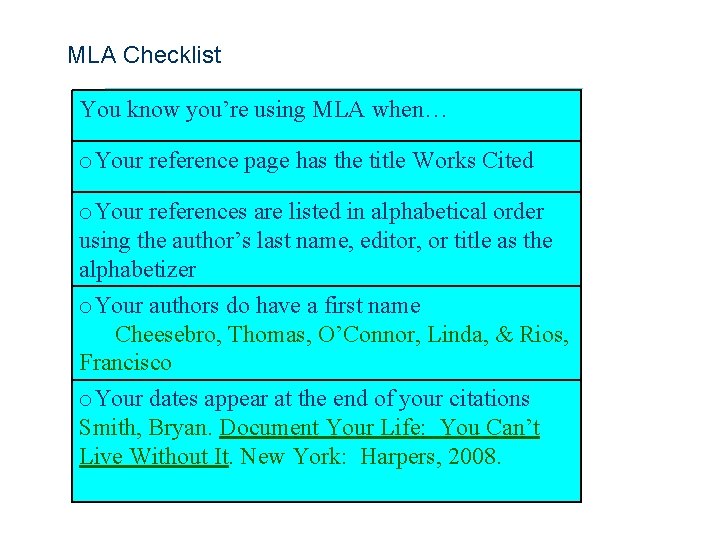
MLA Checklist You know you’re using MLA when… o. Your reference page has the title Works Cited o. Your references are listed in alphabetical order using the author’s last name, editor, or title as the alphabetizer o. Your authors do have a first name Cheesebro, Thomas, O’Connor, Linda, & Rios, Francisco o. Your dates appear at the end of your citations Smith, Bryan. Document Your Life: You Can’t Live Without It. New York: Harpers, 2008.
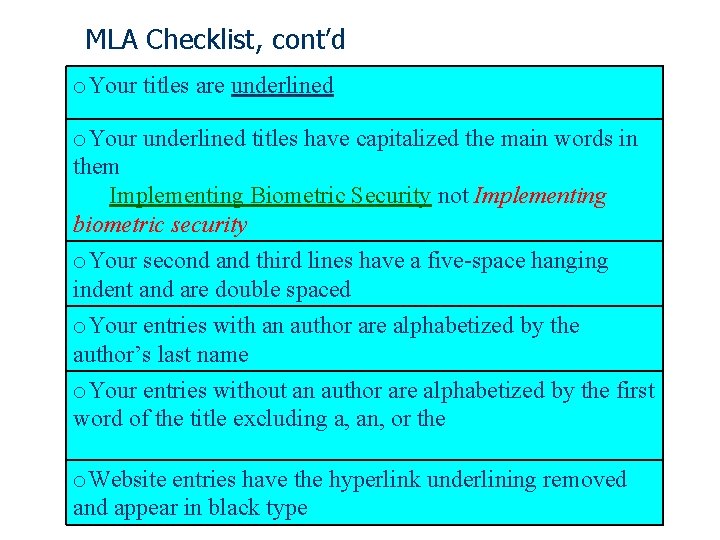
MLA Checklist, cont’d o. Your titles are underlined o. Your underlined titles have capitalized the main words in them Implementing Biometric Security not Implementing biometric security o. Your second and third lines have a five-space hanging indent and are double spaced o. Your entries with an author are alphabetized by the author’s last name o. Your entries without an author are alphabetized by the first word of the title excluding a, an, or the o. Website entries have the hyperlink underlining removed and appear in black type
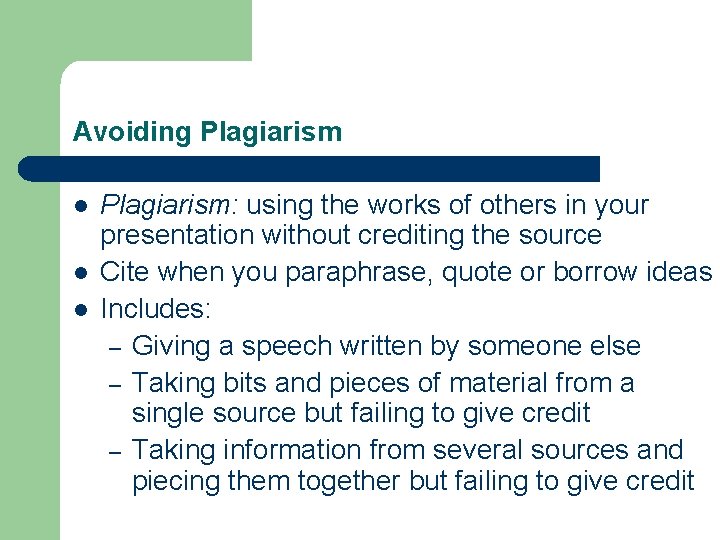
Avoiding Plagiarism l l l Plagiarism: using the works of others in your presentation without crediting the source Cite when you paraphrase, quote or borrow ideas Includes: – Giving a speech written by someone else – Taking bits and pieces of material from a single source but failing to give credit – Taking information from several sources and piecing them together but failing to give credit