
CHAPTER 10 FORCES NOTES on 10 5 Rockets
- Slides: 5
CHAPTER 10: FORCES NOTES on 10. 5 Rockets and Satellites
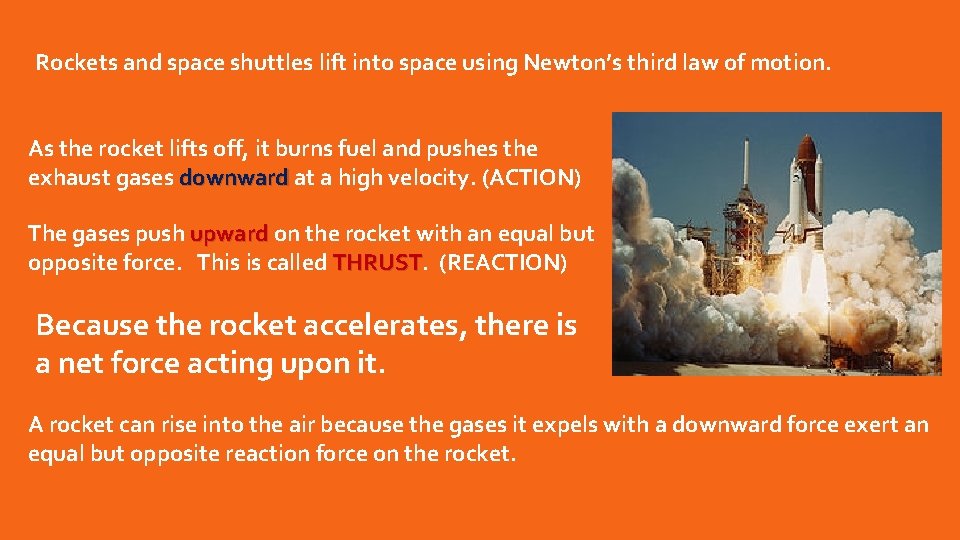
Rockets and space shuttles lift into space using Newton’s third law of motion. As the rocket lifts off, it burns fuel and pushes the exhaust gases downward at a high velocity. (ACTION) The gases push upward on the rocket with an equal but opposite force. This is called THRUST (REACTION) Because the rocket accelerates, there is a net force acting upon it. A rocket can rise into the air because the gases it expels with a downward force exert an equal but opposite reaction force on the rocket.
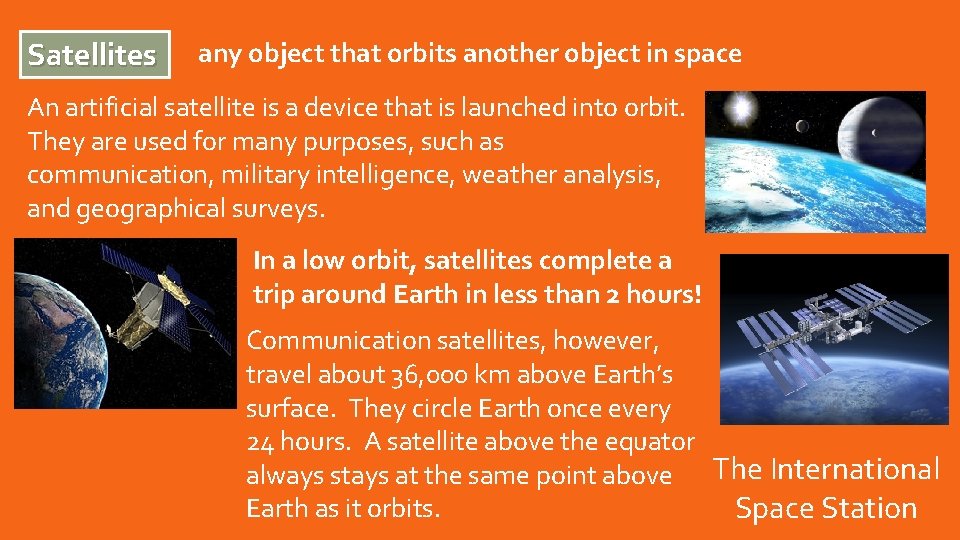
Satellites any object that orbits another object in space An artificial satellite is a device that is launched into orbit. They are used for many purposes, such as communication, military intelligence, weather analysis, and geographical surveys. In a low orbit, satellites complete a trip around Earth in less than 2 hours! Communication satellites, however, travel about 36, 000 km above Earth’s surface. They circle Earth once every 24 hours. A satellite above the equator always stays at the same point above The International Earth as it orbits. Space Station
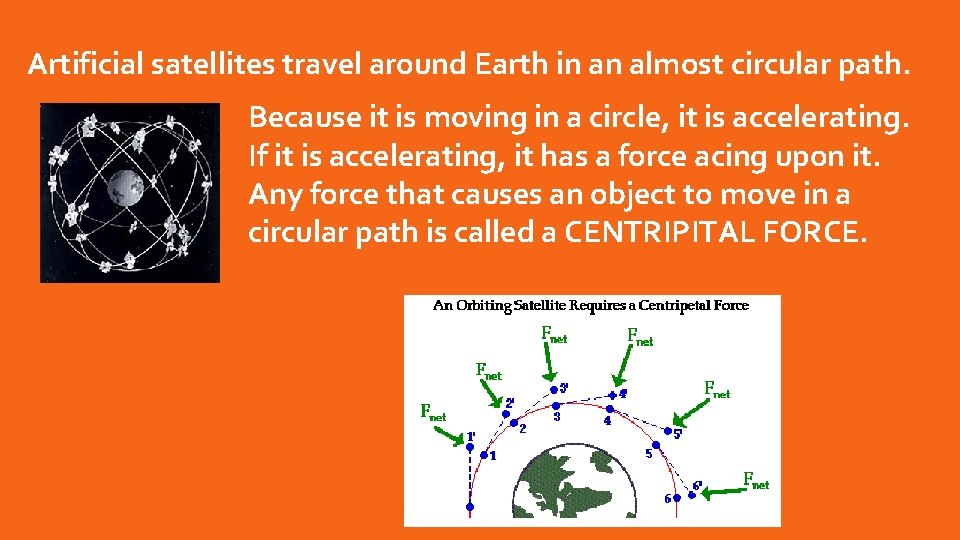
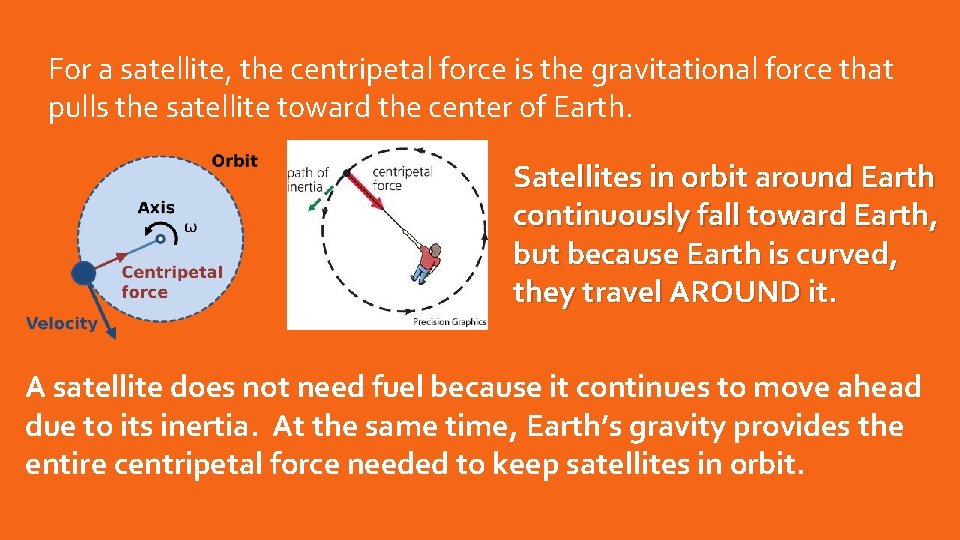
Artificial satellites travel around Earth in an almost circular path. Because it is moving in a circle, it is accelerating. If it is accelerating, it has a force acing upon it. Any force that causes an object to move in a circular path is called a CENTRIPITAL FORCE.
For a satellite, the centripetal force is the gravitational force that pulls the satellite toward the center of Earth. Satellites in orbit around Earth continuously fall toward Earth, but because Earth is curved, they travel AROUND it. A satellite does not need fuel because it continues to move ahead due to its inertia. At the same time, Earth’s gravity provides the entire centripetal force needed to keep satellites in orbit.