
Chapter 10 Food Safety Management Systems Objectives 8
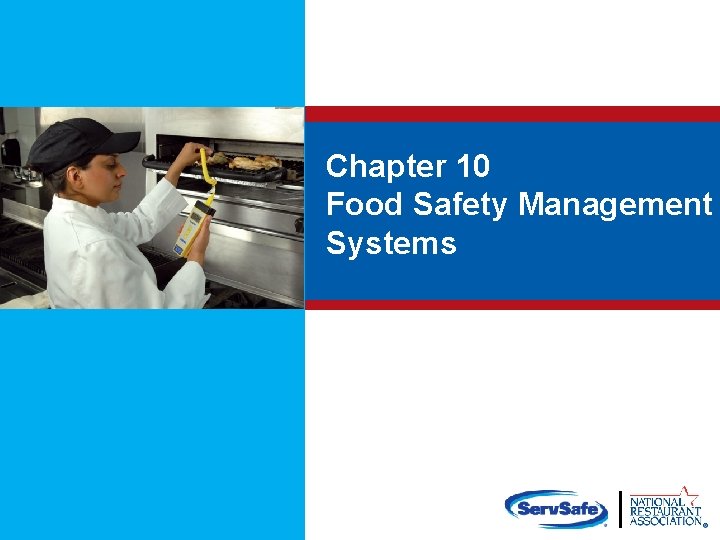
Chapter 10 Food Safety Management Systems
Objectives: 8 -2 l Food safety management systems l Active managerial control l Hazard Analysis Critical Control point (HACCP)
Food Safety Management Systems Food safety management system: 8 -3 l Group of practices and procedures intended to prevent foodborne illness l Actively controls risks and hazards throughout the flow of food
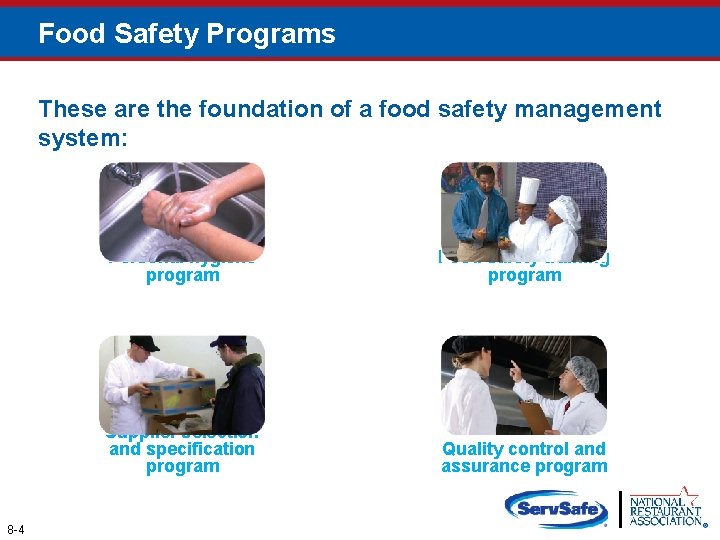
Food Safety Programs These are the foundation of a food safety management system: 8 -4 Personal hygiene program Food safety training program Supplier selection and specification program Quality control and assurance program
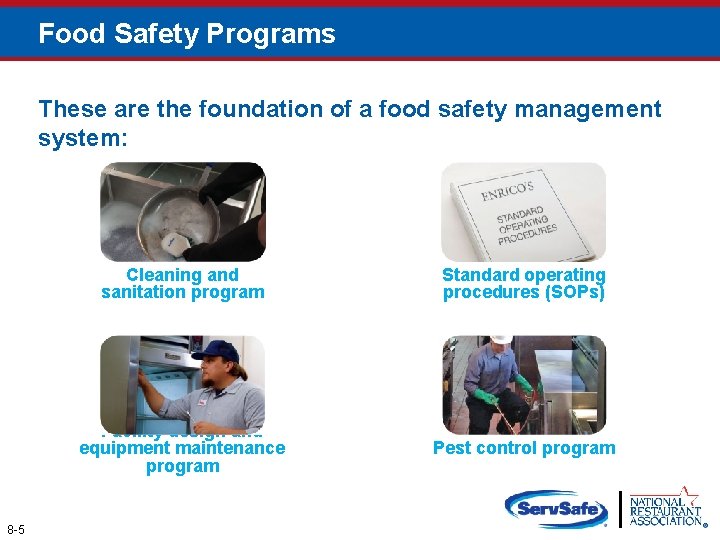
Food Safety Programs These are the foundation of a food safety management system: 8 -5 Cleaning and sanitation program Standard operating procedures (SOPs) Facility design and equipment maintenance program Pest control program
Active Managerial Control Focuses on controlling the five most common risk factors for foodborne illness: 1. Purchasing food from unsafe sources 2. Failing to cook food adequately 3. Holding food at incorrect temperatures 4. Using contaminated equipment 5. Practicing poor personal hygiene 8 -6
Active Managerial Control There are many ways to achieve active managerial control in the operation: l Training programs l Manager supervision l Incorporation of standard operating procedures (SOPs) l HACCP These are critical to the success of active managerial control: 8 -7 l Monitoring critical activities in the operation l Taking the necessary corrective action when required l Verifying that the actions taken control the risks factors
Active Managerial Control The FDA provides recommendations for controlling the common risk factors for foodborne illness: 8 -8 l Demonstration of knowledge – you must be able to show you know how to keep food safe l Staff health controls – procedures for practicing personal hygiene l Controlling hands as a vehicle of contamination – you must have controls to prevent bare-hand contact with ready-to-eat foods
Active Managerial Controll - continued l Time and temperature parameters for controlling pathogens – procedures must be in place to limit the time food spends in the temperature danger zone. Employees must check temperatures every 2 hours. l Consumer advisories – notices must be provided to customers if you serve raw or undercooked menu items, there must be a statement that talks about the risks of eating these foods
HACCP The HACCP approach: 8 -9 l HACCP is based on identifying significant biological, chemical, or physical hazards at specific points within a product’s flow through an operation l Once identified, hazards can be prevented, eliminated, or reduced to safe levels
HACCP To be effective, a HACCP system must be based on a written plan: 8 -10 l It must be specific to each facility’s menu, customers, equipment, processes, and operations l A plan that works for one operation may not work for another
The 7 HACCP Principles The seven HACCP principles: 1. Conduct a hazard analysis 2. Determine critical control points (CCPs) 3. Establish critical limits 4. Establish monitoring procedures 5. Identify corrective actions 6. Verify that the system works 7. Establish procedures for record keeping and documentation 8 -11
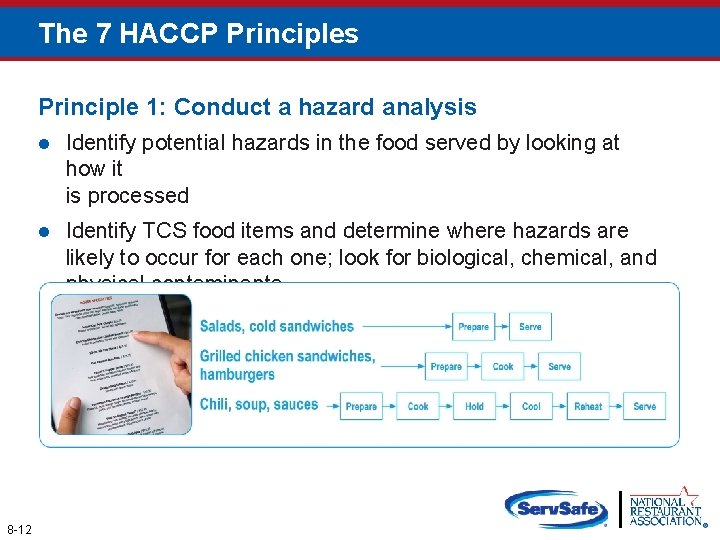
The 7 HACCP Principles Principle 1: Conduct a hazard analysis 8 -12 l Identify potential hazards in the food served by looking at how it is processed l Identify TCS food items and determine where hazards are likely to occur for each one; look for biological, chemical, and physical contaminants
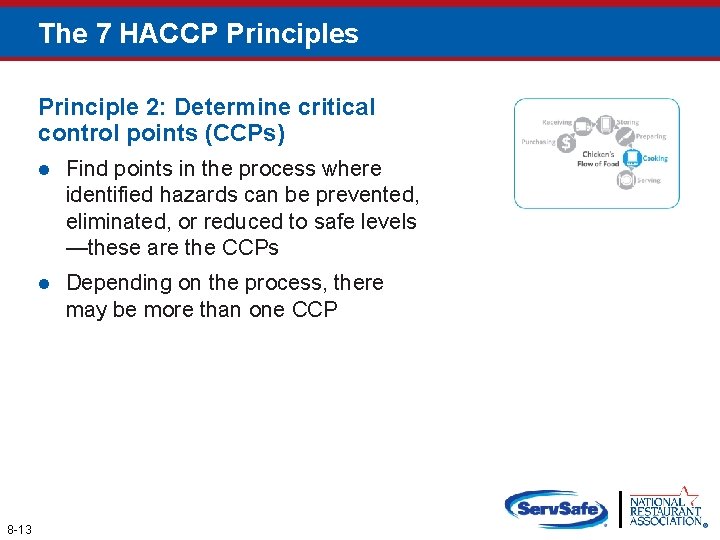
The 7 HACCP Principles Principle 2: Determine critical control points (CCPs) 8 -13 l Find points in the process where identified hazards can be prevented, eliminated, or reduced to safe levels —these are the CCPs l Depending on the process, there may be more than one CCP
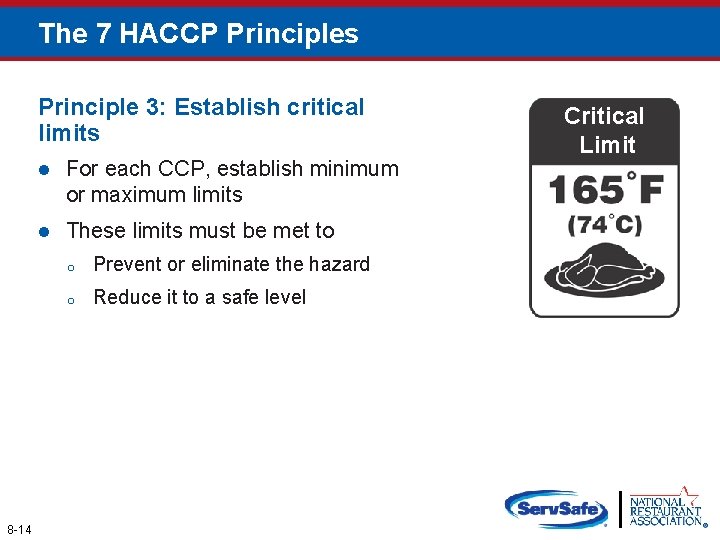
The 7 HACCP Principles Principle 3: Establish critical limits 8 -14 l For each CCP, establish minimum or maximum limits l These limits must be met to o Prevent or eliminate the hazard o Reduce it to a safe level Critical Limit
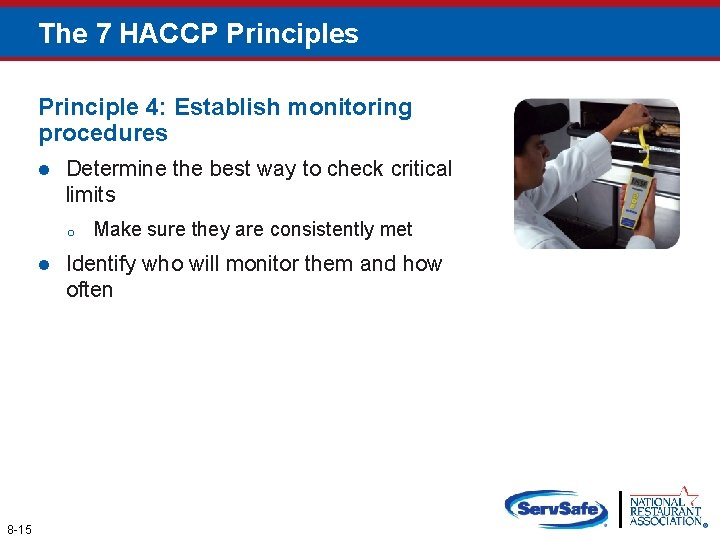
The 7 HACCP Principles Principle 4: Establish monitoring procedures l Determine the best way to check critical limits o l 8 -15 Make sure they are consistently met Identify who will monitor them and how often
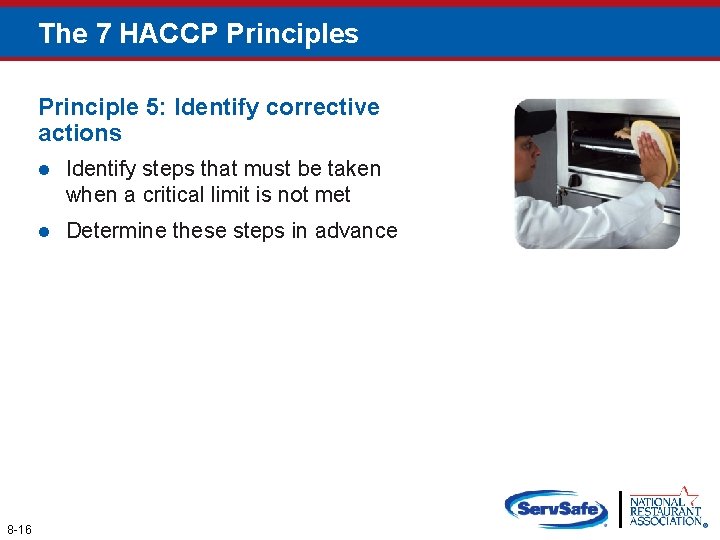
The 7 HACCP Principles Principle 5: Identify corrective actions 8 -16 l Identify steps that must be taken when a critical limit is not met l Determine these steps in advance
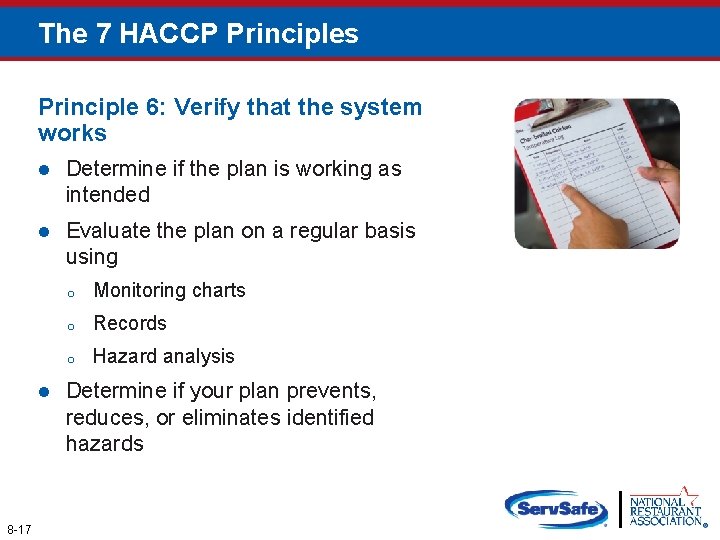
The 7 HACCP Principles Principle 6: Verify that the system works l Determine if the plan is working as intended l Evaluate the plan on a regular basis using l 8 -17 o Monitoring charts o Records o Hazard analysis Determine if your plan prevents, reduces, or eliminates identified hazards
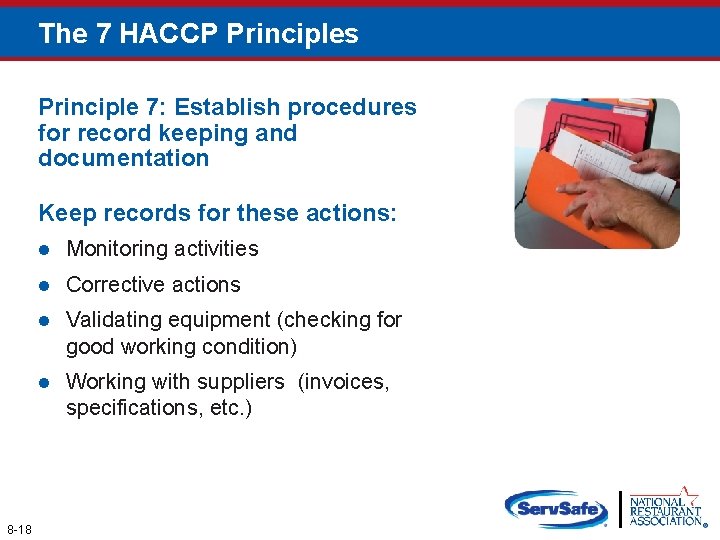
The 7 HACCP Principles Principle 7: Establish procedures for record keeping and documentation Keep records for these actions: 8 -18 l Monitoring activities l Corrective actions l Validating equipment (checking for good working condition) l Working with suppliers (invoices, specifications, etc. )
HACCP These specialized processing methods require a variance and may require a HACCP plan: 8 -19 l Smoking food as a method to preserve it (but not to enhance flavor) l Using food additives or components such as vinegar to preserve or alter food so it no longer requires time and temperature control for safety l Curing food l Custom-processing animals
HACCP These specialized processing methods require a variance and may require a HACCP plan: l 8 -20 Packaging food using ROP methods including o MAP o Vacuum-packed o Sous vide l Treating (e. g. pasteurizing) juice on-site and packaging it for later sale l Sprouting seeds or beans
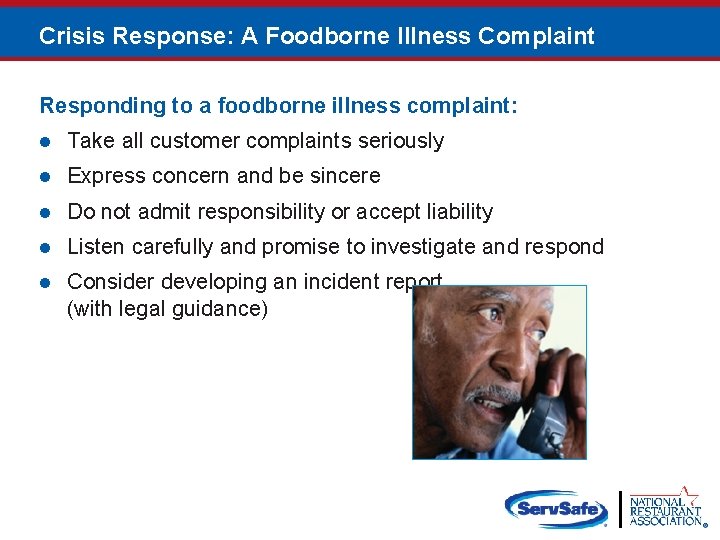
Crisis Response: A Foodborne Illness Complaint Responding to a foodborne illness complaint: l Take all customer complaints seriously l Express concern and be sincere l Do not admit responsibility or accept liability l Listen carefully and promise to investigate and respond l Consider developing an incident report (with legal guidance)
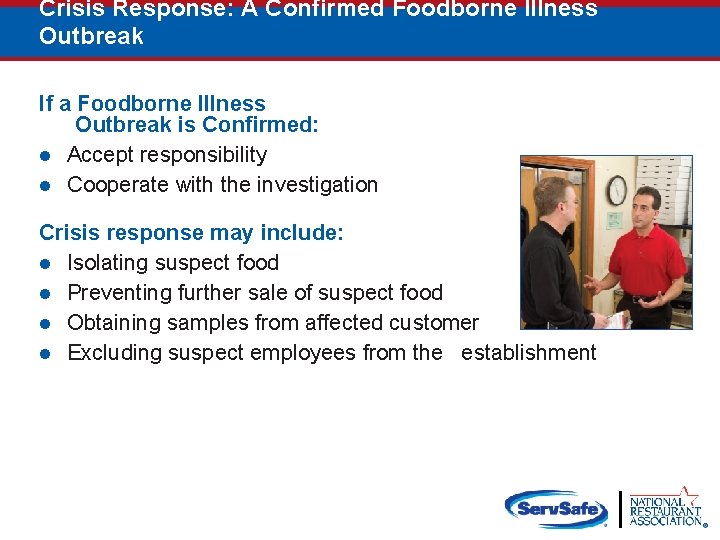
Crisis Response: A Confirmed Foodborne Illness Outbreak If a Foodborne Illness Outbreak is Confirmed: l Accept responsibility l Cooperate with the investigation Crisis response may include: l Isolating suspect food l Preventing further sale of suspect food l Obtaining samples from affected customer l Excluding suspect employees from the establishment
Imminent Health Hazards An imminent health hazard is a significant threat or danger to health that requires immediate correction or closure to prevent injury. If there is a significant risk to the safety or the security of your food, service must be stopped. Then the local regulatory authority must be notified. Spoiled or contaminated food must be thrown out, along with food in packaging that is not intact.
- Slides: 24