
Chapter 10 Fluids substances which flow Liquids take
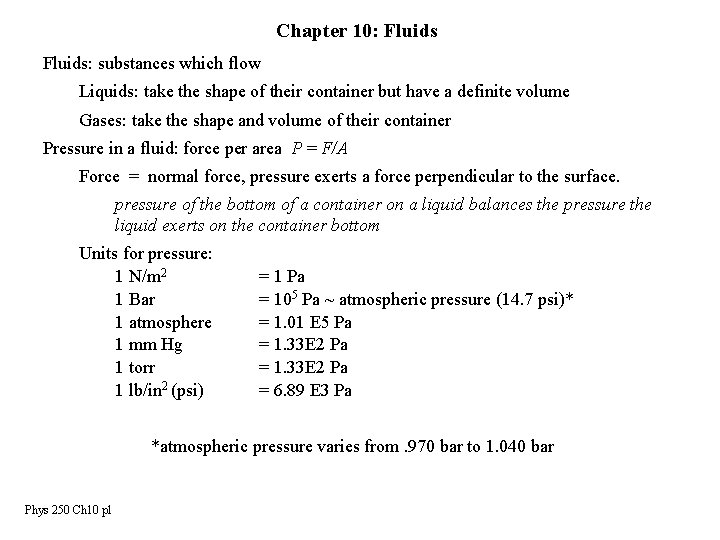
Chapter 10: Fluids: substances which flow Liquids: take the shape of their container but have a definite volume Gases: take the shape and volume of their container Pressure in a fluid: force per area P = F/A Force = normal force, pressure exerts a force perpendicular to the surface. pressure of the bottom of a container on a liquid balances the pressure the liquid exerts on the container bottom Units for pressure: 1 N/m 2 1 Bar 1 atmosphere 1 mm Hg 1 torr 1 lb/in 2 (psi) = 1 Pa = 105 Pa ~ atmospheric pressure (14. 7 psi)* = 1. 01 E 5 Pa = 1. 33 E 2 Pa = 6. 89 E 3 Pa *atmospheric pressure varies from. 970 bar to 1. 040 bar Phys 250 Ch 10 p 1
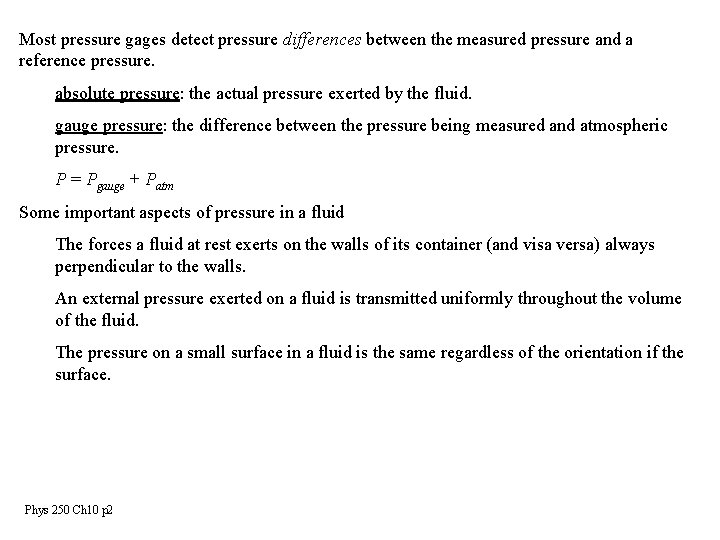
Most pressure gages detect pressure differences between the measured pressure and a reference pressure. absolute pressure: the actual pressure exerted by the fluid. gauge pressure: the difference between the pressure being measured and atmospheric pressure. P = Pgauge + Patm Some important aspects of pressure in a fluid The forces a fluid at rest exerts on the walls of its container (and visa versa) always perpendicular to the walls. An external pressure exerted on a fluid is transmitted uniformly throughout the volume of the fluid. The pressure on a small surface in a fluid is the same regardless of the orientation if the surface. Phys 250 Ch 10 p 2
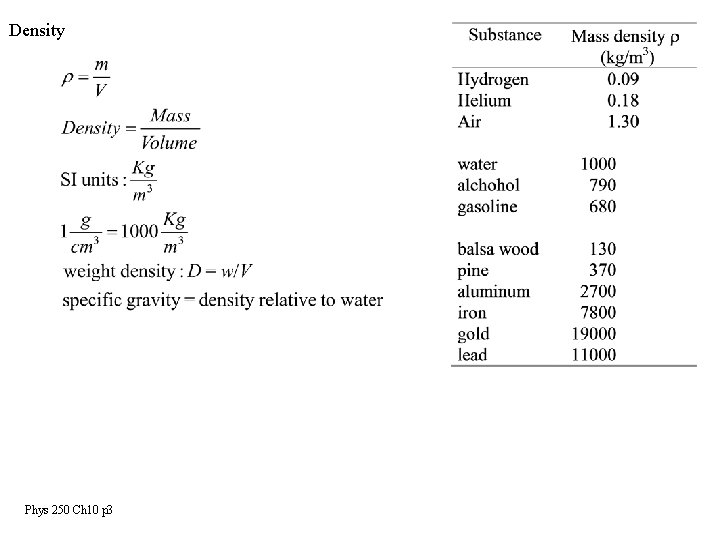
Density Phys 250 Ch 10 p 3
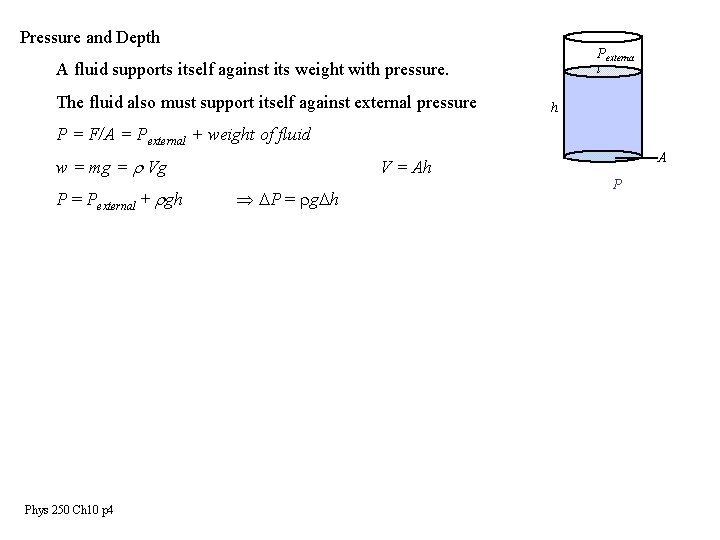
Pressure and Depth Pexterna A fluid supports itself against its weight with pressure. The fluid also must support itself against external pressure l h P = F/A = Pexternal + weight of fluid w = mg = r Vg P = Pexternal + rgh Phys 250 Ch 10 p 4 V = Ah DP = rg. Dh A P

Example: A tank is filled with water to a depth of 1. 5 m. What is the pressure at the bottom of the tank due to the water alone? Example: How high above an IV insertion point into the patient’s arm must the saline bag be hung if the density of the saline solution is 1 E 3 kg/m 3 and the gauge pressure inside the patient's vein is 2. 4 E 3 Pa? Phys 250 Ch 10 p 5
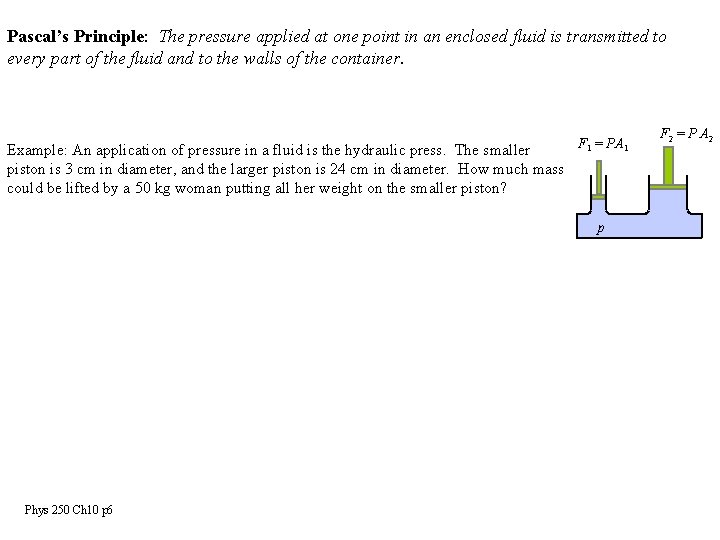
Pascal’s Principle: The pressure applied at one point in an enclosed fluid is transmitted to every part of the fluid and to the walls of the container. Example: An application of pressure in a fluid is the hydraulic press. The smaller piston is 3 cm in diameter, and the larger piston is 24 cm in diameter. How much mass could be lifted by a 50 kg woman putting all her weight on the smaller piston? F 1 = PA 1 p Phys 250 Ch 10 p 6 F 2 = P A 2
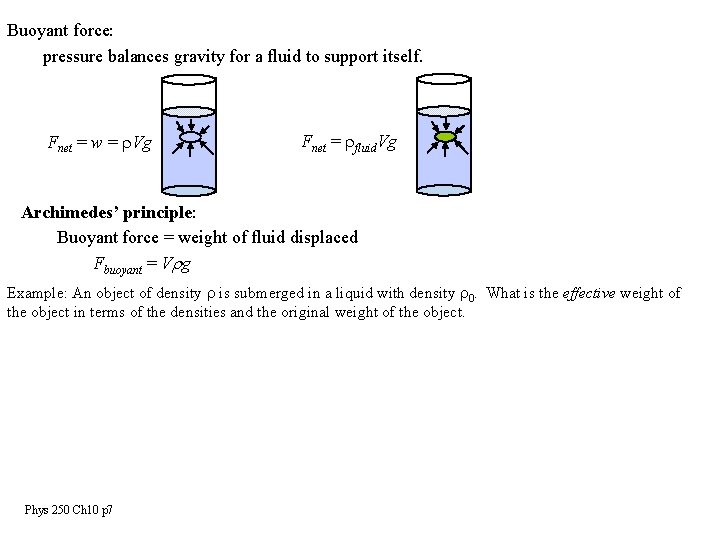
Buoyant force: pressure balances gravity for a fluid to support itself. Fnet = w = r. Vg Fnet = rfluid. Vg Archimedes’ principle: Buoyant force = weight of fluid displaced Fbuoyant = Vrg Example: An object of density r is submerged in a liquid with density r 0. What is the effective weight of the object in terms of the densities and the original weight of the object. Phys 250 Ch 10 p 7
Example: Icebergs are made of freshwater (density of 0. 92 E 3 kg/m 3 at 0ºC). Ocean water, largely because of dissolved salt, has a density of 1. 03 E 3 kg/m 3 at 0ºC. What fraction of an iceberg lies below the surface? Phys 250 Ch 10 p 8
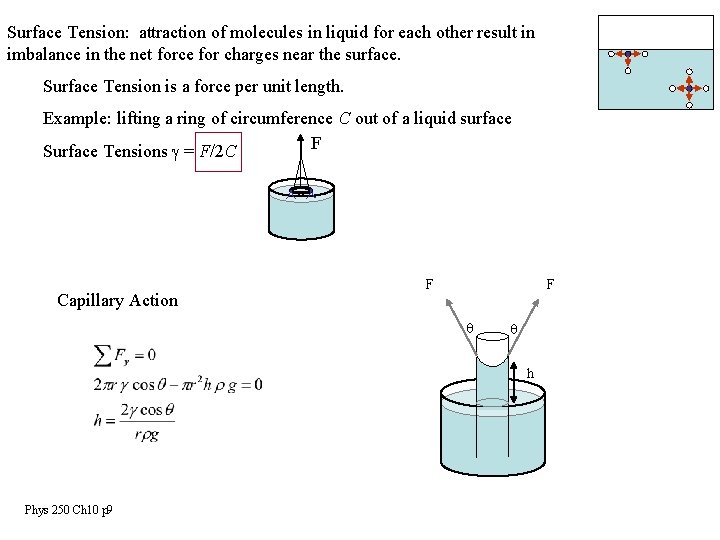
Surface Tension: attraction of molecules in liquid for each other result in imbalance in the net force for charges near the surface. Surface Tension is a force per unit length. Example: lifting a ring of circumference C out of a liquid surface F Surface Tensions g = F/2 C Capillary Action F F q q h Phys 250 Ch 10 p 9
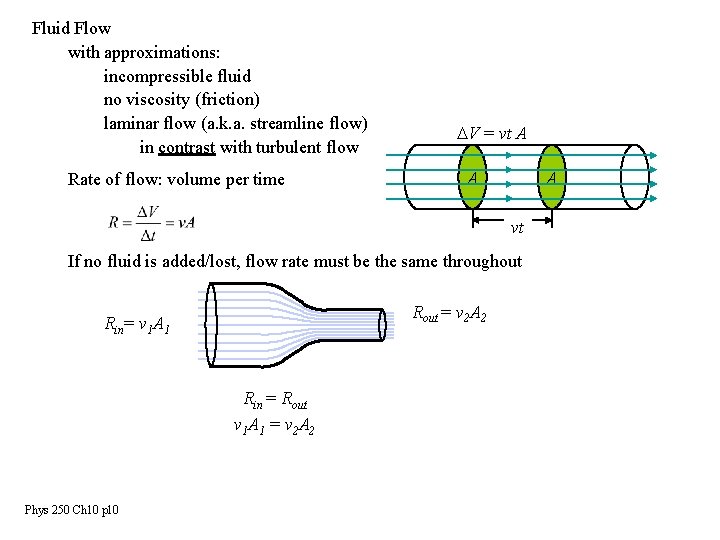
Fluid Flow with approximations: incompressible fluid no viscosity (friction) laminar flow (a. k. a. streamline flow) in contrast with turbulent flow Rate of flow: volume per time DV = vt A A A vt If no fluid is added/lost, flow rate must be the same throughout Rout = v 2 A 2 Rin= v 1 A 1 Rin = Rout v 1 A 1 = v 2 A 2 Phys 250 Ch 10 p 10
Example: A horizontal pipe of 25 cm 2 cross section carries water at a velocity of 3. 0 m/s. The pipe feeds into a smaller pipe with a cross section of only 15 cm 2. What is the velocity of the water in the smaller pipe? Phys 250 Ch 10 p 11

Bernoulli’s Equation: flow with changing heights and pressure Work-Energy Theorem + incompressible fluid p 2, v 2 A 2 p 1, v 1 h 2 A 1 h 1 Phys 250 Ch 10 p 12
Example: Determine the pressure change that occurs in the previous example skip sections 10. 7, 10. 8 Phys 250 Ch 10 p 13
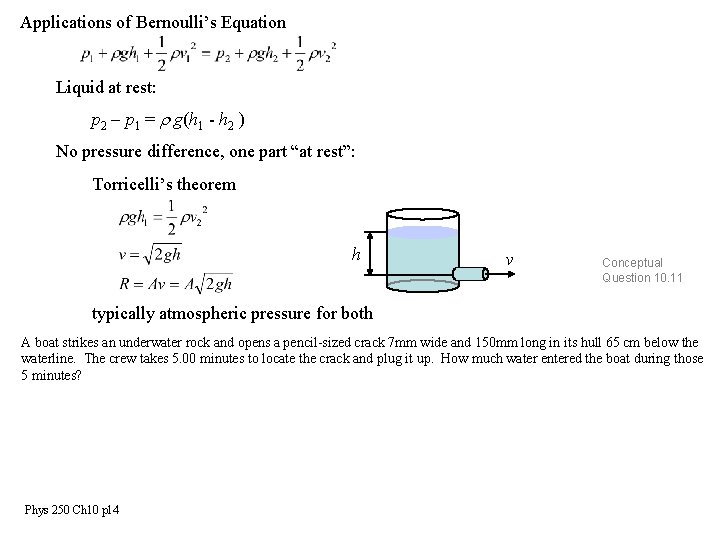
Applications of Bernoulli’s Equation Liquid at rest: p 2 - p 1 = r g(h 1 - h 2 ) No pressure difference, one part “at rest”: Torricelli’s theorem h v Conceptual Question 10. 11 typically atmospheric pressure for both A boat strikes an underwater rock and opens a pencil-sized crack 7 mm wide and 150 mm long in its hull 65 cm below the waterline. The crew takes 5. 00 minutes to locate the crack and plug it up. How much water entered the boat during those 5 minutes? Phys 250 Ch 10 p 14
- Slides: 14