
Chapter 10 Fluency Reflections on Fluency Have you
- Slides: 19
Chapter 10 Fluency
Reflections on Fluency Have you ever been to a book reading where the author read her material very slowly and monotonously? Were you able to follow the narrative? How were you able to prevent yourself from daydreaming or dozing off? How can you make sure your students don’t have similar problems when reading aloud?
Introduction to Fluency is the ability to read with automatic word recognition, expression, and meaning. What does fluency entail? Fluent readers: Read at a good pace Attend to the punctuation in sentences Recognize words automatically Quickly decode unknown words Slow down when needed Use expression when reading aloud
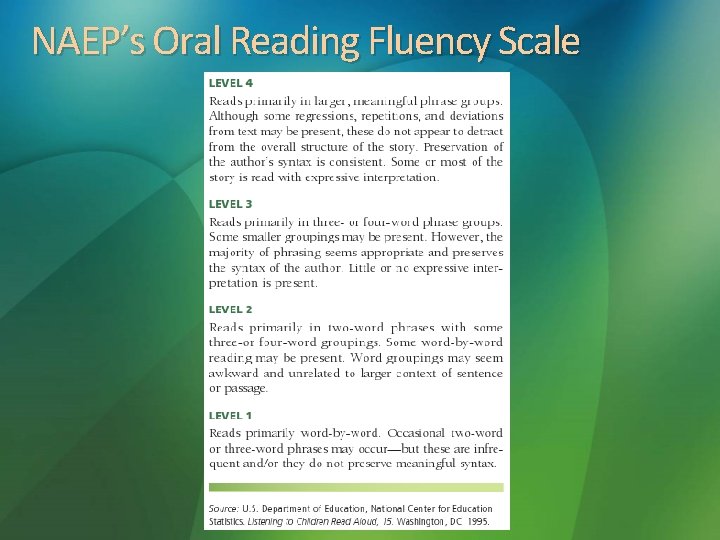
NAEP’s Oral Reading Fluency Scale
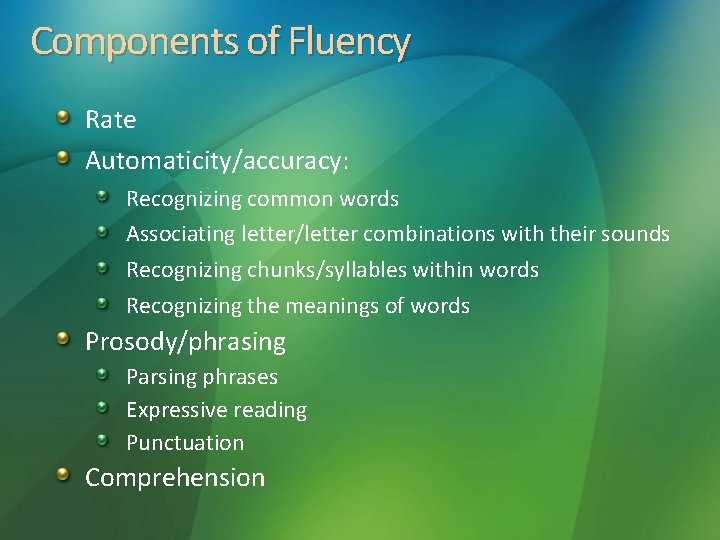
Components of Fluency Rate Automaticity/accuracy: Recognizing common words Associating letter/letter combinations with their sounds Recognizing chunks/syllables within words Recognizing the meanings of words Prosody/phrasing Parsing phrases Expressive reading Punctuation Comprehension
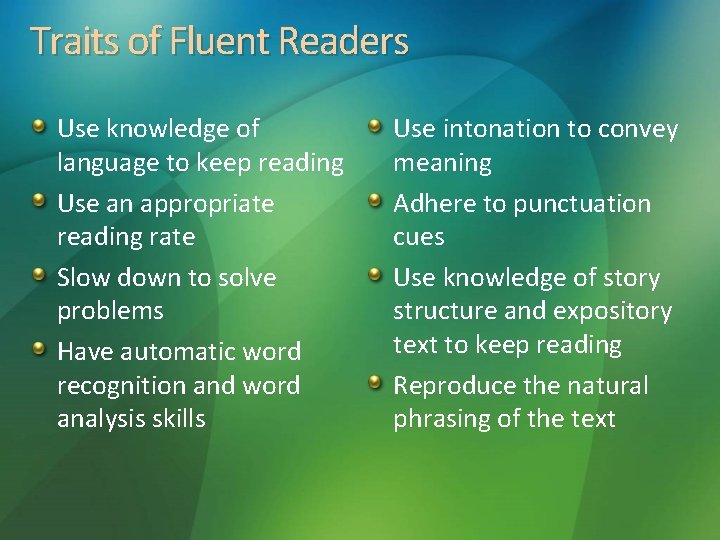
Traits of Fluent Readers Use knowledge of language to keep reading Use an appropriate reading rate Slow down to solve problems Have automatic word recognition and word analysis skills Use intonation to convey meaning Adhere to punctuation cues Use knowledge of story structure and expository text to keep reading Reproduce the natural phrasing of the text
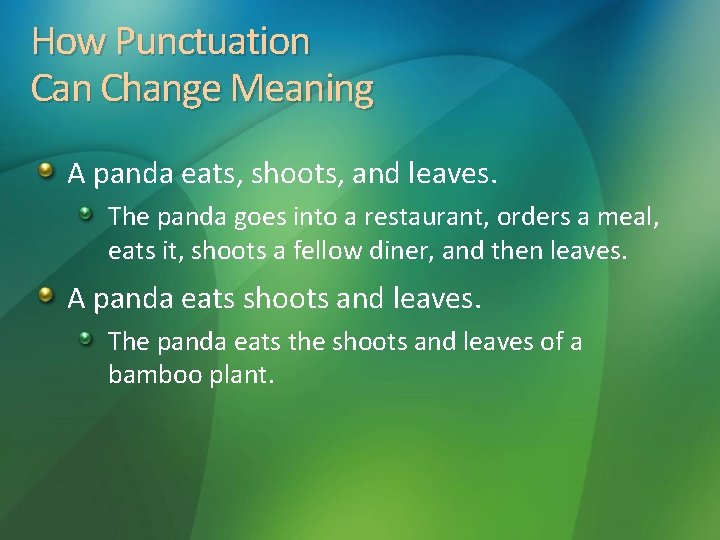
How Punctuation Can Change Meaning A panda eats, shoots, and leaves. The panda goes into a restaurant, orders a meal, eats it, shoots a fellow diner, and then leaves. A panda eats shoots and leaves. The panda eats the shoots and leaves of a bamboo plant.
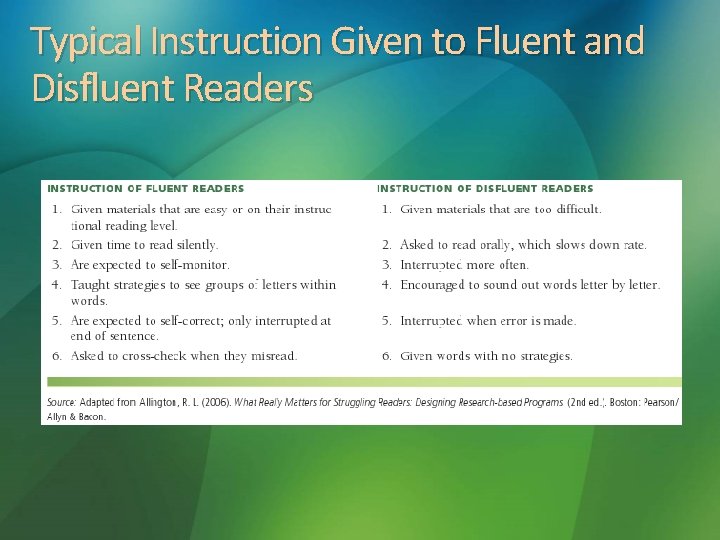
Typical Instruction Given to Fluent and Disfluent Readers
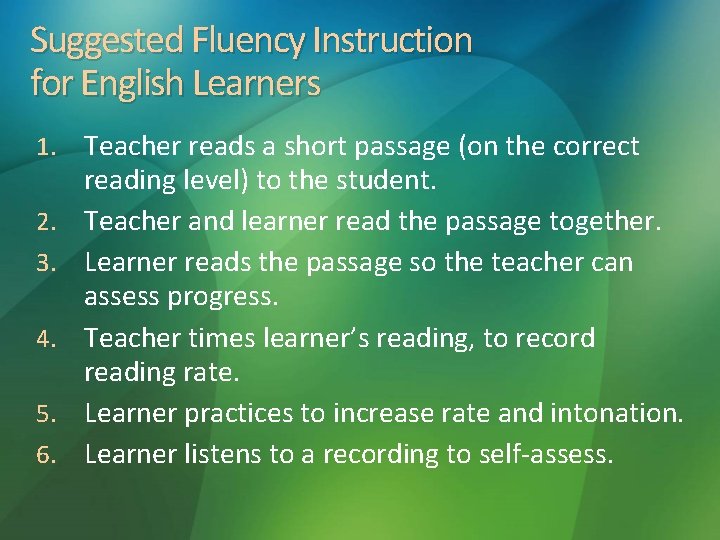
Fluency Instruction for English Learners The teacher reads a short passage (on the student’s instructional level) to the English learner. The teacher and learner read the passage together. The learner reads the passage so the teacher can assess progress. The teacher times the learner’s reading, to record reading rate. The learner practices to increase rate and improve intonation. The learner listens to a recording of his/her reading to self-assess.
Assessment of Fluency: Informal Checklists Running records Miscue analysis Retrospective miscue analysis Rubrics Informal commercial assessments
Assessment of Fluency: Formal Calculate rate and/or accuracy; for example: Stanford Diagnostic Reading Test Gray Oral Reading Tests Gilmore Oral Reading Test Durrell Analysis of Reading Difficulty Diagnostic Reading Scales, Revised Woodcock Reading Mastery Test Instruments do not allow teachers to assess other components of fluency
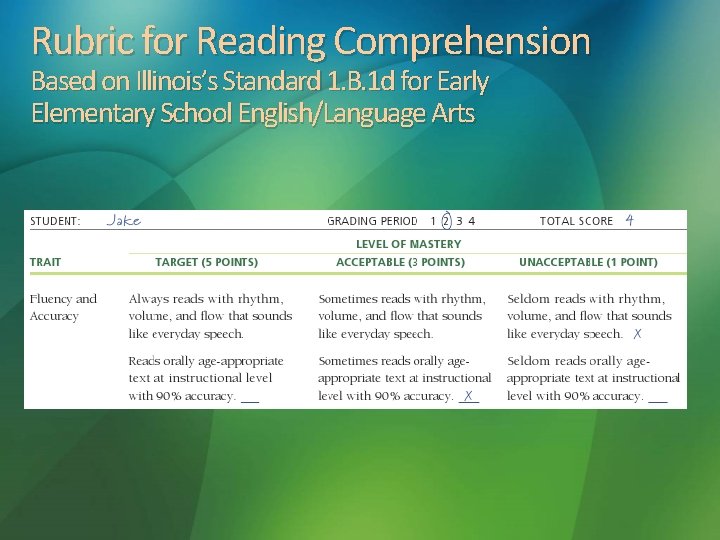
Rubric for Reading Comprehension Based on Illinois’s Standard 1. B. 1 d for Early Elementary School English/Language Arts
Suggested Fluency Instruction for English Learners 1. Teacher reads a short passage (on the correct 2. 3. 4. 5. 6. reading level) to the student. Teacher and learner read the passage together. Learner reads the passage so the teacher can assess progress. Teacher times learner’s reading, to record reading rate. Learner practices to increase rate and intonation. Learner listens to a recording to self-assess.
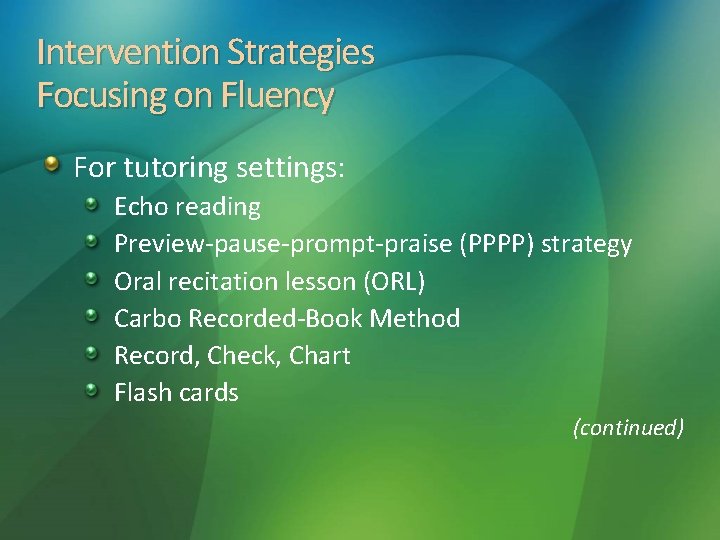
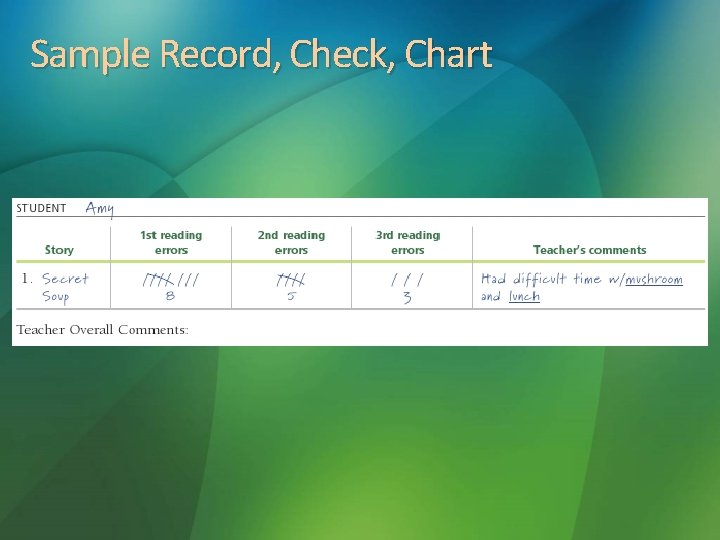
Intervention Strategies Focusing on Fluency For tutoring settings: Echo reading Preview-pause-prompt-praise (PPPP) strategy Oral recitation lesson (ORL) Carbo Recorded-Book Method Record, Check, Chart Flash cards (continued)
Sample Record, Check, Chart
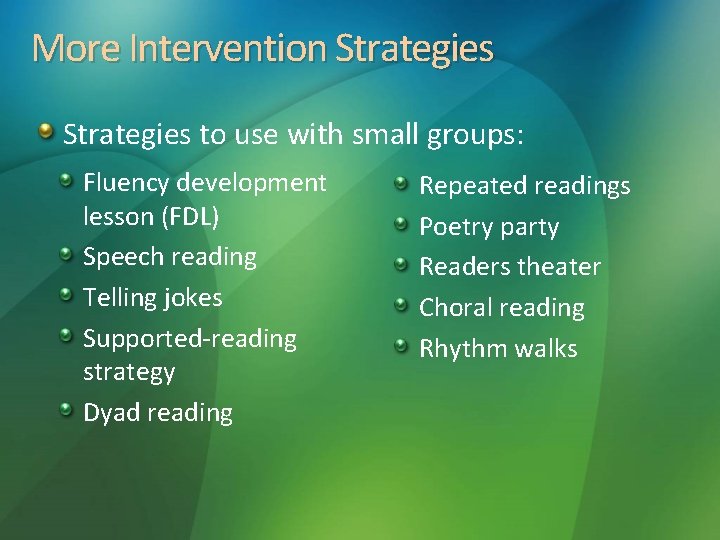
More Intervention Strategies to use with small groups: Fluency development lesson (FDL) Speech reading Telling jokes Supported-reading strategy Dyad reading Repeated readings Poetry party Readers theater Choral reading Rhythm walks
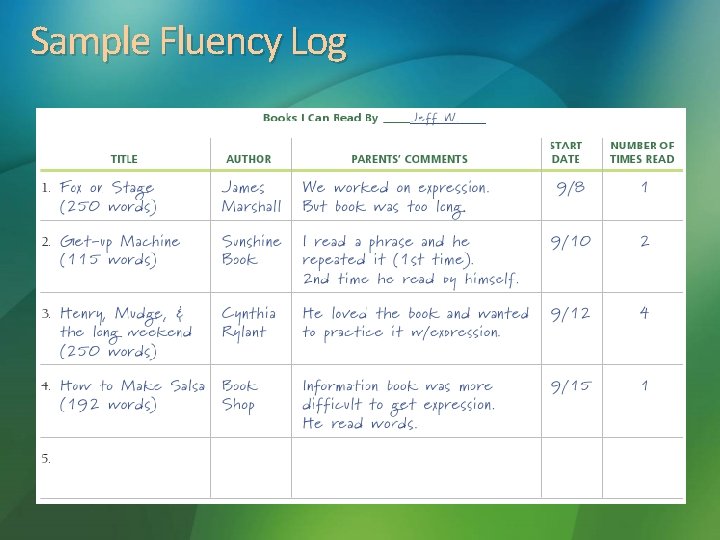
Sample Fluency Log
Fluency and Technology Audiobooks—to follow along, or read along with the narrator Reading Assistant Expanded Edition—speech recognition software Read-along radio dramas Websites with free scripts for readers theater
Related Video Presentation You can see a video presentation on direct instruction in fluency with echo reading (see echo reading in action; this is related to the discussion on pages 270– 271 of the chapter).