
Chapter 10 Financial Planning with Life Insurance 1


- Slides: 31
Chapter 10 Financial Planning with Life Insurance 1 Mc. Graw-Hill/Irwin Copyright © 2010 by The Mc. Graw-Hill Companies, Inc. All rights reserved.
Life Insurance Chapter Objectives 1. Define life insurance and determine your life insurance needs. 2. Distinguish between the types of life insurance companies and analyze various types of life insurance policies these companies issue. 3. Select important provisions in life insurance contracts and create a plan to buy life insurance. 4. Recognize how annuities provide financial security. 2 10 -2
Objective 1 Define Life Insurance and Determine Your Life Insurance Needs • Primary Purpose of Life Insurance: – Protect someone who depends on you from financial loss related to your death • Life insurance: – Obtained by purchasing a policy – The insurance company promises to pay a lump sum to a named beneficiary at the time of the policy holder’s death (or sometimes while they are still alive) 3 10 -3
Purpose of Life Insurance Other reasons: – Pay off a mortgage or debts – Lump-sum endowments for children – Provide an education or income for children – Make charitable donations – Provide retirement income – Accumulate savings – Establish a regular income for survivors – Set up an estate plan – Pay estate and gift taxes 4 10 -4
The Principle of Life Insurance • Mortality tables provide odds on your dying, based on your age and sex. • Premium is based on your life expectancy and the projections for the payouts for persons who die 5 10 -5
Do You Need Life Insurance? • Do you have people you need to protect financially? • Are you single and have a lot of debt? • Do you have parents, relatives, or a charity that you want to support? 6 10 -6
Estimating Your Life Insurance Requirements • The Easy Method – 70% of your salary for seven years while your family adjusts – Assumes typical family • The DINK Method – Dual income, no kids – Assumes spouse earnings => insured – Cover funeral + ½ debts 7 10 -7
Estimating Your Life Insurance Requirements • The “Nonworking” Spouse Method – # years until the youngest child reaches 18 X $10, 000 • The “Family Need” Method – More thorough than the first three – Considers employer provided insurance, Social Security benefits, income and assets 8 10 -8
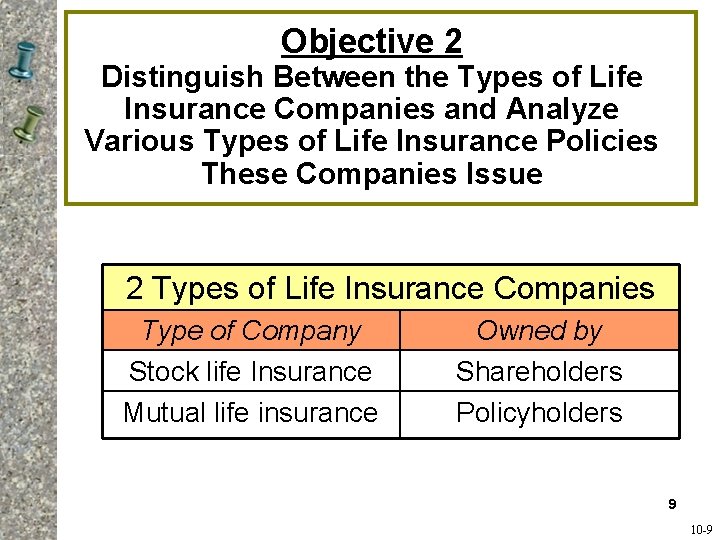
Objective 2 Distinguish Between the Types of Life Insurance Companies and Analyze Various Types of Life Insurance Policies These Companies Issue 2 Types of Life Insurance Companies Type of Company Stock life Insurance Mutual life insurance Owned by Shareholders Policyholders 9 10 -9
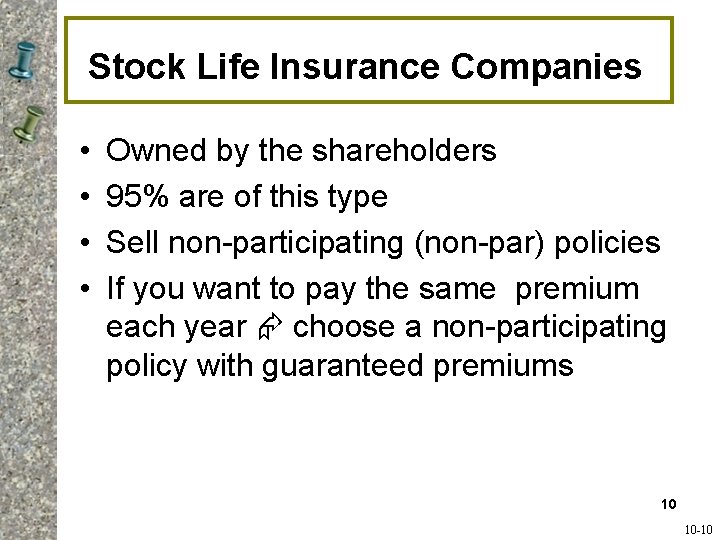
Stock Life Insurance Companies • • Owned by the shareholders 95% are of this type Sell non-participating (non-par) policies If you want to pay the same premium each year choose a non-participating policy with guaranteed premiums 10 10 -10
Mutual Life Insurance Companies • Owned by the policyholders • 5% of policies are from this type company of • Participating policy premiums are higher than non-participating policies – Part of the non-participating premium is refunded to the policyholders annually in the form of a policy dividend 11 10 -11
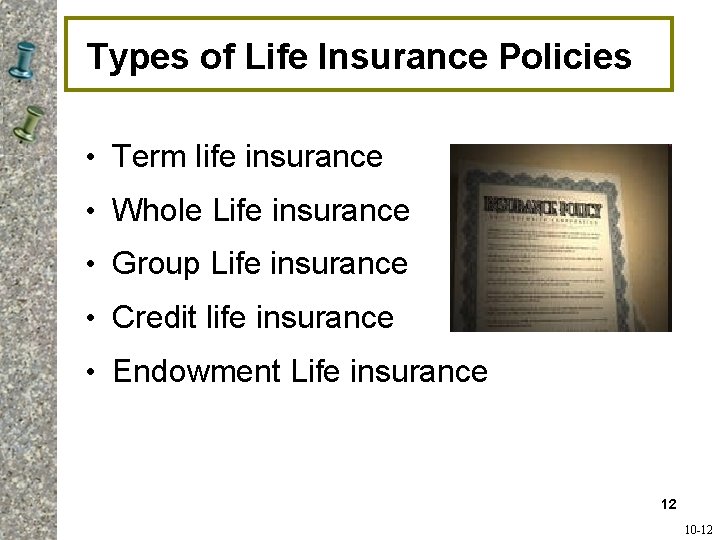
Types of Life Insurance Policies • Term life insurance • Whole Life insurance • Group Life insurance • Credit life insurance • Endowment Life insurance 12 10 -12
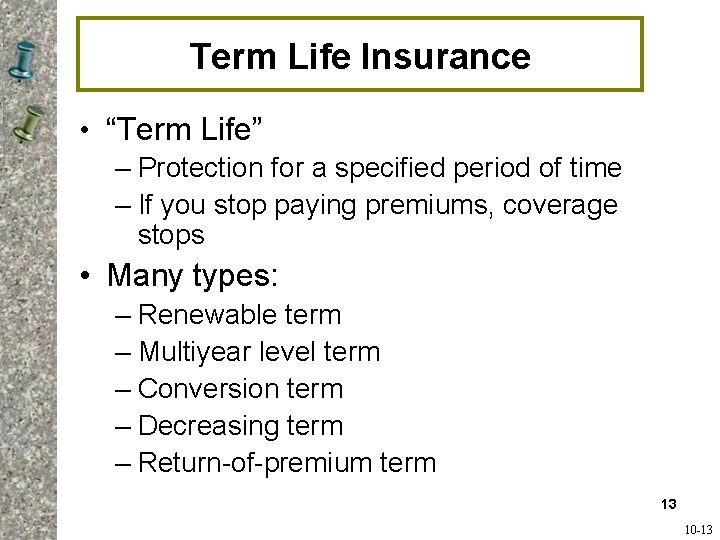
Term Life Insurance • “Term Life” – Protection for a specified period of time – If you stop paying premiums, coverage stops • Many types: – Renewable term – Multiyear level term – Conversion term – Decreasing term – Return-of-premium term 13 10 -13
Whole Life Insurance • “Straight Life” – Pay the premium as long as you live – Amount of premium depends on age when you start the policy – Provides death benefits – Accumulates a cash value • You can borrow against the cash value or draw it out at retirement – Look carefully at the rate of return your money earns 14 10 -14
Whole Life Policy Options • Limited Payment Policy – You pay premiums for a stipulated period • Usually 20 or 30 years, or • Until you reach a specified age (65) – Policy then “paid up” and you remain insured for life • Variable Life Policy – Minimum death benefit guaranteed – Benefit can be greater depending on earnings of the dollars invested in the separate fund 15 10 -15
Whole Life Policy Options • Adjustable Life Policy – Can change premium payments or period of coverage as your needs change. • Universal Life – Term life policy with a cash value • Can borrow against cash value – Premium amount may be changed at any time without changing coverage – Part of premium goes to investment account – Increase in cash value reflects interest earned on short-term investments 16 10 -16
Other Types of Life Insurance Policies • Group life insurance – Term insurance – Often provided by an employer – No physical is required • Credit life insurance – Debt paid off if you die • Mortgage, car, furniture – Also protects lenders – Expensive protection • Endowment Life Insurance 17 10 -17
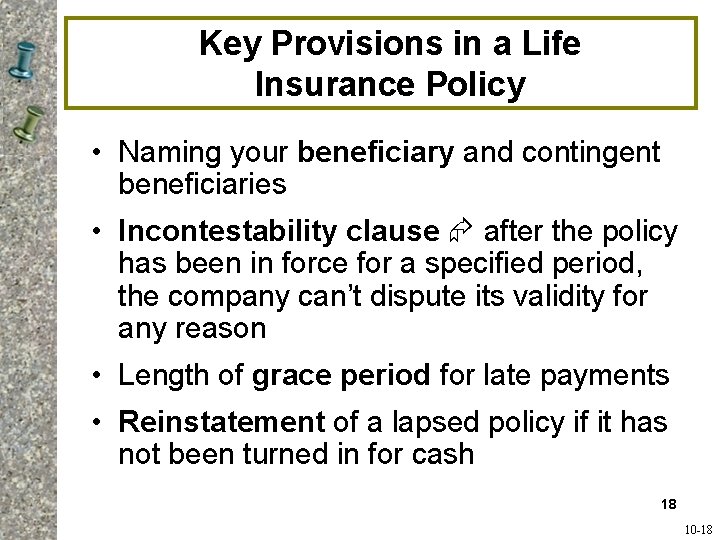
Key Provisions in a Life Insurance Policy • Naming your beneficiary and contingent beneficiaries • Incontestability clause after the policy has been in force for a specified period, the company can’t dispute its validity for any reason • Length of grace period for late payments • Reinstatement of a lapsed policy if it has not been turned in for cash 18 10 -18
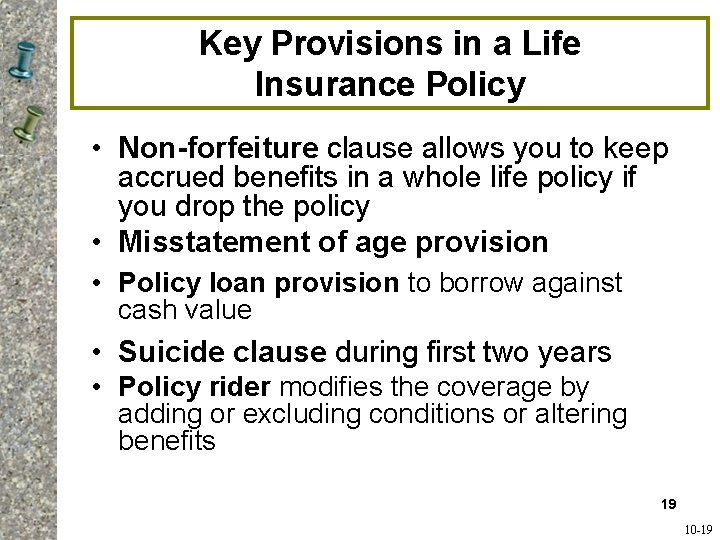
Key Provisions in a Life Insurance Policy • Non-forfeiture clause allows you to keep accrued benefits in a whole life policy if you drop the policy • Misstatement of age provision • Policy loan provision to borrow against cash value • Suicide clause during first two years • Policy rider modifies the coverage by adding or excluding conditions or altering benefits 19 10 -19
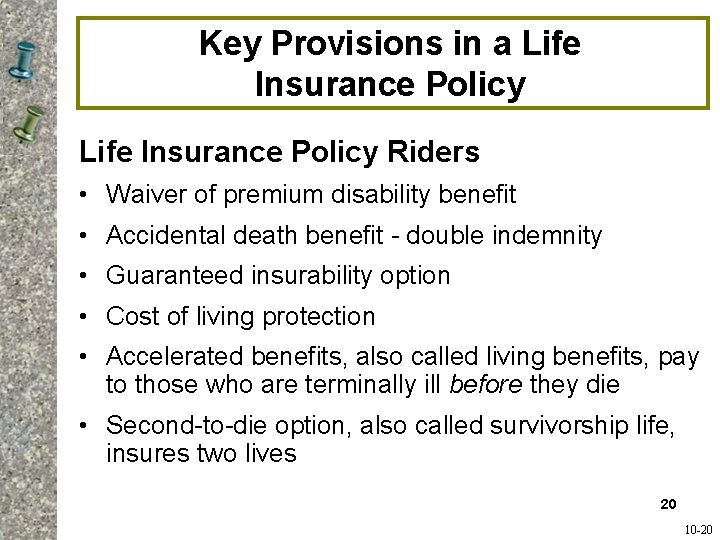
Key Provisions in a Life Insurance Policy Riders • Waiver of premium disability benefit • Accidental death benefit - double indemnity • Guaranteed insurability option • Cost of living protection • Accelerated benefits, also called living benefits, pay to those who are terminally ill before they die • Second-to-die option, also called survivorship life, insures two lives 20 10 -20
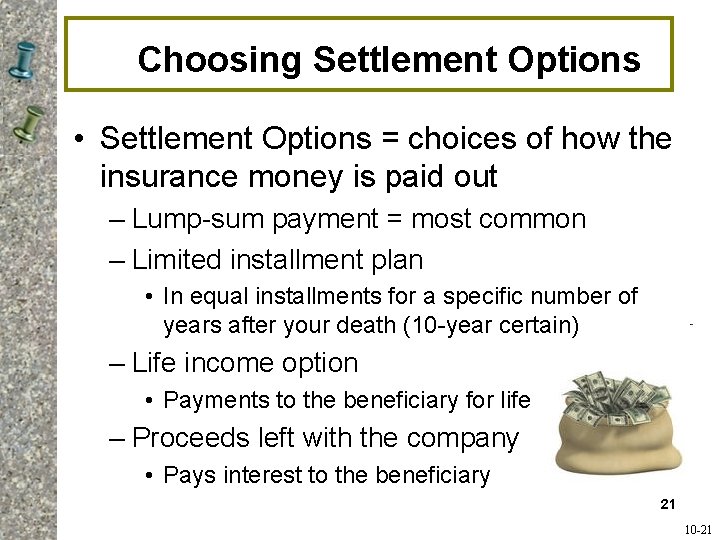
Choosing Settlement Options • Settlement Options = choices of how the insurance money is paid out – Lump-sum payment = most common – Limited installment plan • In equal installments for a specific number of years after your death (10 -year certain) – Life income option • Payments to the beneficiary for life – Proceeds left with the company • Pays interest to the beneficiary 21 10 -21
Buying Life Insurance • Consider: – Present and future sources of income – Other savings and income protection – Group life insurance – Pension benefits – Social Security benefits – Financial strength of the insurance company 22 10 -22
Buying Life Insurance • Determine from whom to buy your policy – Examine both private and public sources – Research the company’s rating by major rating companies: • • • A. M. Best Standard and Poor’s Duff & Phelps Moody’s Weiss Research – Talk to friends or colleagues 23 10 -23
Choosing Your Insurance Agent • Ask friends, parents, and neighbors for recommendations. • Does the agent belong to professional groups or is a Chartered Life Underwriter (CLU)? • Is the agent willing to take the time to answer your questions and find a policy that is right for you? • Does the agent ask about your financial plan? • Do you feel pressured? • Is the agent available when needed? 24 10 -24
Buying Life Insurance • Compare policy costs based on: – Company’s cost of doing business – Return on company’s investments – Mortality rate among policyholders – Policy features – Competition from other firms • Interest-adjusted index – Used to compare policy costs – Lower index = lower cost policy – See sites such as www. quotesmith. com 25 10 -25
Obtaining and Examining a Policy • First step = apply • Second step = provide medical history – Usually no physical for a group policy • Read every word of the contract • 10 -day “free-look” period to change your mind • Give your beneficiaries and lawyer a photocopy 26 10 -26
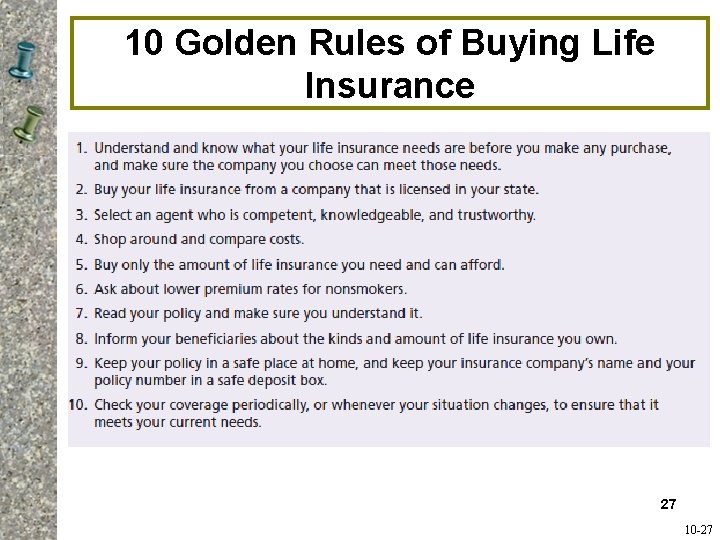
10 Golden Rules of Buying Life Insurance 27 10 -27
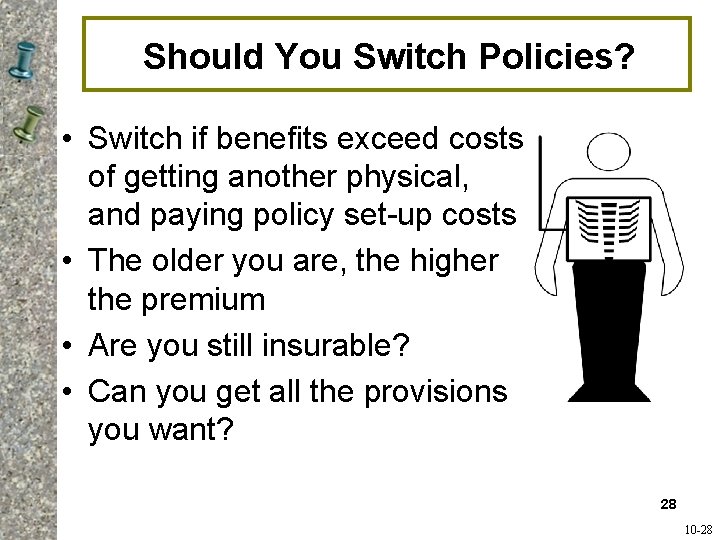
Should You Switch Policies? • Switch if benefits exceed costs of getting another physical, and paying policy set-up costs • The older you are, the higher the premium • Are you still insurable? • Can you get all the provisions you want? 28 10 -28
Objective 4 Recognize How Annuities Provide Financial Security Financial Planning with Annuities • An annuity = a financial contract written by an insurance company, providing a regular income • Can supplement retirement income and shelter income from taxes • Those who expect to live longer than average benefit most from annuities. • Fully fund IRAs, Keoghs and 401(k)’s BEFORE considering an annuity 29 10 -29
Why Buy Annuities? • Provides retirement income for life • Compounded interest grows tax free until money withdrawn • No maximum annual contribution (like IRAs) • Beneficiary guaranteed no less than amount paid in 30 10 -30
Types of Annuities • Fixed annuity – Annuitant receives fixed amount for life • Variable annuity – Amount received depends on investment performance • Can be included in IRAs and Keogh plans 31 10 -31