
Chapter 10 Fibers Another example of trace evidence
Chapter 10: Fibers Another example of trace evidence
DEFINITION OF FIBER • A fiber is the smallest unit of a textile material that has a length many times greater than its diameter. • Fibers can occur naturally as plant and animal fibers, but they can also be man-made. • A fiber can be spun with other fibers to form a yarn that can be woven or knitted to form a fabric. • Fibers are usually collected from clothing, carpeting, furniture, beds, and blankets. • Fibers are often important evidence in crimes that involve personal contact.

There are two types of fibers: natural and man-made (synthetic) • Natural u Cotton u Linen u Wool u Mohair u Cashmere u Silk • Man-Made u Polyester u Rayon u Nylon u Acetate u Acrylic u Spandex
Types of Fibers • Natural fibers are classified based on their origin. • Three classifications 1. Vegetable/Plant 2. Animal 3. Mineral

Cotton • The most common plant fiber • The wide-use of undyed white cotton in clothing and other fabrics has made this fiber meaningless as evidence. • However, when the cotton is dyed with a combination of colors, the value as evidence is increased.
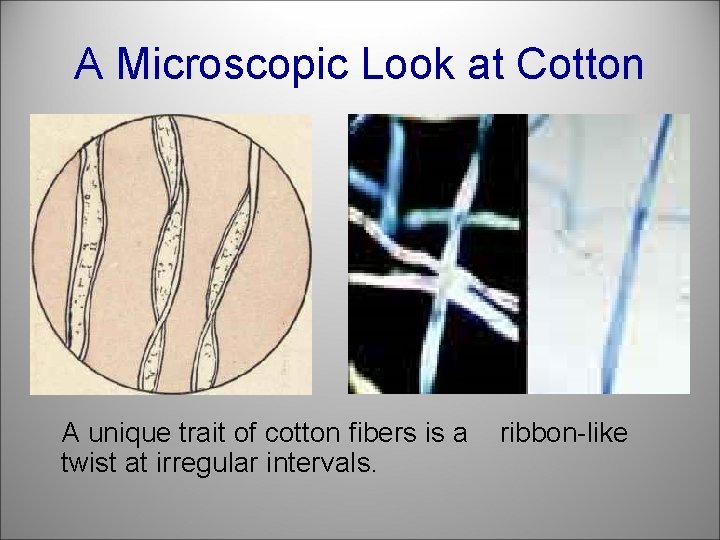
A Microscopic Look at Cotton A unique trait of cotton fibers is a twist at irregular intervals. ribbon-like
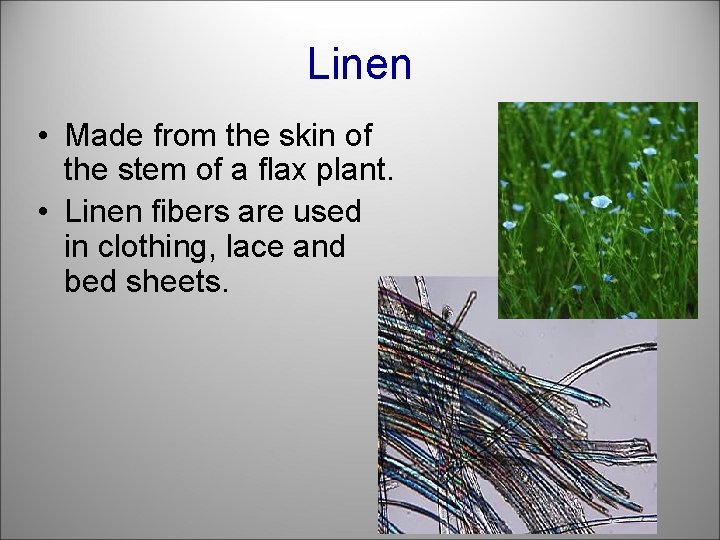
Linen • Made from the skin of the stem of a flax plant. • Linen fibers are used in clothing, lace and bed sheets.
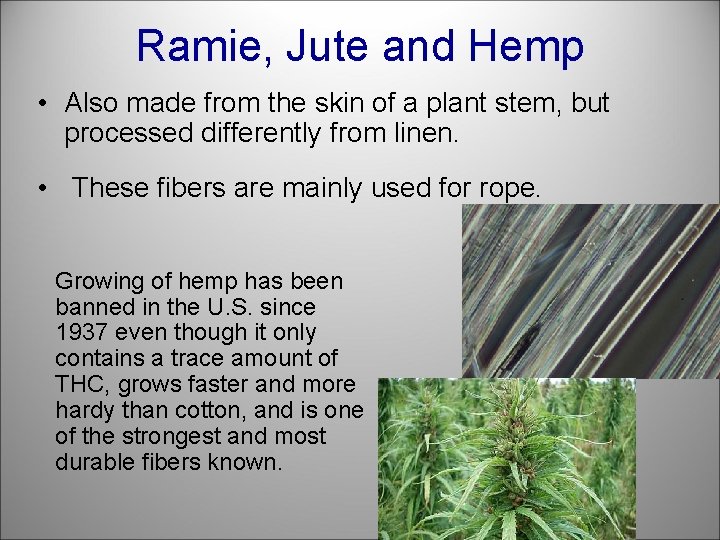
Ramie, Jute and Hemp • Also made from the skin of a plant stem, but processed differently from linen. • These fibers are mainly used for rope. Growing of hemp has been banned in the U. S. since 1937 even though it only contains a trace amount of THC, grows faster and more hardy than cotton, and is one of the strongest and most durable fibers known.
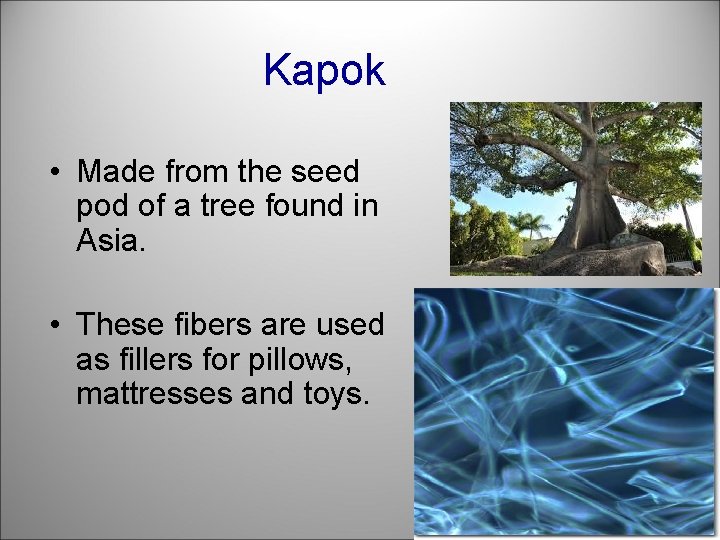
Kapok • Made from the seed pod of a tree found in Asia. • These fibers are used as fillers for pillows, mattresses and toys.

Animal Fibers • Animal fibers are the most common natural fiber found at a crime scene. • These include: – wool (sheep) – mohair (angora goat) – cashmere (cashmere goats) – alpaca – mink
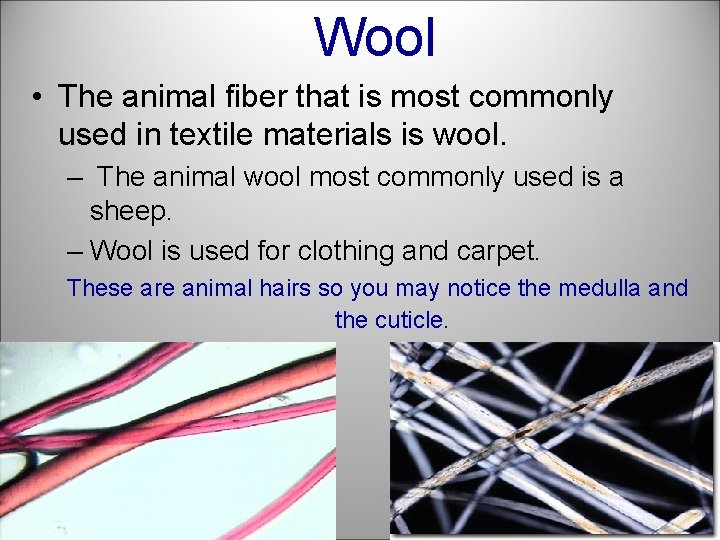
Wool • The animal fiber that is most commonly used in textile materials is wool. – The animal wool most commonly used is a sheep. – Wool is used for clothing and carpet. These are animal hairs so you may notice the medulla and the cuticle.

Animal Fibers from Excrement • Silk comes from the blind, flightless moth Bombyx mori. • After the silkworm hatches, it eats mulberry leaves continuously for 6 weeks. • Next, it secretes a clear fluid that hardens into a silk cocoon. This cocoon is separated into silk fibers.
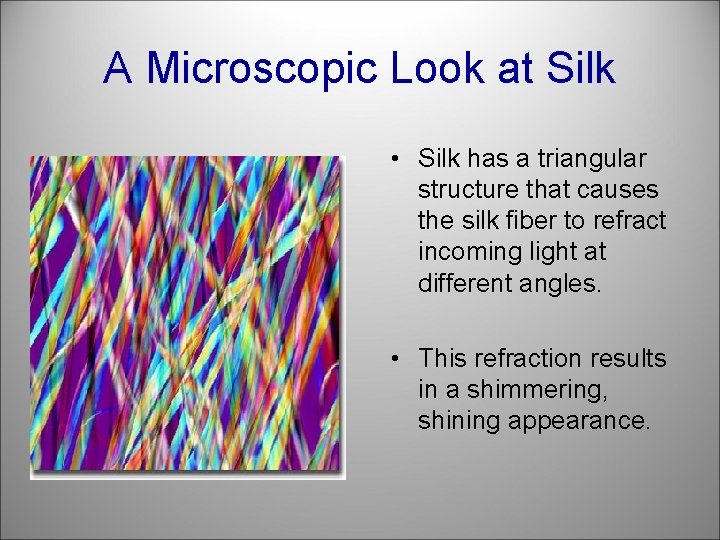
A Microscopic Look at Silk • Silk has a triangular structure that causes the silk fiber to refract incoming light at different angles. • This refraction results in a shimmering, shining appearance.
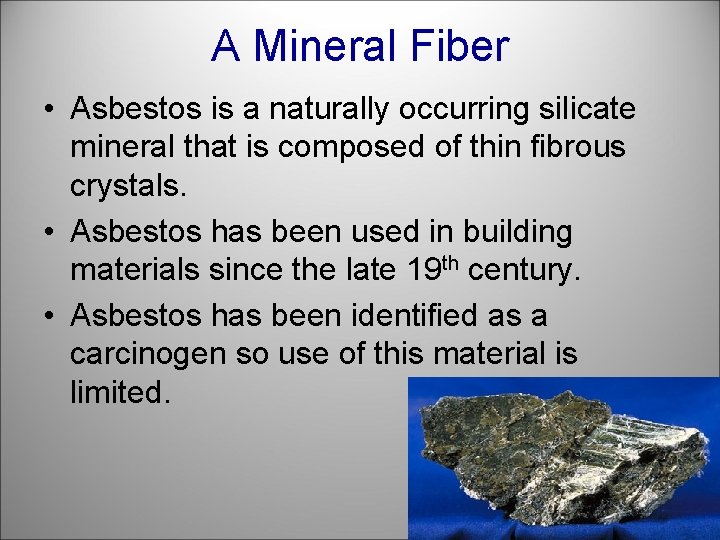
A Mineral Fiber • Asbestos is a naturally occurring silicate mineral that is composed of thin fibrous crystals. • Asbestos has been used in building materials since the late 19 th century. • Asbestos has been identified as a carcinogen so use of this material is limited.
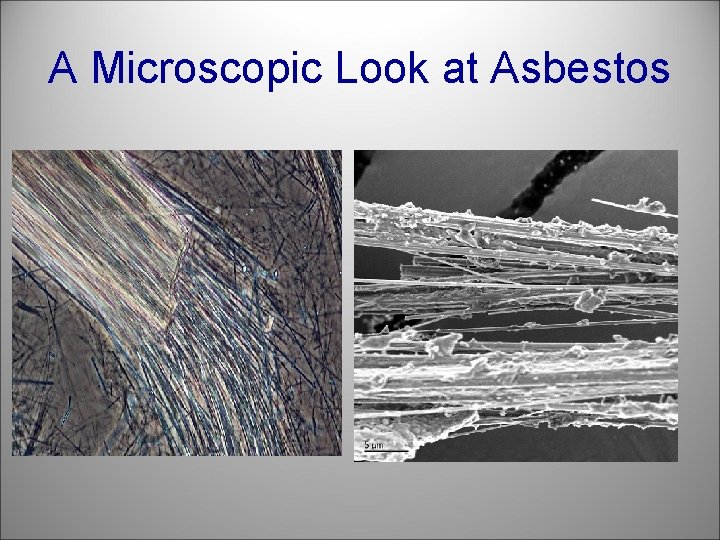
A Microscopic Look at Asbestos

Man-Made/Manufactured Fibers • More than 50% of all textiles are created from man-made fibers. • Two types 1. Regenerated 2. Synthetic
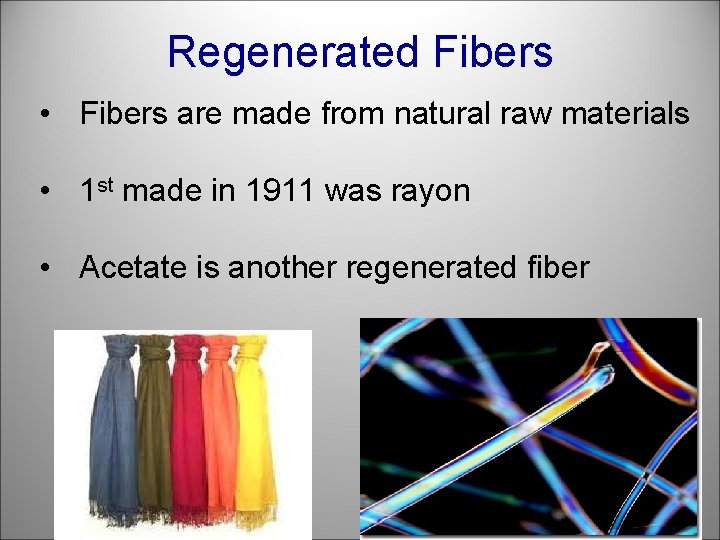
Regenerated Fibers • Fibers are made from natural raw materials • 1 st made in 1911 was rayon • Acetate is another regenerated fiber
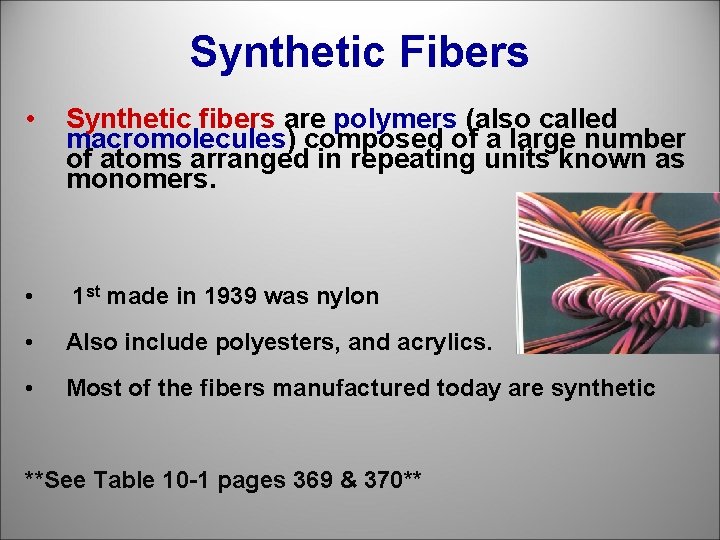
Synthetic Fibers • Synthetic fibers are polymers (also called macromolecules) composed of a large number of atoms arranged in repeating units known as monomers. • 1 st made in 1939 was nylon • Also include polyesters, and acrylics. • Most of the fibers manufactured today are synthetic **See Table 10 -1 pages 369 & 370**

Fibers as Evidence • Fibers may be exchanged between two objects or between an individual and an object. • Whether or not a fiber is transferred is dependent on – the type of fabric(s) involved – the length of time of the contact.
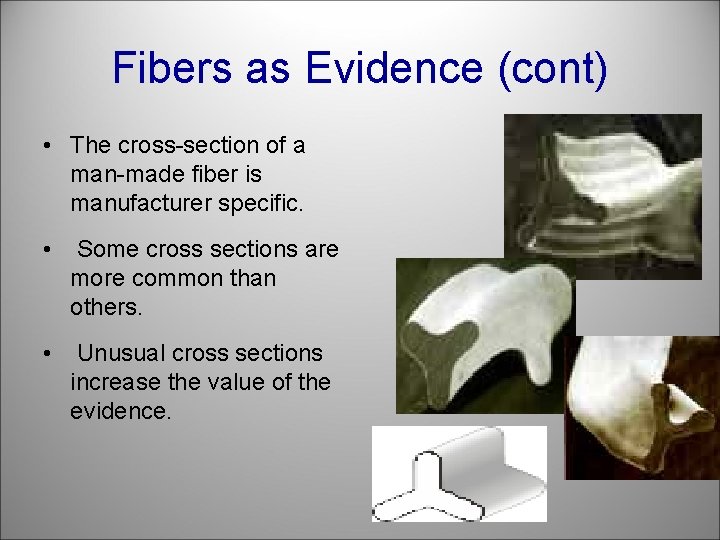
Fibers as Evidence (cont) • The cross-section of a man-made fiber is manufacturer specific. • Some cross sections are more common than others. • Unusual cross sections increase the value of the evidence.
Fibers as Evidence (cont) • Fibers may be dyed before or after they are woven into a fabric. • Dye may also be applied to the surface of a fabric. • A dye’s color may be absorbed unevenly and may fade over time. • All of these factors must be considered when trying to match a crime scene sample with a control/reference sample.
The Analysis of Fibers • A Microspectrophotometer compares fiber colors through spectral patterns. • Chromatography gives a more detailed analysis of the dye composition. • Double Refraction determines the value of the refractive index of the fiber (how it bends light – contributes to shine of fabric) • Infrared Spectrophotometry allows infrared analysis of a single strand of fiber while being viewed under the microscope
When the fibers become a fabric • Fabrics are composed of individual fibers. • These fibers may be knitted, woven, bonded, crocheted, felted, knotted or laminated. • The method used to construct the fabric will determine the amount of stretch, absorbency, water repellence, softness and durability. • These characteristics are unique to a fabric.
Woven Fabric • Woven fabrics are made by interlacing the warp (lengthwise thread) and the weft (crosswise thread). • The warp runs the length of the fabric and parallel to the selvage which is the edge of the fabric. • The weft crosses over and under the warp threads. • Types of weave patterns include: u Plain u Twill u Satin
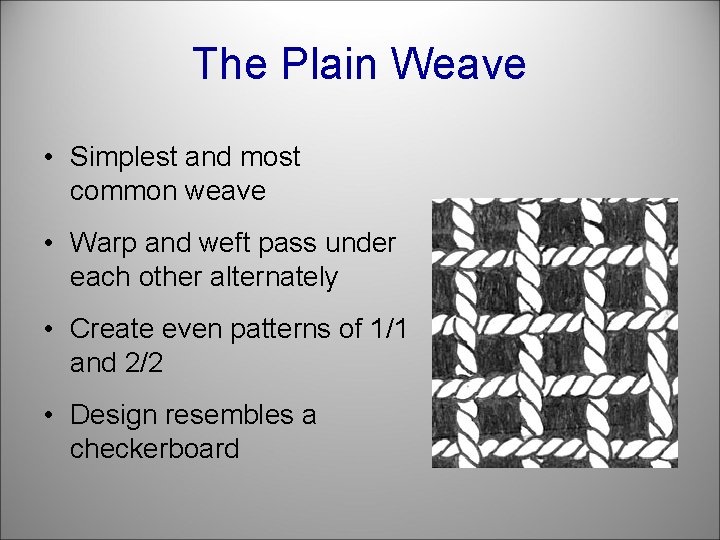
The Plain Weave • Simplest and most common weave • Warp and weft pass under each other alternately • Create even patterns of 1/1 and 2/2 • Design resembles a checkerboard
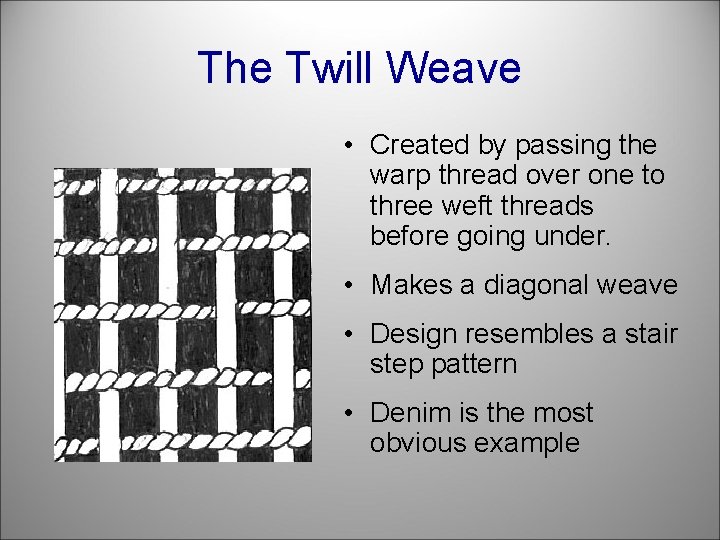
The Twill Weave • Created by passing the warp thread over one to three weft threads before going under. • Makes a diagonal weave • Design resembles a stair step pattern • Denim is the most obvious example
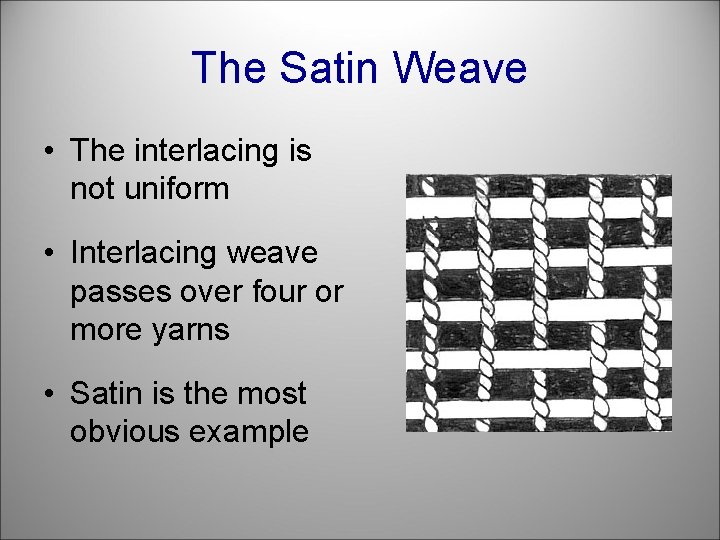
The Satin Weave • The interlacing is not uniform • Interlacing weave passes over four or more yarns • Satin is the most obvious example
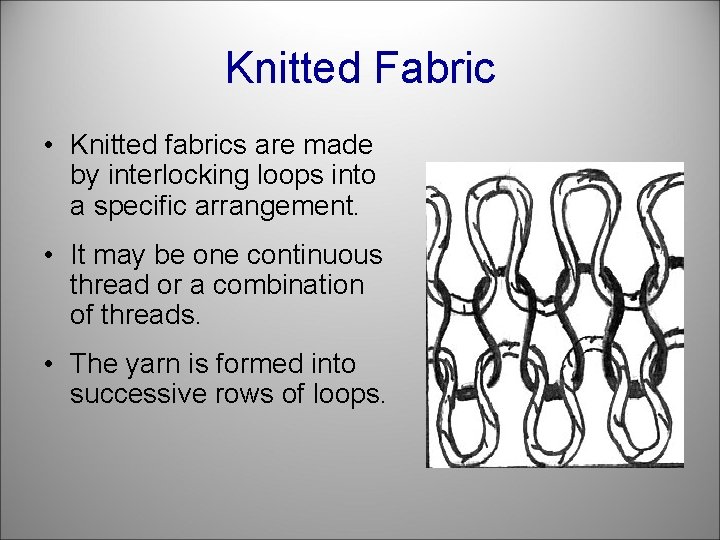
Knitted Fabric • Knitted fabrics are made by interlocking loops into a specific arrangement. • It may be one continuous thread or a combination of threads. • The yarn is formed into successive rows of loops.
The Weave Pattern and Transfer • A tightly woven or knitted fabric “sheds” less than a loosely woven or knitted fabric. • Some textile materials such as leather do not transfer fibrous material. • The age and condition of the fabric will affect the amount of fiber transfer. • How often and for how long a fabric was manufactured is also important to an investigation.
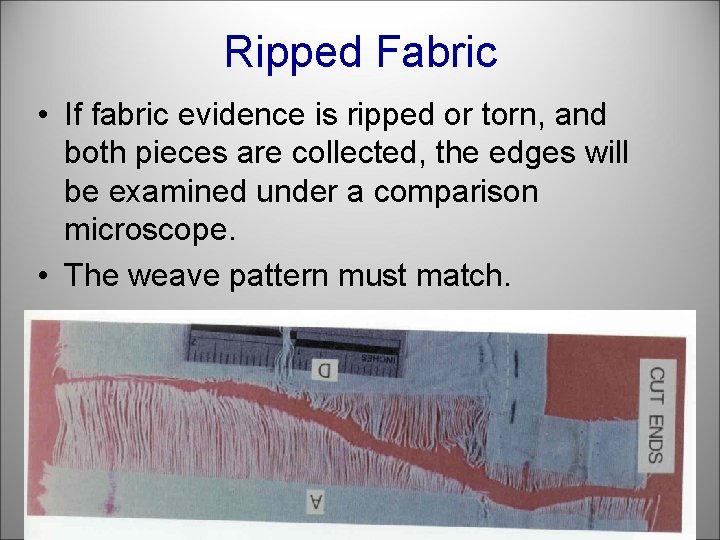
Ripped Fabric • If fabric evidence is ripped or torn, and both pieces are collected, the edges will be examined under a comparison microscope. • The weave pattern must match.
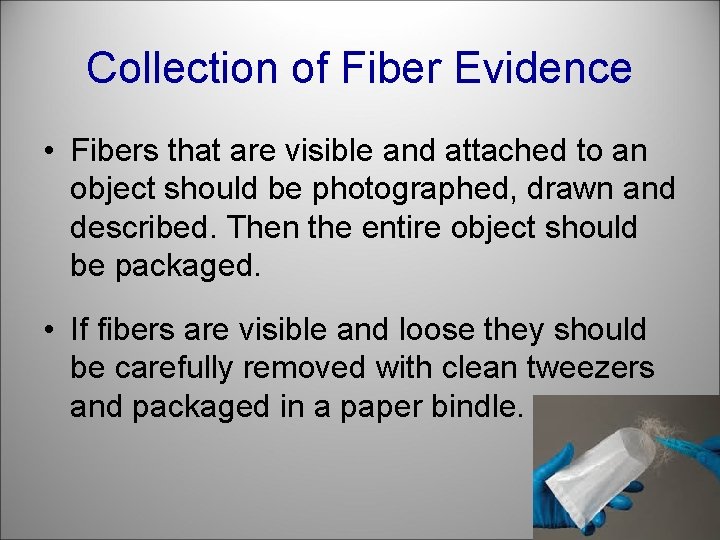
Collection of Fiber Evidence • Fibers that are visible and attached to an object should be photographed, drawn and described. Then the entire object should be packaged. • If fibers are visible and loose they should be carefully removed with clean tweezers and packaged in a paper bindle.
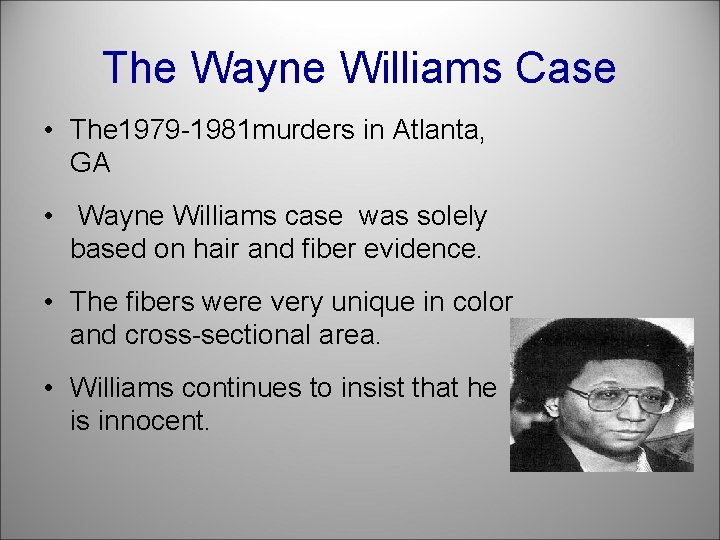
The Wayne Williams Case • The 1979 -1981 murders in Atlanta, GA • Wayne Williams case was solely based on hair and fiber evidence. • The fibers were very unique in color and cross-sectional area. • Williams continues to insist that he is innocent.
REFERENCES • Ramsland, Katherine. "Fiber Analysis. " Crime Library. 13 Mar 2008<http: //www. crimelibrary. com/criminal_mind/forensics/trace/1. html>. • "Masthead of Forensic Science Communications. " Forensic Fiber Examination Guidelines. April 1999 Volume 1 Number 1. Federal Bureau of Investigation. 13 Mar 2008<http: //www. fbi. gov/hq/lab/fsc/backissu/april 1999/houcktoc. ht >. • Lewin, Menachem, and Pearce. Handbook of Fiber Chemistry. New York: Marcel Dekker. • "The Thin Blue Line. " Forensic Scientists, Hair and Fibers. 13 Mar 2008 <http: //www. policensw. com/info/forensic 7 a. html>. • Carpet and Rug Fiber Chemistry. Bane-Clene Corporation 2007. 13 Mar 2008 <http: //www. baneclene. com/articles/fiberchemistry. html>.
- Slides: 33