
CHAPTER 10 EQUITY VALUATION CONCEPTS AND BASIC TOOLS
CHAPTER 10 EQUITY VALUATION: CONCEPTS AND BASIC TOOLS Presenter Venue Date
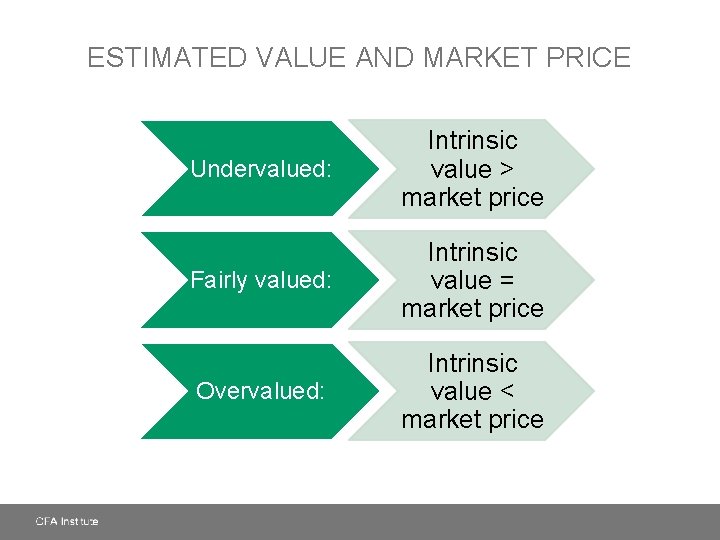
ESTIMATED VALUE AND MARKET PRICE Undervalued: Intrinsic value > market price Fairly valued: Intrinsic value = market price Overvalued: Intrinsic value < market price
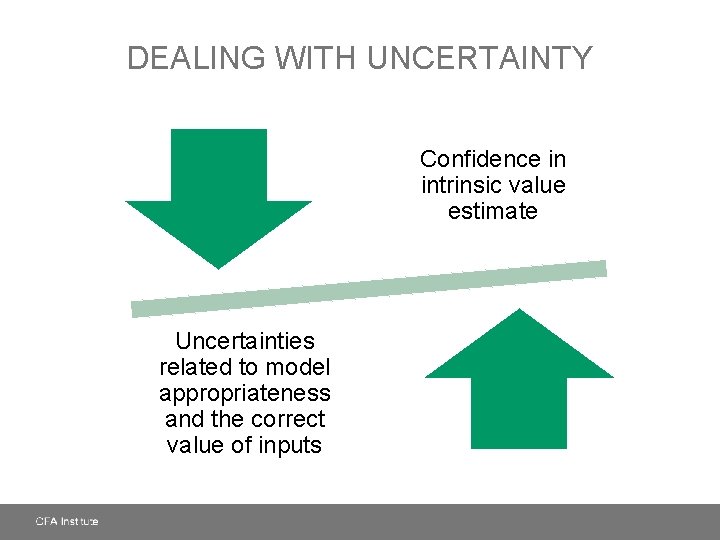
DEALING WITH UNCERTAINTY Confidence in intrinsic value estimate Uncertainties related to model appropriateness and the correct value of inputs
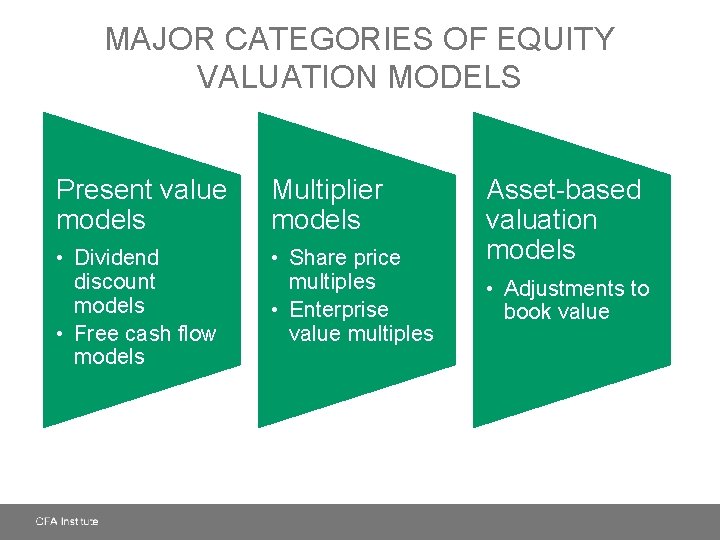
MAJOR CATEGORIES OF EQUITY VALUATION MODELS Present value models Multiplier models • Dividend discount models • Free cash flow models • Share price multiples • Enterprise value multiples Asset-based valuation models • Adjustments to book value

PRESENT VALUE MODELS Value of an investment = present value of expected future benefits Future benefits = dividends Future benefits = free cash flow
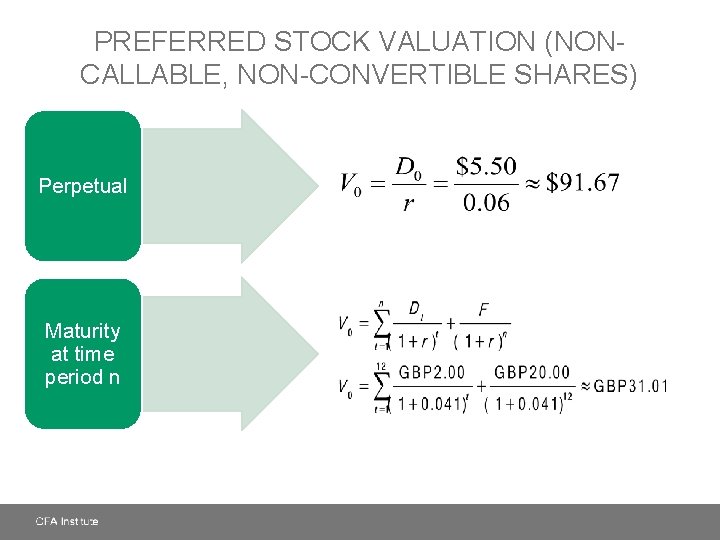
PREFERRED STOCK VALUATION (NONCALLABLE, NON-CONVERTIBLE SHARES) Perpetual Maturity at time period n
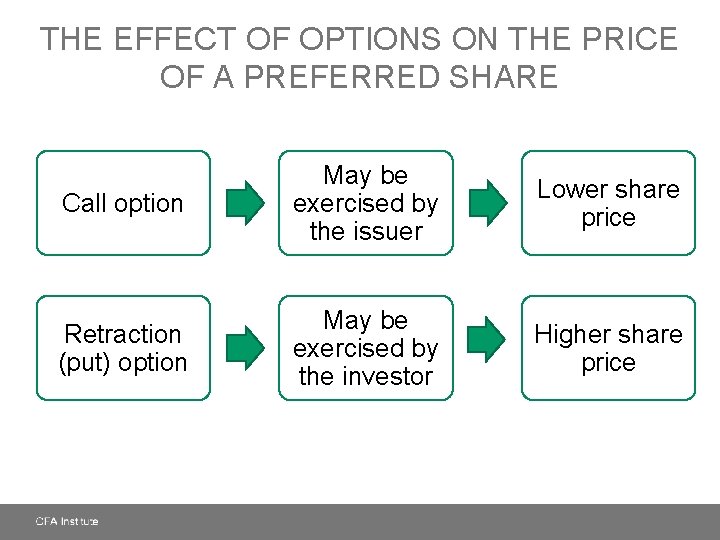
THE EFFECT OF OPTIONS ON THE PRICE OF A PREFERRED SHARE Call option May be exercised by the issuer Lower share price Retraction (put) option May be exercised by the investor Higher share price
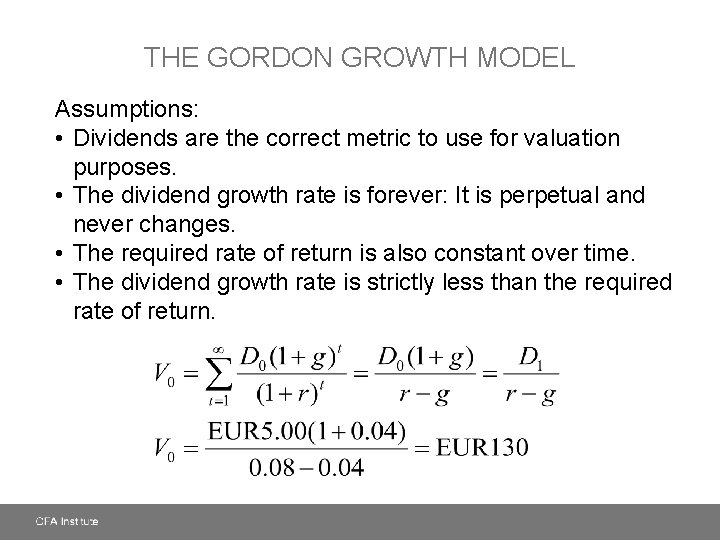
THE GORDON GROWTH MODEL Assumptions: • Dividends are the correct metric to use for valuation purposes. • The dividend growth rate is forever: It is perpetual and never changes. • The required rate of return is also constant over time. • The dividend growth rate is strictly less than the required rate of return.
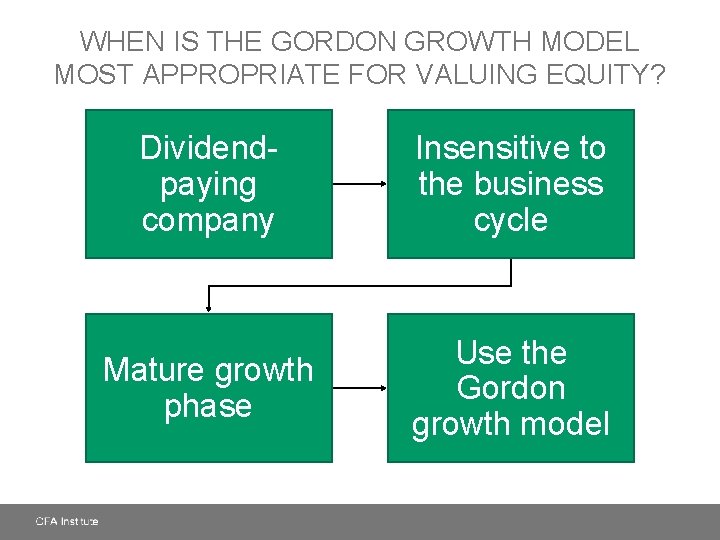
WHEN IS THE GORDON GROWTH MODEL MOST APPROPRIATE FOR VALUING EQUITY? Dividendpaying company Insensitive to the business cycle Mature growth phase Use the Gordon growth model
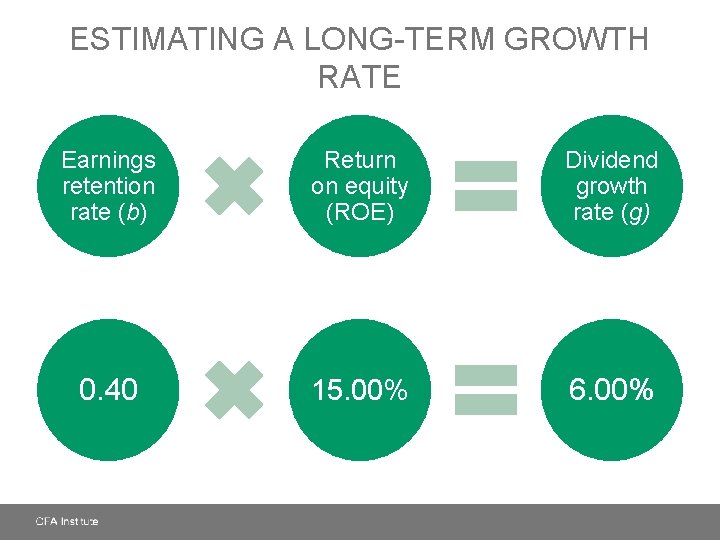
ESTIMATING A LONG-TERM GROWTH RATE Earnings retention rate (b) Return on equity (ROE) Dividend growth rate (g) 0. 40 15. 00% 6. 00%
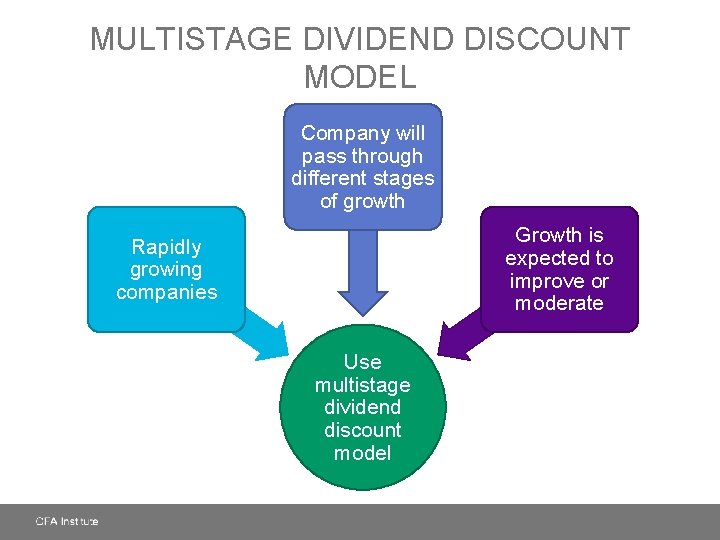
MULTISTAGE DIVIDEND DISCOUNT MODEL Company will pass through different stages of growth Growth is expected to improve or moderate Rapidly growing companies Use multistage dividend discount model
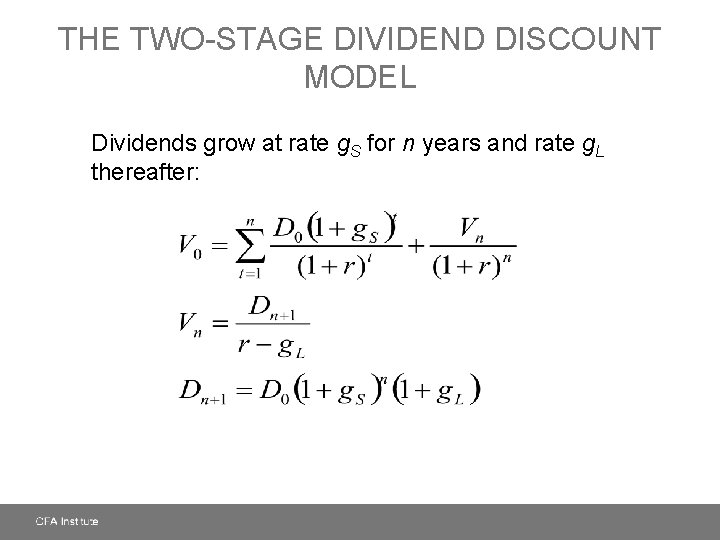
THE TWO-STAGE DIVIDEND DISCOUNT MODEL Dividends grow at rate g. S for n years and rate g. L thereafter:
THE TWO-STAGE DIVIDEND DISCOUNT MODEL (CONTINUED FROM PREVIOUS SLIDE)
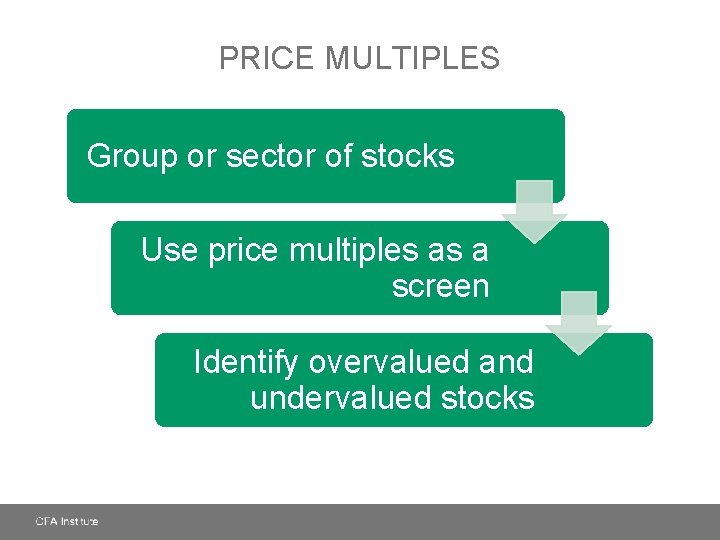
PRICE MULTIPLES Group or sector of stocks Use price multiples as a screen Identify overvalued and undervalued stocks
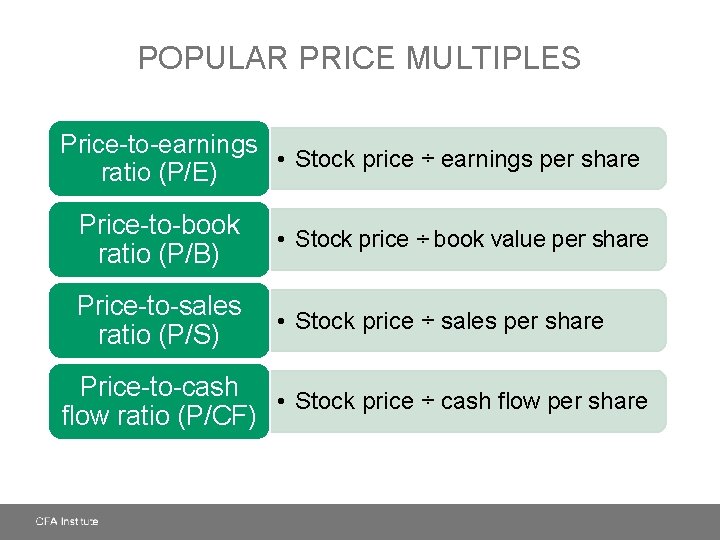
POPULAR PRICE MULTIPLES Price-to-earnings • Stock price ÷ earnings per share ratio (P/E) Price-to-book ratio (P/B) • Stock price ÷ book value per share Price-to-sales ratio (P/S) • Stock price ÷ sales per share Price-to-cash • Stock price ÷ cash flow per share flow ratio (P/CF)

PRICE MULTIPLES FOR TELEFÓNICA AND DEUTSCHE TELEKOM Sources: Company websites: www. telefonica. es and www. deutschetelekom. com.
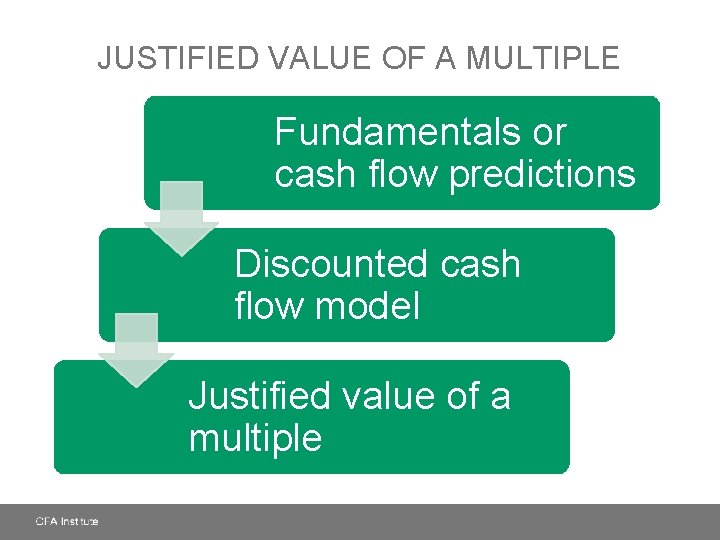
JUSTIFIED VALUE OF A MULTIPLE Fundamentals or cash flow predictions Discounted cash flow model Justified value of a multiple
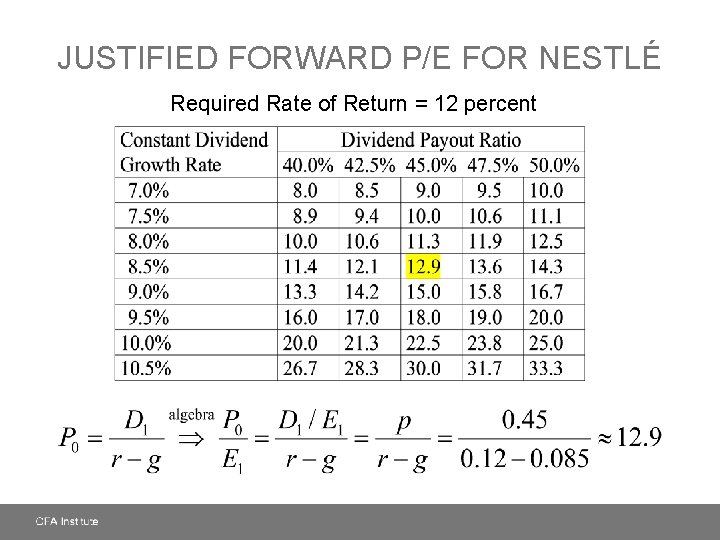
JUSTIFIED FORWARD P/E FOR NESTLÉ Required Rate of Return = 12 percent
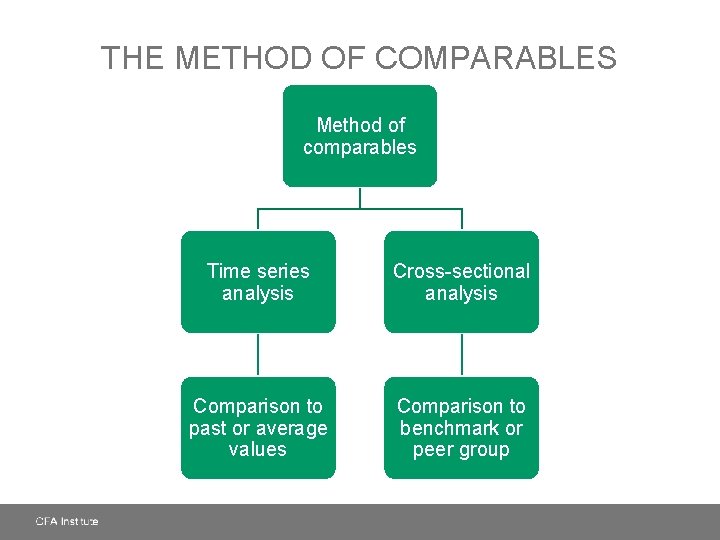
THE METHOD OF COMPARABLES Method of comparables Time series analysis Cross-sectional analysis Comparison to past or average values Comparison to benchmark or peer group
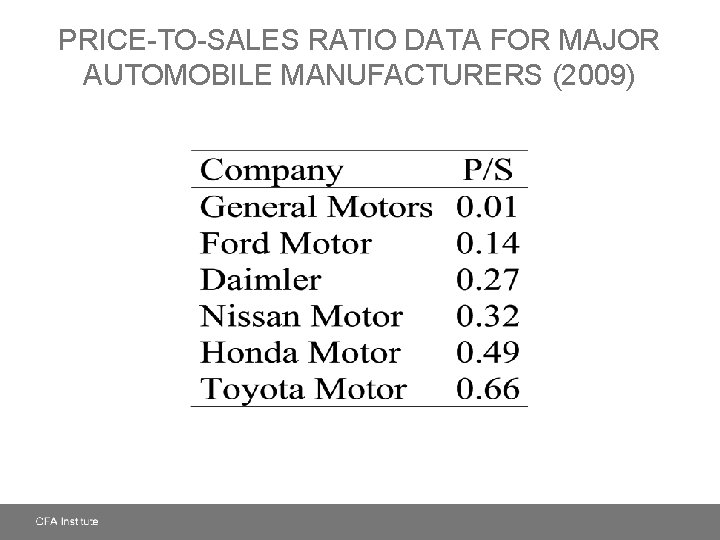
PRICE-TO-SALES RATIO DATA FOR MAJOR AUTOMOBILE MANUFACTURERS (2009)
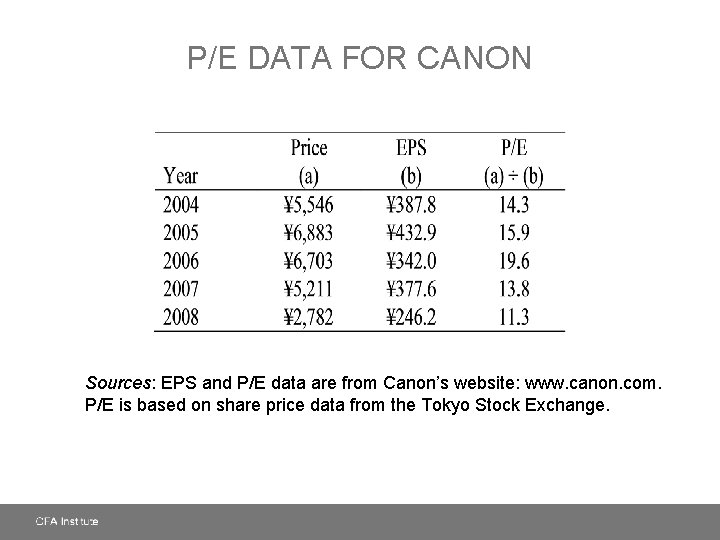
P/E DATA FOR CANON Sources: EPS and P/E data are from Canon’s website: www. canon. com. P/E is based on share price data from the Tokyo Stock Exchange.
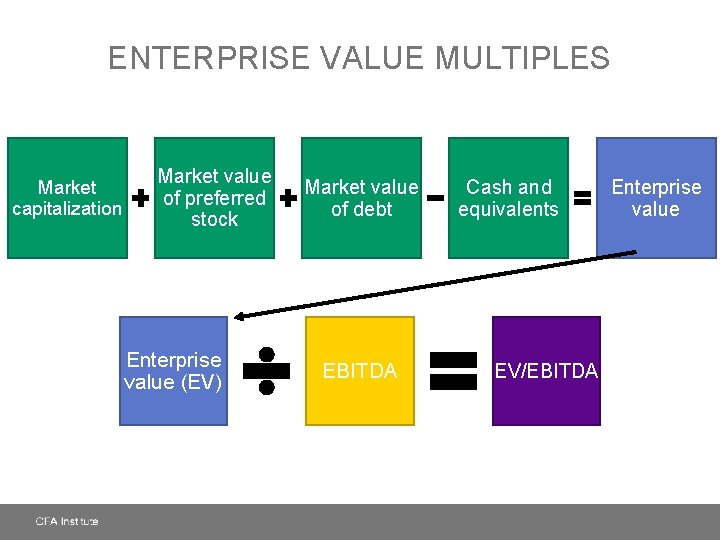
ENTERPRISE VALUE MULTIPLES Market capitalization Market value of preferred stock Enterprise value (EV) Market value of debt EBITDA Cash and equivalents EV/EBITDA Enterprise value
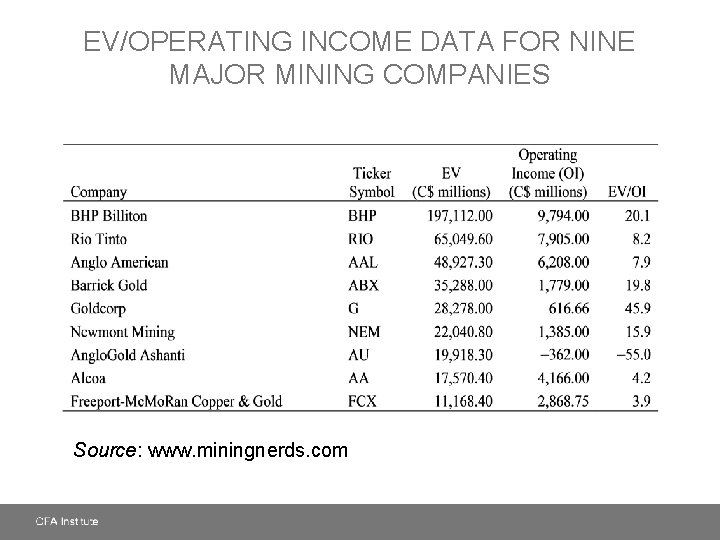
EV/OPERATING INCOME DATA FOR NINE MAJOR MINING COMPANIES Source: www. miningnerds. com
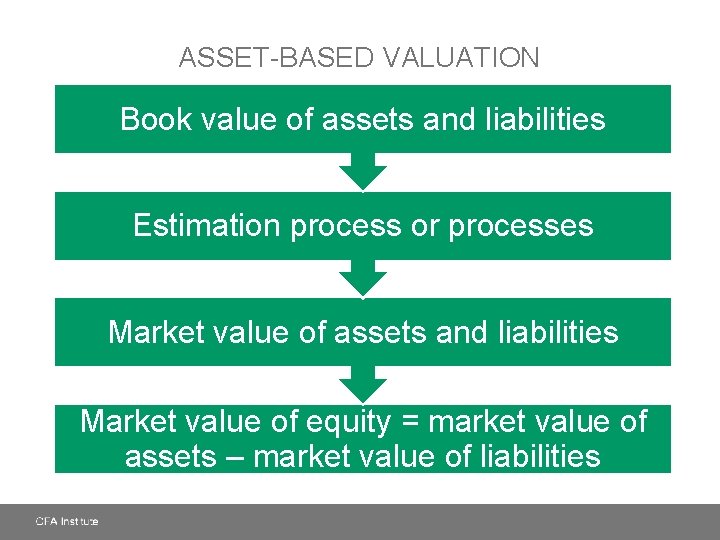
ASSET-BASED VALUATION Book value of assets and liabilities Estimation process or processes Market value of assets and liabilities Market value of equity = market value of assets – market value of liabilities
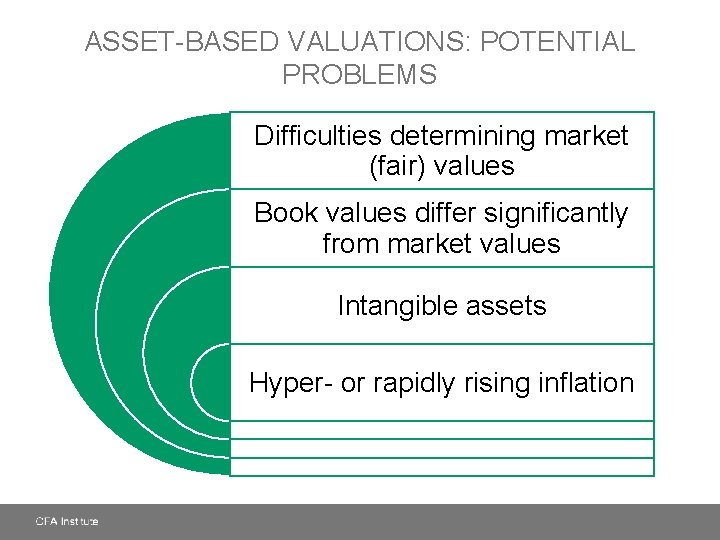
ASSET-BASED VALUATIONS: POTENTIAL PROBLEMS Difficulties determining market (fair) values Book values differ significantly from market values Intangible assets Hyper- or rapidly rising inflation
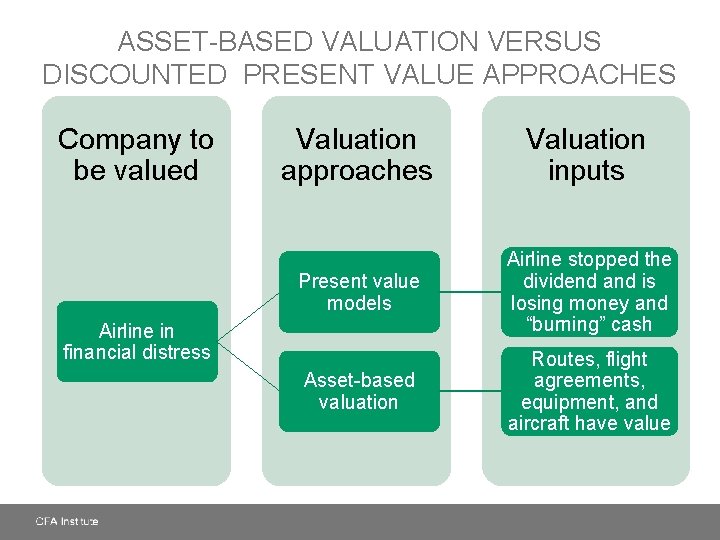
ASSET-BASED VALUATION VERSUS DISCOUNTED PRESENT VALUE APPROACHES Company to be valued Valuation approaches Valuation inputs Present value models Airline stopped the dividend and is losing money and “burning” cash Asset-based valuation Routes, flight agreements, equipment, and aircraft have value Airline in financial distress
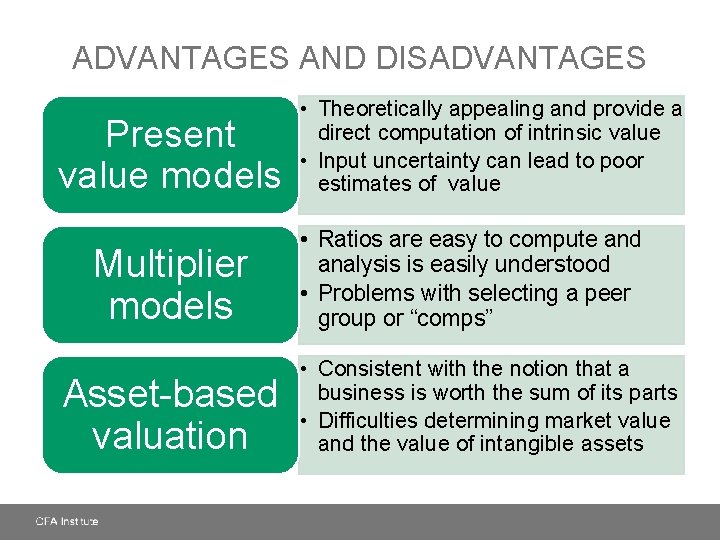
ADVANTAGES AND DISADVANTAGES Present value models Multiplier models Asset-based valuation • Theoretically appealing and provide a direct computation of intrinsic value • Input uncertainty can lead to poor estimates of value • Ratios are easy to compute and analysis is easily understood • Problems with selecting a peer group or “comps” • Consistent with the notion that a business is worth the sum of its parts • Difficulties determining market value and the value of intangible assets
SUMMARY • Overvalued, fairly valued, or undervalued securities • Major categories of equity valuation models • Present value models: dividend discount models and free cash flow models • Multiplier models: price ratios and enterprise value ratios • Asset-based valuation • Advantages and disadvantages of equity valuation models
- Slides: 28