
Chapter 10 Electronic Human Resource Management eHRM 1
- Slides: 14
Chapter 10: Electronic Human Resource Management (e-HRM) 1
Technological Change in HRM A Changing Economy v The way business is conducted has changed rapidly during the past few years and will continue to do so. v Many companies are connecting to the Internet to gain an advantage over or keep up with competitors. v Electronic business (e-business) is any process that a business conducts electronically, especially business involving use of the Internet. v E-business involves several forms of buying and selling goods and services: § Business-to-consumer § Business-to-business § Consumer-to-consumer 2
INTRODUCTION v Advances in computer-related technology have had a major impact on the use of information for managing HR. v A human resource information system (HRIS) is a computer system used to acquire, store, manipulate, analyze, retrieve, and distribute information related to human resources. v Electronic human resource management (E-HRM) represents a relatively new transformation in the field of human resource management. v In a rapidly and drastically changing competitive environment, human resources are one important source of competitively sustainable advantage. v The electronic human resource management (e-HRM) supports the human resource function comply with the human resource (HR) needs of the organization through web technology based channels. It stores information regarding payroll, employee personal data, performance management, training, recruitment and strategic orientation. 3
Uses of E-HRM v With electronic human resource management, HR departments handle record keeping and information sharing. v It decreases the paperwork substantially and allows easy access to voluminous data. v The employee can also keep track of his/her achievements without having to go through litigious procedures. v It uses intranet or other web technology channels. v It can also be used for implementation of different human resource strategies. v The authorization of different HR functions can be distributed through Electronic Human Resource. v In addition to saving resources, through a web-based system is achieved, among the activities that organizations can do through the web site, are personnel matters. Electronic human resource management (E HRM) is one of human resource management science that with the aim of procedures optimizing in order to run faster the human resources function, reducing costs and freeing scientists from administrative constraints to implement the strategic role has been created. 4
E-HR v Organizations are seeking e-HR solutions that can help automate tasks and streamline workflow & Improve the efficiency of the workforce by providing self-service tools, training &Information. v By automating processes, HR can better align itself with the business objectives of the enterprise and focus on higher value business services and employee needs, such as training and development. v Keeping in mind the importance of the issues responsible to managerial effectiveness and organizational goal completion. v HR professional needs to be aware of and knowledgeable enough to adopt the new technology for the benefit of his or her business. E-HRM is the complete integration of all HR process based on common HR data (Ashwathappa, 2007). 5
E-HRM Definition v Electronic human resource management is defined as a way of implementing HRM strategies, policies and practices in organization through a conscious and direct support of and/ or with the full use of web -technology-based channels (Ruel et al. , 2007). v E-HRM can be accessed from virtually anywhere and can be used to more effectively develop the human capital of organizations (Heneman and Greenberger, 2002; Bondarouk et al. , 2009). v The processing and transmission of digitalized HR information is called electronic human resource management (e-HRM). 6
e-HRM outcomes v According to (Beer et al. . , 1984) all e-HRM activities will implicitly or explicitly be directed towards distinguish four possibilities: § high commitment, § high competence, § cost effectiveness and § higher congruence (similarity). v These outcomes, in turn, may change the state of HRM in an organization, in to a new HRM state. v e-HRM will change the nature of the HR department by making less administrative tasks for the HR department and therefore less administrative positions, more focus on the strategic goals of the organization. 7
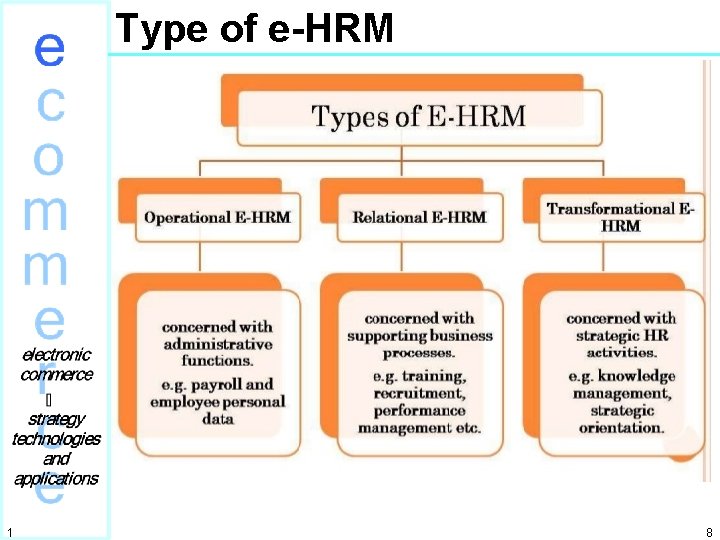
Type of e-HRM 1 8
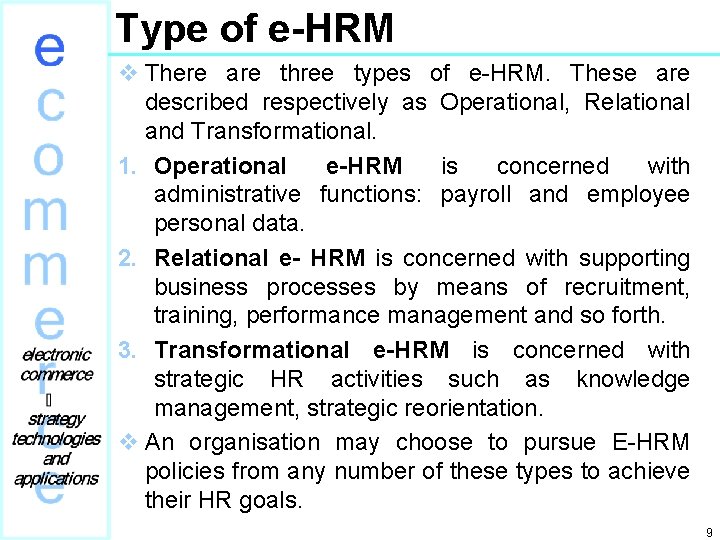
Type of e-HRM v There are three types of e-HRM. These are described respectively as Operational, Relational and Transformational. 1. Operational e-HRM is concerned with administrative functions: payroll and employee personal data. 2. Relational e- HRM is concerned with supporting business processes by means of recruitment, training, performance management and so forth. 3. Transformational e-HRM is concerned with strategic HR activities such as knowledge management, strategic reorientation. v An organisation may choose to pursue E-HRM policies from any number of these types to achieve their HR goals. 9
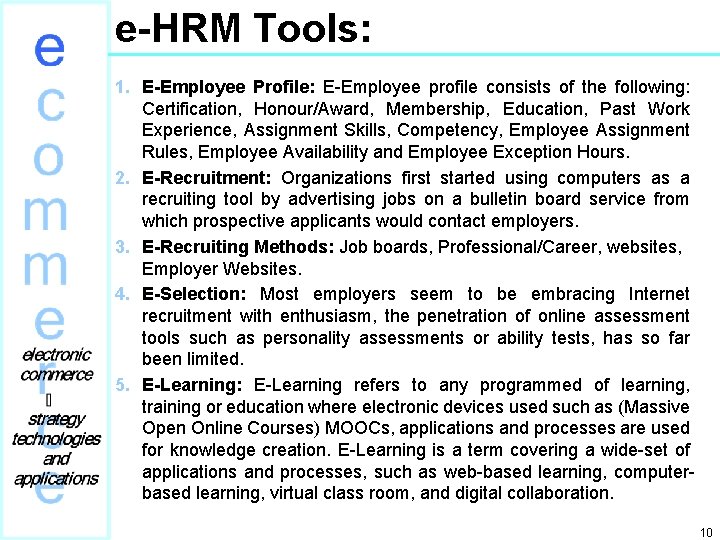
e-HRM Tools: 1. E-Employee Profile: E-Employee profile consists of the following: Certification, Honour/Award, Membership, Education, Past Work Experience, Assignment Skills, Competency, Employee Assignment Rules, Employee Availability and Employee Exception Hours. 2. E-Recruitment: Organizations first started using computers as a recruiting tool by advertising jobs on a bulletin board service from which prospective applicants would contact employers. 3. E-Recruiting Methods: Job boards, Professional/Career, websites, Employer Websites. 4. E-Selection: Most employers seem to be embracing Internet recruitment with enthusiasm, the penetration of online assessment tools such as personality assessments or ability tests, has so far been limited. 5. E-Learning: E-Learning refers to any programmed of learning, training or education where electronic devices used such as (Massive Open Online Courses) MOOCs, applications and processes are used for knowledge creation. E-Learning is a term covering a wide-set of applications and processes, such as web-based learning, computerbased learning, virtual class room, and digital collaboration. 10
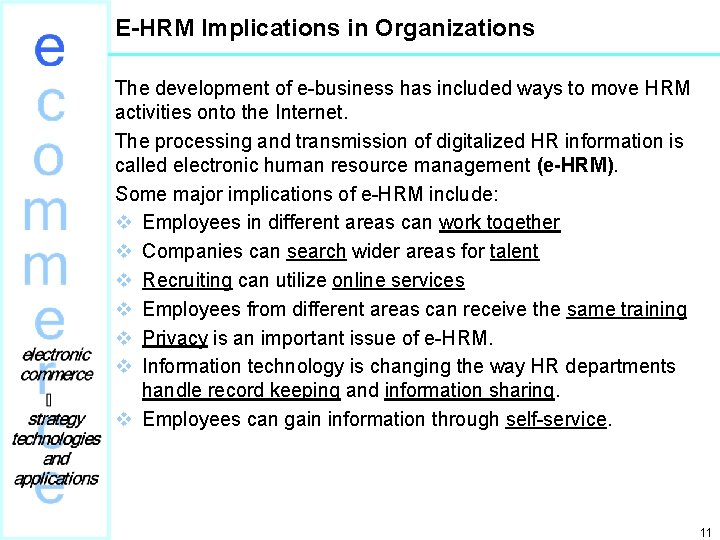
E-HRM Implications in Organizations The development of e-business has included ways to move HRM activities onto the Internet. The processing and transmission of digitalized HR information is called electronic human resource management (e-HRM). Some major implications of e-HRM include: v Employees in different areas can work together v Companies can search wider areas for talent v Recruiting can utilize online services v Employees from different areas can receive the same training v Privacy is an important issue of e-HRM. v Information technology is changing the way HR departments handle record keeping and information sharing. v Employees can gain information through self-service. 11
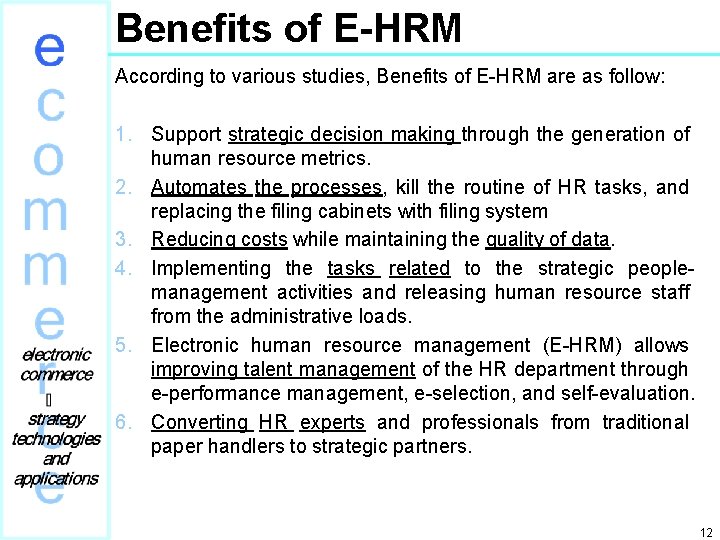
Benefits of E-HRM According to various studies, Benefits of E-HRM are as follow: 1. Support strategic decision making through the generation of human resource metrics. 2. Automates the processes, kill the routine of HR tasks, and replacing the filing cabinets with filing system 3. Reducing costs while maintaining the quality of data. 4. Implementing the tasks related to the strategic peoplemanagement activities and releasing human resource staff from the administrative loads. 5. Electronic human resource management (E-HRM) allows improving talent management of the HR department through e-performance management, e-selection, and self-evaluation. 6. Converting HR experts and professionals from traditional paper handlers to strategic partners. 12
E-HRM effectiveness in Pakistan v In Pakistani organization’ has assessed various EHRM practices and examines the relationship between HRD practices and the philosophy of management. v E-HRM improve quality and efficiency of HR activities by efficient delivery of HR service, cost saving and transforming the role of HR function from administrative expert to a strategic partner. v E-HRM practices in Pakistani banking sector increase bank’s performance. v E-HRM practices release the administrative responsibilities and spare for strategic and value added activities which has a positive impact on employee –employer relation which could be a first step towards sustain competitive advantage 13
Conclusion v The e-HRM plays vital role for improving the organizational performance and has proved effective for the employees working in the organization as it provides sufficient opportunities for employee‘s career planning and development. v Moreover, by the implementation of e- HRM the employees can identify and nurture their talents and helps them to raise their performance. v E- HRM is a way of implementing Human Resource strategies, policies and practices in an organization through a conscious and directed support of and/or with the full use of web- based channels. v e-HRM is an increasing phenomenon; more than one-fifth of large companies have made considerable steps to support HR practices and policies through web technology. 14