
Chapter 10 Education Health and Human Capital CHAPTER







- Slides: 36
Chapter 10 Education, Health and Human Capital CHAPTER 1 ©E. Wayne Nafziger Development Economics 1
Education, Health & Human Capital n Since Abraham Lincoln and John Henry, humankind has denigrated manual work and put a premium on intellectual work. CHAPTER 1 ©E. Wayne Nafziger Development Economics 2
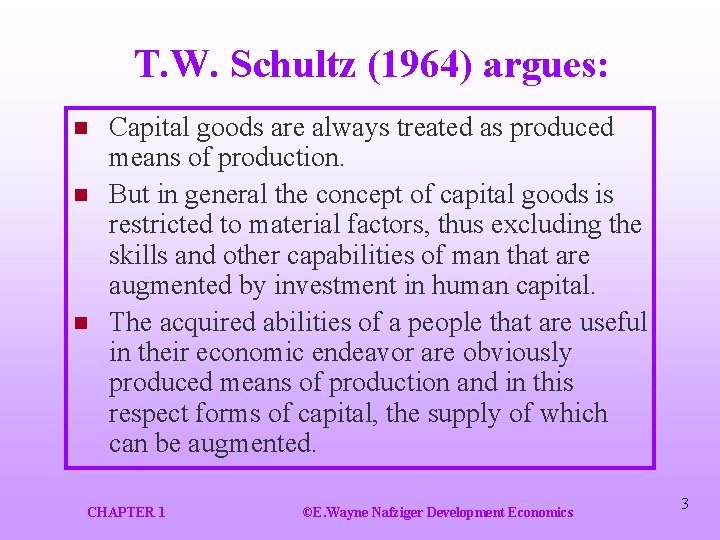
T. W. Schultz (1964) argues: n n n Capital goods are always treated as produced means of production. But in general the concept of capital goods is restricted to material factors, thus excluding the skills and other capabilities of man that are augmented by investment in human capital. The acquired abilities of a people that are useful in their economic endeavor are obviously produced means of production and in this respect forms of capital, the supply of which can be augmented. CHAPTER 1 ©E. Wayne Nafziger Development Economics 3
What are the benefits of LDC education? CHAPTER 1 ©E. Wayne Nafziger Development Economics 4
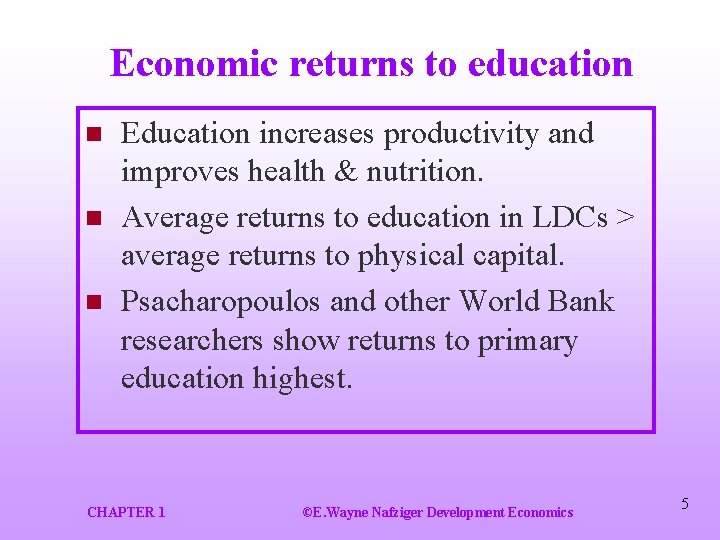
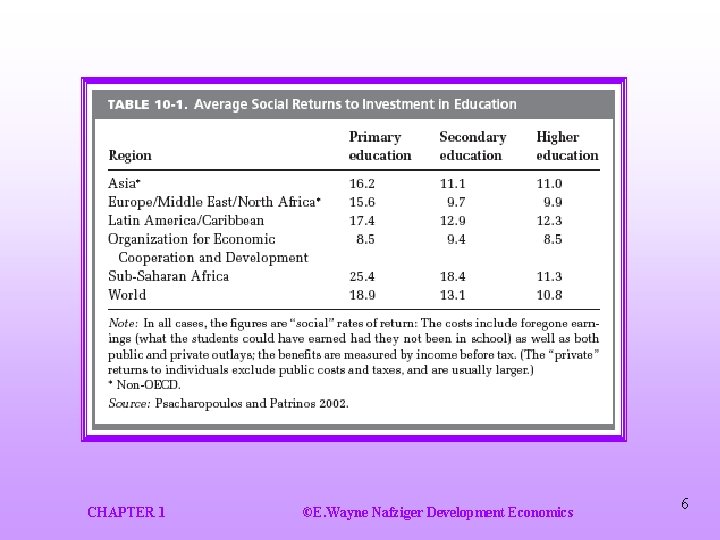
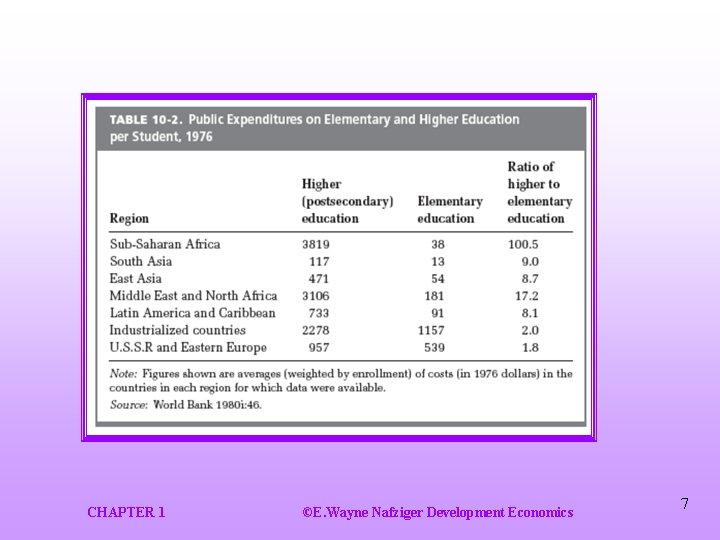
Economic returns to education n Education increases productivity and improves health & nutrition. Average returns to education in LDCs > average returns to physical capital. Psacharopoulos and other World Bank researchers show returns to primary education highest. CHAPTER 1 ©E. Wayne Nafziger Development Economics 5
CHAPTER 1 ©E. Wayne Nafziger Development Economics 6
CHAPTER 1 ©E. Wayne Nafziger Development Economics 7
What are the flaws of Psacharopoulos et al. ’s research n n n Marginal rates of return for primary education lower than secondary education (Knight et al. ). After rapid educational expansion, primary completers, in the 1990 s, can’t get menial blue-collar jobs. Primary graduates “filter down” into lesser jobs, with lower rates of return. CHAPTER 1 ©E. Wayne Nafziger Development Economics 8
Premium for higher education/primary education n Highest in Africa, where university graduates scarce. CHAPTER 1 ©E. Wayne Nafziger Development Economics 9
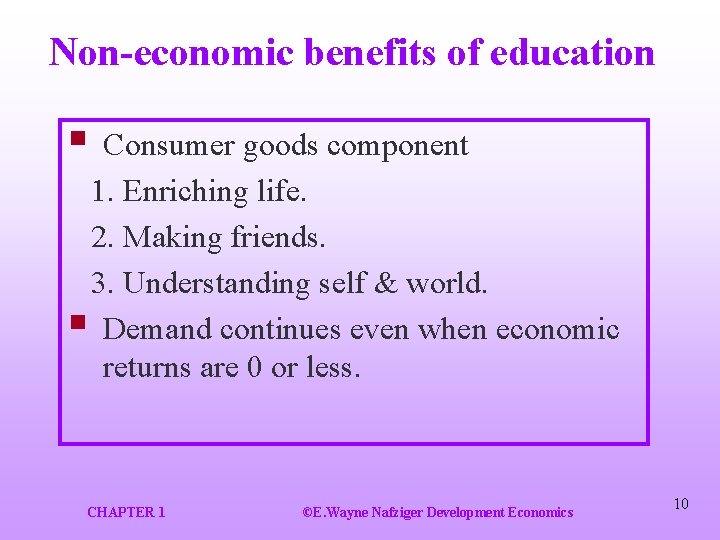
Non-economic benefits of education § Consumer goods component 1. Enriching life. 2. Making friends. 3. Understanding self & world. § Demand continues even when economic returns are 0 or less. CHAPTER 1 ©E. Wayne Nafziger Development Economics 10
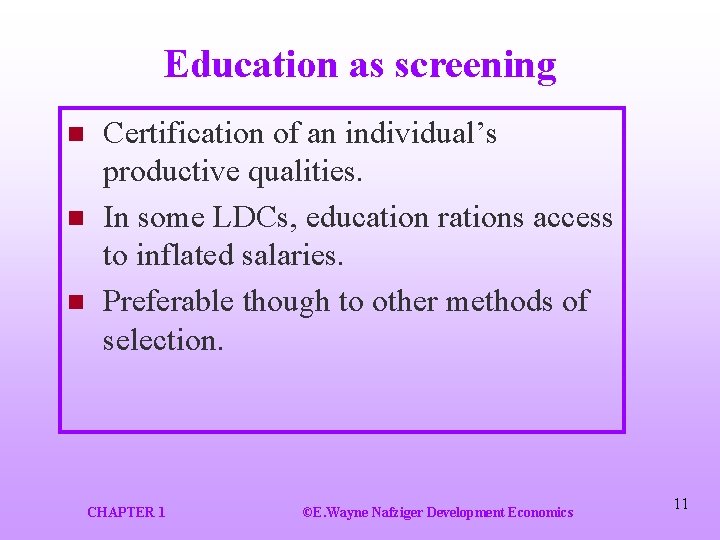
Education as screening n n n Certification of an individual’s productive qualities. In some LDCs, education rations access to inflated salaries. Preferable though to other methods of selection. CHAPTER 1 ©E. Wayne Nafziger Development Economics 11
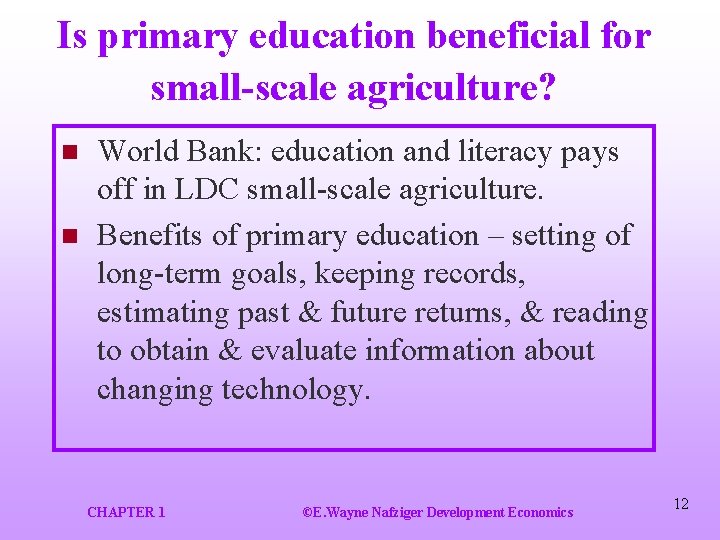
Is primary education beneficial for small-scale agriculture? n n World Bank: education and literacy pays off in LDC small-scale agriculture. Benefits of primary education – setting of long-term goals, keeping records, estimating past & future returns, & reading to obtain & evaluate information about changing technology. CHAPTER 1 ©E. Wayne Nafziger Development Economics 12
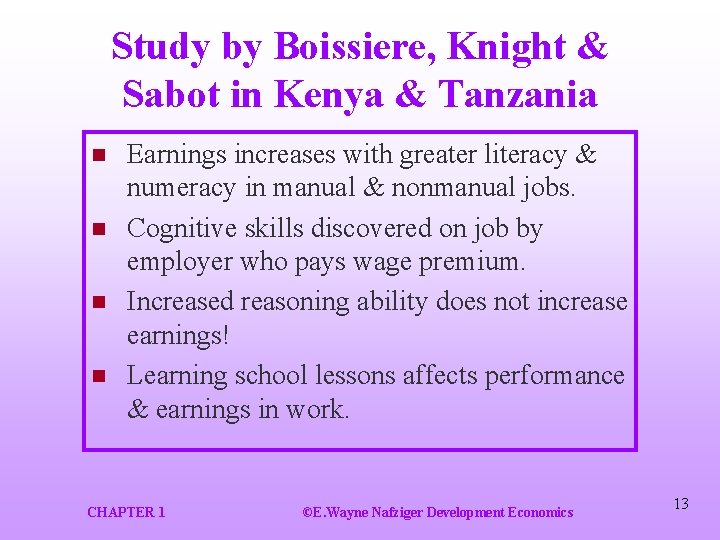
Study by Boissiere, Knight & Sabot in Kenya & Tanzania n n Earnings increases with greater literacy & numeracy in manual & nonmanual jobs. Cognitive skills discovered on job by employer who pays wage premium. Increased reasoning ability does not increase earnings! Learning school lessons affects performance & earnings in work. CHAPTER 1 ©E. Wayne Nafziger Development Economics 13
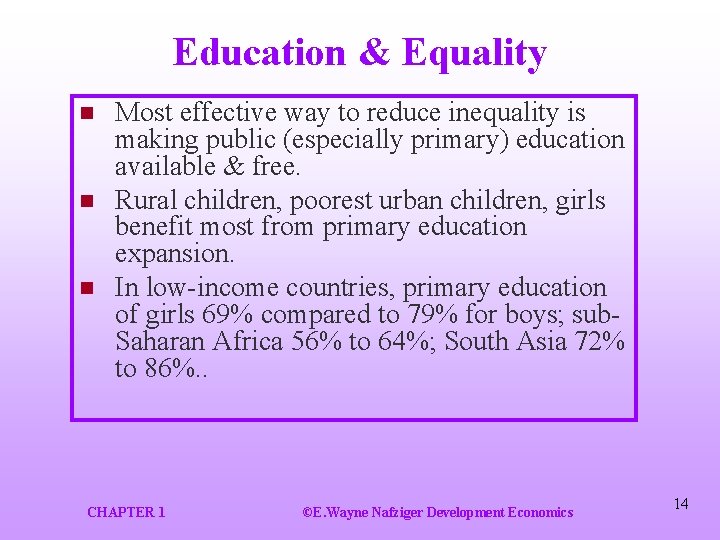
Education & Equality n n n Most effective way to reduce inequality is making public (especially primary) education available & free. Rural children, poorest urban children, girls benefit most from primary education expansion. In low-income countries, primary education of girls 69% compared to 79% for boys; sub. Saharan Africa 56% to 64%; South Asia 72% to 86%. . CHAPTER 1 ©E. Wayne Nafziger Development Economics 14
CHAPTER 1 ©E. Wayne Nafziger Development Economics 15
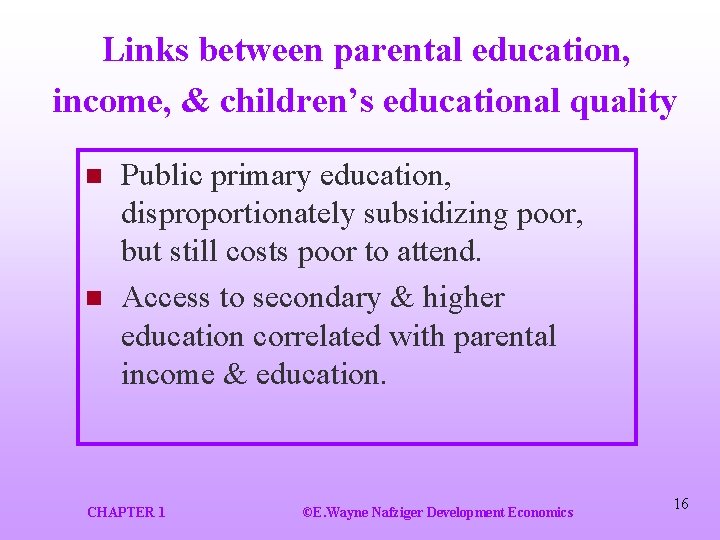
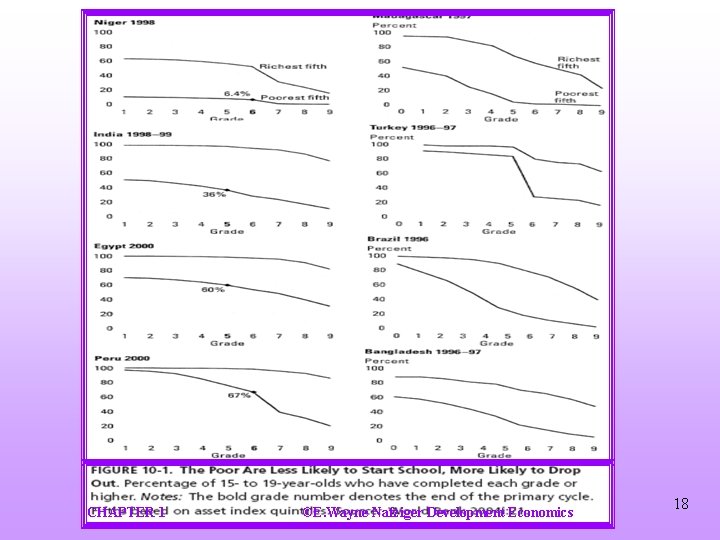
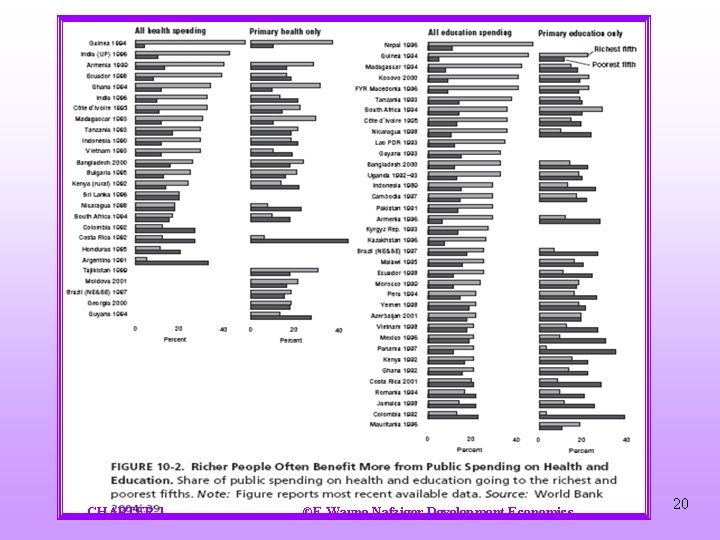
Links between parental education, income, & children’s educational quality n n Public primary education, disproportionately subsidizing poor, but still costs poor to attend. Access to secondary & higher education correlated with parental income & education. CHAPTER 1 ©E. Wayne Nafziger Development Economics 16
Tanzania’s effort to limit secondary education relative to primary education to make education more equitable backfired n Rich sent children to private primary schools, increasing their ability to score high on the primary certificate exam and thus their likelihood of entering secondary school, especially a high ranking one. CHAPTER 1 ©E. Wayne Nafziger Development Economics 17
CHAPTER 1 ©E. Wayne Nafziger Development Economics 18
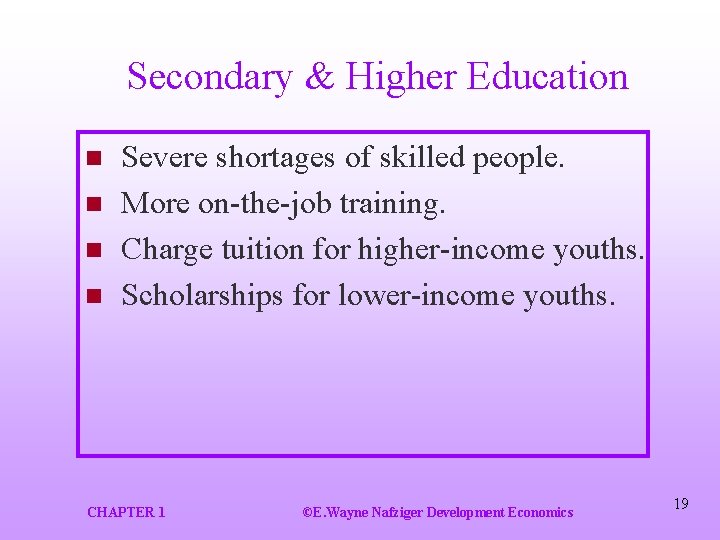
Secondary & Higher Education n n Severe shortages of skilled people. More on-the-job training. Charge tuition for higher-income youths. Scholarships for lower-income youths. CHAPTER 1 ©E. Wayne Nafziger Development Economics 19
CHAPTER 1 ©E. Wayne Nafziger Development Economics 20
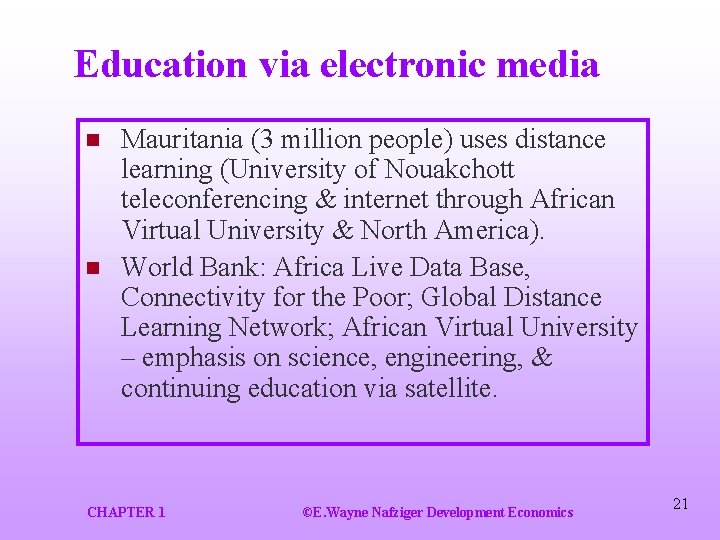
Education via electronic media n n Mauritania (3 million people) uses distance learning (University of Nouakchott teleconferencing & internet through African Virtual University & North America). World Bank: Africa Live Data Base, Connectivity for the Poor; Global Distance Learning Network; African Virtual University – emphasis on science, engineering, & continuing education via satellite. CHAPTER 1 ©E. Wayne Nafziger Development Economics 21
Other topics in the book n n Planning for specialized education & training. Achieving consistency in planning educated people. Vocational & technical skills. Socialization & motivation. CHAPTER 1 ©E. Wayne Nafziger Development Economics 22
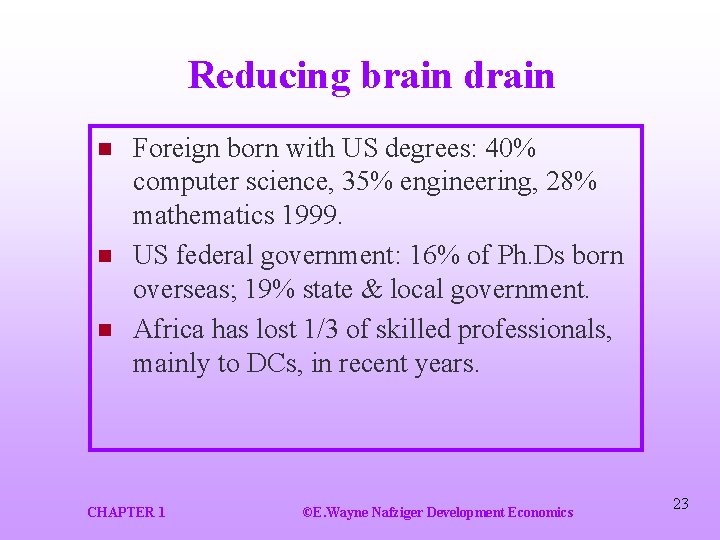
Reducing brain drain n Foreign born with US degrees: 40% computer science, 35% engineering, 28% mathematics 1999. US federal government: 16% of Ph. Ds born overseas; 19% state & local government. Africa has lost 1/3 of skilled professionals, mainly to DCs, in recent years. CHAPTER 1 ©E. Wayne Nafziger Development Economics 23
Does the brain drain hurt LDCs? n n n Borjas: US immigrants educated abroad do not receive their marginal product as wages, thus importing free human capital to US. Grubel-Scott: Incomes of those born in LDCs increases with emigration. Baldwin: overflow of high-level persons otherwise underutilized. CHAPTER 1 ©E. Wayne Nafziger Development Economics 24
But. . . n n LDCs subsidize schooling. LDC labor markets monopsonistic (one buyer), thus meaning LDCs lose more output than income from emigration. High level persons increase productivity of other production factors. LDCs can encourage students to take relevant programs. CHAPTER 1 ©E. Wayne Nafziger Development Economics 25
Policies n n n Scholarships within country or those abroad only for relevant programs. Study in another LDC. Research in universities abroad under supervision of local scholar. Temporary salary to foreign educated graduates in job searches. Eliminate discriminatory barriers to highly educated nationals returning. CHAPTER 1 ©E. Wayne Nafziger Development Economics 26
Health & physical condition n World Health Organization, World Health Report (2003: 5) states: Global health is a study in contrasts. While a baby girl born in Japan today can expect to live for about 85 years, a girl born at the same moment in Sierra Leone has a life expectancy of 36 years. The Japanese child will receive vaccinations, adequate nutrition and good schooling. . Meanwhile, the girl in Sierra Leone has little chance of receiving immunizations and a high probability of being underweight throughout childhood. CHAPTER 1 ©E. Wayne Nafziger Development Economics 27
Health in DCs & LDCs n n Japanese person (on average) receives $550 yearly of medications & Sierra Leonean $3. Millennium Development [health] Goals require health promotion, disease prevention, treatment for acute illness & chronic care, response to new threats from diseases & injuries, & primary health care system (WHO 2003: 5 -6). CHAPTER 1 ©E. Wayne Nafziger Development Economics 28
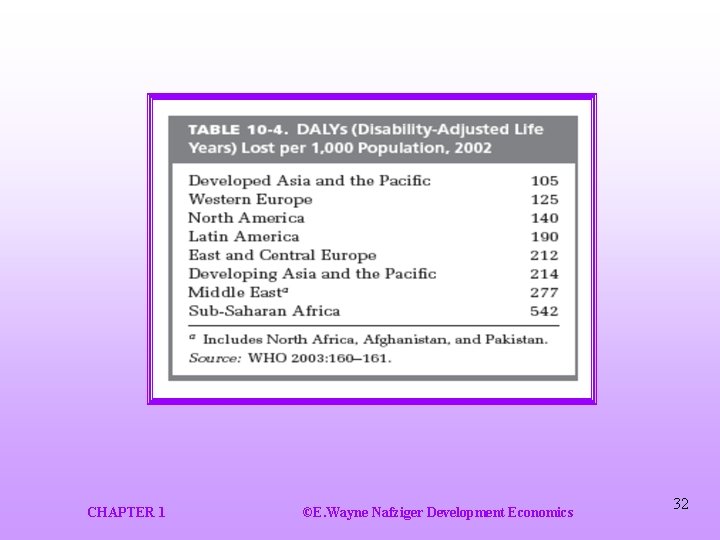
Relation between health & income n n Health & economic development 2 -way relationship. Except for Africa, 1995 -2003, life expectancy gains in all world regions since the 1930 s. Bad health & poor nutrition contribute to low labor productivity, physical suffering, & mental anguish. Malnourishment mostly a problem among the poor. CHAPTER 1 ©E. Wayne Nafziger Development Economics 29
Causes of 57 million deaths (2002) n n n 17 million stroke & heart disease. 7 million cancer. 3. 8 million respiratory infections. 2. 8 million HIV/AIDS. 2. 4 million conditions at birth. 1. 8 million diarrhoeal diseases, 1. 6 million TB, 1. 3 million measles, 1. 2 million malaria, 0. 4 million malnutrition related, 18 million other. CHAPTER 1 ©E. Wayne Nafziger Development Economics 30
Populations with highest risk of deaths § § Children younger than five (18%), of which virtually all are from Africa & other LDCs, Primary contributors are malnutrition, infectious & parasitic diseases, conditions at birth, diarrhoeal diseases, & malaria. Girls lower mortality (except where preferential health care & nutrition for boys). Children from bottom 20% by income. CHAPTER 1 ©E. Wayne Nafziger Development Economics 31
CHAPTER 1 ©E. Wayne Nafziger Development Economics 32
AIDS n n n 20 million died, 1981 -2002 (worldwide). Most of 40 million with HIV will die at least 10 years prematurely. 28 of 40 million with HIV/AIDS in sub. Saharan Africa. CHAPTER 1 ©E. Wayne Nafziger Development Economics 33
AIDS in sub-Saharan Africa 9% prevalence ages 15 -49 years. n Highest among urban high-income, skilled men & their partners. n Women 58% - Dependent on partners for economic security; little power in sexual relationships. - Little power to resist risky sex. n CHAPTER 1 ©E. Wayne Nafziger Development Economics 34
AIDS in sub-Saharan Africa n n Costs: per capita income declines 0. 5 -1. 2% yearly from AIDS. Health care costs, reduced savings, loss of skilled adults (especially teachers) in prime, reduced productivity, orphans, etc. > 20% of southern African adults HIV-positive (2001). Botswana’s life expectancy with AIDS in 2010 projected as 27 compared to 74 without AIDs (Lamptey et al. 2002). CHAPTER 1 ©E. Wayne Nafziger Development Economics 35
How to reduce suffering from AIDS n n Chemotherapy & antiretroviral drugs (but expensive without generic drugs available). UNAIDS, Gates & Clinton Foundations. Preventive measures: education on safer sex, promotion of condom use, prevention & treatment of sexually transmitted diseases cost effective. Brazil mandated universal free access to HIV drugs. CHAPTER 1 ©E. Wayne Nafziger Development Economics 36