
Chapter 10 Designing a physical activity and exercise


- Slides: 28
Chapter 10 Designing a physical activity and exercise program
Designing a program • Several factors should be considered in designing an appropriate exercise program for people. (See chapter two. ) • Physical training works best when you have a plan. • Plan for physical fitness consists of assessing all factors, setting goals and choosing activities for the program.
Assessment • The first step in creating a successful fitness program is to assess your current level of physical activity and fitness for each of the five health-related fitness components (cardiorespiratory endurance, muscular strength, muscular endurance, flexibility, and body composition). • The results of the assessment tests will help you set specific fitness goals and plan your fitness program.
Pre-participation Checklist • YES NO • Has a doctor ever said you have heart trouble? ___ • Do you suffer frequently from chest pains? ___ • Do you often feel faint or have spells of severe dizziness? ___ • Has a doctor ever said your blood pressure was too high? ___ ___ • Has a doctor ever told you that you have a bone or joint problem, such as arthritis, that has been or could be by exercise? ___ aggravated • Are you over age 65 and not accustomed to any exercise? ___ • Are you taking any prescription medications, such as those for heart problems or high blood pressure? ___ • Is there a good physical reason not mentioned here that you ____ should not follow an activity program? _ ___
Setting Goals • Achieving goals is the most effective way to stay motivated about exercise. • Need to set specific, short-term goals based on measurable factors (the SMART criteria : Specific, Measurable, Attainable, Realistic, and Time frame). • These specific goals should be an extension of your overall goals. • Setting these goals involves questions like, "How physically fit do I want to be? " "How important is it to me to reduce my risk of heart disease and diabetes? " "How important is it to me to reduce my risk of falls and hip fracture? " "How much weight do I want to lose
Choosing Activities • An ideal fitness program combines a physically active lifestyle with a systematic exercise program to develop and maintain physical fitness. • To choose activities and exercise program that will suit your goals and preferences.
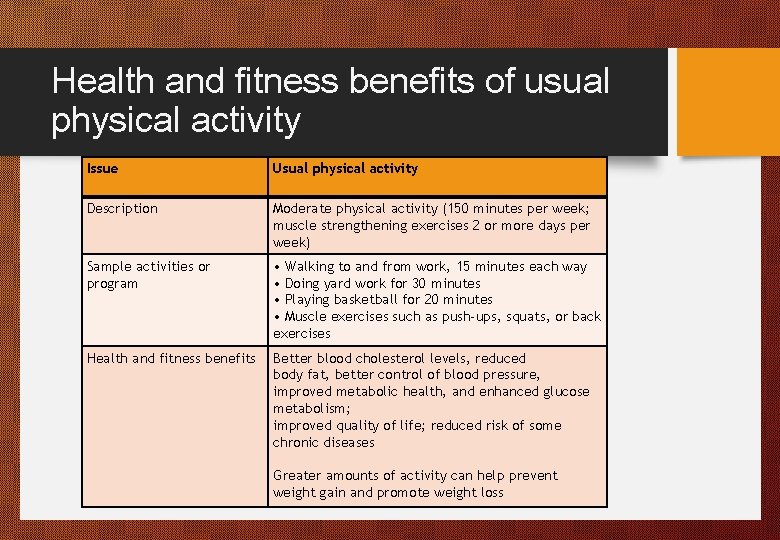
Health and fitness benefits of usual physical activity Issue Usual physical activity Description Moderate physical activity (150 minutes per week; muscle strengthening exercises 2 or more days per week) Sample activities or program • Walking to and from work, 15 minutes each way • Doing yard work for 30 minutes • Playing basketball for 20 minutes • Muscle exercises such as push-ups, squats, or back exercises Health and fitness benefits Better blood cholesterol levels, reduced body fat, better control of blood pressure, improved metabolic health, and enhanced glucose metabolism; improved quality of life; reduced risk of some chronic diseases Greater amounts of activity can help prevent weight gain and promote weight loss
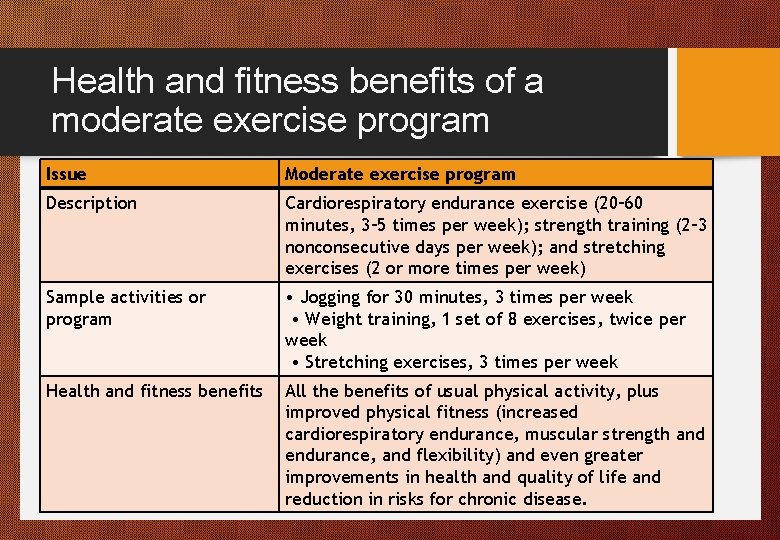
Health and fitness benefits of a moderate exercise program Issue Moderate exercise program Description Cardiorespiratory endurance exercise (20– 60 minutes, 3– 5 times per week); strength training (2– 3 nonconsecutive days per week); and stretching exercises (2 or more times per week) Sample activities or program • Jogging for 30 minutes, 3 times per week • Weight training, 1 set of 8 exercises, twice per week • Stretching exercises, 3 times per week Health and fitness benefits All the benefits of usual physical activity, plus improved physical fitness (increased cardiorespiratory endurance, muscular strength and endurance, and flexibility) and even greater improvements in health and quality of life and reduction in risks for chronic disease.
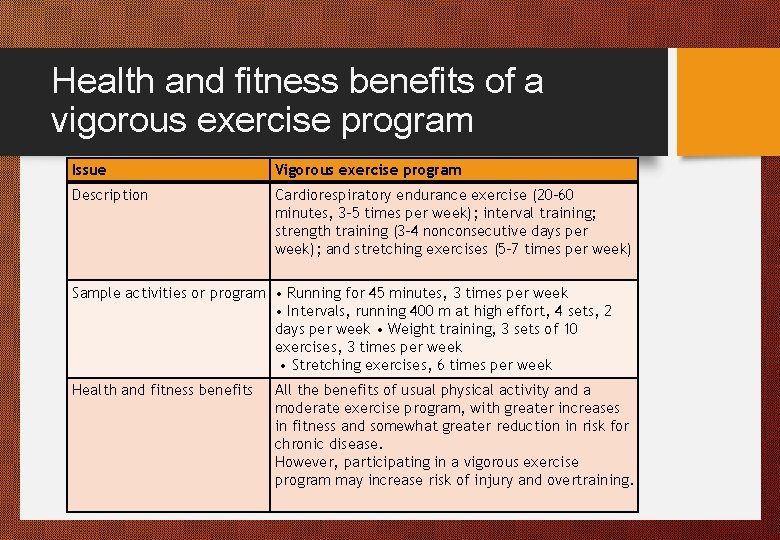
Health and fitness benefits of a vigorous exercise program Issue Vigorous exercise program Description Cardiorespiratory endurance exercise (20– 60 minutes, 3– 5 times per week); interval training; strength training (3– 4 nonconsecutive days per week); and stretching exercises (5– 7 times per week) Sample activities or program • Running for 45 minutes, 3 times per week • Intervals, running 400 m at high effort, 4 sets, 2 days per week • Weight training, 3 sets of 10 exercises, 3 times per week • Stretching exercises, 6 times per week Health and fitness benefits All the benefits of usual physical activity and a moderate exercise program, with greater increases in fitness and somewhat greater reduction in risk for chronic disease. However, participating in a vigorous exercise program may increase risk of injury and overtraining.
Guidelines for Training Train the way you want your body to change To have a more muscular build, lift weights. To be more flexible, do stretching exercises. To improve performance in a particular sport, practice that sport or its movements. • Train regularly • Start slowly, and get in shape gradually • •
Guidelines for Training • Warm Up • Before exercising, warming up can decrease your chances of injury by helping your body gradually progress from rest to activity. • A good warm-up can increase muscle temperature, reduce joint stiffness, bathe joint surfaces in lubricating fluid, and increase blood flow to the muscles, including the heart. • For example, runners may walk and jog slowly prior to running at full speed.
Guidelines for Training • Cool down • During and after exercising, as much as 90% of circulating blood is directed to the muscles and skin, up from as little as 20% during rest. • If you suddenly stop moving after exercise, the amount of blood returning to your heart and brain may be insufficient, and you may experience dizziness, a drop in blood pressure, or other problems. • Cooling down at the end of a workout helps safely restore circulation to its normal resting condition. • Cool down by continuing to move slowly, do stretching exercises while your muscles are still warm.
Guidelines for Training • Exercise safely (See chapter 9. ) • Listen to your body and get adequate rest • Build rest into your training program, and do not exercise if it does not feel right. • Change the volume and intensity of your workouts • To add enjoyment and variety to your program and to further improve fitness, do not train at the same intensity during every workout.
Guidelines for Training • Vary your activities • Change your exercise program from time to keep things fresh and help develop a higher degree of ftness. • Train with a partner • Training partners can motivate and encourage each other • Train your mind • Becoming fit requires commitment, discipline, and patience.
Guidelines for Training • Fuel your body appropriately • Consume enough calories to support your exercise program without gaining body fat • Have fun • Choose a variety of activities that you enjoy • Keep your exercise program in perspective • Balance and moderation are the key ingredients of a fit and well life
Training tips for walking and running • What to wear • Nothing is more important to your enjoyment than comfortable shoes, so do not economize when you buy footwear. • A firm, thick sole, good arch support, and a wellpadded heel are essential. • Nylon or cotton shorts and a T-shirt are adequate during summer.
Training tips for walking and running • Technique • Run or walk with your back comfortably straight, your head up, and your shoulders relaxed. • When jogging, bend your arms, hold your hands in a comfortable position, and keep arm swing to a minimum. • Swing your leg freely from the hip with no attempt to overstride.
Training tips for walking and running • Time of Day • Exercise whenever it is best for your schedule. • Some people prefer to work out before breakfast • Avoid vigorous exercise for 1 -2 hours after a meal due to the digestive system requires an adequate blood supply.
Training tips for walking and running • Where to walk or run • Avoid hard surfaces for the early weeks of training. • Walk or run in the park, on playing fields, on a golf course, or on a running track. • Varying your route will help you maintain interest.
Sample Aerobic fitness program • • A program for three levels of ability A starter program An intermediate program Advanced aerobic program
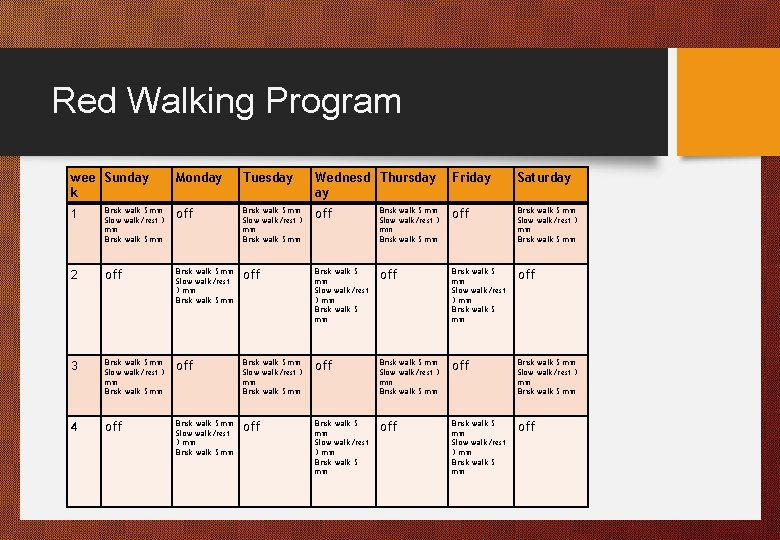
Starter programs • This is suitable for beginner. • Use the walk or walk-jog test to determine your current level of fitness and where you should begin. • The objective of the Walk test is to determine how many minutes (up to 10) you can walk at a brisk pace. • If you cannot walk for 5 min. Begin with the red walking program. • If you can walk more than 5 min. but less than 10, begin with the third week of the red walking program.
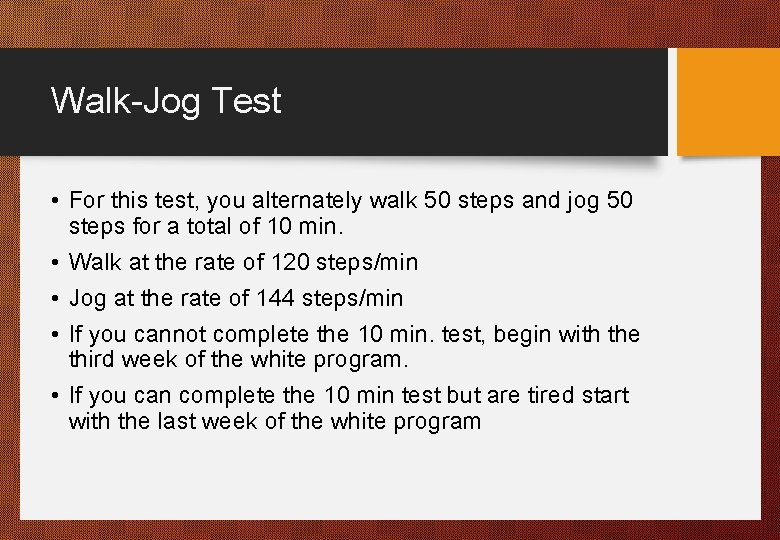
Walk-Jog Test • For this test, you alternately walk 50 steps and jog 50 steps for a total of 10 min. • Walk at the rate of 120 steps/min • Jog at the rate of 144 steps/min • If you cannot complete the 10 min. test, begin with the third week of the white program. • If you can complete the 10 min test but are tired start with the last week of the white program
Red Walking Program wee Sunday k Monday Tuesday Wednesd Thursday ay Friday Saturday 1 Brisk walk 5 min Slow walk/rest 3 min Brisk walk 5 min off Brisk walk 5 min Slow walk/rest 3 min Brisk walk 5 min 2 off Brisk walk 5 min Slow walk/rest 3 min Brisk walk 5 min off 3 Brisk walk 5 min Slow walk/rest 3 min Brisk walk 5 min off Brisk walk 5 min Slow walk/rest 3 min Brisk walk 5 min 4 off Brisk walk 5 min Slow walk/rest 3 min Brisk walk 5 min off
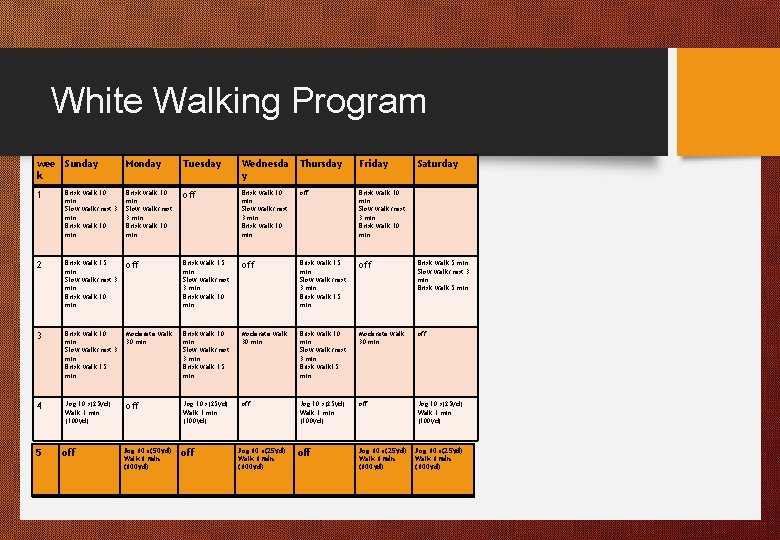
White Walking Program wee Sunday k Monday Tuesday Wednesda y Thursday Friday Saturday 1 Brisk walk 10 min Slow walk/rest 3 min Brisk walk 10 min off Brisk walk 10 min Slow walk/rest 3 min Brisk walk 10 min 2 Brisk walk 15 min Slow walk/rest 3 min Brisk walk 10 min off Brisk walk 15 min Slow walk/rest 3 min Brisk walk 15 min off Brisk walk 5 min Slow walk/rest 3 min Brisk walk 5 min 3 Brisk walk 10 min Slow walk/rest 3 min Brisk walk 15 min Moderate walk 30 min off 4 Jog 10 s(25 yd) Walk 1 min (100 yd) off Jog 10 s(25 yd) Walk 1 min (100 yd) 5 off Jog 10 s(50 yd) Walk 1 min (100 yd) off Jog 10 s(25 yd) Walk 1 min (100 yd)
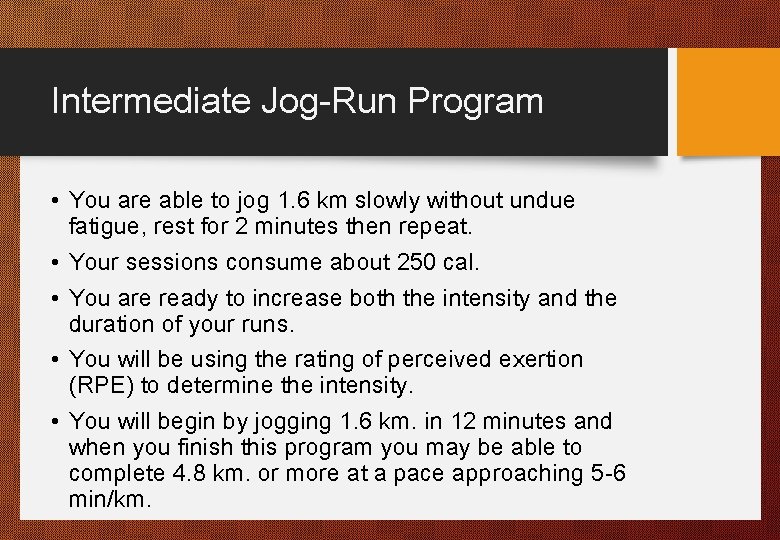
Intermediate Jog-Run Program • You are able to jog 1. 6 km slowly without undue fatigue, rest for 2 minutes then repeat. • Your sessions consume about 250 cal. • You are ready to increase both the intensity and the duration of your runs. • You will be using the rating of perceived exertion (RPE) to determine the intensity. • You will begin by jogging 1. 6 km. in 12 minutes and when you finish this program you may be able to complete 4. 8 km. or more at a pace approaching 5 -6 min/km.
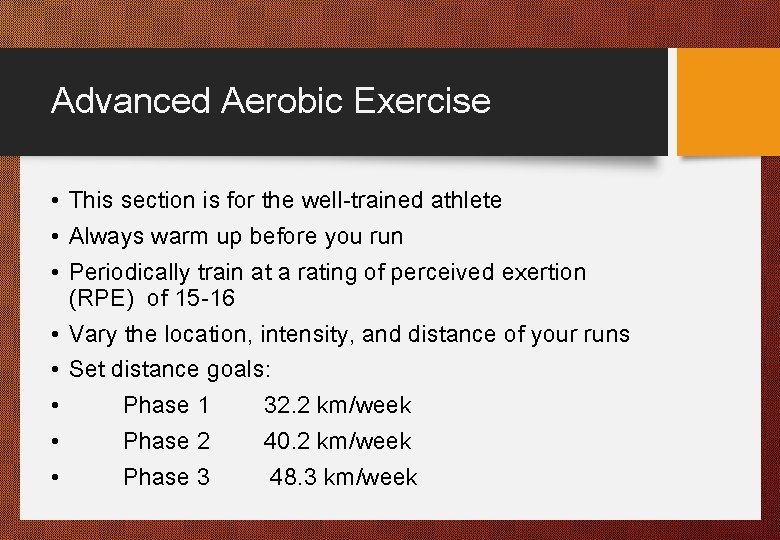
Advanced Aerobic Exercise • This section is for the well-trained athlete • Always warm up before you run • Periodically train at a rating of perceived exertion (RPE) of 15 -16 • Vary the location, intensity, and distance of your runs • Set distance goals: • Phase 1 32. 2 km/week • Phase 2 40. 2 km/week • Phase 3 48. 3 km/week
• According to the World Health Organization (WHO, 2010) physical inactivity is the fourth leading risk factor for global mortality and contributes to 6% of deaths globally, being the principal cause for approximately 21 -25% of breast and colon cancers, and 27% of diabetes and 30% of ischemic heart disease.
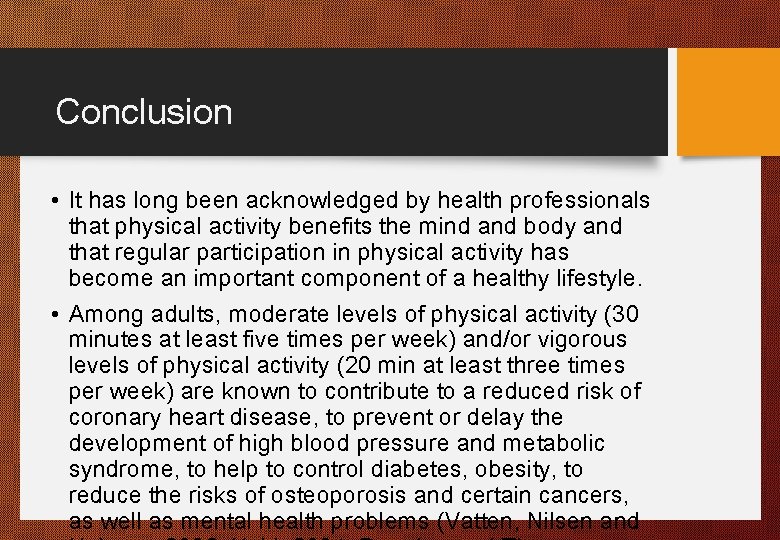
Conclusion • It has long been acknowledged by health professionals that physical activity benefits the mind and body and that regular participation in physical activity has become an important component of a healthy lifestyle. • Among adults, moderate levels of physical activity (30 minutes at least five times per week) and/or vigorous levels of physical activity (20 min at least three times per week) are known to contribute to a reduced risk of coronary heart disease, to prevent or delay the development of high blood pressure and metabolic syndrome, to help to control diabetes, obesity, to reduce the risks of osteoporosis and certain cancers, as well as mental health problems (Vatten, Nilsen and