
Chapter 10 Database Management Data and Information How
Chapter 10 Database Management
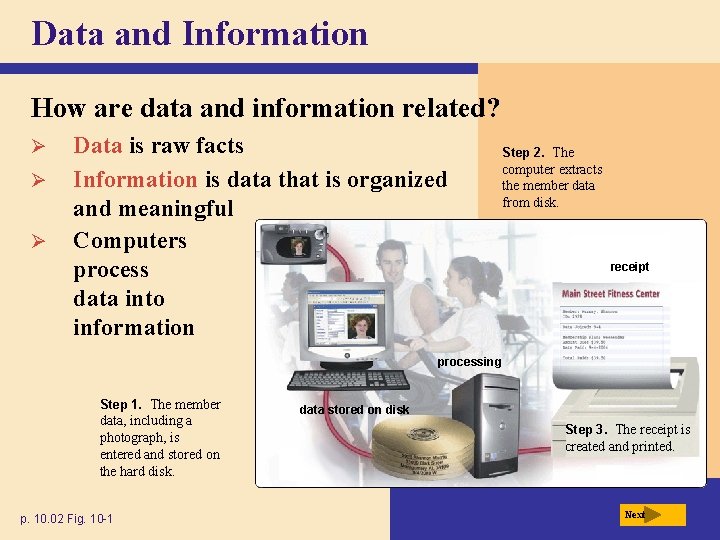
Data and Information How are data and information related? Ø Ø Ø Data is raw facts Information is data that is organized and meaningful Computers process data into information Step 2. The computer extracts the member data from disk. receipt processing Step 1. The member data, including a photograph, is entered and stored on the hard disk. p. 10. 02 Fig. 10 -1 data stored on disk Step 3. The receipt is created and printed. Next
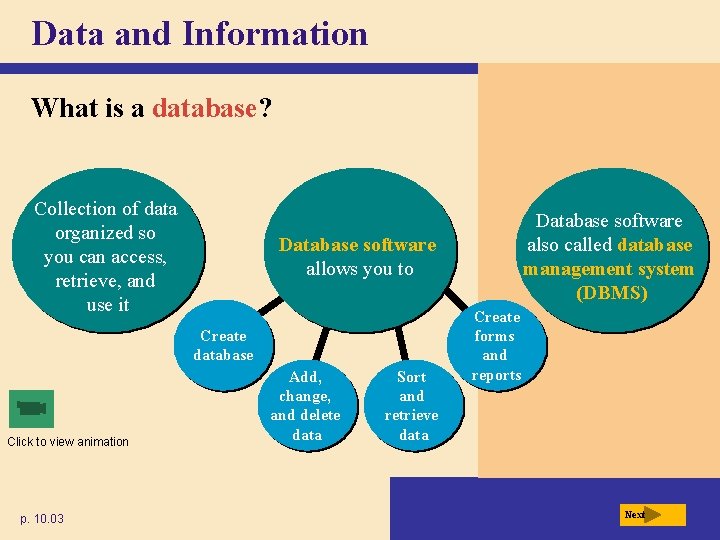
Data and Information What is a database? Collection of data organized so you can access, retrieve, and use it Database software allows you to Create database Click to view animation p. 10. 03 Database software also called database management system (DBMS) Add, change, and delete data Sort and retrieve data Create forms and reports Next

The Hierarchy of Data What is a hierarchy? Ø Database contains files, file contains records, record contains fields, field contains characters p. 10. 05 Fig. 10 -2 Next
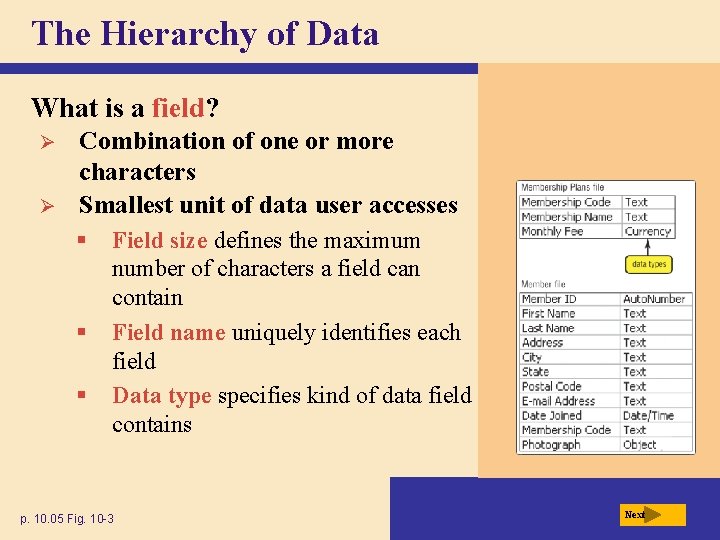
The Hierarchy of Data What is a field? Ø Ø Combination of one or more characters Smallest unit of data user accesses § § § Field size defines the maximum number of characters a field can contain Field name uniquely identifies each field Data type specifies kind of data field contains p. 10. 05 Fig. 10 -3 Next
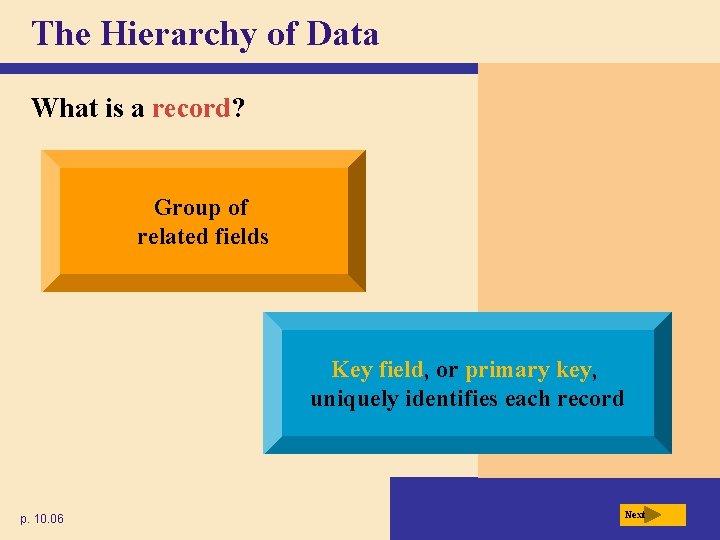
The Hierarchy of Data What is a record? Group of related fields Key field, or primary key, uniquely identifies each record p. 10. 06 Next
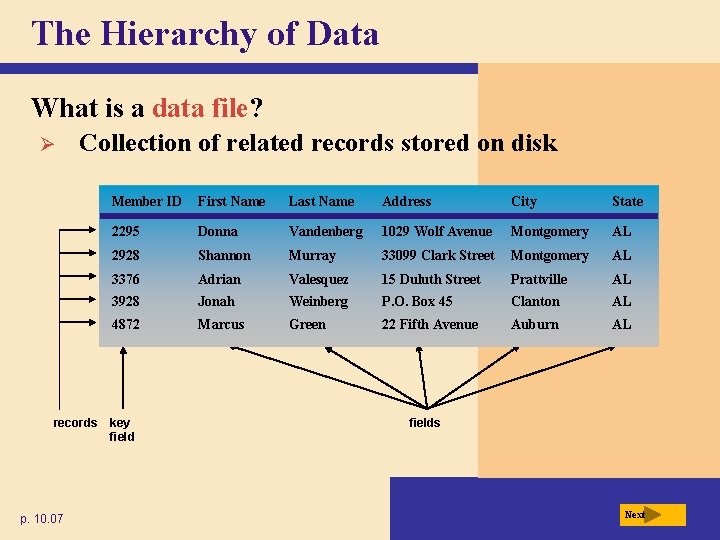
The Hierarchy of Data What is a data file? Ø Collection of related records stored on disk records p. 10. 07 Member ID First Name Last Name Address City State 2295 Donna Vandenberg 1029 Wolf Avenue Montgomery AL 2928 Shannon Murray 33099 Clark Street Montgomery AL 3376 Adrian Valesquez 15 Duluth Street Prattville AL 3928 Jonah Weinberg P. O. Box 45 Clanton AL 4872 Marcus Green 22 Fifth Avenue Auburn AL key fields Next
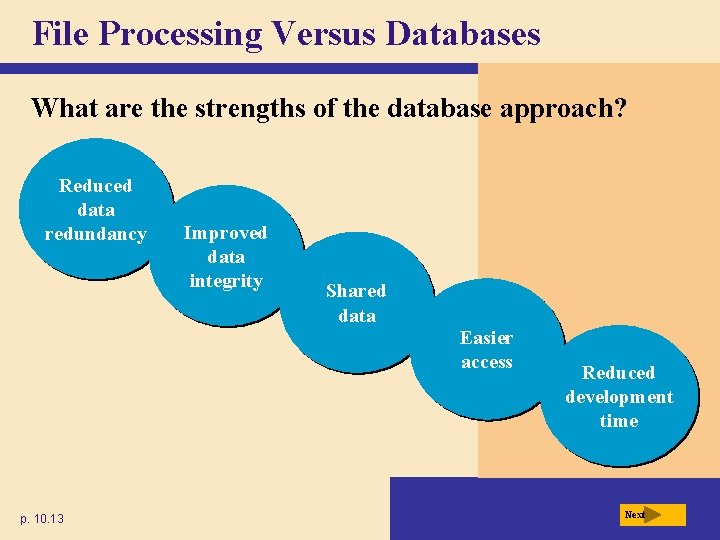
File Processing Versus Databases What are the strengths of the database approach? Reduced data redundancy Improved data integrity Shared data Easier access p. 10. 13 Reduced development time Next
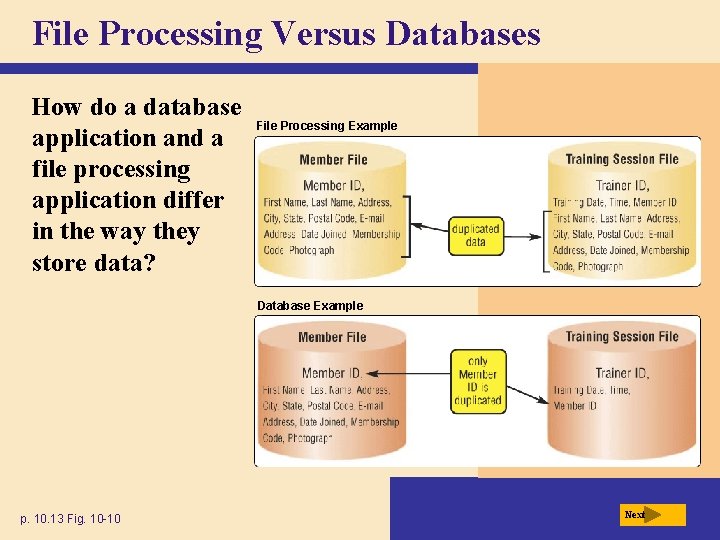
File Processing Versus Databases How do a database application and a file processing application differ in the way they store data? File Processing Example Database Example p. 10. 13 Fig. 10 -10 Next
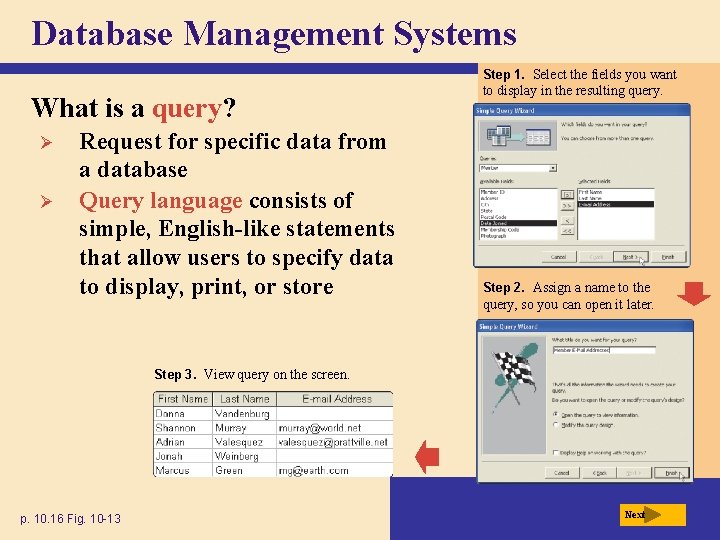
Database Management Systems Step 1. Select the fields you want What is a query? Ø Ø Request for specific data from a database Query language consists of simple, English-like statements that allow users to specify data to display, print, or store to display in the resulting query. Step 2. Assign a name to the query, so you can open it later. Step 3. View query on the screen. p. 10. 16 Fig. 10 -13 Next
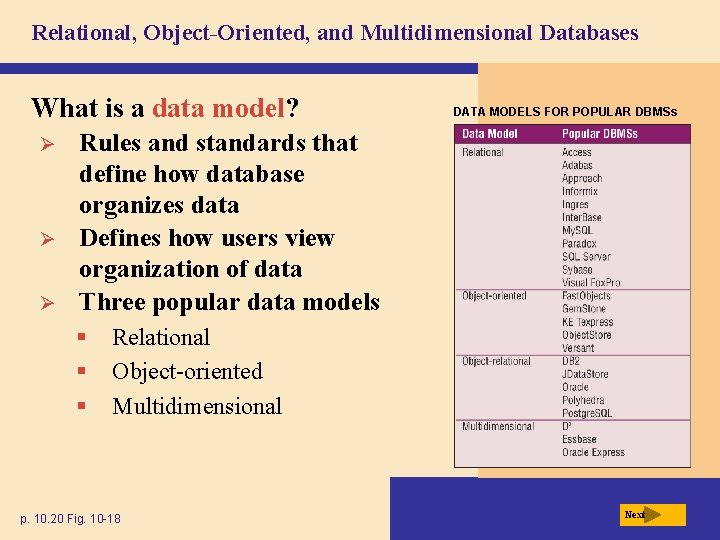
Relational, Object-Oriented, and Multidimensional Databases What is a data model? Ø Ø Ø DATA MODELS FOR POPULAR DBMSs Rules and standards that define how database organizes data Defines how users view organization of data Three popular data models § § § Relational Object-oriented Multidimensional p. 10. 20 Fig. 10 -18 Next
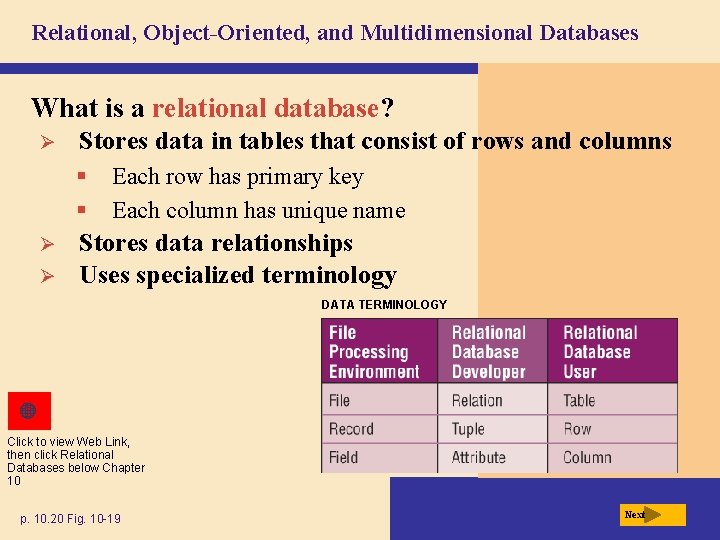
Relational, Object-Oriented, and Multidimensional Databases What is a relational database? Ø Stores data in tables that consist of rows and columns § § Ø Ø Each row has primary key Each column has unique name Stores data relationships Uses specialized terminology DATA TERMINOLOGY Click to view Web Link, then click Relational Databases below Chapter 10 p. 10. 20 Fig. 10 -19 Next
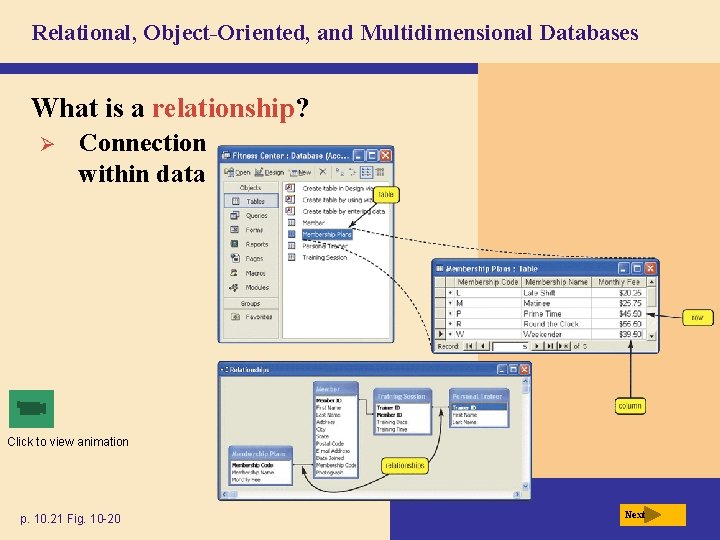
Relational, Object-Oriented, and Multidimensional Databases What is a relationship? Ø Connection within data Click to view animation p. 10. 21 Fig. 10 -20 Next
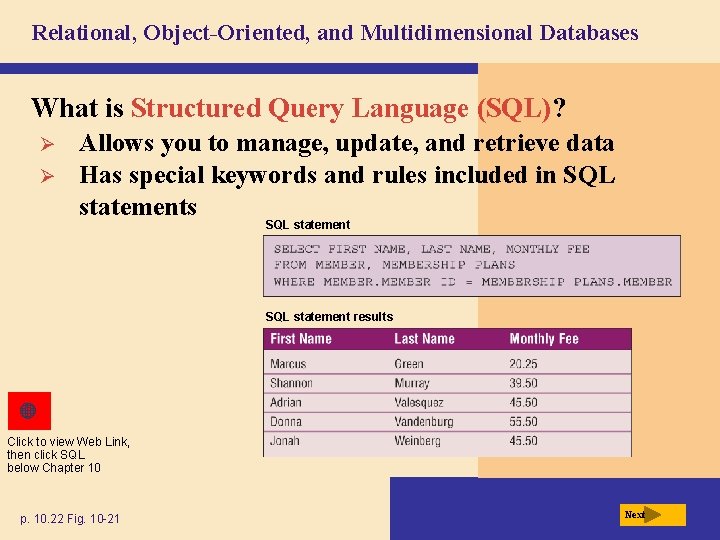
Relational, Object-Oriented, and Multidimensional Databases What is Structured Query Language (SQL)? Ø Ø Allows you to manage, update, and retrieve data Has special keywords and rules included in SQL statements SQL statement results Click to view Web Link, then click SQL below Chapter 10 p. 10. 22 Fig. 10 -21 Next
Relational, Object-Oriented, and Multidimensional Databases What is a data warehouse? Huge database system that stores and manages data required to analyze historical and current transactions Quick and efficient way to access large amounts of data Uses multidimensional databases Often uses a process called data mining to find patterns and relationships among data Data mart is smaller version of data warehouse Click to view Web Link, then click Data Warehouses below Chapter 10 p. 10. 24 Next
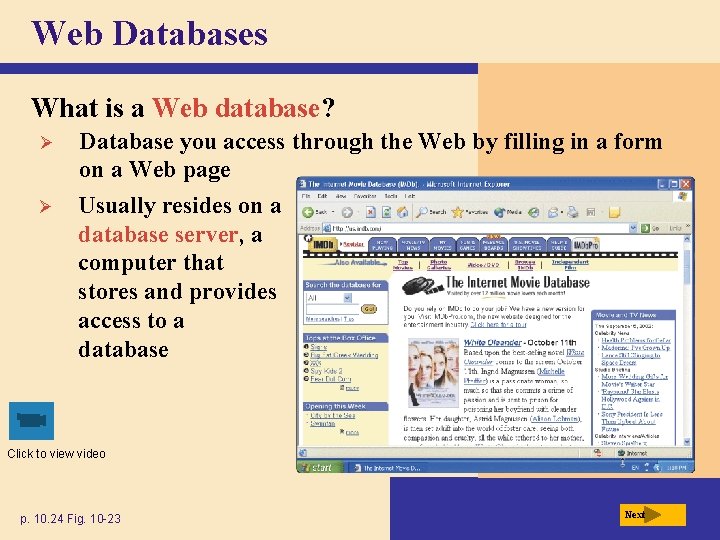
Web Databases What is a Web database? Ø Ø Database you access through the Web by filling in a form on a Web page Usually resides on a database server, a computer that stores and provides access to a database Click to view video p. 10. 24 Fig. 10 -23 Next
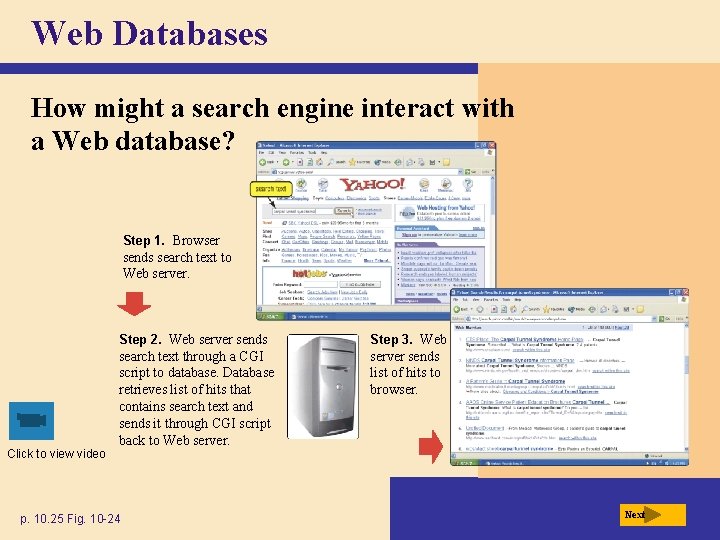
Web Databases How might a search engine interact with a Web database? Step 1. Browser sends search text to Web server. Click to view video Step 2. Web server sends Step 3. Web search text through a CGI script to database. Database retrieves list of hits that contains search text and sends it through CGI script back to Web server sends list of hits to browser. p. 10. 25 Fig. 10 -24 Next
- Slides: 17