
CHAPTER 10 Consumer Choice and Behavioral Economics Chapter
CHAPTER 10 Consumer Choice and Behavioral Economics Chapter Outline and Learning Objectives 10. 1 Utility and Consumer Decision Making 10. 2 Where Demand Comes From 10. 3 Social Influences on Decision Making 10. 4 Behavioral Economics: Do People Make Their Choices Rationally? Appendix: Using Indifference Curves and Budget Lines to Understand Consumer Behavior © 2015 Pearson Education Limited 1 of 59
Consumer decision making In our study of consumers so far, we have looked at what they do, but not why they do what they do. Economics is all about the choices that people make; a better understanding of those choices furthers our understanding of economic behavior. At the same time, we need to know the limits of our understanding. This chapter will examine what we know, and what we can’t explain, about how consumers behave. © 2015 Pearson Education Limited 2 of 59
Household Choice in Output Markets • Every household must make three basic decisions: 1. How much of each product, or output, to demand 2. How much labor to supply 3. How much to spend today and how much to save for the future 6 -3 1 -3
The Determinants of Household Demand • Several factors influence the quantity of a given good or service demanded by a single household: – The price of the product – The income available to the household – The household’s accumulated wealth – The prices of other products available to the household – The household’s tastes and preferences – The household’s expectations about future income, wealth, and prices 6 -4 1 -4
Utility and Consumer Decision Making 10. 1 LEARNING OBJECTIVE Define utility and explain how consumers choose goods and services to maximize their utility. © 2015 Pearson Education Limited 5 of 59
Rationality and its implications As a starting point, economists assume that consumers are rational: making choices intended to make themselves as well-off as possible. We examine these choices when consumers make their decisions about how much of various items to buy, given their scarce resources (income). Facing this budget constraint, how do people choose? Budget constraint: The limited amount of income available to consumers to spend on goods and services. choice set or opportunity set The set of options that is defined and limited by a budget constraint. © 2015 Pearson Education Limited 6 of 59
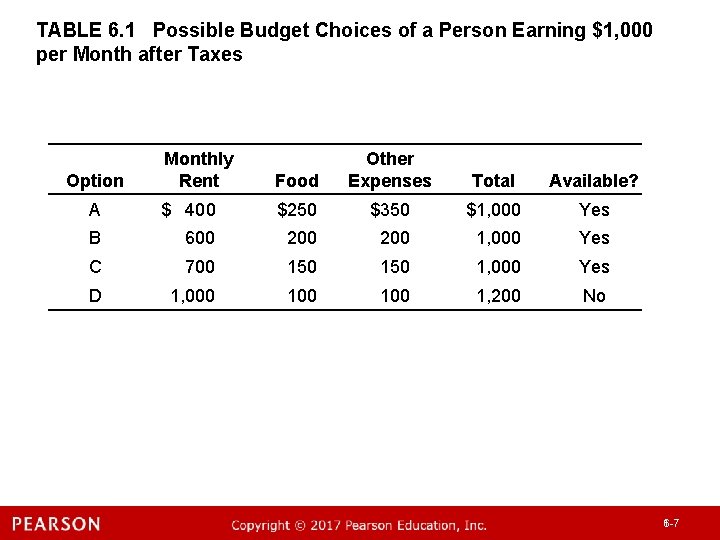
TABLE 6. 1 Possible Budget Choices of a Person Earning $1, 000 per Month after Taxes Monthly Rent Food Other Expenses Total Available? A $ 400 $250 $350 $1, 000 Yes B 600 200 1, 000 Yes C 700 150 1, 000 Yes D 1, 000 100 1, 200 No Option 6 -7 1 -7

The Budget Constraint Preferences, Tastes, Trade-offs, and Opportunity Cost • Within the constraints imposed by limited incomes and fixed prices, households are free to choose what they will and will not buy. • A household makes a choice by weighing the good or service that it chooses against all the other things that the same money could buy. • With a limited budget, the real cost of any good or service is the value of the other goods and services that could have been purchased with the same amount of money. 6 -8 1 -8
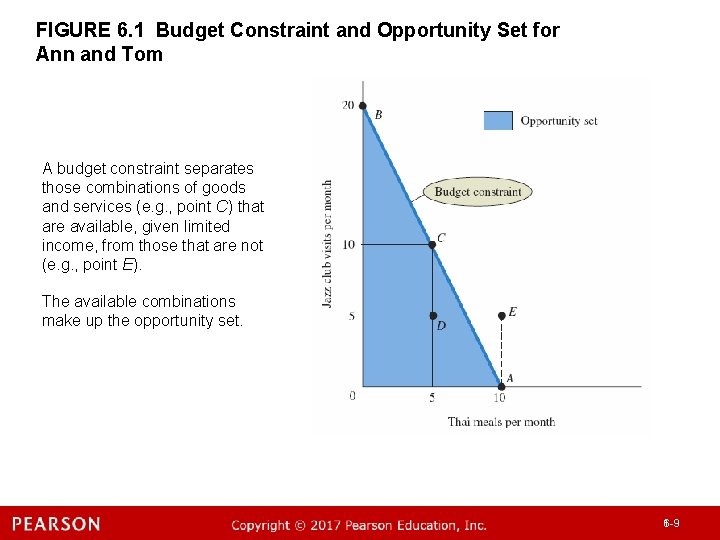
FIGURE 6. 1 Budget Constraint and Opportunity Set for Ann and Tom A budget constraint separates those combinations of goods and services (e. g. , point C) that are available, given limited income, from those that are not (e. g. , point E). The available combinations make up the opportunity set. 6 -9 1 -9
The Budget Constraint (3 of 3) The Budget Constraint More Formally • Both prices and income affect the size of a household’s opportunity set. • real income The set of opportunities to purchase real goods and services available to a household as determined by prices and money income. 6 -10 1 -10
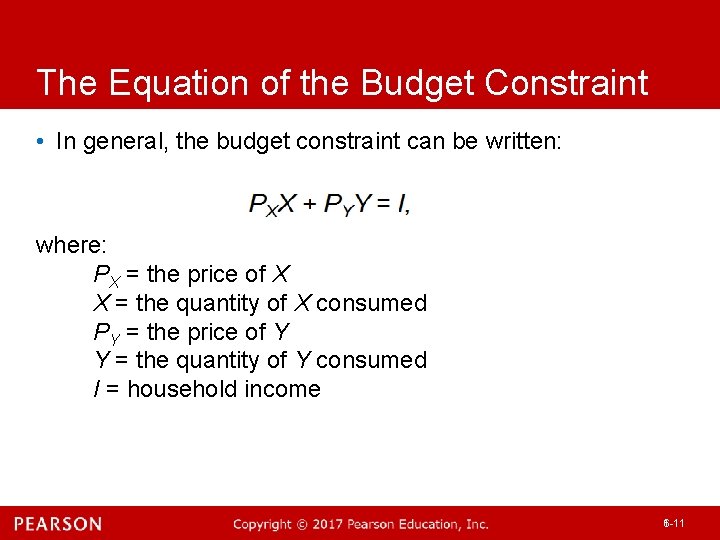
The Equation of the Budget Constraint • In general, the budget constraint can be written: where: PX = the price of X X = the quantity of X consumed PY = the price of Y Y = the quantity of Y consumed I = household income 6 -11 1 -11
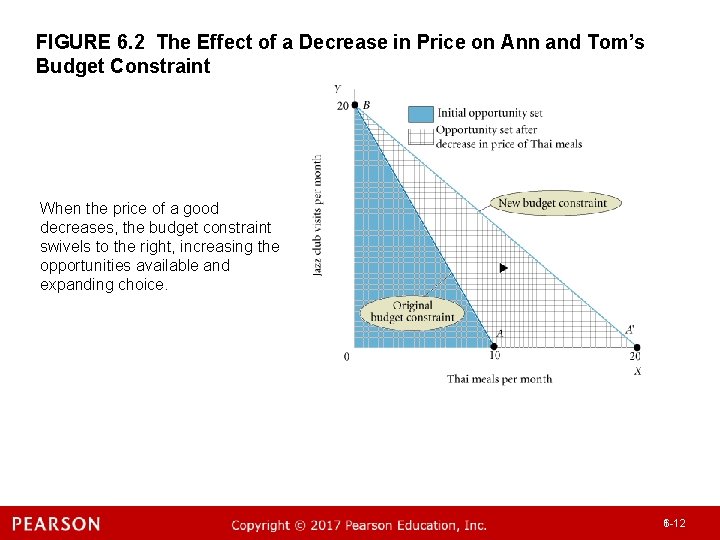
FIGURE 6. 2 The Effect of a Decrease in Price on Ann and Tom’s Budget Constraint When the price of a good decreases, the budget constraint swivels to the right, increasing the opportunities available and expanding choice. 6 -12 1 -12
Measuring happiness (the basis of choice) Economists refer to the enjoyment or satisfaction that people obtain from consuming goods and services as utility. Utility cannot be directly measured; but for now, suppose that it could. What would we see? • As people consumed more of an item (say, pizza) their total utility would change: • The amount by which it would change when consuming an extra unit of a good or service is called the marginal utility. • Generally expect to see the first items consumed produce the most marginal utility, so that subsequent items gave diminishing marginal utility. Law of diminishing marginal utility: The principle that consumers experience diminishing additional satisfaction as they consume more of a good or service during a given period of time. © 2015 Pearson Education Limited 13 of 59
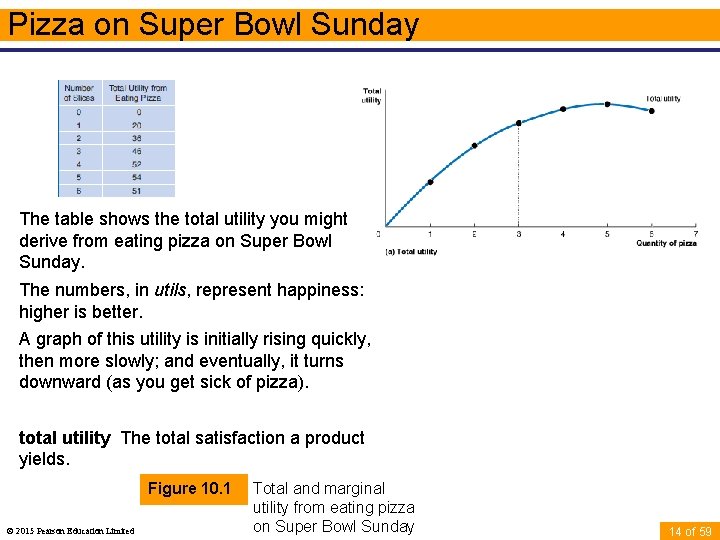
Pizza on Super Bowl Sunday The table shows the total utility you might derive from eating pizza on Super Bowl Sunday. The numbers, in utils, represent happiness: higher is better. A graph of this utility is initially rising quickly, then more slowly; and eventually, it turns downward (as you get sick of pizza). total utility The total satisfaction a product yields. Figure 10. 1 © 2015 Pearson Education Limited Total and marginal utility from eating pizza on Super Bowl Sunday 14 of 59
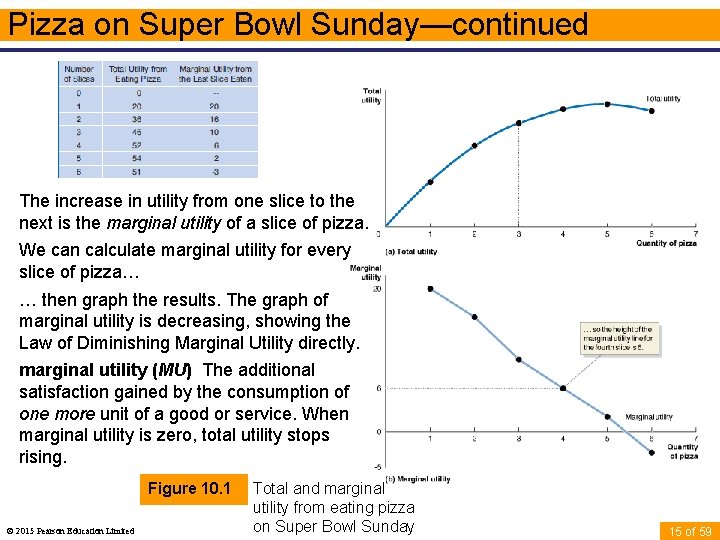
Pizza on Super Bowl Sunday—continued The increase in utility from one slice to the next is the marginal utility of a slice of pizza. We can calculate marginal utility for every slice of pizza… … then graph the results. The graph of marginal utility is decreasing, showing the Law of Diminishing Marginal Utility directly. marginal utility (MU) The additional satisfaction gained by the consumption of one more unit of a good or service. When marginal utility is zero, total utility stops rising. Figure 10. 1 © 2015 Pearson Education Limited Total and marginal utility from eating pizza on Super Bowl Sunday 15 of 59
Allocating your resources Given unlimited resources, a consumer would consume every good and service up until the maximum total utility. But resources are scarce; consumers have a budget constraint. The concept of utility can help us figure out how much of each item to purchase. Each item purchased gives some (possibly negative) marginal utility; by dividing by the price of the item, we obtain the marginal utility per dollar spent; that is, the rate at which that item allows the consumer to transform money into utility. © 2015 Pearson Education Limited 16 of 59
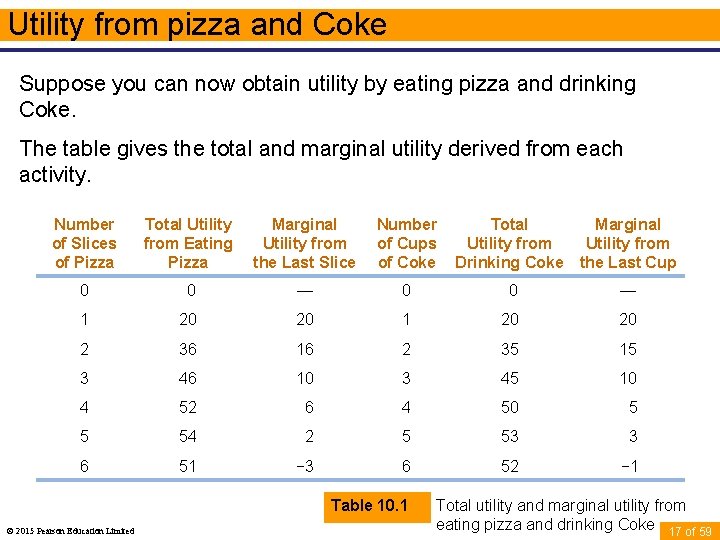
Utility from pizza and Coke Suppose you can now obtain utility by eating pizza and drinking Coke. The table gives the total and marginal utility derived from each activity. Number of Slices of Pizza Total Utility from Eating Pizza Marginal Utility from the Last Slice Number of Cups of Coke 0 0 — 1 20 20 2 36 16 2 35 15 3 46 10 3 45 10 4 52 6 4 50 5 5 54 2 5 53 3 6 51 − 3 6 52 − 1 Table 10. 1 © 2015 Pearson Education Limited Total Marginal Utility from Drinking Coke the Last Cup Total utility and marginal utility from eating pizza and drinking Coke 17 of 59
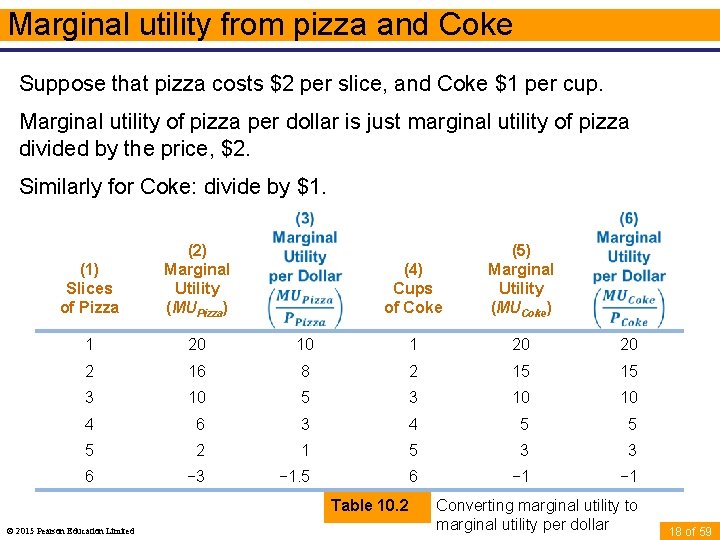
Marginal utility from pizza and Coke Suppose that pizza costs $2 per slice, and Coke $1 per cup. Marginal utility of pizza per dollar is just marginal utility of pizza divided by the price, $2. Similarly for Coke: divide by $1. (1) Slices of Pizza (2) Marginal Utility (MUPizza) 1 20 2 (4) Cups of Coke (5) Marginal Utility (MUCoke) 10 1 20 20 16 8 2 15 15 3 10 10 4 6 3 4 5 5 5 2 1 5 3 3 6 − 3 − 1. 5 6 − 1 Table 10. 2 © 2015 Pearson Education Limited Converting marginal utility to marginal utility per dollar 18 of 59
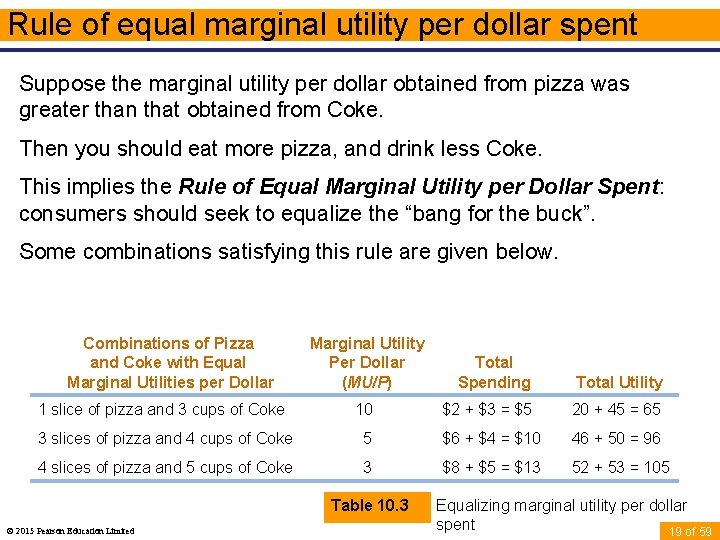
Rule of equal marginal utility per dollar spent Suppose the marginal utility per dollar obtained from pizza was greater than that obtained from Coke. Then you should eat more pizza, and drink less Coke. This implies the Rule of Equal Marginal Utility per Dollar Spent: consumers should seek to equalize the “bang for the buck”. Some combinations satisfying this rule are given below. Combinations of Pizza and Coke with Equal Marginal Utilities per Dollar Marginal Utility Per Dollar (MU/P) Total Spending Total Utility 1 slice of pizza and 3 cups of Coke 10 $2 + $3 = $5 20 + 45 = 65 3 slices of pizza and 4 cups of Coke 5 $6 + $4 = $10 46 + 50 = 96 4 slices of pizza and 5 cups of Coke 3 $8 + $5 = $13 52 + 53 = 105 Table 10. 3 © 2015 Pearson Education Limited Equalizing marginal utility per dollar spent 19 of 59
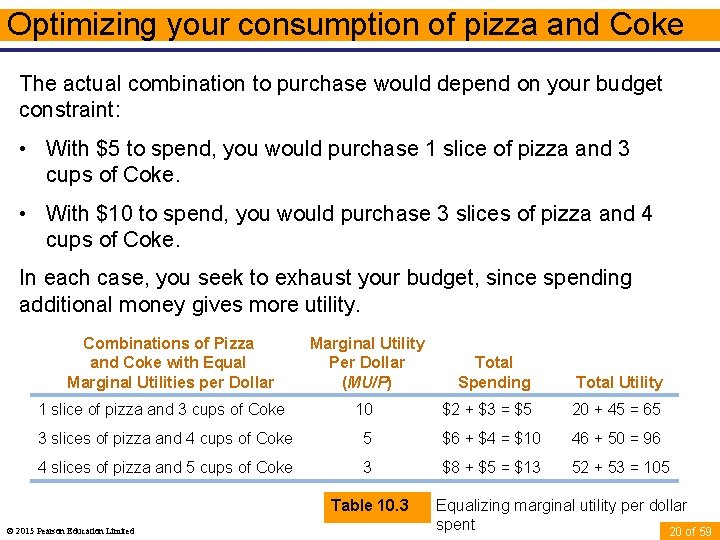
Optimizing your consumption of pizza and Coke The actual combination to purchase would depend on your budget constraint: • With $5 to spend, you would purchase 1 slice of pizza and 3 cups of Coke. • With $10 to spend, you would purchase 3 slices of pizza and 4 cups of Coke. In each case, you seek to exhaust your budget, since spending additional money gives more utility. Combinations of Pizza and Coke with Equal Marginal Utilities per Dollar Marginal Utility Per Dollar (MU/P) Total Spending Total Utility 1 slice of pizza and 3 cups of Coke 10 $2 + $3 = $5 20 + 45 = 65 3 slices of pizza and 4 cups of Coke 5 $6 + $4 = $10 46 + 50 = 96 4 slices of pizza and 5 cups of Coke 3 $8 + $5 = $13 52 + 53 = 105 Table 10. 3 © 2015 Pearson Education Limited Equalizing marginal utility per dollar spent 20 of 59
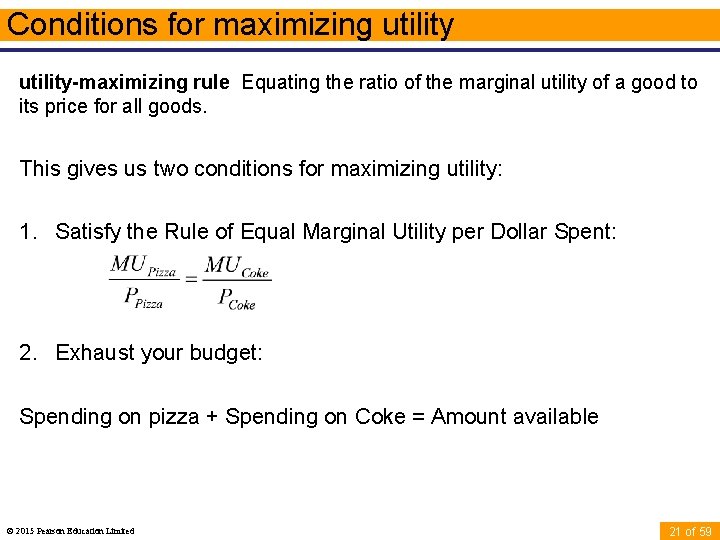
Conditions for maximizing utility-maximizing rule Equating the ratio of the marginal utility of a good to its price for all goods. This gives us two conditions for maximizing utility: 1. Satisfy the Rule of Equal Marginal Utility per Dollar Spent: 2. Exhaust your budget: Spending on pizza + Spending on Coke = Amount available © 2015 Pearson Education Limited 21 of 59
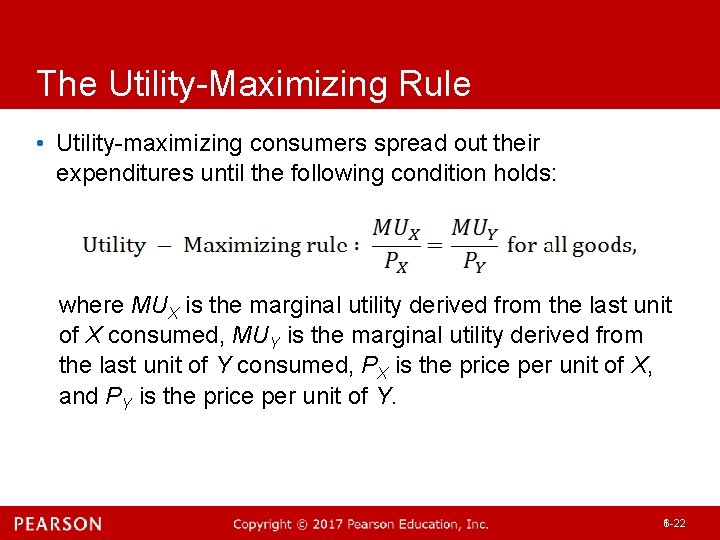
The Utility-Maximizing Rule • Utility-maximizing consumers spread out their expenditures until the following condition holds: where MUX is the marginal utility derived from the last unit of X consumed, MUY is the marginal utility derived from the last unit of Y consumed, PX is the price per unit of X, and PY is the price per unit of Y. 6 -22 1 -22
What if we “disobey” the rule? It should be clear that failing to spend all your money will result in less utility—each item you buy increases our utility. But what if you buy a combination which doesn’t satisfy the Rule of Equal Marginal Utility per Dollar? For example, you could buy 4 slices of pizza and 2 cups of Coke for $10. From Table 10. 1, this would give you 52 + 35 = 87 utils, less than the 96 utils that you get from 3 slices and 4 cups. Marginal utility per dollar from 4 th slice: 3 utils per dollar Marginal utility per dollar from 2 nd cup: 15 utils per dollar Since you get so much more marginal utility per dollar from Coke, you ought to drink more Coke—and indeed, that would increase utility. © 2015 Pearson Education Limited 23 of 59
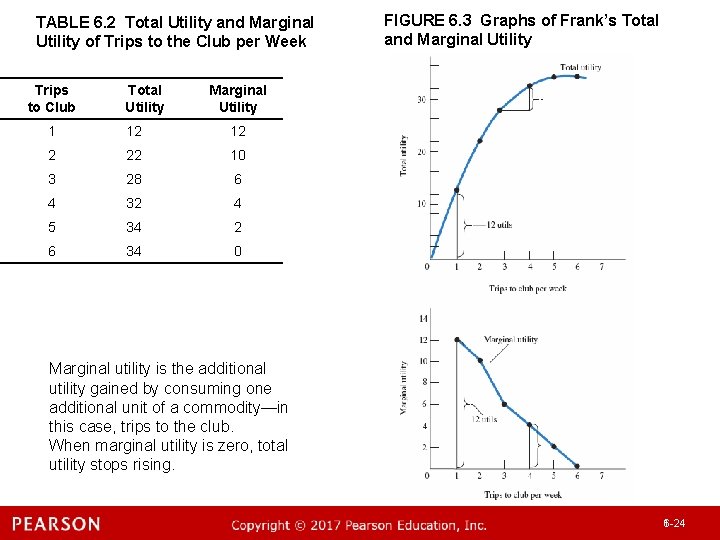
TABLE 6. 2 Total Utility and Marginal Utility of Trips to the Club per Week Trips to Club Total Utility FIGURE 6. 3 Graphs of Frank’s Total and Marginal Utility 1 12 12 2 22 10 3 28 6 4 32 4 5 34 2 6 34 0 Marginal utility is the additional utility gained by consuming one additional unit of a commodity—in this case, trips to the club. When marginal utility is zero, total utility stops rising. 6 -24 1 -24
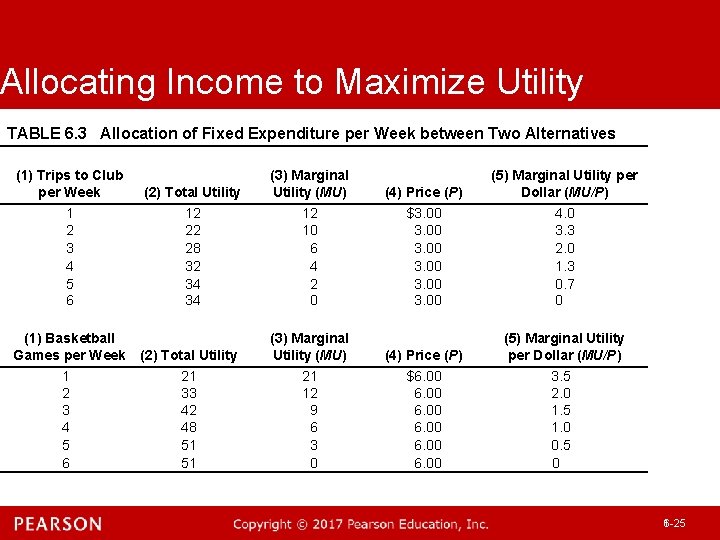
Allocating Income to Maximize Utility TABLE 6. 3 Allocation of Fixed Expenditure per Week between Two Alternatives (1) Trips to Club per Week 1 2 3 4 5 6 (1) Basketball Games per Week 1 2 3 4 5 6 (2) Total Utility 12 22 28 32 34 34 (3) Marginal Utility (MU) 12 10 6 4 2 0 (2) Total Utility 21 33 42 48 51 51 (3) Marginal Utility (MU) 21 12 9 6 3 0 (4) Price (P) $3. 00 (5) Marginal Utility per Dollar (MU/P) 4. 0 3. 3 2. 0 1. 3 0. 7 0 (4) Price (P) $6. 00 (5) Marginal Utility per Dollar (MU/P) 3. 5 2. 0 1. 5 1. 0 0. 5 0 6 -25 1 -25
What if prices change? If the price of pizza changes from $2 to $1. 50, then the Rule of Equal Marginal Utility per Dollar Spent will no longer be satisfied. You must adjust your purchasing decision. We can think of this adjustment in two ways: 1. You can afford more than before; this is like having a higher income. 2. Pizza has become cheaper relative to Coke. We refer to the effect from 1. as the income effect, and the effect from 2. as the substitution effect. © 2015 Pearson Education Limited 26 of 59
1. Income effect The income effect of a price change refers to the change in the quantity demanded of a good that results from the effect of the change in price on consumer purchasing power, holding all other factors constant. We know that some goods are normal (goods that we consume more of as our income rises) and some are inferior (goods that we consume less of as our income rises). If pizza is a normal good, the income effect of its price decreasing will cause you to consume more pizza. If pizza is an inferior good, the income effect of its price decreasing will cause you to consume less pizza. © 2015 Pearson Education Limited 27 of 59
2. Substitution effect The substitution effect of a price change refers to the change in the quantity demanded of a good that results from a change in price making the good more or less expensive relative to other goods, holding constant the effect of the price change on consumer purchasing power. To isolate the substitution effect, we can think of your income decreasing so you can just afford your previous combination. If you had $10 before, you bought 3 slices of pizza (3 x $2. 00) and 4 cups of Coke (4 x $1. 00). If pizza cost $1. 50, $8. 50 would allow you to purchase the same combination of items: 3 x $1. 50 + 4 x $1. 00. © 2015 Pearson Education Limited 28 of 59
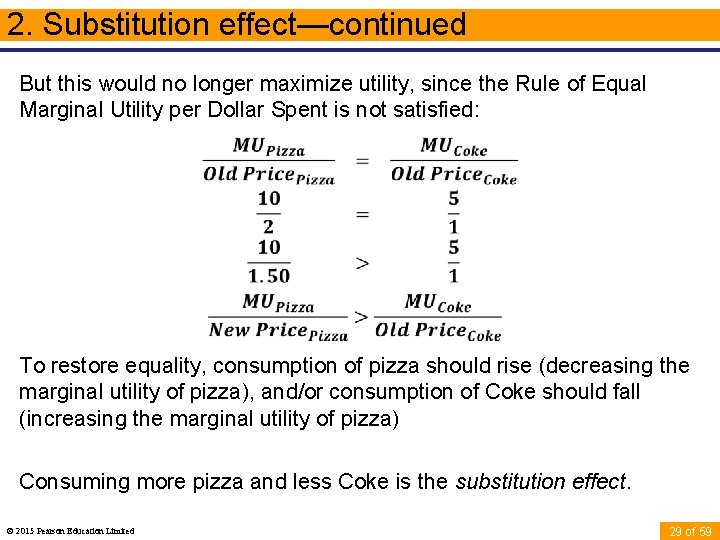
2. Substitution effect—continued But this would no longer maximize utility, since the Rule of Equal Marginal Utility per Dollar Spent is not satisfied: To restore equality, consumption of pizza should rise (decreasing the marginal utility of pizza), and/or consumption of Coke should fall (increasing the marginal utility of pizza) Consuming more pizza and less Coke is the substitution effect. © 2015 Pearson Education Limited 29 of 59
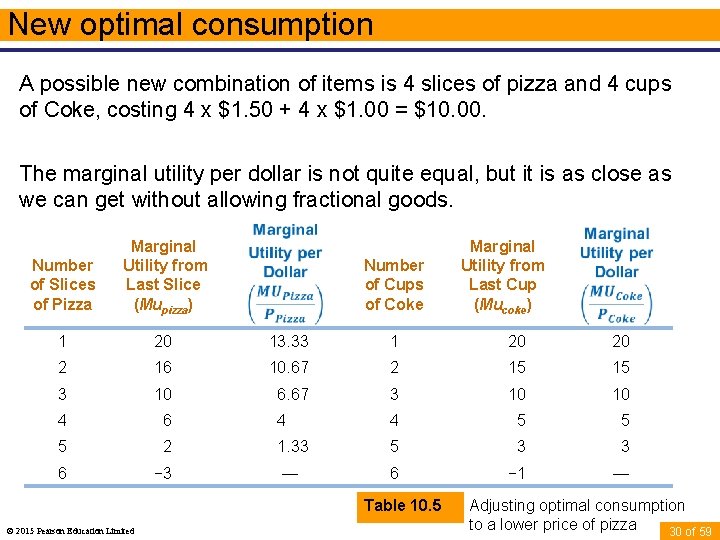
New optimal consumption A possible new combination of items is 4 slices of pizza and 4 cups of Coke, costing 4 x $1. 50 + 4 x $1. 00 = $10. 00. The marginal utility per dollar is not quite equal, but it is as close as we can get without allowing fractional goods. Number of Slices of Pizza Marginal Utility from Last Slice (Mupizza) 1 20 13. 33 1 20 20 2 16 10. 67 2 15 15 3 10 6. 67 3 10 10 4 6 4 4 5 5 5 2 1. 33 5 3 3 6 − 3 — 6 − 1 — Number of Cups of Coke Table 10. 5 © 2015 Pearson Education Limited Marginal Utility from Last Cup (Mucoke) Adjusting optimal consumption to a lower price of pizza 30 of 59
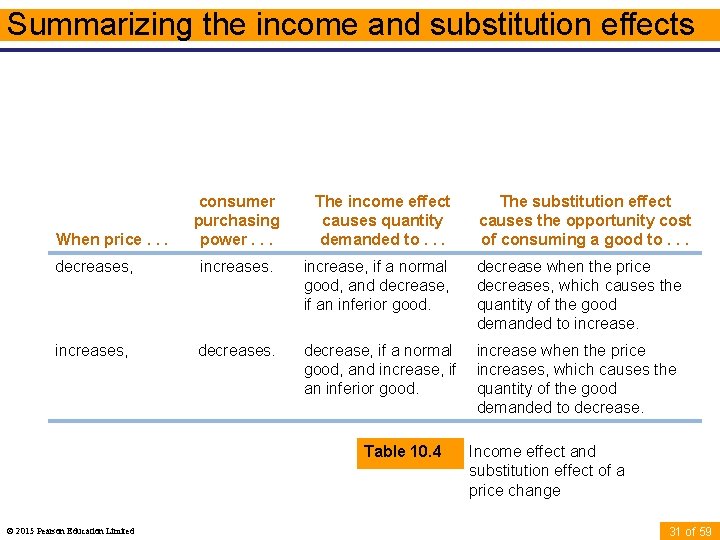
Summarizing the income and substitution effects When price. . . consumer purchasing power. . . The income effect causes quantity demanded to. . . The substitution effect causes the opportunity cost of consuming a good to. . . decreases, increases. increase, if a normal good, and decrease, if an inferior good. decrease when the price decreases, which causes the quantity of the good demanded to increases, decreases. decrease, if a normal good, and increase, if an inferior good. increase when the price increases, which causes the quantity of the good demanded to decrease. Table 10. 4 © 2015 Pearson Education Limited Income effect and substitution effect of a price change 31 of 59
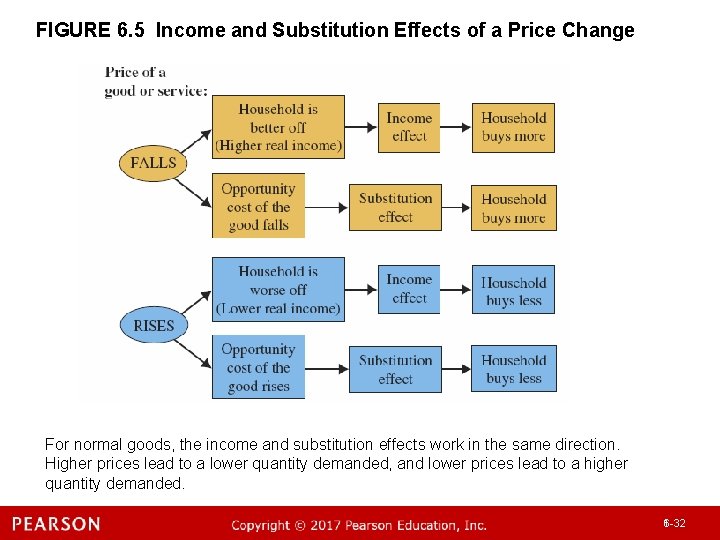
FIGURE 6. 5 Income and Substitution Effects of a Price Change For normal goods, the income and substitution effects work in the same direction. Higher prices lead to a lower quantity demanded, and lower prices lead to a higher quantity demanded. 6 -32 1 -32
Where Demand Curves Come From 10. 2 LEARNING OBJECTIVE Use the concept of utility to explain the law of demand. © 2015 Pearson Education Limited 33 of 59
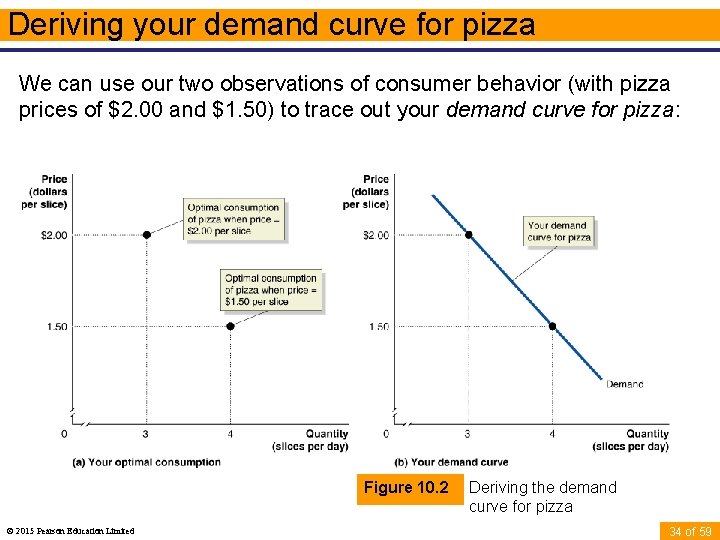
Deriving your demand curve for pizza We can use our two observations of consumer behavior (with pizza prices of $2. 00 and $1. 50) to trace out your demand curve for pizza: Figure 10. 2 © 2015 Pearson Education Limited Deriving the demand curve for pizza 34 of 59
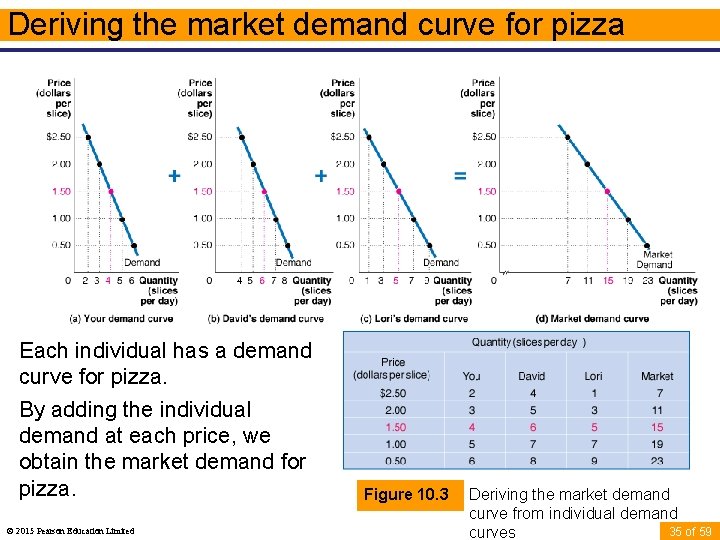
Deriving the market demand curve for pizza Each individual has a demand curve for pizza. By adding the individual demand at each price, we obtain the market demand for pizza. © 2015 Pearson Education Limited Figure 10. 3 Deriving the market demand curve from individual demand 35 of 59 curves
Social Influences on Decision Making 10. 3 LEARNING OBJECTIVE Explain how social influences can affect consumption choices. © 2015 Pearson Education Limited 36 of 59
Why would social influences matter for consumption? In most standard economic models, people are assumed to make choices independently of others. Such models sometimes incorrectly predict consumer behavior, by ignoring the social aspects of decision-making. “The utility from drugs, crime, going bowling… depends on whether friends and neighbors take drugs, commit crime, go bowling…” Gary Becker and Kevin Murphy in Social Economics: Market Behavior in a Social Environment © 2015 Pearson Education Limited 37 of 59
Examples of social influences on demand Celebrity endorsements Firms use celebrity endorsements regularly. They work. Consumers might believe: • “The celebrity knows more about the product than I do”; or • “By buying this product, I will become more like the celebrity. ” Network externalities are situations in which the usefulness of a product increases with the number of consumers who use it. Examples: Facebook; Blu-ray discs; AT&T cell phone service Network externalities might result in market failure, if enough people become locked into inferior products. Example: QWERTY keyboards are designed to be slower to use than alternatives, but almost all keyboards are QWERTY now. © 2015 Pearson Education Limited 38 of 59
Examples of social influences on demand—cont. Fairness People like to be treated fairly, and prefer to treat each other fairly even if it is bad for them financially Example: People tend to tip their servers, even if they never plan to go back to the restaurant. Businesses learn from this, and attempt to appear fair even when it will cost them profits. Example: The NFL sells tickets to the Super Bowl at $850 -$1250 (2013 prices); but these tickets get resold for much more. Surveys reveal that NFL fans would consider it unfair if the NFL raised ticket prices; instead, fans believe the current system of randomly distributing tickets to applicants is fairer. The NFL forgoes potential profit to avoid alienating fans. © 2015 Pearson Education Limited 39 of 59
Testing fairness in the laboratory Ultimatum game Pairs are given $100. Person A proposes a split of the money, say $75 for him, and $25 for person B. If B accepts, each get the money. If B rejects, neither gets any. “Optimal” play: B should accept any split, hence A should offer B very little. Actual play: Non-even splits are often rejected; and people anticipate this, tending to offer 50/50 splits. Dictator game Same game, except B cannot reject. “Optimal” play: give B nothing! Actual play: 50/50 splits are still common! © 2015 Pearson Education Limited 40 of 59
Testing fairness in the laboratory—conclusions The results from these laboratory games suggest that people strongly value fairness. However it may be the perception of fairness that people value: • Subjects might be concerned about the experimenter or other subjects thinking they were selfish, if they kept a large proportion for themselves. • When subjects are asked to perform tasks to earn the money, they are more likely to keep as much as they believe they earned. Conclusion: Care needs to be taken in interpreting artificial laboratory experiments. © 2015 Pearson Education Limited 41 of 59
Behavioral Economics: Do People Make Their Choices Rationally? 10. 4 LEARNING OBJECTIVE Describe the behavioral economics approach to understanding decision making. © 2015 Pearson Education Limited 42 of 59
Behavioral economics In recent years, some economists have started studying situations in which people make choices that do not appear to be economically rational. This field of study is known as behavioral economics. Three common mistakes made by consumers are: 1. Taking into account monetary costs but ignoring nonmonetary opportunity costs 2. Failing to ignore sunk costs 3. Being unrealistic about their own future behavior © 2015 Pearson Education Limited 43 of 59
1. Ignoring nonmonetary opportunity costs People often treat monetary and non-monetary costs differently, even though they are both opportunity costs. Example: People who won the NFL lottery for Super Bowl tickets were asked the following two questions: 1. If you had not won the lottery, would you have been willing to pay $3000 for the ticket? 2. If, after winning the lottery, someone had offered you $3000 for your ticket, would you have sold it? Traditional economists believe that if you answer “no” to the first question, you should answer “yes” to the second; both questions rely on whether you value the ticket at $3000 or more. © 2015 Pearson Education Limited 44 of 59
Super Bowl ticket question results People did not answer those questions similarly; far from it: • 94% said they would not have bought the ticket for $3000; but • 92% said they would not sell the ticket for $3000 either! Behavioral economists refer to this difference to the endowment effect: the tendency of people to be unwilling to sell a good they already own even if they are offered a price that is greater than the price they would be willing to pay to buy the good if they didn’t already own it. In simpler terms, people don’t like losing what they have; they consider losing an object to hurt them more than gaining a similar object would help them. © 2015 Pearson Education Limited 45 of 59
2. Failing to ignore sunk costs A sunk cost is a cost that has already been paid, and cannot be recovered. Once you have paid money and can’t get it back, you should ignore that money in any future decisions you make. But people often allow past costs to influence future decisions. Example: NFL teams persist with first-round-pick quarterbacks much longer than later-round picks with similar performance, because they have “paid” more for the first-rounder. Admitting mistakes and moving on is crucial, but people often find that difficult to do. © 2015 Pearson Education Limited 46 of 59
3. Being unrealistic about future behavior People often make decisions that are inconsistent with their long-run intentions. Example: In 2010, 69% of smokers reported wanting to quit, and 52% actually attempted to quit. But despite their intentions, few actually quit; they found it hard to control their future behavior. Have you ever intended to quit a bad behavior or start a new good behavior, and failed? You likely believed that you would be able to carry through with your intentions. © 2015 Pearson Education Limited 47 of 59
Is our theory useless? Our theory of utility maximization suggests we should compare the marginal utility per dollar spent on every item we buy. But when you go grocery shopping, buying dozens of items, would you really do this? Likely, no. Does this invalidate our theory? Traditional economists often answer “no”, because: 1. Unrealistic assumptions are necessary to simplify complex decision making problems, in order to focus on the most important factors. 2. Models are best judged by the success of their predictions, rather than the accuracy of their assumptions. Indeed, models like our standard one are quite successful in predicting many types of consumer behavior. © 2015 Pearson Education Limited 48 of 59
The behavioral economics of shopping Behavioral economists say that it does matter that consumers do not usually make “optimal” consumption choices. • They believe modeling how people actually make decisions is important. Some important “irrational” consumption behaviors include: Rules of Thumb • Making general rules that often, but not always, produce optimal results • This can save on decision-making time Anchoring • “Irrelevant” information can often influence behavior. • Example: posting “limit 10 items per customer” will often induce people to buy 10 items, even they would have bought fewer without the sign © 2015 Pearson Education Limited 49 of 59
Common misconceptions to avoid Economists do not assume people maximize utility; but they commonly assume people behave as if they maximized utility. To maximize utility, do not seek to equalize the utility gained from each unit of a good, but instead from each dollar spent on each good. Take care interpreting economic experiments; the lessons sometimes don’t carry over to the “real world”. © 2015 Pearson Education Limited 50 of 59
- Slides: 50