
Chapter 10 Congestion Control in Data Networks and
- Slides: 21
Chapter 10 Congestion Control in Data Networks and Internets 1
Introduction Congestion occurs when number of packets transmitted approaches network capacity l Objective of congestion control: l – keep number of packets below level at which performance drops off dramatically Chapter 10 Congestion Control in Data Networks and Internets 2
Queuing Theory Data network is a network of queues l If arrival rate > transmission rate then queue size grows without bound and packet delay goes to infinity l Chapter 10 Congestion Control in Data Networks and Internets 3
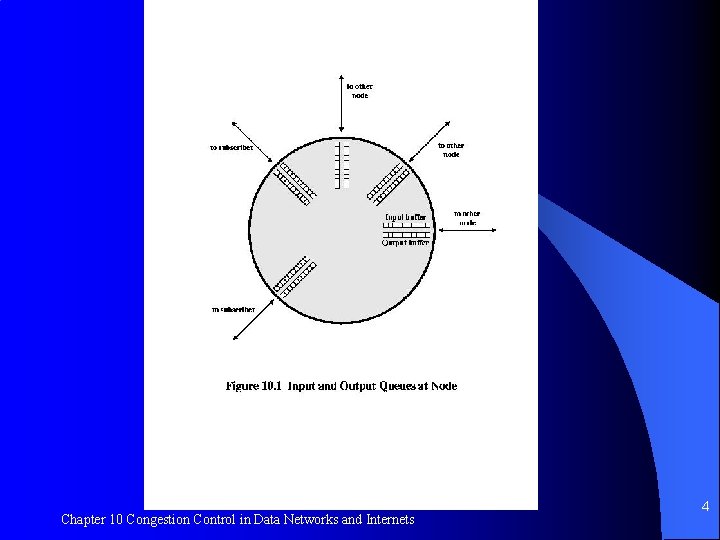
Figure 10. 1 Chapter 10 Congestion Control in Data Networks and Internets 4
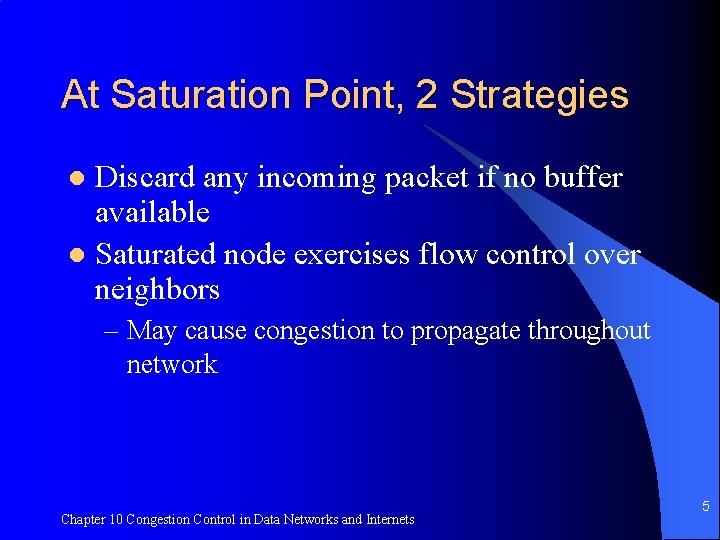
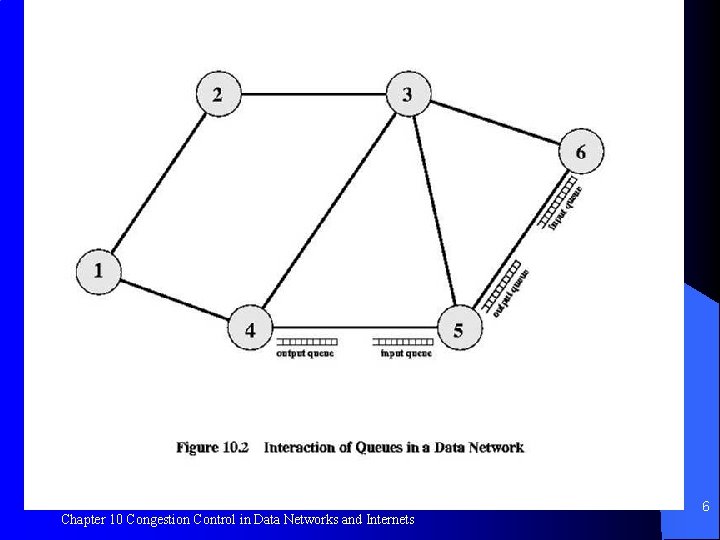
At Saturation Point, 2 Strategies Discard any incoming packet if no buffer available l Saturated node exercises flow control over neighbors l – May cause congestion to propagate throughout network Chapter 10 Congestion Control in Data Networks and Internets 5
Figure 10. 2 Chapter 10 Congestion Control in Data Networks and Internets 6
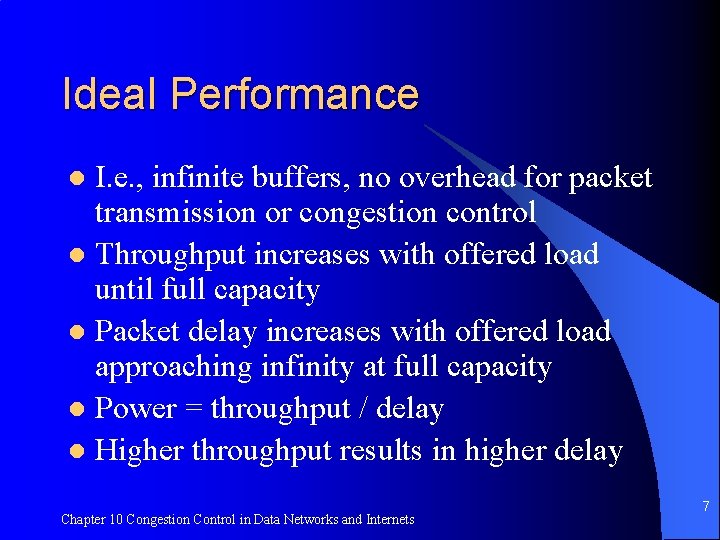
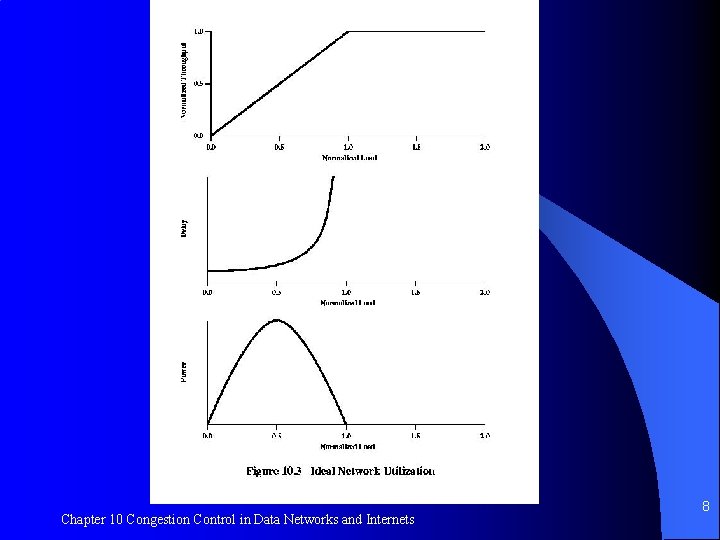
Ideal Performance I. e. , infinite buffers, no overhead for packet transmission or congestion control l Throughput increases with offered load until full capacity l Packet delay increases with offered load approaching infinity at full capacity l Power = throughput / delay l Higher throughput results in higher delay l Chapter 10 Congestion Control in Data Networks and Internets 7
Figure 10. 3 Chapter 10 Congestion Control in Data Networks and Internets 8
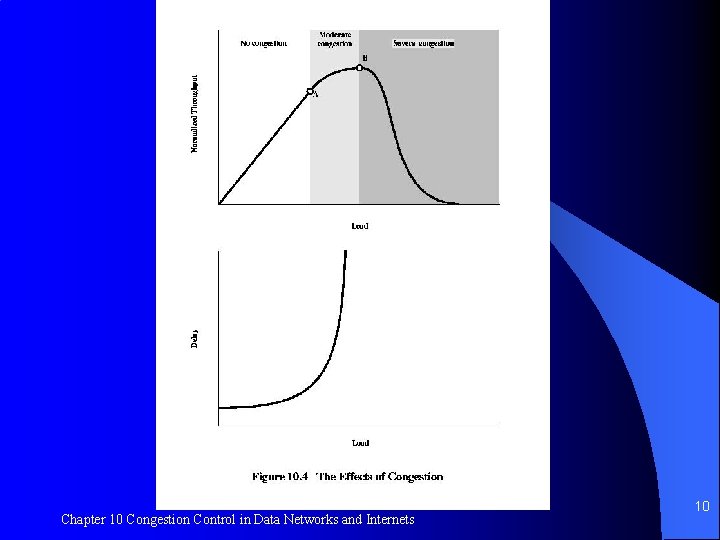
Practical Performance I. e. , finite buffers, non-zero packet processing overhead l With no congestion control, increased load eventually causes moderate congestion: throughput increases at slower rate than load l Further increased load causes packet delays to increase and eventually throughput to drop to zero l Chapter 10 Congestion Control in Data Networks and Internets 9
Figure 10. 4 Chapter 10 Congestion Control in Data Networks and Internets 10
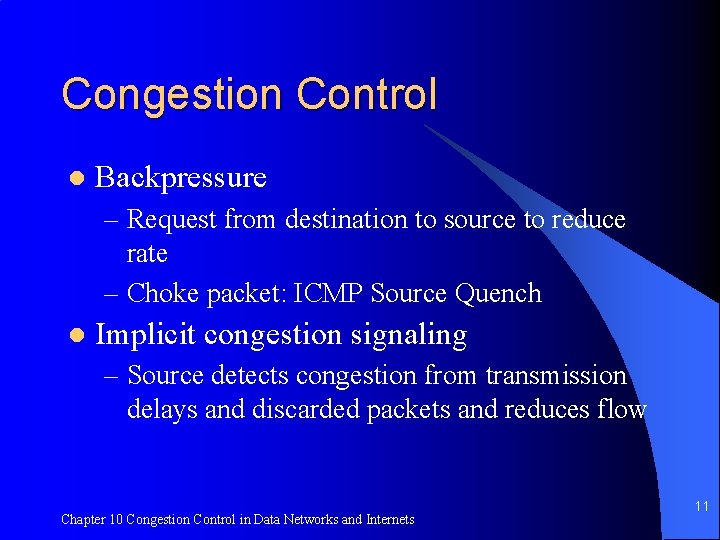
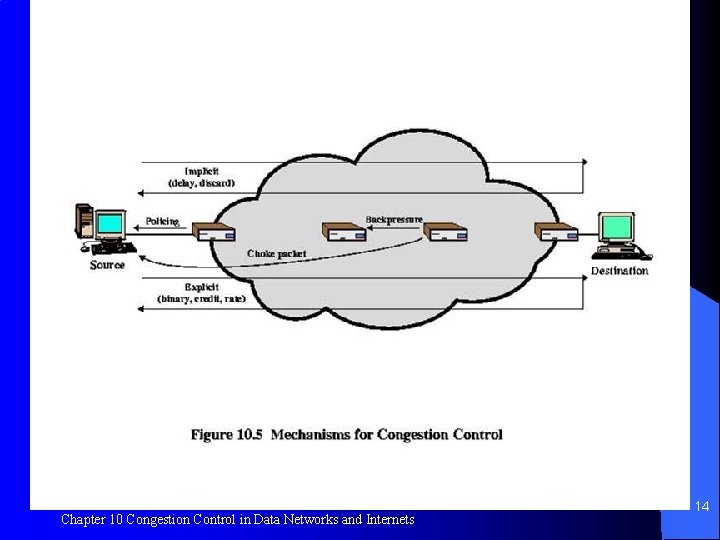
Congestion Control l Backpressure – Request from destination to source to reduce rate – Choke packet: ICMP Source Quench l Implicit congestion signaling – Source detects congestion from transmission delays and discarded packets and reduces flow Chapter 10 Congestion Control in Data Networks and Internets 11
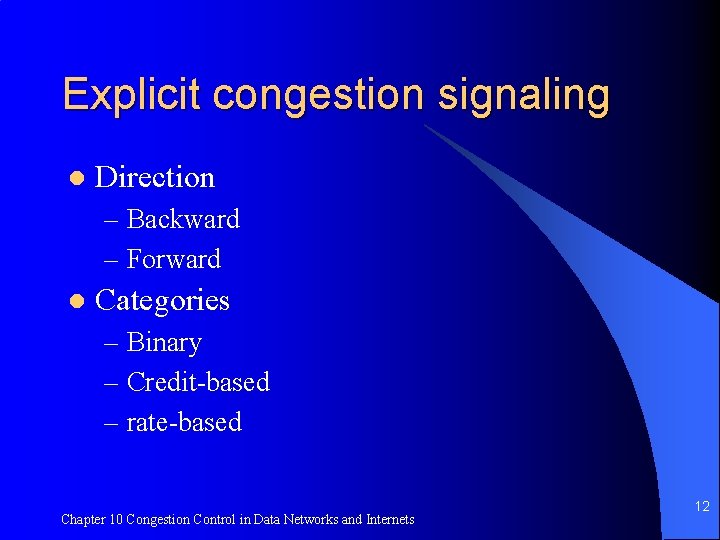
Explicit congestion signaling l Direction – Backward – Forward l Categories – Binary – Credit-based – rate-based Chapter 10 Congestion Control in Data Networks and Internets 12
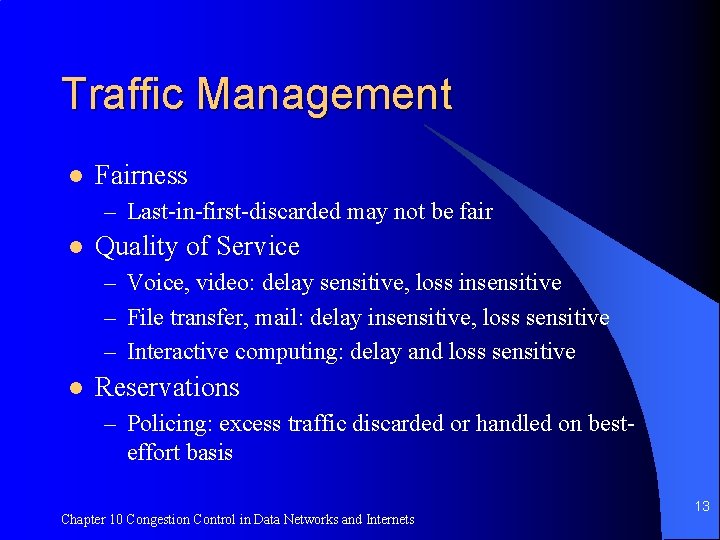
Traffic Management l Fairness – Last-in-first-discarded may not be fair l Quality of Service – Voice, video: delay sensitive, loss insensitive – File transfer, mail: delay insensitive, loss sensitive – Interactive computing: delay and loss sensitive l Reservations – Policing: excess traffic discarded or handled on besteffort basis Chapter 10 Congestion Control in Data Networks and Internets 13
Figure 10. 5 Chapter 10 Congestion Control in Data Networks and Internets 14
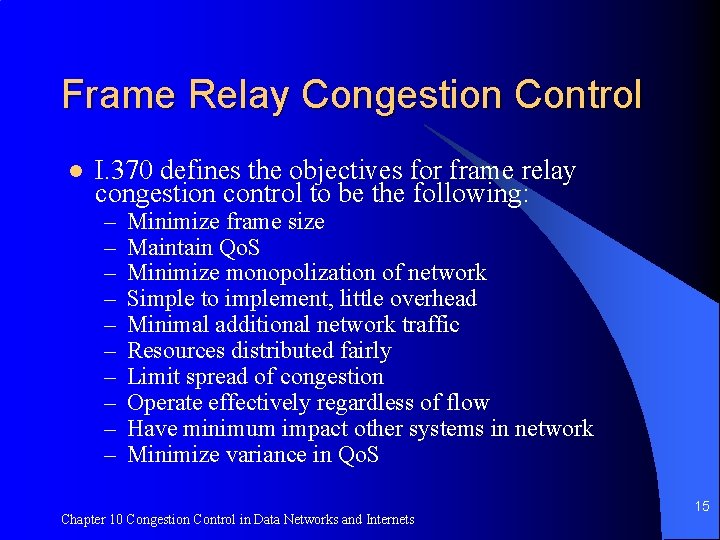
Frame Relay Congestion Control l I. 370 defines the objectives for frame relay congestion control to be the following: – – – – – Minimize frame size Maintain Qo. S Minimize monopolization of network Simple to implement, little overhead Minimal additional network traffic Resources distributed fairly Limit spread of congestion Operate effectively regardless of flow Have minimum impact other systems in network Minimize variance in Qo. S Chapter 10 Congestion Control in Data Networks and Internets 15
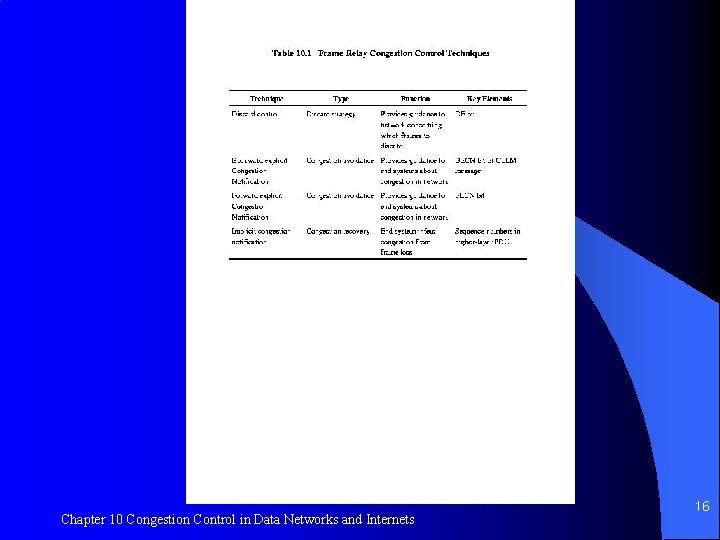
Table 10. 1 Chapter 10 Congestion Control in Data Networks and Internets 16
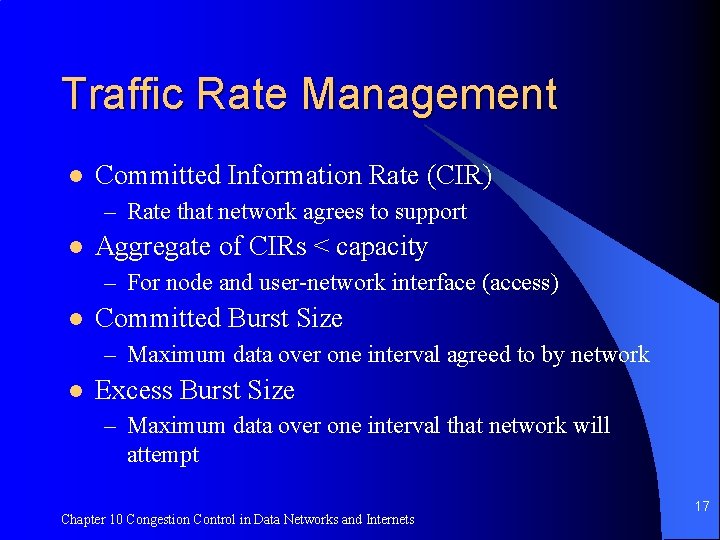
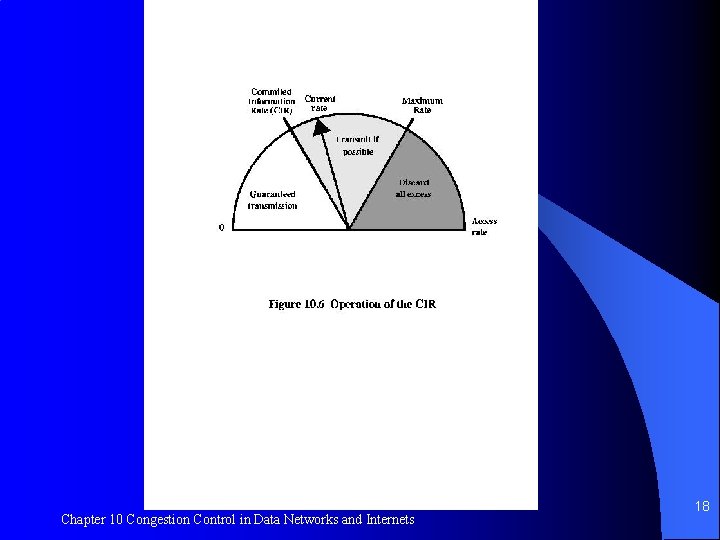
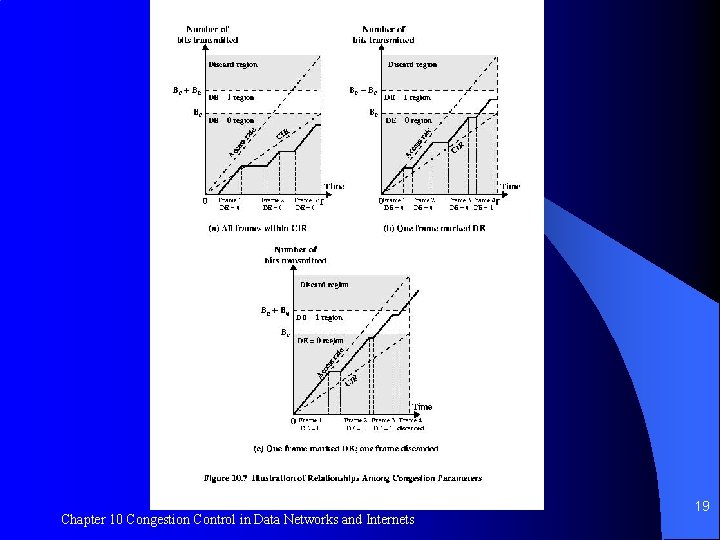
Traffic Rate Management l Committed Information Rate (CIR) – Rate that network agrees to support l Aggregate of CIRs < capacity – For node and user-network interface (access) l Committed Burst Size – Maximum data over one interval agreed to by network l Excess Burst Size – Maximum data over one interval that network will attempt Chapter 10 Congestion Control in Data Networks and Internets 17
Figure 10. 6 Chapter 10 Congestion Control in Data Networks and Internets 18
Figure 10. 7 Chapter 10 Congestion Control in Data Networks and Internets 19
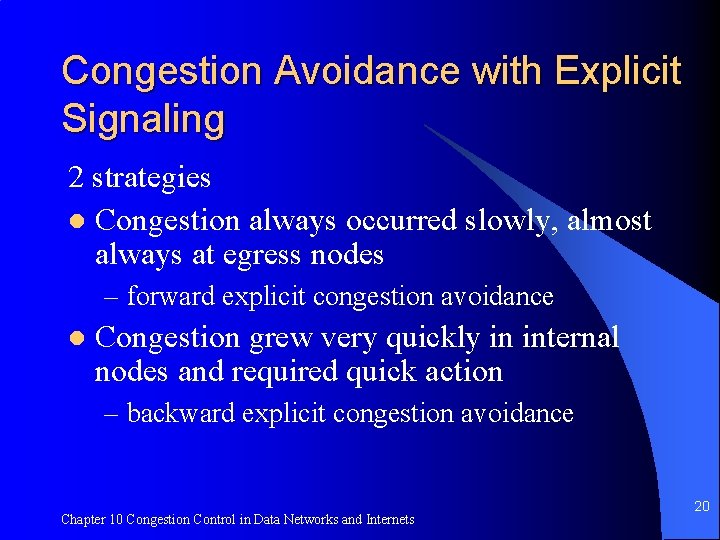
Congestion Avoidance with Explicit Signaling 2 strategies l Congestion always occurred slowly, almost always at egress nodes – forward explicit congestion avoidance l Congestion grew very quickly in internal nodes and required quick action – backward explicit congestion avoidance Chapter 10 Congestion Control in Data Networks and Internets 20
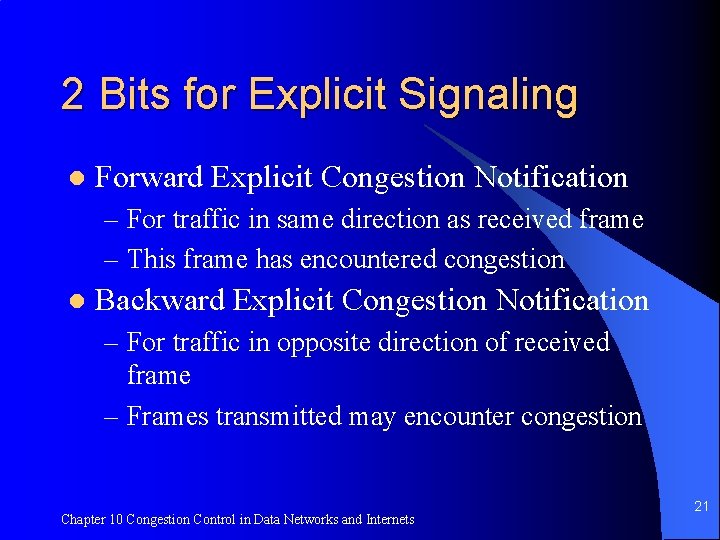
2 Bits for Explicit Signaling l Forward Explicit Congestion Notification – For traffic in same direction as received frame – This frame has encountered congestion l Backward Explicit Congestion Notification – For traffic in opposite direction of received frame – Frames transmitted may encounter congestion Chapter 10 Congestion Control in Data Networks and Internets 21