
Chapter 10 College Career Readiness Why College Career

- Slides: 16
Chapter 10 College & Career Readiness
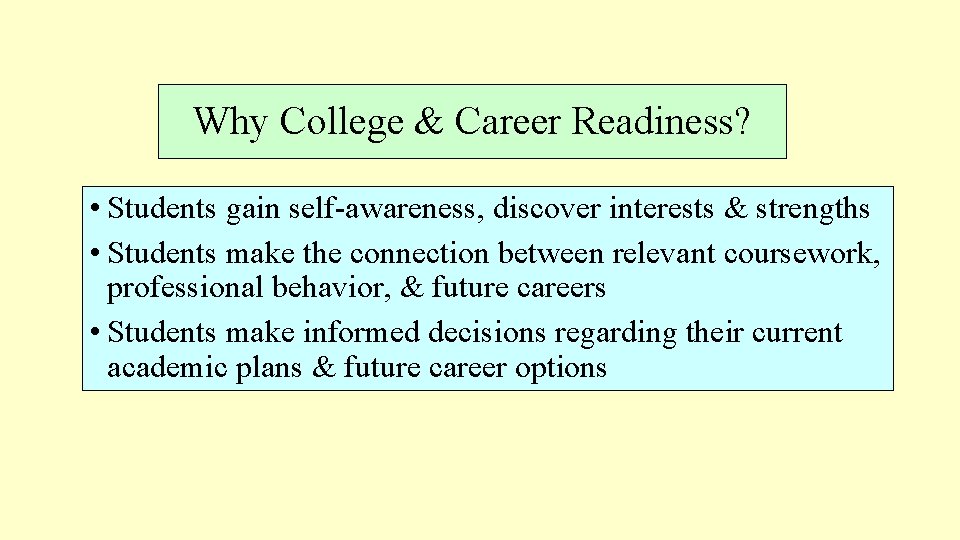
Why College & Career Readiness? • Students gain self-awareness, discover interests & strengths • Students make the connection between relevant coursework, professional behavior, & future careers • Students make informed decisions regarding their current academic plans & future career options
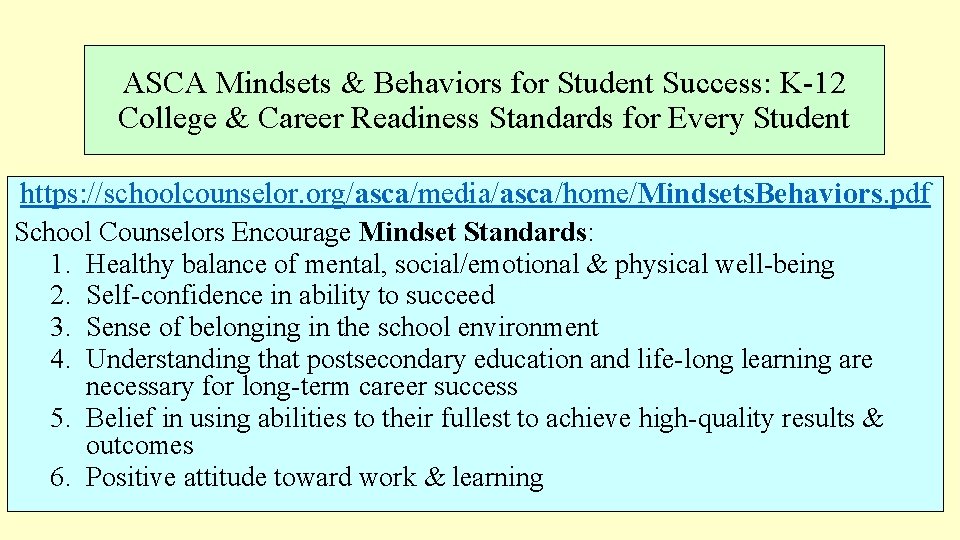
ASCA Mindsets & Behaviors for Student Success: K-12 College & Career Readiness Standards for Every Student https: //schoolcounselor. org/asca/media/asca/home/Mindsets. Behaviors. pdf School Counselors Encourage Mindset Standards: 1. Healthy balance of mental, social/emotional & physical well-being 2. Self-confidence in ability to succeed 3. Sense of belonging in the school environment 4. Understanding that postsecondary education and life-long learning are necessary for long-term career success 5. Belief in using abilities to their fullest to achieve high-quality results & outcomes 6. Positive attitude toward work & learning
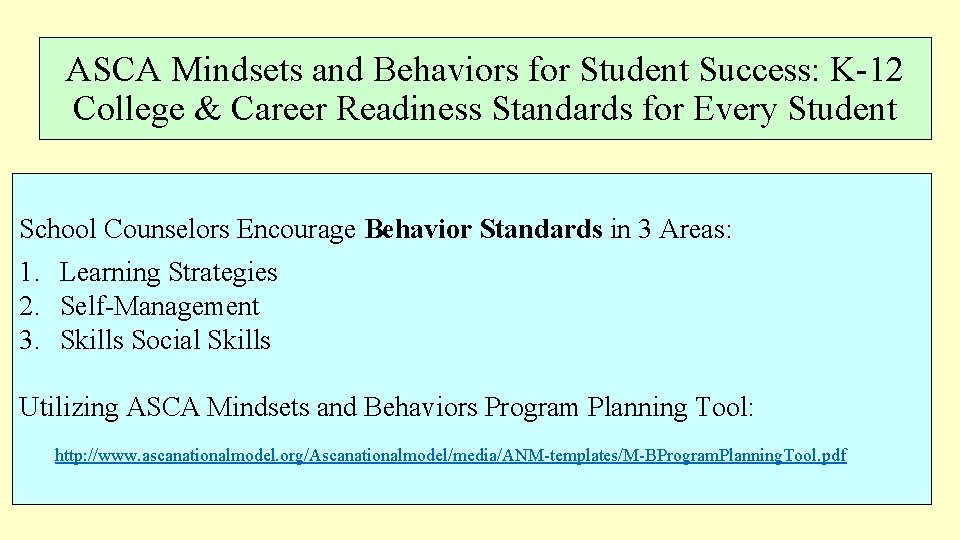
ASCA Mindsets and Behaviors for Student Success: K-12 College & Career Readiness Standards for Every Student School Counselors Encourage Behavior Standards in 3 Areas: 1. Learning Strategies 2. Self-Management 3. Skills Social Skills Utilizing ASCA Mindsets and Behaviors Program Planning Tool: http: //www. ascanationalmodel. org/Ascanationalmodel/media/ANM-templates/M-BProgram. Planning. Tool. pdf
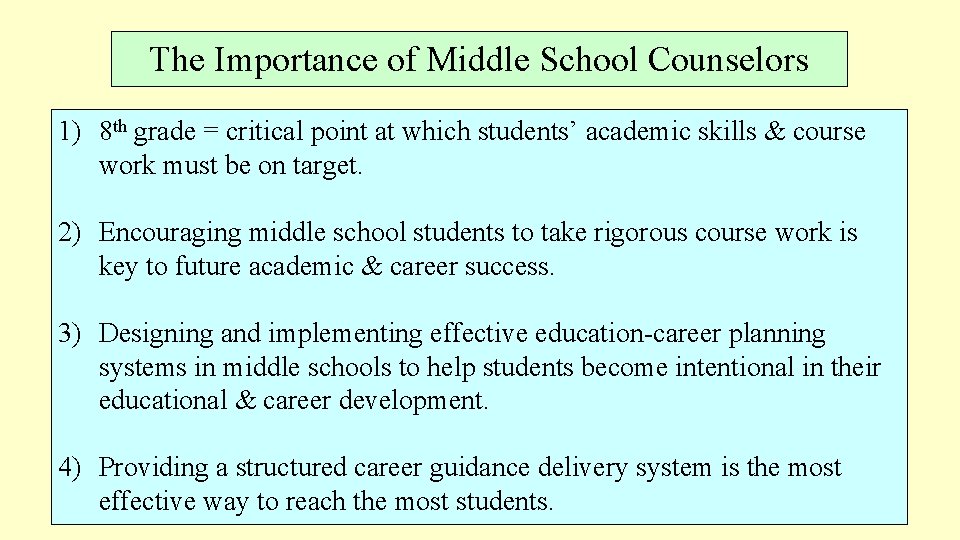
The Importance of Middle School Counselors 1) 8 th grade = critical point at which students’ academic skills & course work must be on target. 2) Encouraging middle school students to take rigorous course work is key to future academic & career success. 3) Designing and implementing effective education-career planning systems in middle schools to help students become intentional in their educational & career development. 4) Providing a structured career guidance delivery system is the most effective way to reach the most students.
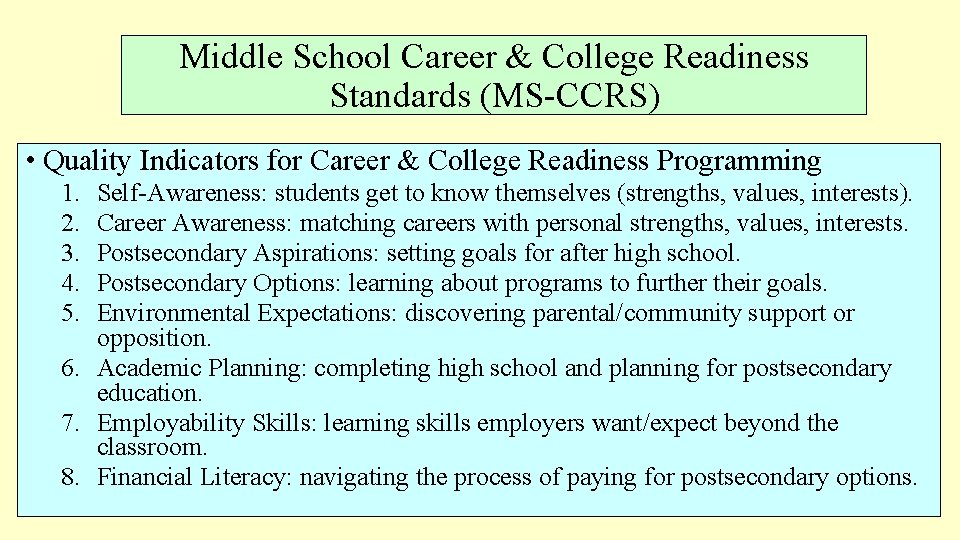
Middle School Career & College Readiness Standards (MS-CCRS) • Quality Indicators for Career & College Readiness Programming 1. 2. 3. 4. 5. Self-Awareness: students get to know themselves (strengths, values, interests). Career Awareness: matching careers with personal strengths, values, interests. Postsecondary Aspirations: setting goals for after high school. Postsecondary Options: learning about programs to further their goals. Environmental Expectations: discovering parental/community support or opposition. 6. Academic Planning: completing high school and planning for postsecondary education. 7. Employability Skills: learning skills employers want/expect beyond the classroom. 8. Financial Literacy: navigating the process of paying for postsecondary options.
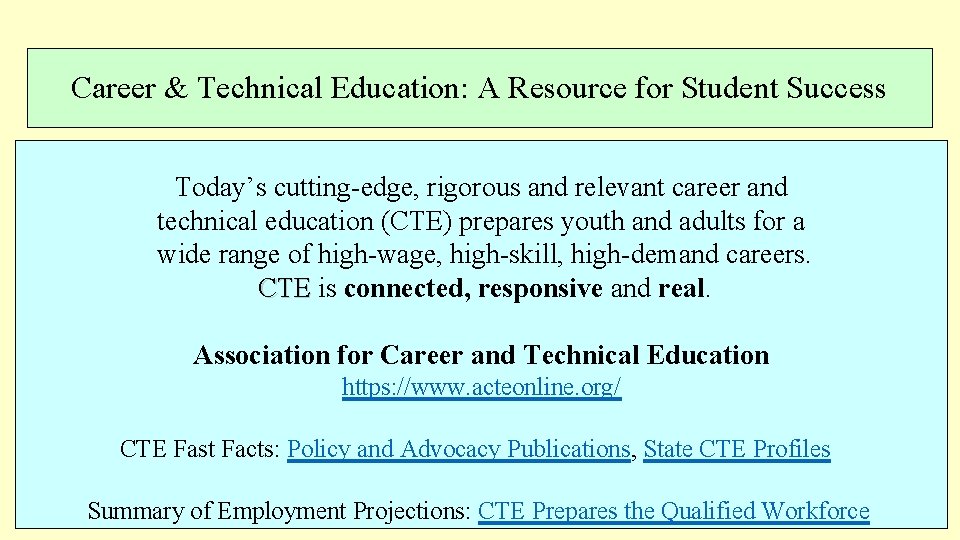
Career & Technical Education: A Resource for Student Success Today’s cutting-edge, rigorous and relevant career and technical education (CTE) prepares youth and adults for a wide range of high-wage, high-skill, high-demand careers. CTE is connected, responsive and real. CTE Association for Career and Technical Education https: //www. acteonline. org/ CTE Fast Facts: Policy and Advocacy Publications, State CTE Profiles Summary of Employment Projections: CTE Prepares the Qualified Workforce
21 st Century Students in a Global Workforce The National Career Cluster Framework ® consists of 16 separate clusters that are grouped by industry The 16 clusters include: 1. 2. 3. 4. 5. 6. 7. 8. 9. Agriculture, Food & 10. Natural Resources 11. Architecture and Construction 12. Arts, A/V Technology and Communication 13. Business, Management 14. & Administration Education & Training 15. Finance Government and Public 16. Administration Health Science Hospitality & Tourism 17. Human Services Information Technology Law, Public Safety and Security Manufacturing Marketing, Sales & Service Science, Technology, Engineering and Mathematics Transportation, Distribution and Logistics *Energy (CO, FL, GA)
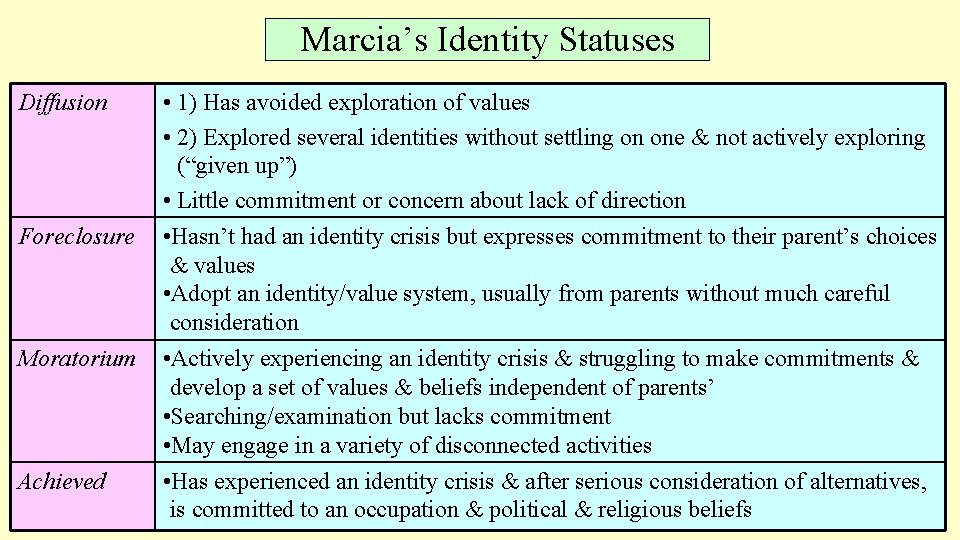
Marcia’s Identity Statuses Diffusion Foreclosure Moratorium Achieved • 1) Has avoided exploration of values • 2) Explored several identities without settling on one & not actively exploring (“given up”) • Little commitment or concern about lack of direction • Hasn’t had an identity crisis but expresses commitment to their parent’s choices & values • Adopt an identity/value system, usually from parents without much careful consideration • Actively experiencing an identity crisis & struggling to make commitments & develop a set of values & beliefs independent of parents’ • Searching/examination but lacks commitment • May engage in a variety of disconnected activities • Has experienced an identity crisis & after serious consideration of alternatives, is committed to an occupation & political & religious beliefs
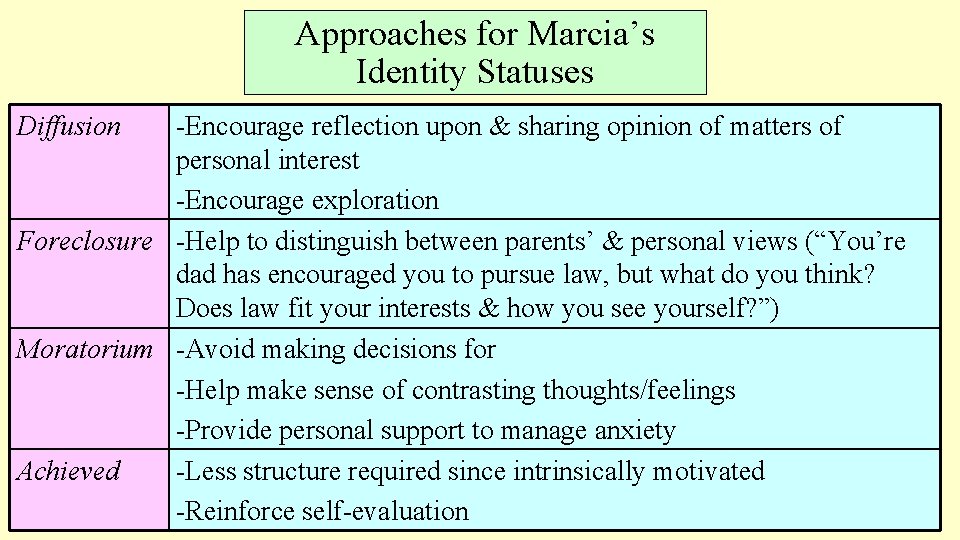
Approaches for Marcia’s Identity Statuses Diffusion -Encourage reflection upon & sharing opinion of matters of personal interest -Encourage exploration Foreclosure -Help to distinguish between parents’ & personal views (“You’re dad has encouraged you to pursue law, but what do you think? Does law fit your interests & how you see yourself? ”) Moratorium -Avoid making decisions for -Help make sense of contrasting thoughts/feelings -Provide personal support to manage anxiety Achieved -Less structure required since intrinsically motivated -Reinforce self-evaluation
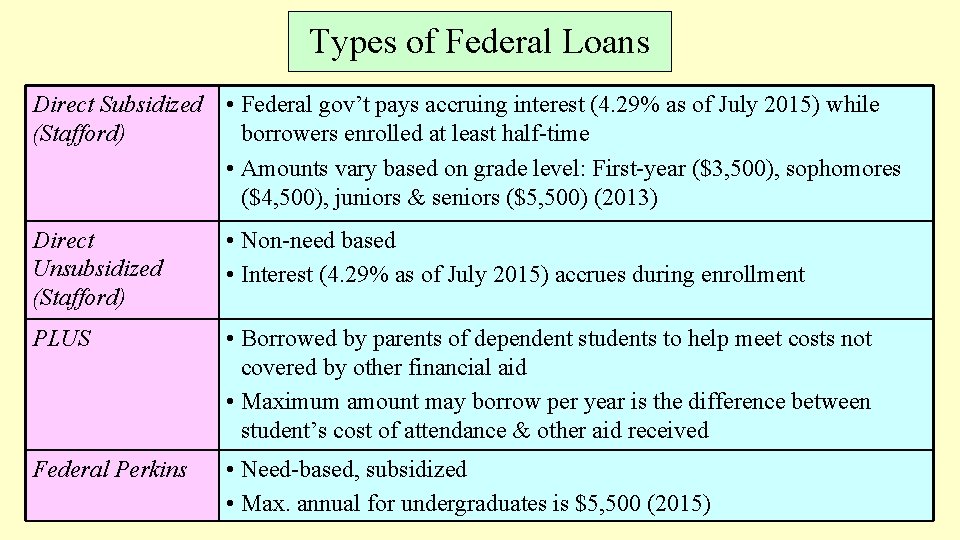
Types of Federal Loans Direct Subsidized (Stafford) • Federal gov’t pays accruing interest (4. 29% as of July 2015) while borrowers enrolled at least half-time • Amounts vary based on grade level: First-year ($3, 500), sophomores ($4, 500), juniors & seniors ($5, 500) (2013) Direct Unsubsidized (Stafford) • Non-need based • Interest (4. 29% as of July 2015) accrues during enrollment PLUS • Borrowed by parents of dependent students to help meet costs not covered by other financial aid • Maximum amount may borrow per year is the difference between student’s cost of attendance & other aid received Federal Perkins • Need-based, subsidized • Max. annual for undergraduates is $5, 500 (2015)
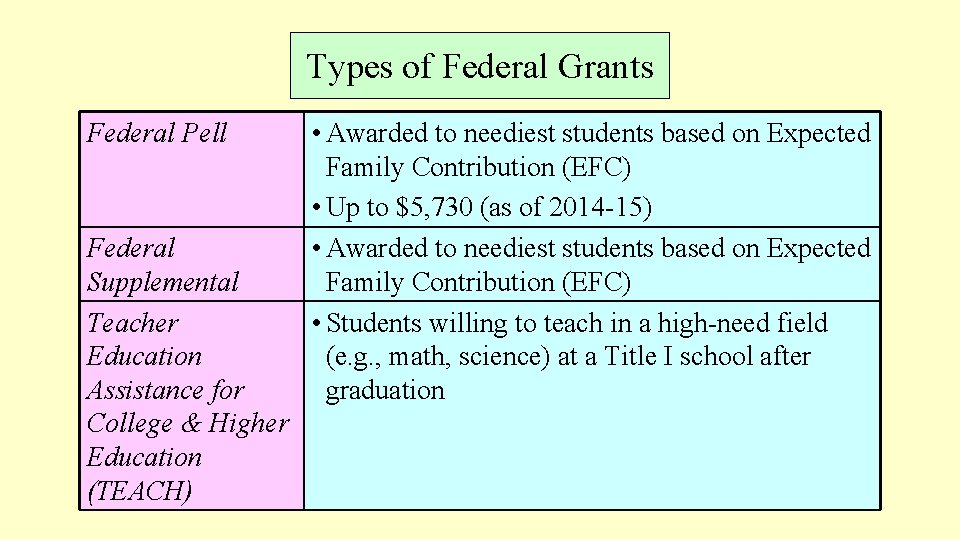
Types of Federal Grants Federal Pell Federal Supplemental Teacher Education Assistance for College & Higher Education (TEACH) • Awarded to neediest students based on Expected Family Contribution (EFC) • Up to $5, 730 (as of 2014 -15) • Awarded to neediest students based on Expected Family Contribution (EFC) • Students willing to teach in a high-need field (e. g. , math, science) at a Title I school after graduation
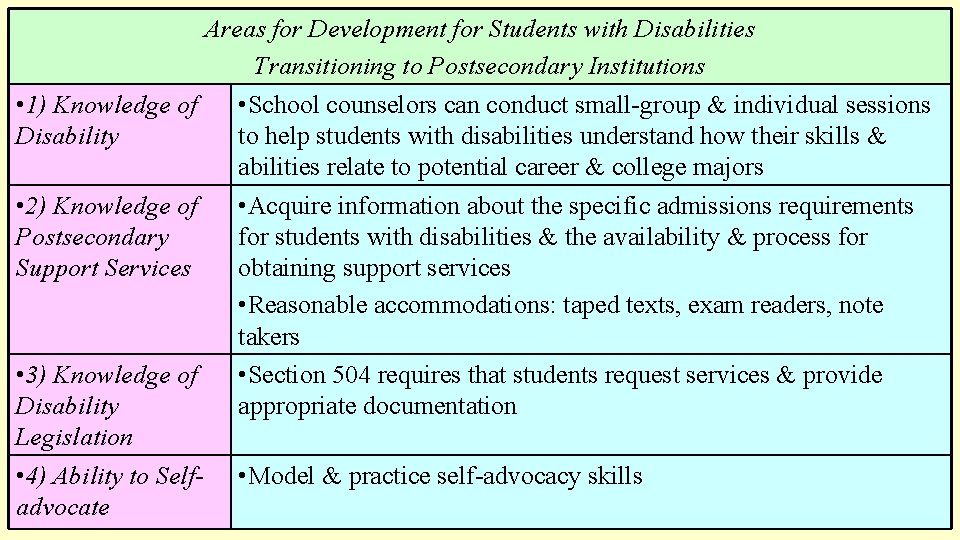
• 1) Knowledge of Disability • 2) Knowledge of Postsecondary Support Services • 3) Knowledge of Disability Legislation • 4) Ability to Selfadvocate Areas for Development for Students with Disabilities Transitioning to Postsecondary Institutions • School counselors can conduct small-group & individual sessions to help students with disabilities understand how their skills & abilities relate to potential career & college majors • Acquire information about the specific admissions requirements for students with disabilities & the availability & process for obtaining support services • Reasonable accommodations: taped texts, exam readers, note takers • Section 504 requires that students request services & provide appropriate documentation • Model & practice self-advocacy skills
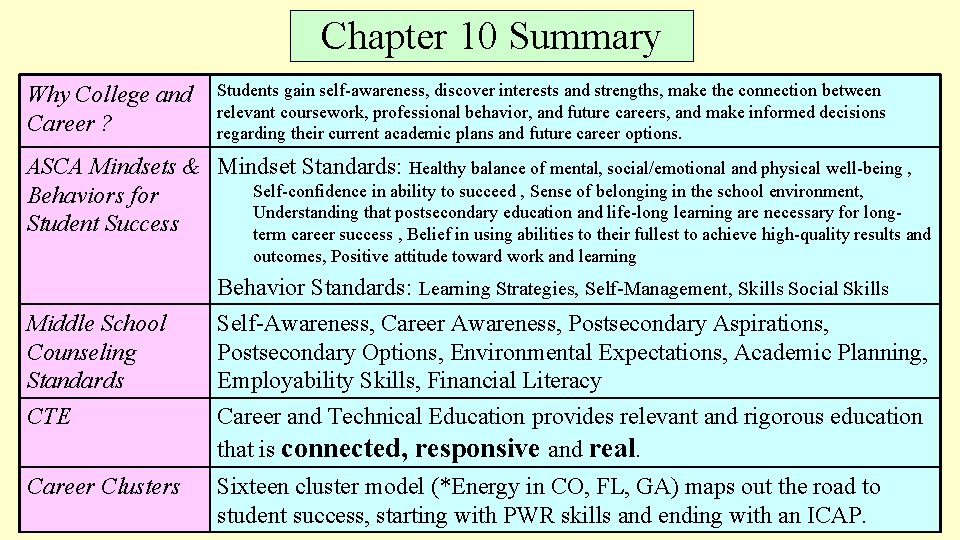
Chapter 10 Summary Why College and Career ? Students gain self-awareness, discover interests and strengths, make the connection between relevant coursework, professional behavior, and future careers, and make informed decisions regarding their current academic plans and future career options. ASCA Mindsets & Mindset Standards: Healthy balance of mental, social/emotional and physical well-being , Self-confidence in ability to succeed , Sense of belonging in the school environment, Behaviors for Understanding that postsecondary education and life-long learning are necessary for long. Student Success term career success , Belief in using abilities to their fullest to achieve high-quality results and outcomes, Positive attitude toward work and learning Middle School Counseling Standards Behavior Standards: Learning Strategies, Self-Management, Skills Social Skills Self-Awareness, Career Awareness, Postsecondary Aspirations, Postsecondary Options, Environmental Expectations, Academic Planning, Employability Skills, Financial Literacy CTE Career and Technical Education provides relevant and rigorous education that is connected, responsive and real. Career Clusters Sixteen cluster model (*Energy in CO, FL, GA) maps out the road to student success, starting with PWR skills and ending with an ICAP.
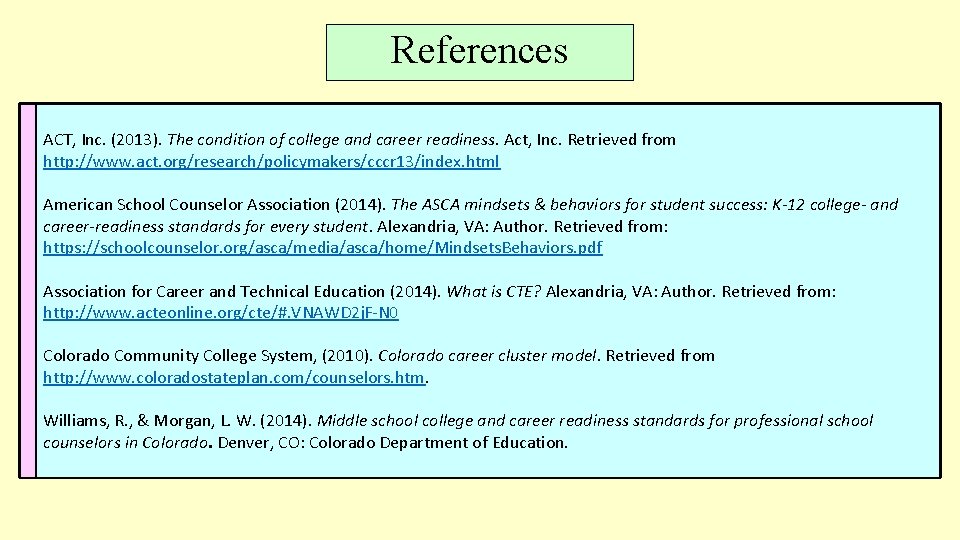
References ACT, Inc. (2013). The condition of college and career readiness. Act, Inc. Retrieved from http: //www. act. org/research/policymakers/cccr 13/index. html American School Counselor Association (2014). The ASCA mindsets & behaviors for student success: K-12 college- and career-readiness standards for every student. Alexandria, VA: Author. Retrieved from: https: //schoolcounselor. org/asca/media/asca/home/Mindsets. Behaviors. pdf Association for Career and Technical Education (2014). What is CTE? Alexandria, VA: Author. Retrieved from: http: //www. acteonline. org/cte/#. VNAWD 2 j. F-N 0 Colorado Community College System, (2010). Colorado career cluster model. Retrieved from http: //www. coloradostateplan. com/counselors. htm. Williams, R. , & Morgan, L. W. (2014). Middle school college and career readiness standards for professional school counselors in Colorado. Denver, CO: Colorado Department of Education.