
CHAPTER 10 Classically Trans Gender Diversity in Artifacts
- Slides: 30
CHAPTER 10 Classically Trans: Gender Diversity in Artifacts, Art, Icons, and Legends from Antiquity to the Middle Ages © Haefele-Thomas & Hansen: Introduction to Transgender Studies, Harrington Park Press, 2019
Discussion Questions • What can we learn about gender identity and gender diversity from artifacts that are thousands of years old? • How do ancient artifacts, legends, and icons reflect contemporary social issues and concerns? • What stereotypes and issues have not changed much over the course of millennia? © Haefele-Thomas & Hansen: Introduction to Transgender Studies, Harrington Park Press, 2019
Introduction: From the Depths of the Nile • Over 1, 200 years ago, two thriving cities, Canopus and Thonis. Heracleion, sank to the bottom of the Nile • Thonis-Heracleion was a major trading hub • Canopus was a religious center • These port cities were centers of commerce for centuries because of their location at the mouth of the Nile River and on the Mediterranean Sea • the rich land of the Nile Delta was not solid enough, so both cities sank • Over the past two decades, excavators have retrieved many stunning artifacts © Haefele-Thomas & Hansen: Introduction to Transgender Studies, Harrington Park Press, 2019
Introduction: From the Depths of the Nile Continued • One of the statues retrieved from the sandy riverbed of the Nile is that of the deity Hapy, the God of the Nile • Hapy embodied both the masculine and the feminine • usually described as a male deity • wears a typical Egyptian male beard • has female breasts • symbolized the god’s association with fertility and nourishment • depicted with the symbols of the lotus for Upper Egypt and the papyrus for Lower Egypt • became a metaphor for a united Egypt © Haefele-Thomas & Hansen: Introduction to Transgender Studies, Harrington Park Press, 2019
Sacredly Trans: Gender Diversity in Religious Artifacts, Icons, and Legends • Does the fact that Hapy was a lesser deity mean that gender fluidity was uncommon and relegated to minor deities? • Or, might the prevalence of gender fluidity in even minor Egyptian deities suggest that gender diversity was present at many levels of myth, spirituality, and folklore? © Haefele-Thomas & Hansen: Introduction to Transgender Studies, Harrington Park Press, 2019
Indigenous Americas • Many tribes throughout the Indigenous Americas and Pacific Islands sang songs and chants recounting creation stories that featured what we would understand today as Two-Spirit or Mahu figures • From the ancient Mohave “Song of the Hwame”: • he dances back and forth, back and forth. He feels it. Even if he’s a girl, he dances that way. • Part of a three-part initiation chant for young people who begin their journey as Two-Spirit © Haefele-Thomas & Hansen: Introduction to Transgender Studies, Harrington Park Press, 2019
Vodou and Diaspora • Vodou (more commonly spelled Voodoo) is a Creole tradition that “embraces elements of African, indigenous American, European esoteric, and Christian origins. . The distinct form of Vodou that emerged in New Orleans has tended to emphasize eclectic, magical, divinatory, and Catholic elements. ” • practiced mostly in Haiti and within Creole populations in New Orleans • related to Hoodoo, which has deep African cultural roots that encompass healing and magic • associated with an empowering resistance to oppression from the reality of slavery • in response, some white Protestant forms of Christianity have classified it as satanic © Haefele-Thomas & Hansen: Introduction to Transgender Studies, Harrington Park Press, 2019
Vodou and Diaspora Continued • Diaspora: a term used for people who have been forced out of their homeland for various reasons • Vodou specifically symbolizes the African diaspora • Numerous gender-diverse divinities are found in African-diasporic Vodou in the Americas • Gynandrous: another antiquated term for hermaphrodite • Mawu-Lisa, a patron saint of artists, is associated with both male and female twins as well as a gynandrous or transgender divinity who “created the first humans from clay” © Haefele-Thomas & Hansen: Introduction to Transgender Studies, Harrington Park Press, 2019
Vodou and Diaspora Continued • Legba is a powerful intermediary between the living and the dead • often understood to be androgynous or transgender • rules the crossroads so that there are no binaries with regard to gender, age, life, or death • Obatalá is an androgynous divinity of peace and a lawmaker • embodies father and mother, king and queen • in the Catholic tradition, Obatalá becomes Our Lady of Mercy, pointing to the fact that Catholicism has marginally embraced some divine figures in Vodou © Haefele-Thomas & Hansen: Introduction to Transgender Studies, Harrington Park Press, 2019
Trans Deities at the British Museum • “The Queen of the Night. ” • from Mesopotamia around 1750 BCE • image is a naked woman with a horned headdress, wings, and talons for feet • Parkinson notes, “She could be an aspect of Ishtar. . . [who] could even be shown with a beard in her more warlike forms. She had the power to assign gender identity and could ‘change man into woman and woman into man. ’” • Ishtar, the goddess of war and love in ancient Mesopotamia, embodied gender flexibility as well as fluidity between human and animal • which are also aspects of many Vodou and Indigenous American deities © Haefele-Thomas & Hansen: Introduction to Transgender Studies, Harrington Park Press, 2019
Trans Deities at the British Museum Continued • A beautiful copper alloy statue from 800 CE in India depicts Shiva, the Hindu dancing god or the lord of the dance. • Parkinson notes, “In Hindu mythology gender is often fluid, with the divine transcending any mortal categories of male and female. ” • Shiva’s gender fluidity is subtle, and you will need to examine the earrings on this figure to see that they are different from each other. • One earring symbolizes masculinity and the other femininity. © Haefele-Thomas & Hansen: Introduction to Transgender Studies, Harrington Park Press, 2019
Trans Deities at the British Museum Continued • From seventeenth-century Nepal a gilded bronze figure with beautiful inlaid turquoise and gems represents the Hindu deity Lakshminarayan • “represents the male god Vishnu and his female consort Lakshmi. . . sometimes shown as a single figure whose body is half male and half female” • the gendered earrings are different • Lakshminarayan’s elaborate combination of the masculine and the feminine is not uncommon in Nepal, where “Hinduism and Buddhism have been practiced side by side, often in distinctive and combined forms” © Haefele-Thomas & Hansen: Introduction to Transgender Studies, Harrington Park Press, 2019
A Legend Burned at the Stake: Jeanne d’Arc and Shifting Religious Attitudes • In 1429 the seventeen-year-old Jeanne, dressed in men’s military attire, went to Prince Charles, the heir to the French throne • The English were invading France • Jeanne promised to lead an army of peasants to drive the English out of France • stated that her masculine clothing and her mission to fight the English were a directive from God • The prince supported the teenager and sent her off with an army of 10, 000 peasants © Haefele-Thomas & Hansen: Introduction to Transgender Studies, Harrington Park Press, 2019
A Legend Burned at the Stake: Jeanne d’Arc and Shifting Religious Attitudes Continued • The French were victorious against the English, and Jeanne d’Arc was a major influence in France’s transformation into a free nation-state • After victory, she “was abducted by English sympathizers (who called her ‘homasse, ’ or ‘man-woman’); they turned her over to the Inquisition in England” • Trial began in April 1431 • judges sentenced her to death because of her refusal to dress in women’s clothes and act in the ways they thought women should act © Haefele-Thomas & Hansen: Introduction to Transgender Studies, Harrington Park Press, 2019
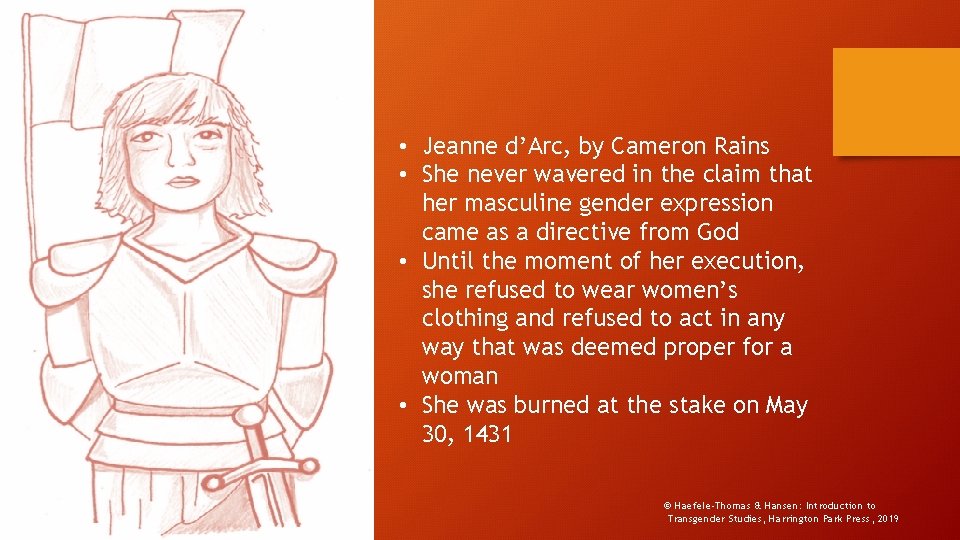
• Jeanne d’Arc, by Cameron Rains • She never wavered in the claim that her masculine gender expression came as a directive from God • Until the moment of her execution, she refused to wear women’s clothing and refused to act in any way that was deemed proper for a woman • She was burned at the stake on May 30, 1431 © Haefele-Thomas & Hansen: Introduction to Transgender Studies, Harrington Park Press, 2019
Egyptian Reality/Chinese Folklore: Pharaoh Hatshepsut and General Mulan • For centuries, it was believed that Pharaoh Hatshepsut (1508? – 1458 BCE) was merely a mythical figure • in the early nineteenth century, her nearly obliterated history and shattered artifacts were discovered • Pharaoh Hatshepsut had been a living, breathing monarch who ruled over two decades of peace and prosperity in Egypt • It is most likely that General Mulan from China was not any one person • probably a compilation of stories about brave young women who honored their families • Mulan’s legend, “despite its journey across time, geography, and cultures, continues to be about a young woman’s successful transgression” © Haefele-Thomas & Hansen: Introduction to Transgender Studies, Harrington Park Press, 2019
In the Twenty-First Century, a Pharaoh on Display • Why did Hatshepsut become a pharaoh and not a queen? • Who was in charge of the art depicting Hatshepsut? • Why were the monuments destroyed? • If the monuments were destroyed, how do we have any history or evidence of Hatshepsut? © Haefele-Thomas & Hansen: Introduction to Transgender Studies, Harrington Park Press, 2019
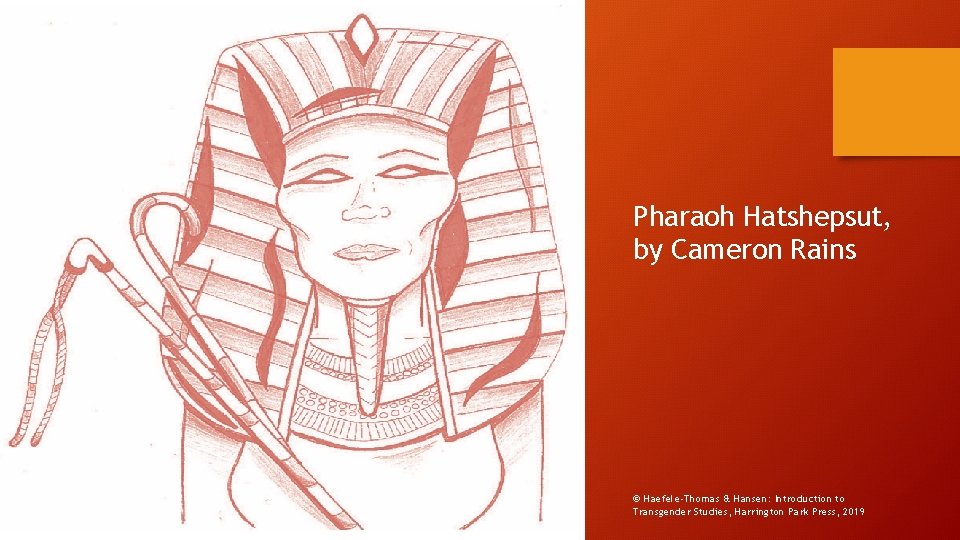
A Pharaoh Nearly Erased: Hatshepsut’s Rediscovery • In the 1920 s and 1930 s, researchers from the Metropolitan Museum of Art in New York discovered two huge pits filled with statues from Hatshepsut’s temple • It took years to piece these relics together because they had been smashed and desecrated • European explorers helped recover the lost history of a ruler who carefully transitioned across the gender binary by way of the masculine statues and other monuments she commissioned to be built to honor her as a king and not as a queen © Haefele-Thomas & Hansen: Introduction to Transgender Studies, Harrington Park Press, 2019
Pharaoh Hatshepsut, by Cameron Rains © Haefele-Thomas & Hansen: Introduction to Transgender Studies, Harrington Park Press, 2019
Mr. Pharaoh Herself: Hatshepsut’s Transition from Queen to Pharaoh • Hatshepsut ruled Egypt for nearly twenty years in the mid-fifteenth century BCE • some military battles were fought during those two decades • Hatshepsut led some of the fights herself • her reign is generally considered to have been peaceful and prosperous • At Semna temple in Nubia, Hatshepsut commissioned reliefs to be carved depicting her in the company of the gods, and “the description of her actions — as an heir, as a builder, as a ritual officiate — are those of a masculine king” • Hatshepsut gradually moved from having artists and temple builders depict her as a queen — a ruler standing in long skirts with her feet close together — to a king with a beard, standing in masculine hunting clothes with legs apart © Haefele-Thomas & Hansen: Introduction to Transgender Studies, Harrington Park Press, 2019
Erasing a Legend • One scholar noted, “While the obliteration of her memory was once explained as an act of retribution on the part of her successor, and more current theories propose that the motive was safeguarding the royal succession, the reasons. . . are still not entirely clear. ” • Thutmose III attempted to erase Hatshepsut from history. • He was not successful. • Many of the broken artifacts have now been put back together, restoring Pharaoh Hatshepsut’s history. © Haefele-Thomas & Hansen: Introduction to Transgender Studies, Harrington Park Press, 2019
China’s Most Honorable Girl: The Legend of Mulan • The famous Chinese legend of the brave girl who went to war in place of her sick and aging father has been in the popular imagination for around 1, 500 years • The story of Mulan comes from an ancient Chinese poem, “The Ballad of Mulan” • “‘I want to buy a saddle and horse, And serve in the army in Father’s place. ’ In the East Market she buys a spirited horse, In the West Market she buys a saddle, In the South Market she buys a bridle, In the North Market she buys a long whip. ” © Haefele-Thomas & Hansen: Introduction to Transgender Studies, Harrington Park Press, 2019
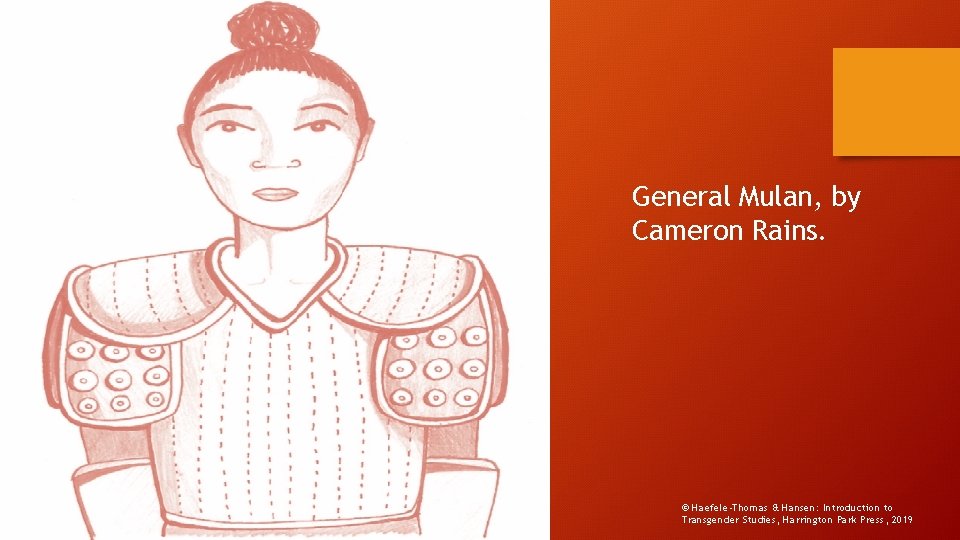
Searching for Mulan’s Origins • It is likely that the Mulan ballad began with an oral tradition • Scholars believe that the earliest written form appeared in Gujin yuelu • which is a Chinese musical collection compiled sometime around 568 CE • originated during a time of civil war and violence in China’s northern regions • comes from a tradition of strong tribal women who fought for their communities © Haefele-Thomas & Hansen: Introduction to Transgender Studies, Harrington Park Press, 2019
General Mulan, by Cameron Rains. © Haefele-Thomas & Hansen: Introduction to Transgender Studies, Harrington Park Press, 2019
Mulan in Popular Culture • Modern example of the evolution of Mulan’s legend is Maxine Hong Kingston’s 1976 novel, The Woman Warrior • explores what it means to be a Chinese American woman and feminist in the United States in the late twentieth century • In the 1998 Disney film Mulan, the young warrior stares into a pool and questions when the reflection will show the true person inside • resonates with trans people who feel that the person whom the world sees— and specifically the gender identity that the world assumes—does not reflect who they are on the inside © Haefele-Thomas & Hansen: Introduction to Transgender Studies, Harrington Park Press, 2019
Mulan in Popular Culture Continued • The film reverts to a cisnormative and heteronormative ending when Mulan returns home, throws off the warrior’s outfit, embraces her femininity, and gets engaged to a man • The ancient “Ballad” leaves the reader with a much more ambiguous ending: “How can they tell if I am he or she? ” • Another film version of Mulan’s story is the 2009 Chinese movie Mulan: Rise of a Warrior • original title Hua Mulan • directed by Jingle Ma and Wei Dong • Hua Mulan cross-dresses, leaves her village to fight in her father’s place in the military, and over the course of twelve years becomes a general © Haefele-Thomas & Hansen: Introduction to Transgender Studies, Harrington Park Press, 2019
Trans Cornerstones of Western Civilization: Ancient Greece and Rome • One famous Greek story is alive and well in our contemporary popular culture: Hedwig and the Angry Inch • The song “The Origin of Love” comes from The Symposium, written in the fourth century BCE by the Greek philosopher Plato • The Symposium looks at love in its various forms • same-sex desire • love between a man and a woman • love that has no erotic component © Haefele-Thomas & Hansen: Introduction to Transgender Studies, Harrington Park Press, 2019
Trans Cornerstones of Western Civilization: Ancient Greece and Rome • The Symposium includes the story of the first human beings, who embodied at least two genders, perhaps more. • They were too happy in the eyes of Zeus, who was often a jealous god. • Zeus sent down a lightning bolt that cut the humans up and tore their genders apart so that they roamed around without all their parts. • This piece of mythology is an interesting way to think about the creation of a gender binary. © Haefele-Thomas & Hansen: Introduction to Transgender Studies, Harrington Park Press, 2019
Trans Cornerstones of Western Civilization: Ancient Greece and Rome Continued • Where did the word hermaphrodite come from? • The Roman poet Ovid wrote the most well-known version of the tale of Hermaphroditus, the beautiful son of Hermes and Aphrodite. • One day Hermaphroditus was bathing in a spring, where a nymph, Salmacis, fell in love with him. • He rejected her. • In her heartbreak, she cried to the gods to never separate her from her beloved. © Haefele-Thomas & Hansen: Introduction to Transgender Studies, Harrington Park Press, 2019
Trans Cornerstones of Western Civilization: Ancient Greece and Rome Continued • That is when their bodies melded together: So these two joined in close embrace, no longer Two beings, and no longer man and woman, But neither, and yet both. Hermaphroditus Saw that the water had made him half a man, With limbs all softness. • Gender stereotypes in Ovid’s story © Haefele-Thomas & Hansen: Introduction to Transgender Studies, Harrington Park Press, 2019