
Chapter 10 Cipher Techniques Some Problems Types of
Chapter 10: Cipher Techniques • • Some Problems Types of Ciphers Networks Examples November 1, 2004 Introduction to Computer Security © 2004 Matt Bishop 1
Overview • Problems – What can go wrong if you naively use ciphers • Cipher types – Stream or block ciphers? • Networks – Link vs end-to-end use • Examples – Privacy-Enhanced Electronic Mail (PEM) – Security at the Network Layer (IPsec) November 1, 2004 Introduction to Computer Security © 2004 Matt Bishop 2
Problems • Using cipher requires knowledge of environment, and threats in the environment, in which cipher will be used – Is the set of possible messages small? – Do the messages exhibit regularities that remain after encipherment? – Can an active wiretapper rearrange or change parts of the message? November 1, 2004 Introduction to Computer Security © 2004 Matt Bishop 3
Attack #1: Precomputation • Set of possible messages M small • Public key cipher f used • Idea: precompute set of possible ciphertexts f(M), build table (m, f(m)) • When ciphertext f(m) appears, use table to find m • Also called forward searches November 1, 2004 Introduction to Computer Security © 2004 Matt Bishop 4
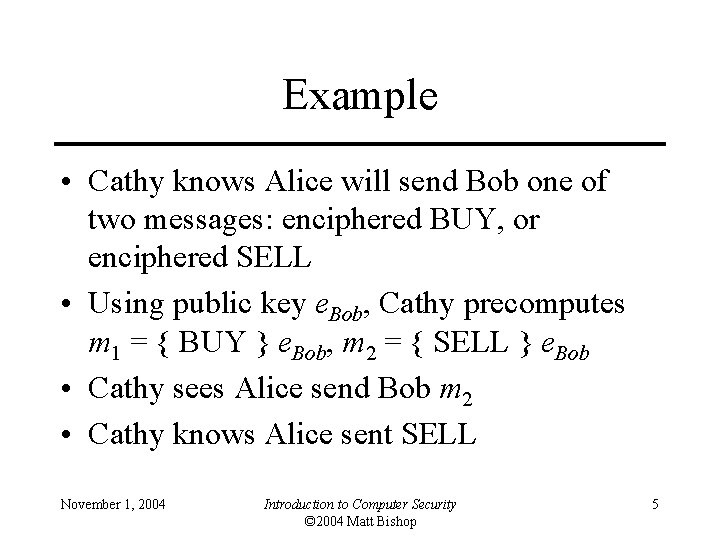
Example • Cathy knows Alice will send Bob one of two messages: enciphered BUY, or enciphered SELL • Using public key e. Bob, Cathy precomputes m 1 = { BUY } e. Bob, m 2 = { SELL } e. Bob • Cathy sees Alice send Bob m 2 • Cathy knows Alice sent SELL November 1, 2004 Introduction to Computer Security © 2004 Matt Bishop 5
May Not Be Obvious • Digitized sound – Seems like far too many possible plaintexts • Initial calculations suggest 232 such plaintexts – Analysis of redundancy in human speech reduced this to about 100, 000 (≈ 217) • This is small enough to worry about precomputation attacks November 1, 2004 Introduction to Computer Security © 2004 Matt Bishop 6
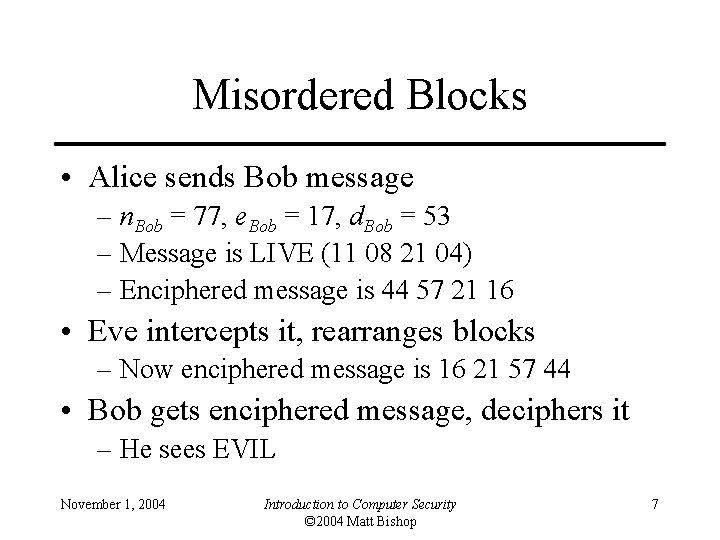
Misordered Blocks • Alice sends Bob message – n. Bob = 77, e. Bob = 17, d. Bob = 53 – Message is LIVE (11 08 21 04) – Enciphered message is 44 57 21 16 • Eve intercepts it, rearranges blocks – Now enciphered message is 16 21 57 44 • Bob gets enciphered message, deciphers it – He sees EVIL November 1, 2004 Introduction to Computer Security © 2004 Matt Bishop 7
Notes • Digitally signing each block won’t stop this attack • Two approaches: – Cryptographically hash the entire message and sign it – Place sequence numbers in each block of message, so recipient can tell intended order • Then you sign each block November 1, 2004 Introduction to Computer Security © 2004 Matt Bishop 8
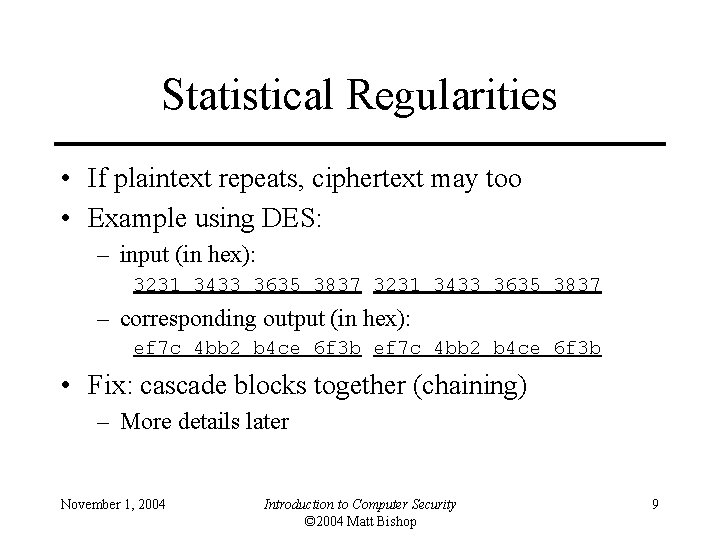
Statistical Regularities • If plaintext repeats, ciphertext may too • Example using DES: – input (in hex): 3231 3433 3635 3837 – corresponding output (in hex): ef 7 c 4 bb 2 b 4 ce 6 f 3 b • Fix: cascade blocks together (chaining) – More details later November 1, 2004 Introduction to Computer Security © 2004 Matt Bishop 9
What These Mean • Use of strong cryptosystems, well-chosen (or random) keys not enough to be secure • Other factors: – Protocols directing use of cryptosystems – Ancillary information added by protocols – Implementation (not discussed here) – Maintenance and operation (not discussed here) November 1, 2004 Introduction to Computer Security © 2004 Matt Bishop 10
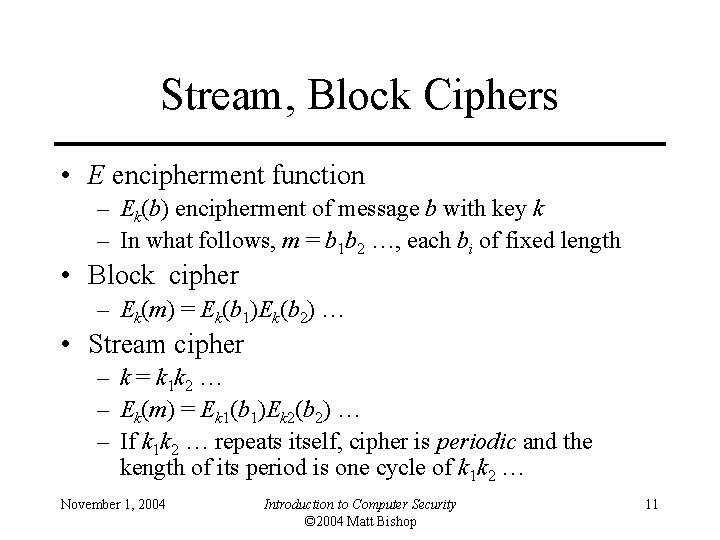
Stream, Block Ciphers • E encipherment function – Ek(b) encipherment of message b with key k – In what follows, m = b 1 b 2 …, each bi of fixed length • Block cipher – Ek(m) = Ek(b 1)Ek(b 2) … • Stream cipher – k = k 1 k 2 … – Ek(m) = Ek 1(b 1)Ek 2(b 2) … – If k 1 k 2 … repeats itself, cipher is periodic and the kength of its period is one cycle of k 1 k 2 … November 1, 2004 Introduction to Computer Security © 2004 Matt Bishop 11

Examples • Vigenère cipher – bi = 1 character, k = k 1 k 2 … where ki = 1 character – Each bi enciphered using ki mod length(k) – Stream cipher • DES – bi = 64 bits, k = 56 bits – Each bi enciphered separately using k – Block cipher November 1, 2004 Introduction to Computer Security © 2004 Matt Bishop 12
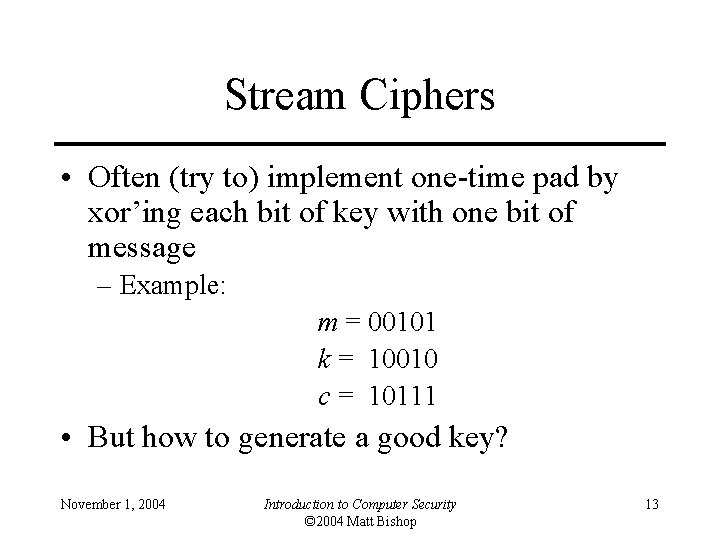
Stream Ciphers • Often (try to) implement one-time pad by xor’ing each bit of key with one bit of message – Example: m = 00101 k = 10010 c = 10111 • But how to generate a good key? November 1, 2004 Introduction to Computer Security © 2004 Matt Bishop 13
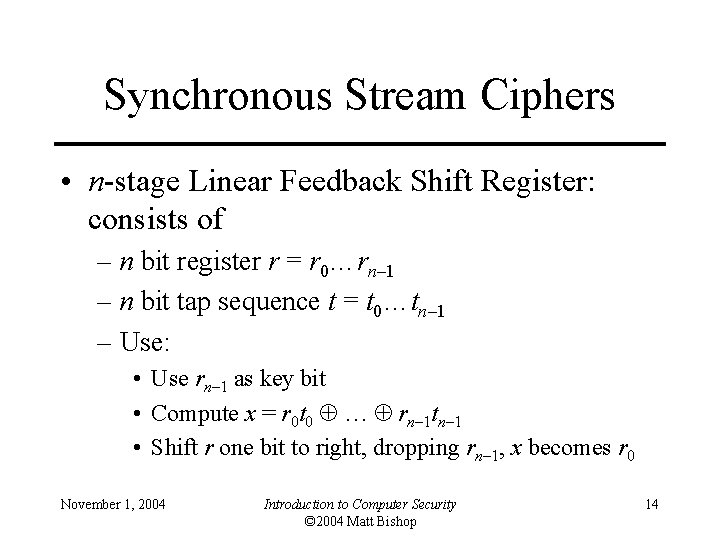
Synchronous Stream Ciphers • n-stage Linear Feedback Shift Register: consists of – n bit register r = r 0…rn– 1 – n bit tap sequence t = t 0…tn– 1 – Use: • Use rn– 1 as key bit • Compute x = r 0 t 0 … rn– 1 tn– 1 • Shift r one bit to right, dropping rn– 1, x becomes r 0 November 1, 2004 Introduction to Computer Security © 2004 Matt Bishop 14
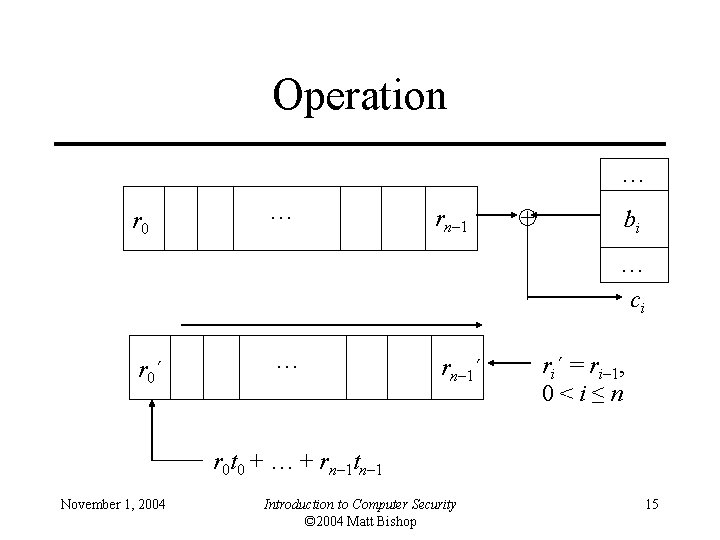
Operation … r 0 … rn– 1 bi … ci r 0´ … rn– 1´ ri´ = ri– 1, 0<i≤n r 0 t 0 + … + rn– 1 tn– 1 November 1, 2004 Introduction to Computer Security © 2004 Matt Bishop 15
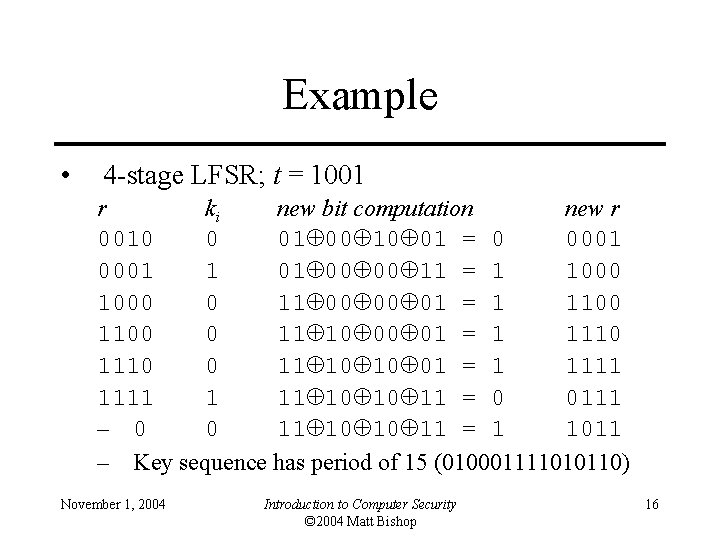
Example • 4 -stage LFSR; t = 1001 r ki new bit computation new r 0010 0 01 00 10 01 = 0 0001 1 01 00 00 11 = 1 1000 0 11 00 00 01 = 1 1100 0 11 10 00 01 = 1 1110 0 11 10 10 01 = 1 1111 10 10 11 = 0 0111 – 0 0 11 10 10 11 = 1 1011 – Key sequence has period of 15 (010001111010110) November 1, 2004 Introduction to Computer Security © 2004 Matt Bishop 16
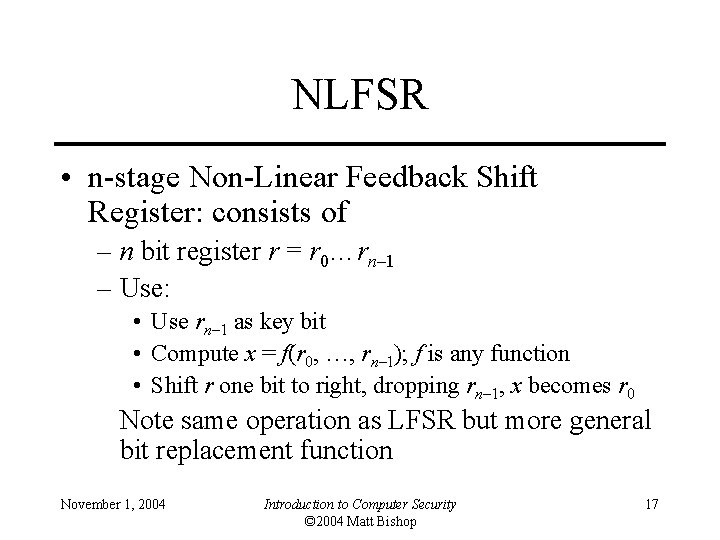
NLFSR • n-stage Non-Linear Feedback Shift Register: consists of – n bit register r = r 0…rn– 1 – Use: • Use rn– 1 as key bit • Compute x = f(r 0, …, rn– 1); f is any function • Shift r one bit to right, dropping rn– 1, x becomes r 0 Note same operation as LFSR but more general bit replacement function November 1, 2004 Introduction to Computer Security © 2004 Matt Bishop 17
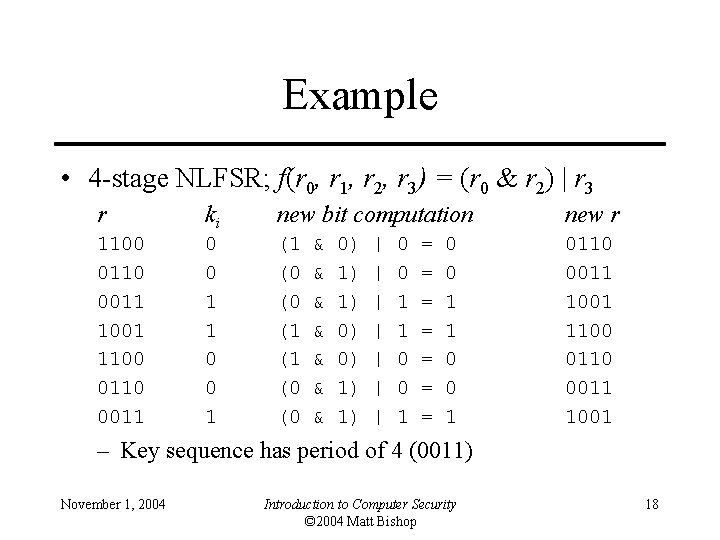
Example • 4 -stage NLFSR; f(r 0, r 1, r 2, r 3) = (r 0 & r 2) | r 3 r ki new bit computation new r 1100 0110 0011 1001 1100 0110 0011 0 0 1 (1 (0 (0 (1 (1 (0 (0 0110 0011 1001 1100 0110 0011 1001 & & & & 0) 1) 1) 0) 0) 1) 1) | | | | 0 0 1 1 0 0 1 = = = = 0 0 1 1 0 0 1 – Key sequence has period of 4 (0011) November 1, 2004 Introduction to Computer Security © 2004 Matt Bishop 18
Eliminating Linearity • NLFSRs not common – No body of theory about how to design them to have long period • Alternate approach: output feedback mode – For E encipherment function, k key, r register: • Compute r = Ek(r); key bit is rightmost bit of r • Set r to r and iterate, repeatedly enciphering register and extracting key bits, until message enciphered – Variant: use a counter that is incremented for each encipherment rather than a register • Take rightmost bit of Ek(i), where i is number of encipherment November 1, 2004 Introduction to Computer Security © 2004 Matt Bishop 19
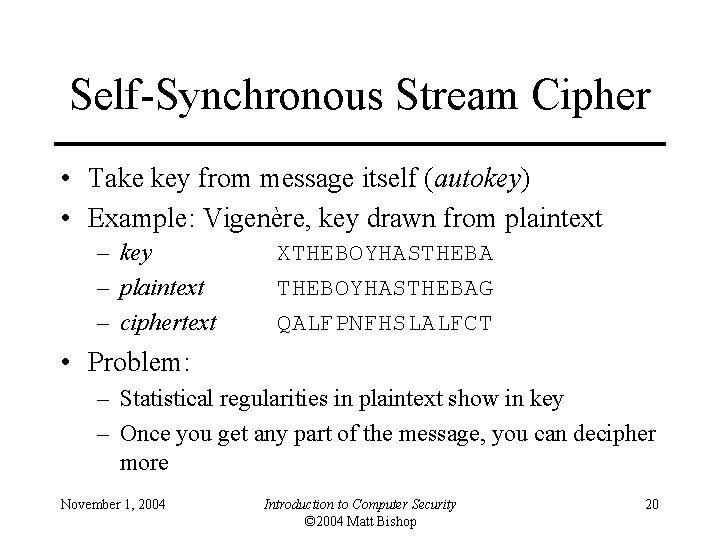
Self-Synchronous Stream Cipher • Take key from message itself (autokey) • Example: Vigenère, key drawn from plaintext – key – plaintext – ciphertext XTHEBOYHASTHEBAG QALFPNFHSLALFCT • Problem: – Statistical regularities in plaintext show in key – Once you get any part of the message, you can decipher more November 1, 2004 Introduction to Computer Security © 2004 Matt Bishop 20
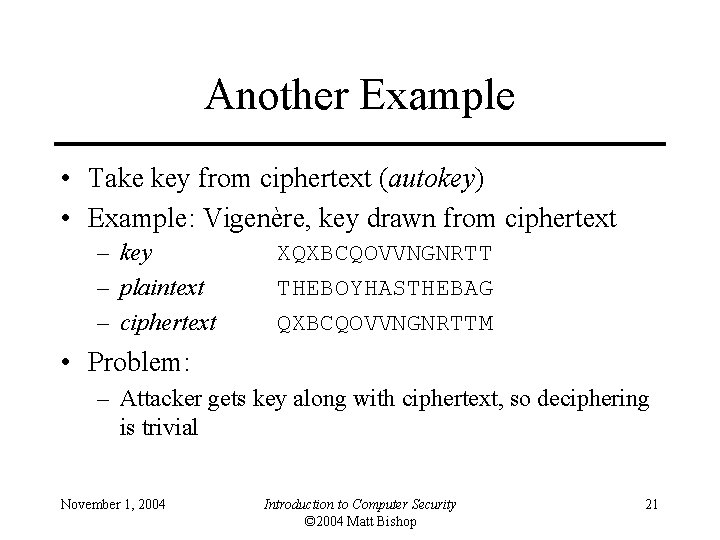
Another Example • Take key from ciphertext (autokey) • Example: Vigenère, key drawn from ciphertext – key – plaintext – ciphertext XQXBCQOVVNGNRTT THEBOYHASTHEBAG QXBCQOVVNGNRTTM • Problem: – Attacker gets key along with ciphertext, so deciphering is trivial November 1, 2004 Introduction to Computer Security © 2004 Matt Bishop 21
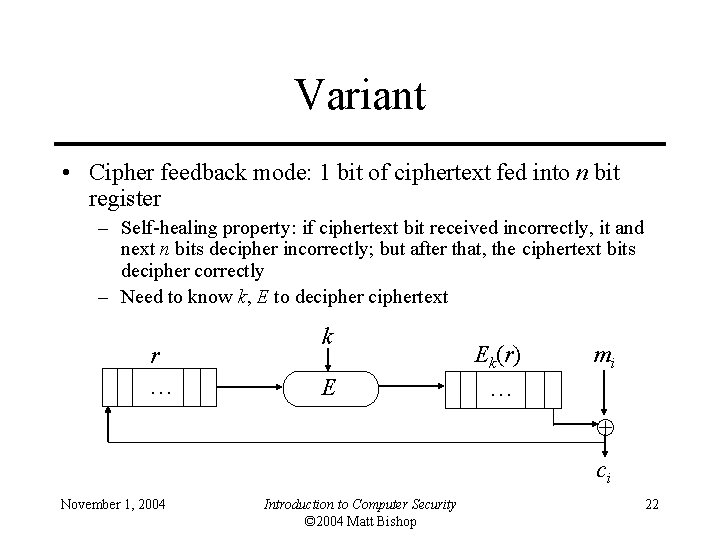
Variant • Cipher feedback mode: 1 bit of ciphertext fed into n bit register – Self-healing property: if ciphertext bit received incorrectly, it and next n bits decipher incorrectly; but after that, the ciphertext bits decipher correctly – Need to know k, E to deciphertext r … k E Ek(r) … mi ci November 1, 2004 Introduction to Computer Security © 2004 Matt Bishop 22
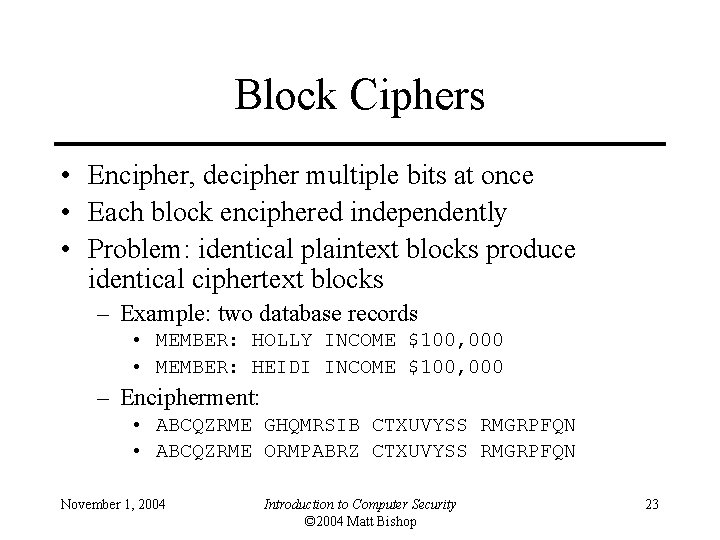
Block Ciphers • Encipher, decipher multiple bits at once • Each block enciphered independently • Problem: identical plaintext blocks produce identical ciphertext blocks – Example: two database records • MEMBER: HOLLY INCOME $100, 000 • MEMBER: HEIDI INCOME $100, 000 – Encipherment: • ABCQZRME GHQMRSIB CTXUVYSS RMGRPFQN • ABCQZRME ORMPABRZ CTXUVYSS RMGRPFQN November 1, 2004 Introduction to Computer Security © 2004 Matt Bishop 23
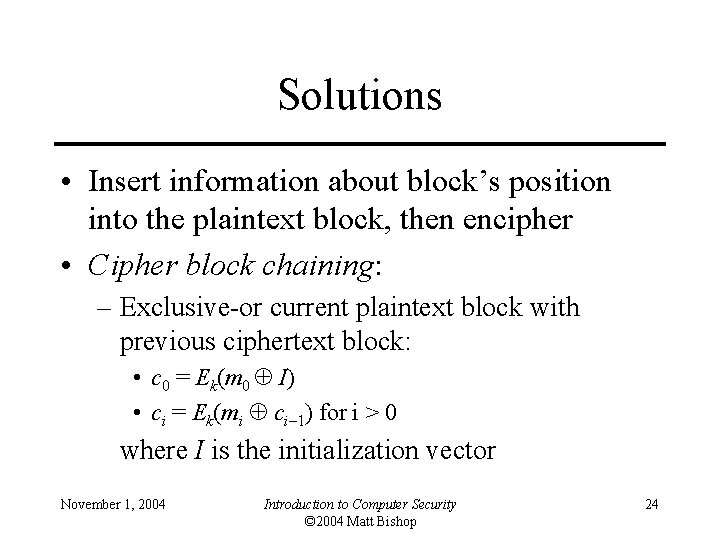
Solutions • Insert information about block’s position into the plaintext block, then encipher • Cipher block chaining: – Exclusive-or current plaintext block with previous ciphertext block: • c 0 = Ek(m 0 I) • ci = Ek(mi ci– 1) for i > 0 where I is the initialization vector November 1, 2004 Introduction to Computer Security © 2004 Matt Bishop 24
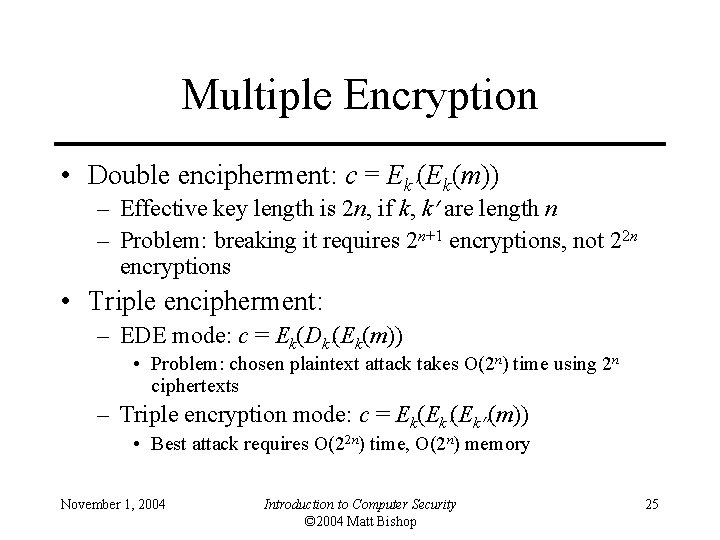
Multiple Encryption • Double encipherment: c = Ek (Ek(m)) – Effective key length is 2 n, if k, k are length n – Problem: breaking it requires 2 n+1 encryptions, not 22 n encryptions • Triple encipherment: – EDE mode: c = Ek(Dk (Ek(m)) • Problem: chosen plaintext attack takes O(2 n) time using 2 n ciphertexts – Triple encryption mode: c = Ek(Ek (m)) • Best attack requires O(22 n) time, O(2 n) memory November 1, 2004 Introduction to Computer Security © 2004 Matt Bishop 25
Networks and Cryptography • ISO/OSI model • Conceptually, each host has peer at each layer – Peers communicate with peers at same layer November 1, 2004 Introduction to Computer Security © 2004 Matt Bishop 26
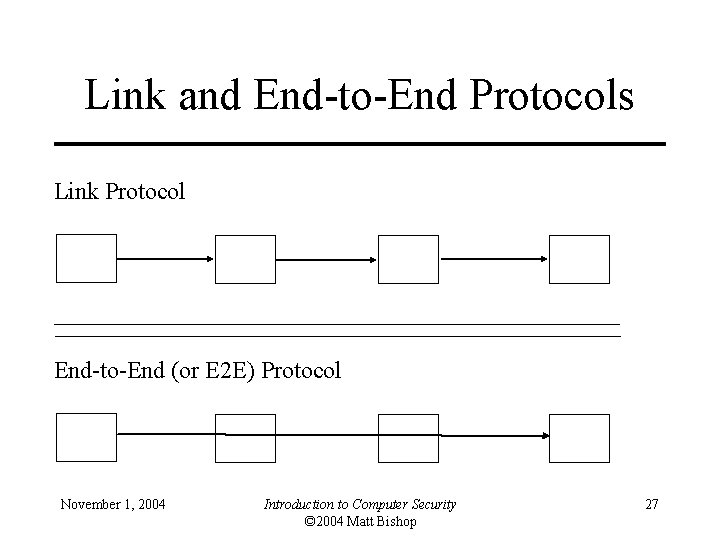
Link and End-to-End Protocols Link Protocol End-to-End (or E 2 E) Protocol November 1, 2004 Introduction to Computer Security © 2004 Matt Bishop 27
Encryption • Link encryption – Each host enciphers message so host at “next hop” can read it – Message can be read at intermediate hosts • End-to-end encryption – Host enciphers message so host at other end of communication can read it – Message cannot be read at intermediate hosts November 1, 2004 Introduction to Computer Security © 2004 Matt Bishop 28
Examples • TELNET protocol – Messages between client, server enciphered, and encipherment, decipherment occur only at these hosts – End-to-end protocol • PPP Encryption Control Protocol – Host gets message, deciphers it • Figures out where to forward it • Enciphers it in appropriate key and forwards it – Link protocol November 1, 2004 Introduction to Computer Security © 2004 Matt Bishop 29
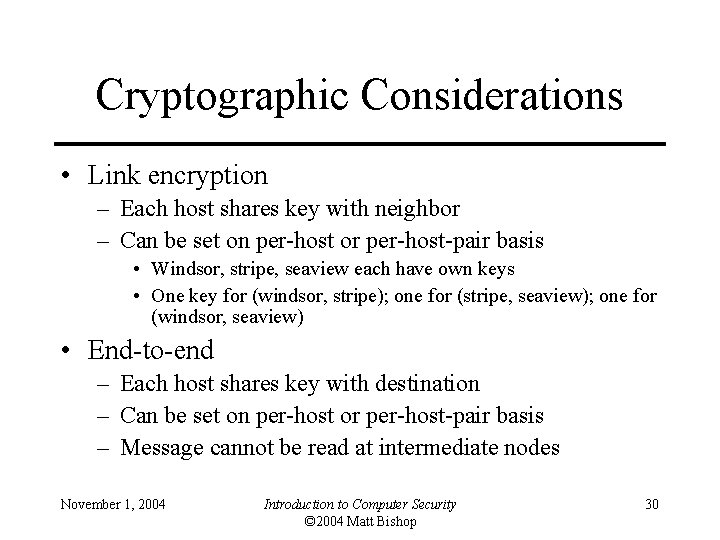
Cryptographic Considerations • Link encryption – Each host shares key with neighbor – Can be set on per-host or per-host-pair basis • Windsor, stripe, seaview each have own keys • One key for (windsor, stripe); one for (stripe, seaview); one for (windsor, seaview) • End-to-end – Each host shares key with destination – Can be set on per-host or per-host-pair basis – Message cannot be read at intermediate nodes November 1, 2004 Introduction to Computer Security © 2004 Matt Bishop 30
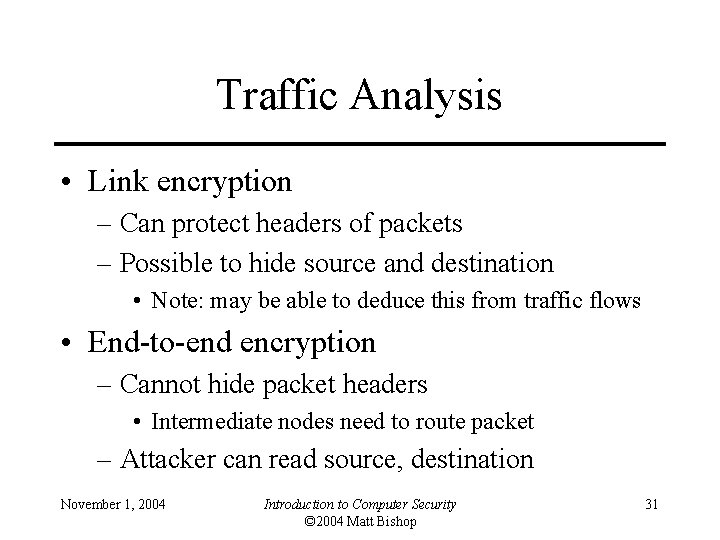
Traffic Analysis • Link encryption – Can protect headers of packets – Possible to hide source and destination • Note: may be able to deduce this from traffic flows • End-to-end encryption – Cannot hide packet headers • Intermediate nodes need to route packet – Attacker can read source, destination November 1, 2004 Introduction to Computer Security © 2004 Matt Bishop 31
Example Protocols • Privacy-Enhanced Electronic Mail (PEM) – Applications layer protocol • IP Security (IPSec) – Network layer protocol November 1, 2004 Introduction to Computer Security © 2004 Matt Bishop 32
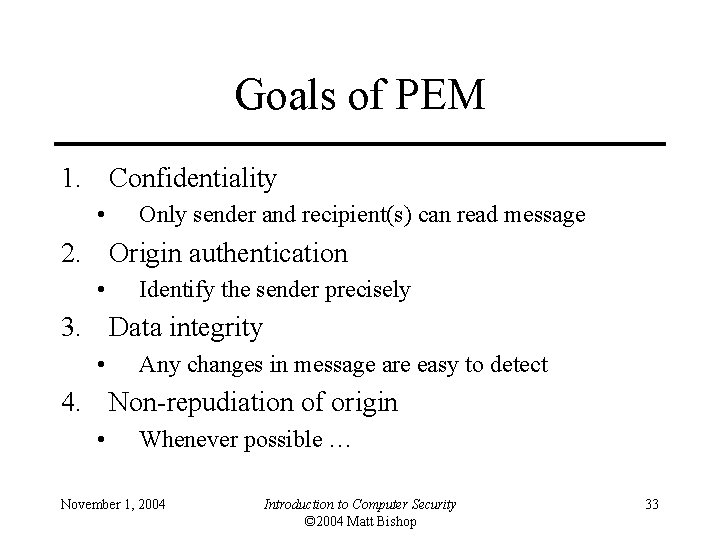
Goals of PEM 1. Confidentiality • Only sender and recipient(s) can read message 2. Origin authentication • Identify the sender precisely 3. Data integrity • Any changes in message are easy to detect 4. Non-repudiation of origin • Whenever possible … November 1, 2004 Introduction to Computer Security © 2004 Matt Bishop 33
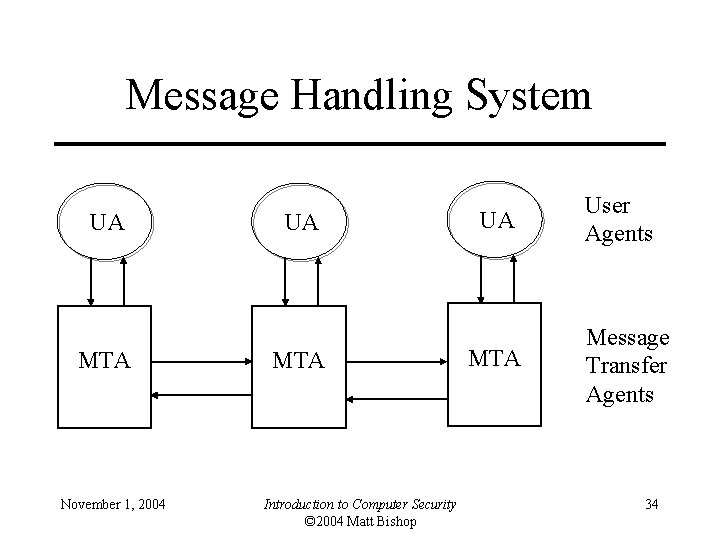
Message Handling System UA MTA November 1, 2004 UA MTA Introduction to Computer Security © 2004 Matt Bishop UA MTA User Agents Message Transfer Agents 34
Design Principles • Do not change related existing protocols – Cannot alter SMTP • Do not change existing software – Need compatibility with existing software • Make use of PEM optional – Available if desired, but email still works without them – Some recipients may use it, others not • Enable communication without prearrangement – Out-of-bands authentication, key exchange problematic November 1, 2004 Introduction to Computer Security © 2004 Matt Bishop 35
Basic Design: Keys • Two keys – Interchange keys tied to sender, recipients and is static (for some set of messages) • Like a public/private key pair • Must be available before messages sent – Data exchange keys generated for each message • Like a session key, session being the message November 1, 2004 Introduction to Computer Security © 2004 Matt Bishop 36
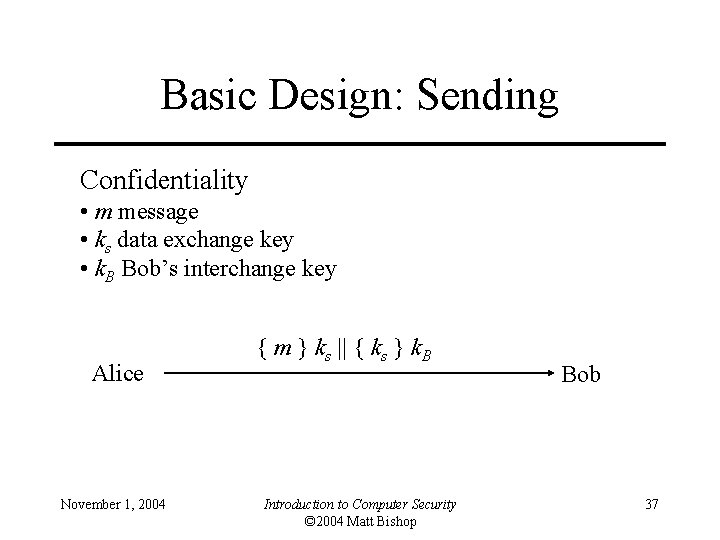
Basic Design: Sending Confidentiality • m message • ks data exchange key • k. B Bob’s interchange key Alice November 1, 2004 { m } ks || { ks } k. B Introduction to Computer Security © 2004 Matt Bishop Bob 37
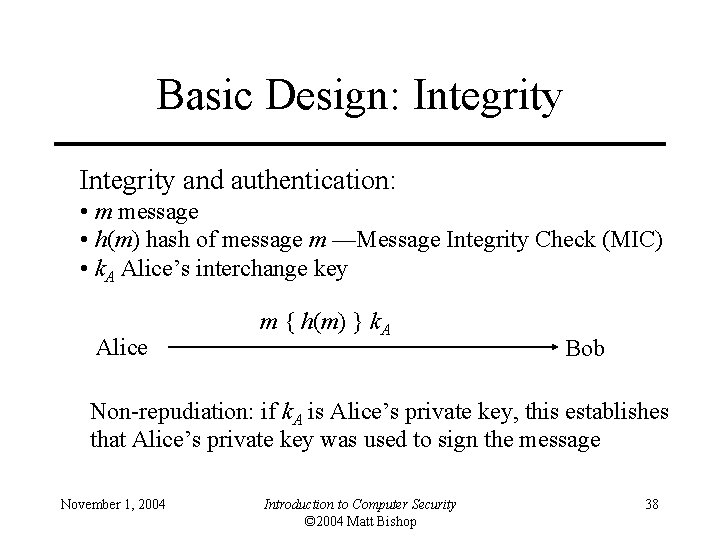
Basic Design: Integrity and authentication: • m message • h(m) hash of message m —Message Integrity Check (MIC) • k. A Alice’s interchange key Alice m { h(m) } k. A Bob Non-repudiation: if k. A is Alice’s private key, this establishes that Alice’s private key was used to sign the message November 1, 2004 Introduction to Computer Security © 2004 Matt Bishop 38
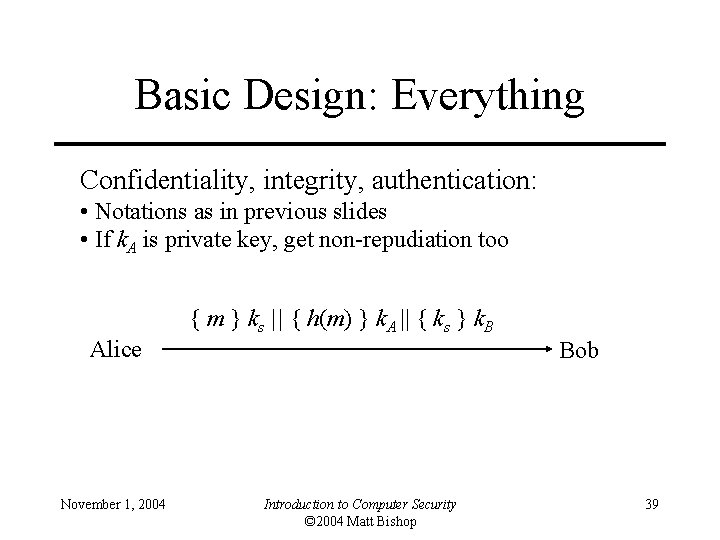
Basic Design: Everything Confidentiality, integrity, authentication: • Notations as in previous slides • If k. A is private key, get non-repudiation too Alice November 1, 2004 { m } ks || { h(m) } k. A || { ks } k. B Bob Introduction to Computer Security © 2004 Matt Bishop 39
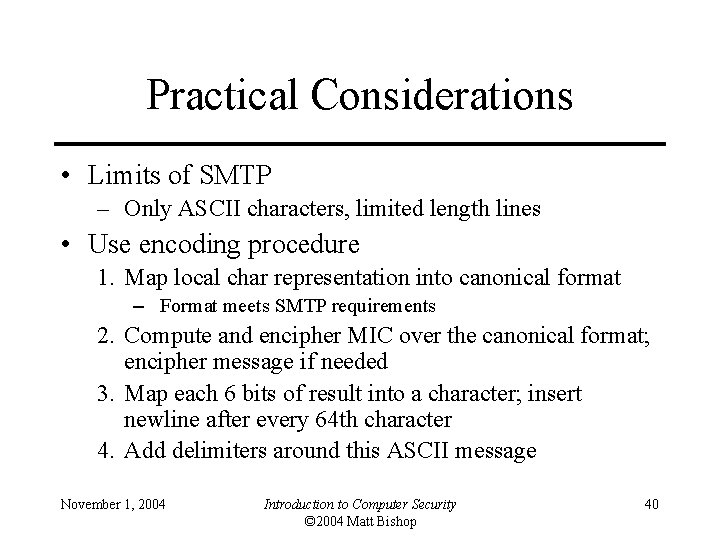
Practical Considerations • Limits of SMTP – Only ASCII characters, limited length lines • Use encoding procedure 1. Map local char representation into canonical format – Format meets SMTP requirements 2. Compute and encipher MIC over the canonical format; encipher message if needed 3. Map each 6 bits of result into a character; insert newline after every 64 th character 4. Add delimiters around this ASCII message November 1, 2004 Introduction to Computer Security © 2004 Matt Bishop 40
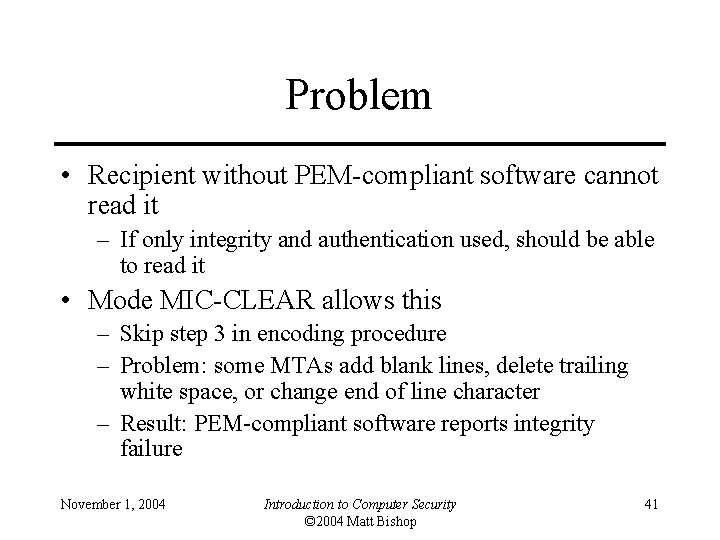
Problem • Recipient without PEM-compliant software cannot read it – If only integrity and authentication used, should be able to read it • Mode MIC-CLEAR allows this – Skip step 3 in encoding procedure – Problem: some MTAs add blank lines, delete trailing white space, or change end of line character – Result: PEM-compliant software reports integrity failure November 1, 2004 Introduction to Computer Security © 2004 Matt Bishop 41
PEM vs. PGP • Use different ciphers – PGP uses IDEA cipher – PEM uses DES in CBC mode • Use different certificate models – PGP uses general “web of trust” – PEM uses hierarchical certification structure • Handle end of line differently – PGP remaps end of line if message tagged “text”, but leaves them alone if message tagged “binary” – PEM always remaps end of line November 1, 2004 Introduction to Computer Security © 2004 Matt Bishop 42
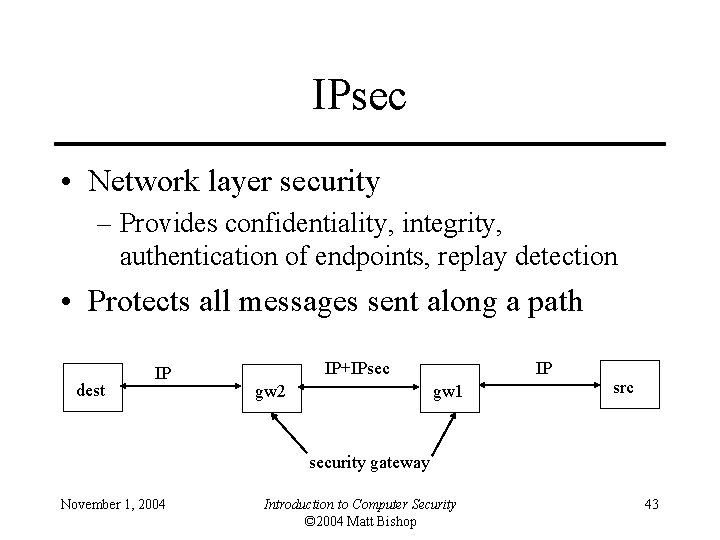
IPsec • Network layer security – Provides confidentiality, integrity, authentication of endpoints, replay detection • Protects all messages sent along a path dest IP IP+IPsec gw 2 IP gw 1 src security gateway November 1, 2004 Introduction to Computer Security © 2004 Matt Bishop 43
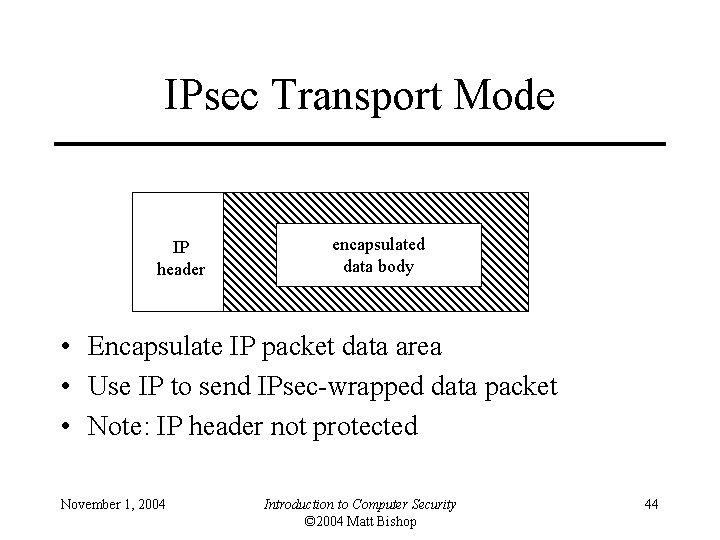
IPsec Transport Mode IP header encapsulated data body • Encapsulate IP packet data area • Use IP to send IPsec-wrapped data packet • Note: IP header not protected November 1, 2004 Introduction to Computer Security © 2004 Matt Bishop 44
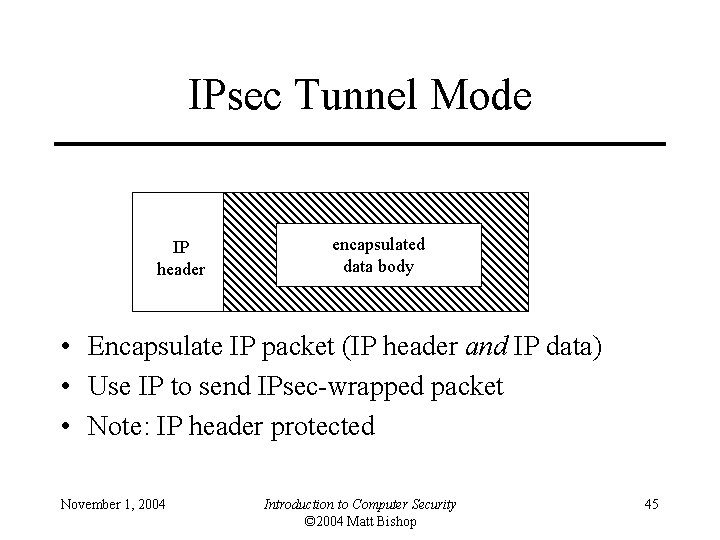
IPsec Tunnel Mode IP header encapsulated data body • Encapsulate IP packet (IP header and IP data) • Use IP to send IPsec-wrapped packet • Note: IP header protected November 1, 2004 Introduction to Computer Security © 2004 Matt Bishop 45
IPsec Protocols • Authentication Header (AH) – Message integrity – Origin authentication – Anti-replay • Encapsulating Security Payload (ESP) – Confidentiality – Others provided by AH November 1, 2004 Introduction to Computer Security © 2004 Matt Bishop 46
IPsec Architecture • Security Policy Database (SPD) – Says how to handle messages (discard them, add security services, forward message unchanged) – SPD associated with network interface – SPD determines appropriate entry from packet attributes • Including source, destination, transport protocol November 1, 2004 Introduction to Computer Security © 2004 Matt Bishop 47
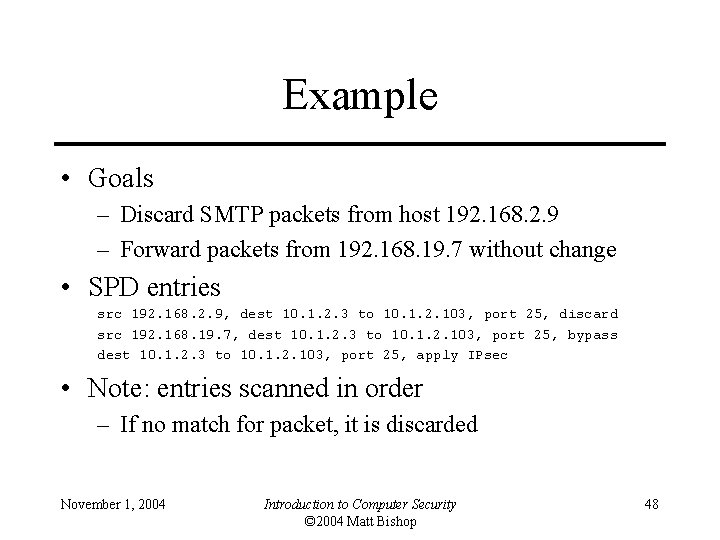
Example • Goals – Discard SMTP packets from host 192. 168. 2. 9 – Forward packets from 192. 168. 19. 7 without change • SPD entries src 192. 168. 2. 9, dest 10. 1. 2. 3 to 10. 1. 2. 103, port 25, discard src 192. 168. 19. 7, dest 10. 1. 2. 3 to 10. 1. 2. 103, port 25, bypass dest 10. 1. 2. 3 to 10. 1. 2. 103, port 25, apply IPsec • Note: entries scanned in order – If no match for packet, it is discarded November 1, 2004 Introduction to Computer Security © 2004 Matt Bishop 48
IPsec Architecture • Security Association (SA) – Association between peers for security services • Identified uniquely by dest address, security protocol (AH or ESP), unique 32 -bit number (security parameter index, or SPI) – Unidirectional • Can apply different services in either direction – SA uses either ESP or AH; if both required, 2 SAs needed November 1, 2004 Introduction to Computer Security © 2004 Matt Bishop 49
SA Database (SAD) • Entry describes SA; some fields for all packets: – AH algorithm identifier, keys • When SA uses AH – ESP encipherment algorithm identifier, keys • When SA uses confidentiality from ESP – ESP authentication algorithm identifier, keys • When SA uses authentication, integrity from ESP – SA lifetime (time for deletion or max byte count) – IPsec mode (tunnel, transport, either) November 1, 2004 Introduction to Computer Security © 2004 Matt Bishop 50
SAD Fields • Antireplay (inbound only) – When SA uses antireplay feature • Sequence number counter (outbound only) – Generates AH or ESP sequence number • Sequence counter overflow field – Stops traffic over this SA if sequence counter overflows • Aging variables – Used to detect time-outs November 1, 2004 Introduction to Computer Security © 2004 Matt Bishop 51
IPsec Architecture • Packet arrives • Look in SPD – Find appropriate entry – Get dest address, security protocol, SPI • Find associated SA in SAD – Use dest address, security protocol, SPI – Apply security services in SA (if any) November 1, 2004 Introduction to Computer Security © 2004 Matt Bishop 52
SA Bundles and Nesting • Sequence of SAs that IPsec applies to packets – This is a SA bundle • Nest tunnel mode SAs – This is iterated tunneling November 1, 2004 Introduction to Computer Security © 2004 Matt Bishop 53
Example: Nested Tunnels • Group in A. org needs to communicate with group in B. org • Gateways of A, B use IPsec mechanisms – But the information must be secret to everyone except the two groups, even secret from other people in A. org and B. org • Inner tunnel: a SA between the hosts of the two groups • Outer tunnel: the SA between the two gateways November 1, 2004 Introduction to Computer Security © 2004 Matt Bishop 54
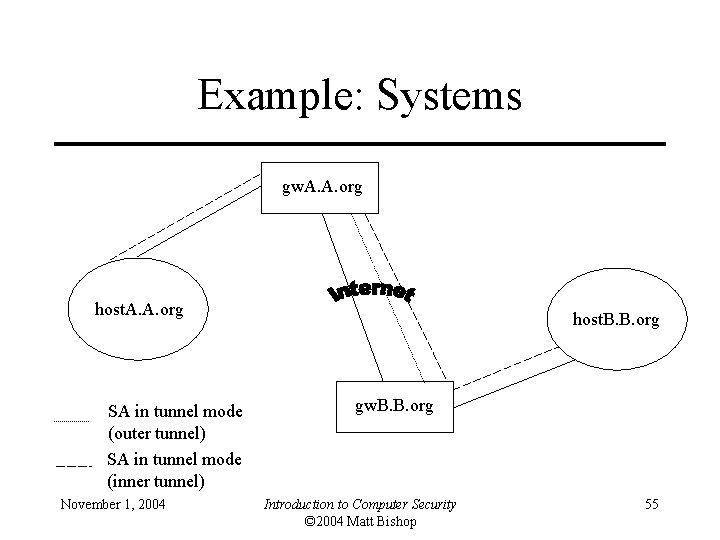
Example: Systems gw. A. A. org host. A. A. org SA in tunnel mode (outer tunnel) SA in tunnel mode (inner tunnel) November 1, 2004 host. B. B. org gw. B. B. org Introduction to Computer Security © 2004 Matt Bishop 55
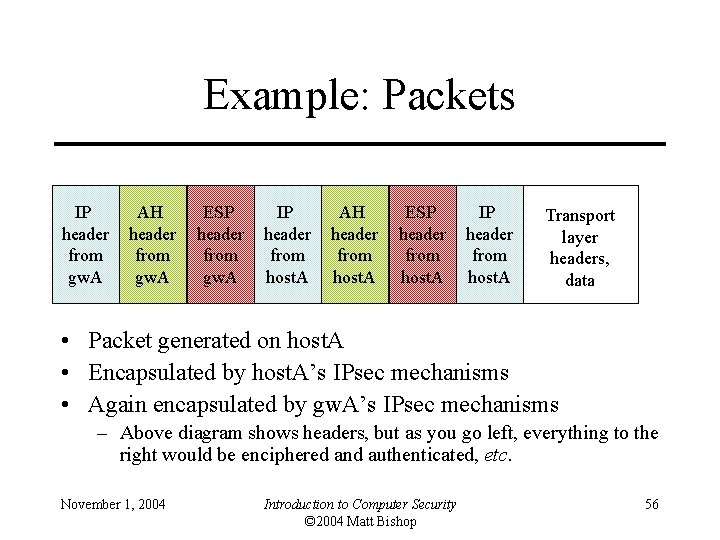
Example: Packets IP header from gw. A AH header from gw. A ESP header from gw. A IP header from host. A AH header from host. A ESP header from host. A IP header from host. A Transport layer headers, data • Packet generated on host. A • Encapsulated by host. A’s IPsec mechanisms • Again encapsulated by gw. A’s IPsec mechanisms – Above diagram shows headers, but as you go left, everything to the right would be enciphered and authenticated, etc. November 1, 2004 Introduction to Computer Security © 2004 Matt Bishop 56
AH Protocol • Parameters in AH header – Length of header – SPI of SA applying protocol – Sequence number (anti-replay) – Integrity value check • Two steps – Check that replay is not occurring – Check authentication data November 1, 2004 Introduction to Computer Security © 2004 Matt Bishop 57
Sender • Check sequence number will not cycle • Increment sequence number • Compute IVC of packet – Includes IP header, AH header, packet data • IP header: include all fields that will not change in transit; assume all others are 0 • AH header: authentication data field set to 0 for this • Packet data includes encapsulated data, higher level protocol data November 1, 2004 Introduction to Computer Security © 2004 Matt Bishop 58
Recipient • Assume AH header found • Get SPI, destination address • Find associated SA in SAD – If no associated SA, discard packet • If antireplay not used – Verify IVC is correct • If not, discard November 1, 2004 Introduction to Computer Security © 2004 Matt Bishop 59
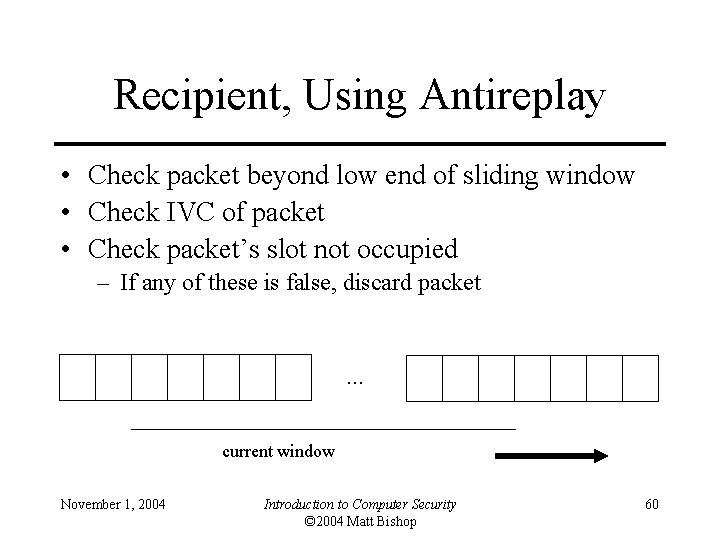
Recipient, Using Antireplay • Check packet beyond low end of sliding window • Check IVC of packet • Check packet’s slot not occupied – If any of these is false, discard packet … current window November 1, 2004 Introduction to Computer Security © 2004 Matt Bishop 60
AH Miscellany • All implementations must support: HMAC_MD 5 HMAC_SHA-1 • May support other algorithms November 1, 2004 Introduction to Computer Security © 2004 Matt Bishop 61
ESP Protocol • Parameters in ESP header – – SPI of SA applying protocol Sequence number (anti-replay) Generic “payload data” field Padding and length of padding • Contents depends on ESP services enabled; may be an initialization vector for a chaining cipher, for example • Used also to pad packet to length required by cipher – Optional authentication data field November 1, 2004 Introduction to Computer Security © 2004 Matt Bishop 62
Sender • Add ESP header – Includes whatever padding needed • Encipher result – Do not encipher SPI, sequence numbers • If authentication desired, compute as for AH protocol except over ESP header, payload and not encapsulating IP header November 1, 2004 Introduction to Computer Security © 2004 Matt Bishop 63
Recipient • Assume ESP header found • Get SPI, destination address • Find associated SA in SAD – If no associated SA, discard packet • If authentication used – Do IVC, antireplay verification as for AH • Only ESP, payload are considered; not IP header • Note authentication data inserted after encipherment, so no deciphering need be done November 1, 2004 Introduction to Computer Security © 2004 Matt Bishop 64
Recipient • If confidentiality used – Decipher enciphered portion of ESP heaser – Process padding – Decipher payload – If SA is transport mode, IP header and payload treated as original IP packet – If SA is tunnel mode, payload is an encapsulated IP packet and so is treated as original IP packet November 1, 2004 Introduction to Computer Security © 2004 Matt Bishop 65
ESP Miscellany • Must use at least one of confidentiality, authentication services • Synchronization material must be in payload – Packets may not arrive in order, so if not, packets following a missing packet may not be decipherable • Implementations of ESP assume classical cryptosystem – Implementations of public key systems usually far slower than implementations of classical systems – Not required November 1, 2004 Introduction to Computer Security © 2004 Matt Bishop 66
More ESP Miscellany • All implementations must support (encipherment algorithms): DES in CBC mode NULL algorithm (identity; no encipherment) • All implementations must support (integrity algorithms): HMAC_MD 5 HMAC_SHA-1 NULL algorithm (no MAC computed) • Both cannot be NULL at the same time November 1, 2004 Introduction to Computer Security © 2004 Matt Bishop 67
Which to Use: PEM, IPsec • What do the security services apply to? – If applicable to one application and application layer mechanisms available, use that • PEM for electronic mail – If more generic services needed, look to lower layers • IPsec for network layer, either end-to-end or link mechanisms, for connectionless channels as well as connections – If endpoint is host, IPsec sufficient; if endpoint is user, application layer mechanism such as PEM needed November 1, 2004 Introduction to Computer Security © 2004 Matt Bishop 68
Key Points • Key management critical to effective use of cryptosystems – Different levels of keys (session vs. interchange) • Keys need infrastructure to identify holders, allow revoking – Key escrowing complicates infrastructure • Digital signatures provide integrity of origin and content Much easier with public key cryptosystems than with classical cryptosystems November 1, 2004 Introduction to Computer Security © 2004 Matt Bishop 69
- Slides: 69