
Chapter 10 Chemical Bonding II Structure Determines Properties
Chapter 10 Chemical Bonding II Structure Determines Properties! • properties of molecular substances depend on • the structure of the molecule the structure includes many factors, including: üthe skeletal arrangement of the atoms üthe kind of bonding between the atoms Øionic, polar covalent, or covalent üthe shape of the molecule • bonding theory should allow you to predict the shapes of molecules Tro, Chemistry: A Molecular Approach 1

Molecular Geometry • Molecules are 3 -dimensional objects • We often describe the shape of a molecule • • with terms that relate to geometric figures These geometric figures have characteristic “corners” that indicate the positions of the surrounding atoms around a central atom in the center of the geometric figure The geometric figures also have characteristic angles that we call bond angles Tro, Chemistry: A Molecular Approach 2
Using Lewis Theory to Predict Molecular Shapes • Lewis theory predicts there are regions of • electrons in an atom based on placing shared pairs of valence electrons between bonding nuclei and unshared valence electrons located on single nuclei this idea can then be extended to predict the shapes of molecules by realizing these regions are all negatively charged and should repel Tro, Chemistry: A Molecular Approach 3
VSEPR Theory • electron groups around the central atom will be most stable when they are as far apart as possible – we call this valence shell electron pair repulsion theory üsince electrons are negatively charged, they should be most stable when they are separated as much as possible • the resulting geometric arrangement will allow us to predict the shapes and bond angles in the molecule Tro, Chemistry: A Molecular Approach 4
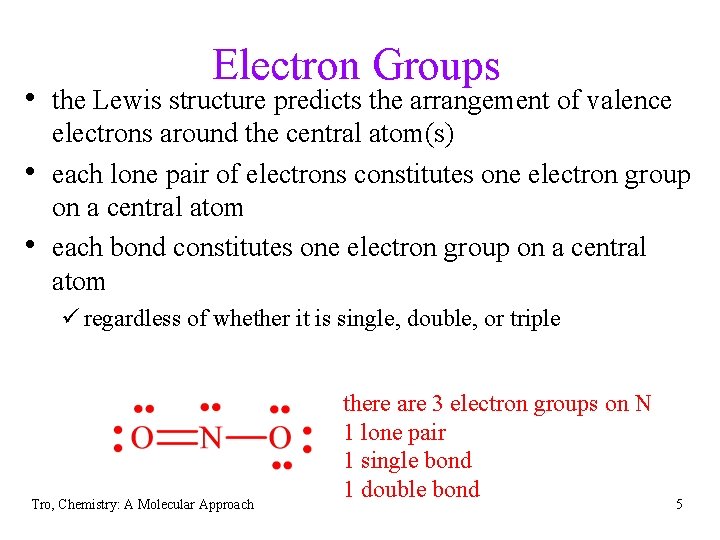
Electron Groups • the Lewis structure predicts the arrangement of valence • • electrons around the central atom(s) each lone pair of electrons constitutes one electron group on a central atom each bond constitutes one electron group on a central atom ü regardless of whether it is single, double, or triple Tro, Chemistry: A Molecular Approach there are 3 electron groups on N 1 lone pair 1 single bond 1 double bond 5
Molecular Geometries • there are 5 basic arrangements of electron groups around a central atom ü based on a maximum of 6 bonding electron groups Ø though there may be more than 6 on very large atoms, it is very rare • each of these 5 basic arrangements results in 5 different basic molecular shapes ü in order for the molecular shape and bond angles to be a “perfect” geometric figure, all the electron groups must be bonds and all the bonds must be equivalent • for molecules that exhibit resonance, it doesn’t matter which resonance form you use – the molecular geometry will be the same Tro, Chemistry: A Molecular Approach 6
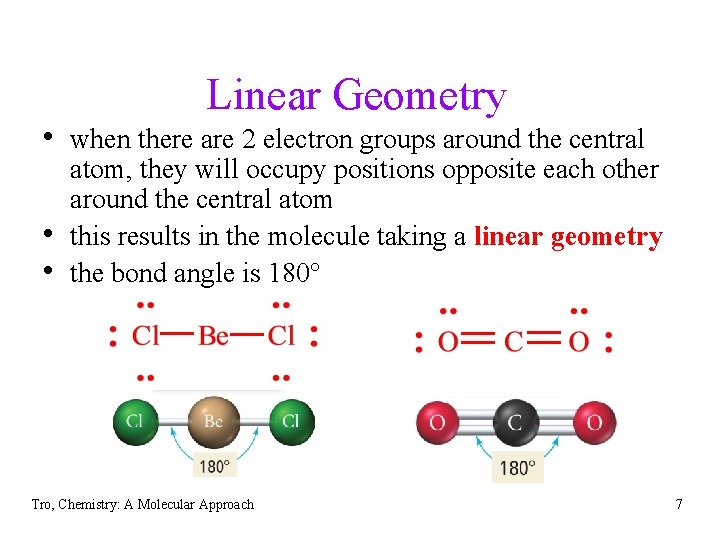
Linear Geometry • when there are 2 electron groups around the central • • atom, they will occupy positions opposite each other around the central atom this results in the molecule taking a linear geometry the bond angle is 180° Tro, Chemistry: A Molecular Approach 7
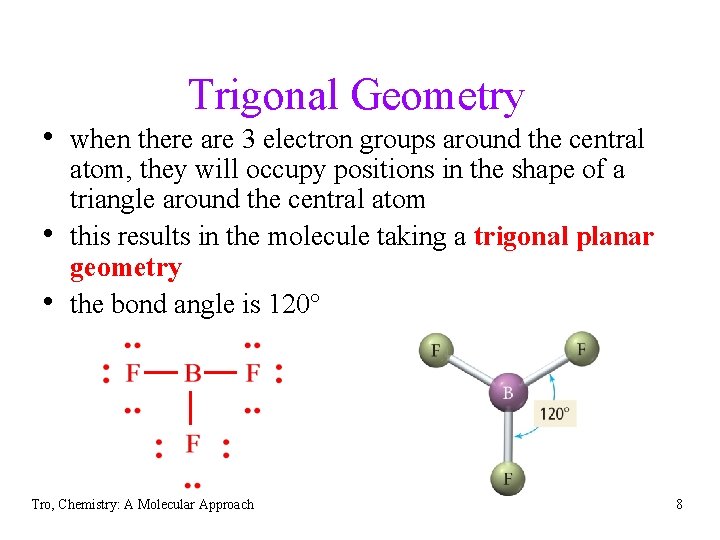
Trigonal Geometry • when there are 3 electron groups around the central • • atom, they will occupy positions in the shape of a triangle around the central atom this results in the molecule taking a trigonal planar geometry the bond angle is 120° Tro, Chemistry: A Molecular Approach 8
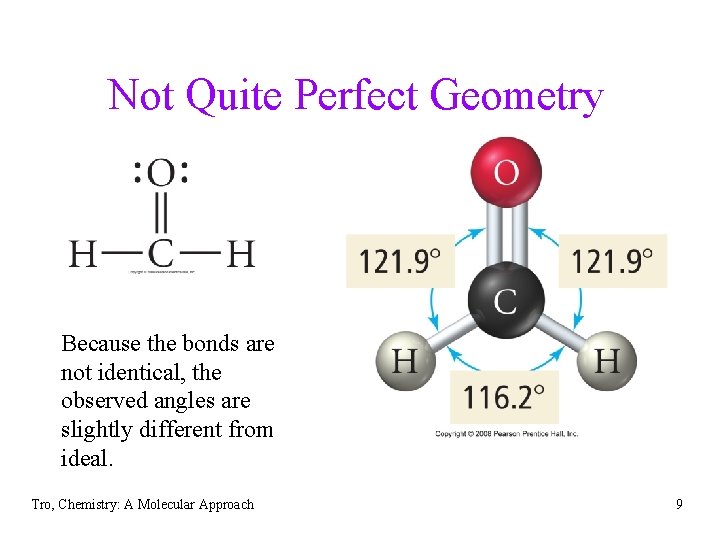
Not Quite Perfect Geometry Because the bonds are not identical, the observed angles are slightly different from ideal. Tro, Chemistry: A Molecular Approach 9
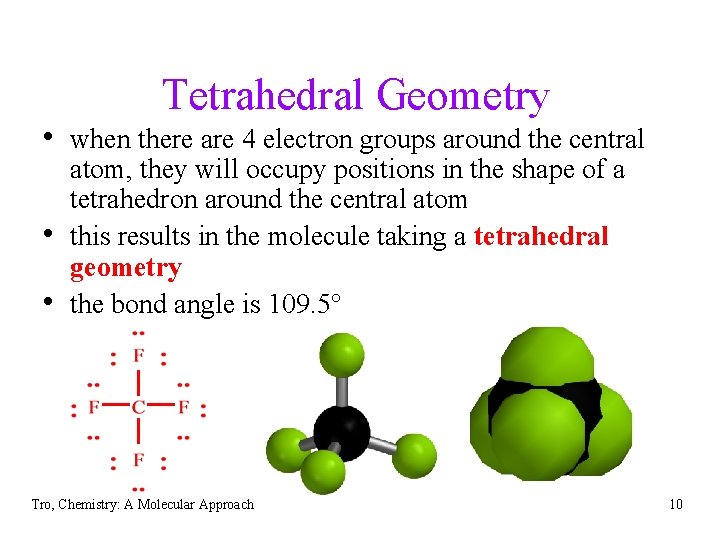
Tetrahedral Geometry • when there are 4 electron groups around the central • • atom, they will occupy positions in the shape of a tetrahedron around the central atom this results in the molecule taking a tetrahedral geometry the bond angle is 109. 5° Tro, Chemistry: A Molecular Approach 10
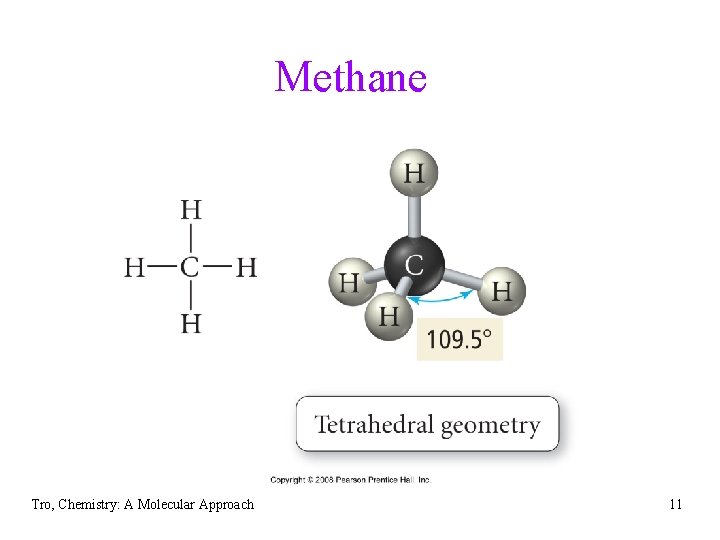
Methane Tro, Chemistry: A Molecular Approach 11
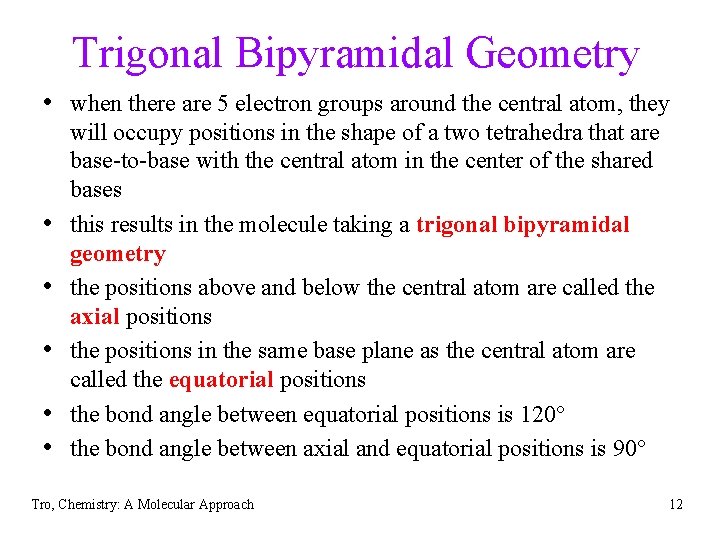
Trigonal Bipyramidal Geometry • when there are 5 electron groups around the central atom, they • • • will occupy positions in the shape of a two tetrahedra that are base-to-base with the central atom in the center of the shared bases this results in the molecule taking a trigonal bipyramidal geometry the positions above and below the central atom are called the axial positions the positions in the same base plane as the central atom are called the equatorial positions the bond angle between equatorial positions is 120° the bond angle between axial and equatorial positions is 90° Tro, Chemistry: A Molecular Approach 12
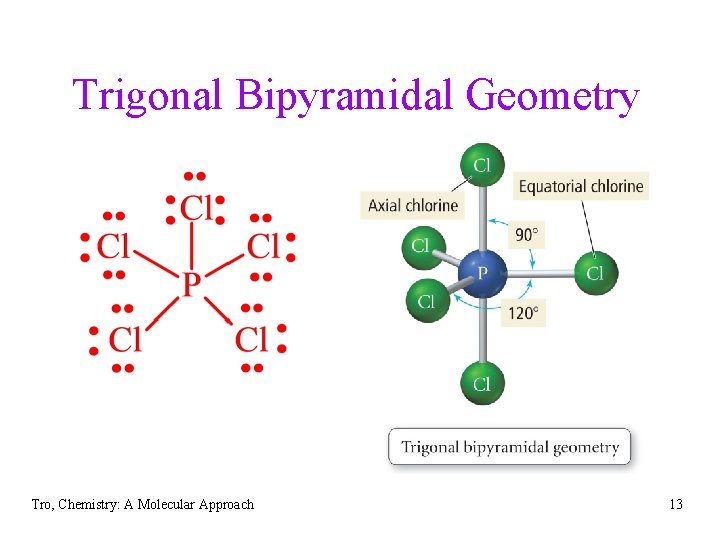
Trigonal Bipyramidal Geometry Tro, Chemistry: A Molecular Approach 13
Octahedral Geometry • when there are 6 electron groups around the central • atom, they will occupy positions in the shape of two square-base pyramids that are base-to-base with the central atom in the center of the shared bases this results in the molecule taking an octahedral geometry ü it is called octahedral because the geometric figure has 8 sides • all positions are equivalent • the bond angle is 90° Tro, Chemistry: A Molecular Approach 14
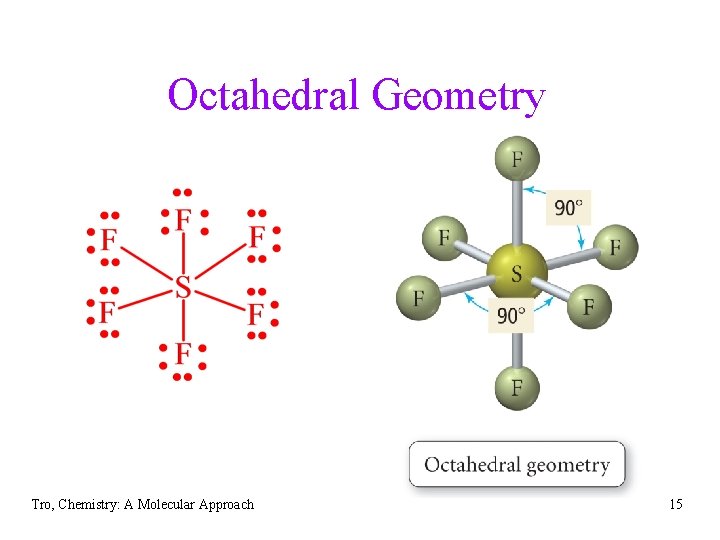
Octahedral Geometry Tro, Chemistry: A Molecular Approach 15
The Effect of Lone Pairs • lone pair groups “occupy more space” on the central atom übecause their electron density is exclusively on the central atom rather than shared like bonding electron groups • relative sizes of repulsive force interactions is: Lone Pair – Lone Pair > Lone Pair – Bonding Pair > Bonding Pair – Bonding Pair • this effects the bond angles, making them smaller than expected Tro, Chemistry: A Molecular Approach 16
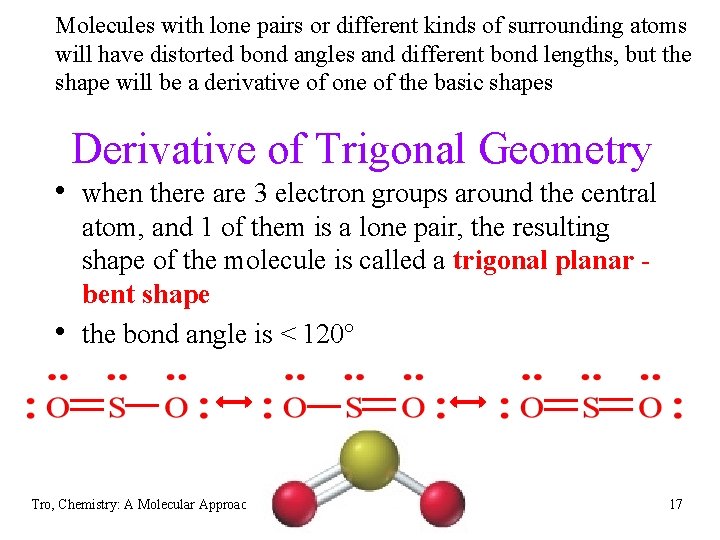
Molecules with lone pairs or different kinds of surrounding atoms will have distorted bond angles and different bond lengths, but the shape will be a derivative of one of the basic shapes Derivative of Trigonal Geometry • when there are 3 electron groups around the central • atom, and 1 of them is a lone pair, the resulting shape of the molecule is called a trigonal planar bent shape the bond angle is < 120° Tro, Chemistry: A Molecular Approach 17
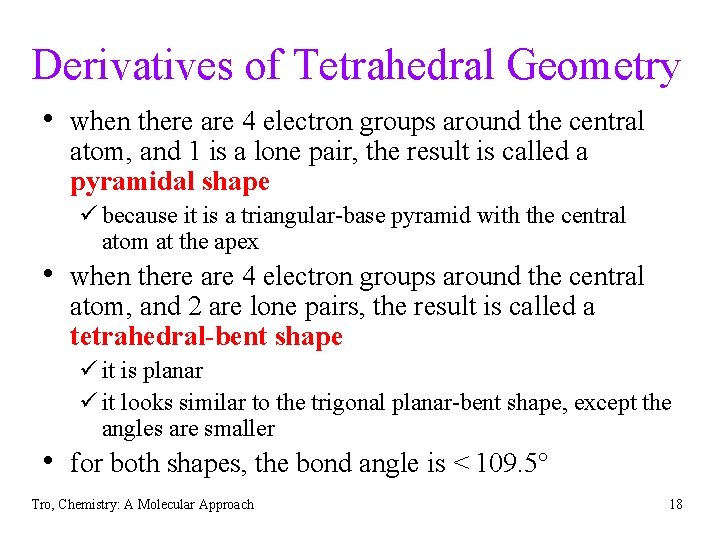
Derivatives of Tetrahedral Geometry • when there are 4 electron groups around the central atom, and 1 is a lone pair, the result is called a pyramidal shape ü because it is a triangular-base pyramid with the central atom at the apex • when there are 4 electron groups around the central atom, and 2 are lone pairs, the result is called a tetrahedral-bent shape ü it is planar ü it looks similar to the trigonal planar-bent shape, except the angles are smaller • for both shapes, the bond angle is < 109. 5° Tro, Chemistry: A Molecular Approach 18
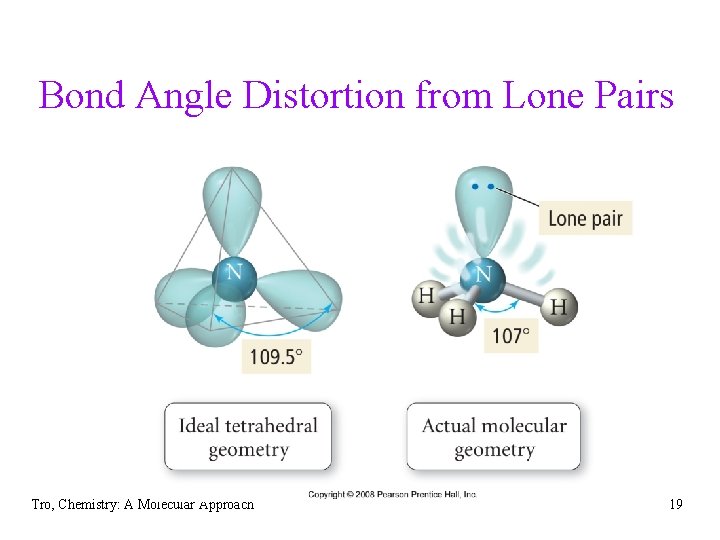
Bond Angle Distortion from Lone Pairs Tro, Chemistry: A Molecular Approach 19

Tetrahedral-Bent Shape Tro, Chemistry: A Molecular Approach 20
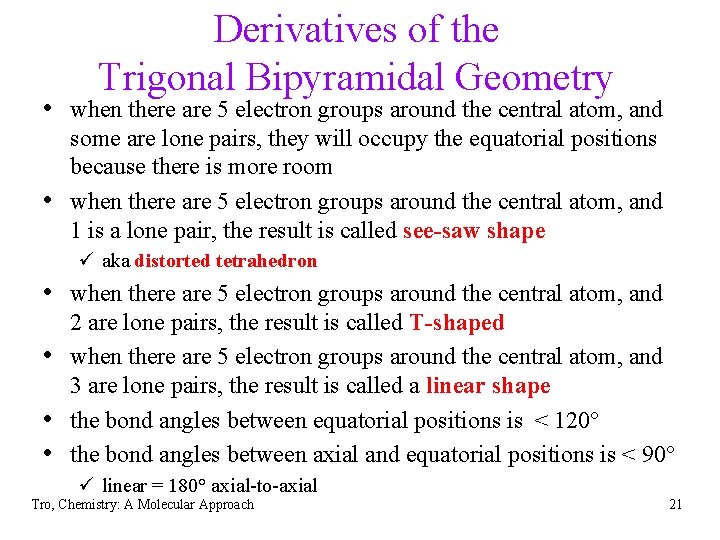
Derivatives of the Trigonal Bipyramidal Geometry • when there are 5 electron groups around the central atom, and • some are lone pairs, they will occupy the equatorial positions because there is more room when there are 5 electron groups around the central atom, and 1 is a lone pair, the result is called see-saw shape ü aka distorted tetrahedron • when there are 5 electron groups around the central atom, and • • • 2 are lone pairs, the result is called T-shaped when there are 5 electron groups around the central atom, and 3 are lone pairs, the result is called a linear shape the bond angles between equatorial positions is < 120° the bond angles between axial and equatorial positions is < 90° ü linear = 180° axial-to-axial Tro, Chemistry: A Molecular Approach 21
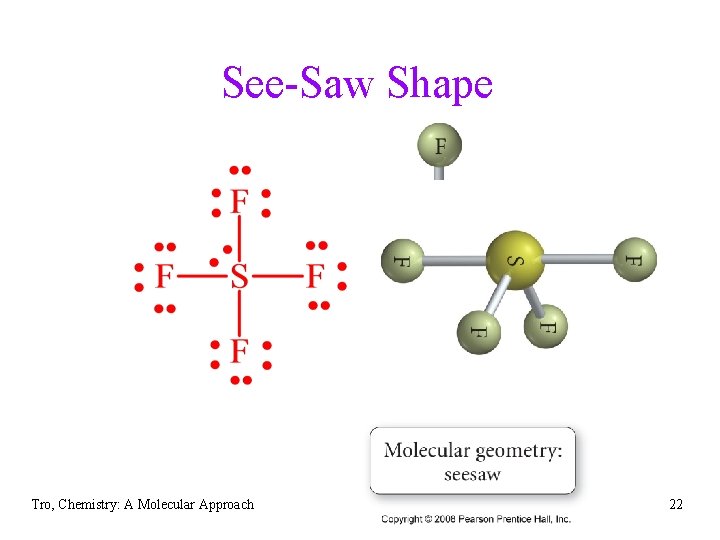
See-Saw Shape Tro, Chemistry: A Molecular Approach 22
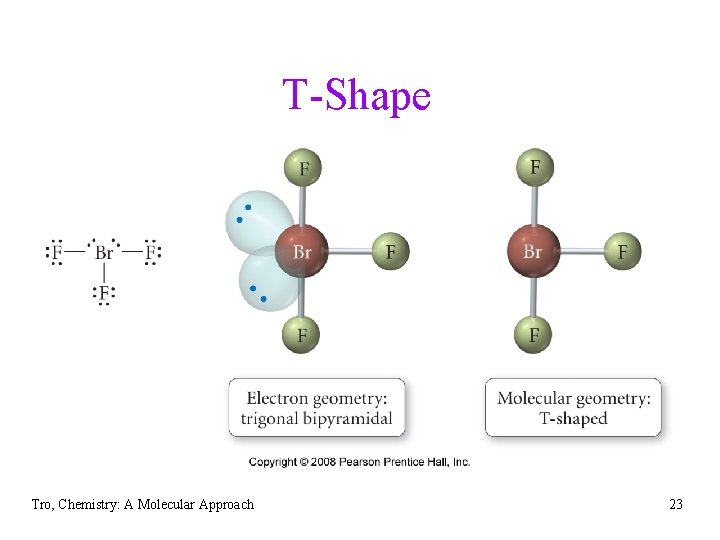
T-Shape Tro, Chemistry: A Molecular Approach 23
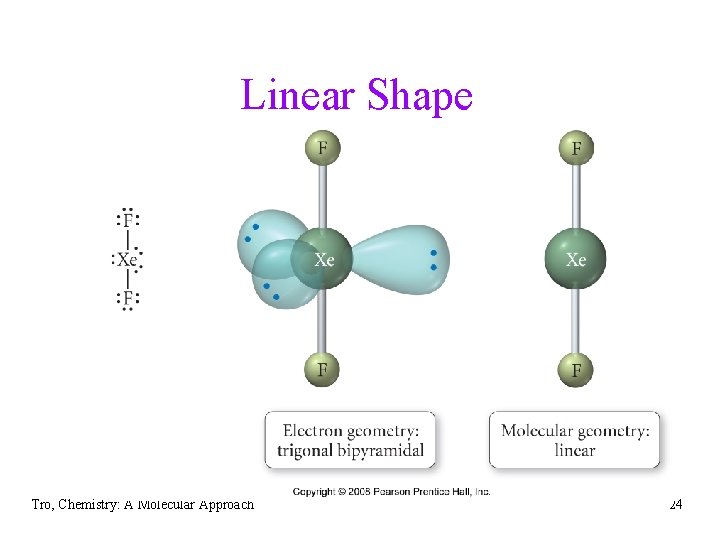
Linear Shape Tro, Chemistry: A Molecular Approach 24
Derivatives of the Octahedral Geometry • when there are 6 electron groups around the central atom, • and some are lone pairs, each even number lone pair will take a position opposite the previous lone pair when there are 6 electron groups around the central atom, and 1 is a lone pair, the result is called a square pyramid shape ü the bond angles between axial and equatorial positions is < 90° • when there are 6 electron groups around the central atom, and 2 are lone pairs, the result is called a square planar shape ü the bond angles between equatorial positions is 90° Tro, Chemistry: A Molecular Approach 25

Square Pyramidal Shape Tro, Chemistry: A Molecular Approach 26
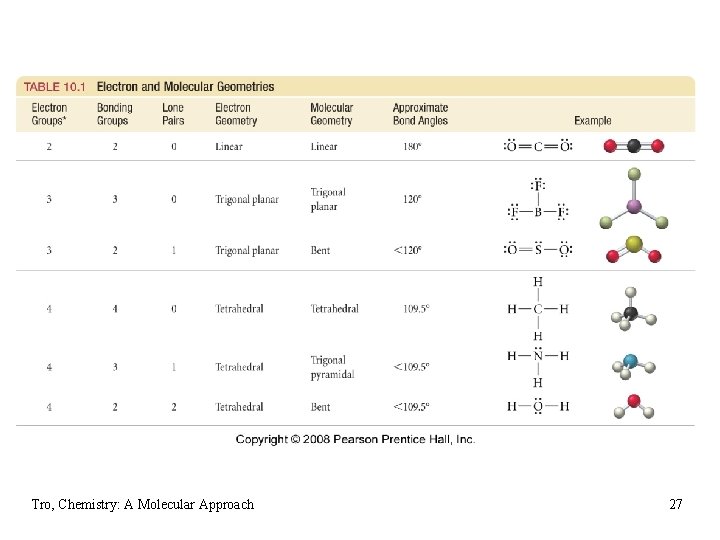
Tro, Chemistry: A Molecular Approach 27
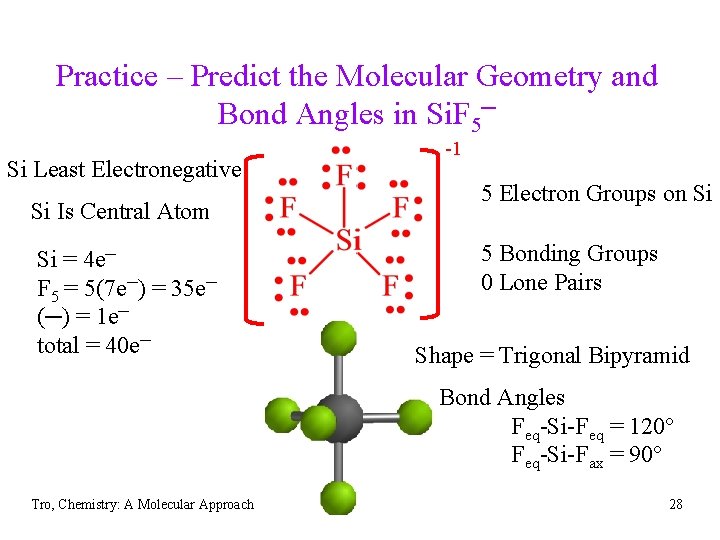
Practice – Predict the Molecular Geometry and Bond Angles in Si. F 5─ Si Least Electronegative Si Is Central Atom Si = 4 e─ F 5 = 5(7 e─) = 35 e─ (─) = 1 e─ total = 40 e─ -1 5 Electron Groups on Si 5 Bonding Groups 0 Lone Pairs Shape = Trigonal Bipyramid Bond Angles Feq-Si-Feq = 120° Feq-Si-Fax = 90° Tro, Chemistry: A Molecular Approach 28
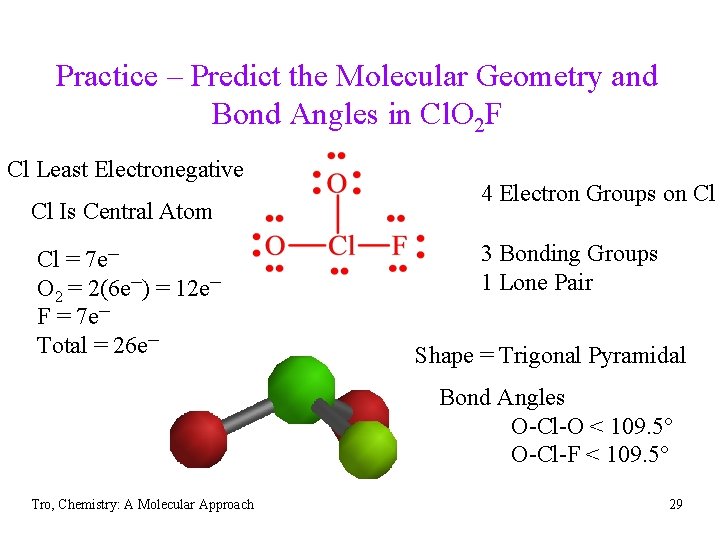
Practice – Predict the Molecular Geometry and Bond Angles in Cl. O 2 F Cl Least Electronegative Cl Is Central Atom Cl = 7 e─ O 2 = 2(6 e─) = 12 e─ F = 7 e─ Total = 26 e─ 4 Electron Groups on Cl 3 Bonding Groups 1 Lone Pair Shape = Trigonal Pyramidal Bond Angles O-Cl-O < 109. 5° O-Cl-F < 109. 5° Tro, Chemistry: A Molecular Approach 29
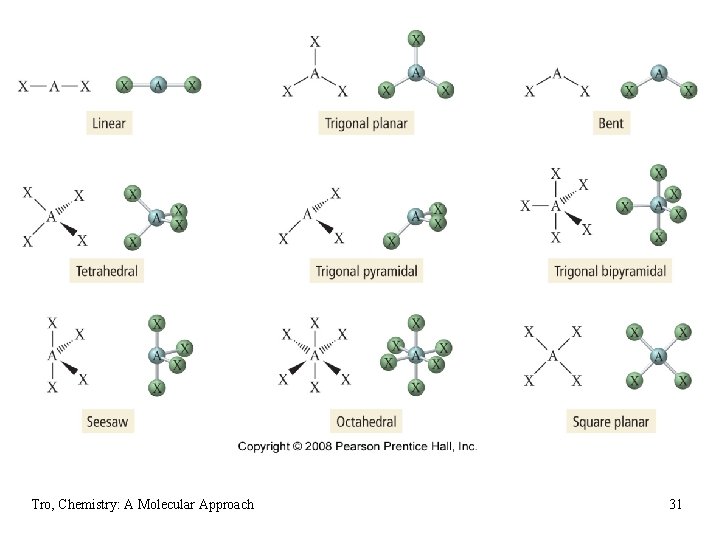
Representing 3 -Dimensional Shapes on a 2 -Dimensional Surface • one of the problems with drawing molecules is trying • • to show their dimensionality by convention, the central atom is put in the plane of the paper put as many other atoms as possible in the same plane and indicate with a straight line for atoms in front of the plane, use a solid wedge for atoms behind the plane, use a hashed wedge Tro, Chemistry: A Molecular Approach 30
Tro, Chemistry: A Molecular Approach 31
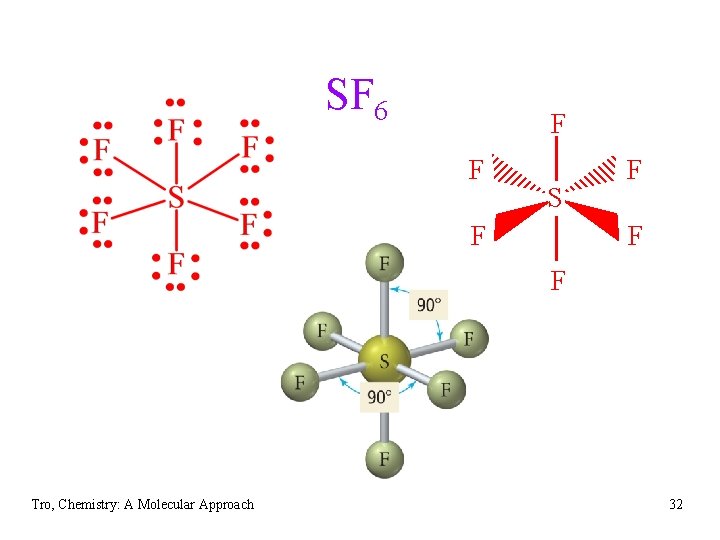
SF 6 F F S F F Tro, Chemistry: A Molecular Approach 32

Multiple Central Atoms • many molecules have larger structures with many • • interior atoms we can think of them as having multiple central atoms when this occurs, we describe the shape around each central atom in sequence shape around left C is tetrahedral shape around center C is trigonal planar shape around right O is tetrahedral-bent Tro, Chemistry: A Molecular Approach 33
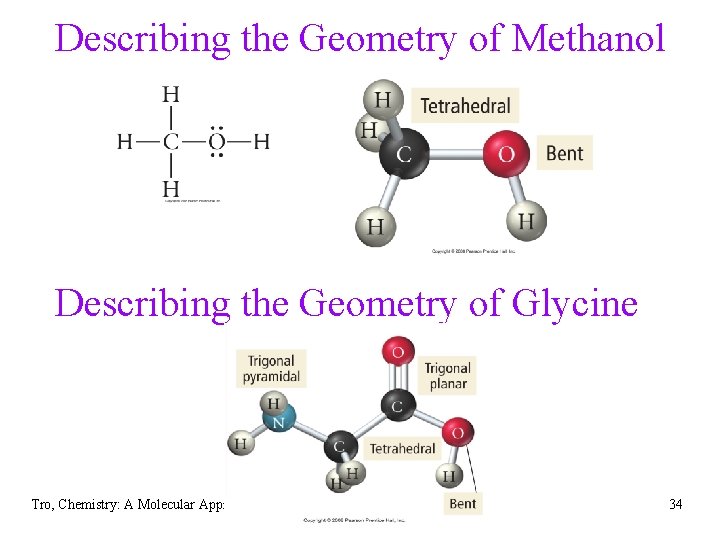
Describing the Geometry of Methanol Describing the Geometry of Glycine Tro, Chemistry: A Molecular Approach 34
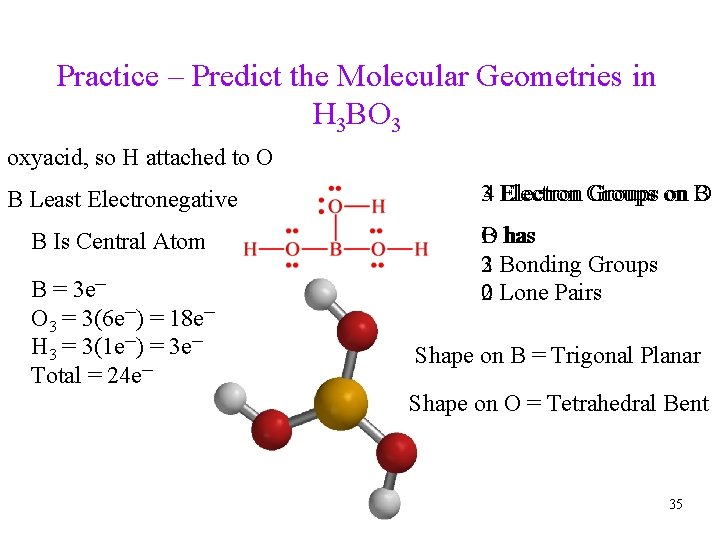
Practice – Predict the Molecular Geometries in H 3 BO 3 oxyacid, so H attached to O B Least Electronegative B Is Central Atom B = 3 e─ O 3 = 3(6 e─) = 18 e─ H 3 = 3(1 e─) = 3 e─ Total = 24 e─ 34 Electron Groups on on B O O has B 23 Bonding Groups 20 Lone Pairs Shape on B = Trigonal Planar Shape on O = Tetrahedral Bent 35
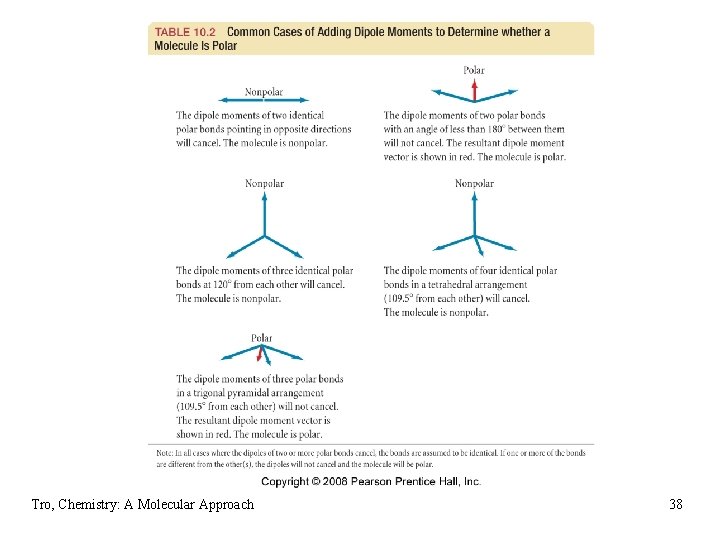
Polarity of Molecules • in order for a molecule to be polar it must 1) have polar bonds Ø electronegativity difference - theory Ø bond dipole moments - measured 2) have an unsymmetrical shape Ø vector addition • polarity affects the intermolecular forces of attraction ü therefore boiling points and solubilities Ø like dissolves like • nonbonding pairs affect molecular polarity, strong pull in its direction Tro, Chemistry: A Molecular Approach 36
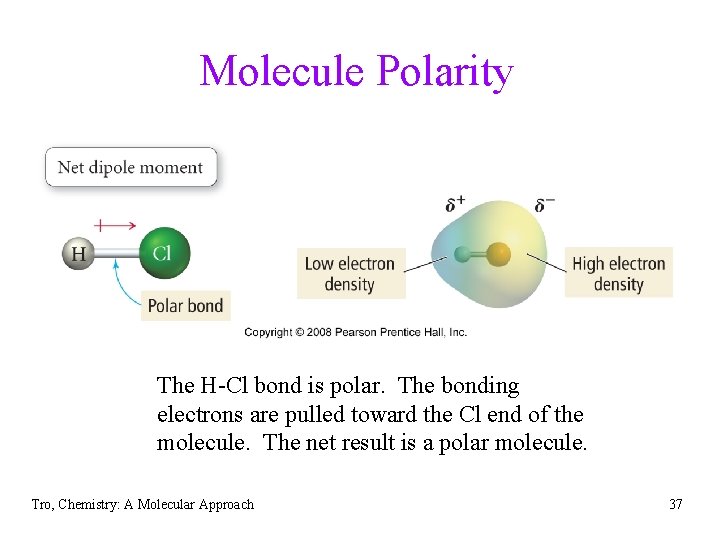
Molecule Polarity The H-Cl bond is polar. The bonding electrons are pulled toward the Cl end of the molecule. The net result is a polar molecule. Tro, Chemistry: A Molecular Approach 37
Tro, Chemistry: A Molecular Approach 38
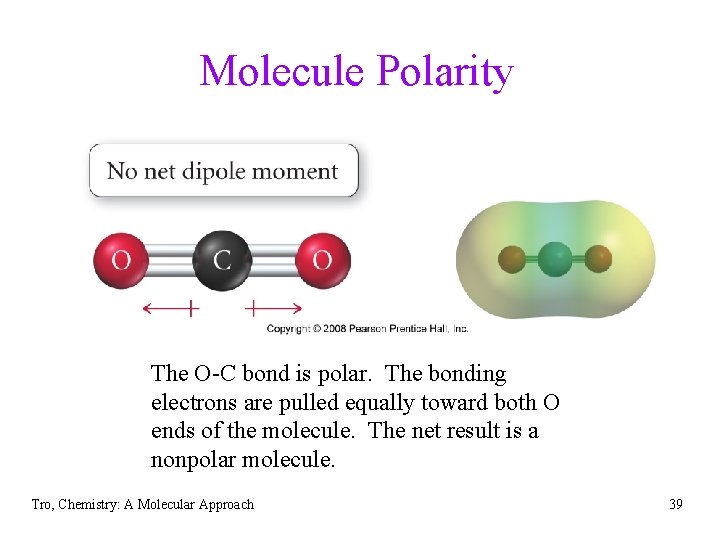
Molecule Polarity The O-C bond is polar. The bonding electrons are pulled equally toward both O ends of the molecule. The net result is a nonpolar molecule. Tro, Chemistry: A Molecular Approach 39
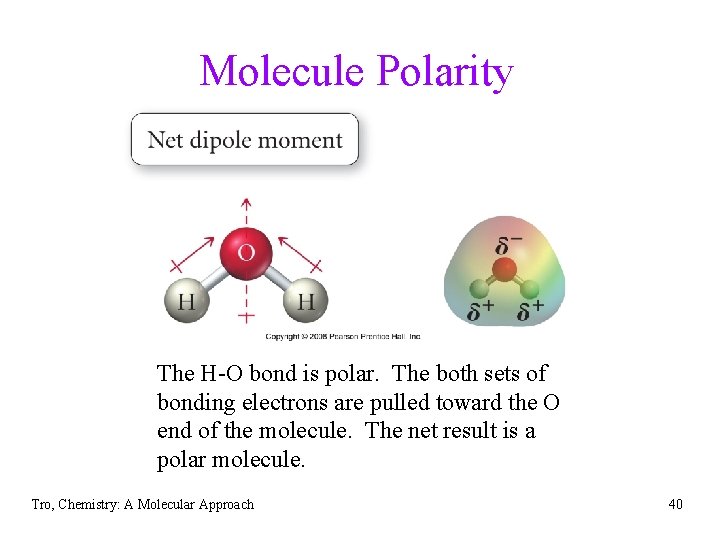
Molecule Polarity The H-O bond is polar. The both sets of bonding electrons are pulled toward the O end of the molecule. The net result is a polar molecule. Tro, Chemistry: A Molecular Approach 40
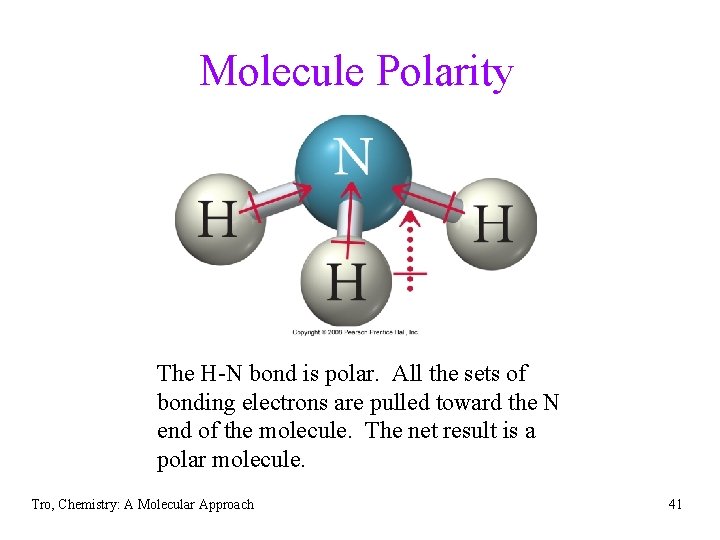
Molecule Polarity The H-N bond is polar. All the sets of bonding electrons are pulled toward the N end of the molecule. The net result is a polar molecule. Tro, Chemistry: A Molecular Approach 41
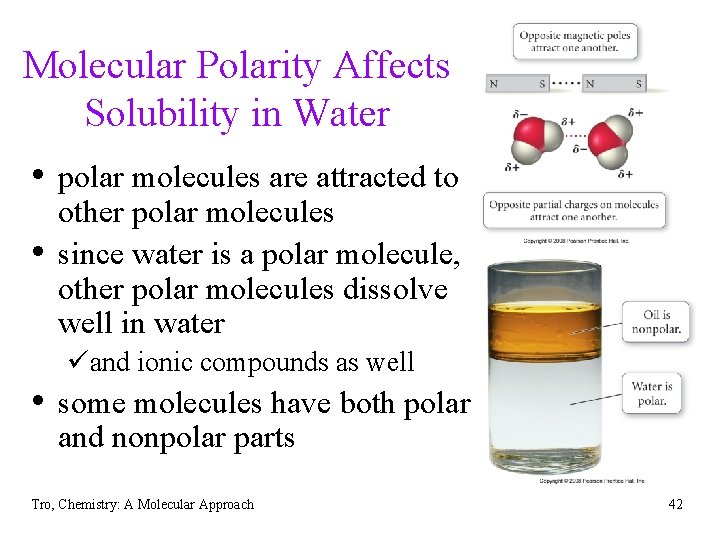
Molecular Polarity Affects Solubility in Water • polar molecules are attracted to • other polar molecules since water is a polar molecule, other polar molecules dissolve well in water üand ionic compounds as well • some molecules have both polar and nonpolar parts Tro, Chemistry: A Molecular Approach 42
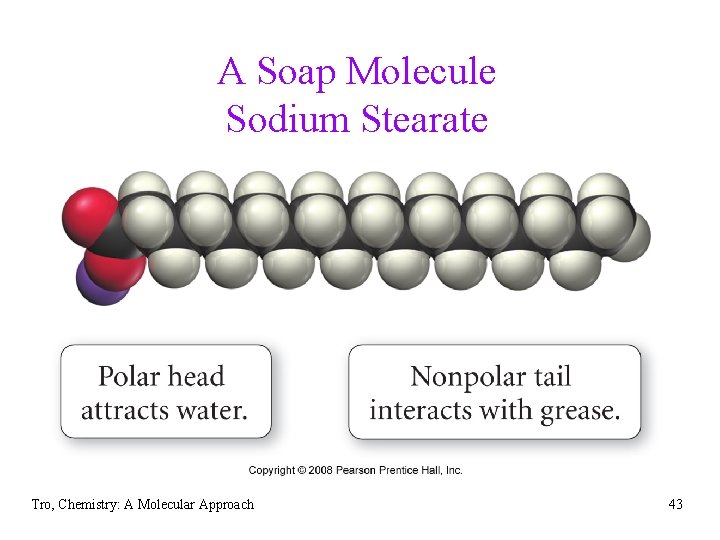
A Soap Molecule Sodium Stearate Tro, Chemistry: A Molecular Approach 43
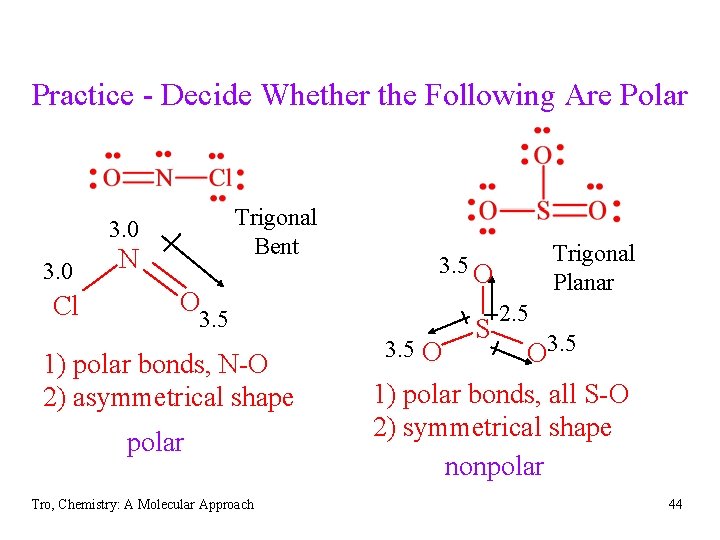
Practice - Decide Whether the Following Are Polar Trigonal Bent 3. 0 Cl N O 3. 5 1) polar bonds, N-O 2) asymmetrical shape polar Tro, Chemistry: A Molecular Approach Trigonal Planar 3. 5 O S 2. 5 O 3. 5 1) polar bonds, all S-O 2) symmetrical shape nonpolar 3. 5 O 44
Problems with Lewis Theory • Lewis theory gives good first approximations of • • the bond angles in molecules, but usually cannot be used to get the actual angle Lewis theory cannot write one correct structure for many molecules where resonance is important Lewis theory often does not predict the correct magnetic behavior of molecules üe. g. , O 2 is paramagnetic, though the Lewis structure predicts it is diamagnetic Tro, Chemistry: A Molecular Approach 45
- Slides: 45