
Chapter 10 Cell Reproduction Mitosis High School Biology
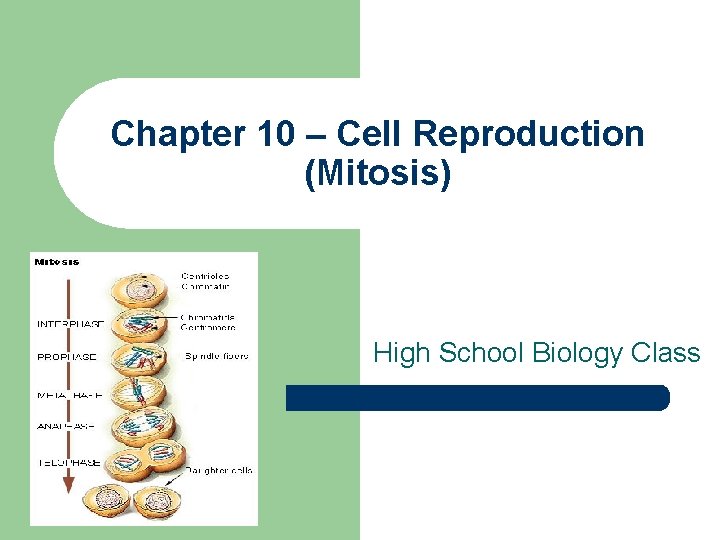
Chapter 10 – Cell Reproduction (Mitosis) High School Biology Class

Why New Cells Are Needed l When cells reproduce they make new cells that can be used for a variety of reasons: 1) Growth and Development 2) Repair and Replacement 3) Asexual Reproduction
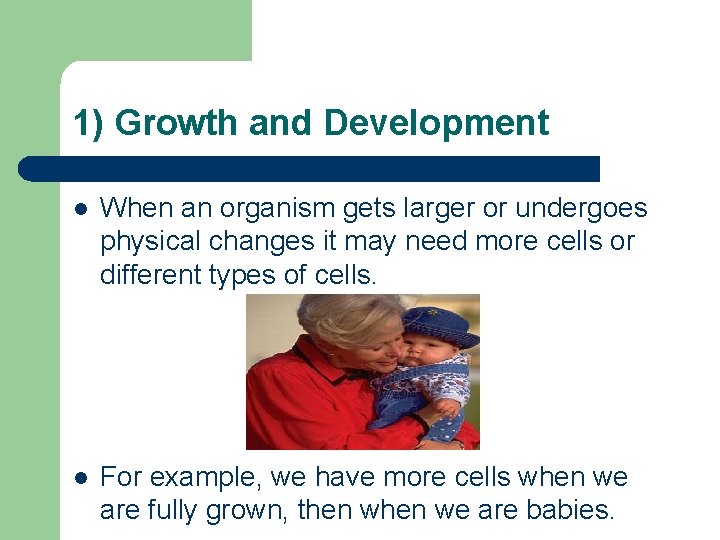
1) Growth and Development l When an organism gets larger or undergoes physical changes it may need more cells or different types of cells. l For example, we have more cells when we are fully grown, then we are babies.
2) Repair and Replacement l When an organism is hurt or injured it needs to repair and replace injured or dead cells. l For example, when you get a cut on your skin, you need to make more cells to take the place of the damaged ones.
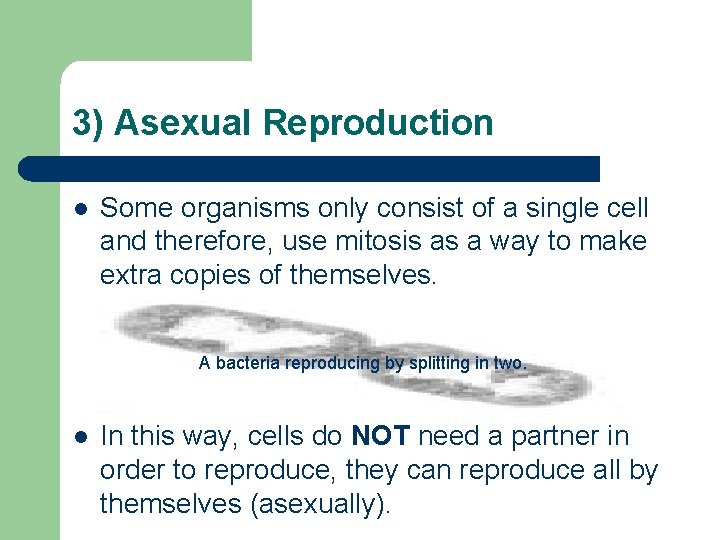
3) Asexual Reproduction l Some organisms only consist of a single cell and therefore, use mitosis as a way to make extra copies of themselves. A bacteria reproducing by splitting in two. l In this way, cells do NOT need a partner in order to reproduce, they can reproduce all by themselves (asexually).
Binary Fission l Binary fission occurs when a cell produces an identical (exact) copy of itself. l The process occurs in basically two stages: A) all the DNA in the nucleus gets copied. B) the cytoplasm divides (splits) in half.
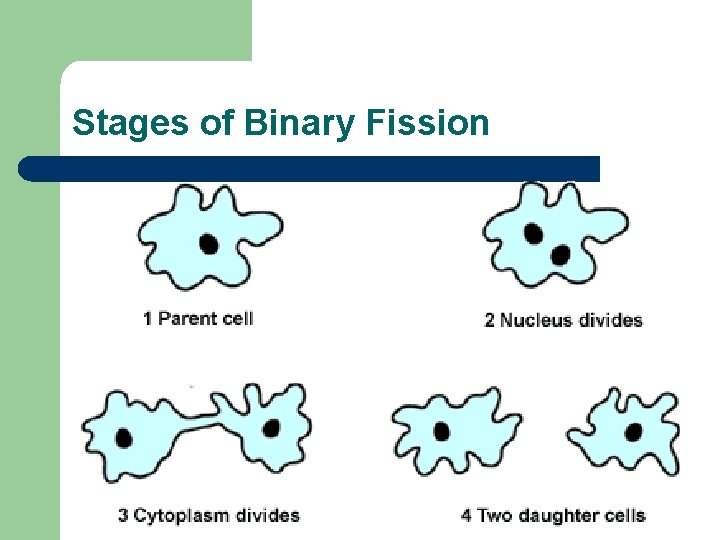
Stages of Binary Fission
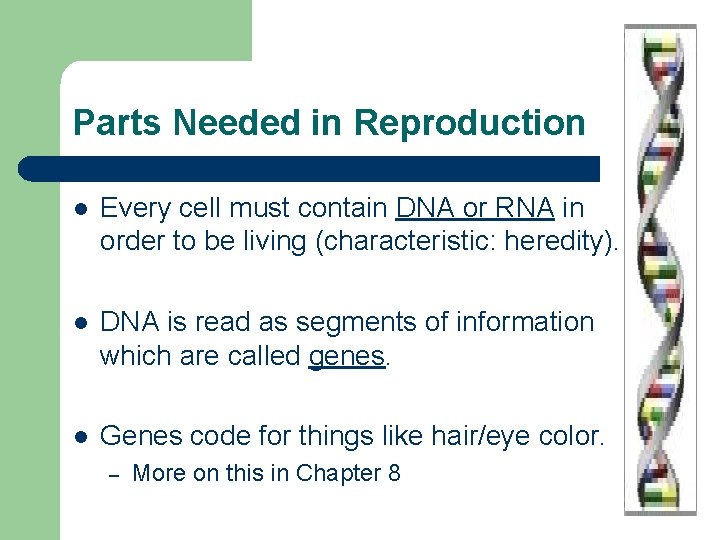
Parts Needed in Reproduction l Every cell must contain DNA or RNA in order to be living (characteristic: heredity). l DNA is read as segments of information which are called genes. l Genes code for things like hair/eye color. – More on this in Chapter 8
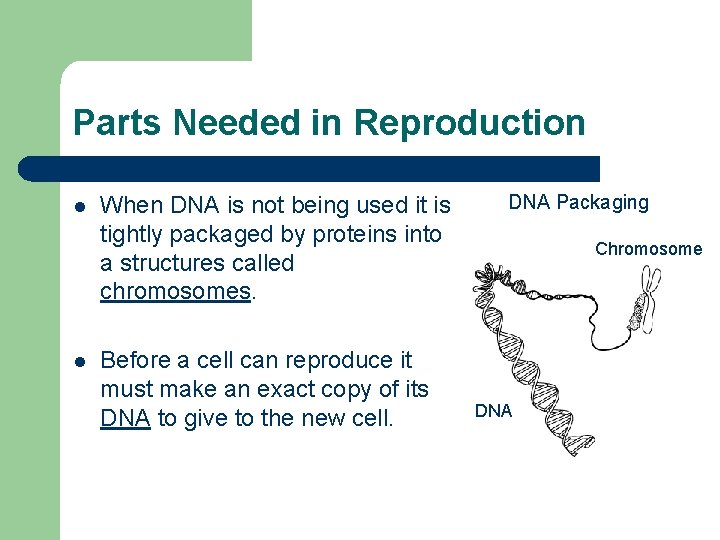
Parts Needed in Reproduction l l When DNA is not being used it is tightly packaged by proteins into a structures called chromosomes. Before a cell can reproduce it must make an exact copy of its DNA to give to the new cell. DNA Packaging Chromosome DNA
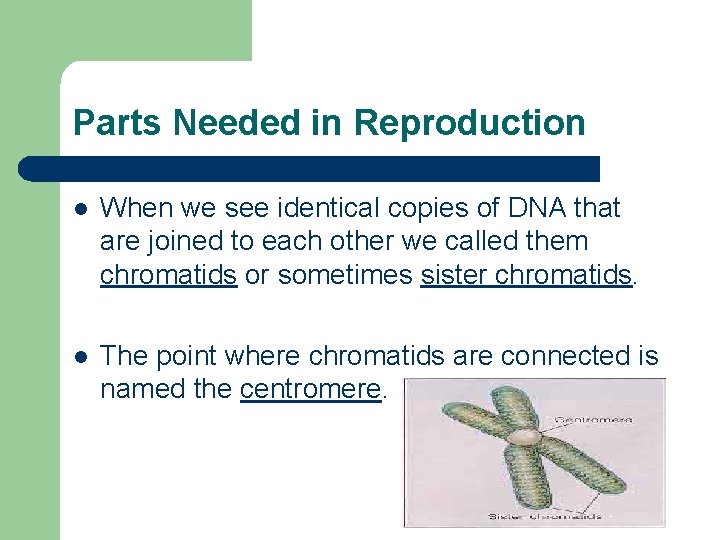
Parts Needed in Reproduction l When we see identical copies of DNA that are joined to each other we called them chromatids or sometimes sister chromatids. l The point where chromatids are connected is named the centromere.
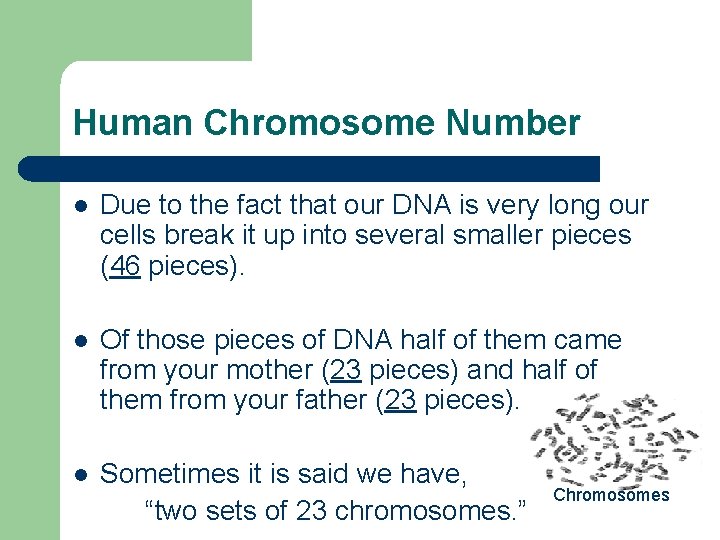
Human Chromosome Number l Due to the fact that our DNA is very long our cells break it up into several smaller pieces (46 pieces). l Of those pieces of DNA half of them came from your mother (23 pieces) and half of them from your father (23 pieces). l Sometimes it is said we have, “two sets of 23 chromosomes. ” Chromosomes
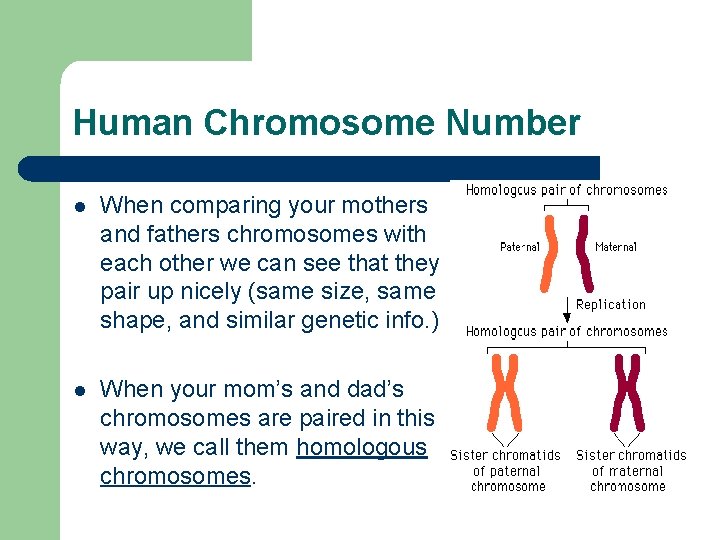
Human Chromosome Number l When comparing your mothers and fathers chromosomes with each other we can see that they pair up nicely (same size, same shape, and similar genetic info. ) l When your mom’s and dad’s chromosomes are paired in this way, we call them homologous chromosomes.
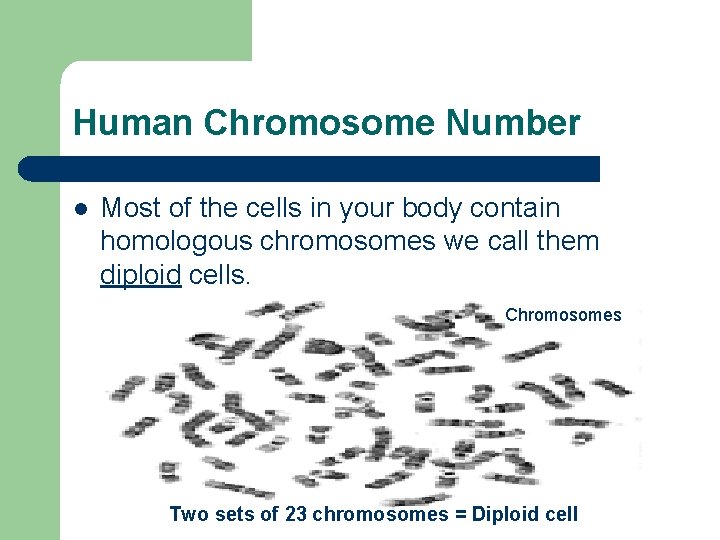
Human Chromosome Number l Most of the cells in your body contain homologous chromosomes we call them diploid cells. Chromosomes Two sets of 23 chromosomes = Diploid cell
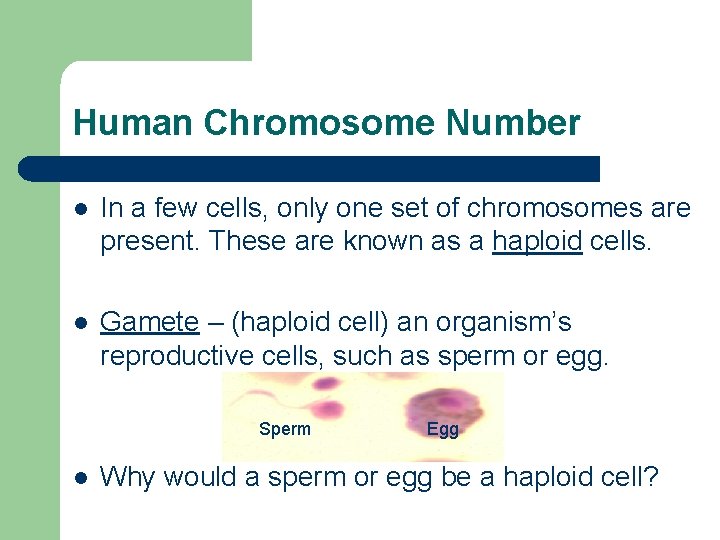
Human Chromosome Number l In a few cells, only one set of chromosomes are present. These are known as a haploid cells. l Gamete – (haploid cell) an organism’s reproductive cells, such as sperm or egg. Sperm l Egg Why would a sperm or egg be a haploid cell?
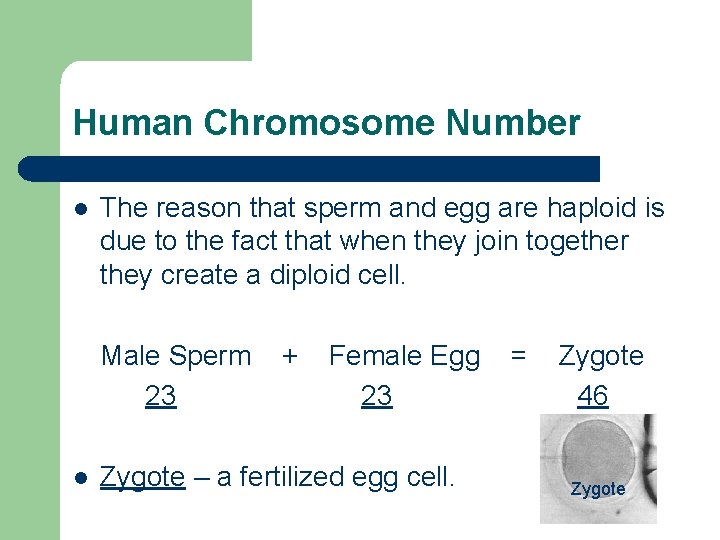
Human Chromosome Number l The reason that sperm and egg are haploid is due to the fact that when they join together they create a diploid cell. Male Sperm 23 l + Female Egg 23 Zygote – a fertilized egg cell. = Zygote 46 Zygote
Types of Human Chromosomes l There are two types of human chromosomes: 1) Sex Chromosomes – the chromosomes that determine the sex (gender) of an individual. *There is 1 pair of chromosomes involved in this. 2) Autosomes – chromosomes that are not directly involved in determining the sex of an individual. *The other 22 pairs of chromosomes are this type.
Sex Chromosomes l How is sex (gender) determined in humans? – Females have 23 pairs of chromosomes, but their sex chromosomes are the same “X” and “X”. – Males also have 23 pairs of chromosomes, but their sex chromosomes are different “X” and “Y”.
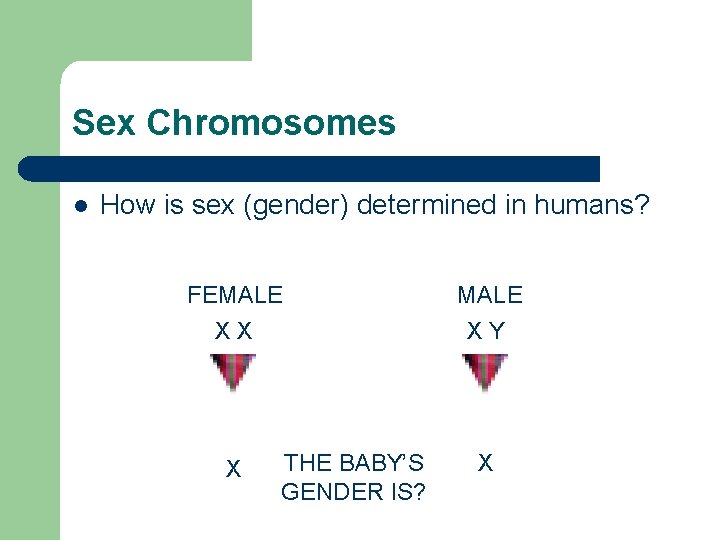
Sex Chromosomes l How is sex (gender) determined in humans? FEMALE XX X THE BABY’S GENDER IS? MALE XY X
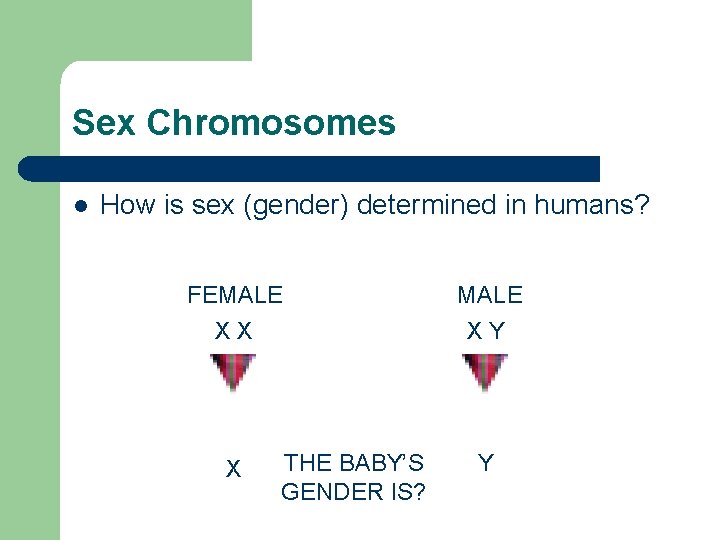
Sex Chromosomes l How is sex (gender) determined in humans? FEMALE XX X THE BABY’S GENDER IS? MALE XY Y
Sex Chromosomes l Who is ultimately responsible for determining the sex of a baby? Male or Female? Why? l How does knowing this help explain why the probability of being born a male or female is always 50: 50 in humans?
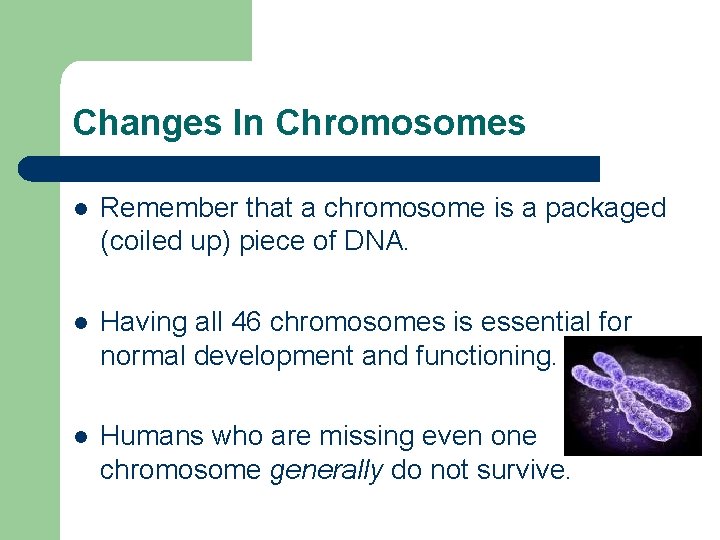
Changes In Chromosomes l Remember that a chromosome is a packaged (coiled up) piece of DNA. l Having all 46 chromosomes is essential for normal development and functioning. l Humans who are missing even one chromosome generally do not survive.
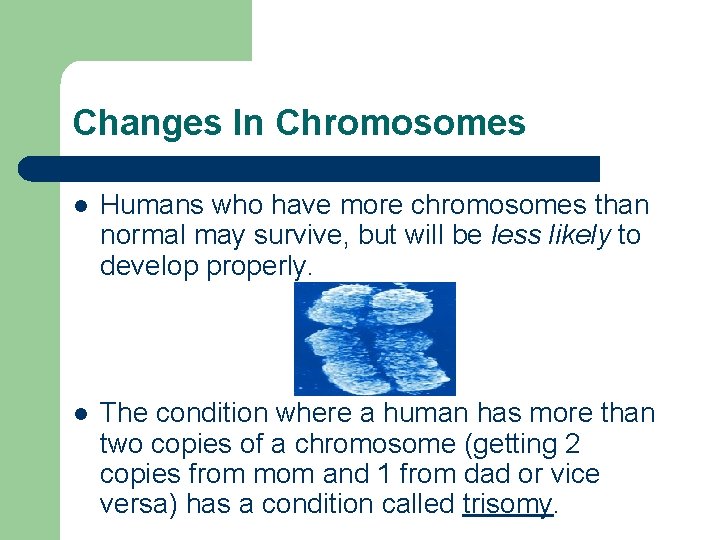
Changes In Chromosomes l Humans who have more chromosomes than normal may survive, but will be less likely to develop properly. l The condition where a human has more than two copies of a chromosome (getting 2 copies from mom and 1 from dad or vice versa) has a condition called trisomy.
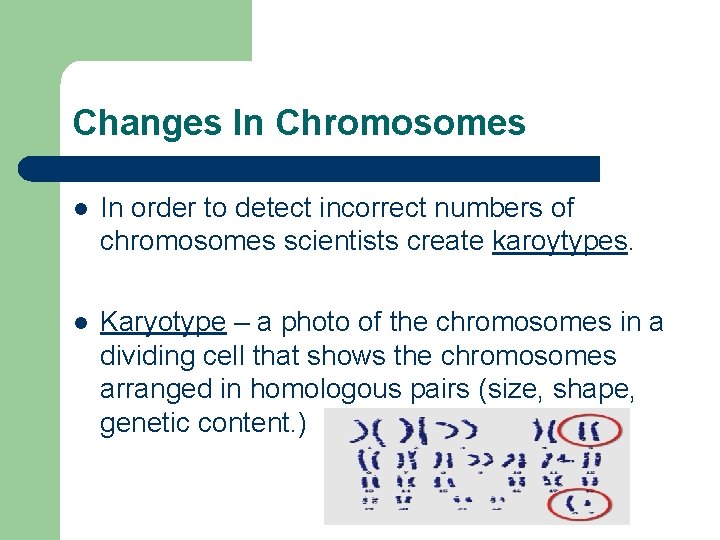
Changes In Chromosomes l In order to detect incorrect numbers of chromosomes scientists create karoytypes. l Karyotype – a photo of the chromosomes in a dividing cell that shows the chromosomes arranged in homologous pairs (size, shape, genetic content. )
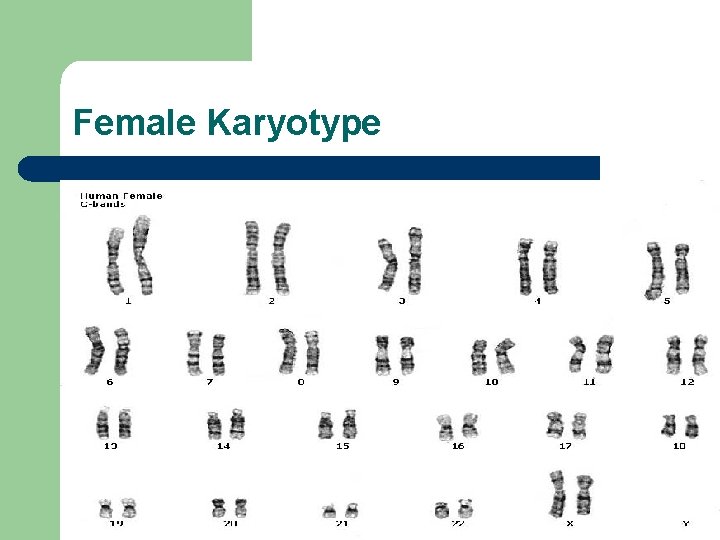
Female Karyotype
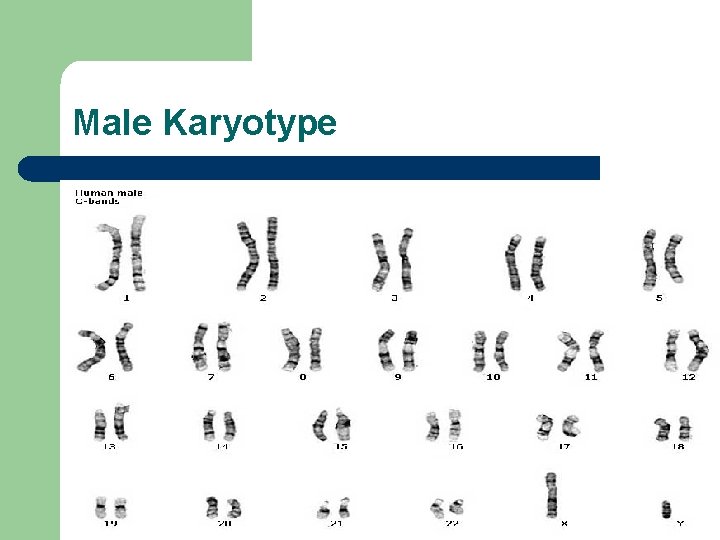
Male Karyotype
Chromosome Abnormalities A) Down Syndrome (trisomy 21) – an individual has an extra copy of chromosome 21. Characteristics: l l l Short Stature Round Face Upper Eyelids cover inner corners of the eyes Mental Retardation 1 in every 800 births
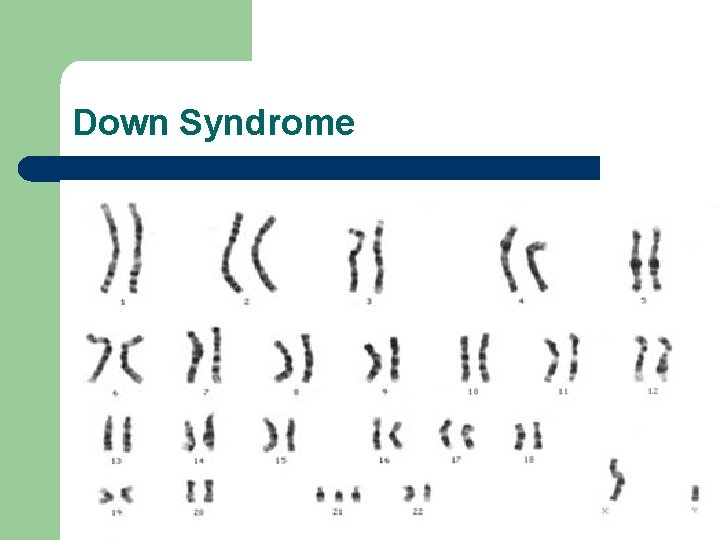
Down Syndrome
Chromosome Abnormalities B) Klinefelter Syndrome (trisomy 23) – a male has an extra copy of the “X” sex chromosome. – Characteristics: l l l Tall Stature Usually unable to have kids Upper Eyelids cover inner corners of the eyes Normal Intelligence 1 in every 600 males
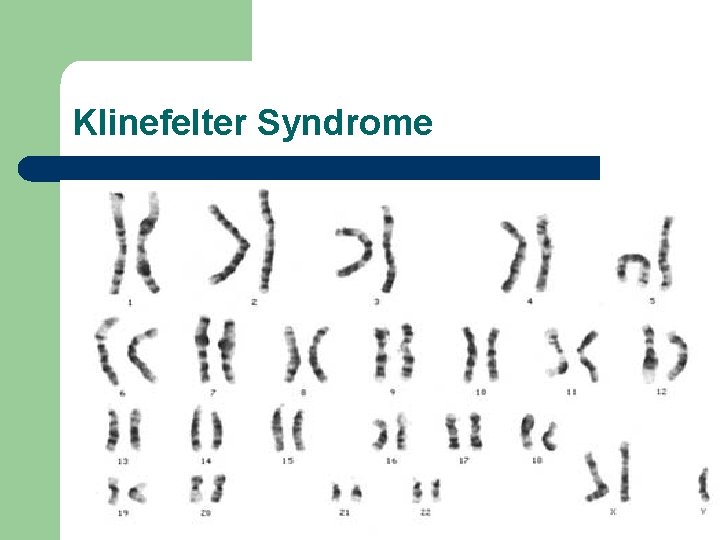
Klinefelter Syndrome
Chromosome Abnormalities C) Turner Syndrome (single 23) – a female has only one “ X” sex chromosome instead of two. – Characteristics: l l l Short Stature Usually unable to have kids Produce lower amounts of testosterone Normal Intelligence 1 in every 2500 females
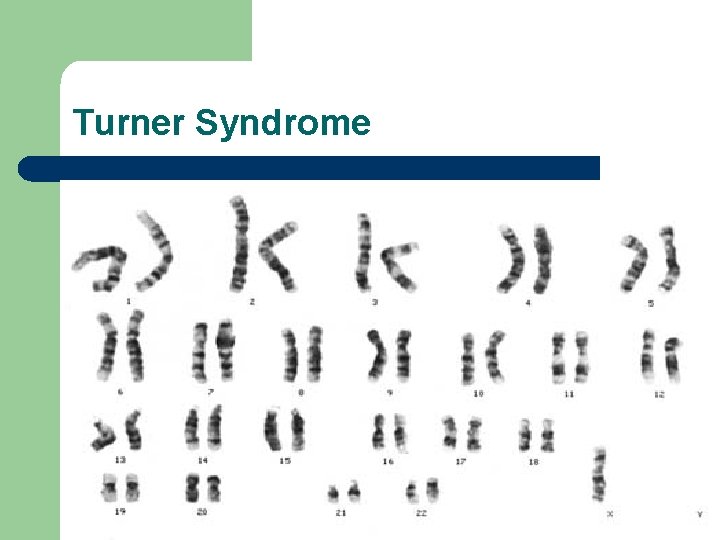
Turner Syndrome
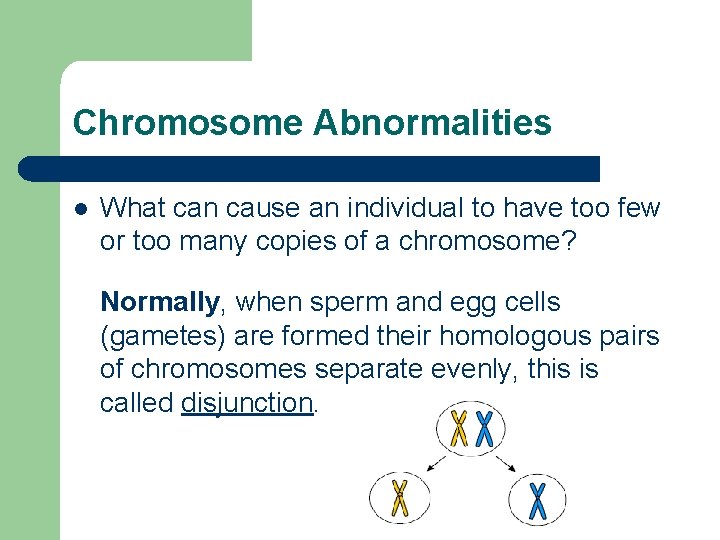
Chromosome Abnormalities l What can cause an individual to have too few or too many copies of a chromosome? Normally, when sperm and egg cells (gametes) are formed their homologous pairs of chromosomes separate evenly, this is called disjunction.
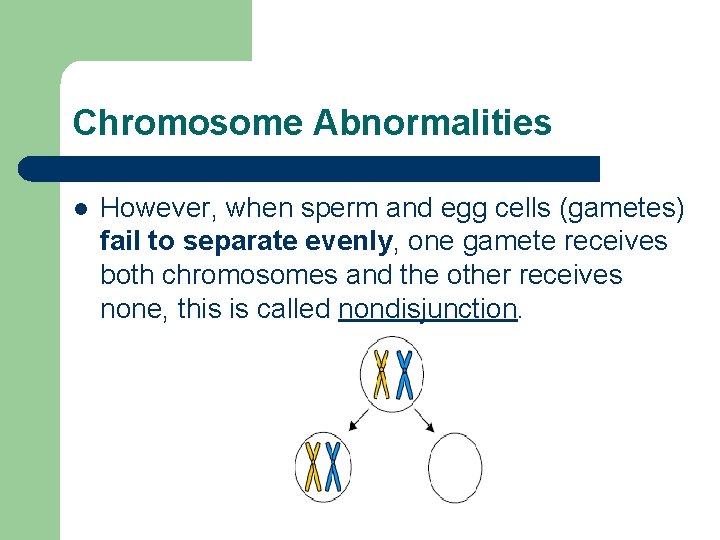
Chromosome Abnormalities l However, when sperm and egg cells (gametes) fail to separate evenly, one gamete receives both chromosomes and the other receives none, this is called nondisjunction.
Chromosome Abnormalities l Sometimes the chromosomes themselves are not formed correctly and this is due to mutations such as: 1) Deletion – a piece of chromosome breaks off completely after mitosis and thus the new cell will lack a certain set of genes.
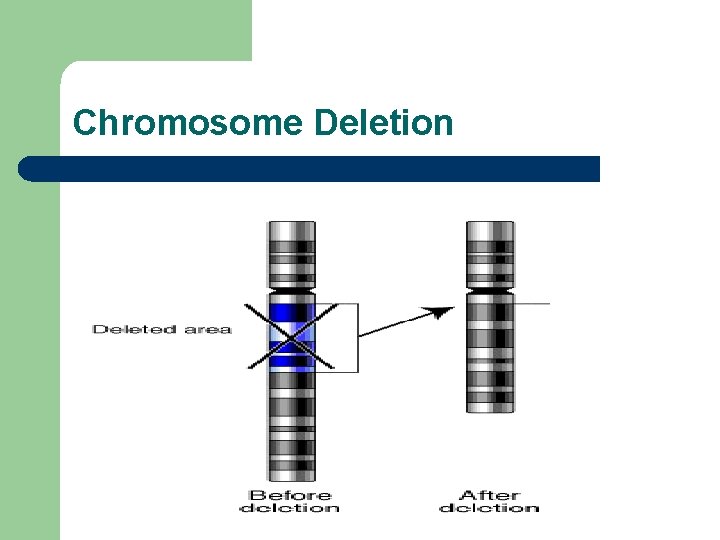
Chromosome Deletion
Chromosome Abnormalities l Sometimes the chromosomes themselves are not formed correctly and this is due to mutations such as: 2) Duplication – a chromosome fragment attaches to its homologous chromosome, which will then carry two copies of a certain set of genes.
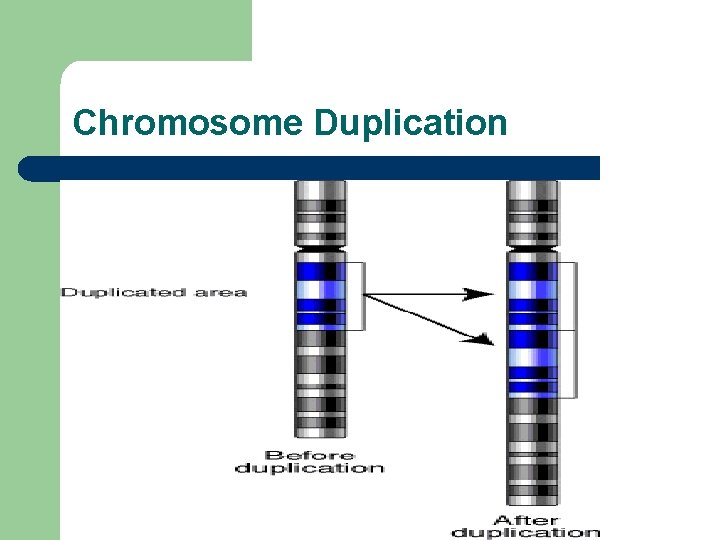
Chromosome Duplication
Chromosome Abnormalities l Sometimes the chromosomes themselves are not formed correctly and this is due to mutations such as: 3) Inversion – a chromosome piece breaks off and then reattaches to the original, but in reverse orientation (order).
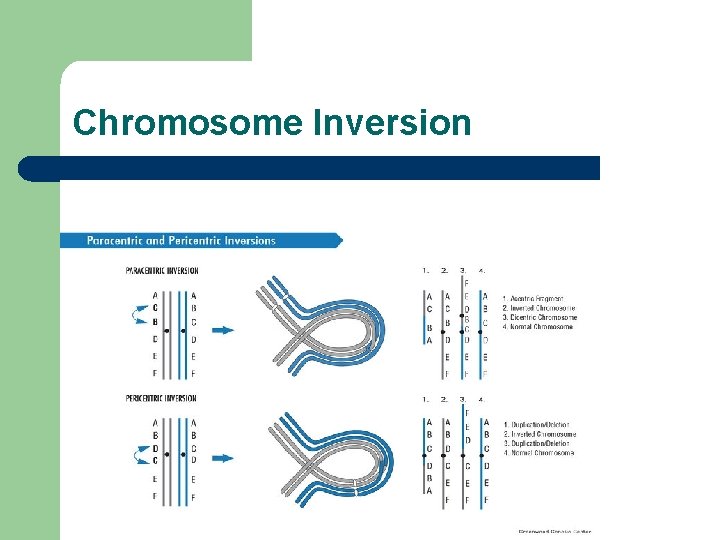
Chromosome Inversion
Chromosome Abnormalities l Sometimes the chromosomes themselves are not formed correctly and this is due to mutations such as: 4) Translocation – a chromosome piece breaks off and then reattaches to a nonhomologous chromosome.
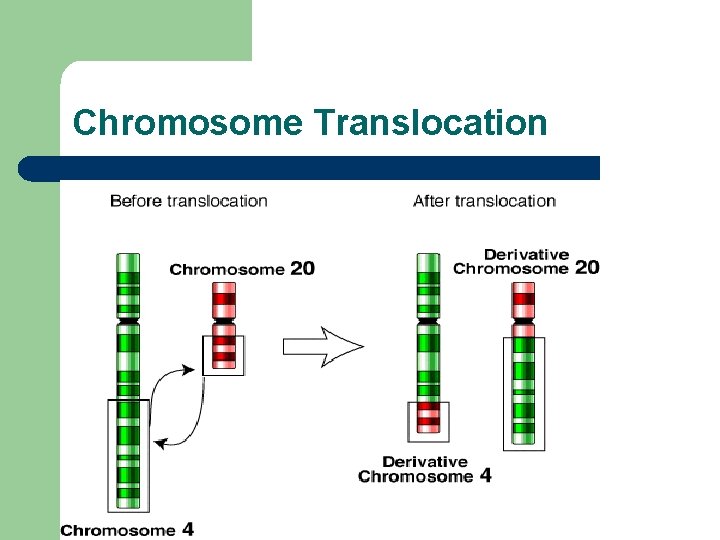
Chromosome Translocation
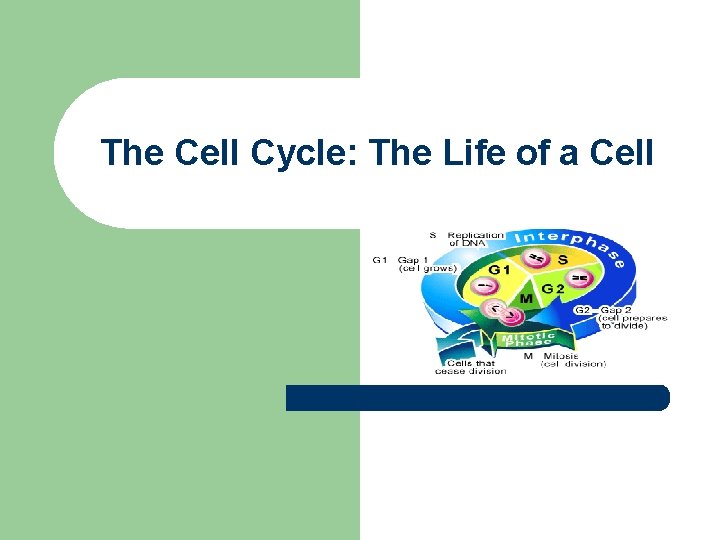
The Cell Cycle: The Life of a Cell
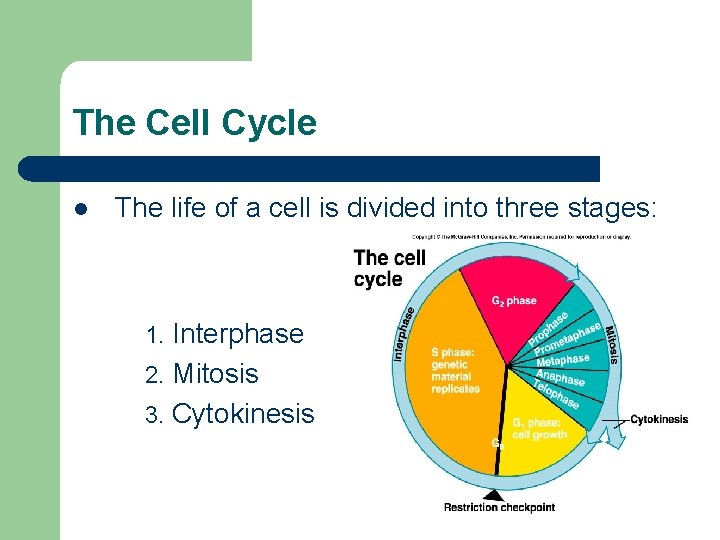
The Cell Cycle l The life of a cell is divided into three stages: Interphase 2. Mitosis 3. Cytokinesis 1.
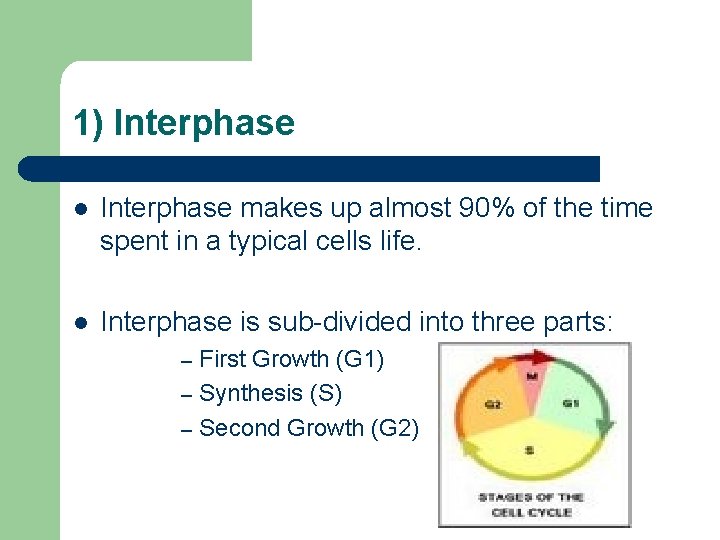
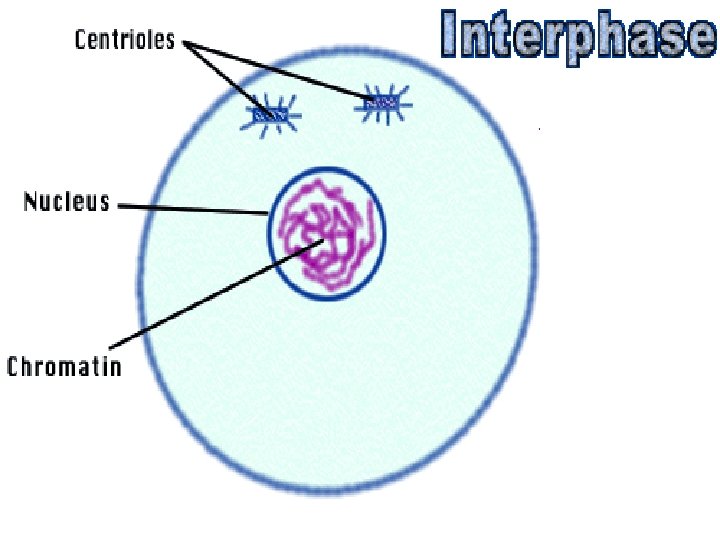
1) Interphase l Interphase makes up almost 90% of the time spent in a typical cells life. l Interphase is sub-divided into three parts: First Growth (G 1) – Synthesis (S) – Second Growth (G 2) –
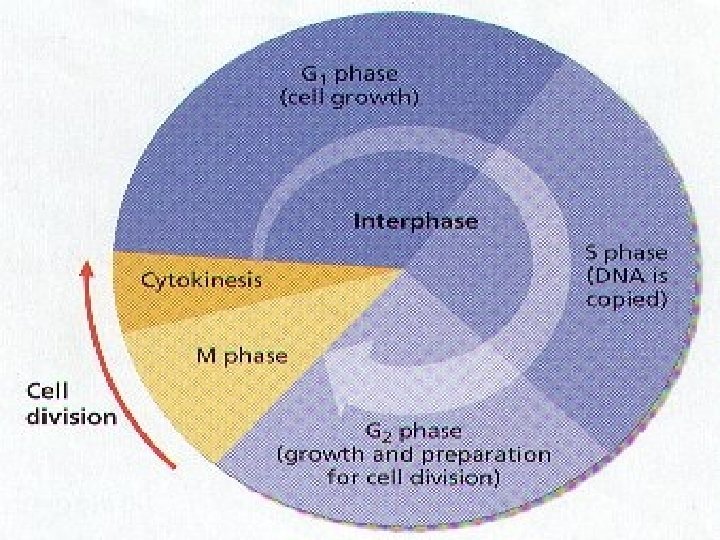
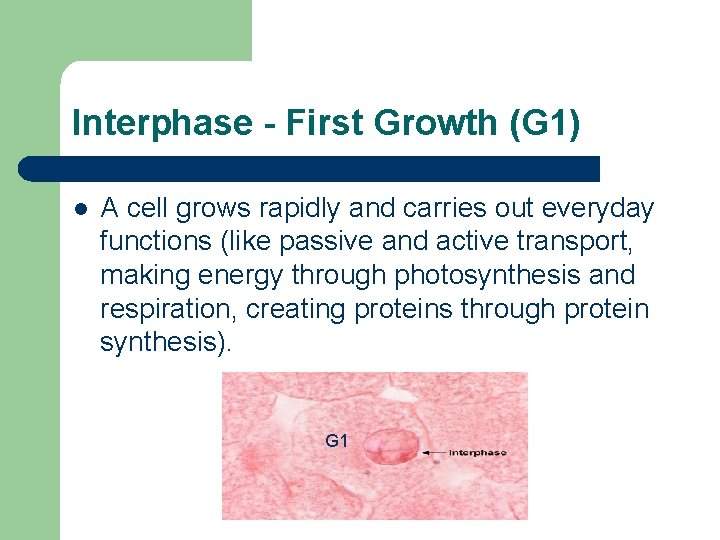
Interphase - First Growth (G 1) l A cell grows rapidly and carries out everyday functions (like passive and active transport, making energy through photosynthesis and respiration, creating proteins through protein synthesis). G 1
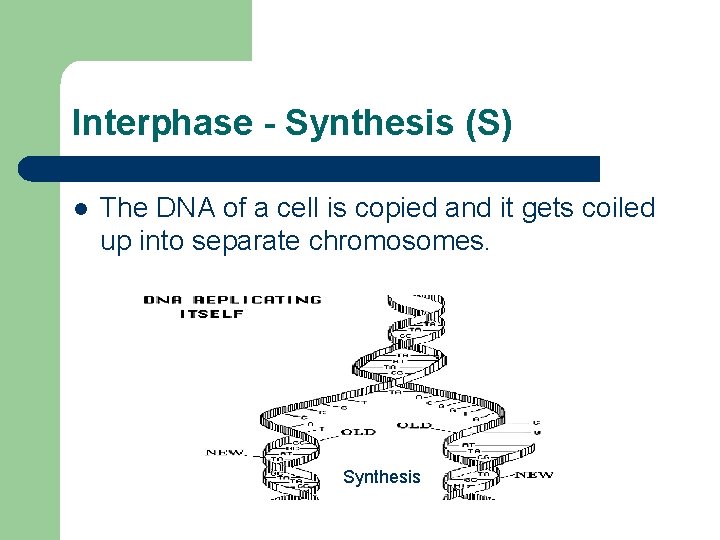
Interphase - Synthesis (S) l The DNA of a cell is copied and it gets coiled up into separate chromosomes. Synthesis
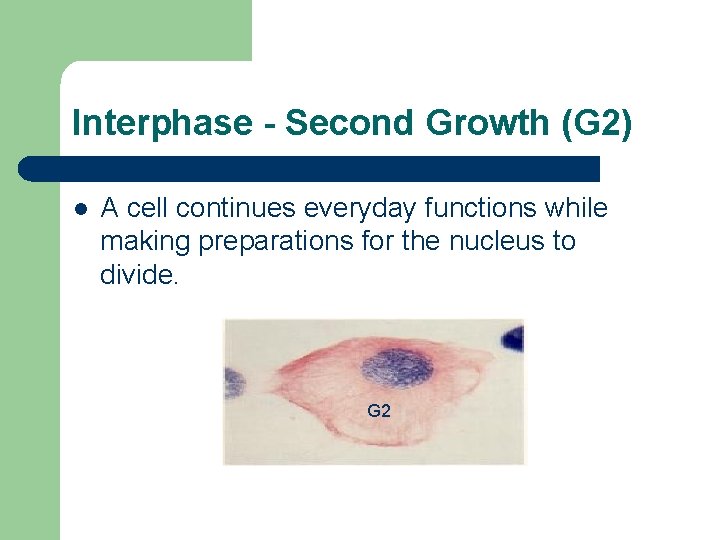
Interphase - Second Growth (G 2) l A cell continues everyday functions while making preparations for the nucleus to divide. G 2
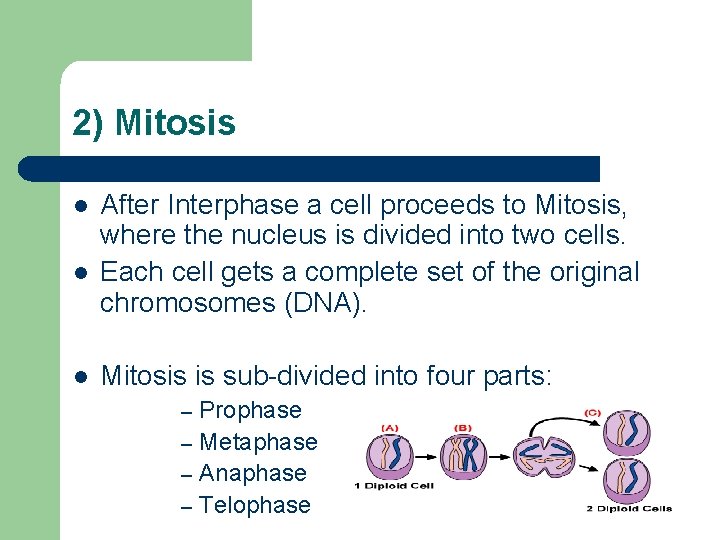
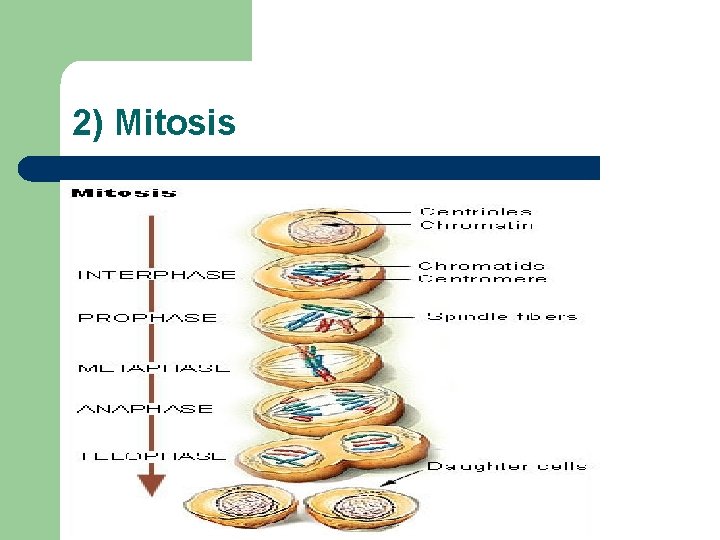
2) Mitosis l l l After Interphase a cell proceeds to Mitosis, where the nucleus is divided into two cells. Each cell gets a complete set of the original chromosomes (DNA). Mitosis is sub-divided into four parts: Prophase – Metaphase – Anaphase – Telophase –
2) Mitosis
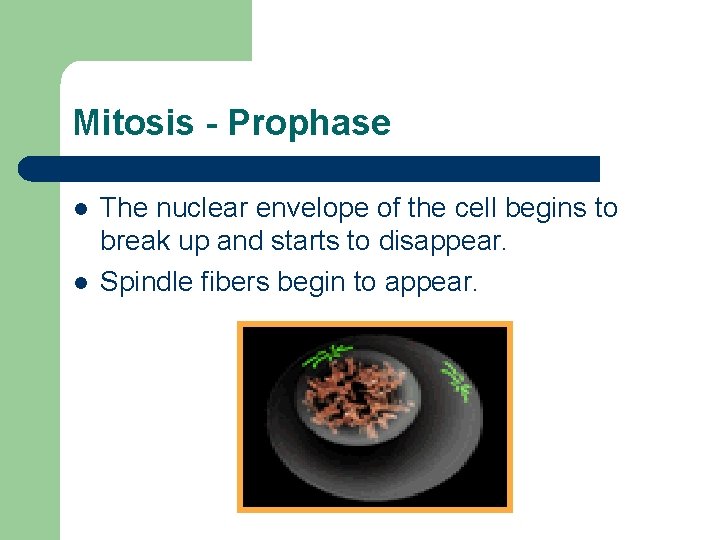
Mitosis - Prophase l l The nuclear envelope of the cell begins to break up and starts to disappear. Spindle fibers begin to appear.
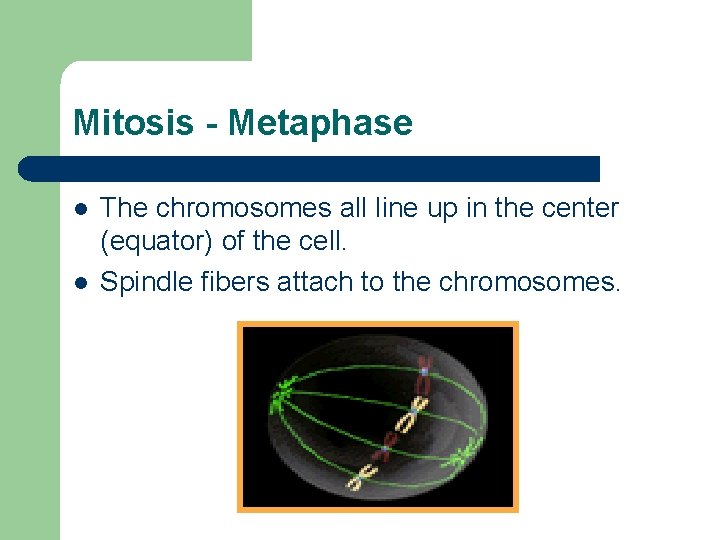
Mitosis - Metaphase l l The chromosomes all line up in the center (equator) of the cell. Spindle fibers attach to the chromosomes.
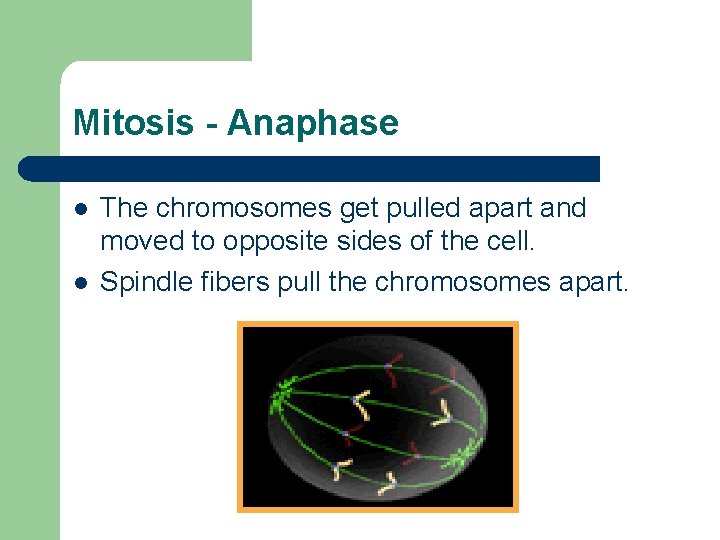
Mitosis - Anaphase l l The chromosomes get pulled apart and moved to opposite sides of the cell. Spindle fibers pull the chromosomes apart.
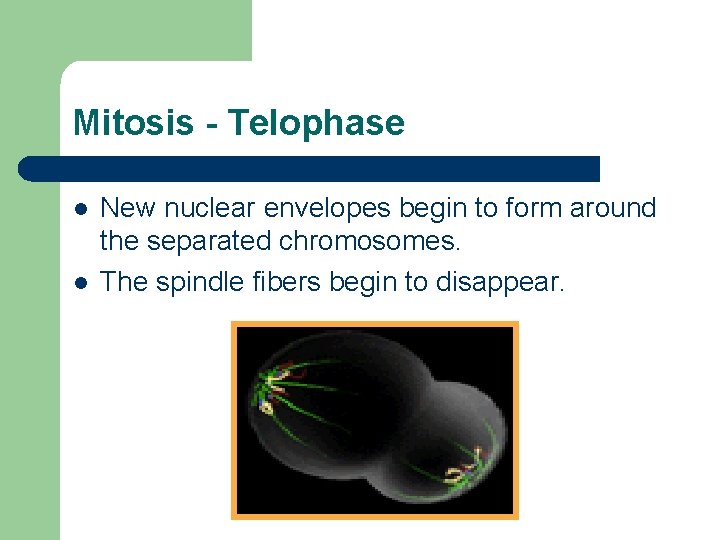
Mitosis - Telophase l l New nuclear envelopes begin to form around the separated chromosomes. The spindle fibers begin to disappear.
Mitosis Animation l http: //www. eduvinet. de/mallig/bio/Repetito/Mitose 1. html
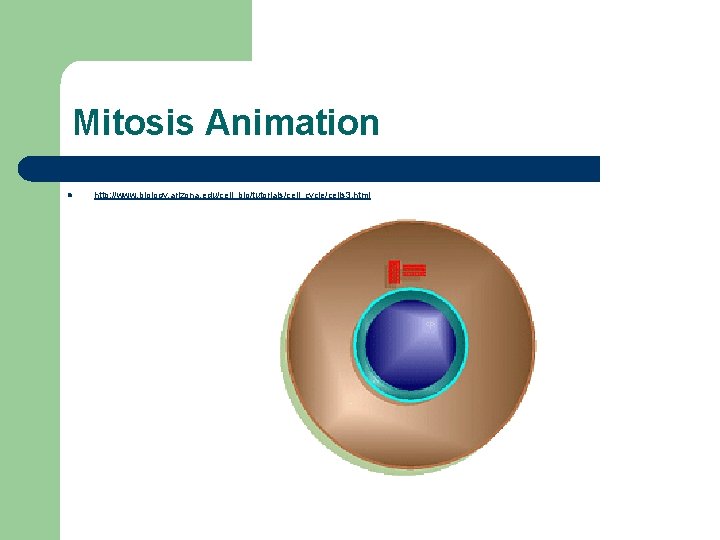
Mitosis Animation l http: //www. biology. arizona. edu/cell_bio/tutorials/cell_cycle/cells 3. html
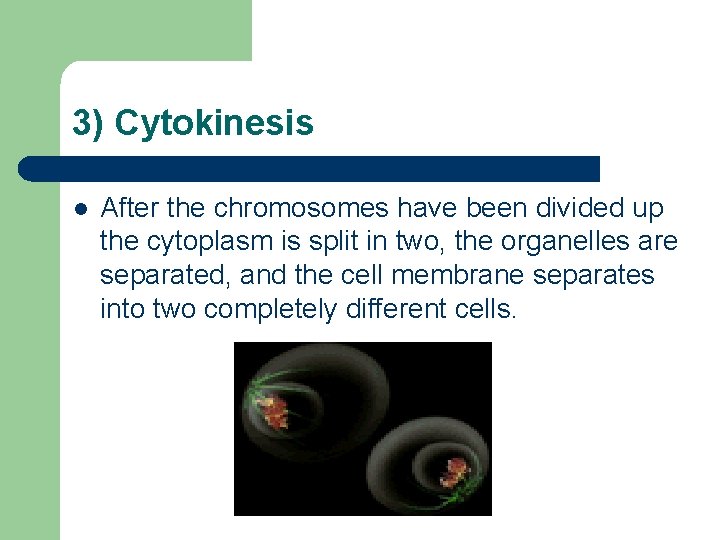
3) Cytokinesis l After the chromosomes have been divided up the cytoplasm is split in two, the organelles are separated, and the cell membrane separates into two completely different cells.
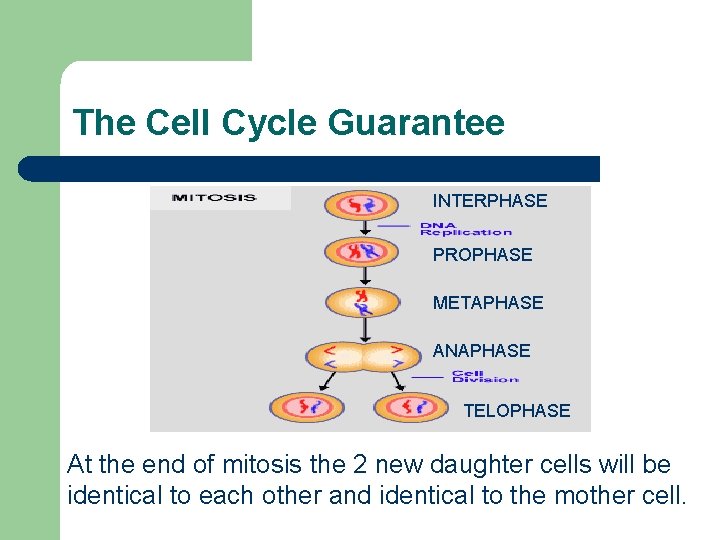
The Cell Cycle Guarantee INTERPHASE PROPHASE METAPHASE ANAPHASE TELOPHASE At the end of mitosis the 2 new daughter cells will be identical to each other and identical to the mother cell.
How Long is One Cell Cycle? • It depends… • Skin and Hair cells complete a cycle every 24 hours. • Some bacteria can do it every 2 hours. • Nerve and Brain cells never go through a complete cell cycle.
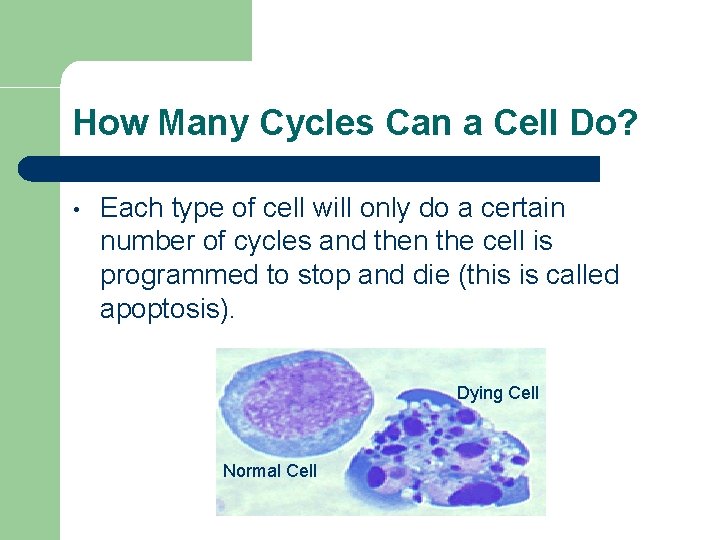
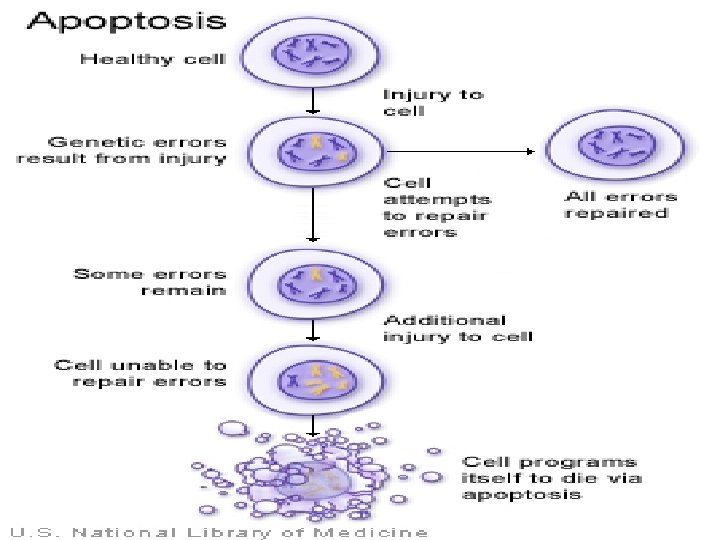
How Many Cycles Can a Cell Do? • Each type of cell will only do a certain number of cycles and then the cell is programmed to stop and die (this is called apoptosis). Dying Cell Normal Cell
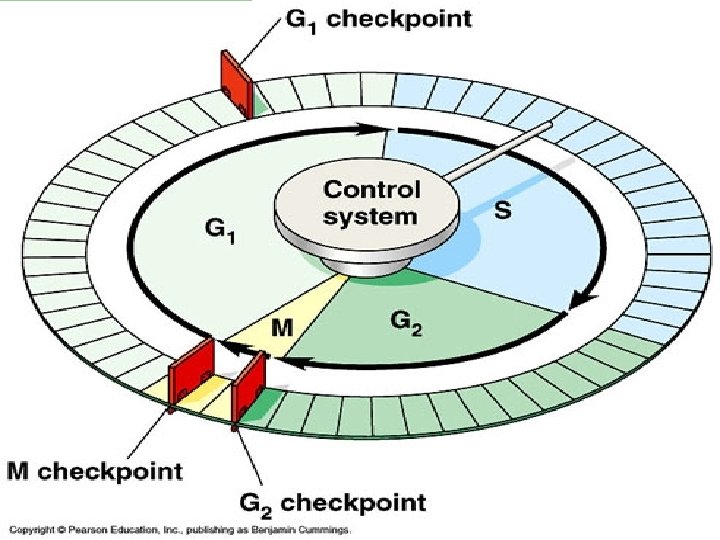
What Controls the Cell Cycle? l There are three checkpoints in the cell cycle that trigger the next phase. l The three checkpoints are: 1. 2. 3. G 1 – Key decision to determine if cell will divide. G 2 – Makes sure DNA errors are repaired. Mitosis – Starts G 1 phase over again.
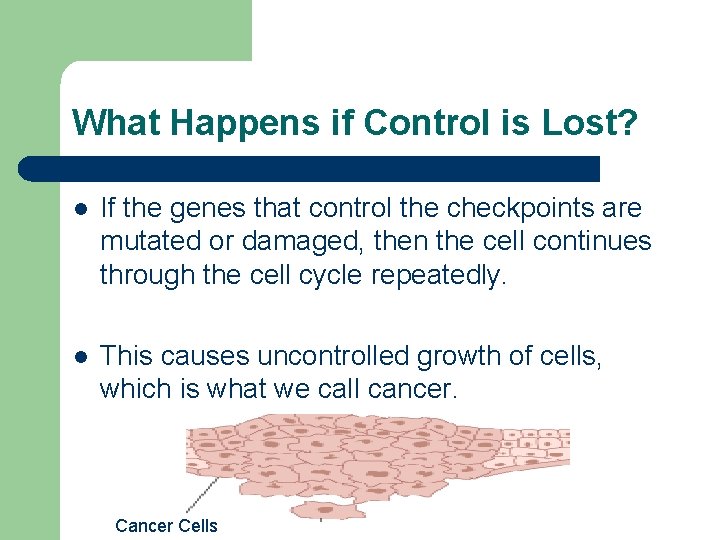
What Happens if Control is Lost? l If the genes that control the checkpoints are mutated or damaged, then the cell continues through the cell cycle repeatedly. l This causes uncontrolled growth of cells, which is what we call cancer. Cancer Cells
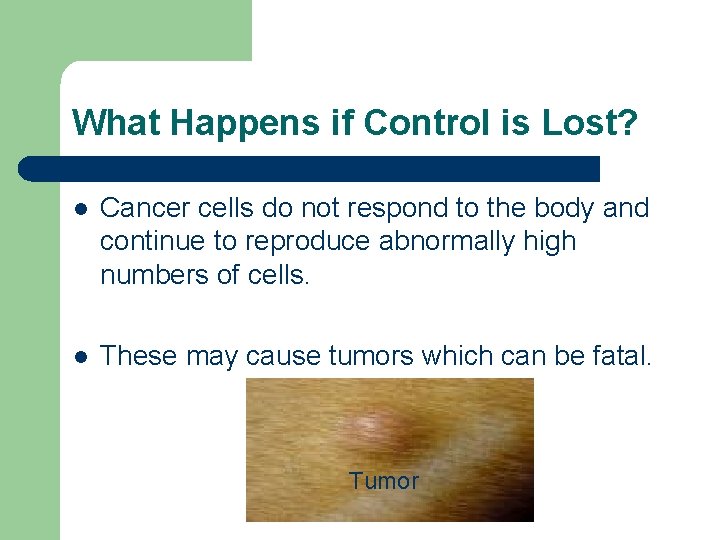
What Happens if Control is Lost? l Cancer cells do not respond to the body and continue to reproduce abnormally high numbers of cells. l These may cause tumors which can be fatal. Tumor
How do Checkpoints get Damaged? l Sometimes mutations are caused by: A) Environment (UV radiation, viruses) B) Physical Activity (obesity) C) Diet (high fat and low fiber diets) D) Genetics (prior family history) E) Tobacco (cigarette smoking)
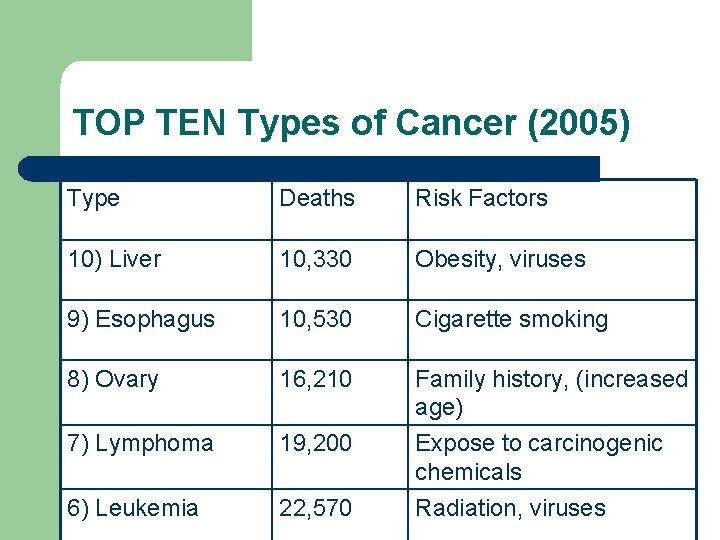
TOP TEN Types of Cancer (2005) Type Deaths Risk Factors 10) Liver 10, 330 Obesity, viruses 9) Esophagus 10, 530 Cigarette smoking 8) Ovary 16, 210 Family history, (increased age) 7) Lymphoma 19, 200 6) Leukemia 22, 570 Expose to carcinogenic chemicals Radiation, viruses
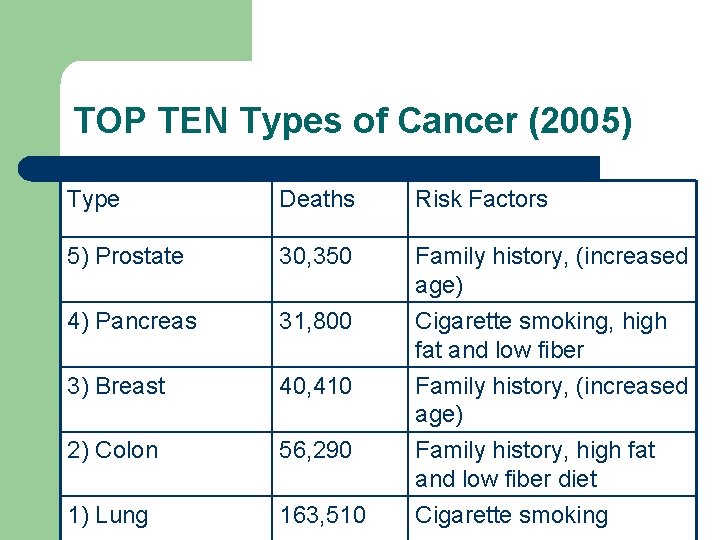
TOP TEN Types of Cancer (2005) Type Deaths Risk Factors 5) Prostate 30, 350 4) Pancreas 31, 800 Family history, (increased age) Cigarette smoking, high fat and low fiber 3) Breast 40, 410 2) Colon 56, 290 1) Lung 163, 510 Family history, (increased age) Family history, high fat and low fiber diet Cigarette smoking
American Cancer Society Goals: l Cancer prevention focuses on the preventing the use of tobacco, establishing better diets, increasing physical activity, promoting family health history, and reducing skin cancer in both adults and youths.
Any Questions? l “All the things of the universe are perfect miracles, each as profound as any. ” --Walt Whitman l “You must learn day by day, year by year, to broaden your horizon. The more things you love, the more you are interested in, the more you enjoy, the more you are indignant about, the more you have left when anything happens. ” --Ethel Barrymore
- Slides: 71