
Chapter 10 Cell Energy ATP Photosynthesis and Cellular



- Slides: 48
Chapter 10 Cell Energy- ATP Photosynthesis and Cellular Respiration
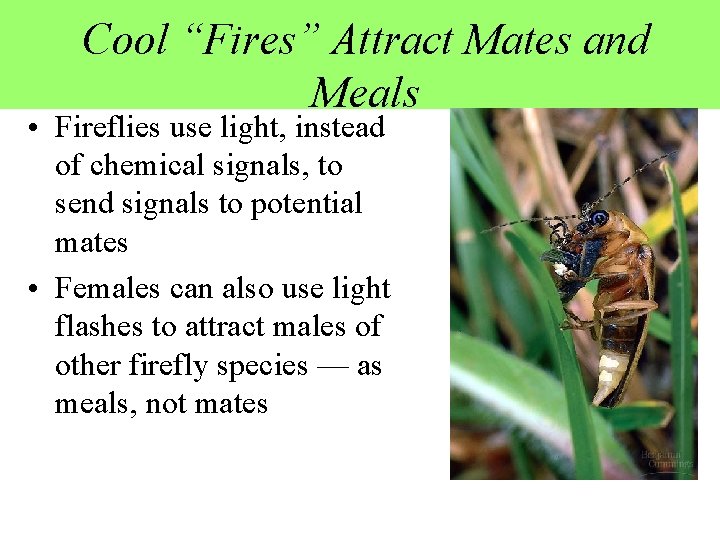
Cool “Fires” Attract Mates and Meals • Fireflies use light, instead of chemical signals, to send signals to potential mates • Females can also use light flashes to attract males of other firefly species — as meals, not mates
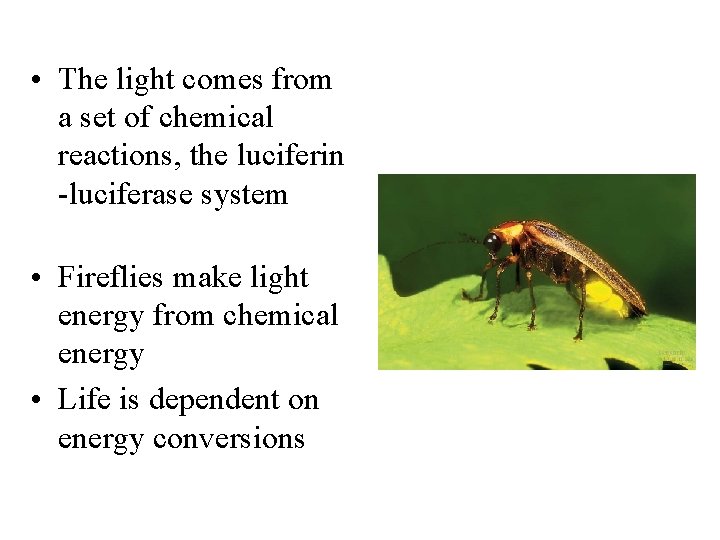
• The light comes from a set of chemical reactions, the luciferin -luciferase system • Fireflies make light energy from chemical energy • Life is dependent on energy conversions
ENERGY AND THE CELL • Living cells are compartmentalized by membranes • Membranes are sites where chemical reactions can occur in an orderly manner • Living cells process energy by means of enzymecontrolled chemical reactions
Energy is the capacity to perform work • Energy is defined as the capacity to do work • All organisms require energy to stay alive • Energy makes change possible
Chemical reactions either store or release energy • Cells carry out thousands of chemical reactions – The sum of these reactions constitutes cellular metabolism
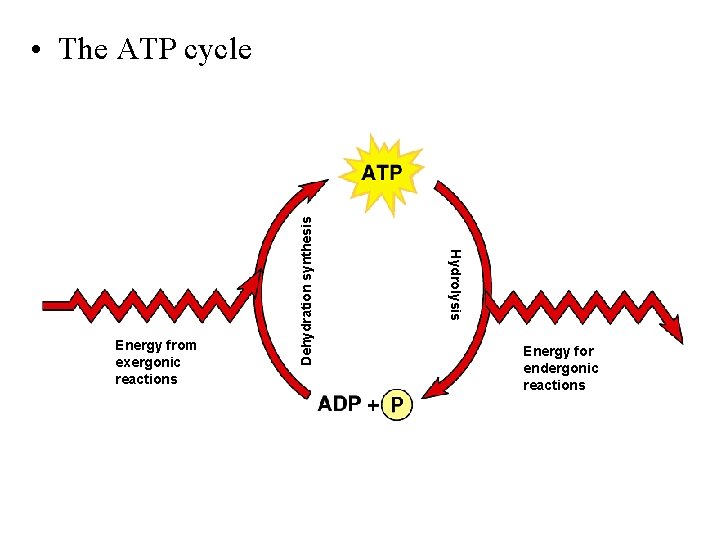
ATP shuttles chemical energy within the cell • In cellular respiration, some energy is stored in ATP molecules • ATP powers nearly all forms of cellular work • ATP molecules are the key to energy coupling
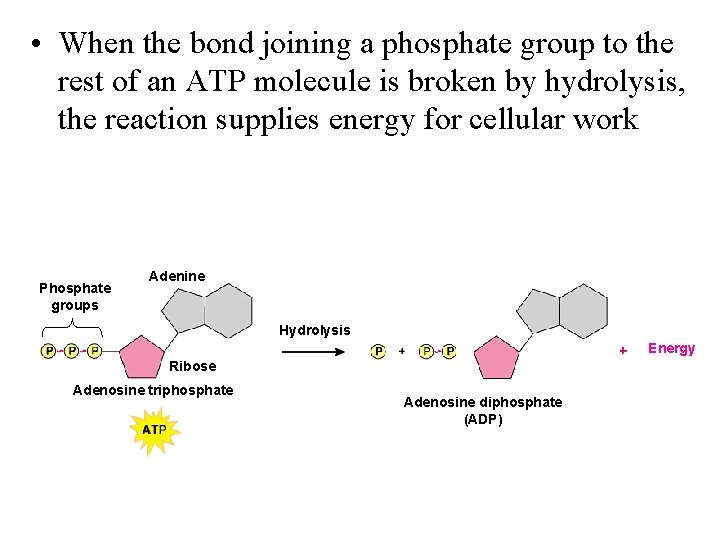
• When the bond joining a phosphate group to the rest of an ATP molecule is broken by hydrolysis, the reaction supplies energy for cellular work Phosphate groups Adenine Hydrolysis Energy Ribose Adenosine triphosphate Adenosine diphosphate (ADP)
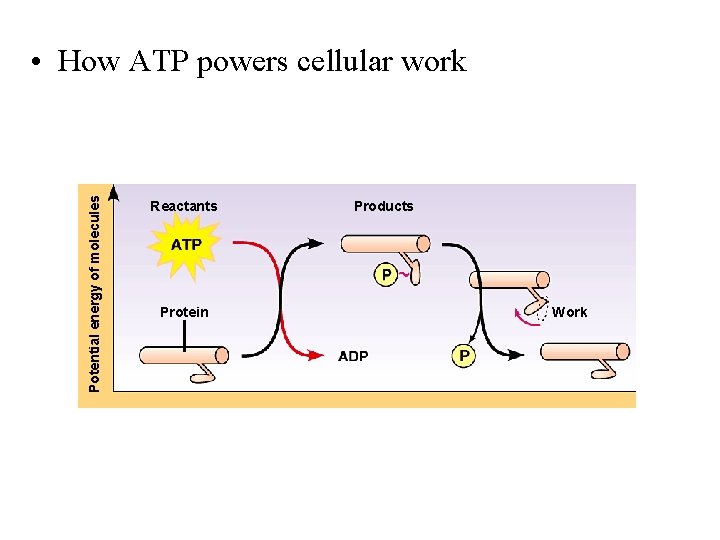
Potential energy of molecules • How ATP powers cellular work Reactants Protein Products Work
Hydrolysis Energy from exergonic reactions Dehydration synthesis • The ATP cycle Energy for endergonic reactions
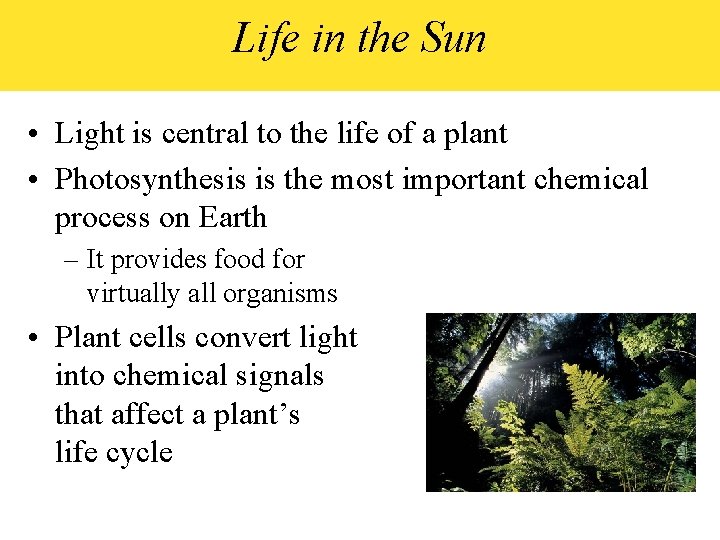
Life in the Sun • Light is central to the life of a plant • Photosynthesis is the most important chemical process on Earth – It provides food for virtually all organisms • Plant cells convert light into chemical signals that affect a plant’s life cycle
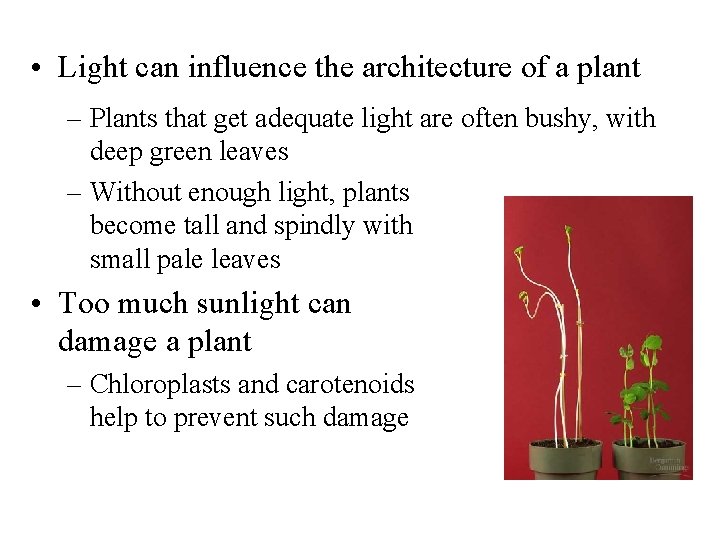
• Light can influence the architecture of a plant – Plants that get adequate light are often bushy, with deep green leaves – Without enough light, plants become tall and spindly with small pale leaves • Too much sunlight can damage a plant – Chloroplasts and carotenoids help to prevent such damage
AN OVERVIEW OF PHOTOSYNTHESIS • Photosynthesis is the process by which autotrophic organisms use light energy to make sugar and oxygen gas from carbon dioxide and water Carbon dioxide Water Glucose PHOTOSYNTHESIS Oxygen gas
Autotrophs are the producers of the biosphere • Plants, some protists, and some bacteria are photosynthetic autotrophs – They are the ultimate producers of food consumed by virtually all organisms
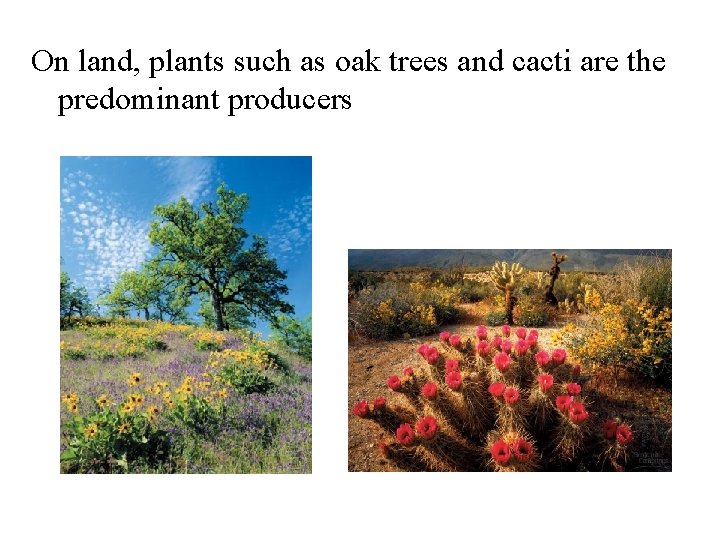
On land, plants such as oak trees and cacti are the predominant producers
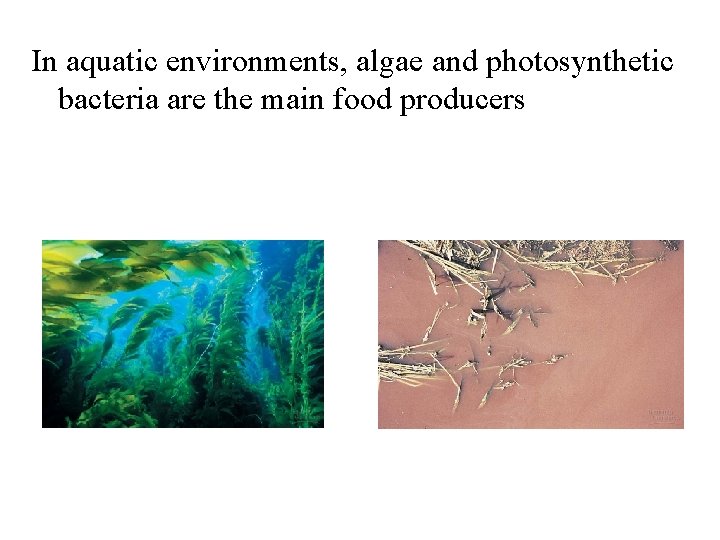
In aquatic environments, algae and photosynthetic bacteria are the main food producers
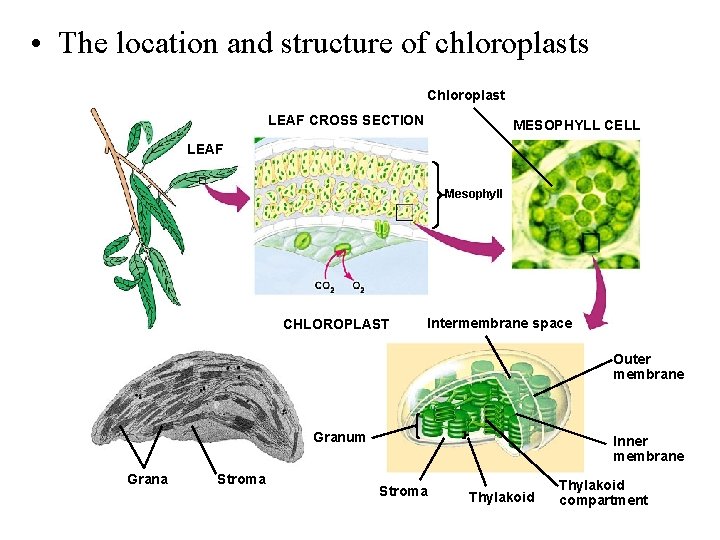
Photosynthesis occurs in chloroplasts • In most plants, photosynthesis occurs primarily in the leaves, in the chloroplasts • A chloroplast contains: – stroma, a fluid – grana, stacks of thylakoids • The thylakoids contain chlorophyll – Chlorophyll is the green pigment that captures light for photosynthesis
• The location and structure of chloroplasts Chloroplast LEAF CROSS SECTION MESOPHYLL CELL LEAF Mesophyll CHLOROPLAST Intermembrane space Outer membrane Granum Grana Stroma Inner membrane Stroma Thylakoid compartment
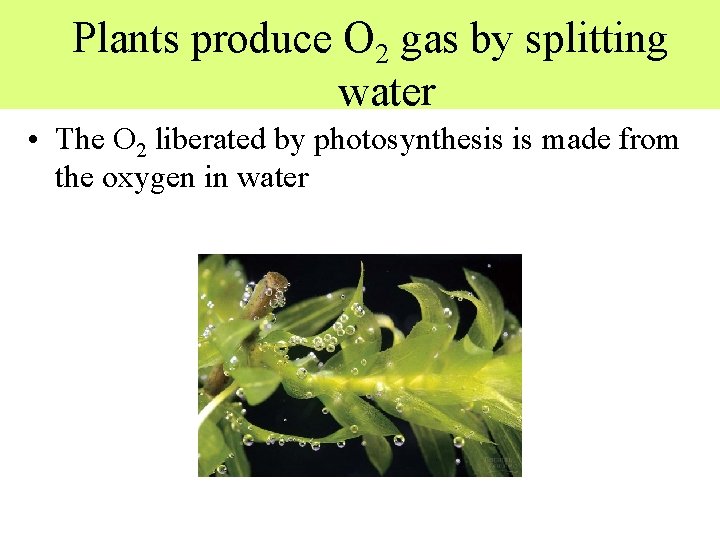
Plants produce O 2 gas by splitting water • The O 2 liberated by photosynthesis is made from the oxygen in water
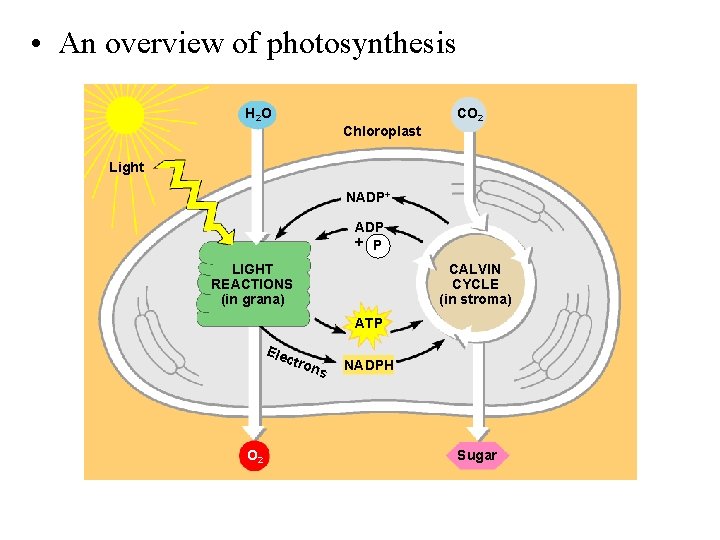
Overview: Photosynthesis occurs in two stages linked by ATP and NADPH • The complete process of photosynthesis consists of two linked sets of reactions: – the light reactions and the Calvin cycle • The light reactions convert light energy to chemical energy and produce O 2 • The Calvin cycle assembles sugar molecules from CO 2 using the energy-carrying products of the light reactions
• An overview of photosynthesis H 2 O Chloroplast CO 2 Light NADP+ ADP + P LIGHT REACTIONS (in grana) CALVIN CYCLE (in stroma) ATP Ele ctro O 2 ns NADPH Sugar
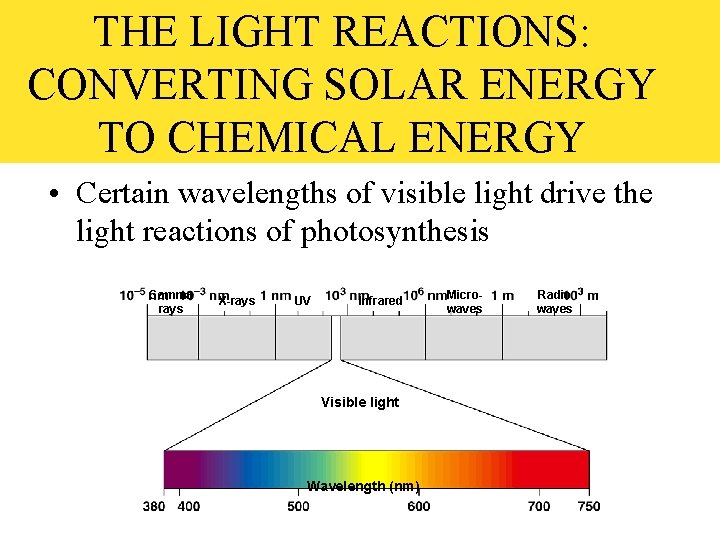
THE LIGHT REACTIONS: CONVERTING SOLAR ENERGY TO CHEMICAL ENERGY • Certain wavelengths of visible light drive the light reactions of photosynthesis Gamma rays X-rays UV Infrared Visible light Wavelength (nm) Microwaves Radio waves
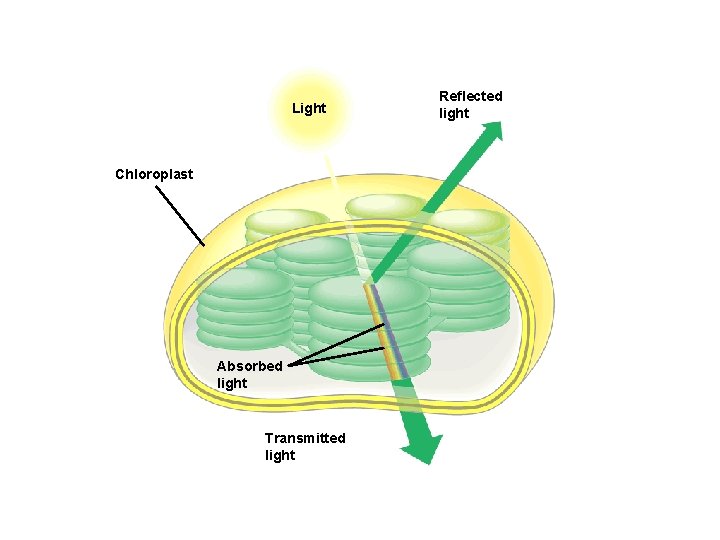
Light Chloroplast Absorbed light Transmitted light Reflected light
Photosystems capture solar power • Each of the many light-harvesting photosystems consists of: – an “antenna” of chlorophyll and other pigment molecules that absorb light – a primary electron acceptor that receives excited electrons from the reaction-center chlorophyll
Primary electron acceptor PHOTOSYSTEM Photon Reaction center Pigment molecules of antenna
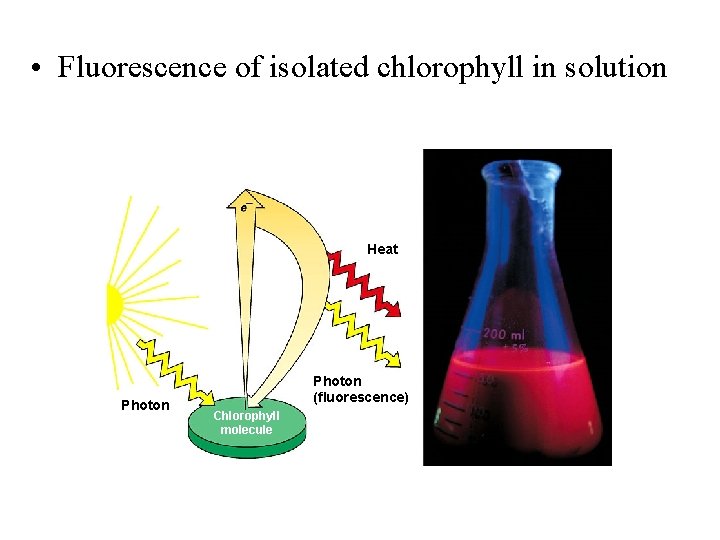
• Fluorescence of isolated chlorophyll in solution Heat Photon (fluorescence) Chlorophyll molecule
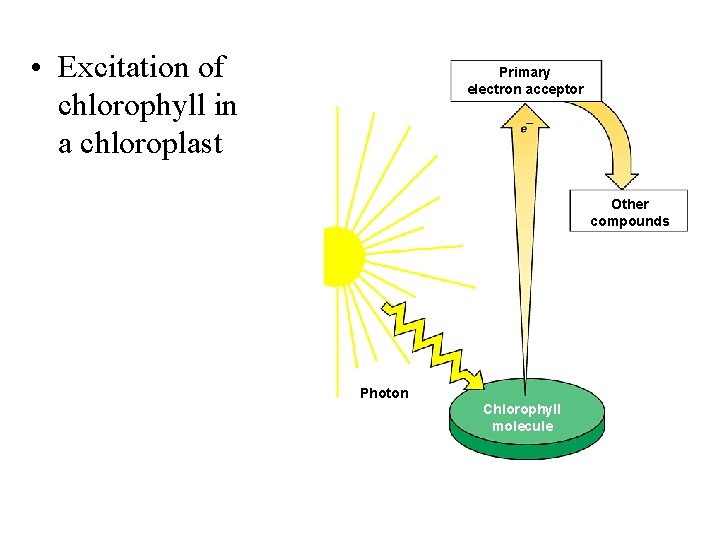
• Excitation of chlorophyll in a chloroplast Primary electron acceptor Other compounds Photon Chlorophyll molecule
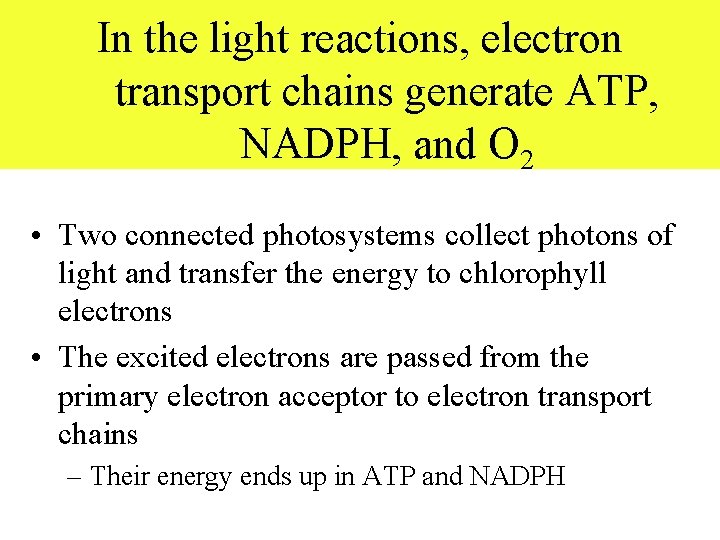
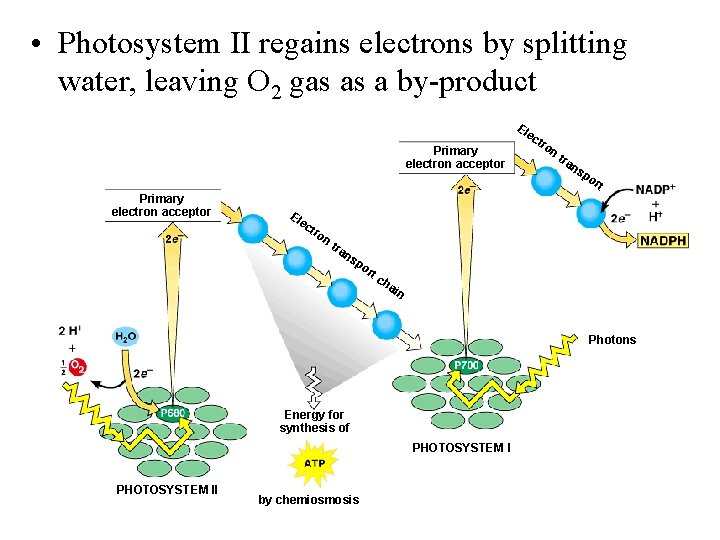
In the light reactions, electron transport chains generate ATP, NADPH, and O 2 • Two connected photosystems collect photons of light and transfer the energy to chlorophyll electrons • The excited electrons are passed from the primary electron acceptor to electron transport chains – Their energy ends up in ATP and NADPH
• Photosystem II regains electrons by splitting water, leaving O 2 gas as a by-product El ec Primary electron acceptor El ec tro n tra ns po rt tra ns p or t ch ain Photons Energy for synthesis of PHOTOSYSTEM II by chemiosmosis
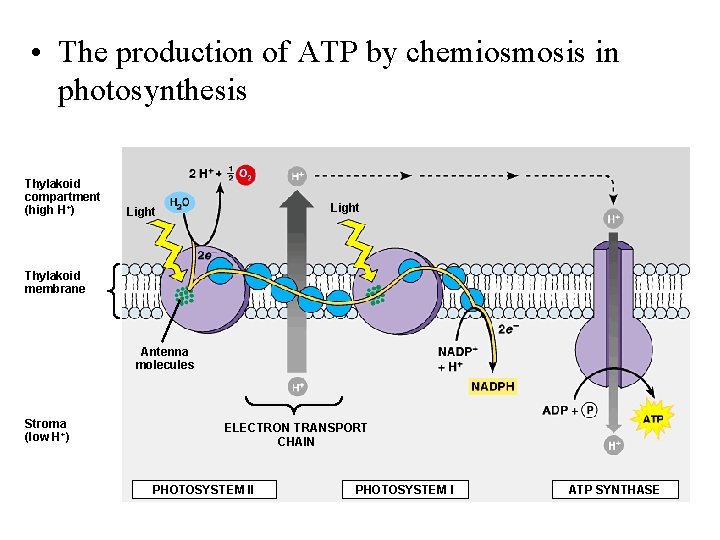
• The production of ATP by chemiosmosis in photosynthesis Thylakoid compartment (high H+) Light Thylakoid membrane Antenna molecules Stroma (low H+) ELECTRON TRANSPORT CHAIN PHOTOSYSTEM II PHOTOSYSTEM I ATP SYNTHASE
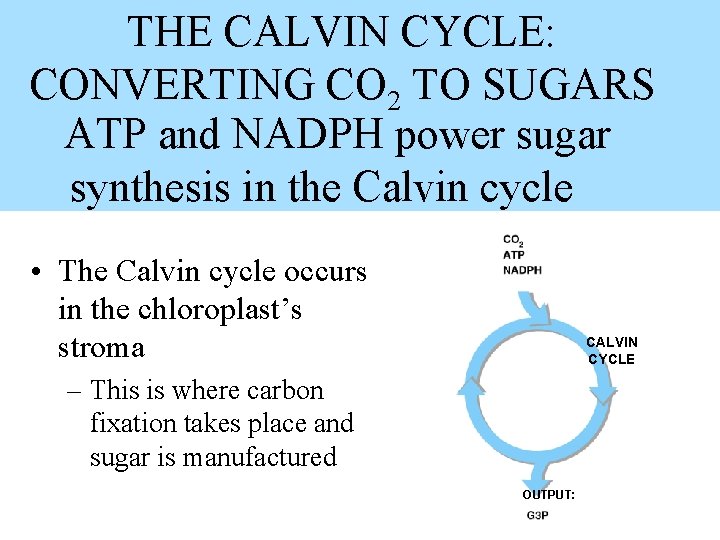
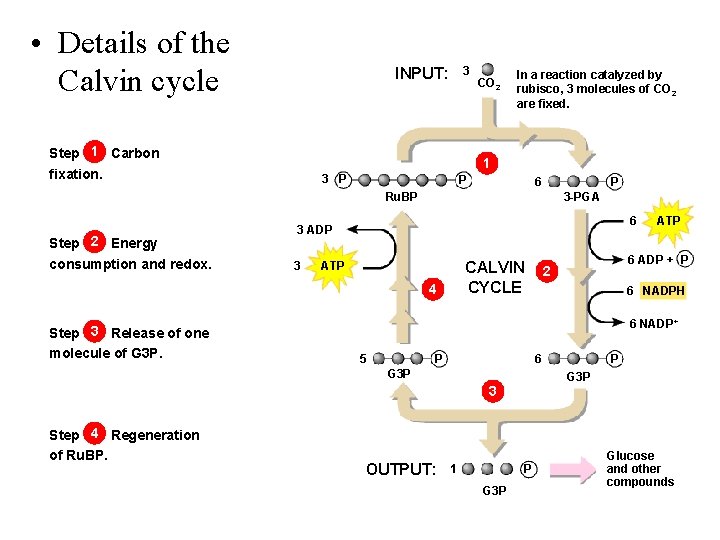
THE CALVIN CYCLE: CONVERTING CO 2 TO SUGARS ATP and NADPH power sugar synthesis in the Calvin cycle • The Calvin cycle occurs in the chloroplast’s stroma CALVIN CYCLE – This is where carbon fixation takes place and sugar is manufactured OUTPUT:
• Details of the Calvin cycle 3 INPUT: Step 1 Carbon fixation. CO 2 In a reaction catalyzed by rubisco, 3 molecules of CO 2 are fixed. 1 3 P P 6 P Ru. BP Step 2 Energy consumption and redox. 3 -PGA 6 3 ADP 3 ATP CALVIN CYCLE 4 Step 3 Release of one molecule of G 3 P. 6 ADP + P 2 6 NADPH 6 NADP+ 5 P 6 G 3 P OUTPUT: 1 P G 3 P 3 Step 4 Regeneration of Ru. BP. ATP Glucose and other compounds
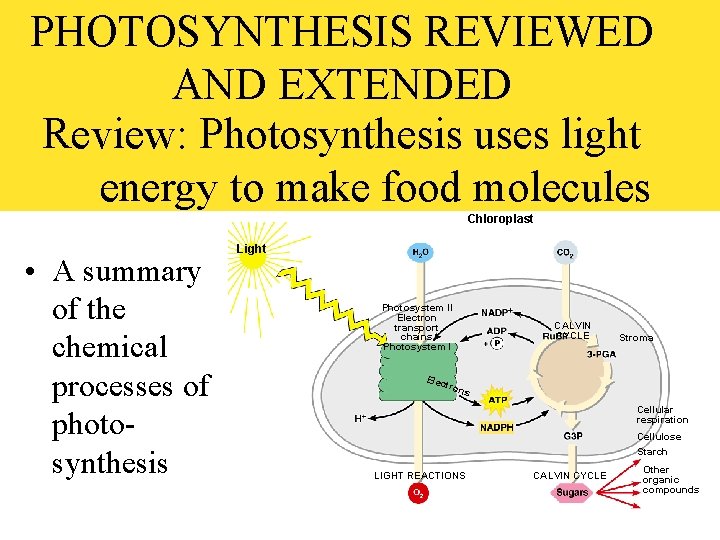
PHOTOSYNTHESIS REVIEWED AND EXTENDED Review: Photosynthesis uses light energy to make food molecules Chloroplast • A summary of the chemical processes of photosynthesis Light Photosystem II Electron transport chains Photosystem I Elec CALVIN CYCLE Stroma tron s Cellular respiration Cellulose Starch LIGHT REACTIONS CALVIN CYCLE Other organic compounds
• Many plants make more sugar than they need – The excess is stored in roots, tuber, and fruits – These are a major source of food for animals
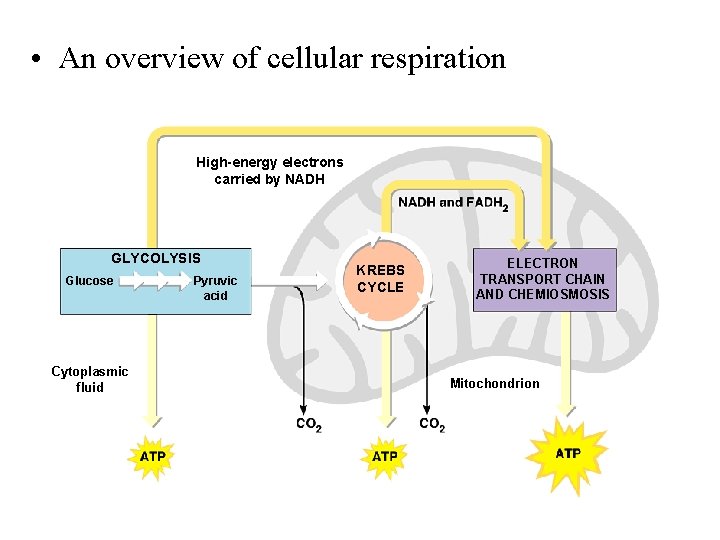
STAGES OF CELLULAR RESPIRATION AND FERMENTATION Overview: Respiration occurs in three main stages • Cellular respiration oxidizes sugar and produces ATP in three main stages – Glycolysis occurs in the cytoplasm – The Krebs cycle and the electron transport chain occur in the mitochondria
• An overview of cellular respiration High-energy electrons carried by NADH GLYCOLYSIS Glucose Cytoplasmic fluid Pyruvic acid KREBS CYCLE ELECTRON TRANSPORT CHAIN AND CHEMIOSMOSIS Mitochondrion
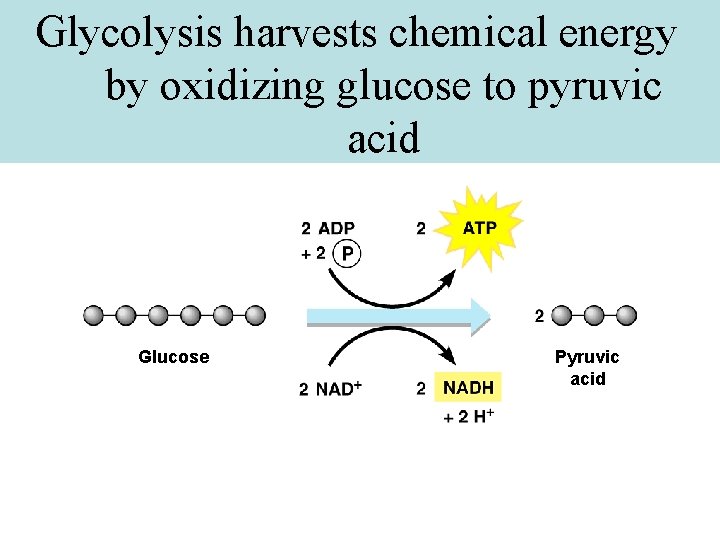
Glycolysis harvests chemical energy by oxidizing glucose to pyruvic acid Glucose Pyruvic acid
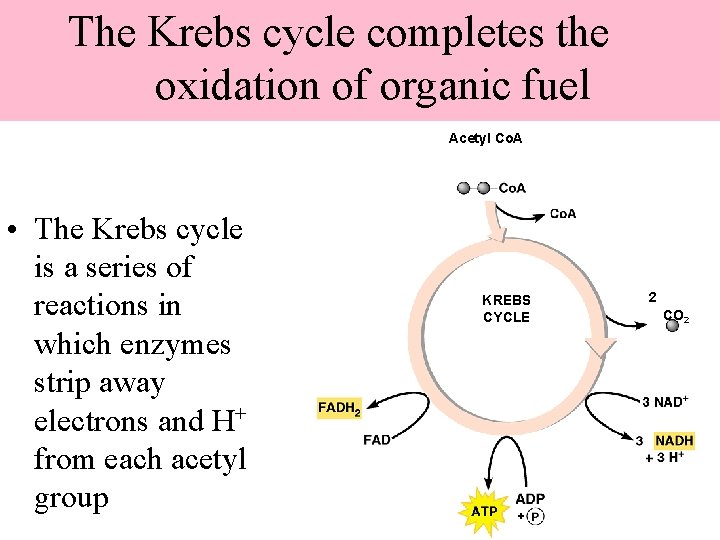
The Krebs cycle completes the oxidation of organic fuel Acetyl Co. A • The Krebs cycle is a series of reactions in which enzymes strip away electrons and H+ from each acetyl group KREBS CYCLE 2 CO 2
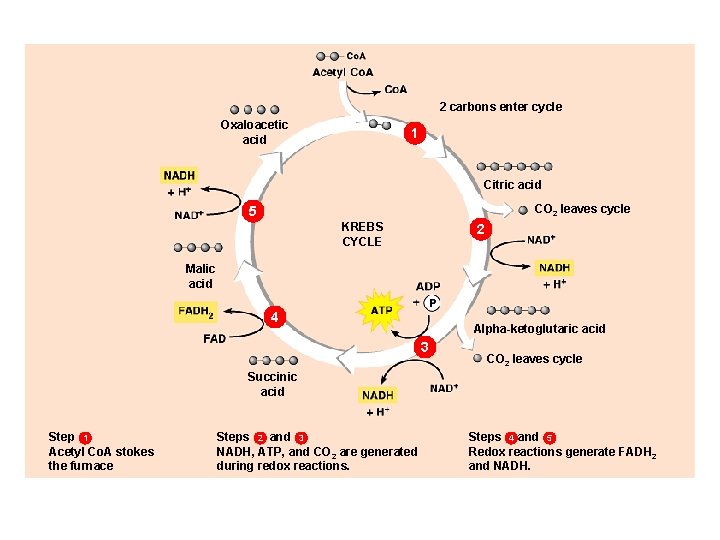
2 carbons enter cycle Oxaloacetic acid 1 Citric acid CO 2 leaves cycle 5 KREBS CYCLE 2 Malic acid 4 Alpha-ketoglutaric acid 3 CO 2 leaves cycle Succinic acid Step 1 Acetyl Co. A stokes the furnace Steps 2 and 3 NADH, ATP, and CO 2 are generated during redox reactions. Steps 4 and 5 Redox reactions generate FADH 2 and NADH.
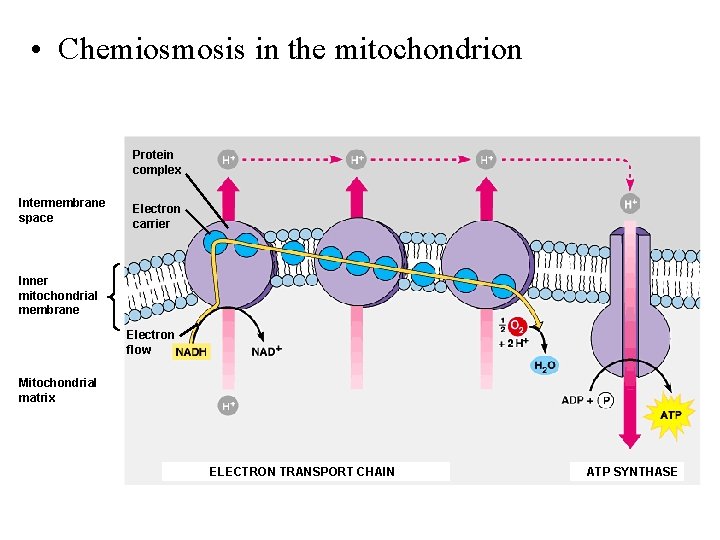
• Chemiosmosis in the mitochondrion Protein complex Intermembrane space Electron carrier Inner mitochondrial membrane Electron flow Mitochondrial matrix ELECTRON TRANSPORT CHAIN ATP SYNTHASE
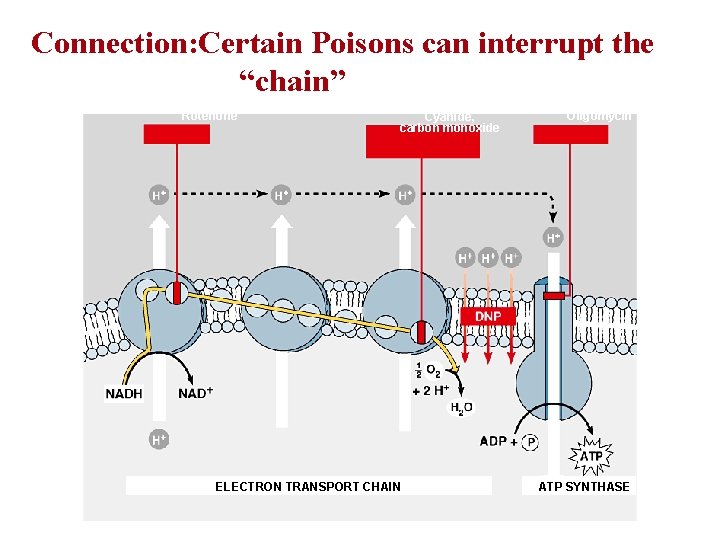
Connection: Certain Poisons can interrupt the “chain” Rotenone Cyanide, carbon monoxide ELECTRON TRANSPORT CHAIN Oligomycin ATP SYNTHASE
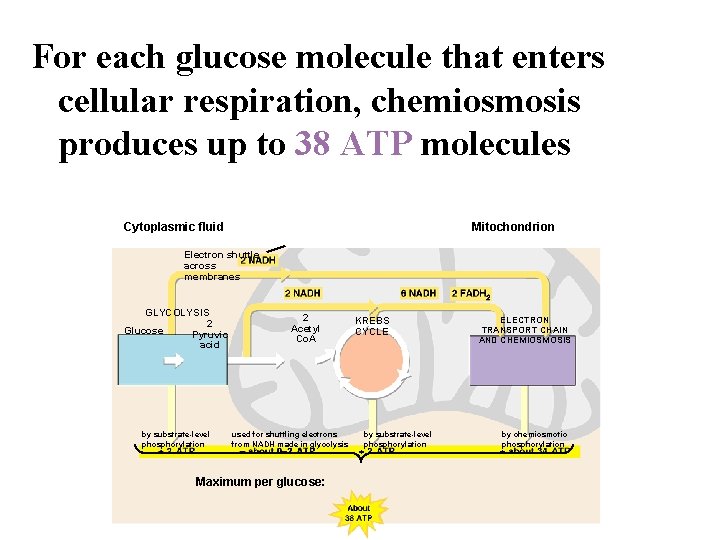
For each glucose molecule that enters cellular respiration, chemiosmosis produces up to 38 ATP molecules Cytoplasmic fluid Mitochondrion Electron shuttle across membranes GLYCOLYSIS 2 Glucose Pyruvic acid by substrate-level phosphorylation 2 Acetyl Co. A used for shuttling electrons from NADH made in glycolysis Maximum per glucose: KREBS CYCLE by substrate-level phosphorylation KREBS CYCLE ELECTRON TRANSPORT CHAIN AND CHEMIOSMOSIS by chemiosmotic phosphorylation
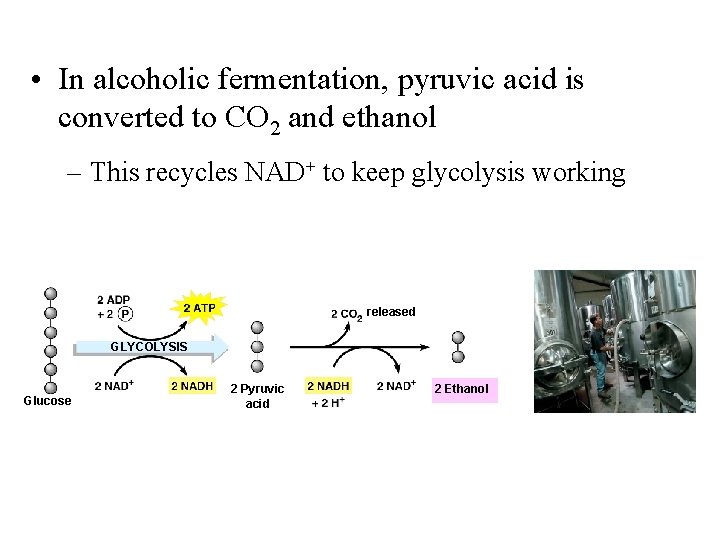
Fermentation is an anaerobic alternative to aerobic respiration • Under anaerobic conditions, many kinds of cells can use glycolysis alone to produce small amounts of ATP – But a cell must have a way of replenishing NAD+
• In alcoholic fermentation, pyruvic acid is converted to CO 2 and ethanol – This recycles NAD+ to keep glycolysis working released GLYCOLYSIS Glucose 2 Pyruvic acid 2 Ethanol
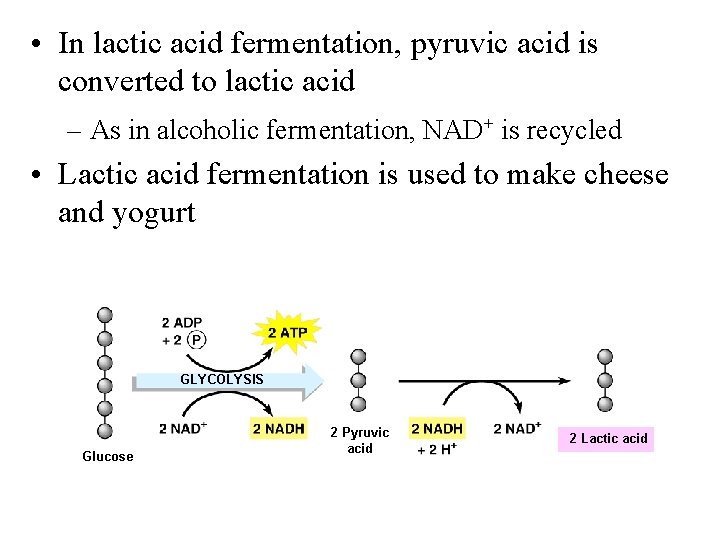
• In lactic acid fermentation, pyruvic acid is converted to lactic acid – As in alcoholic fermentation, NAD+ is recycled • Lactic acid fermentation is used to make cheese and yogurt GLYCOLYSIS Glucose 2 Pyruvic acid 2 Lactic acid
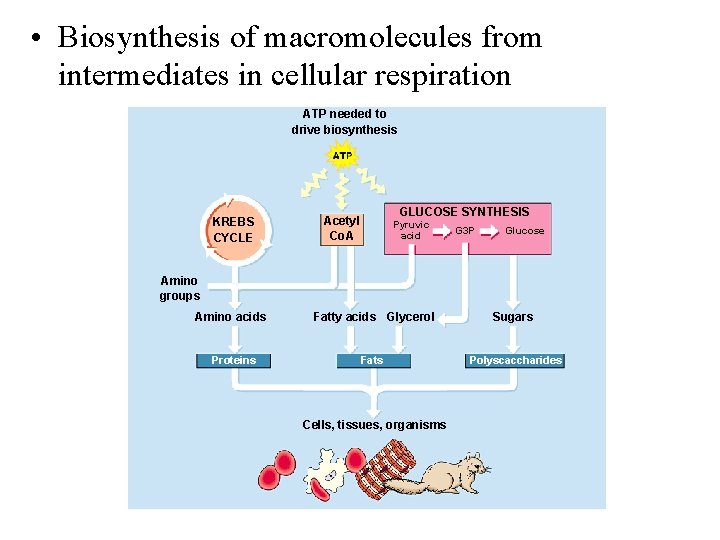
Food molecules provide raw materials for biosynthesis • In addition to energy, cells need raw materials for growth and repair – Some are obtained directly from food – Others are made from intermediates in glycolysis and the Krebs cycle • Biosynthesis consumes ATP
• Biosynthesis of macromolecules from intermediates in cellular respiration ATP needed to drive biosynthesis KREBS CYCLE GLUCOSE SYNTHESIS Acetyl Co. A Pyruvic acid G 3 P Glucose Amino groups Amino acids Fatty acids Glycerol Sugars Proteins Fats Polyscaccharides Cells, tissues, organisms
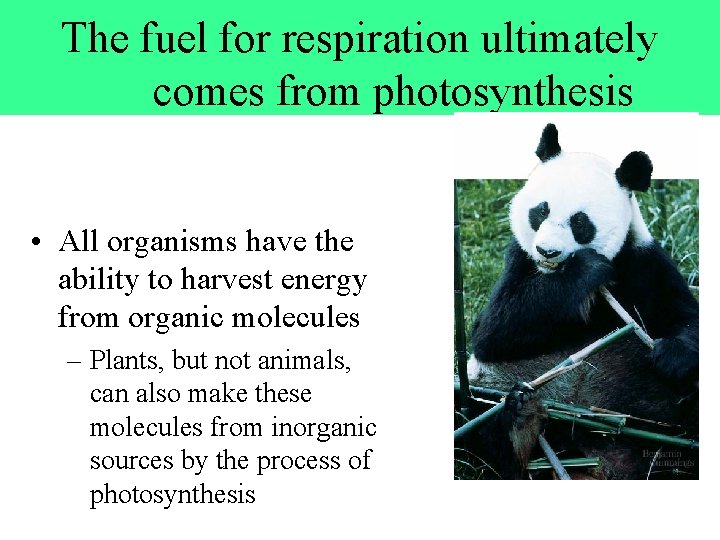
The fuel for respiration ultimately comes from photosynthesis • All organisms have the ability to harvest energy from organic molecules – Plants, but not animals, can also make these molecules from inorganic sources by the process of photosynthesis