
Chapter 10 Body Structure and Function Copyright 2017
Chapter 10 Body Structure and Function Copyright © 2017, Elsevier, Inc. All rights reserved.
A Steady State Homeostasis Various body functions and processes work to promote health and survival. Ø Homeostasis is affected by illness, disease, and injury. Ø Knowing the body’s normal structure (anatomy) and function (physiology) will help you understand signs, symptoms, and the reasons for care and procedures. Ø Copyright © 2017, Elsevier, Inc. All rights reserved. 2
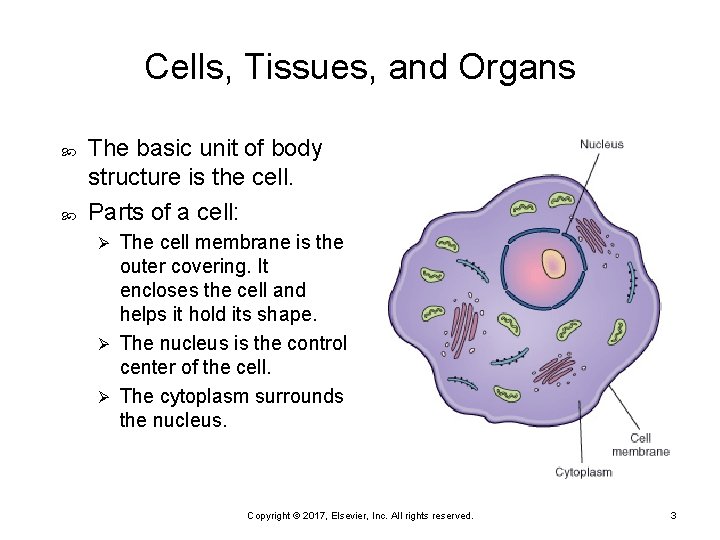
Cells, Tissues, and Organs The basic unit of body structure is the cell. Parts of a cell: The cell membrane is the outer covering. It encloses the cell and helps it hold its shape. Ø The nucleus is the control center of the cell. Ø The cytoplasm surrounds the nucleus. Ø Copyright © 2017, Elsevier, Inc. All rights reserved. 3
Cells, Tissues, and Organs (Cont. ) Ø Ø Ø Ø Groups of cells with similar functions combine to form tissues. Epithelial tissue covers internal and external body surfaces. Connective tissue anchors, connects, and supports other tissues. Muscle tissue stretches and contracts to let the body move. Nerve tissue receives and carries impulses to the brain and back to body parts. Groups of tissues with the same function form organs. Systems are formed by organs that work together to perform special functions. Copyright © 2017, Elsevier, Inc. All rights reserved. 4
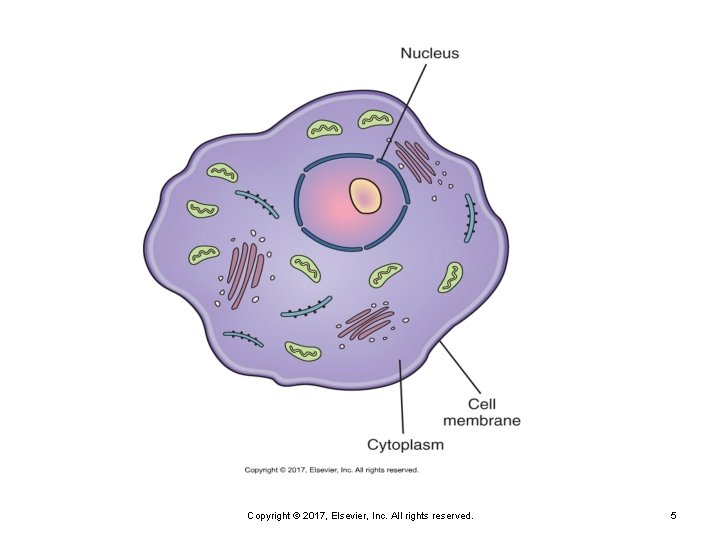
Copyright © 2017, Elsevier, Inc. All rights reserved. 5
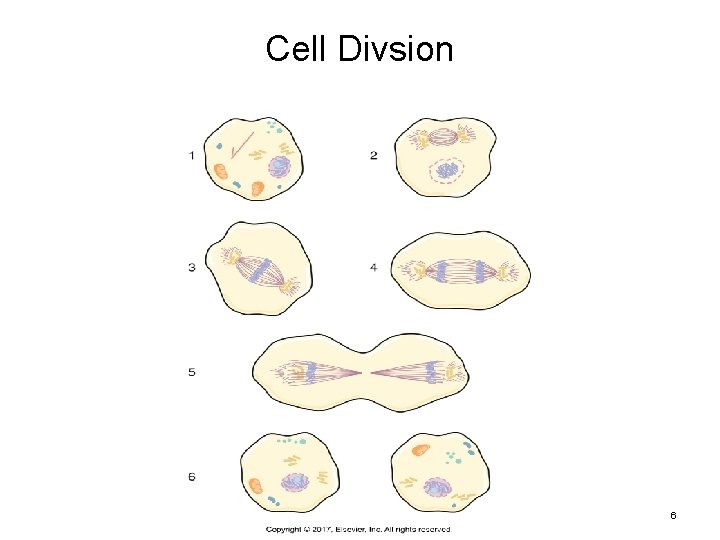
Cell Divsion Copyright © 2017, Elsevier, Inc. All rights reserved. 6
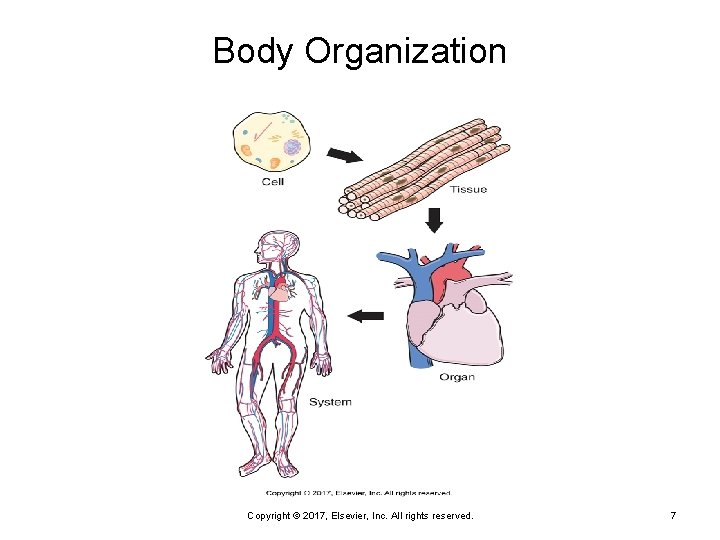
Body Organization Copyright © 2017, Elsevier, Inc. All rights reserved. 7
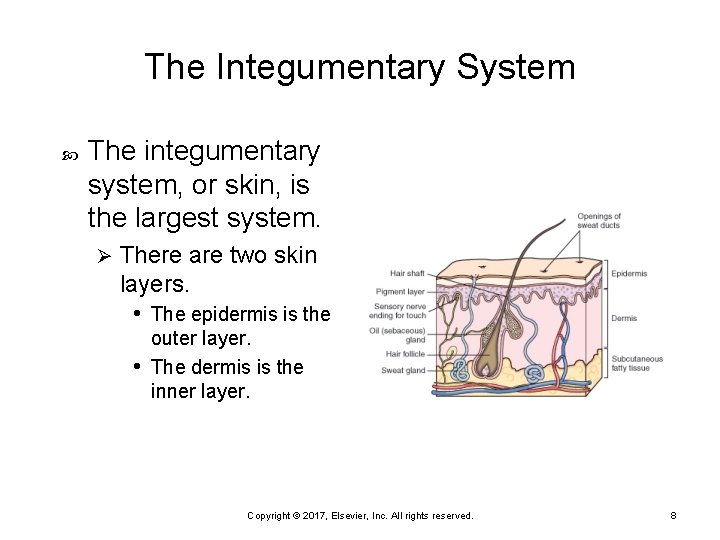
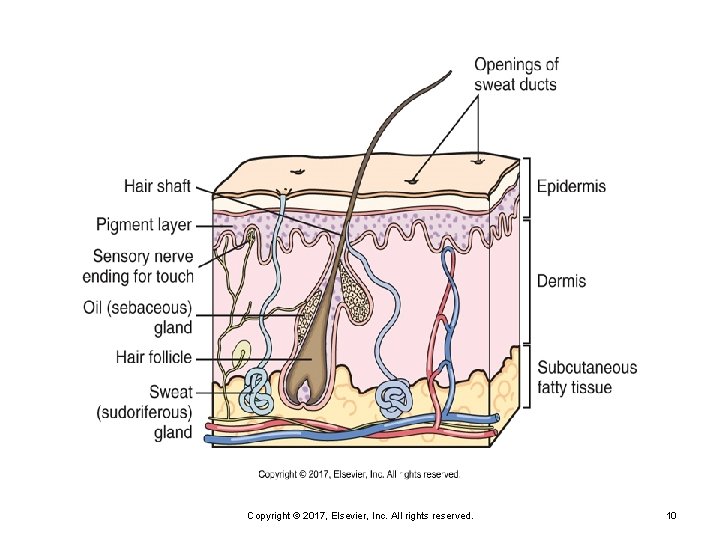
The Integumentary System The integumentary system, or skin, is the largest system. Ø There are two skin layers. • The epidermis is the outer layer. • The dermis is the inner layer. Copyright © 2017, Elsevier, Inc. All rights reserved. 8
The Integumentary System (Cont. ) The skin has many functions. It is the body’s protective covering. Ø It prevents microorganisms and other substances from entering the body. Ø It prevents excess amounts of water from leaving the body. Ø It protects organs from injury. Ø Nerve endings in the skin sense both pleasant and unpleasant stimulation. Ø It helps regulate body temperature. Ø It stores fats and water. Ø Copyright © 2017, Elsevier, Inc. All rights reserved. 9
Copyright © 2017, Elsevier, Inc. All rights reserved. 10
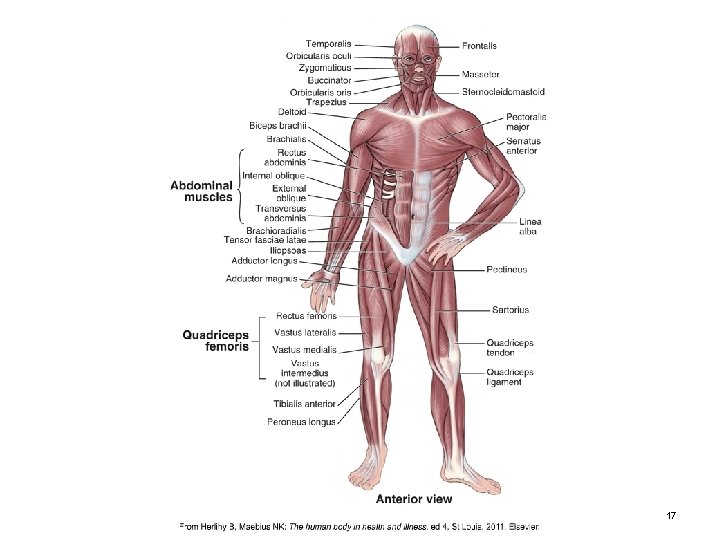
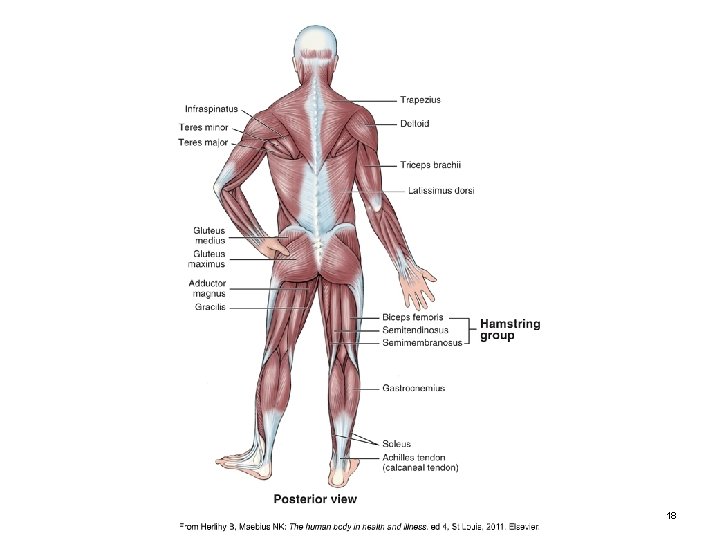
The Musculoskeletal System The musculoskeletal system provides the framework for the body. It lets the body move. Ø It protects internal organs and gives the body shape. Ø Bones Ø There are four types of bones. • • Ø Long bones bear the body’s weight. Short bones allow skill and ease in movement. Flat bones protect the organs. Irregular bones allow various degrees of movement and flexibility. Bone marrow forms blood cells. Copyright © 2017, Elsevier, Inc. All rights reserved. 11
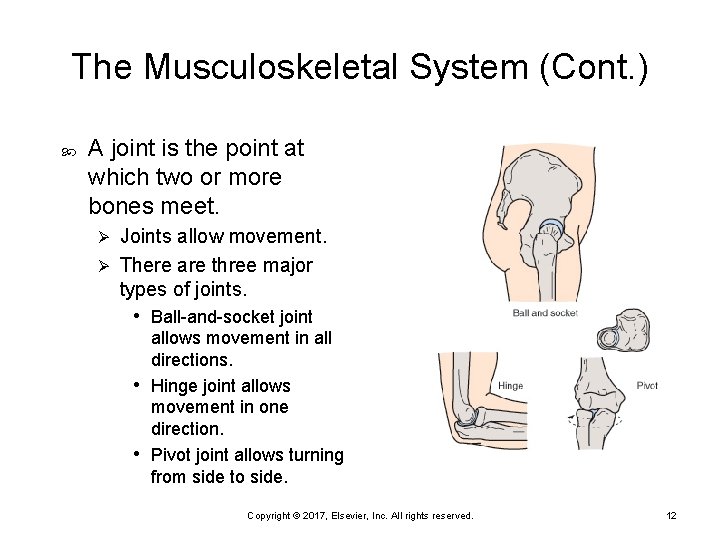
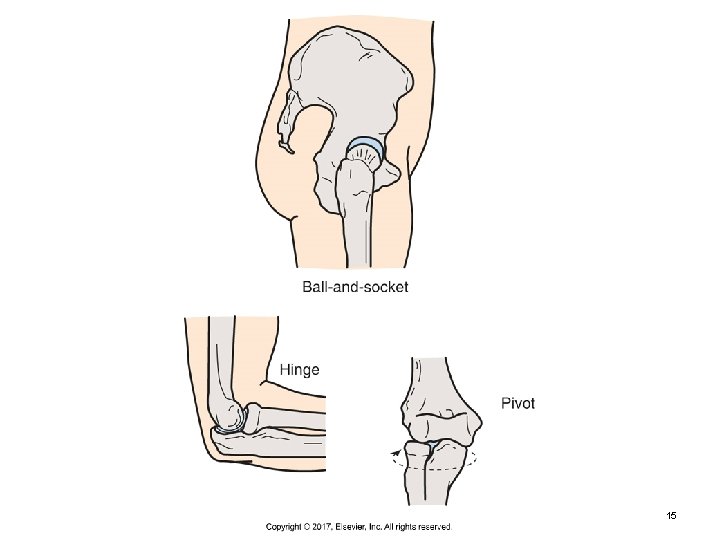
The Musculoskeletal System (Cont. ) A joint is the point at which two or more bones meet. Joints allow movement. Ø There are three major types of joints. Ø • Ball-and-socket joint allows movement in all directions. • Hinge joint allows movement in one direction. • Pivot joint allows turning from side to side. Copyright © 2017, Elsevier, Inc. All rights reserved. 12
The Musculoskeletal System (Cont. ) Muscles Voluntary muscles can be consciously controlled. Ø Involuntary muscles work automatically. Ø • You cannot control them. Ø Cardiac muscle is in the heart. • It is an involuntary muscle. Muscles have three functions. • Movement of body parts • Maintenance of posture or muscle tone • Production of body heat Sphincters • Circular bands of muscle fibers • Constrict (narrow) a passage Copyright © 2017, Elsevier, Inc. All rights reserved. 13
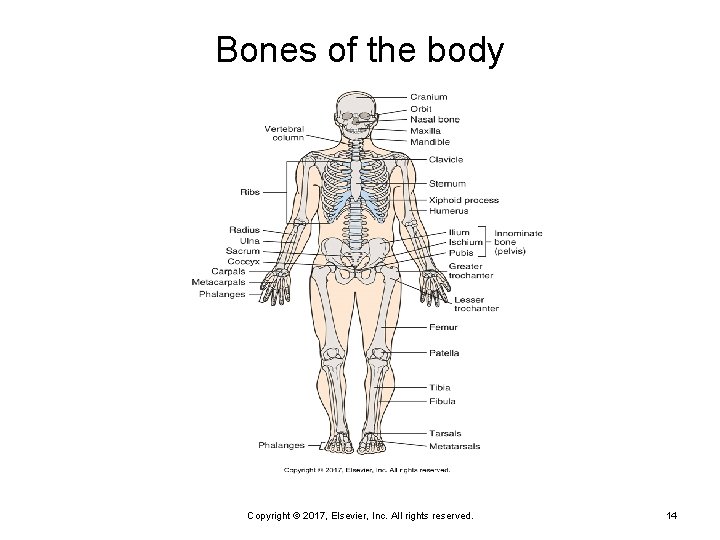
Bones of the body Copyright © 2017, Elsevier, Inc. All rights reserved. 14
Copyright © 2017, Elsevier, Inc. All rights reserved. 15
Copyright © 2017, Elsevier, Inc. All rights reserved. 16
Copyright © 2017, Elsevier, Inc. All rights reserved. 17
Copyright © 2017, Elsevier, Inc. All rights reserved. 18

The Nervous System The nervous system controls, directs, and coordinates body functions. Ø It has two main divisions. • The central nervous system (CNS) consists of the brain and spinal cord. • The peripheral nervous system involves the nerves throughout the body. Copyright © 2017, Elsevier, Inc. All rights reserved. 19
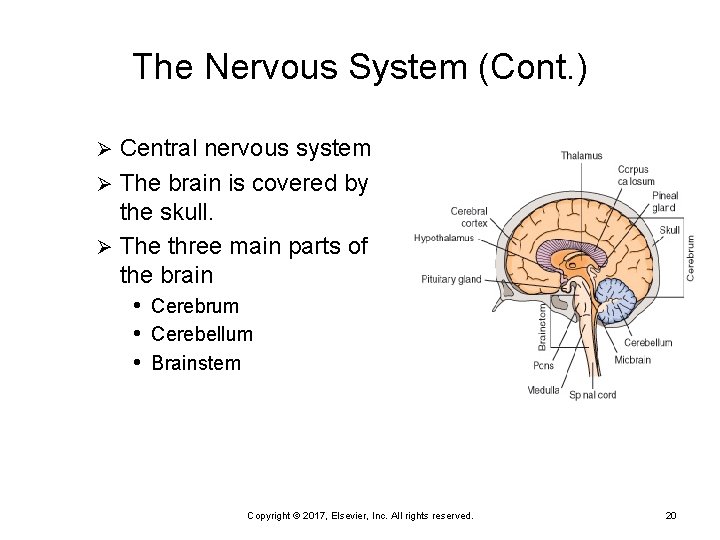
The Nervous System (Cont. ) Central nervous system Ø The brain is covered by the skull. Ø The three main parts of the brain • Cerebrum • Cerebellum • Brainstem Ø Copyright © 2017, Elsevier, Inc. All rights reserved. 20
The Nervous System (Cont. ) The spinal cord lies within the spinal column. Ø The spinal cord contains pathways that conduct messages to and from the brain. The brain and spinal cord are covered and protected by three layers of connective tissue called meninges. The outer layer (dura mater) lies next to the skull. Ø The middle layer is the arachnoid. Ø The inner layer is the pia mater. Ø Copyright © 2017, Elsevier, Inc. All rights reserved. 21
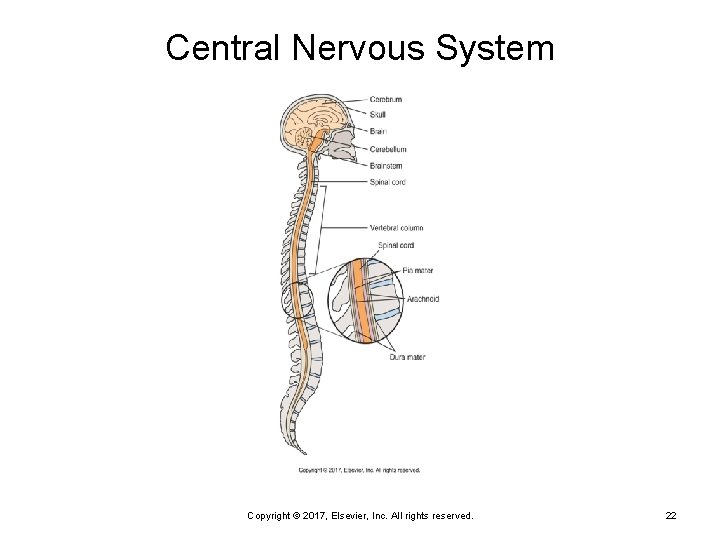
Central Nervous System Copyright © 2017, Elsevier, Inc. All rights reserved. 22
The Nervous System (Cont. ) Peripheral nervous system It involves the nerves throughout the body. Ø The peripheral nervous system has 12 pairs of cranial nerves and 31 pairs of spinal nerves. • Cranial nerves conduct impulses between the brain and Ø the head, neck, chest, and abdomen. • Spinal nerves carry impulses from the skin, extremities, and the internal structures not supplied by cranial nerves. Copyright © 2017, Elsevier, Inc. All rights reserved. 23
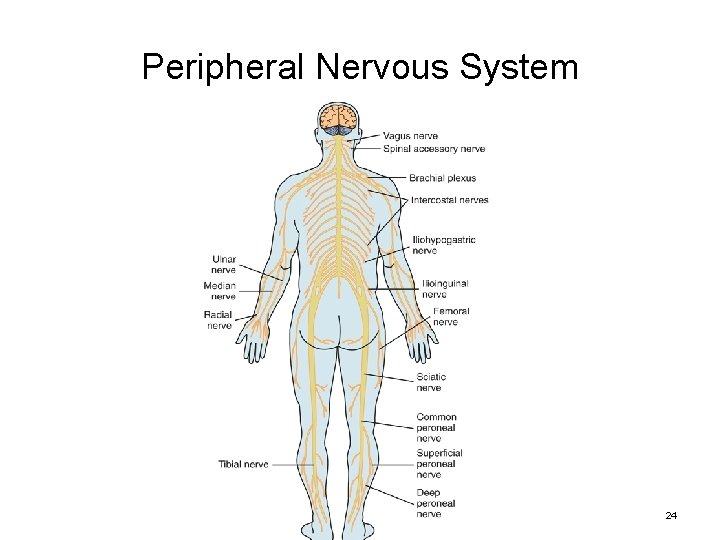
Peripheral Nervous System Copyright © 2017, Elsevier, Inc. All rights reserved. 24
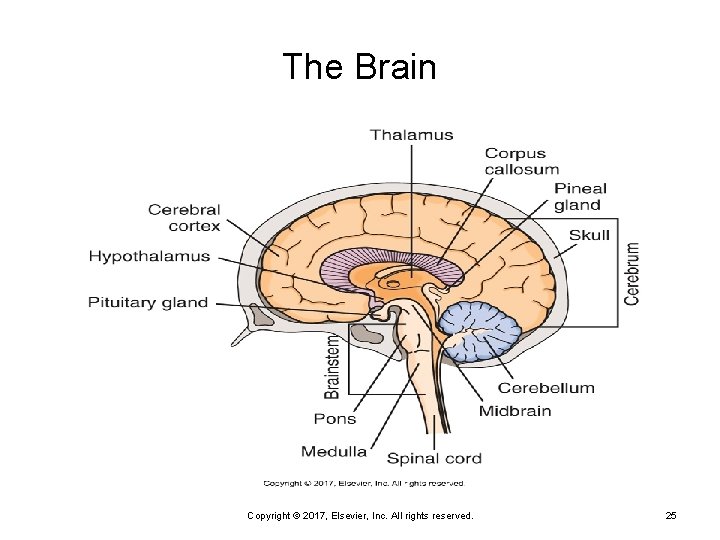
The Brain Copyright © 2017, Elsevier, Inc. All rights reserved. 25
The Nervous System (Cont. ) The sense organs Ø The five senses are sight, hearing, taste, smell, and touch. • Receptors for taste are in the tongue (taste buds). • Receptors for smell are in the nose. • Touch receptors are in the dermis, especially in the toes and fingertips. Copyright © 2017, Elsevier, Inc. All rights reserved. 26
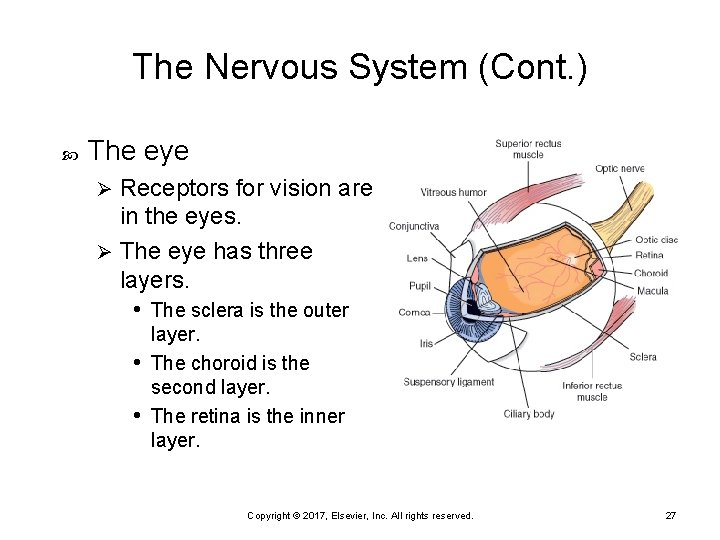
The Nervous System (Cont. ) The eye Receptors for vision are in the eyes. Ø The eye has three layers. • The sclera is the outer Ø layer. • The choroid is the second layer. • The retina is the inner layer. Copyright © 2017, Elsevier, Inc. All rights reserved. 27
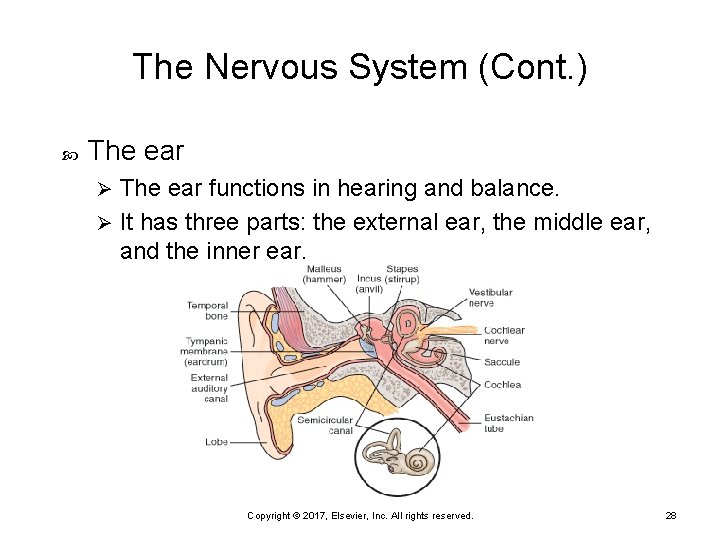
The Nervous System (Cont. ) The ear functions in hearing and balance. Ø It has three parts: the external ear, the middle ear, and the inner ear. Ø Copyright © 2017, Elsevier, Inc. All rights reserved. 28
The Nervous System (Cont. ) The external ear is called the pinna or auricle. The eardrum (tympanic membrane) separates the external and middle ear. The middle ear contains the eustachian tube and three small bones called ossicles. Ø The ossicles are the malleus, the incus, and the stapes. The inner ear consists of the semicircular canals and the cochlea. The cochlea contains fluid that carries sound waves to the acoustic nerve. Ø The three semicircular canals are involved with balance. Ø Copyright © 2017, Elsevier, Inc. All rights reserved. 29
The Circulatory System The circulatory system is made up of the blood, heart, and blood vessels. The circulatory system has many functions. Ø Ø Ø Blood carries food, hormones, and other substances to the cells. Blood transports the gases of respiration. Blood removes waste products from cells. Blood plays a role in maintaining the body’s fluid balance. Blood and blood vessels help regulate body temperature. The system produces and carries cells that defend the body from microbes that cause disease. Copyright © 2017, Elsevier, Inc. All rights reserved. 30
The Circulatory System (Cont. ) The blood consists of blood cells and plasma. Ø Plasma is mostly water. Ø Red blood cells (RBCs) are called erythrocytes. • They give blood its red color because of a substance in Ø the RBC called hemoglobin. White blood cells (WBCs) are called leukocytes. • They protect the body against infection. Ø Platelets (thrombocytes) are needed for blood clotting. Ø Copyright © 2017, Elsevier, Inc. All rights reserved. 31
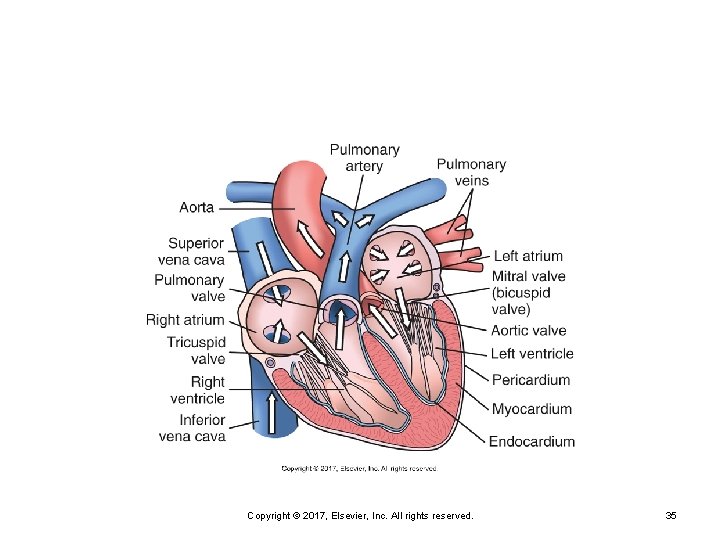
The Circulatory System (Cont. ) The heart is a muscle. It pumps blood through the blood vessels to the tissues and cells. Ø It lies in the middle to lower part of the chest cavity toward the left side. Ø The heart is hollow and has three layers. The pericardium is the outer layer. Ø The myocardium is the thick, muscular part of the heart. Ø The endocardium lines the inner surface of the heart. Ø Copyright © 2017, Elsevier, Inc. All rights reserved. 32
The Circulatory System (Cont. ) The heart has four chambers. Ø Upper chambers receive blood and are called atria. • The right atrium receives blood from body tissues. • The left atrium receives blood from the lungs. Lower chambers pump blood and are called ventricles. The right ventricle pumps blood to the lungs for oxygen. Ø The left ventricle pumps blood to all parts of the body. Ø Valves are between the atria and ventricles. Heart action has two phases. Diastole is the resting phase. Ø Systole is the working phase. Ø Copyright © 2017, Elsevier, Inc. All rights reserved. 33
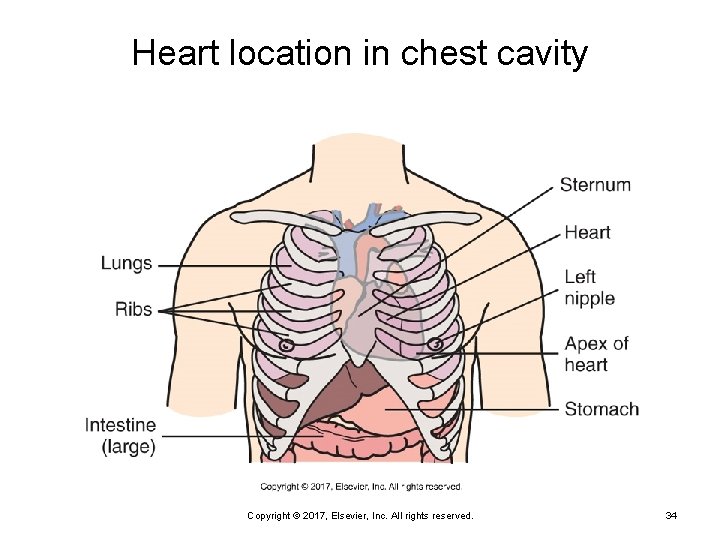
Heart location in chest cavity Copyright © 2017, Elsevier, Inc. All rights reserved. 34
Copyright © 2017, Elsevier, Inc. All rights reserved. 35
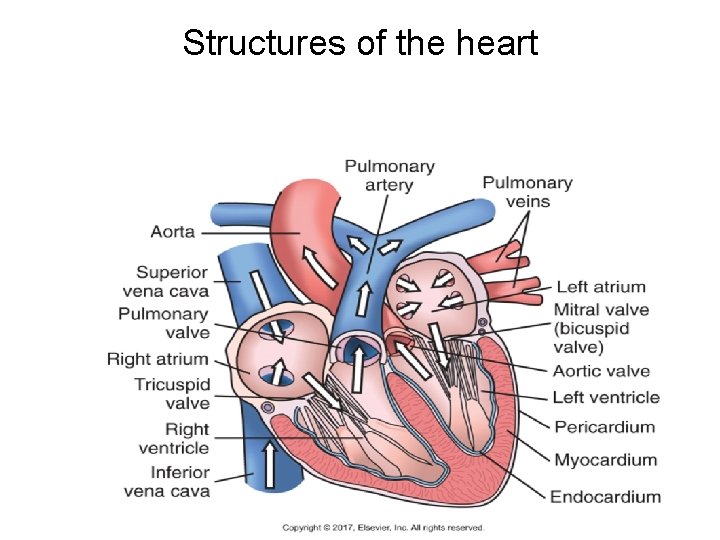
Structures of the heart Copyright © 2017, Elsevier, Inc. All rights reserved. 36
The Circulatory System (Cont. ) The blood vessels Arteries carry blood away from the heart. • The aorta is the largest artery. • The smallest branch of an artery is an arteriole. Ø Capillaries are very tiny blood vessels. • The capillaries pick up waste products from the cells. Ø Veins return blood to the heart. • The two main veins are the inferior vena cava and the Ø superior vena cava. Copyright © 2017, Elsevier, Inc. All rights reserved. 37
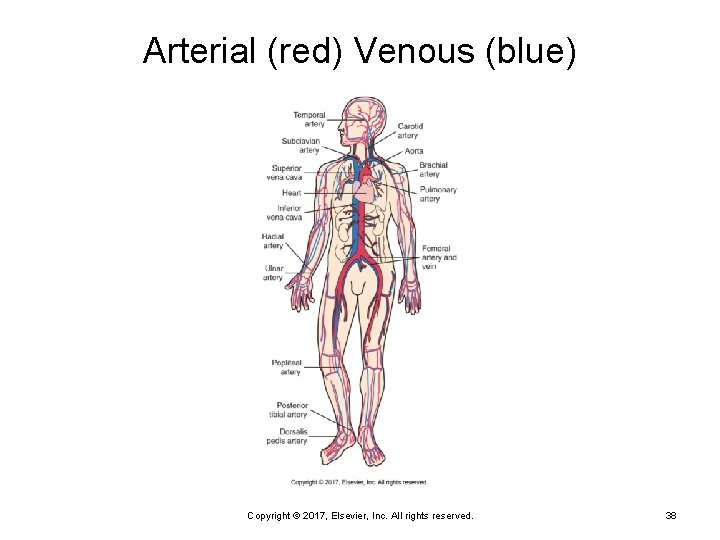
Arterial (red) Venous (blue) Copyright © 2017, Elsevier, Inc. All rights reserved. 38
The Lymphatic System The lymphatic system is a complex network that transports lymph throughout the body. The lymphatic system Collects extra lymph from the tissues and returns it to the blood; this helps maintain fluid balance Ø Defends the body against infection by producing lymphocytes Ø Absorbs fats from the intestines and transports them to the blood Ø Copyright © 2017, Elsevier, Inc. All rights reserved. 39
The Lymphatic System (Cont. ) Right lymphatic duct Collects lymph from the right arm and from the right side of the head, neck, and chest Ø Empties into a vein on the right side of the neck Ø Thoracic duct Collects lymph from the pelvis, abdomen, lower chest, and rest of the body Ø Empties into a vein on the left side of the neck Ø Copyright © 2017, Elsevier, Inc. All rights reserved. 40
The Lymphatic System (Cont. ) Tonsils and adenoids Ø Trap microorganisms in the mouth and nose to help prevent infection Spleen Ø Ø Ø Is the largest structure in the lymphatic system Has a rich blood supply Filters and removes bacteria and other substances Destroys old RBCs Saves the iron found in hemoglobin when RBCs are destroyed Stores blood Copyright © 2017, Elsevier, Inc. All rights reserved. 41
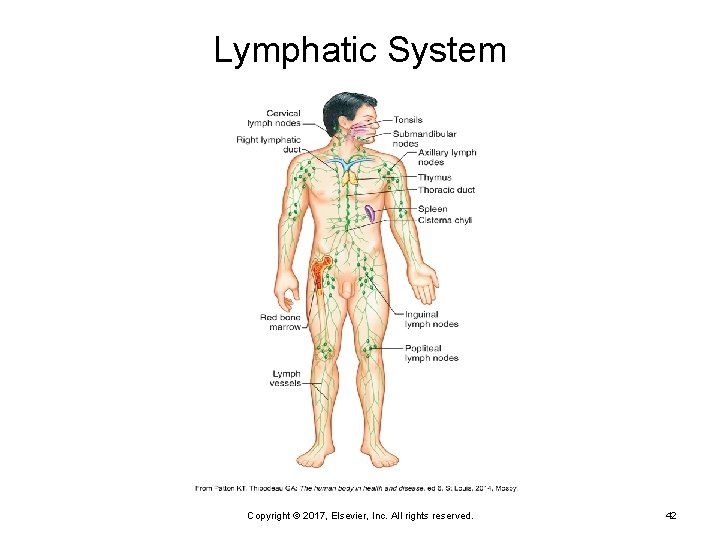
Lymphatic System Copyright © 2017, Elsevier, Inc. All rights reserved. 42
The Respiratory System (Cont. ) Respiration involves inhalation (inspiration) and exhalation (expiration). The lungs are spongy tissues filled with alveoli, blood vessels, and nerves. Ø Each lung is divided into lobes. • The right lung has three lobes; the left lung has two. The lungs are separated from the abdominal cavity by a muscle called the diaphragm. Ø Each lung is covered by a two-layered sac called the pleura. Ø A bony framework made up of the ribs, sternum, and vertebrae protects the lungs. Ø Copyright © 2017, Elsevier, Inc. All rights reserved. 43
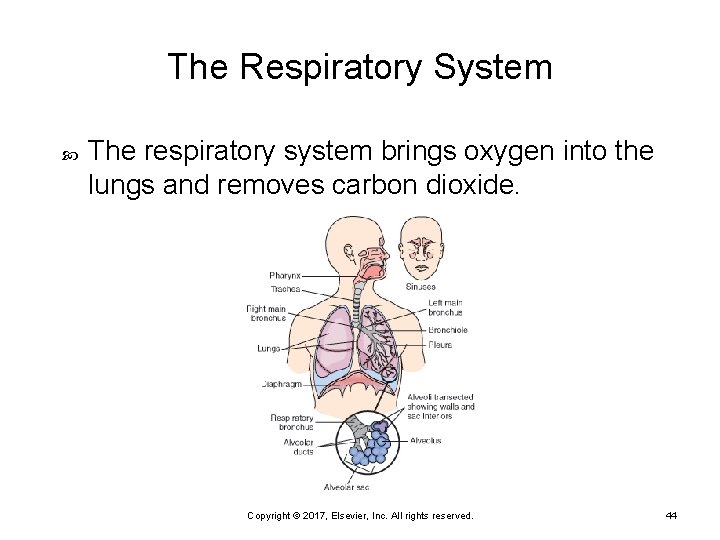
The Respiratory System The respiratory system brings oxygen into the lungs and removes carbon dioxide. Copyright © 2017, Elsevier, Inc. All rights reserved. 44
The Digestive System (Cont. ) Digestion Breaks down food physically and chemically so it can be absorbed for use by the cells Ø Removes solid wastes from the body Ø The digestive system involves the alimentary canal (GI tract) and the accessory organs of digestion. Its major parts are the mouth, pharynx, esophagus, stomach, small intestine, and large intestine. Ø Accessory organs are the teeth, tongue, salivary glands, liver, gallbladder, and pancreas. Ø Copyright © 2017, Elsevier, Inc. All rights reserved. 45
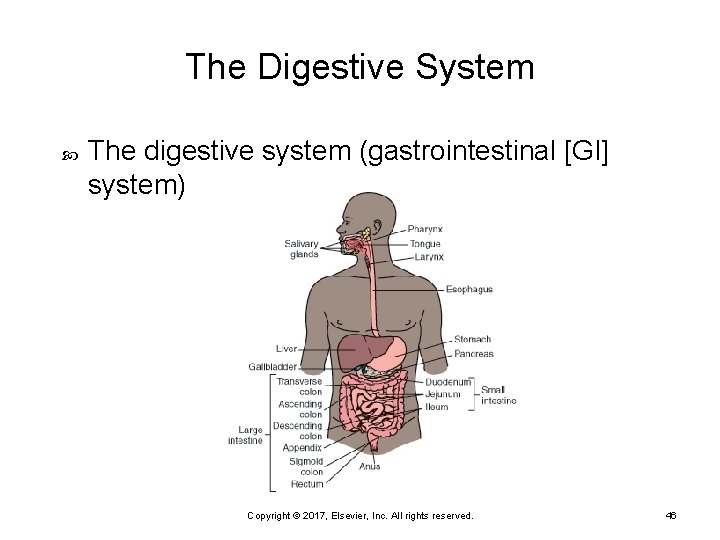
The Digestive System The digestive system (gastrointestinal [GI] system) Copyright © 2017, Elsevier, Inc. All rights reserved. 46
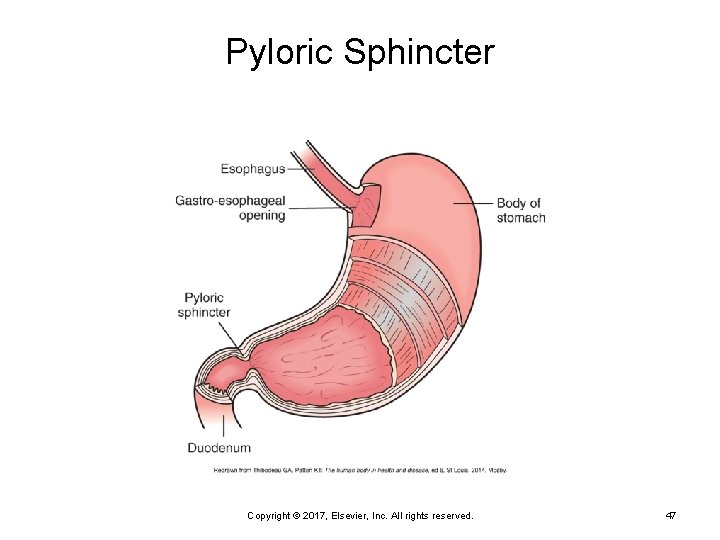
Pyloric Sphincter Copyright © 2017, Elsevier, Inc. All rights reserved. 47
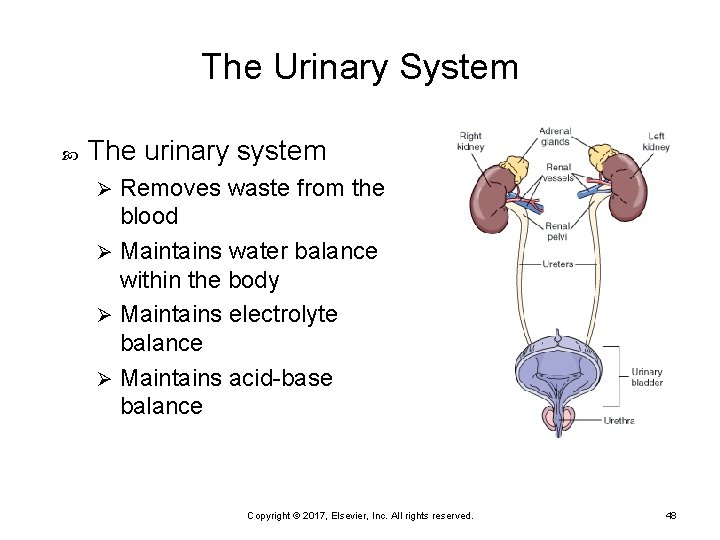
The Urinary System The urinary system Removes waste from the blood Ø Maintains water balance within the body Ø Maintains electrolyte balance Ø Maintains acid-base balance Ø Copyright © 2017, Elsevier, Inc. All rights reserved. 48
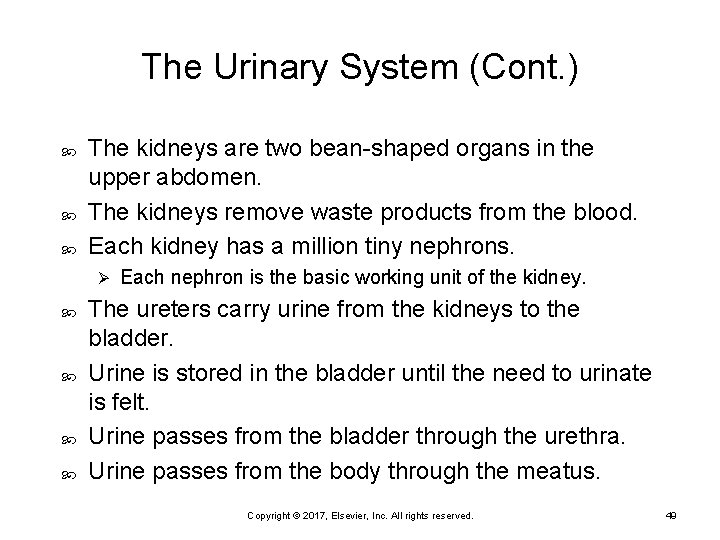
The Urinary System (Cont. ) The kidneys are two bean-shaped organs in the upper abdomen. The kidneys remove waste products from the blood. Each kidney has a million tiny nephrons. Ø Each nephron is the basic working unit of the kidney. The ureters carry urine from the kidneys to the bladder. Urine is stored in the bladder until the need to urinate is felt. Urine passes from the bladder through the urethra. Urine passes from the body through the meatus. Copyright © 2017, Elsevier, Inc. All rights reserved. 49
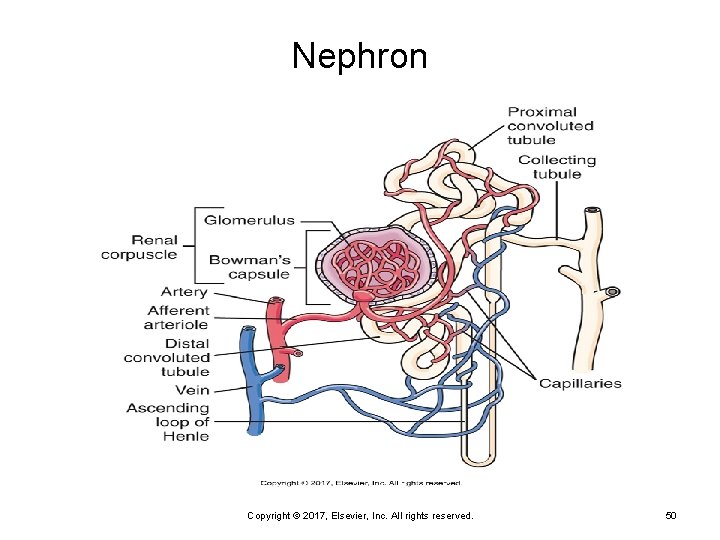
Nephron Copyright © 2017, Elsevier, Inc. All rights reserved. 50
The Reproductive System Human reproduction results from the union of a male sex cell and a female sex cell. Differences in the male and female reproductive systems allow for the process of reproduction. Copyright © 2017, Elsevier, Inc. All rights reserved. 51
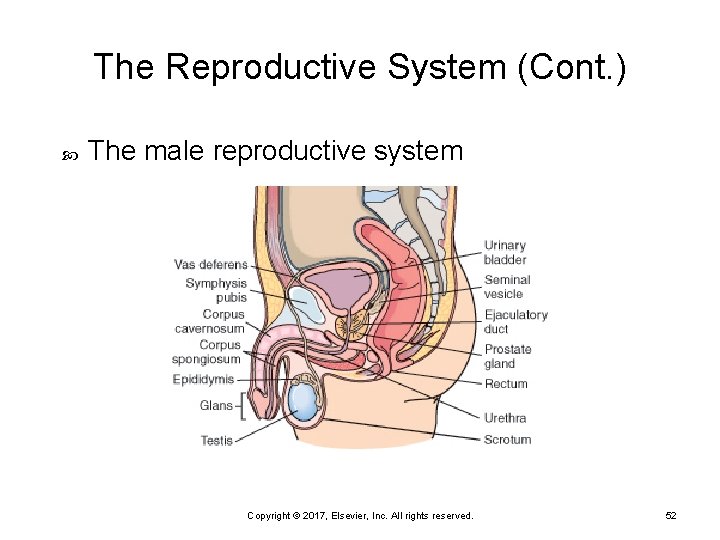
The Reproductive System (Cont. ) The male reproductive system Copyright © 2017, Elsevier, Inc. All rights reserved. 52
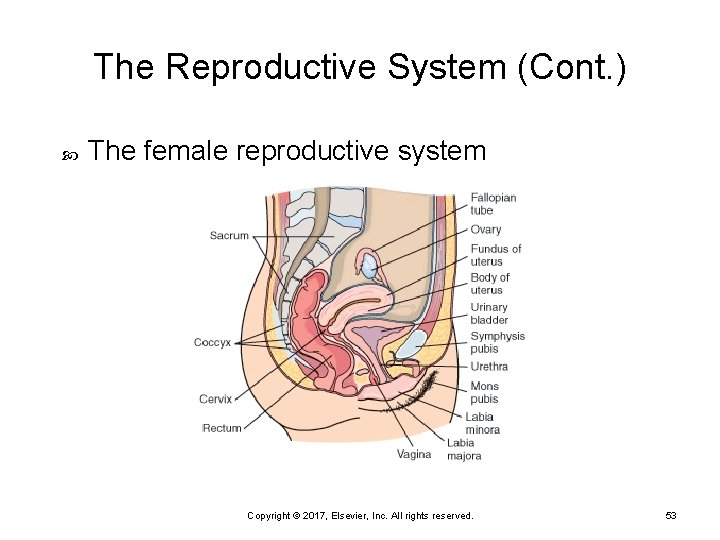
The Reproductive System (Cont. ) The female reproductive system Copyright © 2017, Elsevier, Inc. All rights reserved. 53
The Reproductive System (Cont. ) The external female genitalia is called the vulva. The mons pubis is a rounded, fatty pad over a bone called the symphysis pubis. Ø The labia majora and labia minora are two folds of tissue on each side of the vaginal opening. Ø The clitoris is a small organ composed of erectile tissue. Ø It becomes hard when sexually stimulated. Ø The mammary glands (breasts) secrete milk after childbirth. Ø Copyright © 2017, Elsevier, Inc. All rights reserved. 54
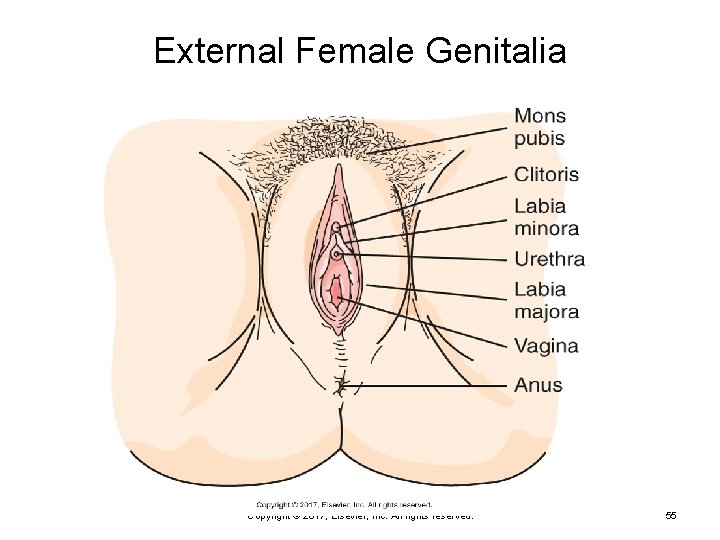
External Female Genitalia Copyright © 2017, Elsevier, Inc. All rights reserved. 55
The Reproductive System (Cont. ) Menstruation Ø If pregnancy does not occur, the endometrium breaks up and is discharged from the body through the vagina. The uniting of the sperm and ovum into one cell is called fertilization. During intercourse, millions of sperm are deposited into the vagina. Ø If a sperm and an ovum unite in a fallopian tube, fertilization results. Ø The fertilized cell travels down the fallopian tube to the uterus. Ø The fertilized cell implants in the thick endometrium and grows during pregnancy. Ø Copyright © 2017, Elsevier, Inc. All rights reserved. 56
The Endocrine System The endocrine system is made up of glands called the endocrine glands. The endocrine glands secrete chemical substances called hormones into the bloodstream. Ø Hormones regulate the activities of other organs and glands in the body. Ø Copyright © 2017, Elsevier, Inc. All rights reserved. 57
The Endocrine System (Cont. ) The pituitary gland is called the master gland. It is at the base of the brain behind the eyes. Ø The anterior pituitary lobe secretes: • Growth hormone (GH) • Thyroid-stimulating hormone (TSH) • Adrenocorticotropic hormone (ACTH) • Hormones that regulate growth, development, and Ø function of the male and female reproductive systems Ø The posterior pituitary lobe secretes: • Antidiuretic hormone (ADH) • Oxytocin Copyright © 2017, Elsevier, Inc. All rights reserved. 58
The Endocrine System (Cont. ) The thyroid gland is in the neck in front of the larynx. Ø The thyroid gland secretes thyroid hormone (TH, thyroxine). There are four parathyroid glands. Two lie on each side of the thyroid gland. Ø The parathyroid glands secrete parathormone. Ø Copyright © 2017, Elsevier, Inc. All rights reserved. 59
The Endocrine System (Cont. ) There are two adrenal glands. The adrenal medulla secretes epinephrine and norepinephrine. Ø The adrenal cortex secretes three groups of hormones needed for life. • Glucocorticoids • Mineralocorticoids • Small amounts of male and female sex hormones Ø Copyright © 2017, Elsevier, Inc. All rights reserved. 60
The Endocrine System (Cont. ) The thymus secretes the hormone thymosin. The pancreas secretes insulin. The gonads are the glands of human reproduction. Male sex glands (testes) secrete testosterone. Ø Female sex glands (ovaries) secrete estrogen and progesterone. Ø Copyright © 2017, Elsevier, Inc. All rights reserved. 61
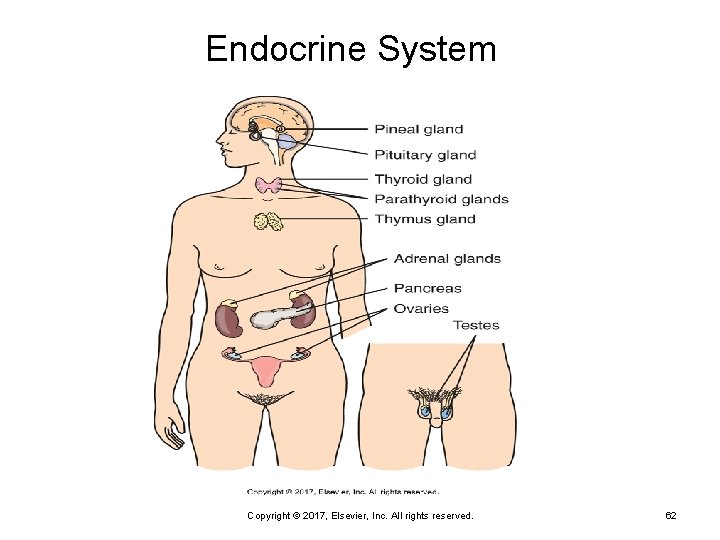
Endocrine System Copyright © 2017, Elsevier, Inc. All rights reserved. 62
The Immune System Protects the body from disease and infection Defends against threats inside and outside the body Special cells and substances function to produce immunity. Ø Ø Ø Antibodies Antigens Phagocytes Lymphocytes B lymphocytes (B cells) T lymphocytes (T cells) When the body senses an antigen (an unwanted substance), the immune system reacts. Copyright © 2017, Elsevier, Inc. All rights reserved. 63
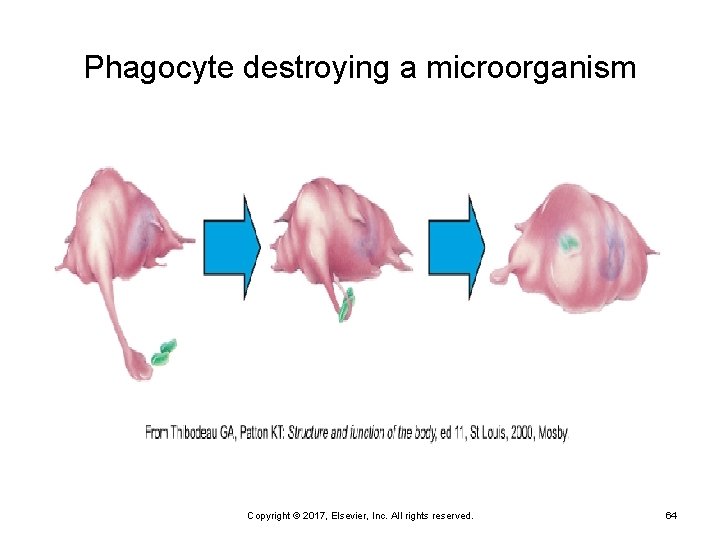
Phagocyte destroying a microorganism Copyright © 2017, Elsevier, Inc. All rights reserved. 64
- Slides: 64