
Chapter 10 Blended Competencies Clinical Reasoning and Processes
Chapter 10 Blended Competencies, Clinical Reasoning, and Processes of Person-Centered Care Copyright © 2011 Wolters Kluwer Health | Lippincott Williams & Wilkins
![“Who nurses choose to be every time they show up for practice [work] literally](http://slidetodoc.com/presentation_image_h/2558d218e4ae9314fbefcdbabffd2c85/image-2.jpg "“Who nurses choose to be every time they show up for practice [work] literally")
“Who nurses choose to be every time they show up for practice [work] literally has the power to influence and in some cases determine how people are born, live, suffer and die. ” (Textbook p. 195)
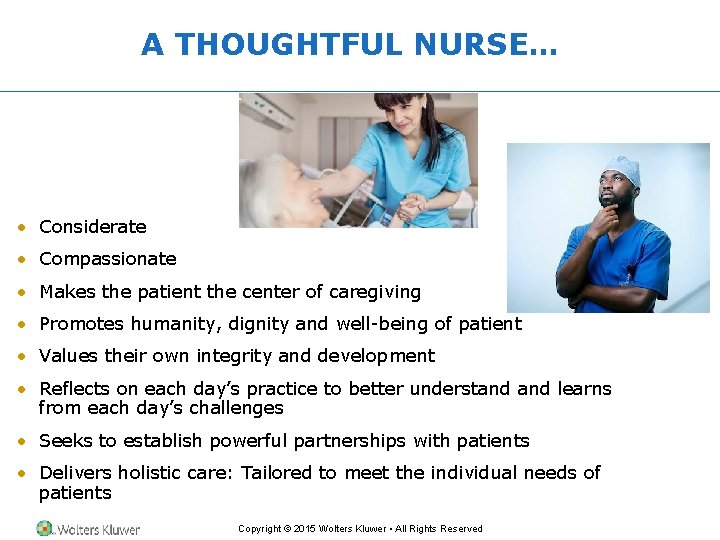
A THOUGHTFUL NURSE… • Considerate • Compassionate • Makes the patient the center of caregiving • Promotes humanity, dignity and well-being of patient • Values their own integrity and development • Reflects on each day’s practice to better understand learns from each day’s challenges • Seeks to establish powerful partnerships with patients • Delivers holistic care: Tailored to meet the individual needs of patients Copyright © 2015 Wolters Kluwer • All Rights Reserved
Thoughtful Person-Centered Practice • The person/patient • The professional nurse • Reflective practice leading to personal learning • Clinical reasoning, judgment, and decision making • The nurse’s action in response to individual clinical needs • Patient-centered nursing process Copyright © 2015 Wolters Kluwer • All Rights Reserved
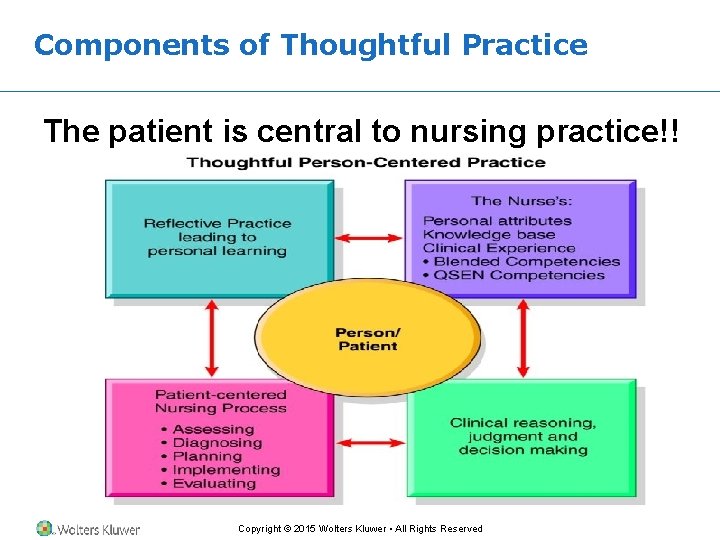
Components of Thoughtful Practice The patient is central to nursing practice!! Copyright © 2015 Wolters Kluwer • All Rights Reserved
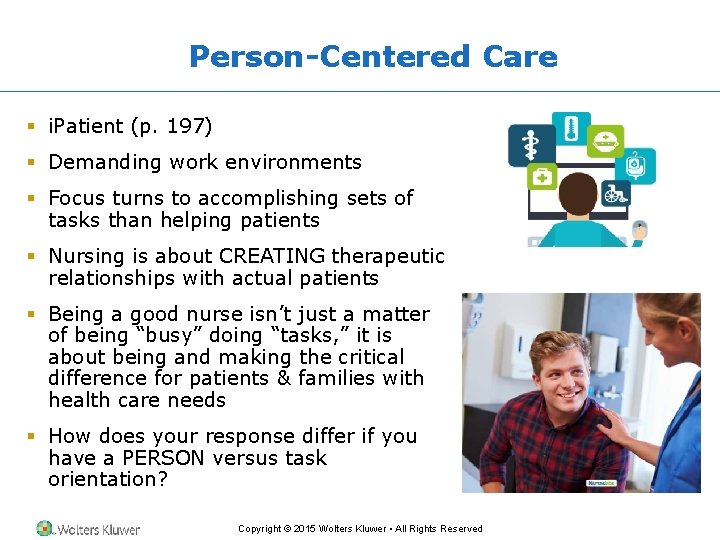
Person-Centered Care § i. Patient (p. 197) § Demanding work environments § Focus turns to accomplishing sets of tasks than helping patients § Nursing is about CREATING therapeutic relationships with actual patients § Being a good nurse isn’t just a matter of being “busy” doing “tasks, ” it is about being and making the critical difference for patients & families with health care needs § How does your response differ if you have a PERSON versus task orientation? Copyright © 2015 Wolters Kluwer • All Rights Reserved
10 Guiding Principles of Person-Centered Care 1. All team members are considered caregivers. 2. Care is based on continuous healing relationships. 3. Care is customized and reflects patient needs, values, and choices. 4. Knowledge and information are freely shared between and among patients, care partners, physicians, and other caregivers. 5. Care is provided in a healing environment of comfort, peace, and support. Copyright © 2015 Wolters Kluwer • All Rights Reserved
10 Guiding Principles of Person-Centered Care (cont. ) 6. Families and friends of the patient are considered an essential part of the care team. 7. Patient safety is a visible priority. 8. Transparency is the rule in the care of the patient. 9. All caregivers cooperate with one another through a common focus on the best interests and personal goals of the patient. 10. The patient is the source of control for one’s care. Copyright © 2015 Wolters Kluwer • All Rights Reserved
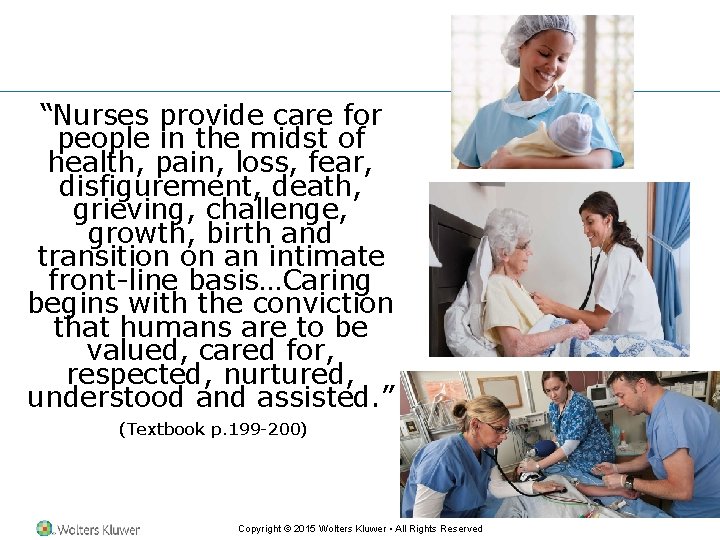
“Nurses provide care for people in the midst of health, pain, loss, fear, disfigurement, death, grieving, challenge, growth, birth and transition on an intimate front-line basis…Caring begins with the conviction that humans are to be valued, cared for, respected, nurtured, understood and assisted. ” (Textbook p. 199 -200) Copyright © 2015 Wolters Kluwer • All Rights Reserved
Blended Competencies-Summarized • Cognitive Skills—using critical thinking; a systematic way to form and shape one’s thinking • Technical Skills—manipulating equipment skillfully to produce desired outcome (practice skill in lab) • Interpersonal Skills—promoting the dignity and respect of patients and establishing caring relationships • Ethical/legal Skills—establishing a personal moral code and professional role responsibilities Copyright © 2015 Wolters Kluwer • All Rights Reserved
Blended Competencies • Developing Cognitive Competencies or the method of critical thinking: – Offer scientific rationale for patient plan of care. – Select nursing interventions most likely to yield desired outcomes. – Use critical thinking to solve problems creatively. – Display purpose of thinking and adequacy of knowledge. – Work through potential problems and use helpful resources. – Critique judgments/decisions • Developing the personal attributes to think critically Copyright © 2015 Wolters Kluwer • All Rights Reserved
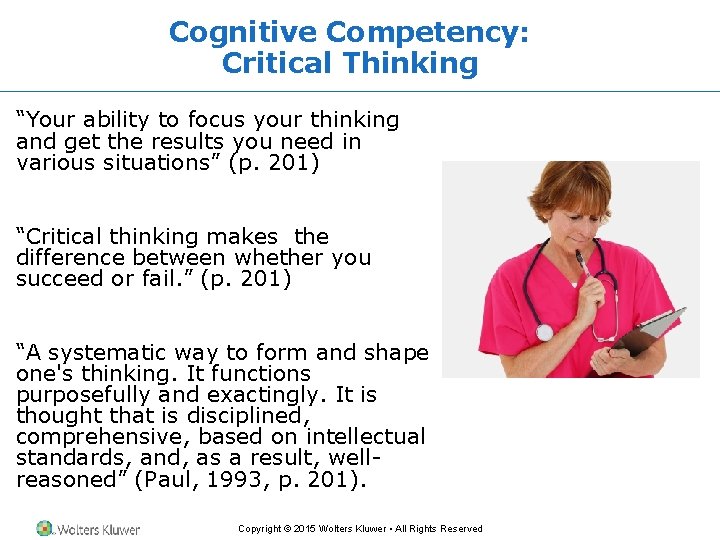
Cognitive Competency: Critical Thinking “Your ability to focus your thinking and get the results you need in various situations” (p. 201) “Critical thinking makes the difference between whether you succeed or fail. ” (p. 201) “A systematic way to form and shape one's thinking. It functions purposefully and exactingly. It is thought that is disciplined, comprehensive, based on intellectual standards, and, as a result, wellreasoned” (Paul, 1993, p. 201). Copyright © 2015 Wolters Kluwer • All Rights Reserved
Blended Competencies (cont. ) • Developing Technical Competencies – Use technical equipment with competence and ease to achieve goals with minimal distress to patients. – Creatively adapt equipment and technical procedures to needs of patients in diverse circumstances. – NEVER forget that the patient’s well-being and sometimes the patient’s life depend on your technical competence Copyright © 2015 Wolters Kluwer • All Rights Reserved
Blended Competencies (cont. ) • Developing Interpersonal Competencies – Use interactions with patients and significant others and colleagues to promote human dignity and respect. – Elicit personal strengths and abilities of patients to achieve health goals and establish caring relationships. – Provide the healthcare team with knowledge about patient goals and expectations. – Work collaboratively with healthcare team as respected and credible colleagues. Copyright © 2015 Wolters Kluwer • All Rights Reserved
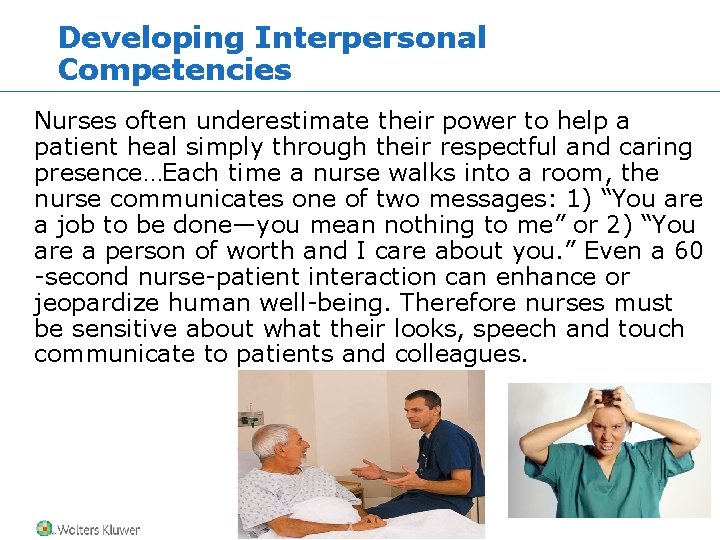
Developing Interpersonal Competencies Nurses often underestimate their power to help a patient heal simply through their respectful and caring presence…Each time a nurse walks into a room, the nurse communicates one of two messages: 1) “You are a job to be done—you mean nothing to me” or 2) “You are a person of worth and I care about you. ” Even a 60 -second nurse-patient interaction can enhance or jeopardize human well-being. Therefore nurses must be sensitive about what their looks, speech and touch communicate to patients and colleagues. Copyright © 2015 Wolters Kluwer • All Rights Reserved
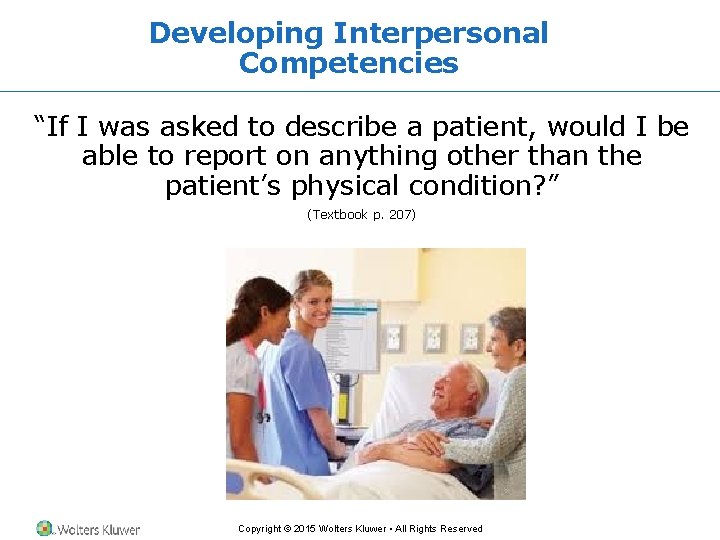
Developing Interpersonal Competencies “If I was asked to describe a patient, would I be able to report on anything other than the patient’s physical condition? ” (Textbook p. 207) Copyright © 2015 Wolters Kluwer • All Rights Reserved
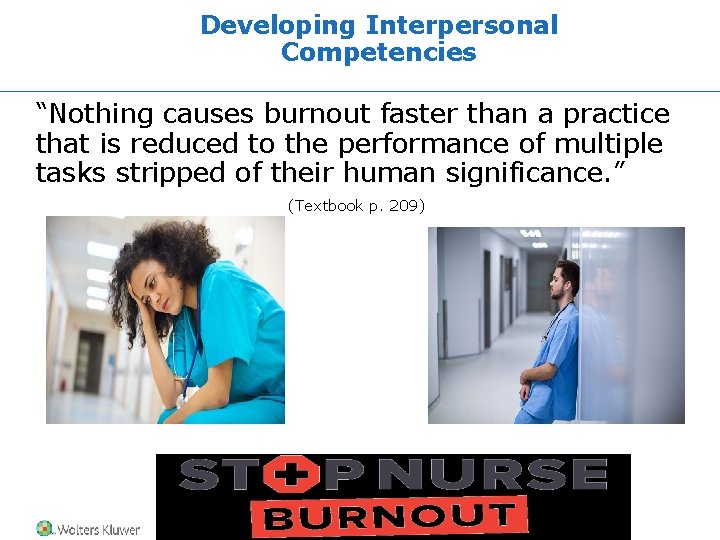
Developing Interpersonal Competencies “Nothing causes burnout faster than a practice that is reduced to the performance of multiple tasks stripped of their human significance. ” (Textbook p. 209) Copyright © 2015 Wolters Kluwer • All Rights Reserved
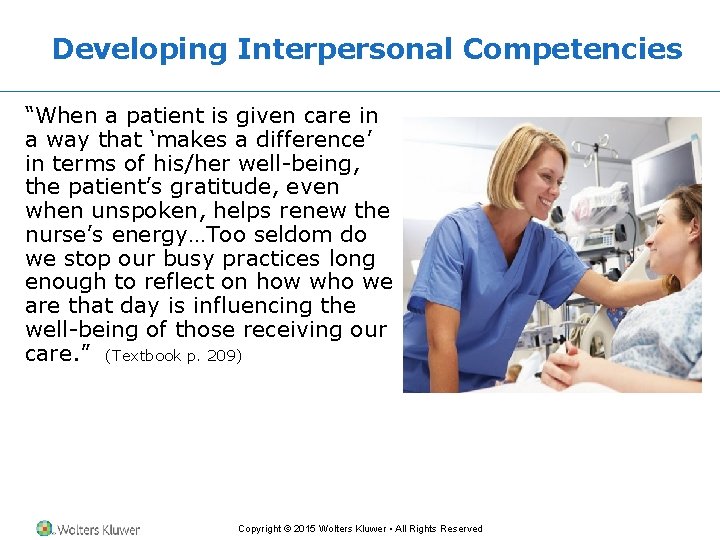
Developing Interpersonal Competencies “When a patient is given care in a way that ‘makes a difference’ in terms of his/her well-being, the patient’s gratitude, even when unspoken, helps renew the nurse’s energy…Too seldom do we stop our busy practices long enough to reflect on how who we are that day is influencing the well-being of those receiving our care. ” (Textbook p. 209) Copyright © 2015 Wolters Kluwer • All Rights Reserved
Blended Competencies (cont. ) • Developing Ethical/Legal Competencies – Are trusted to act in ways that advance interests of patients- establish a personal ethical code – Are accountable for the practice- documents interventions. If it wasn’t documented, it WASN’T done! – Act as effective patient advocates – Mediate ethical conflict among patient, significant others, and healthcare team • Must report incompetent, unethical, or illegal practices!! “whistle-blowing” Copyright © 2015 Wolters Kluwer • All Rights Reserved
QSEN Competencies • Quality and Safety Education for Nurses • Goal of the project is to meet the challenge of preparing future nurses who will have the knowledge, skills and attitudes (KSAs) necessary to continuously improve the quality and safety of the health care systems within which they work • Quality and Safety Competencies for nursing and proposed targets for the knowledge, skills and attitudes to be developed in pre-licensure programs for each competency Copyright © 2015 Wolters Kluwer • All Rights Reserved
QSEN Competencies Preparing future nurses who will have the knowledge, skills, and attitudes (KSAs) necessary to continuously improve the quality and safety of the health care systems within which they work ! e s e h T e z i r o m e M • Person-centered care • Teamwork and collaboration • Evidence-based practice • Quality improvement • Safety • Informatics Copyright © 2015 Wolters Kluwer • All Rights Reserved

Trial-and-Error Problem-Solving Ø Involves testing any number of solutions until one is found that words for that particular problem Ø NOT efficient for the nurse Ø Can be dangerous to the patient Ø NOT recommended as a guide for nursing practice Ø Example: Experiencing with ethnic food on dehydrated patient Ø P. 212 Copyright © 2015 Wolters Kluwer • All Rights Reserved
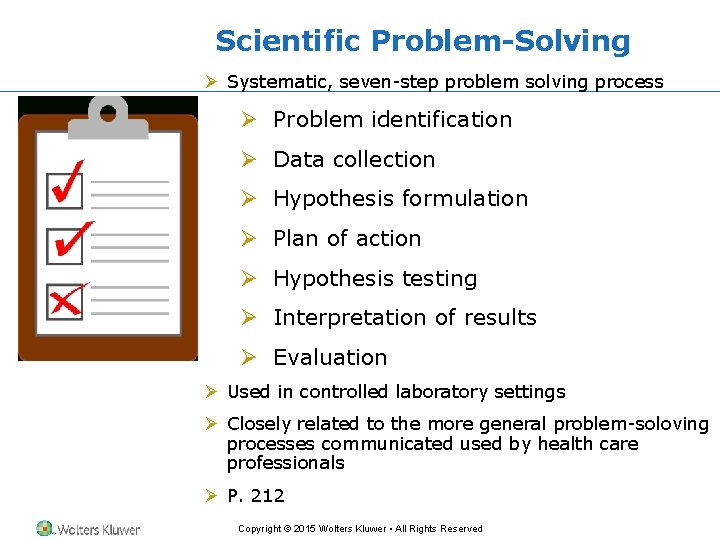
Scientific Problem-Solving Ø Systematic, seven-step problem solving process Ø Problem identification Ø Data collection Ø Hypothesis formulation Ø Plan of action Ø Hypothesis testing Ø Interpretation of results Ø Evaluation Ø Used in controlled laboratory settings Ø Closely related to the more general problem-soloving processes communicated used by health care professionals Ø P. 212 Copyright © 2015 Wolters Kluwer • All Rights Reserved
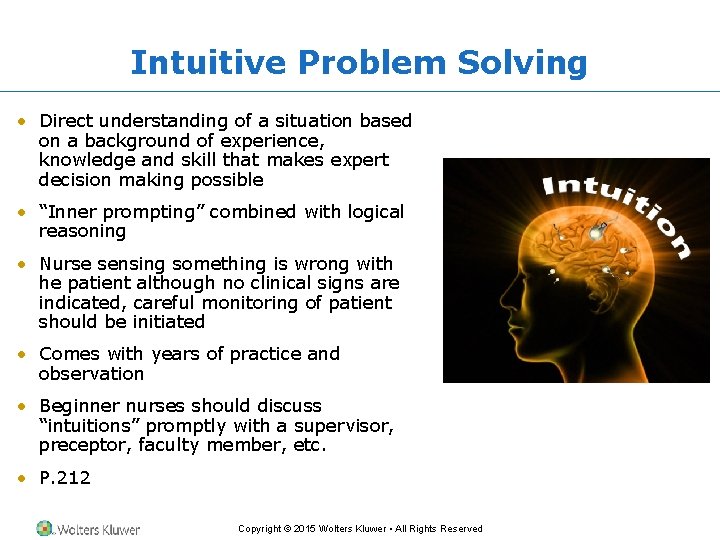
Intuitive Problem Solving • Direct understanding of a situation based on a background of experience, knowledge and skill that makes expert decision making possible • “Inner prompting” combined with logical reasoning • Nurse sensing something is wrong with he patient although no clinical signs are indicated, careful monitoring of patient should be initiated • Comes with years of practice and observation • Beginner nurses should discuss “intuitions” promptly with a supervisor, preceptor, faculty member, etc. • P. 212 Copyright © 2015 Wolters Kluwer • All Rights Reserved
Problem Solving and the Nursing Process • Systematic method that provides a framework for the nurse and patient to develop a holistic plan of care – Four aims of nursing: PROMOTE health, PREVENT disease or illness, to RESTORE health, to FACILITATE coping with altered functioning** • Forms the basic framework of research • Distinguishes nursing as a profession, distinct from medicine Copyright © 2015 Wolters Kluwer • All Rights Reserved
Five Steps of the Nursing Process ADPIE: Learn it, Love it, Live it!!!! • Assessing: collecting, validating, and communicating patient data • Diagnosing: analyzing patient data to identify patient strengths and problems • Planning: specifying patient outcomes and related nursing interventions • Implementing: carrying out the plan of care • Evaluating: measuring extent to which patient achieved outcomes Copyright © 2015 Wolters Kluwer • All Rights Reserved
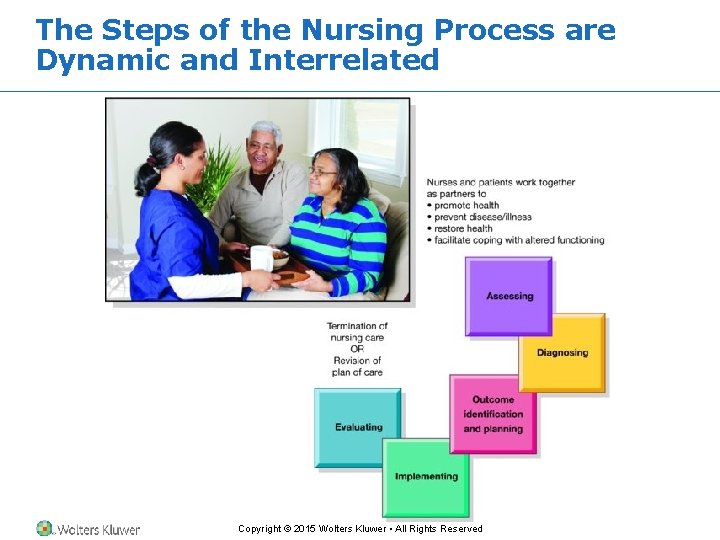
The Steps of the Nursing Process are Dynamic and Interrelated Copyright © 2015 Wolters Kluwer • All Rights Reserved
Characteristics of the Nursing Process • Systematic: part of an ordered sequence of activities • Dynamic: great interaction and overlapping among the five steps • Interpersonal: human being is always at the heart of nursing (patient-centered) • Outcome Oriented: nurses and patients work together to identify outcomes • Universally Applicable: a framework for all nursing activities Copyright © 2015 Wolters Kluwer • All Rights Reserved
Benefits of the Nursing Process • Patient – Scientifically based, holistic individualized patient care – Continuity of care – Clear, efficient, cost-effective plan of action • Nurse – Opportunity to work collaboratively with other health care workers – Satisfaction of making a difference in lives of patients – Opportunity to grow professionally Copyright © 2015 Wolters Kluwer • All Rights Reserved
- Slides: 30