
Chapter 10 Billing the Guest Folio Learning Objectives
Chapter 10 Billing the Guest Folio
Learning Objectives § § Understand front-office recordkeeping. Describe an account receivable. Define the guest folio. Understand the differences between the Transient Ledger vs. the City Ledger.
Accounts Receivable (1 of 7) Account Receivable ◦ A customer who owes a business for services that have not been paid. ◦ The bill containing the account of a guest is a “folio” ◦ Hotels have two types of customers: ◦ Transient guests – Those currently registered and occupying rooms ◦ The guest in Room# 314 ◦ City Guests – Persons or organizations that owe the hotel but are not currently staying at the hotel ◦ VISA, AMEX, Corporation ABC Inc.
Accounts Receivable (2 of 7) Types of Accounts Receivable ◦ The Ledger – An accounting book, that contains a set of accounts. ◦ The Transient Ledger (= Front Office Ledger = Guest Ledger = Rooms Ledger) ◦ Where the folios of the current registered guests are kept. ◦ It is maintained at the Front Desk. ◦ Charges are “posted” continually, as incurred by guests. ◦ Bill is presented to the guest on departure. ◦ The City Ledger ◦ Where the folios of of non-registered guests/organizations are. ◦ It is maintained in the Accounting Office. ◦ Charges are posted periodically and bill is presented for payment periodically.
Accounts Receivable (3 of 7) ◦ What is and isn’t accounted for ◦ When guests pay cash directly, no “accounts receivable” is created.
Accounts Receivable (4 of 7) Folio (= Guest Bill or Guest Account) ◦ The individual account receivable ◦ Location and filing of folios ◦ Kept at the FO in paper form in manual systems. ◦ Kept in memory of the computer system and printed on demand at the FO in a computerized system. ◦ Number of folios ◦ One per room is most common ◦ One per guest, when rooms are shared ◦ One per many rooms, if one guest is paying
Accounts Receivable (5 of 7) Master Accounts ◦ Used for single-entity groups for common charges, not billable to individuals. How master accounts are structured: ◦ Single entity groups ◦ Convention groups ◦ Tour groups

Accounts Receivable (6 of 7) Split billing ◦ The distribution of charges between a Master Account/Folio (A Folio) and a guests personal folio (B Folio) ◦ Casino Comps ◦ – Posted to A Folio, others to B Folio ◦ Preferred-guest Programs ◦ Room rate to A Folio, others to B
Accounts Receivable (7 of 7) Understanding Charges and Credits ◦ Charges/Debits - Charges incurred by the guest that increase the amount owed ◦ Assets - Something a business owns ◦ Cash, accounts receivable ◦ Increase in incomes are made with credits ◦ Sale of room, food, beverages ◦ Sales or Incomes

Posting to the Folio (The Account Receivable) (1 of 8) Overview of the Billing Procedure ◦ Preparation of the Folio ◦ The folio is created when the guest arrives and registers; may be pre-printed if computerized. ◦ Folios are sequentially numbered for control purposes. ◦ All relevant information is on the folio. ◦ Filing the folio ◦ Electronic folios are in computer memory and printed on demand. ◦ Manual folios are filed sequentially by room number at the FO in cashiers well or pit or bucket.
Posting to the Folio (The Account Receivable) (2 of 8) ◦ Presenting the bill ◦ Credit is a privilege, hotelier has the right to demand pre-payment. ◦ Bills are presented normally on departure. ◦ Bills may be presented weekly, or when credit limit is reached.
Posting to the Folio (The Account Receivable) (3 of 8) ◦ Communicating the charges ◦ Guests incur charges throughout the hotel. ◦ It is vital to get that charge information from the Point of Sale to the FO quickly and accurately. ◦ Without an electronic interface ◦ Bellboys, runners, waiters used to physically carry vouchers ◦ Vouchers delayed, lost, or misplaced in the process. ◦ Resulting problem of difficult to collect “late charges” ◦ Pneumatic tubes used in larger properties to send vouchers just like drive-thru banks ◦ Need to prepare Department Control sheet at POS ◦ With electronic systems ◦ Point of Sale (POS) systems integrated into Property Management Systems (PMS) ◦ Instantaneous, automatic, and accurate posting of charges

Posting to the Folio (The Account Receivable) (4 of 8) Recording Charges to Accounts Receivable ◦ Understanding the Posting Line ◦ Reference Numbers – Each department charge has a number ◦ Posting Room Charges ◦ Sales taxes Recording Credits to Accounts Receivable ◦ Three means of setting accounts ◦ Cash: $, other currency, personal/travelers checks ◦ Allowance: Reduction in the guests bill ◦ Transfers
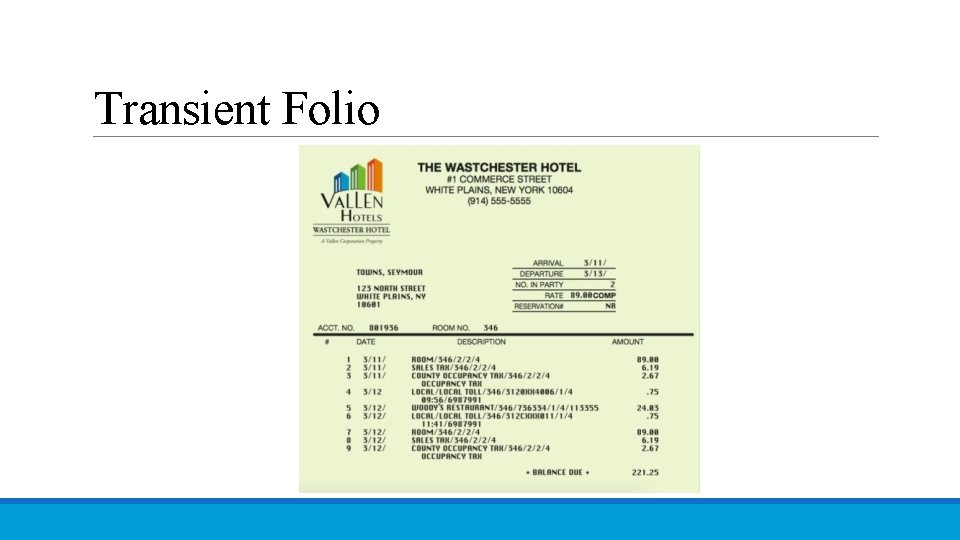
Transient Folio
Posting to the Folio (The Account Receivable) (5 of 8) Settling with Allowances ◦ Stores give you a partial or full refund (Credit), if you return your purchase, for an error etc. ◦ Comp Allowances - When the whole bill or some items are given free or “comped”; Example - High-Roller in a Casino ◦ Allowances for poor service - Discount given for poor service, bad or delayed food/drinks etc. ◦ Allowances to correct errors - Mathematical errors, “I never made that call/saw that in-room movie” etc. , ◦ Extended-Stay allowance - Discount given as a condition of extended stay. Full rate is charged and allowance given at end ◦ Recording the Allowance
Posting to the Folio (The Account Receivable) (6 of 8) Settling with Transfer ◦ An accounting technique that moves a figure from one folio/account to another ◦ One account is credited, the other debited by the same amount ◦ Folio Transfer from Registered Guest to Registered Guest
Posting to the Folio (The Account Receivable) (7 of 8) ◦ Transient Ledger to City Ledger: Credit Cards ◦ Most common; used when guest pays by credit card ◦ Folio balance of the guest is transferred to the folio of credit card company (AMEX, VISA, Discover etc. , ) in the City Ledger ◦ Exhibit 10 -2 ◦ Transient Ledger to City Ledger: Direct ◦ When the folio balance of guest is transferred to an authorized individual/corporate/organizational account ◦ Example: Guest folio amount is transferred to UNT account, as guest came on official visit invited by UNT
Posting to the Folio (The Account Receivable) (8 of 8) ◦ Master accounts ◦ Coupons ◦ Skippers ◦ Transfer from the City Ledger to the Guest Ledger: Advance Deposits
- Slides: 18