
Chapter 10 Balance Learning Outcomes Expectations Balance and
Chapter 10 Balance
Learning Outcomes • Expectations: – Balance and its role in injury prevention – Creating progressive balance-training programs – Be able to do, instruct, and describe a wide variety of balancetraining exercises
What is Balance • Why we need it – Necessary for all functional movements – Has two varieties • Static and Dynamic balance – Reducing, receiving, and accepting force on the right joints at the right time and having adequate ability to stabilize and the body flows through all planes of motion is what is needed to achieve dynamic balance
How to Train Balance • Balance training should continuously push someone outside of their ability to remain completely stabilized (balance threshold) but then allow them to come back to stabilization – Limit of stability • how far someone can go outside of their base of support before having to return to safety – Need to stress this system in all planes of motion and in unstable environments (ie: single-leg, bosu, Airex pad, etc)
How to Train Balance • Proprioceptively Enriched Environments – Unstable yet controllable environment – Progress appropriately – Proper progression • • • Floor Balance beam Half foam roll Airex pad* Dyna Disc
Why we do it • Benefits – Improves dynamic joint stabilization. * • Stabilizing a joint through movement – The main goal for Balance Stabilization Exercises is to improve reflexive muscle contractions. *
Problems Occurring • Problems causing poor balance – Muscle imbalances, joint dysfunctions, pain, and swelling – Most adults experience low back pain – Lower extremity injuries (ACL tears and ankle sprains) – Most clients that come across fitness professionals will have something wrong with them that is causing them to have poor balance.
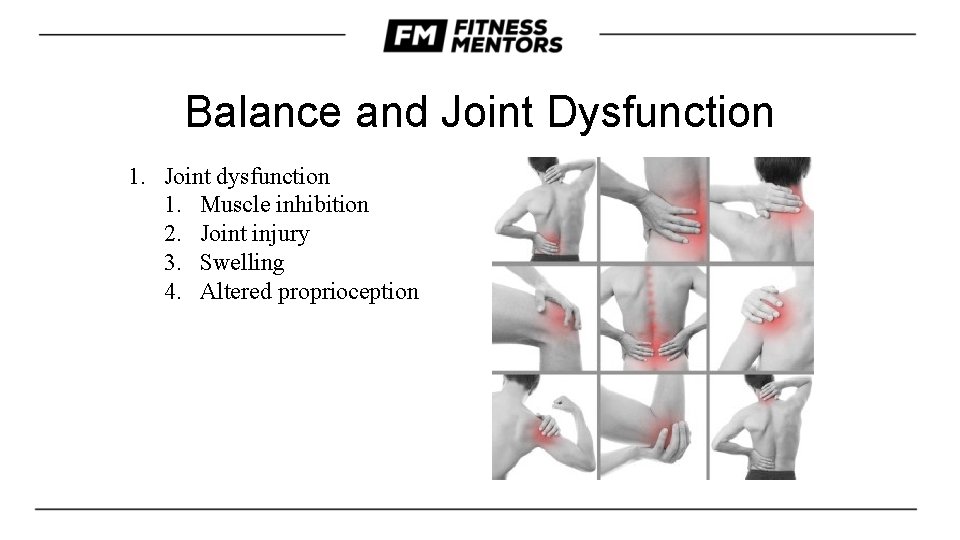
Balance and Joint Dysfunction 1. Joint dysfunction 1. Muscle inhibition 2. Joint injury 3. Swelling 4. Altered proprioception
How to use Balance Training during Recovery from Injury • Very common for physical therapists to use balance training with those recovering from ACL injuries – Training balance consistently for at least 10 minutes per day for 3 -4 days per week has been shown to increase static and dynamic balance
Program Design • Exercise Selection – Safe – Progressive • • Easy to hard Simple to complex Known to unknown Static to dynamic – Proprioceptively challenging • • Floor Balance beam Half foam roll Airex pad*
Changing it up – Use three planes of motion – Cycle through different ranges of motion – Use different variables accordingly
Progressions • Stabilization, Strength, and Power phases of balance • Progress up to power or regress down to stabilization as needed. * The Single Leg Lift and Chop is balance stabilization.
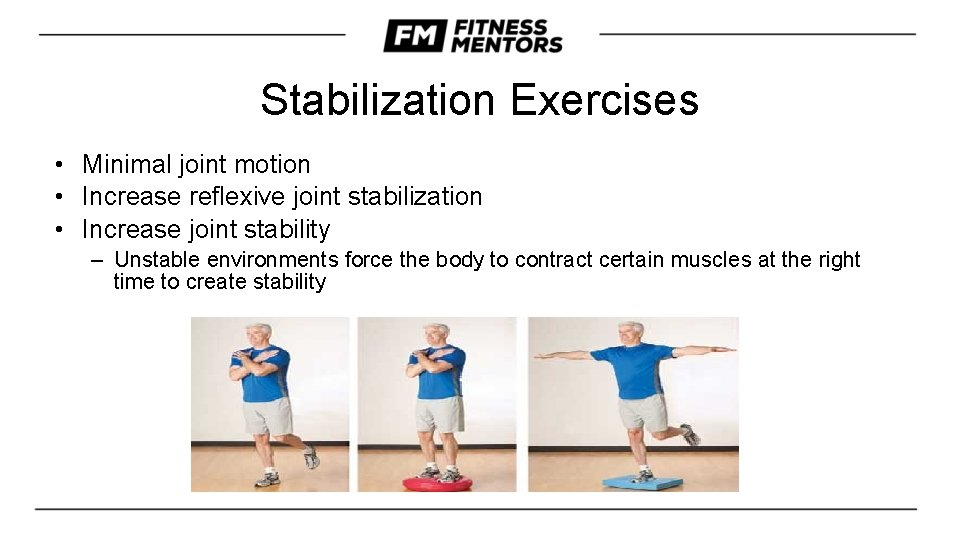
Stabilization Exercises • Minimal joint motion • Increase reflexive joint stabilization • Increase joint stability – Unstable environments force the body to contract certain muscles at the right time to create stability
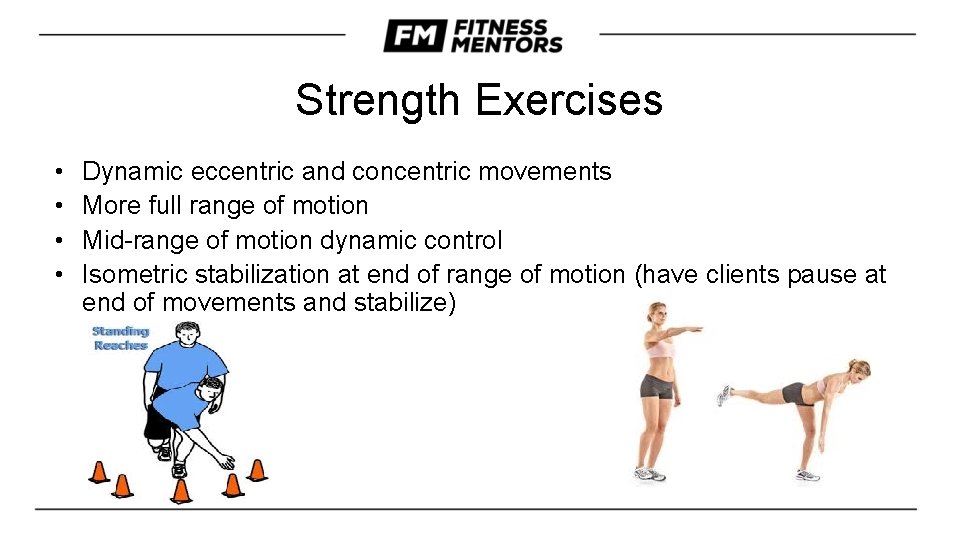
Strength Exercises • • Dynamic eccentric and concentric movements More full range of motion Mid-range of motion dynamic control Isometric stabilization at end of range of motion (have clients pause at end of movements and stabilize)
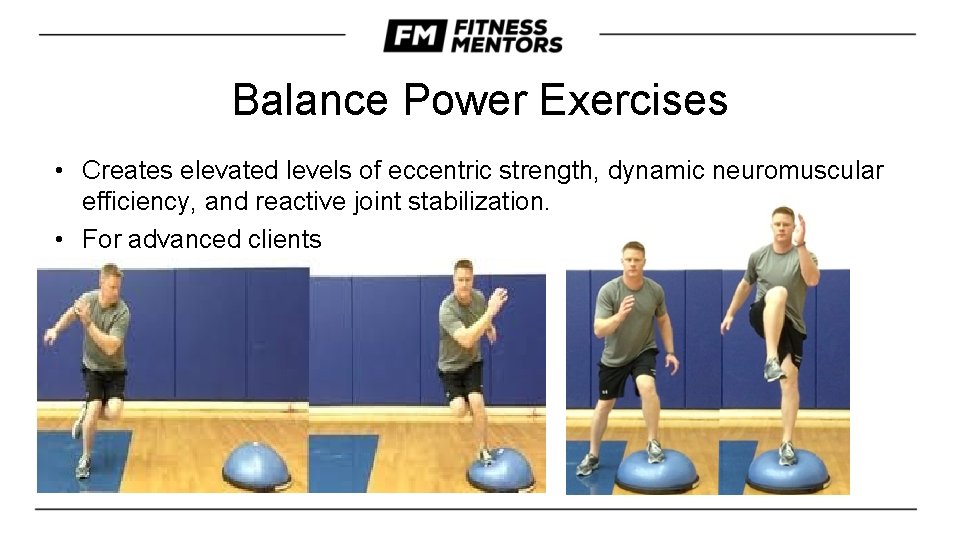
Balance Power Exercises • Creates elevated levels of eccentric strength, dynamic neuromuscular efficiency, and reactive joint stabilization. • For advanced clients
Implementing a Balance Program • Stabilization Level (Phase 1) – 1 -4 exercises, 1 -3 sets, 12 -20 reps (6 -10 SL) – Tempo = Slow, 0 -90 s rest • Strength Level (Phases 2, 3, and 4) – 0 -4 exercises, 2 -3 sets, 8 -12 reps – Tempo = Medium, 0 -60 s rest • Power Level (Phase 5) – 0 -2 exercises, 2 -3 sets, 8 -12 reps – Tempo = controlled (hold landing position for 3 -5 s), 0 -60 s rest
Summary • Helps the body move efficiently through full spectrum of movements and exercises • Progressive and systematic approach to program design – Regress as necessary – Do not skip any steps • Progression is as follows: stabilization, strength, and power.
- Slides: 17