
CHAPTER 10 ASSESSMENT OF YOUNG CHILDREN STANDARDS STAGES

- Slides: 35
CHAPTER 10: ASSESSMENT OF YOUNG CHILDREN: STANDARDS, STAGES, AND APPROACHES Mary Stewart Anderson EDSP 5335 DR. Woodbury Houston Baptist University
Overview § Definitions § Key Pieces of Legislation § Response to Intervention § Quality Standards for Assessment Measures § Stages of Assessment § Team Approaches § Assessment Typologies § Considerations for EC Assessment § Review/Quiz
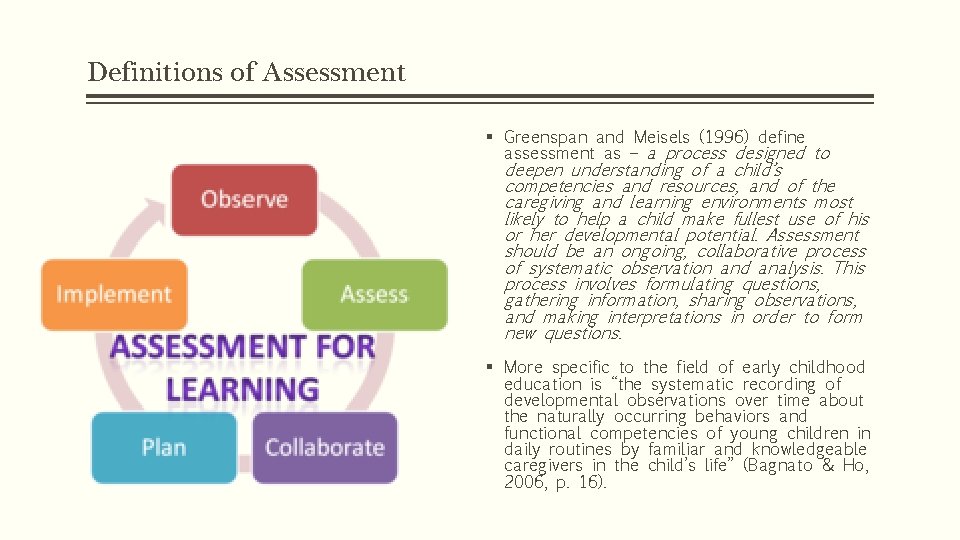
Definitions of Assessment § Greenspan and Meisels (1996) define assessment as – a process designed to deepen understanding of a child’s competencies and resources, and of the caregiving and learning environments most likely to help a child make fullest use of his or her developmental potential. Assessment should be an ongoing, collaborative process of systematic observation and analysis. This process involves formulating questions, gathering information, sharing observations, and making interpretations in order to form new questions. § More specific to the field of early childhood education is “the systematic recording of developmental observations over time about the naturally occurring behaviors and functional competencies of young children in daily routines by familiar and knowledgeable caregivers in the child’s life” (Bagnato & Ho, 2006, p. 16).
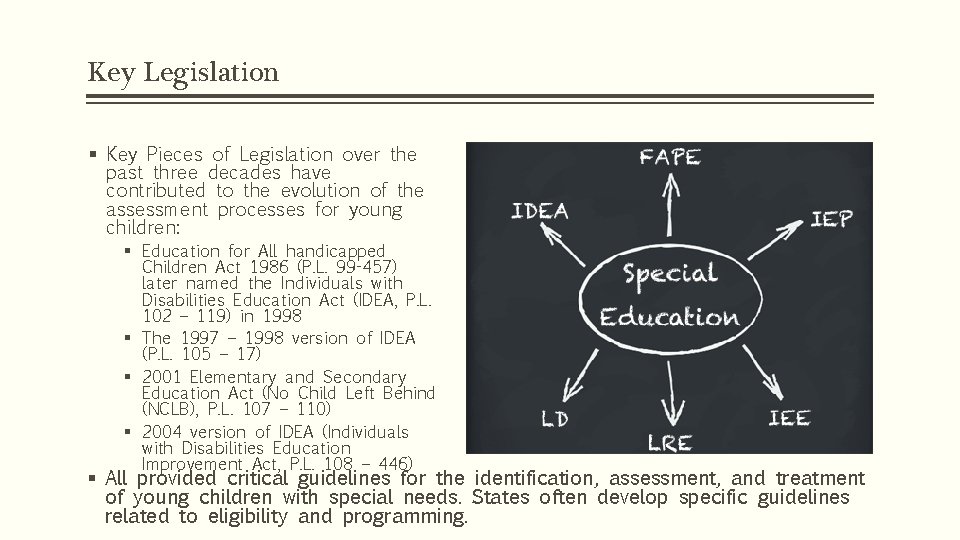
Key Legislation § Key Pieces of Legislation over the past three decades have contributed to the evolution of the assessment processes for young children: § Education for All handicapped Children Act 1986 (P. L. 99 -457) later named the Individuals with Disabilities Education Act (IDEA, P. L. 102 – 119) in 1998 § The 1997 – 1998 version of IDEA (P. L. 105 – 17) § 2001 Elementary and Secondary Education Act (No Child Left Behind (NCLB), P. L. 107 – 110) § 2004 version of IDEA (Individuals with Disabilities Education Improvement Act, P. L. 108 – 446) § All provided critical guidelines for the identification, assessment, and treatment of young children with special needs. States often develop specific guidelines related to eligibility and programming.
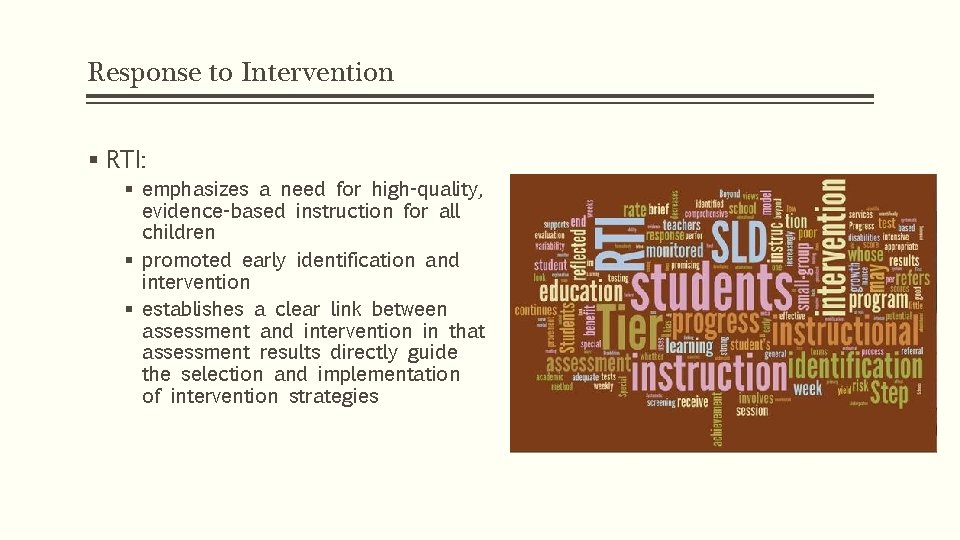
Response to Intervention § RTI: § emphasizes a need for high-quality, evidence-based instruction for all children § promoted early identification and intervention § establishes a clear link between assessment and intervention in that assessment results directly guide the selection and implementation of intervention strategies
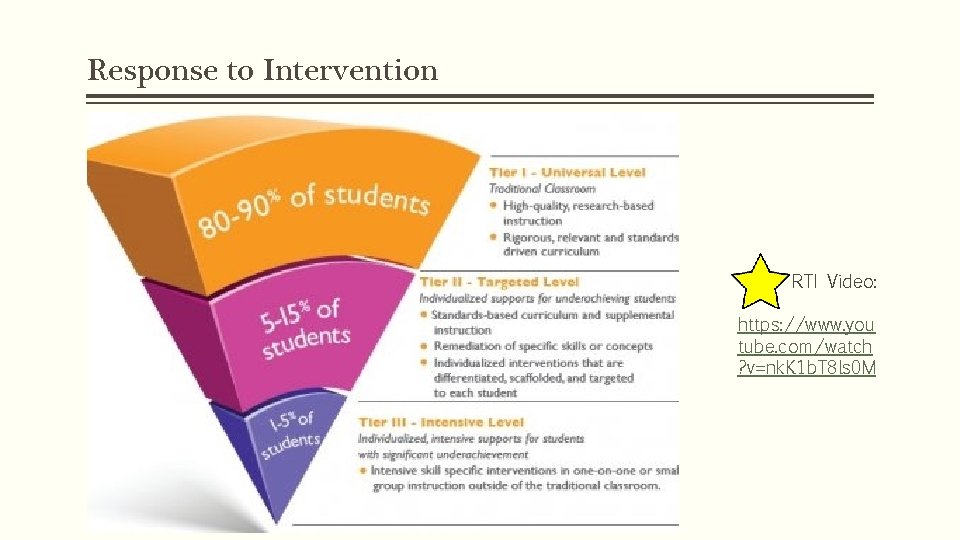
Response to Intervention RTI Video: https: //www. you tube. com/watch ? v=nk. K 1 b. T 8 ls 0 M
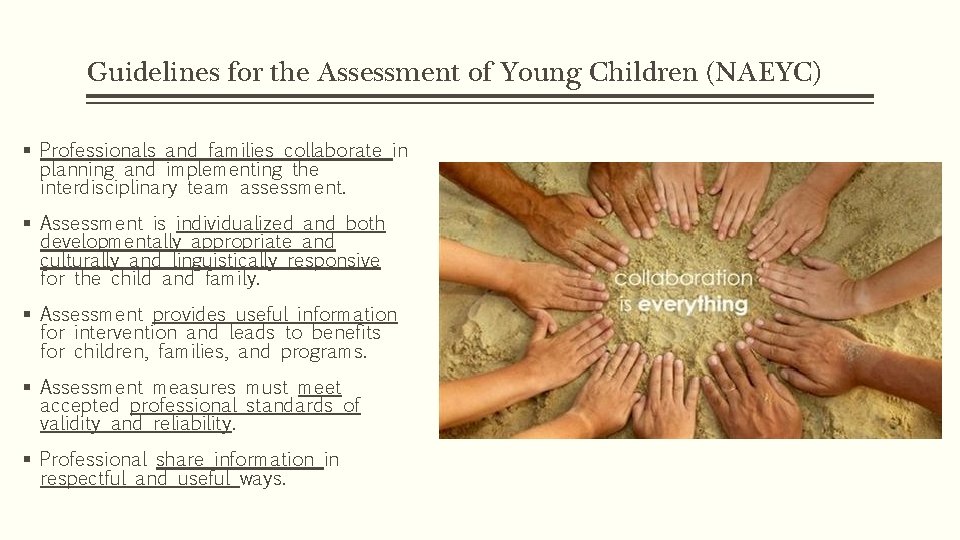
Guidelines for the Assessment of Young Children (NAEYC) § Professionals and families collaborate in planning and implementing the interdisciplinary team assessment. § Assessment is individualized and both developmentally appropriate and culturally and linguistically responsive for the child and family. § Assessment provides useful information for intervention and leads to benefits for children, families, and programs. § Assessment measures must meet accepted professional standards of validity and reliability. § Professional share information in respectful and useful ways.
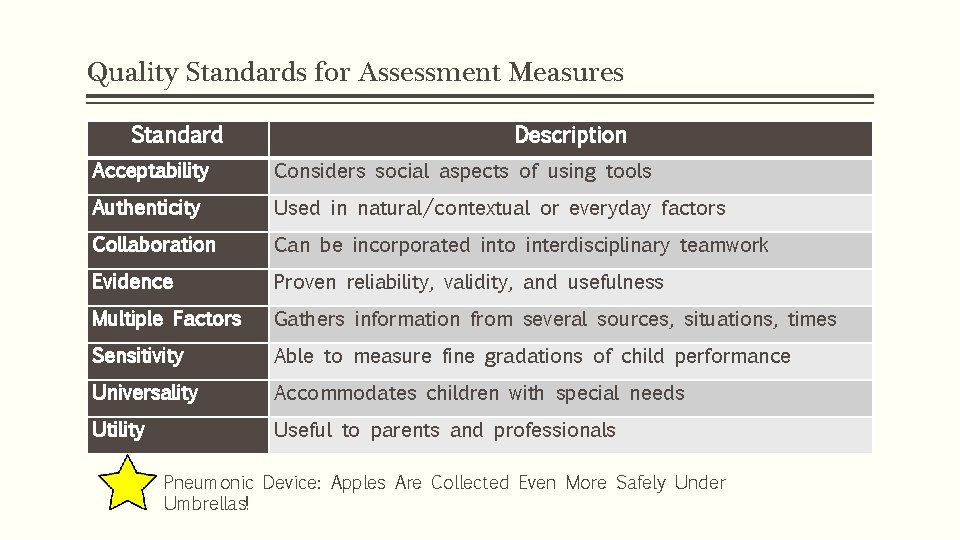
Quality Standards for Assessment Measures Standard Description Acceptability Considers social aspects of using tools Authenticity Used in natural/contextual or everyday factors Collaboration Can be incorporated into interdisciplinary teamwork Evidence Proven reliability, validity, and usefulness Multiple Factors Gathers information from several sources, situations, times Sensitivity Able to measure fine gradations of child performance Universality Accommodates children with special needs Utility Useful to parents and professionals Pneumonic Device: Apples Are Collected Even More Safely Under Umbrellas!
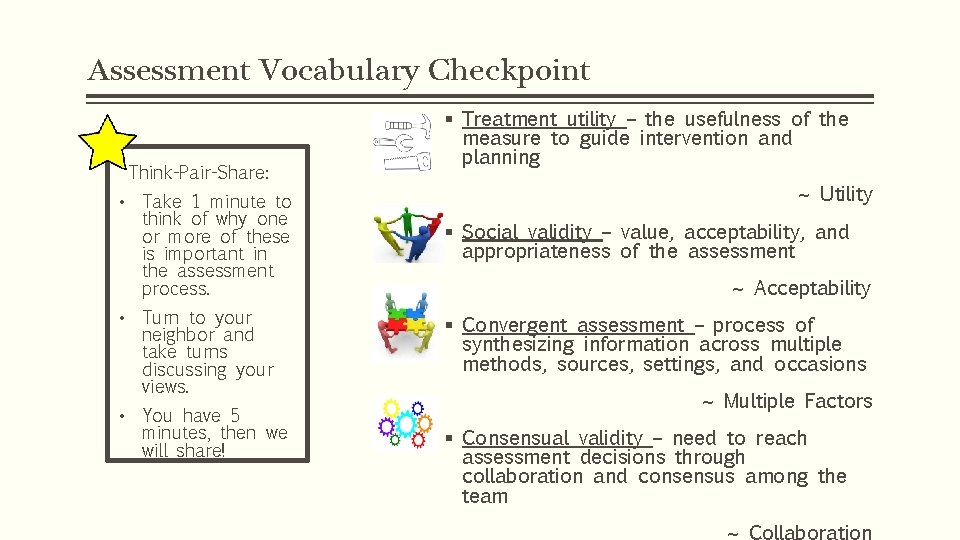
Assessment Vocabulary Checkpoint Think-Pair-Share: § Treatment utility – the usefulness of the measure to guide intervention and planning ~ Utility • Take 1 minute to think of why one or more of these is important in the assessment process. § Social validity – value, acceptability, and appropriateness of the assessment • Turn to your neighbor and take turns discussing your views. § Convergent assessment – process of synthesizing information across multiple methods, sources, settings, and occasions • You have 5 minutes, then we will share! ~ Acceptability ~ Multiple Factors § Consensual validity – need to reach assessment decisions through collaboration and consensus among the team ~ Collaboration
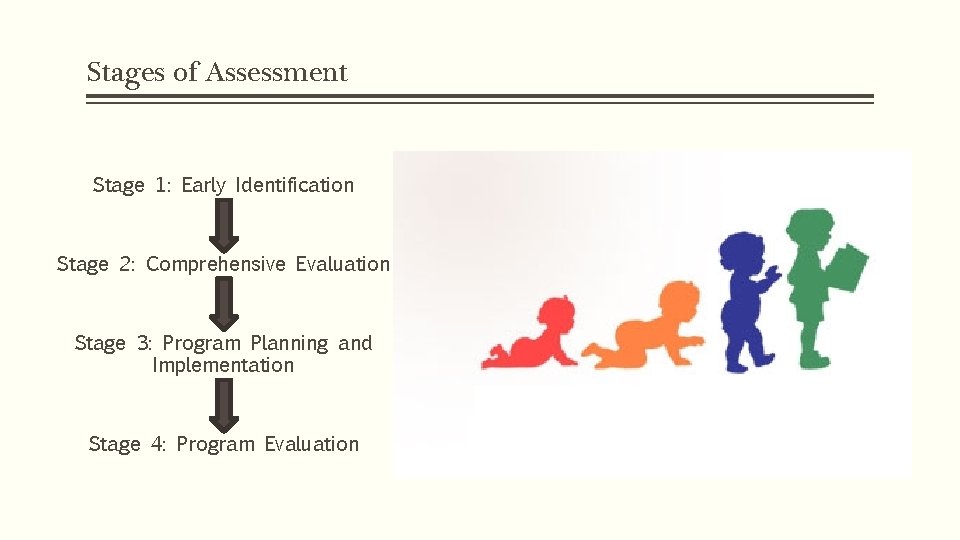
Stages of Assessment Stage 1: Early Identification Stage 2: Comprehensive Evaluation Stage 3: Program Planning and Implementation Stage 4: Program Evaluation
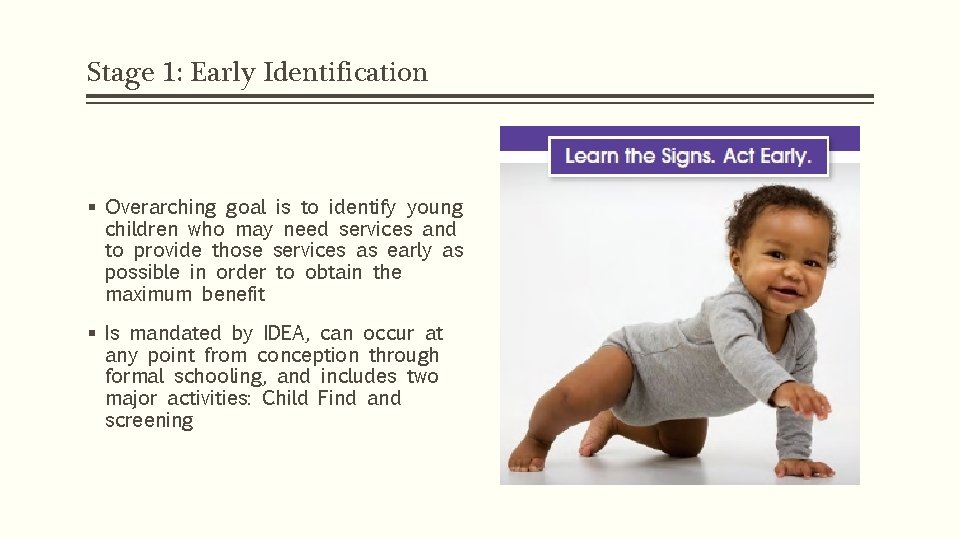
Stage 1: Early Identification § Overarching goal is to identify young children who may need services and to provide those services as early as possible in order to obtain the maximum benefit § Is mandated by IDEA, can occur at any point from conception through formal schooling, and includes two major activities: Child Find and screening
Stage 1: Early Identification – Child Find § Child Find is a community-wide effort involving many agencies that have contact with infants and young children and their families § Federal legislation mandates that each state conduct comprehensive and coordinated activities to identify any children who need early intervention services as early as possible § One key functions = increase public awareness of issues related to delay/disability and to encourage individuals to identify potential children who may be eligible for services Learn the Signs. Act Early. https: //www. youtube. com/watch? v=9 Ithxd 5 KWhw
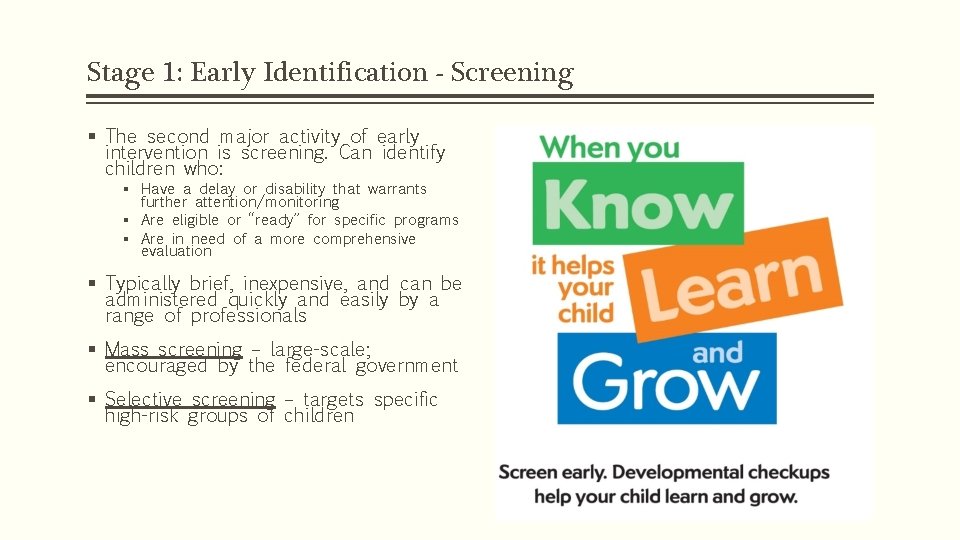
Stage 1: Early Identification - Screening § The second major activity of early intervention is screening. Can identify children who: § Have a delay or disability that warrants further attention/monitoring § Are eligible or “ready” for specific programs § Are in need of a more comprehensive evaluation § Typically brief, inexpensive, and can be administered quickly and easily by a range of professionals § Mass screening – large-scale; encouraged by the federal government § Selective screening – targets specific high-risk groups of children
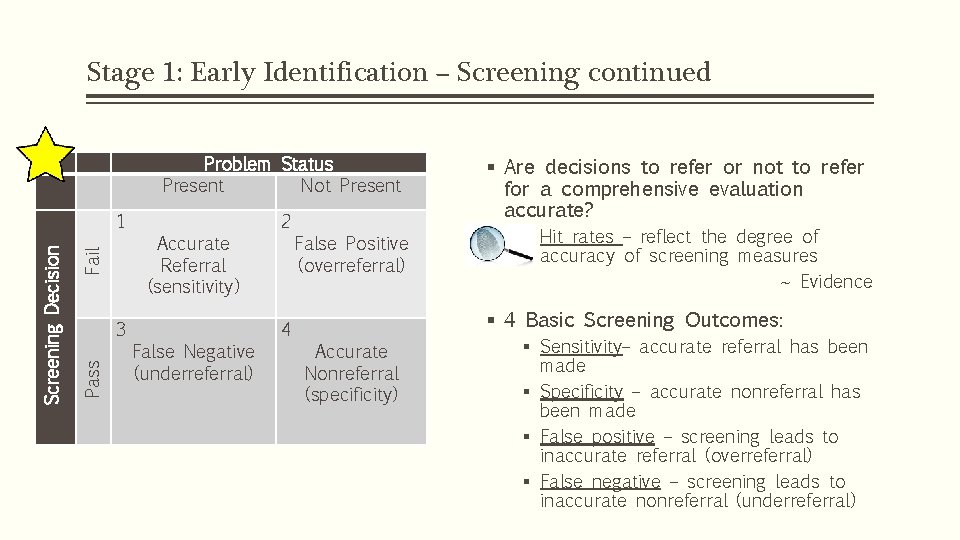
Stage 1: Early Identification – Screening continued Problem Status Present Not Present Fail 3 Pass Screening Decision 1 Accurate Referral (sensitivity) False Negative (underreferral) 2 4 False Positive (overreferral) § Are decisions to refer or not to refer for a comprehensive evaluation accurate? § Hit rates – reflect the degree of accuracy of screening measures ~ Evidence § 4 Basic Screening Outcomes: Accurate Nonreferral (specificity) § Sensitivity– accurate referral has been made § Specificity – accurate nonreferral has been made § False positive – screening leads to inaccurate referral (overreferral) § False negative – screening leads to inaccurate nonreferral (underreferral)
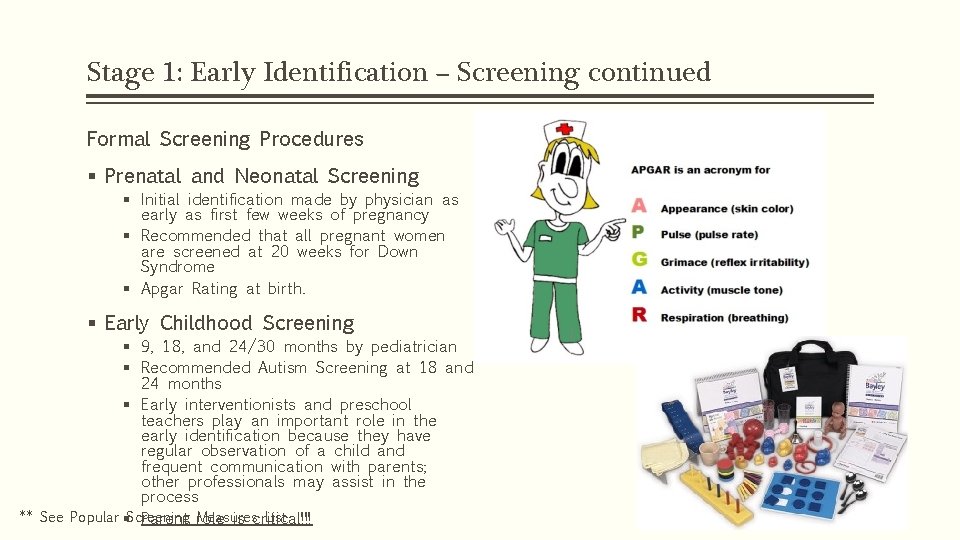
Stage 1: Early Identification – Screening continued Formal Screening Procedures § Prenatal and Neonatal Screening § Initial identification made by physician as early as first few weeks of pregnancy § Recommended that all pregnant women are screened at 20 weeks for Down Syndrome § Apgar Rating at birth. § Early Childhood Screening § 9, 18, and 24/30 months by pediatrician § Recommended Autism Screening at 18 and 24 months § Early interventionists and preschool teachers play an important role in the early identification because they have regular observation of a child and frequent communication with parents; other professionals may assist in the process ** See Popular §Screening Measures List Parent role is critical!!!
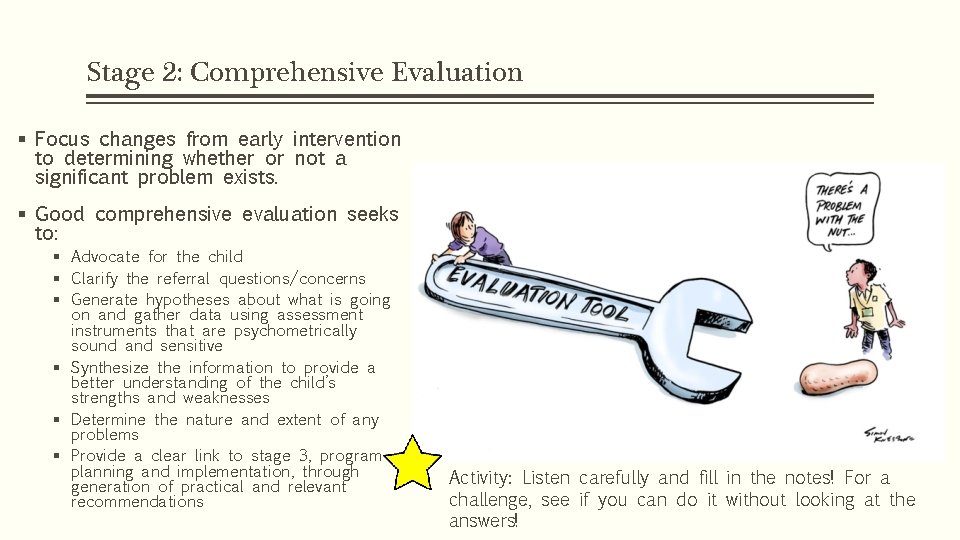
Stage 2: Comprehensive Evaluation § Focus changes from early intervention to determining whether or not a significant problem exists. § Good comprehensive evaluation seeks to: § Advocate for the child § Clarify the referral questions/concerns § Generate hypotheses about what is going on and gather data using assessment instruments that are psychometrically sound and sensitive § Synthesize the information to provide a better understanding of the child’s strengths and weaknesses § Determine the nature and extent of any problems § Provide a clear link to stage 3, program planning and implementation, through generation of practical and relevant recommendations Activity: Listen carefully and fill in the notes! For a challenge, see if you can do it without looking at the answers!
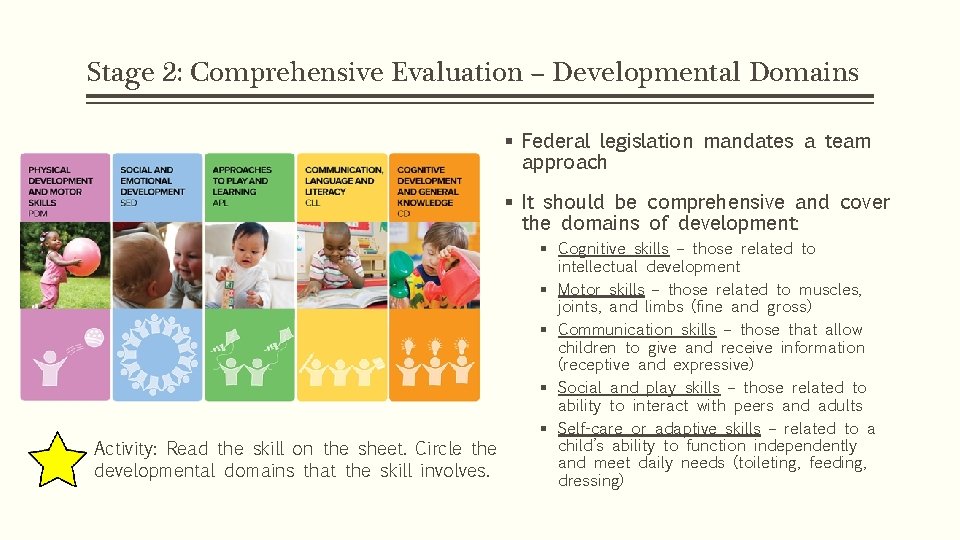
Stage 2: Comprehensive Evaluation – Developmental Domains § Federal legislation mandates a team approach § It should be comprehensive and cover the domains of development: Activity: Read the skill on the sheet. Circle the developmental domains that the skill involves. § Cognitive skills – those related to intellectual development § Motor skills – those related to muscles, joints, and limbs (fine and gross) § Communication skills – those that allow children to give and receive information (receptive and expressive) § Social and play skills – those related to ability to interact with peers and adults § Self-care or adaptive skills – related to a child’s ability to function independently and meet daily needs (toileting, feeding, dressing)
Stage 2: Comprehensive Evaluation – Medical and Family Issues § Medical Issues § Understanding a child’s medical condition can provide information about need for assistance/attention in preschool or childcare setting § Can significantly impact rate and course of development § Family Issues § IDEA requires examination of the family’s strengths and needs also § A collaborative partnership is key to meet the needs of the child § Family involvement in questionnaires and assessment is essential to the evaluation process.
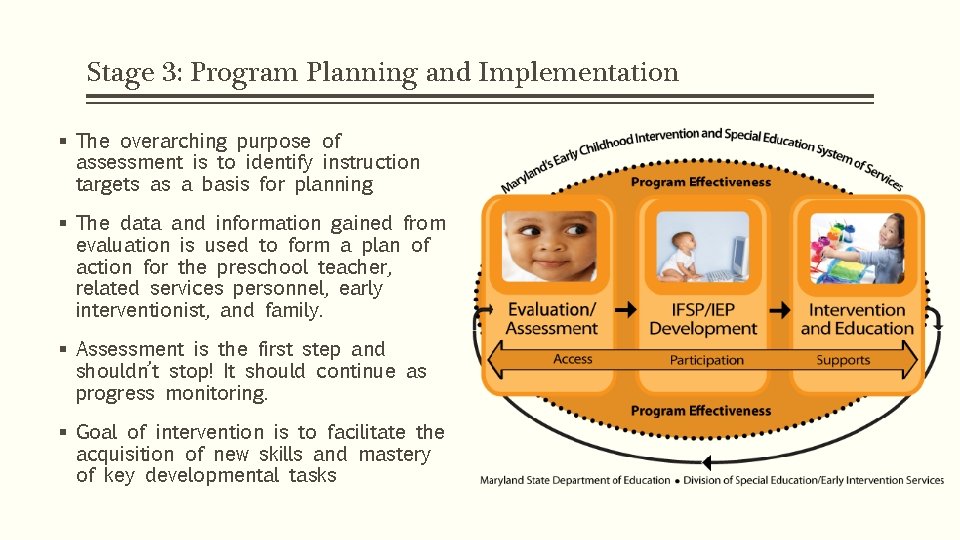
Stage 3: Program Planning and Implementation § The overarching purpose of assessment is to identify instruction targets as a basis for planning § The data and information gained from evaluation is used to form a plan of action for the preschool teacher, related services personnel, early interventionist, and family. § Assessment is the first step and shouldn’t stop! It should continue as progress monitoring. § Goal of intervention is to facilitate the acquisition of new skills and mastery of key developmental tasks
Stage 3: Program Planning and Implementation – IDEA, 2004 § Federal regulations mandate that a child’s individual education plan shall include “specific early intervention services based on peer-reviewed research, to the extent practicable” and a “statement of the measurable results or outcomes” (IDEA, 2004). The teacher or early interventionist is required to provide ongoing formal and informal assessment of a child’s progress in targeted developmental domains and behaviors, as specified in the IEP or IFSP
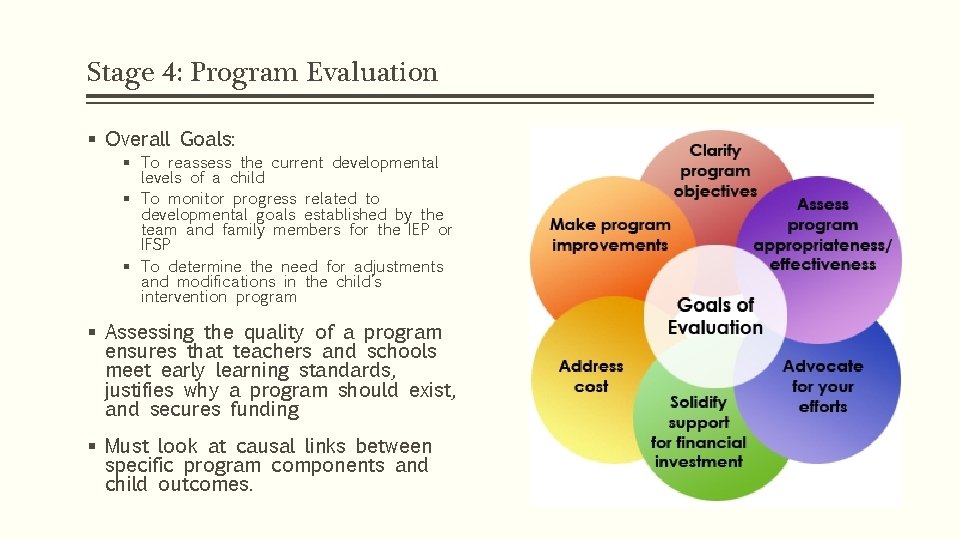
Stage 4: Program Evaluation § Overall Goals: § To reassess the current developmental levels of a child § To monitor progress related to developmental goals established by the team and family members for the IEP or IFSP § To determine the need for adjustments and modifications in the child’s intervention program § Assessing the quality of a program ensures that teachers and schools meet early learning standards, justifies why a program should exist, and secures funding § Must look at causal links between specific program components and child outcomes.
Team Approaches § IDEA mandates that assessment involve multiple disciplines and the family § Team members may include: a psychologist, social worker, early interventionist, educator, audiologist, nurse, speech and language pathologist, nutritionist, occupational therapist, physical therapist, pediatrician, and the child’s parents § Three types of teams: § Multidisciplinary § Interdisciplinary § Transdisciplinary
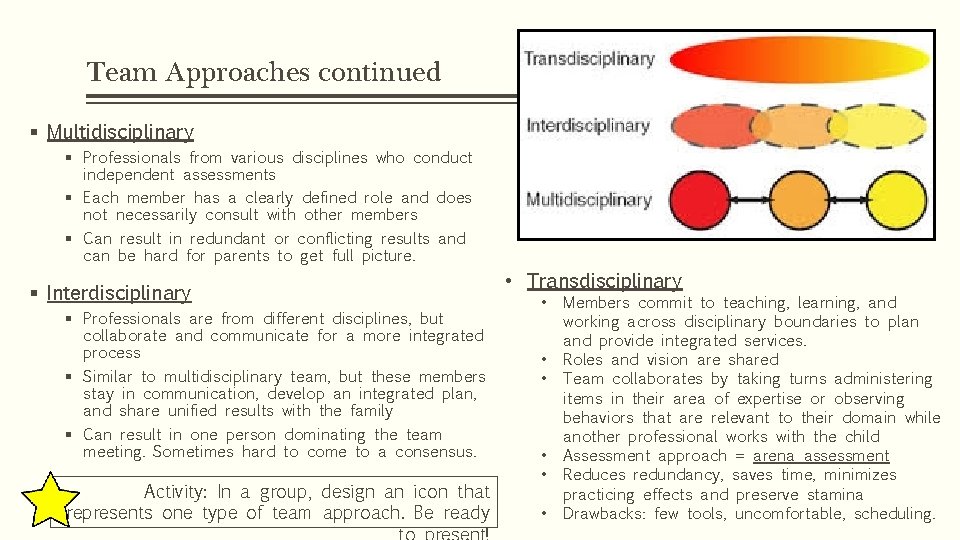
Team Approaches continued § Multidisciplinary § Professionals from various disciplines who conduct independent assessments § Each member has a clearly defined role and does not necessarily consult with other members § Can result in redundant or conflicting results and can be hard for parents to get full picture. § Interdisciplinary § Professionals are from different disciplines, but collaborate and communicate for a more integrated process § Similar to multidisciplinary team, but these members stay in communication, develop an integrated plan, and share unified results with the family § Can result in one person dominating the team meeting. Sometimes hard to come to a consensus. Activity: In a group, design an icon that represents one type of team approach. Be ready • Transdisciplinary • • • Members commit to teaching, learning, and working across disciplinary boundaries to plan and provide integrated services. Roles and vision are shared Team collaborates by taking turns administering items in their area of expertise or observing behaviors that are relevant to their domain while another professional works with the child Assessment approach = arena assessment Reduces redundancy, saves time, minimizes practicing effects and preserve stamina Drawbacks: few tools, uncomfortable, scheduling.
Assessment Typologies § Formal/Informal § Normative/Criterion-Referenced § Standardized/Adaptive-to-Disability § Direct/Indirect § Naturalistic/Clinical § Product-/Process-Oriented
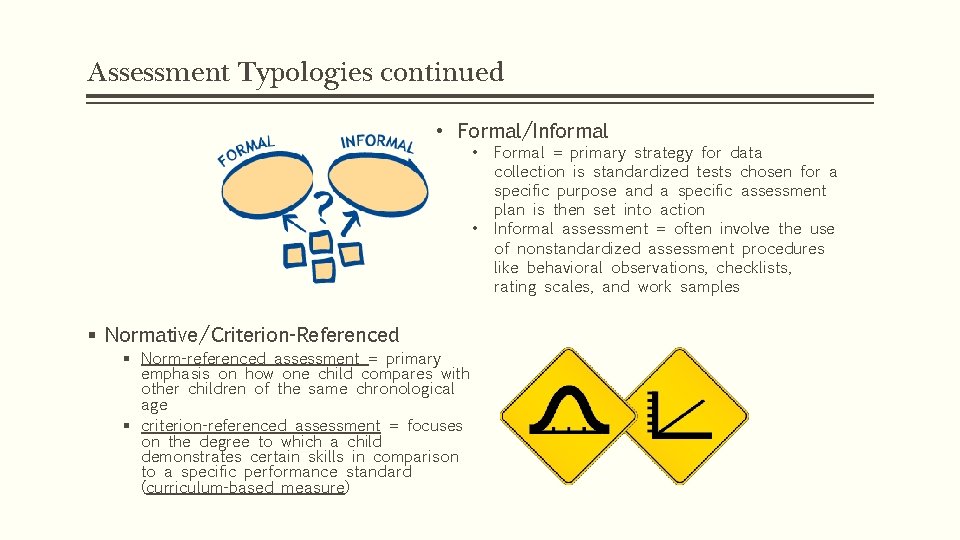
Assessment Typologies continued • Formal/Informal • • § Normative/Criterion-Referenced § Norm-referenced assessment = primary emphasis on how one child compares with other children of the same chronological age § criterion-referenced assessment = focuses on the degree to which a child demonstrates certain skills in comparison to a specific performance standard (curriculum-based measure) Formal = primary strategy for data collection is standardized tests chosen for a specific purpose and a specific assessment plan is then set into action Informal assessment = often involve the use of nonstandardized assessment procedures like behavioral observations, checklists, rating scales, and work samples
Assessment Typologies continued § Standardized/Adaptive-to-Disability § Standardized = fixed set of specific guidelines regarding test content, administration, scoring, and interpretation § Adaptive-to-disability = more flexible data gathering strategies to gain profile of a child’s abilities • Direct/Indirect • • Direct = face-to-face testing or observation of a video to code behaviors Indirect = involves the collection of information about a child through other assessment techniques like interview or rating scales
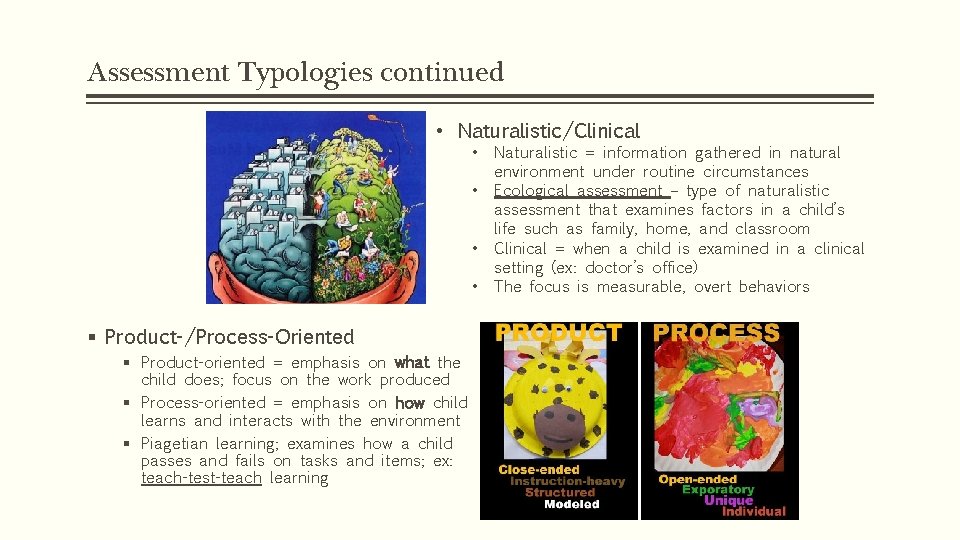
Assessment Typologies continued • Naturalistic/Clinical • • § Product-/Process-Oriented § Product-oriented = emphasis on what the child does; focus on the work produced § Process-oriented = emphasis on how child learns and interacts with the environment § Piagetian learning; examines how a child passes and fails on tasks and items; ex: teach-test-teach learning Naturalistic = information gathered in natural environment under routine circumstances Ecological assessment – type of naturalistic assessment that examines factors in a child’s life such as family, home, and classroom Clinical = when a child is examined in a clinical setting (ex: doctor’s office) The focus is measurable, overt behaviors
Alternative Assessment § A philosophy and organizational approach toward describing and measuring a child’s behavior; performance-based (focuses on work), authentic (natural environment), and curriculum-based (integration of assessment with curriculum) § Practice: § 1. design and assessment battery based on the curriculum content (product) and educational strategies (process) used for a specific child § 2. use the results from this assessment to modify instructional practices § 3. reassess the child to determine which modifications have benefited him or her § 4. make further refinements in the child’s educational plan based on the findings § 5. repeat these steps in a dynamic fashion as the child progresses through his or her
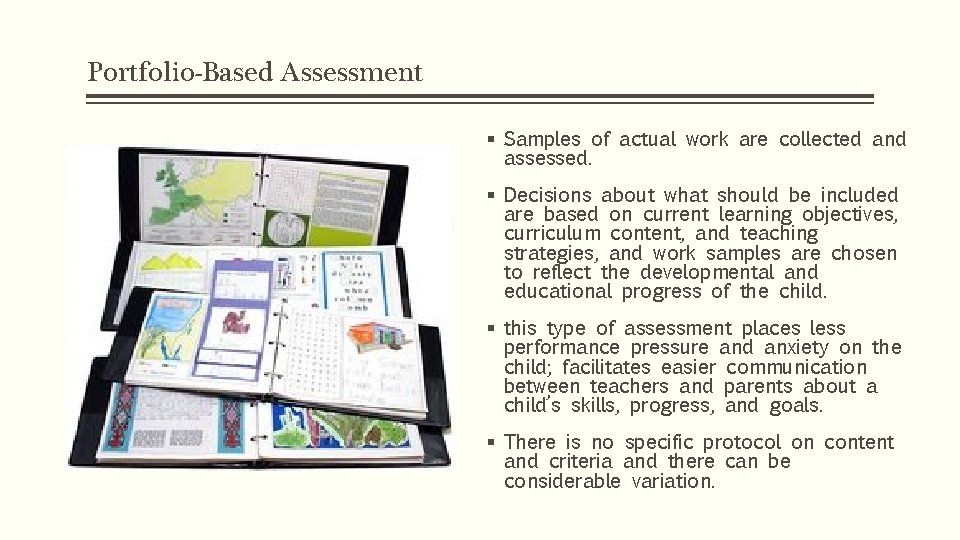
Portfolio-Based Assessment § Samples of actual work are collected and assessed. § Decisions about what should be included are based on current learning objectives, curriculum content, and teaching strategies, and work samples are chosen to reflect the developmental and educational progress of the child. § this type of assessment places less performance pressure and anxiety on the child; facilitates easier communication between teachers and parents about a child’s skills, progress, and goals. § There is no specific protocol on content and criteria and there can be considerable variation.
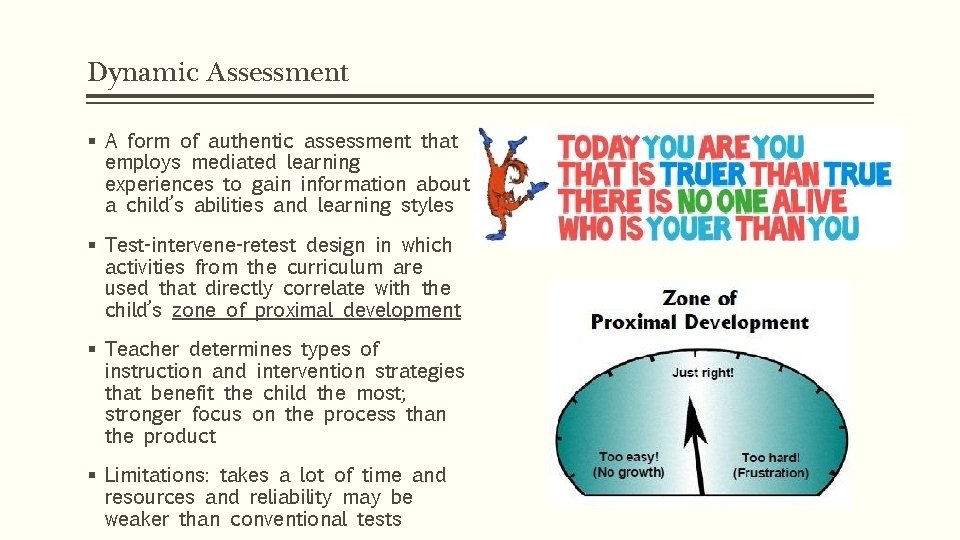
Dynamic Assessment § A form of authentic assessment that employs mediated learning experiences to gain information about a child’s abilities and learning styles § Test-intervene-retest design in which activities from the curriculum are used that directly correlate with the child’s zone of proximal development § Teacher determines types of instruction and intervention strategies that benefit the child the most; stronger focus on the process than the product § Limitations: takes a lot of time and resources and reliability may be weaker than conventional tests
Assessment Experiences – Reflection/Discussion § What assessments have you given before? § How did you choose the type of assessment to use? § What kinds of assessments do you like? Which do you not like? Why? § Do you think that some assessments are more effective than others? § How do time and convenience factor into your assessment choices?
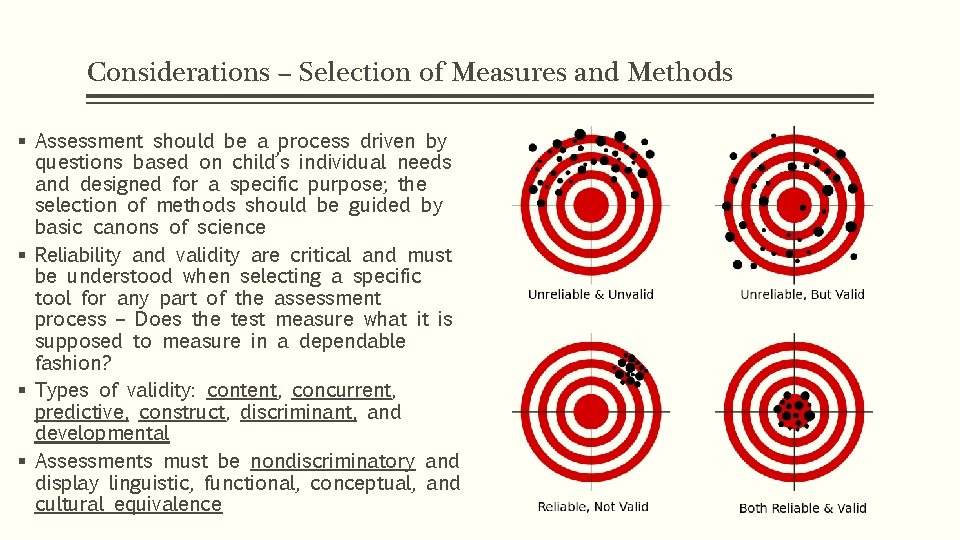
Considerations – Selection of Measures and Methods § Assessment should be a process driven by questions based on child’s individual needs and designed for a specific purpose; the selection of methods should be guided by basic canons of science § Reliability and validity are critical and must be understood when selecting a specific tool for any part of the assessment process – Does the test measure what it is supposed to measure in a dependable fashion? § Types of validity: content, concurrent, predictive, construct, discriminant, and developmental § Assessments must be nondiscriminatory and display linguistic, functional, conceptual, and cultural equivalence
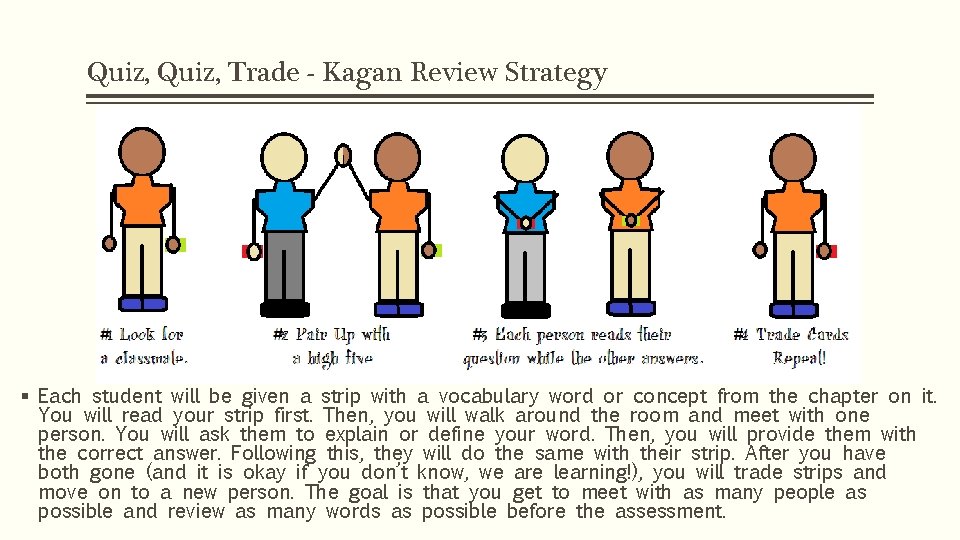
Quiz, Trade - Kagan Review Strategy § Each student will be given a strip with a vocabulary word or concept from the chapter on it. You will read your strip first. Then, you will walk around the room and meet with one person. You will ask them to explain or define your word. Then, you will provide them with the correct answer. Following this, they will do the same with their strip. After you have both gone (and it is okay if you don’t know, we are learning!), you will trade strips and move on to a new person. The goal is that you get to meet with as many people as possible and review as many words as possible before the assessment.
JEOPARDY
References Hooper, S. and Umansky, W. (2009). Young Children with Special Needs (5 th ed. ). Upper Saddle River, New Jersey: Pearson.