
Chapter 10 Assessing Environment Home Community and Workplace

- Slides: 22
Chapter 10 Assessing Environment: Home, Community, and Workplace Access and Safety Copyright © 2014 Wolters Kluwer Health | Lippincott Williams & Wilkins
Learning Objectives • Describe the roles and responsibilities of the occupational therapist in the evaluation of environmental access. • Identify factors that act as environmental or contextual enablers or barriers/hindrances to occupational performance. • Identify environmental features that influence the safety of the client and the occupational therapist. • Apply critical appraisal when selecting assessment instruments appropriate for use in evaluating access to home, community, and workplace. • Explain how legislation and building standards influence the degree of environmental access that is available for people with disabilities. Copyright © 2014 Wolters Kluwer Health | Lippincott Williams & Wilkins
Evaluation of the Environment • Occupational functioning is influenced by the context of the client’s environment. • Assessment of attributes of the environment should be augmented by who will use the environment and the functions they will carry out there. Copyright © 2014 Wolters Kluwer Health | Lippincott Williams & Wilkins
Client-Centered Approach • The client–therapist interaction begins with an interview and assessment so that therapist can gain an understanding of the client’s occupational profile. • The client-centered approach determines the roles and occupations the client previously had and what the client wants or is expected to be able to do. • Collaborative goal setting is important in establishing this approach successfully. • Occupational therapists complete analysis of occupational performance, including environmental assessment, to determine client’s abilities and capacities. Copyright © 2014 Wolters Kluwer Health | Lippincott Williams & Wilkins
Roles • The roles carried out by clients address purposeful activities related to self-maintenance, self-enhancement, and self-advancement. • Specific features of the environment can support or hinder the fulfillment of valued roles within the home, community, and workplace. Copyright © 2014 Wolters Kluwer Health | Lippincott Williams & Wilkins
Environmental Barriers and Supports • The International Classification of Functioning, Disability and Health classifies environmental factors as assistive products and technology; the natural and human-made environments; supports and relationships; attitudes; and services, systems, and policies. • Therapists must be able to identify the key environmental barriers and supports that influence the occupational functioning of clients. • Improved accessibility through the use of universal design and barrier-free design is preferable. Copyright © 2014 Wolters Kluwer Health | Lippincott Williams & Wilkins
Influences on Environmental Accessibility and Safety • Various societal and cultural attitudes influence the degree to which the physical environment is made accessible, inclusive, and safe for people with disabilities. • Influences manifest as national and state legislation, building standards, and professional practice requirements. Copyright © 2014 Wolters Kluwer Health | Lippincott Williams & Wilkins
Legislation • United Nations Convention on the Rights of Persons with Disabilities (2006) • Americans with Disabilities Act (ADA, 1990) • Canada’s Ontarians with Disabilities Act (2001) – Both laws designed to enable the participation and inclusion of people with disabilities in society – Titles II and III detail the steps to be taken by public and private sector services, programs, and facilities to comply with and implement the requirements of the ADA. • Occupational therapists are skilled in occupational analysis, environmental assessment, and determining PEO fit and are well suited to assist with meeting the requirements of the legislation. Copyright © 2014 Wolters Kluwer Health | Lippincott Williams & Wilkins
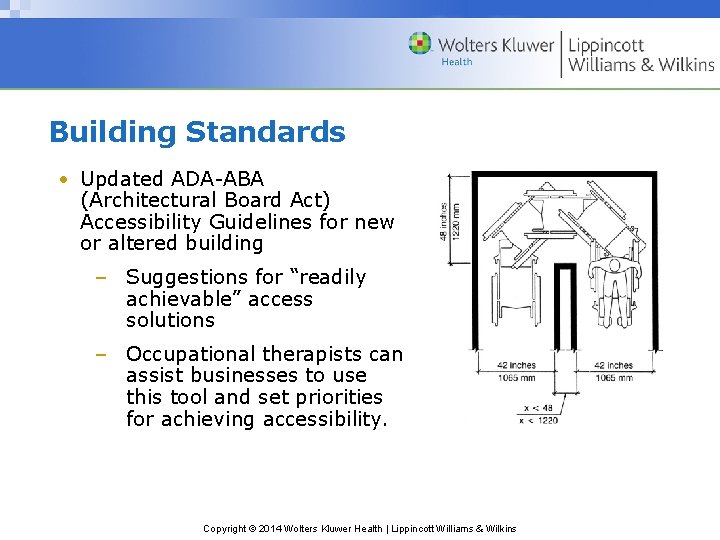
Building Standards • Updated ADA-ABA (Architectural Board Act) Accessibility Guidelines for new or altered building – Suggestions for “readily achievable” access solutions – Occupational therapists can assist businesses to use this tool and set priorities for achieving accessibility. Copyright © 2014 Wolters Kluwer Health | Lippincott Williams & Wilkins
Professional Practice Requirements • Standards of practice, core competencies, and functions expected of therapists are developed at the national and state level and provide performance criteria. • Knowledge of and ability to perform assessments of context/environment are considered to be core competencies and functions of practice for all occupational therapists. Copyright © 2014 Wolters Kluwer Health | Lippincott Williams & Wilkins
Environment Assessment • Ideally, the occupational therapist should select instruments with standardization that assess personenvironment-occupation (PEO) fit. • There are few measures that have been developed to assess this complex PEO relationship. Copyright © 2014 Wolters Kluwer Health | Lippincott Williams & Wilkins
Assessment of Access to Home • Important component of the occupational therapy process • Often completed as a part of the discharge planning process • Purpose is to identify the degree of fit for the person, the completion of his or her daily roles, and the home environment. Copyright © 2014 Wolters Kluwer Health | Lippincott Williams & Wilkins
Assessment of Access to Home— (cont. ) • Ensuring that clients’ home environments are able to provide them with supports they need is important to enabling the client to continue living at home safely. • Recognize that people have great attachment to their homes. • Clients belongings and how their home looks are meaningful to them. Copyright © 2014 Wolters Kluwer Health | Lippincott Williams & Wilkins
Assessment of Access to Home— (cont. ) • Specific assessments – SAFER-HOME – HOME FAST – Westmead Home Safety Assessment – I-HOPE – Home Safety Self Assessment Tool Copyright © 2014 Wolters Kluwer Health | Lippincott Williams & Wilkins
Assessment of Access to Home— (cont. ) • Self-assessment guides – Maintaining Seniors’ Independence: A Guide to Home Adaptations – Maintaining Seniors’ Independence through Home Adaptation: A Self-assessment Guide – A Consumer’s Guide to Home Adaptation Copyright © 2014 Wolters Kluwer Health | Lippincott Williams & Wilkins
Assessment of Access to Home— (cont. ) • Home safety and fall prevention – Home assessments reduce the risk of falls, especially in people who have a history of past falls. – Home environmental interventions are also effective in preventing falls in older adults, particularly those who are at high risk of falls. Copyright © 2014 Wolters Kluwer Health | Lippincott Williams & Wilkins
Assessment of Access to Home— (cont. ) • Housing options – U. S. Office of Fair Housing and Equal Opportunity administers legislation and policies that ensures equal access to housing. – Home and community settings can present risks because they are complex and often unfamiliar to therapist. Copyright © 2014 Wolters Kluwer Health | Lippincott Williams & Wilkins
Assessment of Access to Community • Occupational therapists are involved in changing environments to enable their clients’ participation and fulfillment of community roles. • Therapists can assume consultation or advocacy roles with groups seeking to make educational, cultural, commercial, and religious facilities accessible. • Universal design principles are now being applied across most community settings • Occupational therapists play important role in promoting this mainstream approach to design. Copyright © 2014 Wolters Kluwer Health | Lippincott Williams & Wilkins
Assessment of Access to Community— (cont. ) • Specific assessments and tools – CHIEF – Facilitators and Barriers Survey – Measure of Quality of the Environment – Multidimensional Scale of Perceived Social Support – Home and Community Environment Instrument Copyright © 2014 Wolters Kluwer Health | Lippincott Williams & Wilkins
Assessment of Access to Workplace • Occupational therapists play an important role in enabling clients to fulfill self-advancement roles by assisting them to seek or return to work. • Workplace assessment is a key step in helping learn how workplace factors impact work performance and safety. • It is important to assess the sociocultural environment, including social supports, staff interactions, and attitudes of coworkers and supervisors. • Knowledge of the ADA and supporting guidelines is critical. • A range of strategies such as workstation modifications and assistive technologies can be implemented to reduce performance barriers. Copyright © 2014 Wolters Kluwer Health | Lippincott Williams & Wilkins
Assessment of Access to Workplace— (cont. ) • Specific assessments or tools – Americans with Disabilities Act Checklist for Readily Achievable Barrier Removal – ADA Work-Site Assessment – Job Analysis during Employer Site Visit – Work Environment Scale – Work Experience Survey – Workplace Environment Impact Scale Copyright © 2014 Wolters Kluwer Health | Lippincott Williams & Wilkins
General Comments on Assessing Access to Home, Community, and Workplace • Many therapists rely on experience, observation, and interviews when called on to evaluate the environment. • These methods cannot stand alone as a part of best practice in occupational therapy. • Use of standardized instruments that have evidence of acceptable measurement properties is also necessary. Copyright © 2014 Wolters Kluwer Health | Lippincott Williams & Wilkins