
Chapter 10 and 15 Document and Handwriting Analysis
- Slides: 41
Chapter 10 and 15 Document and Handwriting Analysis “The handwriting on the wall may be a forgery” —Ralph Hodgson, British poet Kendall/Hunt Publishing Company
Document Analysis Students will learn: § § Chapter 15 That an expert analyst can in What types of evidence are s Three types of forgery. How to characterize differen Kendall/Hunt Publishing Company 1
Document Analysis Students will be able to: § § § Chapter 15 Analyze handwriting using 12 points Detect deliberately disguised handw Detect erasures and develop impres Design an experiment using paper c List safeguards against the counterf Kendall/Hunt Publishing Company 2
Questioned Documents § Involves the examination of handwriting, ink, paper, etc. to ascertain source or authenticity § Examples include letters, checks, licenses, contracts, wills, passports § Investigations include: verification, authentication, characterizing papers, pigments, and inks Chapter 15 Kendall/Hunt Publishing Company 3
Related Fields § Historical Dating—the verification of age and value of a document or object § Fraud Investigation—focuses on the money trail and criminal intent § Paper and Ink Specialists—date, type, source, and/or catalogue various types of paper, watermarks, ink, printing/copy/fax machines, computer cartridges § Forgery Specialists—analyze altered, obliterated, changed, or doctored documents and photos § Typewriting Analysts—determine origin, make, and models § Computer Crime Investigators—investigate cybercrime Chapter 15 Kendall/Hunt Publishing Company 4
Document Examination Forensic Document Examination: involves the analysis and comparison of questioned documents with known material in order to identify whenever possible, the author or origin of the questioned document. Chapter 15 Kendall/Hunt Publishing Company 5
Handwriting analysis involves two phases: § The hardware—ink, paper, pens, pencils, typewriter, printers § Visual examination of the writing Chapter 15 Kendall/Hunt Publishing Company 6
Handwriting Characteristics § Line Quality § Word and Letter Spacing § Letter Comparison § Pen Lifts § Connecting strokes § Beginning and ending strokes Chapter 15 § Unusual Letter Formation § Shading or pen pressure § Slant § Baseline Habits § Flourishes or embellishments § Diacritic Placement Kendall/Hunt Publishing Company 7
Handwriting Identification § Analysis of the “knowns” with a determination of the characteristics found in the known § Analysis of the questioned or unknown writing and determination of its characteristics § Comparison of the questioned writing with the known writing. § Evaluation of the evidence, including the similarities and dissimilarities between the “questioned” and “known” writing § The document examiner must have enough exemplars to make a determination of whether or not the two samples match. Chapter 15 Kendall/Hunt Publishing Company 8
Handwriting Samples § The subject should not be shown the questioned document § The subject is not told how to spell words or use punctuation § The subject should use materials similar to those of the document § The dictated text should match some parts of the document § The subject should be asked to sign the text § Always have a witness Chapter 15 Kendall/Hunt Publishing Company 9
Methods of Forgery § Simulated forgery—one made by copying a genuine signature § Traced forgery—one made by tracing a genuine signature § Blind forgery—made without a model of the signature Chapter 15 Kendall/Hunt Publishing Company 10
Types of Forgery § Check Fraud § Forgery § Theft of card or number § Counterfeit § Art—imitation with intent to deceive § Alterations § Paper Money § Microscopic examination § Electromagnetic radiation § Counterfeit § Chemical analysis § Identity § Social Security § Driver’s license Chapter 15 § Credit Cards § Contracts—alterations of contracts, medical records Kendall/Hunt Publishing Company 11
Document Alterations § Obliterations—removal of writing by physical or chemical means can be detected by: § Microscopic examination § UV or infrared (IR) light § Digital image processing § Indentations can be detected by: § Oblique lighting § Electrostatic detection apparatus (ESDA) Chapter 15 Kendall/Hunt Publishing Company 12
Famous Forgers and Forgeries § Major George Byron (Lord Byron forgeries) § Thomas Chatterton (Literary forgeries) § John Payne Collier (Printed forgeries) § Dorman David (Texas Declaration of Independence) § Mark Hofmann (Mormon, Freemason forgeries) § William Henry Ireland (Shakespeare forgeries) § Clifford Irving (Howard Hughes forgery) § Konrad Kujau (Hitler Diaries) § James Macpherson (Ossian manuscript) § George Psalmanasar (Literary forgery) § Alexander Howland Smith (Historical documents) Chapter 15 Kendall/Hunt Publishing Company 13
Forensic Linguist § Experts that look at the linguistic content (the way something is written) of a questioned document. § Language that is used can help to establish the writer’s age, gender, ethnicity, level of education, professional training, and ideology. Chapter 15 Kendall/Hunt Publishing Company 14
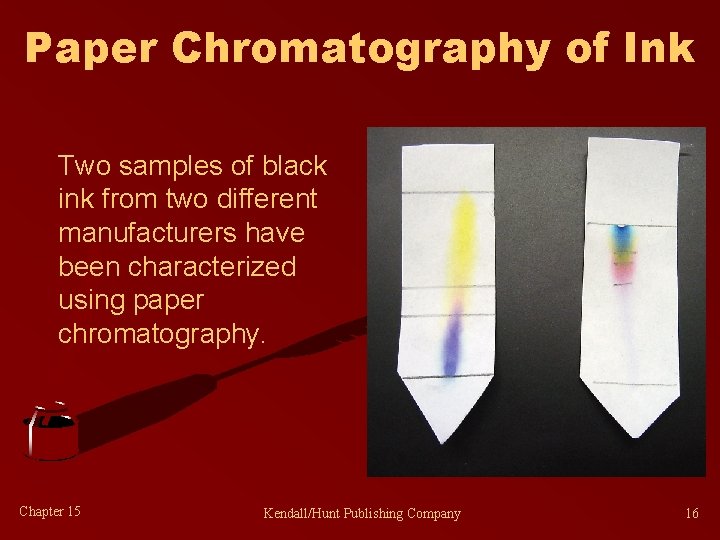
Ink Chromatography is a method of physically separating the components of inks Types § HPLC—high-performance liquid chromatography § TLC—thin-layer chromatography § Paper Chromatography Chapter 15 Kendall/Hunt Publishing Company 15
Paper Chromatography of Ink Two samples of black ink from two different manufacturers have been characterized using paper chromatography. Chapter 15 Kendall/Hunt Publishing Company 16
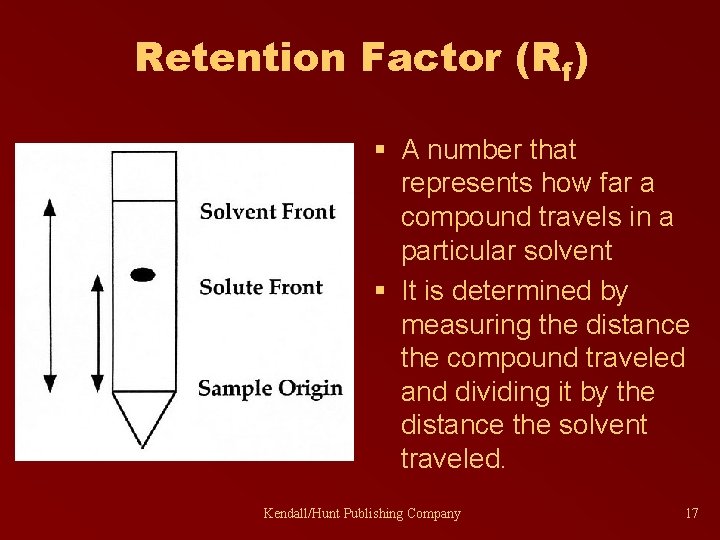
Retention Factor (Rf) § A number that represents how far a compound travels in a particular solvent § It is determined by measuring the distance the compound traveled and dividing it by the distance the solvent traveled. Kendall/Hunt Publishing Company 17
Paper Differences § § § § Chapter 15 Raw material Weight Density Thickness Color Watermarks Age Fluorescence Kendall/Hunt Publishing Company 18
Pencils § Lead § Hardness Scale—a traditional measure of the hardness of the "leads" (actually made of graphite) in pencils. The hardness scale, from softer to harder, takes the form. . . , 3 B, 2 B, B, HB, F, H, 2 H, 3 H, 4 H, . . . , with the standard "number 2" pencil being of hardness 2 H. Chapter 15 Kendall/Hunt Publishing Company 19
Evidence § Class characteristics may include general types of pens, pencils or paper. § Individual characteristics may include unique, individual handwriting characteristics; trash marks from copiers, or printer serial numbers. Chapter 15 Kendall/Hunt Publishing Company 20
More about Document Analysis For additional information about document and handwriting analysis, check out Court TV’s Crime Library at: lwww. crimelibrary. com/criminal_mind/forensics/literary/1. htm Or forgery cases at: www. crimelibrary. com/criminal_mind/scams/lincoln_forgers/index. html Chapter 15 Kendall/Hunt Publishing Company 21
The Constitution: The Fourth Amendment “The right of the people to be secure in their persons, houses, papers, and effects against unreasonable searches and seizures, shall not be violated, and no warrants shall issue, but upon probable cause, supported by oath or affirmation, and particularly describing the place to be searched, and their person or things to be seized. ” Ratified: Dec. 15, 1791 Chapter 15 Kendall/Hunt Publishing Company 22
Chapter 10 Handwriting Analysis, Forgery, and Counterfeiting By the end of this chapter you will be able to: ) describe 12 types of handwriting characteristics ) ) ) that can be analyzed in a document demonstrate an example of each of the 3 types of handwriting traits identify the major goal of a forensic handwriting analysis distinguish between the terms forgery and fraudulence identify several ways that businesses prevent check forgery describe 4 features of paper currency that are used to detect counterfeit bills All Rights Reserved South-Western / Cengage Learning © 2009 Chapter 15 Kendall/Hunt Publishing Company 23
Introduction ) Read p. 276 (Frank Abagnale) ) Document analysts examine and compare questioned documents with known material. ) Experts in the field investigate such things as handwriting, computer printouts, commercial printing, paper, and ink. ) Document experts may study threatening, ransom, or suicide notes. Their work can help identify a document’s author. ) What is graphology? Chapter 15 Kendall/Hunt Publishing Company 24
History of Forensic Handwriting Analysis ) In the 1930 s, handwriting analysis played a role in the famous Lindbergh case. (Bruno Hauptmann—ransom note) ) In 1999, the United States Court of Appeals determined that handwriting analysis qualified as a form of expert testimony. ) To be admissible in court, however, scientifically accepted guidelines must be followed. ) Handwriting analysis has been used by Scotland Yard, the FBI, and the Secret Service. Chapter 15 Kendall/Hunt Publishing Company 25
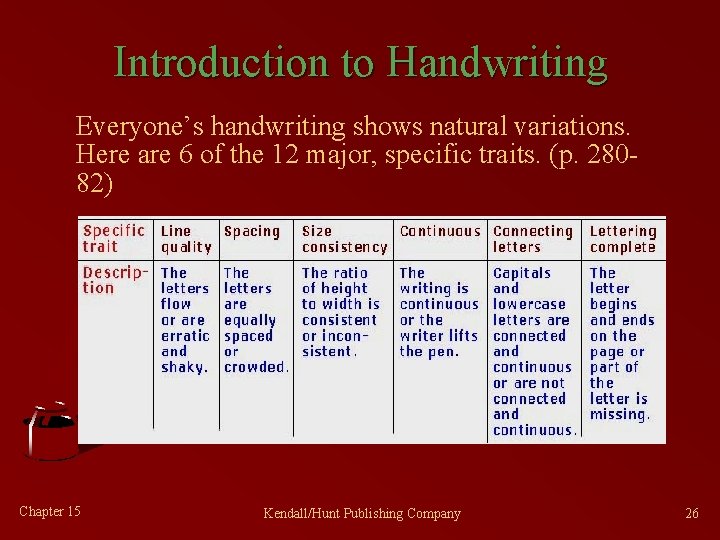
Introduction to Handwriting Everyone’s handwriting shows natural variations. Here are 6 of the 12 major, specific traits. (p. 28082) Chapter 15 Kendall/Hunt Publishing Company 26
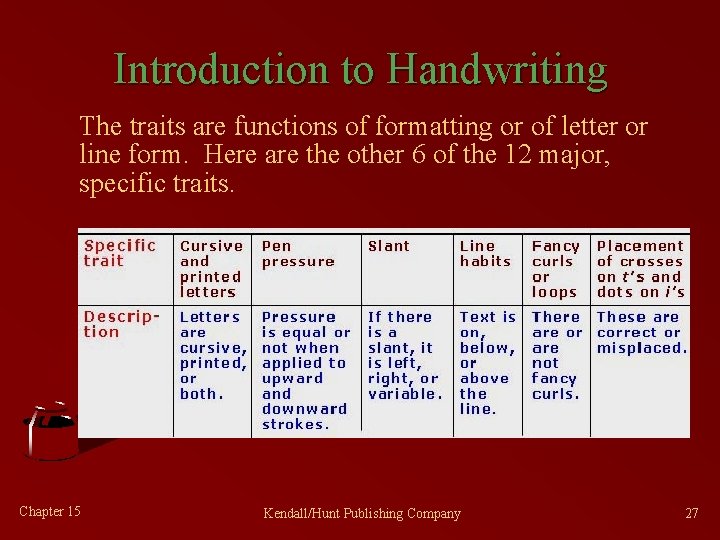
Introduction to Handwriting The traits are functions of formatting or of letter or line form. Here are the other 6 of the 12 major, specific traits. Chapter 15 Kendall/Hunt Publishing Company 27
Handwriting Examination Two writings are the product of one person if their similarities are unique and no unexplainable difference are found. What are forgeries? 1. Examine the questionable document for detectable traits and record them. 2. Obtain some writing of the suspect’s (an exemplar) and compare the traits found in the questionable document with it. (what are some good sources of exemplars? ) 3. Draw conclusions about the authorship of the questionable document based on the comparison. Chapter 15 Kendall/Hunt Publishing Company 28
Technology Used in Handwriting Analysis Biometric Signature Pads ) This computerized pad “learns” to recognize how a person signs his or her name based on the speed, pressure, and rhythm of the signing. ) Forgeries then are recognized by the detection of even slight differences. Computerized Analysis of Handwriting ) Computers can make objective comparisons between handwritings. ) Suspect signatures can be compared with ones stored in databases. (FISH—Forensic Chapter 15 Kendall/Hunt Publishing Company Information System for Handwriting) 29
Handwriting Evidence in the Courtroom )Written report is prepared for the jury )Give expert testimony answering questions from the defense and prosecuting attorneys )Show procedure was done, similarities, defend your conclusions )Document analysis has evolved and the American Board of Forensic Document Examiners train and certify forensic scientists Chapter 15 Kendall/Hunt Publishing Company 30
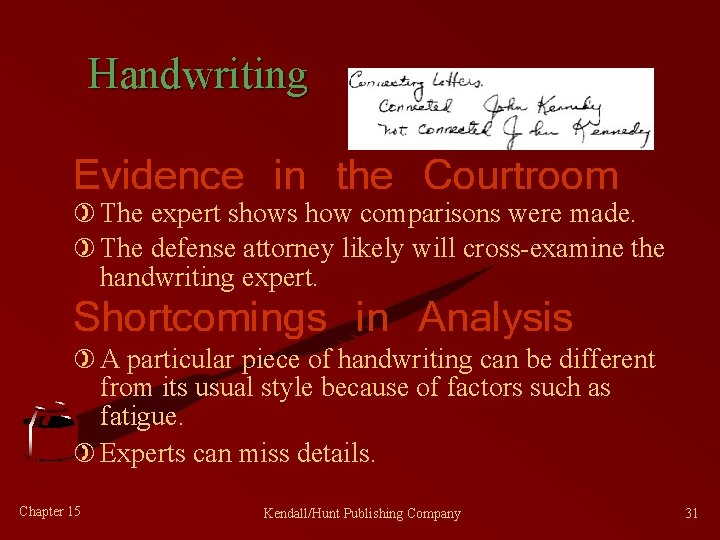
Handwriting Evidence in the Courtroom ) The expert shows how comparisons were made. ) The defense attorney likely will cross-examine the handwriting expert. Shortcomings in Analysis ) A particular piece of handwriting can be different from its usual style because of factors such as fatigue. ) Experts can miss details. Chapter 15 Kendall/Hunt Publishing Company 31
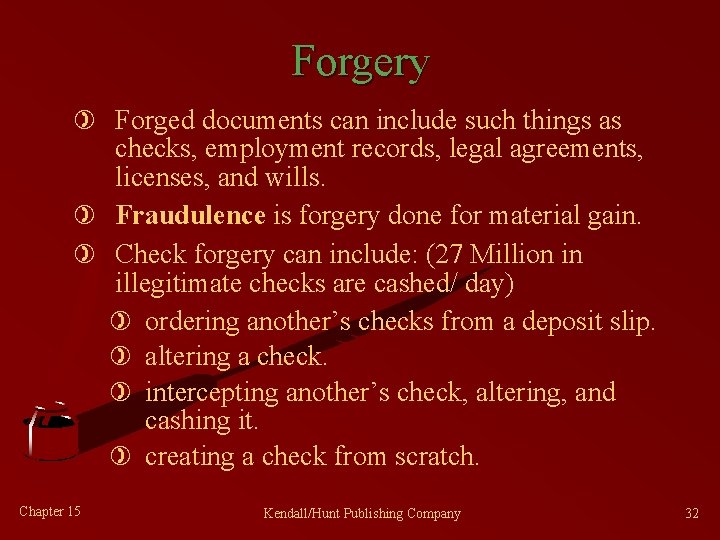
Forgery ) Forged documents can include such things as checks, employment records, legal agreements, licenses, and wills. ) Fraudulence is forgery done for material gain. ) Check forgery can include: (27 Million in illegitimate checks are cashed/ day) ) ordering another’s checks from a deposit slip. ) altering a check. ) intercepting another’s check, altering, and cashing it. ) creating a check from scratch. Chapter 15 Kendall/Hunt Publishing Company 32
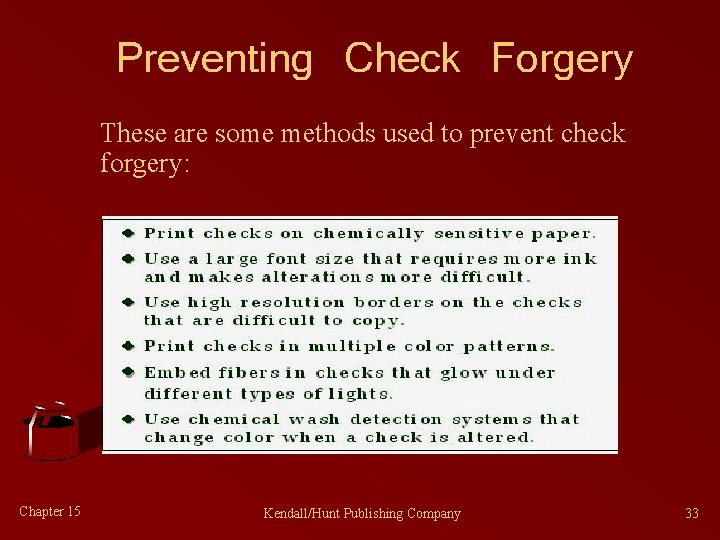
Preventing Check Forgery These are some methods used to prevent check forgery: Chapter 15 Kendall/Hunt Publishing Company 33
Literary Forgery ) Letters or other documents written by famous people can be very valuable. ) The best literary forgers aim to duplicate the original document by using materials similar to those used for the original: ) old paper ) chemically treated materials to fake an older look ) inks mixed from substances that would have been used at the time ) watermarks that add the appearance of age ) tools and styles that would have been popular at the time Chapter 15 Kendall/Hunt Publishing Company 34
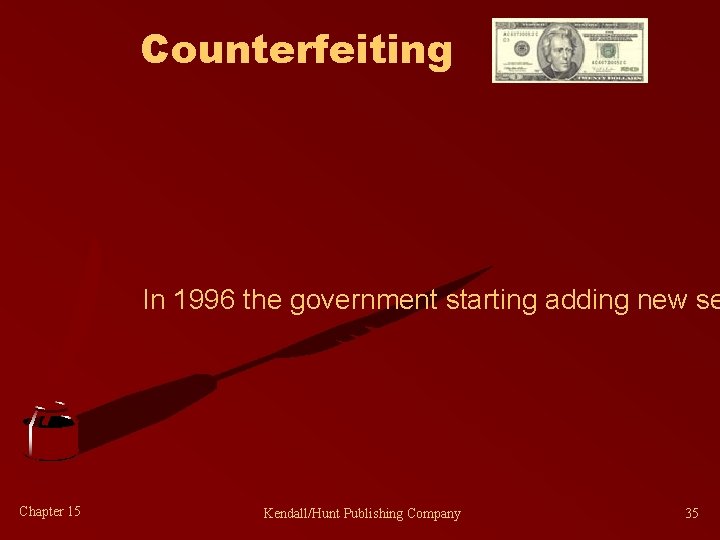
Counterfeiting In 1996 the government starting adding new se Chapter 15 Kendall/Hunt Publishing Company 35
Counterfeiting money is a crime stretching back into ancient times. Items most often forged today include: )currency )traveler’s checks )food stamps )certain bonds )postage stamps Chapter 15 Kendall/Hunt Publishing Company 36
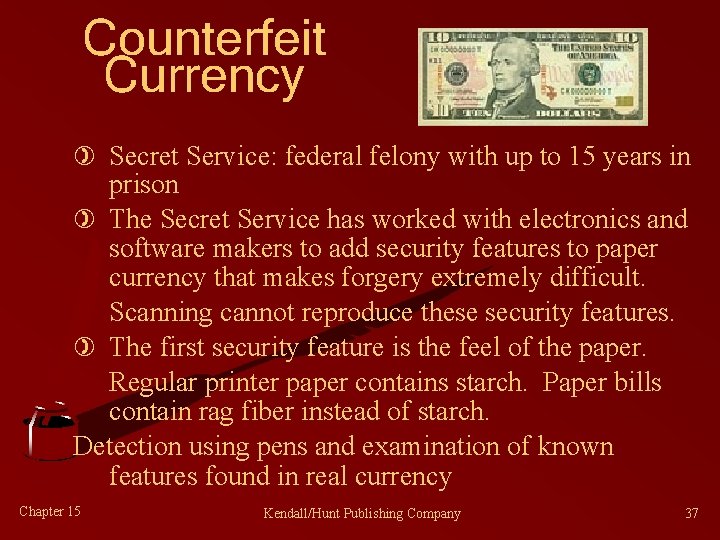
Counterfeit Currency ) Secret Service: federal felony with up to 15 years in prison ) The Secret Service has worked with electronics and software makers to add security features to paper currency that makes forgery extremely difficult. Scanning cannot reproduce these security features. ) The first security feature is the feel of the paper. Regular printer paper contains starch. Paper bills contain rag fiber instead of starch. Detection using pens and examination of known features found in real currency Chapter 15 Kendall/Hunt Publishing Company 37
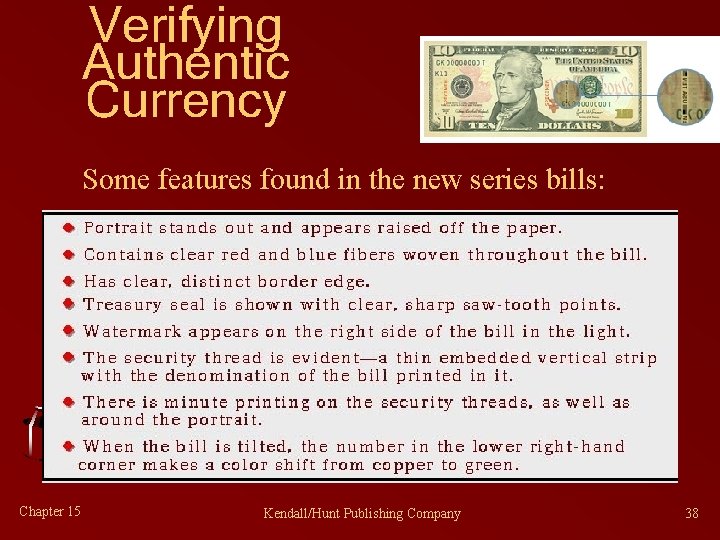
Verifying Authentic Currency Some features found in the new series bills: Chapter 15 Kendall/Hunt Publishing Company 38
Examine some handwriting and bills )Read p. 290 -91—case studies and Cunningham )Complete the Ransom note Activity 10. 2, p. 297 -300. Use your own paper, follow all of the directions, including writing up a lab report (you may write it up, instead of typing it) (with a partner) )Complete the bill activity on p. 301 -307, take the pre-test, complete the activities (A, B, C, D) and answer questions on p. 307(with a partner) Chapter 15 Kendall/Hunt Publishing Company 39
. . . . Summary ) Handwriting analysis compares questioned documents with exemplars to establish authorship. ) Aspects of a person’s handwriting style can be analyzed to accomplish that. ) Many new features of paper currency help prevent counterfeiting. ) Technological advances have enhanced chances of detecting forged documents. Chapter 15 Kendall/Hunt Publishing Company 40