
Chapter 10 7 Planar Graphs These class notes
- Slides: 23
Chapter 10. 7 Planar Graphs These class notes are based on material from our textbook, Discrete Mathematics and Its Applications, 7 th ed. , by Kenneth H. Rosen, published by Mc. Graw Hill, Boston, MA, 2011. They are intended for classroom use only and are not a substitute for reading the textbook.
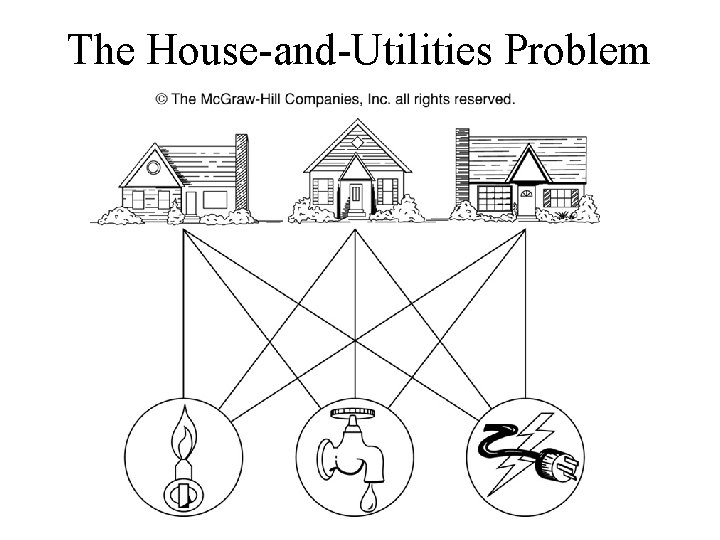
The House-and-Utilities Problem
Planar Graphs • Consider the previous slide. Is it possible to join the three houses to the three utilities in such a way that none of the connections cross?
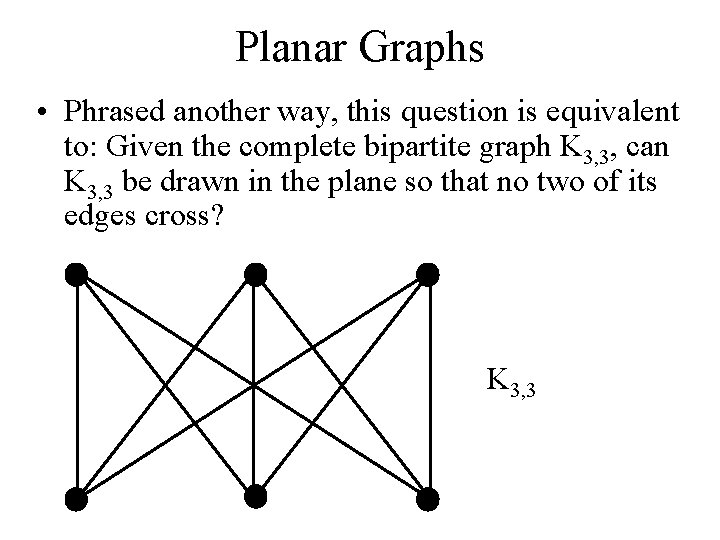
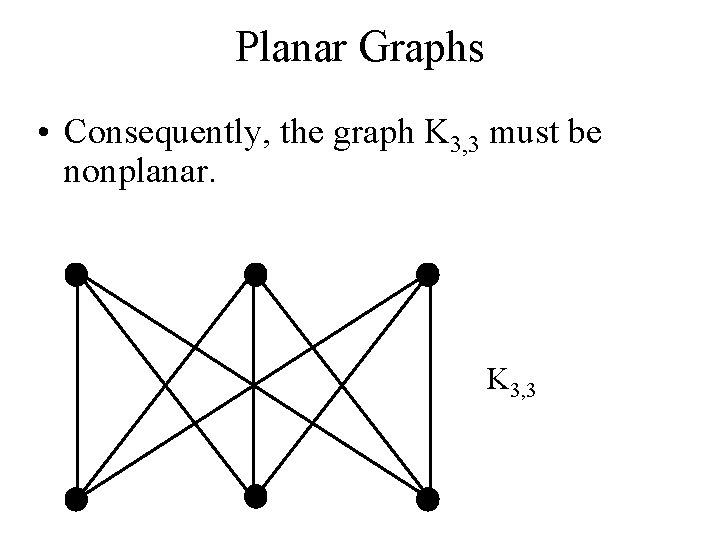
Planar Graphs • Phrased another way, this question is equivalent to: Given the complete bipartite graph K 3, 3, can K 3, 3 be drawn in the plane so that no two of its edges cross? K 3, 3
Planar Graphs • A graph is called planar if it can be drawn in the plane without any edges crossing. • A crossing of edges is the intersection of the lines or arcs representing them at a point other than their common endpoint. • Such a drawing is called a planar representation of the graph.
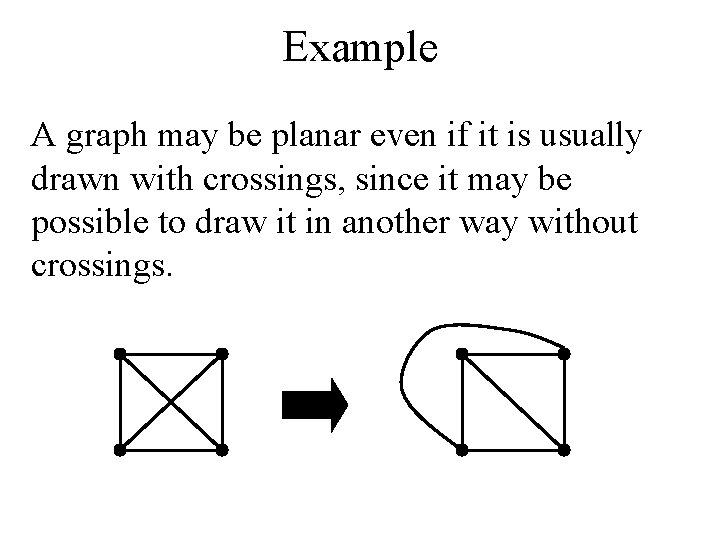
Example A graph may be planar even if it is usually drawn with crossings, since it may be possible to draw it in another way without crossings.
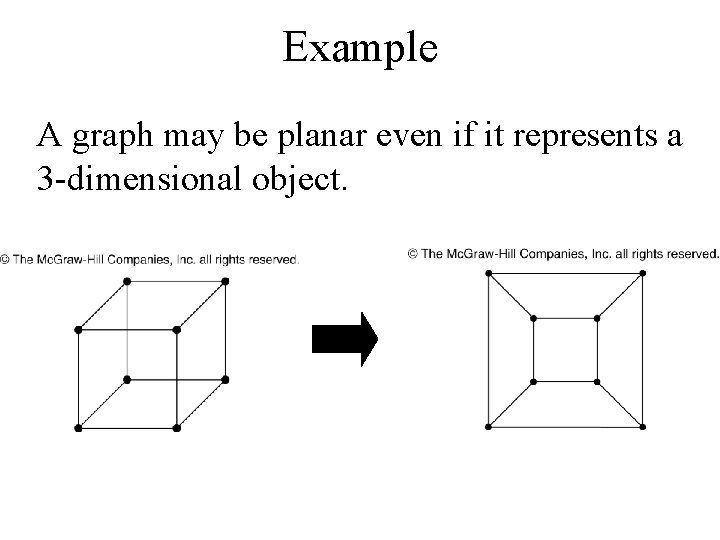
Example A graph may be planar even if it represents a 3 -dimensional object.
Planar Graphs • We can prove that a particular graph is planar by showing how it can be drawn without any crossings. • However, not all graphs are planar. • It may be difficult to show that a graph is nonplanar. We would have to show that there is no way to draw the graph without any edges crossing.
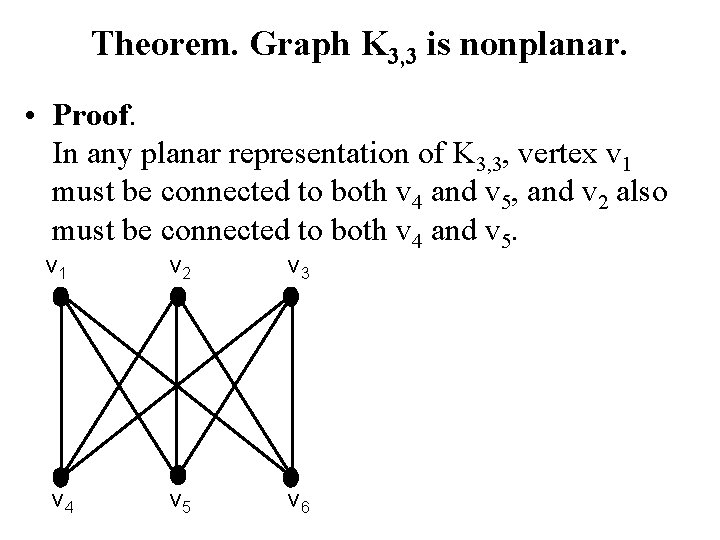
Theorem. Graph K 3, 3 is nonplanar. • Proof. In any planar representation of K 3, 3, vertex v 1 must be connected to both v 4 and v 5, and v 2 also must be connected to both v 4 and v 5. v 1 v 2 v 3 v 4 v 5 v 6
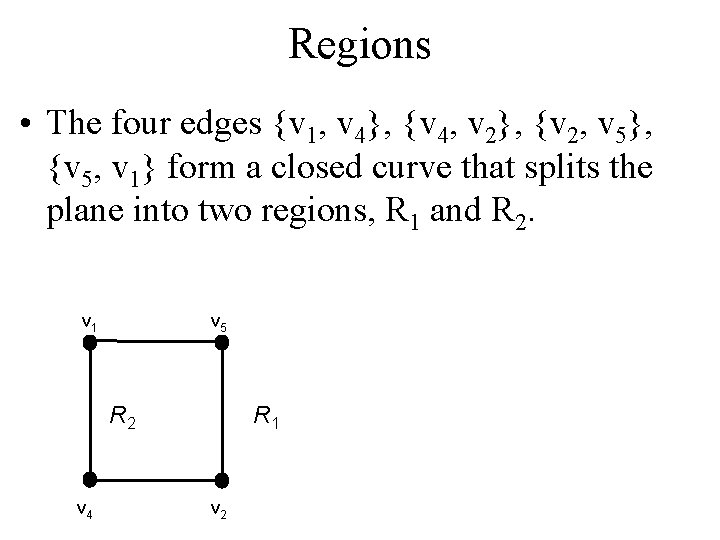
Regions • The four edges {v 1, v 4}, {v 4, v 2}, {v 2, v 5}, {v 5, v 1} form a closed curve that splits the plane into two regions, R 1 and R 2. v 1 v 5 R 2 v 4 R 1 v 2
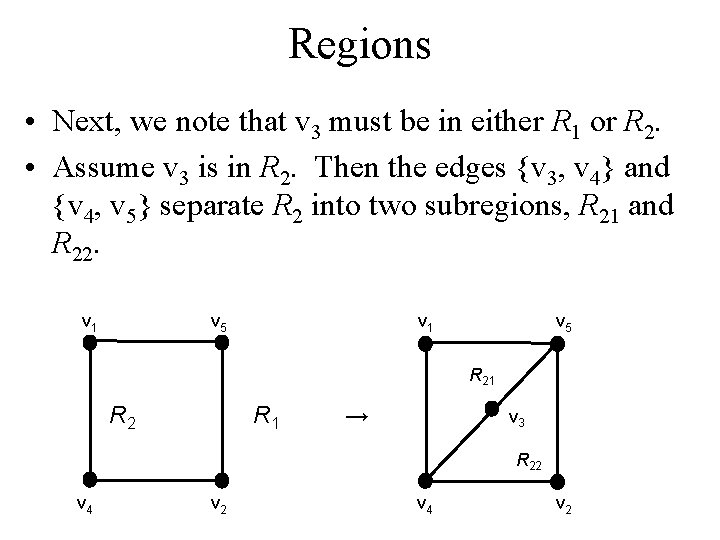
Regions • Next, we note that v 3 must be in either R 1 or R 2. • Assume v 3 is in R 2. Then the edges {v 3, v 4} and {v 4, v 5} separate R 2 into two subregions, R 21 and R 22. v 1 v 5 R 21 R 2 R 1 → v 3 R 22 v 4 v 2
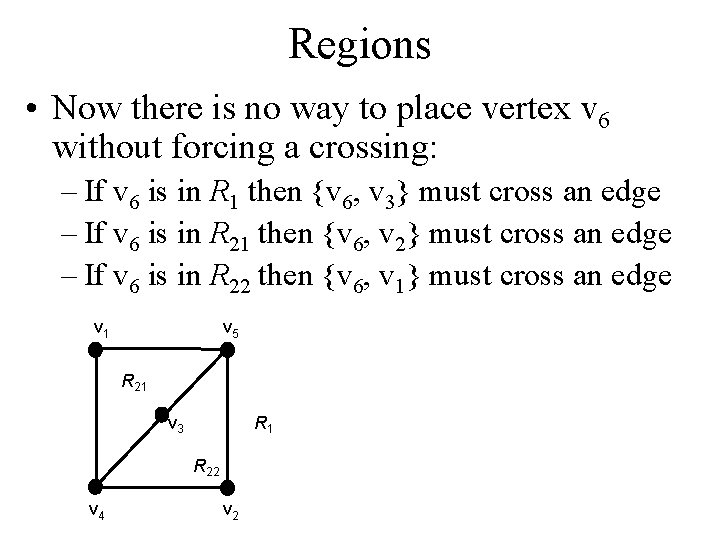
Regions • Now there is no way to place vertex v 6 without forcing a crossing: – If v 6 is in R 1 then {v 6, v 3} must cross an edge – If v 6 is in R 21 then {v 6, v 2} must cross an edge – If v 6 is in R 22 then {v 6, v 1} must cross an edge v 1 v 5 R 21 v 3 R 1 R 22 v 4 v 2
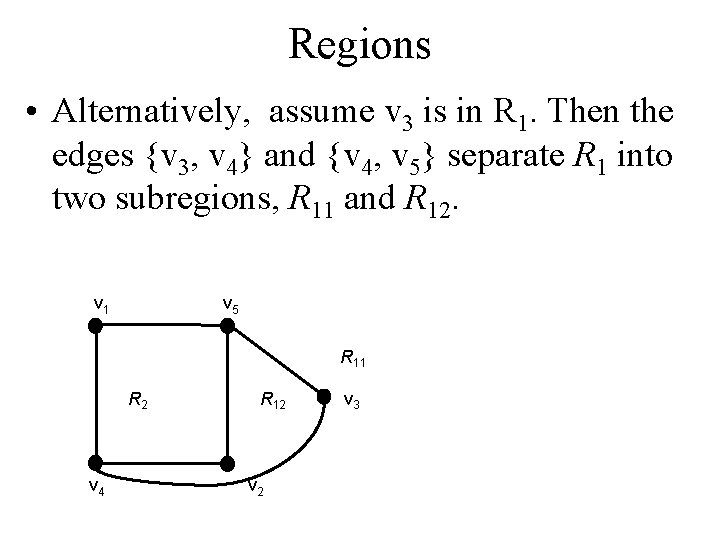
Regions • Alternatively, assume v 3 is in R 1. Then the edges {v 3, v 4} and {v 4, v 5} separate R 1 into two subregions, R 11 and R 12. v 1 v 5 R 11 R 2 v 4 R 12 v 3
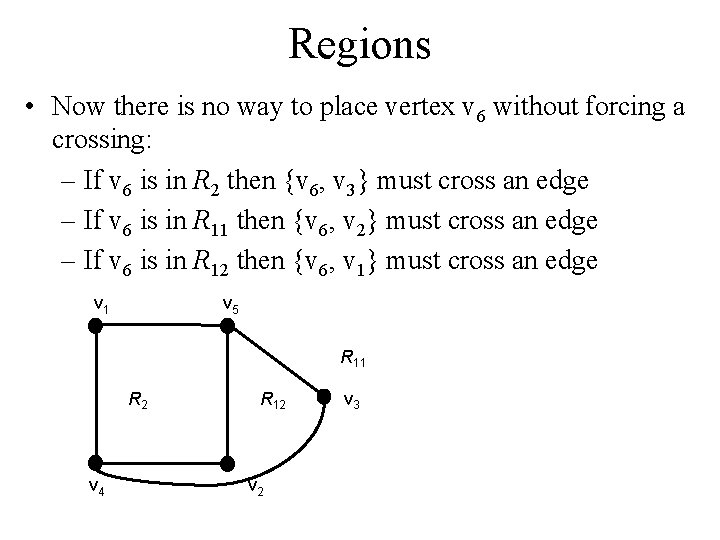
Regions • Now there is no way to place vertex v 6 without forcing a crossing: – If v 6 is in R 2 then {v 6, v 3} must cross an edge – If v 6 is in R 11 then {v 6, v 2} must cross an edge – If v 6 is in R 12 then {v 6, v 1} must cross an edge v 1 v 5 R 11 R 2 v 4 R 12 v 3
Planar Graphs • Consequently, the graph K 3, 3 must be nonplanar. K 3, 3
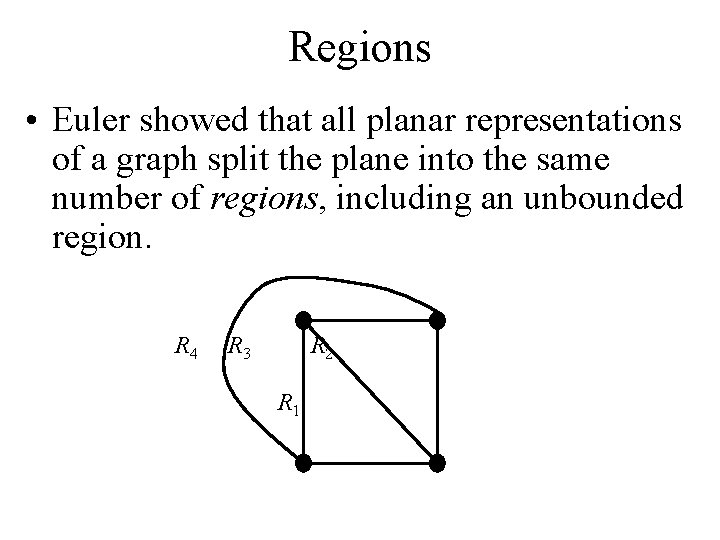
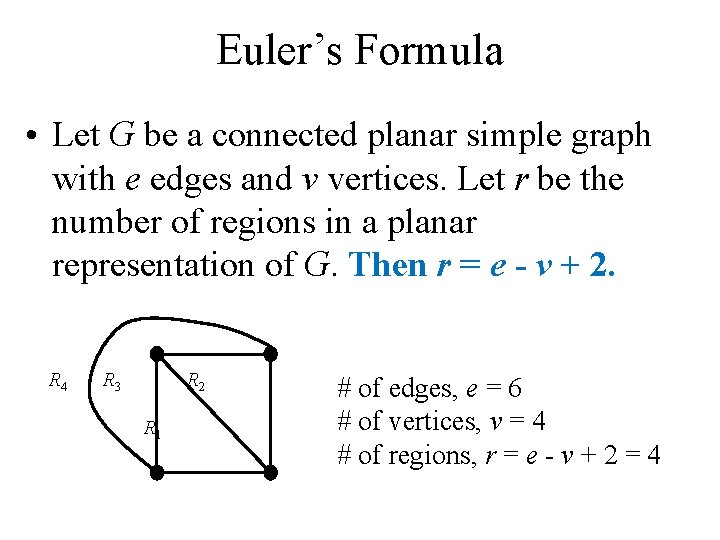
Regions • Euler showed that all planar representations of a graph split the plane into the same number of regions, including an unbounded region. R 4 R 3 R 2 R 1
Regions • Euler devised a formula for expressing the relationship between the number of vertices, edges, and regions of a planar graph. • These may help us determine if a graph can be planar or not.
Euler’s Formula • Let G be a connected planar simple graph with e edges and v vertices. Let r be the number of regions in a planar representation of G. Then r = e - v + 2. R 4 R 3 R 2 R 1 # of edges, e = 6 # of vertices, v = 4 # of regions, r = e - v + 2 = 4
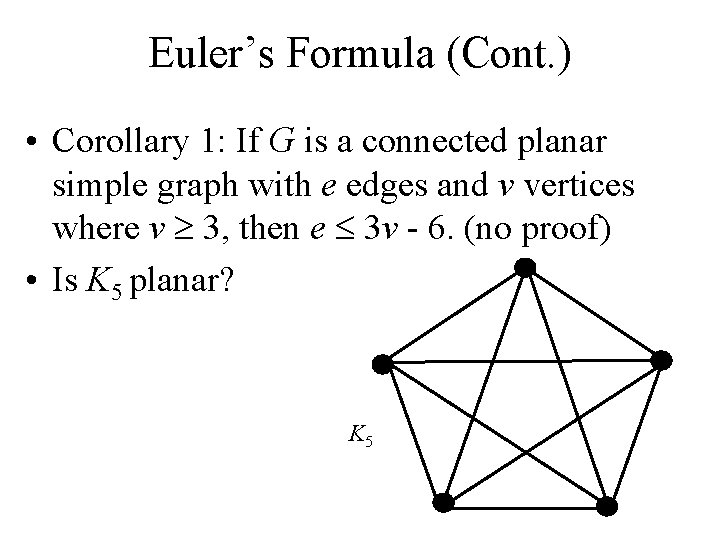
Euler’s Formula (Cont. ) • Corollary 1: If G is a connected planar simple graph with e edges and v vertices where v 3, then e 3 v - 6. (no proof) • Is K 5 planar? K 5
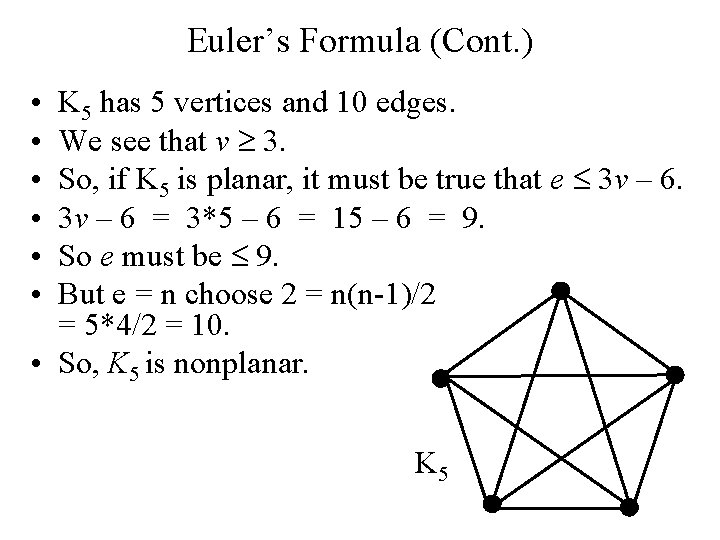
Euler’s Formula (Cont. ) • • • K 5 has 5 vertices and 10 edges. We see that v 3. So, if K 5 is planar, it must be true that e 3 v – 6 = 3*5 – 6 = 15 – 6 = 9. So e must be 9. But e = n choose 2 = n(n-1)/2 = 5*4/2 = 10. • So, K 5 is nonplanar. K 5
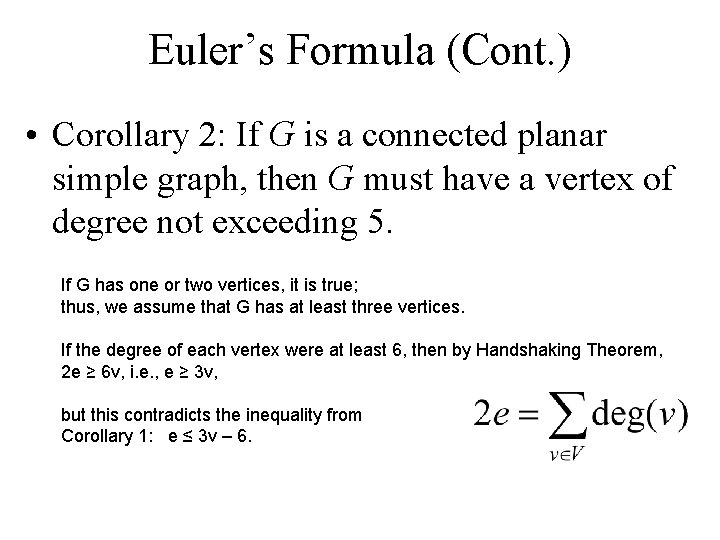
Euler’s Formula (Cont. ) • Corollary 2: If G is a connected planar simple graph, then G must have a vertex of degree not exceeding 5. If G has one or two vertices, it is true; thus, we assume that G has at least three vertices. If the degree of each vertex were at least 6, then by Handshaking Theorem, 2 e ≥ 6 v, i. e. , e ≥ 3 v, but this contradicts the inequality from Corollary 1: e ≤ 3 v – 6.
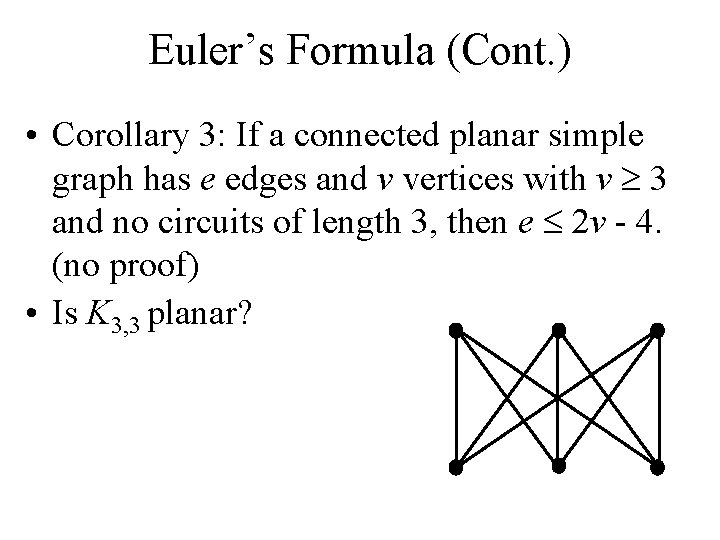
Euler’s Formula (Cont. ) • Corollary 3: If a connected planar simple graph has e edges and v vertices with v 3 and no circuits of length 3, then e 2 v - 4. (no proof) • Is K 3, 3 planar?
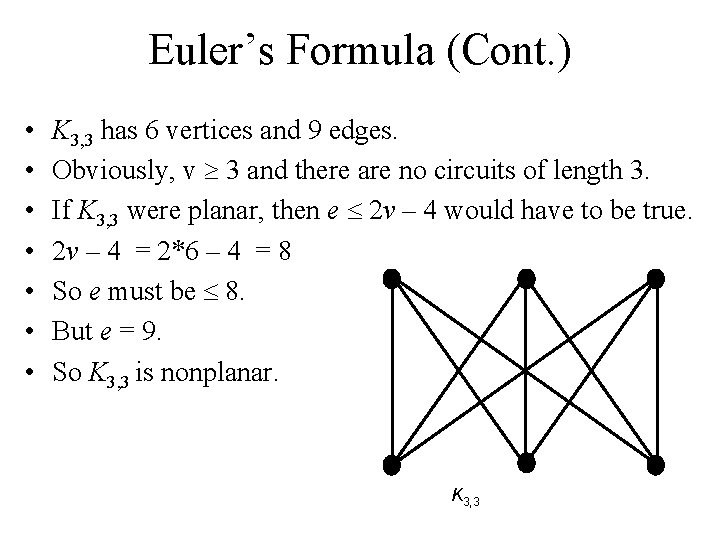
Euler’s Formula (Cont. ) • • K 3, 3 has 6 vertices and 9 edges. Obviously, v 3 and there are no circuits of length 3. If K 3, 3 were planar, then e 2 v – 4 would have to be true. 2 v – 4 = 2*6 – 4 = 8 So e must be 8. But e = 9. So K 3, 3 is nonplanar. K 3, 3