
Chapter 10 4 Comprehension Conversation Theories about our
Chapter 10. 4 • Comprehension » Conversation ◊ Theories about our partners ◊ Empirical effects » Review Study Questions. • No study question today. 12/21/2021
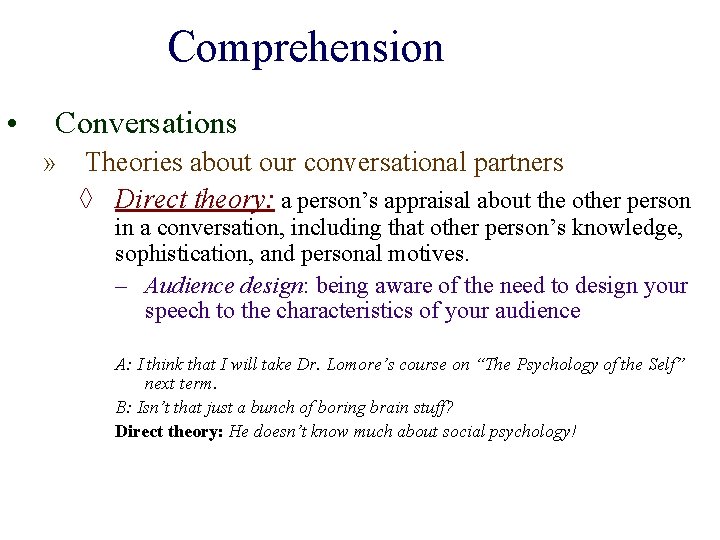
Comprehension • Conversations » Theories about our conversational partners ◊ Direct theory: a person’s appraisal about the other person in a conversation, including that other person’s knowledge, sophistication, and personal motives. – Audience design: being aware of the need to design your speech to the characteristics of your audience A: I think that I will take Dr. Lomore’s course on “The Psychology of the Self” next term. B: Isn’t that just a bunch of boring brain stuff? Direct theory: He doesn’t know much about social psychology!
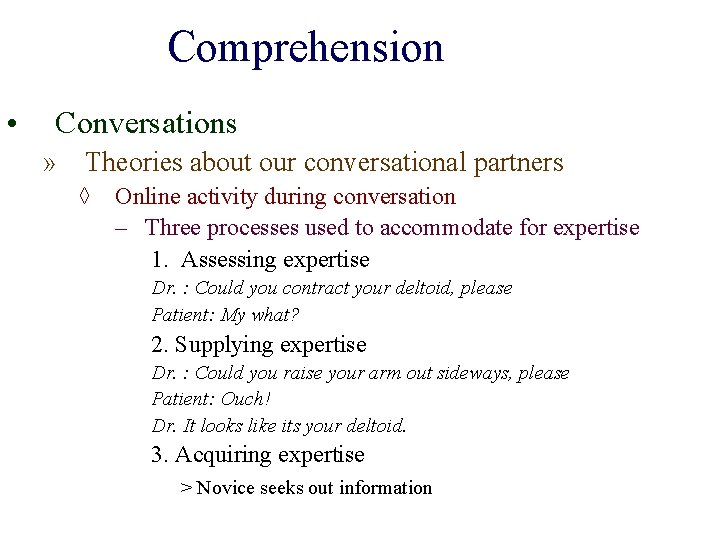
Comprehension • Conversations » Theories about our conversational partners ◊ Online activity during conversation – Three processes used to accommodate for expertise 1. Assessing expertise Dr. : Could you contract your deltoid, please Patient: My what? 2. Supplying expertise Dr. : Could you raise your arm out sideways, please Patient: Ouch! Dr. It looks like its your deltoid. 3. Acquiring expertise > Novice seeks out information
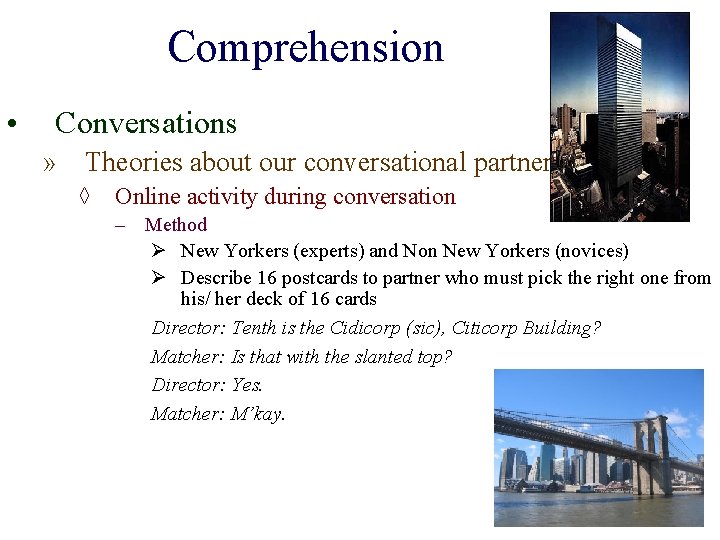
Comprehension • Conversations » Theories about our conversational partners ◊ Online activity during conversation – Method Ø New Yorkers (experts) and Non New Yorkers (novices) Ø Describe 16 postcards to partner who must pick the right one from his/ her deck of 16 cards Director: Tenth is the Cidicorp (sic), Citicorp Building? Matcher: Is that with the slanted top? Director: Yes. Matcher: M’kay.
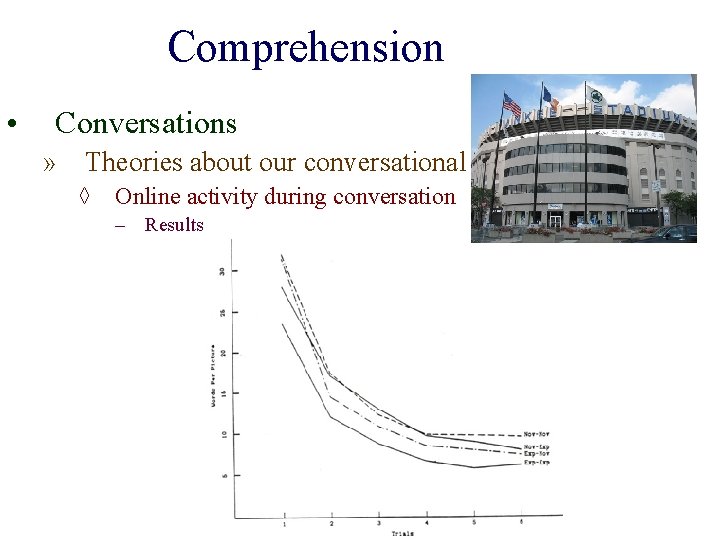
Comprehension • Conversations » Theories about our conversational partners ◊ Online activity during conversation – Results
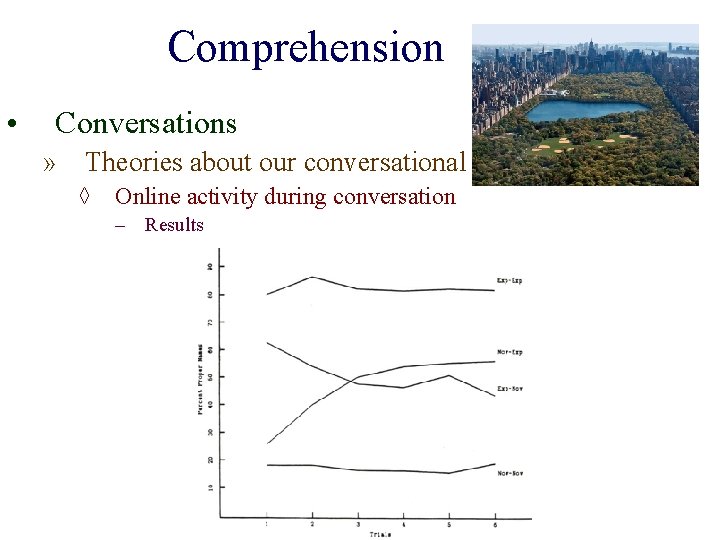
Comprehension • Conversations » Theories about our conversational partners ◊ Online activity during conversation – Results
Comprehension • Conversations » Theories about our conversational partners ◊ Second order theory: What you think the other person thinks about you. -> I. e. , an evaluation of the other person’s direct theory A: I think that I will take Dr. Lomore’s course on “The Psychology of the Self” next term. B: Me too! Christie gave me some readings that she thought I would like. Direct theory: He knows the professor by first name and is bragging about it. Second-order theory: He thinks I will be impressed that he calls the professor “Christie”.
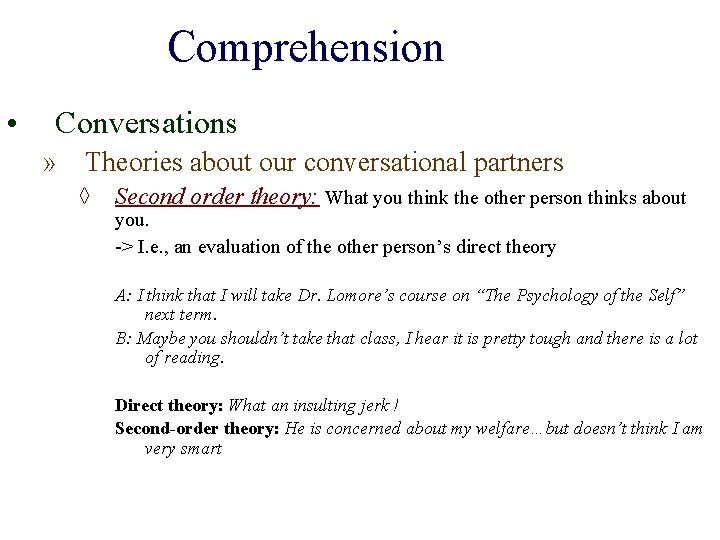
Comprehension • Conversations » Theories about our conversational partners ◊ Second order theory: What you think the other person thinks about you. -> I. e. , an evaluation of the other person’s direct theory A: I think that I will take Dr. Lomore’s course on “The Psychology of the Self” next term. B: Maybe you shouldn’t take that class, I hear it is pretty tough and there is a lot of reading. Direct theory: What an insulting jerk ! Second-order theory: He is concerned about my welfare…but doesn’t think I am very smart
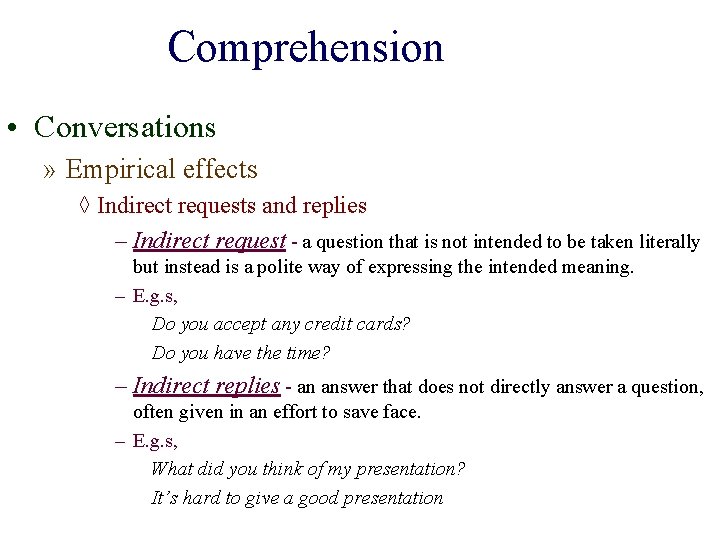
Comprehension • Conversations » Empirical effects ◊ Indirect requests and replies – Indirect request - a question that is not intended to be taken literally but instead is a polite way of expressing the intended meaning. – E. g. s, Do you accept any credit cards? Do you have the time? – Indirect replies - an answer that does not directly answer a question, often given in an effort to save face. – E. g. s, What did you think of my presentation? It’s hard to give a good presentation
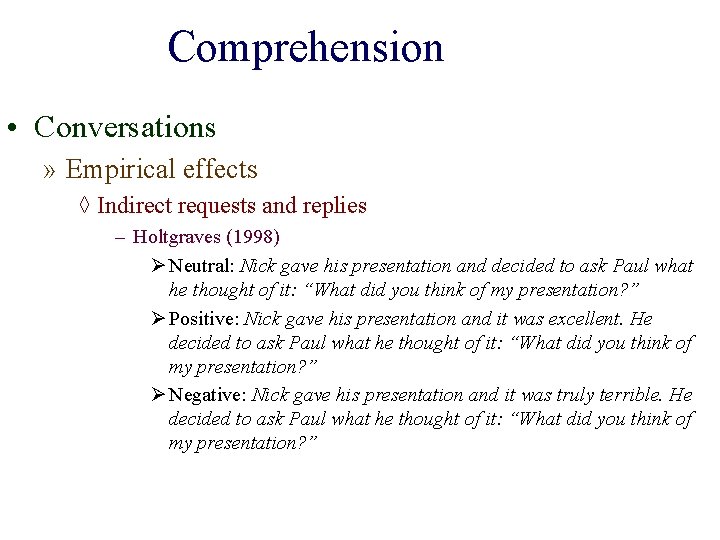
Comprehension • Conversations » Empirical effects ◊ Indirect requests and replies – Holtgraves (1998) Ø Neutral: Nick gave his presentation and decided to ask Paul what he thought of it: “What did you think of my presentation? ” Ø Positive: Nick gave his presentation and it was excellent. He decided to ask Paul what he thought of it: “What did you think of my presentation? ” Ø Negative: Nick gave his presentation and it was truly terrible. He decided to ask Paul what he thought of it: “What did you think of my presentation? ”
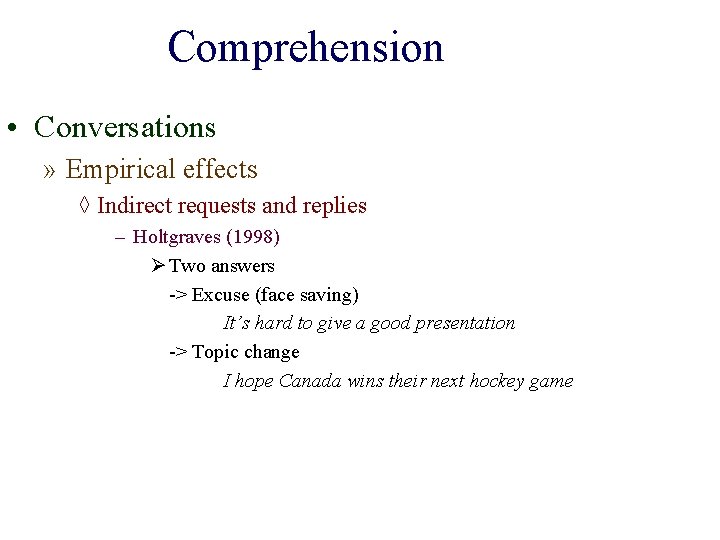
Comprehension • Conversations » Empirical effects ◊ Indirect requests and replies – Holtgraves (1998) Ø Two answers -> Excuse (face saving) It’s hard to give a good presentation -> Topic change I hope Canada wins their next hockey game
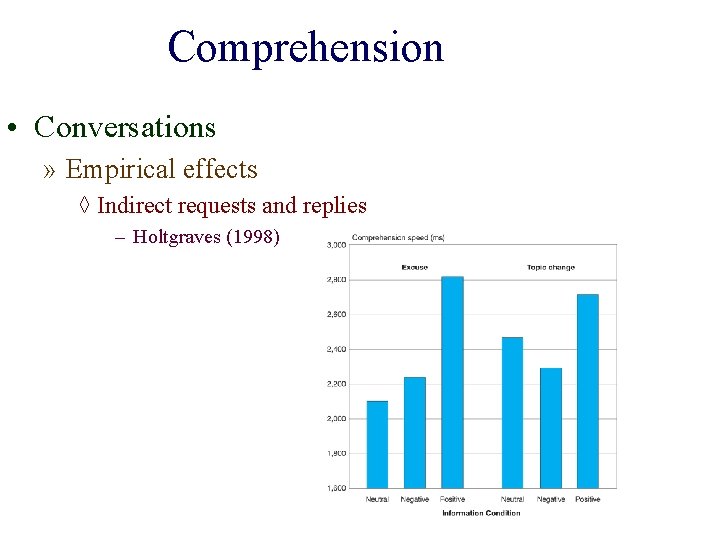
Comprehension • Conversations » Empirical effects ◊ Indirect requests and replies – Holtgraves (1998)
Comprehension • Conversations » Empirical effects ◊ Egocentric speech – Optimal design: We tailor our speech to optimize the listener’s chances of full understanding, – Keysar (1994) > Adults disregard the principle of optimal design and speak (and comprehend) as egocentrically as children > Used a version of “Theory of mind” experiment -> one person knows something the other person does not know > Our first pass is egocentric, adjustments occur later are particularly prone to errors.
Review Chapter 7: Knowing » Semantic Memory ◊ Empirical Tests – ◊ Models – – – ◊ Artificial and natural categories Prototype and exemplar theories Semantic Priming – – – ◊ ERP studies • The N 400 Categorization – – ◊ TLC Feature Comparison Spreading Activation Neurophysiological evidence – ◊ The sentence verification task Priming Tasks Priming in other tasks Automaticity Neurophysiology II – – Context and connectionism The living/nonliving dissociation • Connectionist model of semantic impairment
Review Chapter 7: Knowing » Key Terms ◊ » Sentence verification task; True-false effect; Category size effect; Semantic distance; typicality effect; Semantic priming; TLC; Hierarchical organization; Cognitive economy; Feature comparison model; Defining features; Characteristic features; Spreading activation; Semantic relatedness effect; Propositional representation; The fan effect; Prime; Target; Evoked responses; N 400; Lexical decision task; Exemplar theory; Prototype theory; Dichoptic viewing; Category-based representation; Property-based representation Study Questions ◊ ◊ ◊ Describe four well established findings from the sentence verification task. Which of these findings are predicted by TLC and which findings are not handled well by TLC? Which findings can Feature Comparison and Spreading Activation handle? What is the N 400 and why is it important to the study of semantic memory? Compare and contrast category-based and property-based representation. How does this distinction account for the living/non-living dichotomy in neuropsychological studies?
Review • Chapter 8: Using knowledge in the real world » » Seven Sins of Memory Reconstructive memory Semantic integration Propositional representation and networks ◊ ◊ » » Scripts False memory ◊ ◊ » How to build a network Empirical support Eyewitness memory Repressed/recovered memories Autobiographical memories ◊ ◊ ◊ Very Long Term Memory Real World Memories Emotion and Memories – Flashbulb memories
Review • Chapter 8: Using knowledge in the real world » Study Questions ◊ Would you rather that I mark your technical accuracy or your content accuracy for this question? Why? ◊ Draw a propositional network that represents the meaning in a simple sentence. e. g. , The old car pulling the trailer climbed the steep hill. ◊ Compare and contrast misinformation effects with retroactive interference. ◊ According to research, what do you expect will happen to your knowledge of Cognitive Psychology over the next several years?
Review • Chapter 8: Using knowledge in the real world » Key Terms ◊ Transience; absent-mindedness; blocking; misattribution; cryptomnesia; suggestibility; bias; persistence; schemata; reproductions; reconstructions; technical accuracy; content accuracy; propositions; case grammar; semantic case; strength assumption; activation assumption; spread of activation; dampening assumption; active list assumption; the fan effect; scripts; headers; frames; default values; script-pointer-plus-tag theory; false memory; leading questions; memory impairment; misinformation effect; source misattribution; misinformation acceptance; imagination inflation; repressed memories; recovered memories; autobiographical memory; self-reference effect; self-schema; permastore; amygdala; flashbulb memory;
Review • Chapter 9: Language » Outline ◊ Language vs. communication – – ◊ ◊ ◊ What is language Whorf’s hypothesis Speech perception – – – ◊ Hockett’s linguistic universals Design features Acoustic Phonetics Articulatory Phonetics Top down processes Syntax – – Finite state grammar Phrase structure grammar Transformational grammar Lexical and semantic factors • Case Grammar • Cognitive roles ◊ Brain & Language – Aphasia • Classic localization model – Language in intact brains • ERP studies • Individual differences
Review • Chapter 9: Language » Study Questions ◊ Compare and contrast animal communication with human language. Use Hockett’s defining features to underscore the distinction. ◊ Compare and contrast acoustic and articulatory phonetics ◊ How has sentence ambiguity been used to study the psycholinguistics of grammar ◊ Compare and contrast Broca’s aphasia, Wernicke’s aphasia, and conduction aphasia
Review • Chapter 9: Language » Key Terms ◊ Continuity theory; apparent specificity; language; linguistics; psycholingistics; semanticity; arbitrariness; discreteness; duality of patterning; displacement; productivity; traditional transmission; grammar; phonology; syntax; linguistic competency; dysfluences; linguistic intuitions; linguistic relativity hypothesis; phonetics; articulatory phonetics; acoustic phonetics; the speech spectrograph; phoneme; places of articulation; manners of articulation; voicing; voice onset time; categorical perception; coarticulation; phonemic restoration effect; finite state grammar; phrase structure grammar; transformational grammar; deep structure; surface structure; transformational rules; case grammar; aphasia; Broca’s aphasia; expressive or nonfluent deficits; receptive or fluency deficits; dysarthria; Speech apraxia; Wernicke’s aphasia; neologisitic; anomia; classical localization model; transcortical motor aphasia; transcortical sensory aphasia; conduction aphasia; arcuate fasciculus; P 600;
Review • Chapter 10: Comprehension » » Traditional research Online comprehension tasks ◊ ◊ » Reading ◊ ◊ » Gernsbacher’s Structure Building Situation model approach Gaze duration Dual route model Conversation ◊ ◊ Cursing and Humour Pragmatics Structure Empirical investigations
Review • Chapter 10: Comprehension » Study Questions ◊ Describe three processes and two control mechanisms associated with Gernsbacher’s structure building model of comprehension. ◊ Describe the two routes for word naming. ◊ Describe the violation theory of humour. ◊ Describe some of the maxims or rules of conversation.
• Chapter 10: Comprehension » Key Terms ◊ Traditional comprehension research; “on-line” procedures; lexical decision; mental structure building; enhancement; suppression; mapping; advantage of first mention; advantage of clause recency; reference; inference; anaphoric reference; implication; bridging; saccade; fixation; regressions; gaze duration; mind-eye assumption; moving window technique; perceptual span during reading; dual route model; horse-race model; direct or whole word or addressed phonological route; indirect or phonetic or assembled phonological route; regular and irregular orthography; pseudohomophones; acquired dyslexia; phonological or deep dyslexia; surface dyslexia; imlicature; direct speech act; indirect speech act; dysphemic swearing; Idiomatic swearing; emphatic swearing; cathartic swearing; Coprolalia; Violation theory of humour; Surprise disambiguation; locution; illocution; perlocution; conversational maxims (quantity, quality, relevance, and manner); constative locution; directive locution; commissive locution; acknowledgement; cooperative principal; direct theory; second-order theory;
- Slides: 25