
Chapter 10 13 Cognitive Development in Early Middle
- Slides: 46
Chapter 10 & 13 Cognitive Development in Early & Middle Childhood Copyright © 2014 Mc. Graw-Hill Education. All rights reserved. No reproduction or distribution without the prior written consent of Mc. Graw-Hill Education.
Jean Piaget’s Preoperational Stage 2 -7 years old Copyright © 2014 Mc. Graw-Hill Education. All rights reserved. No reproduction or distribution without the prior written consent of Mc. Graw-Hill Education.
Piaget’s Preoperational Stage § Preoperational stage: Piaget’s second stage, lasting from 2 to 7 years of age, during which time children begin to represent the world with words, images, and drawings § Operations: Internalized set of actions; Mental manipulations of concepts and ideas § Stages: § Symbolic Function (Preconceptual) 2 -4 years § Intuitive 4 -7 years Copyright © 2014 Mc. Graw-Hill Education. All rights reserved. No reproduction or distribution without the prior written consent of Mc. Graw-Hill Education.
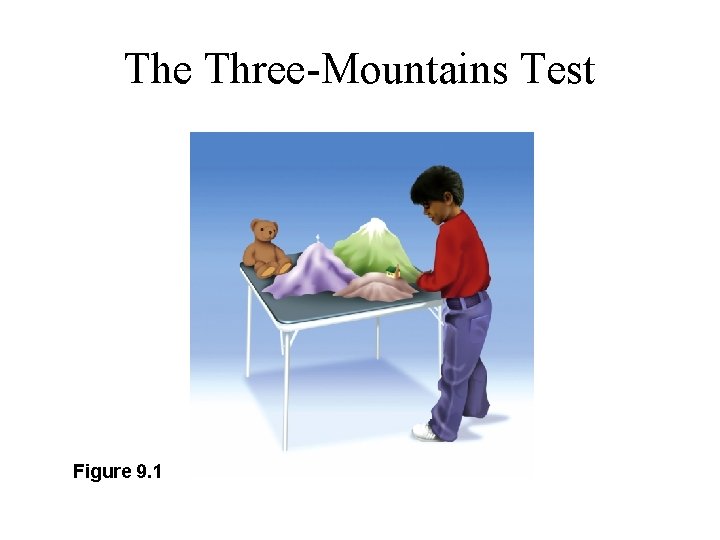
Piaget’s Preoperational Stage § Symbolic function stage § First substage of preoperational thought § Occurs in ages 2 to 4, imaginative drawings § Ability to mentally represent object not present § Thoughts limited by beliefs: § Egocentrism § Animism Copyright © 2014 Mc. Graw-Hill Education. All rights reserved. No reproduction or distribution without the prior written consent of Mc. Graw-Hill Education.
The Three-Mountains Test Figure 9. 1
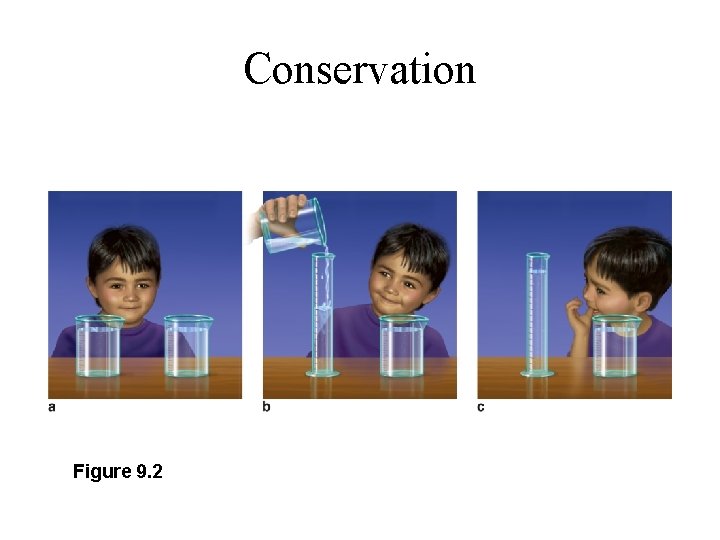
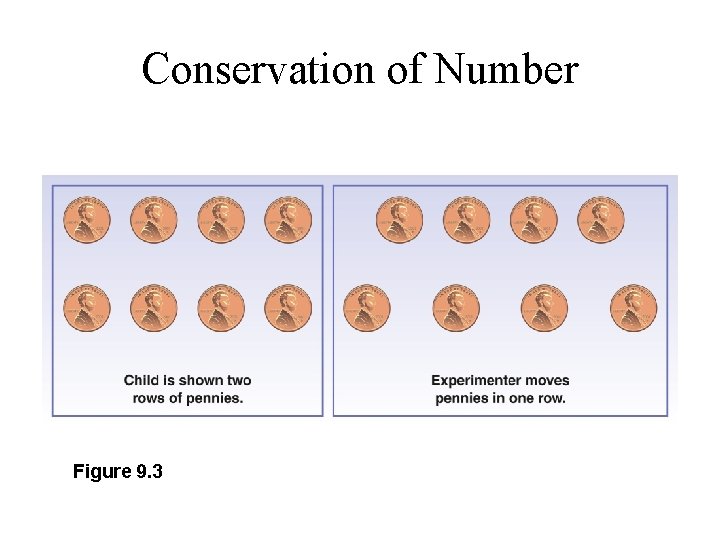
Piaget’s Preoperational Stage § Intuitive thought substage § Uses primitive reasoning, seeks answers to all § Occurs about 4 to 7 years of age § Limits in preoperational thought § Centration § Lack of Conservation § Irreversibility § Lack of Class Inclusion Copyright © 2014 Mc. Graw-Hill Education. All rights reserved. No reproduction or distribution without the prior written consent of Mc. Graw-Hill Education.
Conservation Figure 9. 2
Conservation of Number Figure 9. 3
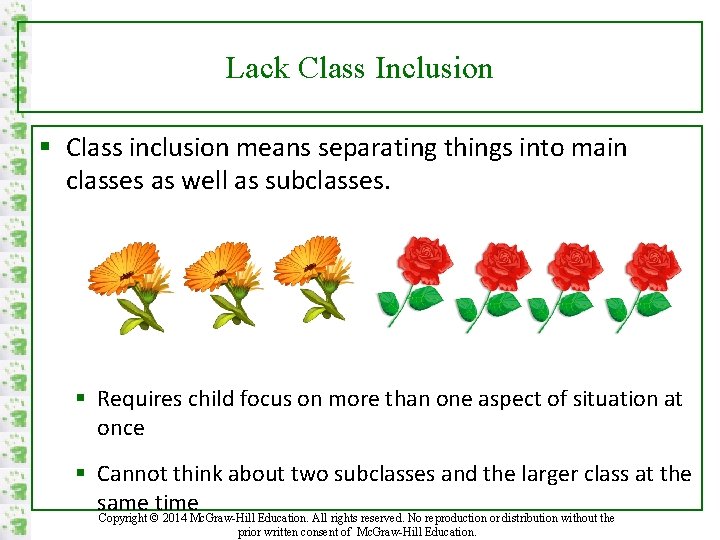
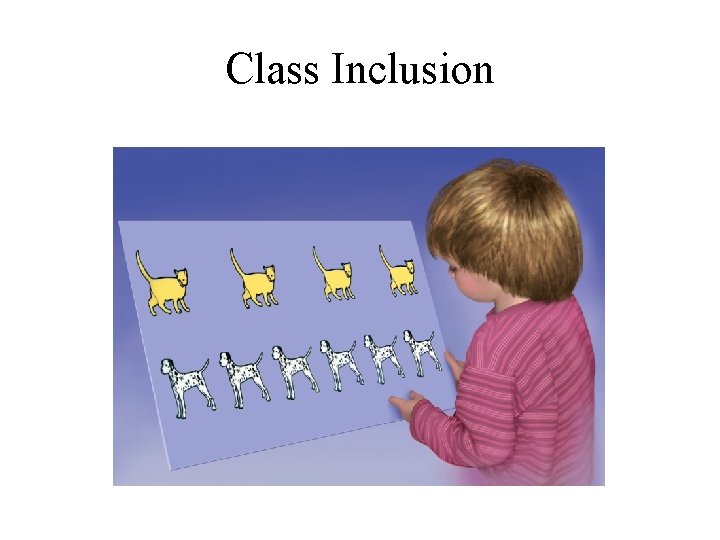
Lack Class Inclusion § Class inclusion means separating things into main classes as well as subclasses. § Requires child focus on more than one aspect of situation at once § Cannot think about two subclasses and the larger class at the same time Copyright © 2014 Mc. Graw-Hill Education. All rights reserved. No reproduction or distribution without the prior written consent of Mc. Graw-Hill Education.
Class Inclusion
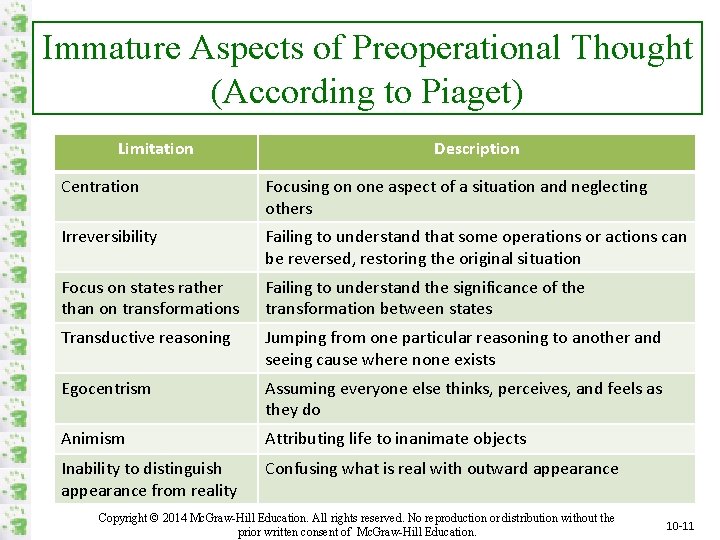
Immature Aspects of Preoperational Thought (According to Piaget) Limitation Description Centration Focusing on one aspect of a situation and neglecting others Irreversibility Failing to understand that some operations or actions can be reversed, restoring the original situation Focus on states rather than on transformations Failing to understand the significance of the transformation between states Transductive reasoning Jumping from one particular reasoning to another and seeing cause where none exists Egocentrism Assuming everyone else thinks, perceives, and feels as they do Animism Attributing life to inanimate objects Inability to distinguish appearance from reality Confusing what is real with outward appearance Copyright © 2014 Mc. Graw-Hill Education. All rights reserved. No reproduction or distribution without the prior written consent of Mc. Graw-Hill Education. 10 -11
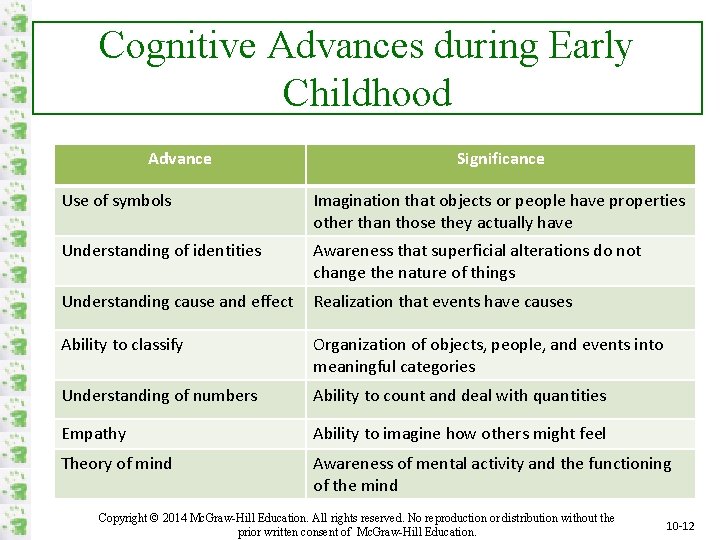
Cognitive Advances during Early Childhood Advance Significance Use of symbols Imagination that objects or people have properties other than those they actually have Understanding of identities Awareness that superficial alterations do not change the nature of things Understanding cause and effect Realization that events have causes Ability to classify Organization of objects, people, and events into meaningful categories Understanding of numbers Ability to count and deal with quantities Empathy Ability to imagine how others might feel Theory of mind Awareness of mental activity and the functioning of the mind Copyright © 2014 Mc. Graw-Hill Education. All rights reserved. No reproduction or distribution without the prior written consent of Mc. Graw-Hill Education. 10 -12
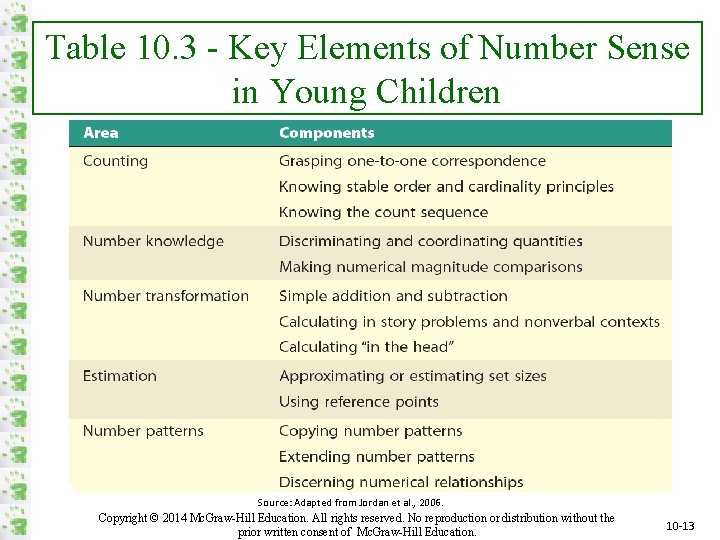
Table 10. 3 - Key Elements of Number Sense in Young Children Source: Adapted from Jordan et al. , 2006. Copyright © 2014 Mc. Graw-Hill Education. All rights reserved. No reproduction or distribution without the prior written consent of Mc. Graw-Hill Education. 10 -13
The Concrete Operational Stage 7 -12 years old Copyright © 2014 Mc. Graw-Hill Education. All rights reserved. No reproduction or distribution without the prior written consent of Mc. Graw-Hill Education.
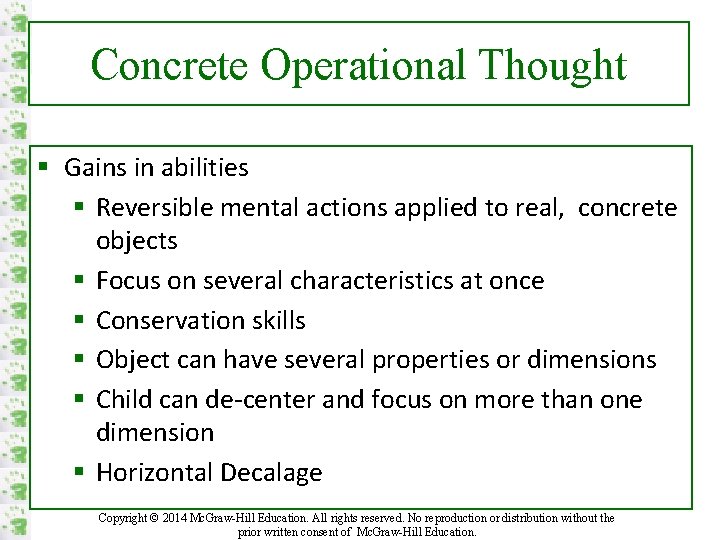
Concrete Operational Thought § Gains in abilities § Reversible mental actions applied to real, concrete objects § Focus on several characteristics at once § Conservation skills § Object can have several properties or dimensions § Child can de-center and focus on more than one dimension § Horizontal Decalage Copyright © 2014 Mc. Graw-Hill Education. All rights reserved. No reproduction or distribution without the prior written consent of Mc. Graw-Hill Education.
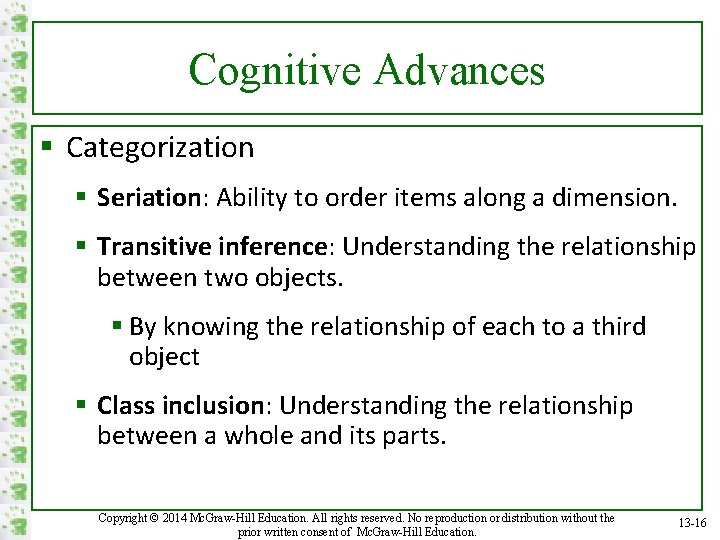
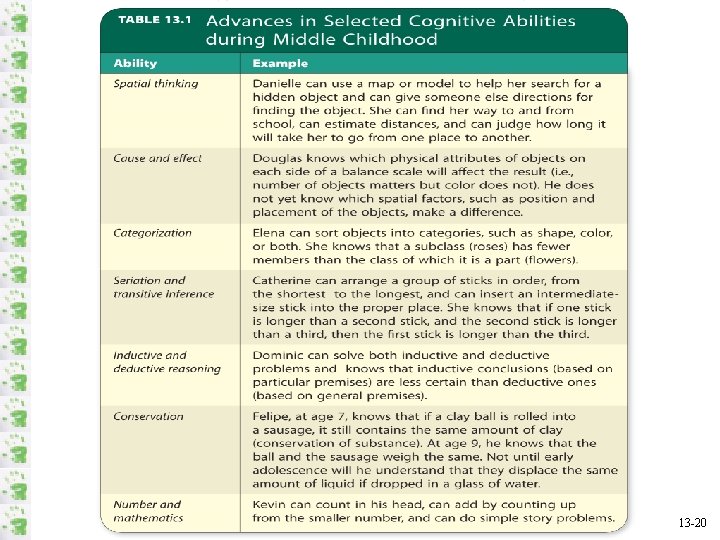
Cognitive Advances § Categorization § Seriation: Ability to order items along a dimension. § Transitive inference: Understanding the relationship between two objects. § By knowing the relationship of each to a third object § Class inclusion: Understanding the relationship between a whole and its parts. Copyright © 2014 Mc. Graw-Hill Education. All rights reserved. No reproduction or distribution without the prior written consent of Mc. Graw-Hill Education. 13 -16
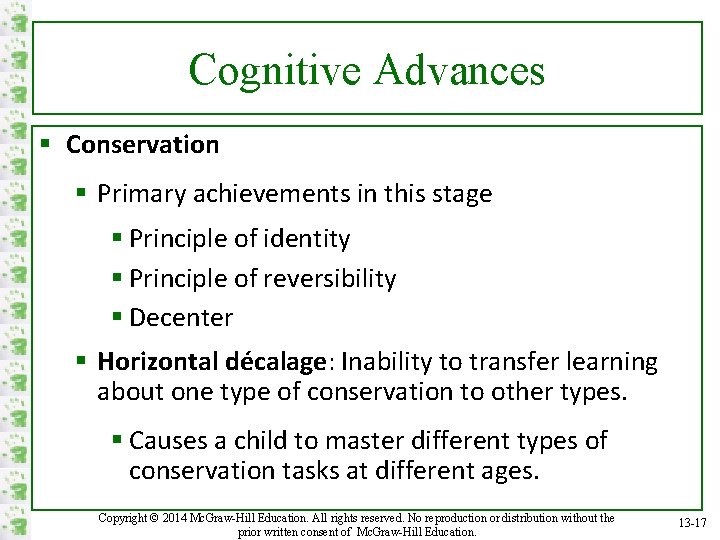
Cognitive Advances § Conservation § Primary achievements in this stage § Principle of identity § Principle of reversibility § Decenter § Horizontal décalage: Inability to transfer learning about one type of conservation to other types. § Causes a child to master different types of conservation tasks at different ages. Copyright © 2014 Mc. Graw-Hill Education. All rights reserved. No reproduction or distribution without the prior written consent of Mc. Graw-Hill Education. 13 -17
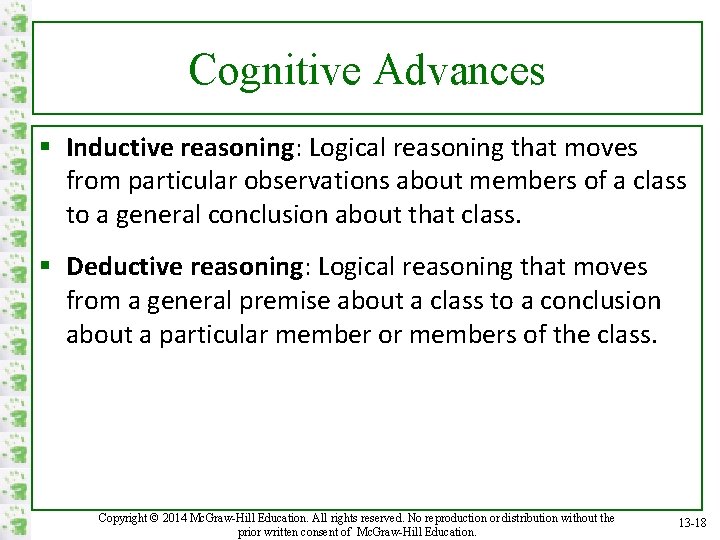
Cognitive Advances § Inductive reasoning: Logical reasoning that moves from particular observations about members of a class to a general conclusion about that class. § Deductive reasoning: Logical reasoning that moves from a general premise about a class to a conclusion about a particular member or members of the class. Copyright © 2014 Mc. Graw-Hill Education. All rights reserved. No reproduction or distribution without the prior written consent of Mc. Graw-Hill Education. 13 -18
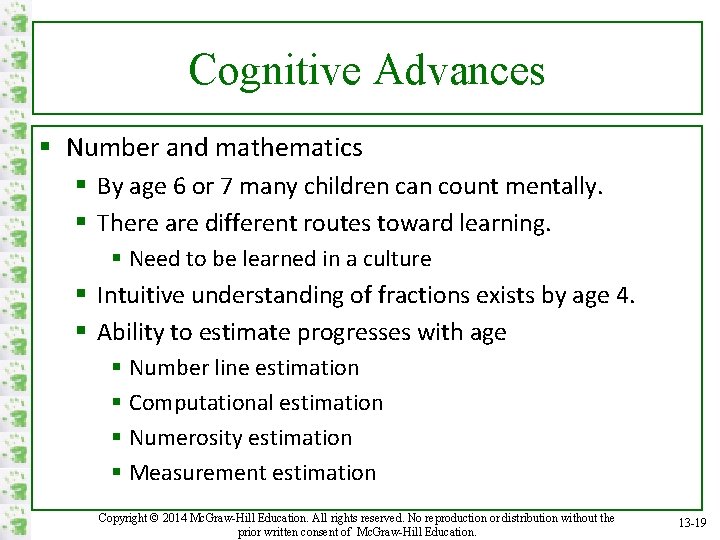
Cognitive Advances § Number and mathematics § By age 6 or 7 many children can count mentally. § There are different routes toward learning. § Need to be learned in a culture § Intuitive understanding of fractions exists by age 4. § Ability to estimate progresses with age § Number line estimation § Computational estimation § Numerosity estimation § Measurement estimation Copyright © 2014 Mc. Graw-Hill Education. All rights reserved. No reproduction or distribution without the prior written consent of Mc. Graw-Hill Education. 13 -19
Copyright © 2014 Mc. Graw-Hill Education. All rights reserved. No reproduction or distribution without the prior written consent of Mc. Graw-Hill Education. 13 -20
Information Processing Theory Copyright © 2014 Mc. Graw-Hill Education. All rights reserved. No reproduction or distribution without the prior written consent of Mc. Graw-Hill Education.
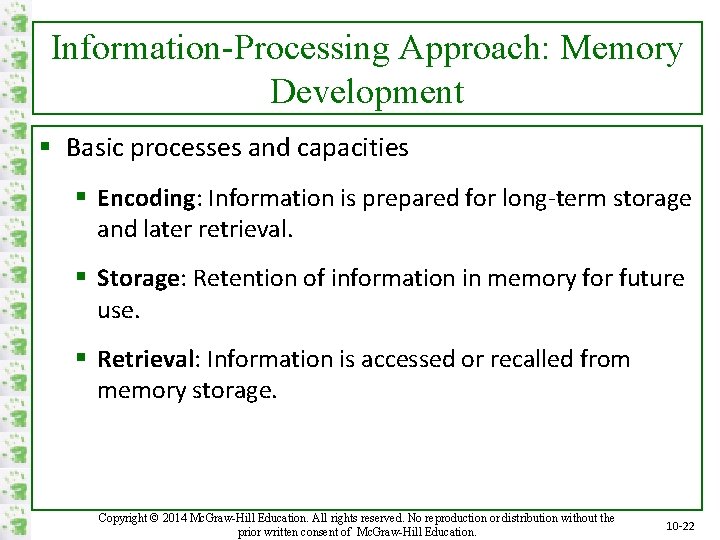
Information-Processing Approach: Memory Development § Basic processes and capacities § Encoding: Information is prepared for long-term storage and later retrieval. § Storage: Retention of information in memory for future use. § Retrieval: Information is accessed or recalled from memory storage. Copyright © 2014 Mc. Graw-Hill Education. All rights reserved. No reproduction or distribution without the prior written consent of Mc. Graw-Hill Education. 10 -22
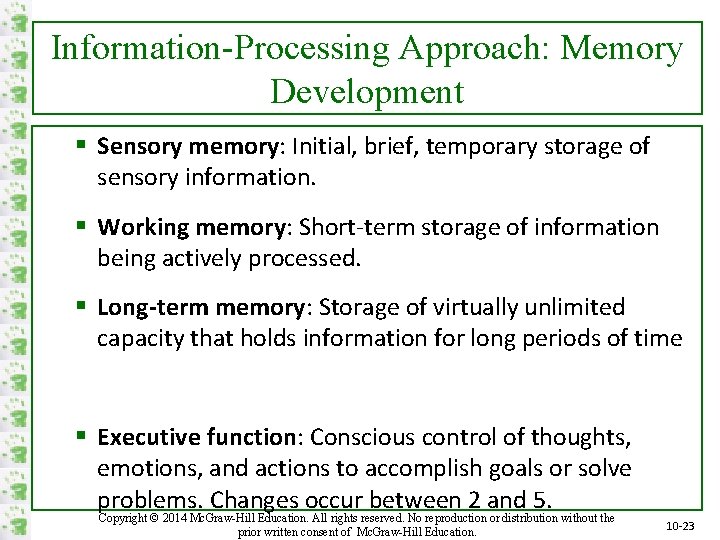
Information-Processing Approach: Memory Development § Sensory memory: Initial, brief, temporary storage of sensory information. § Working memory: Short-term storage of information being actively processed. § Long-term memory: Storage of virtually unlimited capacity that holds information for long periods of time § Executive function: Conscious control of thoughts, emotions, and actions to accomplish goals or solve problems. Changes occur between 2 and 5. Copyright © 2014 Mc. Graw-Hill Education. All rights reserved. No reproduction or distribution without the prior written consent of Mc. Graw-Hill Education. 10 -23
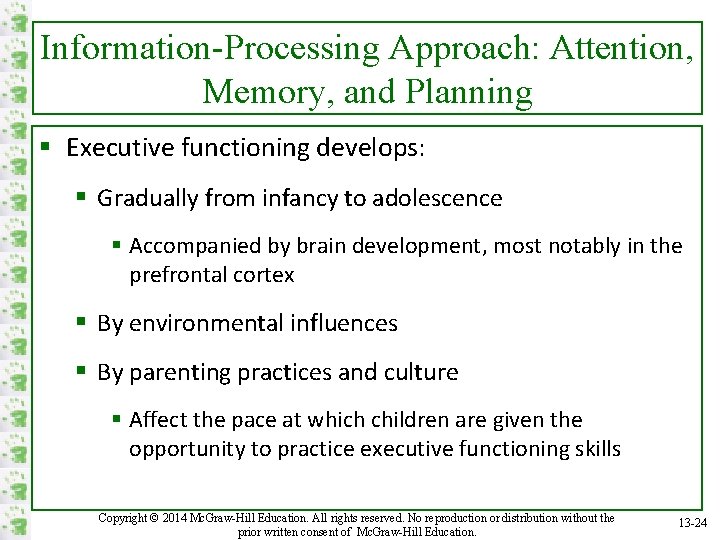
Information-Processing Approach: Attention, Memory, and Planning § Executive functioning develops: § Gradually from infancy to adolescence § Accompanied by brain development, most notably in the prefrontal cortex § By environmental influences § By parenting practices and culture § Affect the pace at which children are given the opportunity to practice executive functioning skills Copyright © 2014 Mc. Graw-Hill Education. All rights reserved. No reproduction or distribution without the prior written consent of Mc. Graw-Hill Education. 13 -24
Information-Processing Approach: Memory Development § Forming and retaining childhood memories: Three types of memories. § Generic memory: Produces scripts of familiar routines to guide behavior. (age 2) § Episodic memory: Long-term memory of specific experiences or events, linked to time and place. § Autobiographical memory: Type of episodic memory of distinctive experiences that form a person’s life history. (age 3 -4) Copyright © 2014 Mc. Graw-Hill Education. All rights reserved. No reproduction or distribution without the prior written consent of Mc. Graw-Hill Education. 10 -25
Information-Processing Approach: Memory Development § Influences on memory retention: § Uniqueness of the event § Events with emotional impact § Central aspects remembered best § Active participation § Social interaction model: Proposes that children construct autobiographical memories through conversation with adults about shared events. Copyright © 2014 Mc. Graw-Hill Education. All rights reserved. No reproduction or distribution without the prior written consent of Mc. Graw-Hill Education. 10 -26
Memory in Early Childhood § Best for meaningful and familiar events § § As young as 11 months remember sequences just experienced 16 months can reenact sequence after delay of 6 weeks By 4 years, can remember events up to 18 months earlier Less likely than older children to reject false suggestions about events § STM § § Increases from 2 digits at 2 years old to 5 digits for 7 year old Better able to transfer information to LTM More room to process information Speed increases Copyright © 2014 Mc. Graw-Hill Education. All rights reserved. No reproduction or distribution without the prior written consent of Mc. Graw-Hill Education.
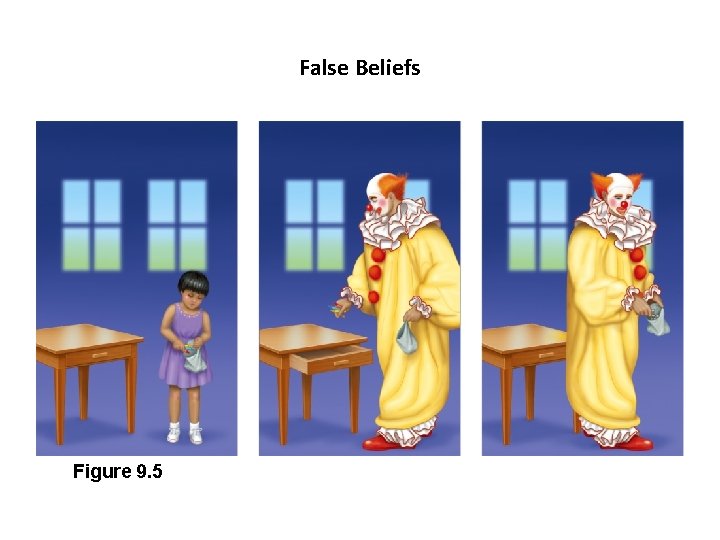
Theory of Mind § The Child’s Theory of Mind § Awareness of mental processes of self, others § Ages 18 months to 3 years, child understands three mental states are related to behavior § Perceptions § Emotions § Desires § Ages 3 -5: Realizes thinking goes on in the mind and that there are ‘false beliefs’ § Ages 5 -7: Deeper appreciation of mind itself Copyright © 2014 Mc. Graw-Hill Education. All rights reserved. No reproduction or distribution without the prior written consent of Mc. Graw-Hill Education.
False Beliefs Figure 9. 5
Theory of Mind § The Child’s Theory of Mind § Ages 5 -6: knows different experiences exist § Age 7: realizes knowledge is subjective § Theory focuses on preschool years to age 7 § Individual differences include: number of siblings, disabilities, parental interactions § Important developments occur after age 7 Copyright © 2014 Mc. Graw-Hill Education. All rights reserved. No reproduction or distribution without the prior written consent of Mc. Graw-Hill Education.
Theory of Mind § Reflects brain maturation and general improvements in cognition. § Social competence and language development contribute to an understanding of thoughts and emotions. § Pretend play stimulates the development of theory-ofmind skills. § Incomplete or ineffective theory of mind may be a sign of a cognitive or developmental impairment. Copyright © 2014 Mc. Graw-Hill Education. All rights reserved. No reproduction or distribution without the prior written consent of Mc. Graw-Hill Education. 10 -31
Information-Processing Approach: Attention, Memory, and Planning Selective attention • Ability to deliberately direct one’s attention and shut out distractions. • Inhibitory control - Voluntary suppression of unwanted responses. Metamemory • Understanding of processes of memory. Copyright © 2014 Mc. Graw-Hill Education. All rights reserved. No reproduction or distribution without the prior written consent of Mc. Graw-Hill Education. 13 -32
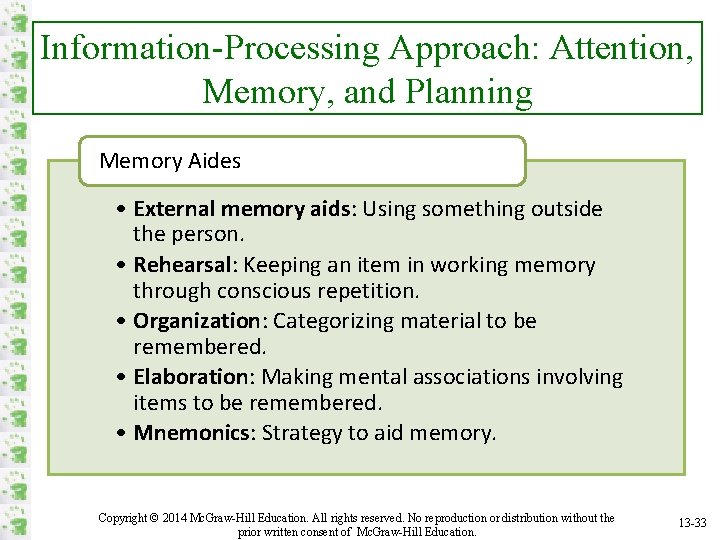
Information-Processing Approach: Attention, Memory, and Planning Memory Aides • External memory aids: Using something outside the person. • Rehearsal: Keeping an item in working memory through conscious repetition. • Organization: Categorizing material to be remembered. • Elaboration: Making mental associations involving items to be remembered. • Mnemonics: Strategy to aid memory. Copyright © 2014 Mc. Graw-Hill Education. All rights reserved. No reproduction or distribution without the prior written consent of Mc. Graw-Hill Education. 13 -33
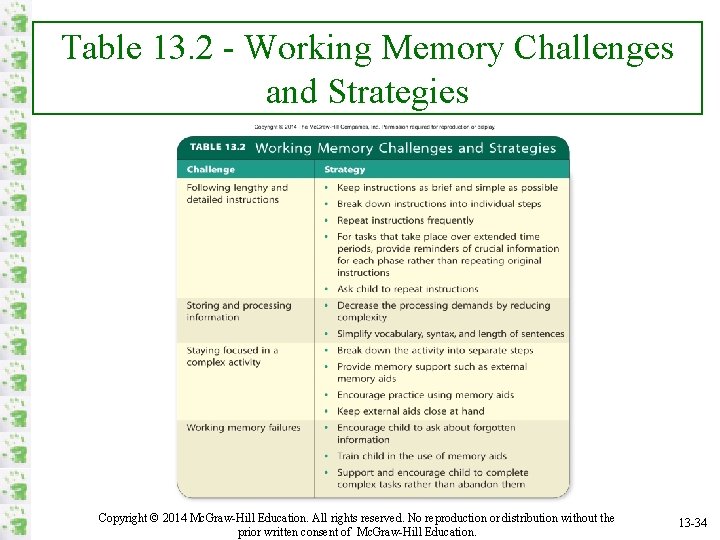
Table 13. 2 - Working Memory Challenges and Strategies Copyright © 2014 Mc. Graw-Hill Education. All rights reserved. No reproduction or distribution without the prior written consent of Mc. Graw-Hill Education. 13 -34
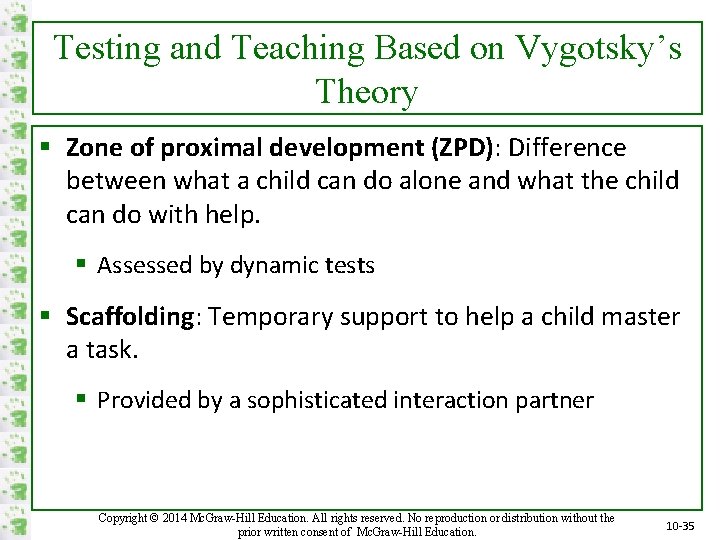
Testing and Teaching Based on Vygotsky’s Theory § Zone of proximal development (ZPD): Difference between what a child can do alone and what the child can do with help. § Assessed by dynamic tests § Scaffolding: Temporary support to help a child master a task. § Provided by a sophisticated interaction partner Copyright © 2014 Mc. Graw-Hill Education. All rights reserved. No reproduction or distribution without the prior written consent of Mc. Graw-Hill Education. 10 -35
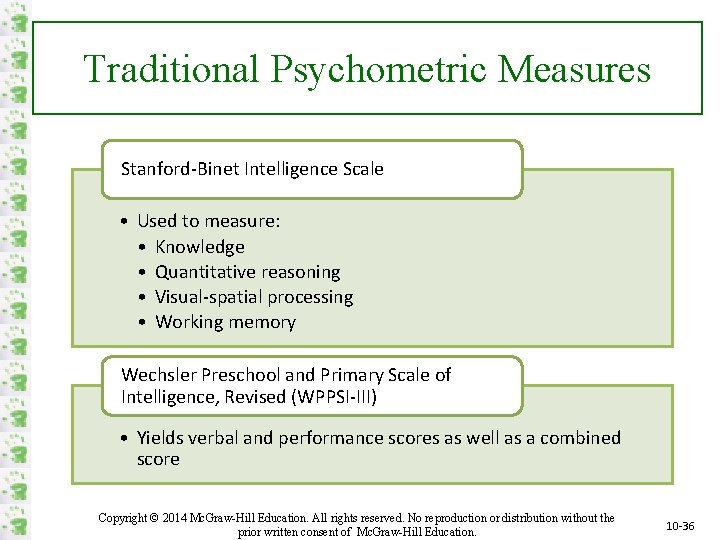
Traditional Psychometric Measures Stanford-Binet Intelligence Scale • Used to measure: • Knowledge • Quantitative reasoning • Visual-spatial processing • Working memory Wechsler Preschool and Primary Scale of Intelligence, Revised (WPPSI-III) • Yields verbal and performance scores as well as a combined score Copyright © 2014 Mc. Graw-Hill Education. All rights reserved. No reproduction or distribution without the prior written consent of Mc. Graw-Hill Education. 10 -36
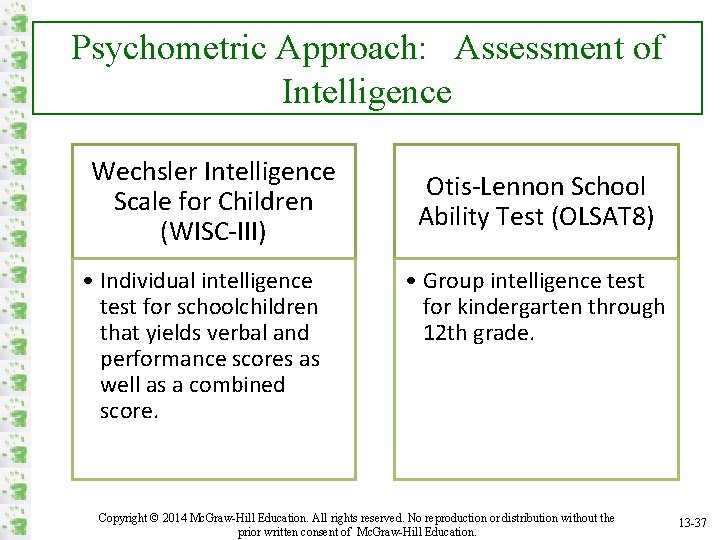
Psychometric Approach: Assessment of Intelligence Wechsler Intelligence Scale for Children (WISC-III) • Individual intelligence test for schoolchildren that yields verbal and performance scores as well as a combined score. Otis-Lennon School Ability Test (OLSAT 8) • Group intelligence test for kindergarten through 12 th grade. Copyright © 2014 Mc. Graw-Hill Education. All rights reserved. No reproduction or distribution without the prior written consent of Mc. Graw-Hill Education. 13 -37
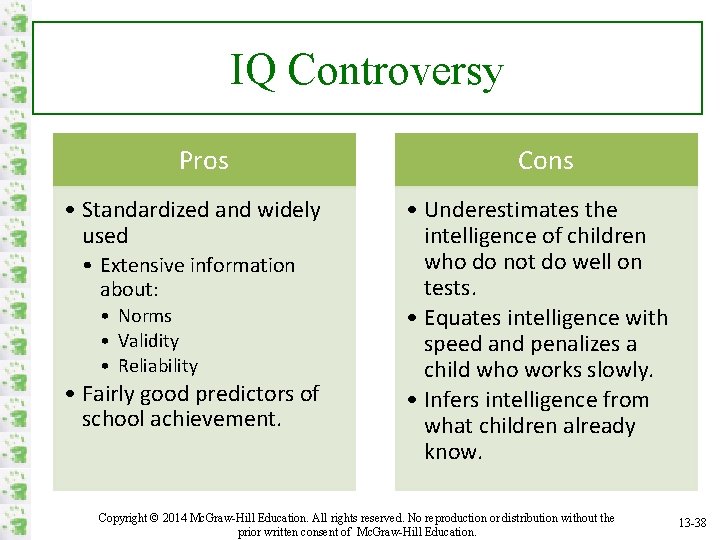
IQ Controversy Pros • Standardized and widely used • Extensive information about: • Norms • Validity • Reliability • Fairly good predictors of school achievement. Cons • Underestimates the intelligence of children who do not do well on tests. • Equates intelligence with speed and penalizes a child who works slowly. • Infers intelligence from what children already know. Copyright © 2014 Mc. Graw-Hill Education. All rights reserved. No reproduction or distribution without the prior written consent of Mc. Graw-Hill Education. 13 -38
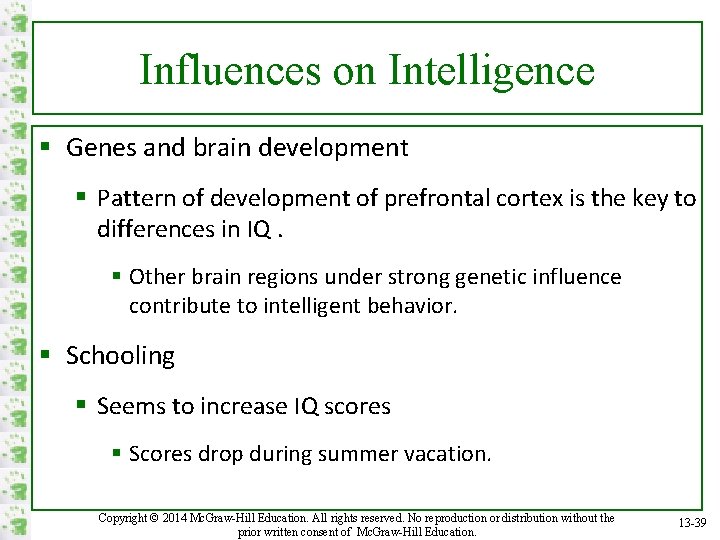
Influences on Intelligence § Genes and brain development § Pattern of development of prefrontal cortex is the key to differences in IQ. § Other brain regions under strong genetic influence contribute to intelligent behavior. § Schooling § Seems to increase IQ scores § Scores drop during summer vacation. Copyright © 2014 Mc. Graw-Hill Education. All rights reserved. No reproduction or distribution without the prior written consent of Mc. Graw-Hill Education. 13 -39
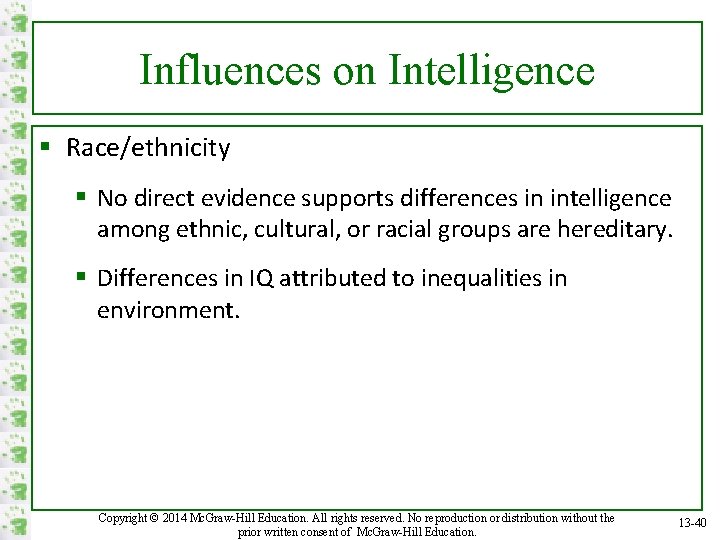
Influences on Intelligence § Race/ethnicity § No direct evidence supports differences in intelligence among ethnic, cultural, or racial groups are hereditary. § Differences in IQ attributed to inequalities in environment. Copyright © 2014 Mc. Graw-Hill Education. All rights reserved. No reproduction or distribution without the prior written consent of Mc. Graw-Hill Education. 13 -40
Influences on Intelligence § Culture § Test of intelligence developed in one culture may not be equally valid in another. § Culture-free test: Intelligence test, if possible to design, that would have no culturally linked content. § Culture-fair test: Intelligence test that deals with experiences common to various cultures. § Attempt to avoid cultural bias Copyright © 2014 Mc. Graw-Hill Education. All rights reserved. No reproduction or distribution without the prior written consent of Mc. Graw-Hill Education. 13 -41
Gardner’s Theory of Multiple Intelligences § There are eight distinct forms of intelligence. § High intelligence in one area does not necessarily accompany high intelligence in any of the others. Copyright © 2014 Mc. Graw-Hill Education. All rights reserved. No reproduction or distribution without the prior written consent of Mc. Graw-Hill Education. 13 -42
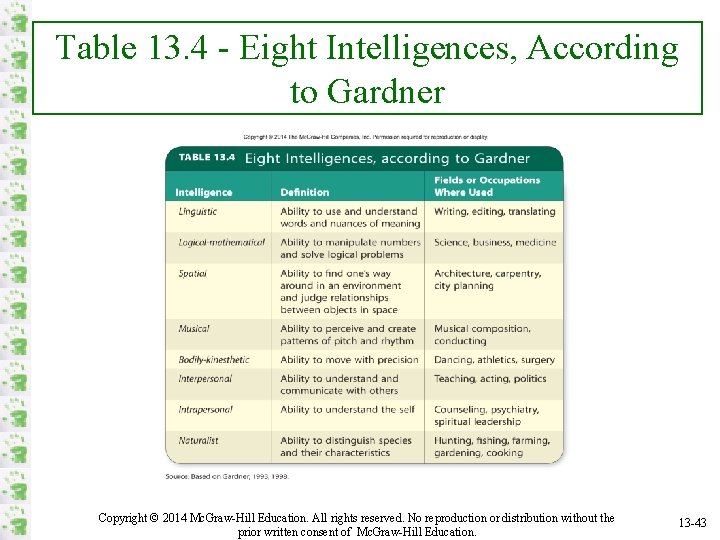
Table 13. 4 - Eight Intelligences, According to Gardner Copyright © 2014 Mc. Graw-Hill Education. All rights reserved. No reproduction or distribution without the prior written consent of Mc. Graw-Hill Education. 13 -43
Sternberg’s Triarchic Theory of Intelligence § Intelligence consists of three elements: § Componential element: Analytic aspect of intelligence § Determines how efficiently people process information § Experiential element: Insightful aspect of intelligence § Determines how people approach novel or familiar tasks § Contextual element: Practical aspect of intelligence § Determines how people deal with their environment Copyright © 2014 Mc. Graw-Hill Education. All rights reserved. No reproduction or distribution without the prior written consent of Mc. Graw-Hill Education. 13 -44
Sternberg’s Triarchic Theory of Intelligence § Focused on processes that predicted intelligent behavior across domains of knowledge § Verbal § Quantitative § Figural § Tacit knowledge: Information that is not formally taught or openly expressed, but is necessary to get ahead. Copyright © 2014 Mc. Graw-Hill Education. All rights reserved. No reproduction or distribution without the prior written consent of Mc. Graw-Hill Education. 13 -45
Other Directions in Intelligence Testing § Kaufman Assessment Battery for Children (K-ABC-II): Nontraditional individual intelligence test designed to provide fair assessments of: § Minority children § Children with disabilities § Dynamic tests: Based on Vygotsky’s theory that emphasizes potential rather than past learning. Copyright © 2014 Mc. Graw-Hill Education. All rights reserved. No reproduction or distribution without the prior written consent of Mc. Graw-Hill Education. 13 -46