
CHAPTER 1 WHAT IS CHEMISTRY WHAT IS CHEMISTRY
- Slides: 13
CHAPTER 1 WHAT IS CHEMISTRY?
WHAT IS CHEMISTRY? n Chemistry is the study of the composition, structure, and properties of matter and the changes it undergoes. n What is matter? – Anything that has mass and takes up space.
n Chemistry deals with questions such as: – What is that material made of? – What is its makeup and internal structure? – How does it behave and change when heated, cooled or mixed with other materials? – Why does this behavior occur?
Instruments n Instruments are used in chemistry to extend our ability to observe and make measurements. – Particularly useful for things to small to be seen by the unaided eye. – Can you thin of any examples?
Branches of Chemistry n n n Organic- study of most carbon-containing compounds. Inorganic- study of all substances not classified as organic, mainly those compounds not containing carbon. Physical- study of properties and changes of matter and their relationship to energy. Analytical- identification of the components and composition of materials. Biochemistry- study of substances and processes occurring in living things. Theoretical- uses mathematics and computers to understand the principles behind observed chemical behavior and to design and predict the properties of new compounds.
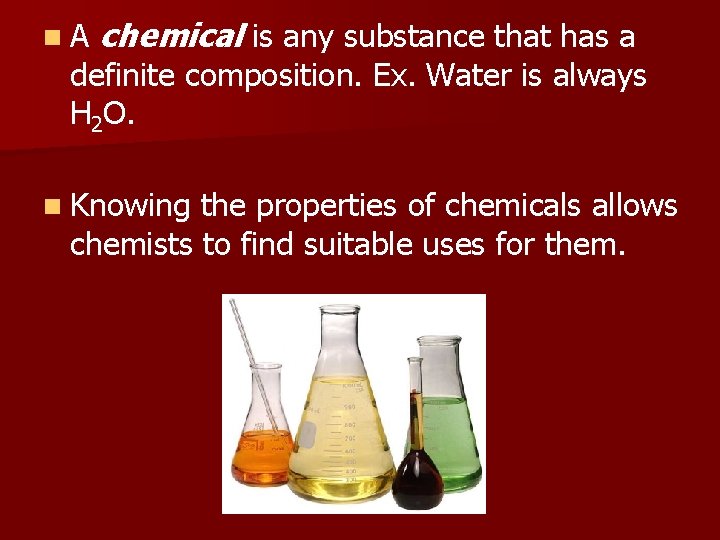
n. A chemical is any substance that has a definite composition. Ex. Water is always H 2 O. n Knowing the properties of chemicals allows chemists to find suitable uses for them.
Types of Research n Basic Research- carried out for the sake of increasing knowledge. Ex. basic research might seek to discover the genetic map of a plant or animal, or show economic and human resources affect economic growth in rural areas. n Chance discoveries can be the result of basic research. – Accidental discoveries § § Saccharin Coca-Cola Teflon Vulcanized Rubber
Types of Research (Cont’d) n Applied Research- generally carried out to solve a problem. It expands on basic research findings to uncover practical ways in which new knowledge can be advanced to benefit individuals and society. Ex. Researchers might use a genetic map to develop gene therapies to treat human diseases or develop new programs to enhance community capital and stability in rural communities.
Types of Research (Cont’d) n Technological Development- typically involves the production and use of products that improve our quality of life. – Computers – Biodegradable materials – CD’s – MRI’s – Cell phones Technological advances often lag behind the basic discoveries that are eventually used in the technologies. Ex. Teflon
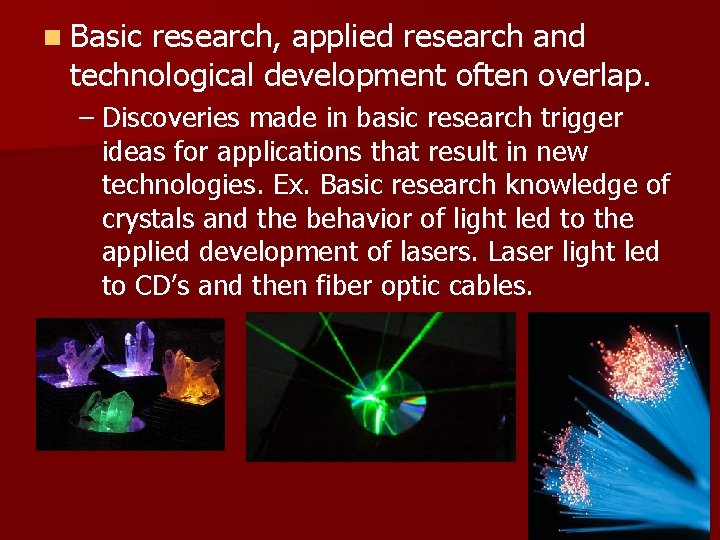
n Basic research, applied research and technological development often overlap. – Discoveries made in basic research trigger ideas for applications that result in new technologies. Ex. Basic research knowledge of crystals and the behavior of light led to the applied development of lasers. Laser light led to CD’s and then fiber optic cables.
IMPORTANCE OF CHEMISTRY n Chemistry is all around you. – Air you breathe – Food you digest – Clothes you wear – Textbook you read n Chemistry science. is often said to be the central
SCIENCE V. S. TECHNOLOGY n How is science different from technology? n Science: – Experimental investigation and exploration of natural phenomena – Pursues knowledge for its own sake – Does not cause change in itself n Technology – The practical application of scientific knowledge – Leads to change (for better or for worse)
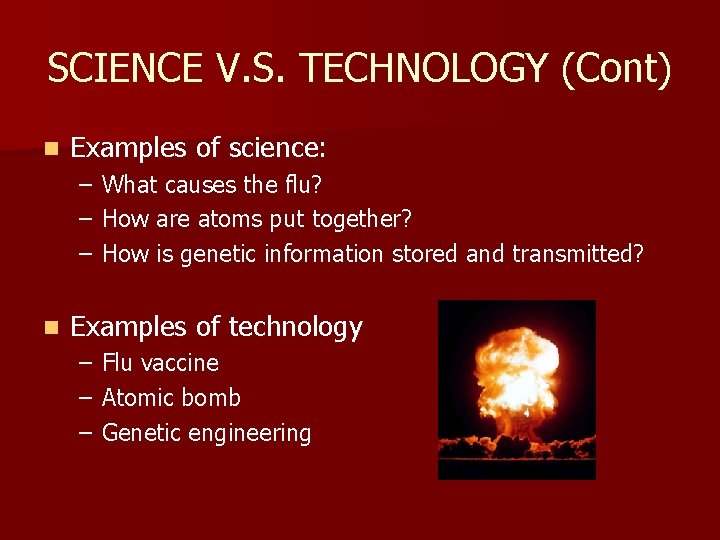
SCIENCE V. S. TECHNOLOGY (Cont) n Examples of science: – – – n What causes the flu? How are atoms put together? How is genetic information stored and transmitted? Examples of technology – – – Flu vaccine Atomic bomb Genetic engineering