
Chapter 1 What is Action Research Guiding Questions
- Slides: 33
Chapter 1: What is Action Research?
Guiding Questions 1. What is action research? 2. What are the stages of action research? 3. What types of research methods are available for action research? Putman & Rock, Action Research © SAGE Publishing, 2017. 2
Guiding Questions 4. Why should teachers conduct action research? 5. What is CAPES and how can it be used to frame action research? Putman & Rock, Action Research © SAGE Publishing, 2017. 3
Setting the Context: Research in the Age of Accountability Potential for Data Usage • Inform instruction • Improve instruction • Connect to effective teaching practices Benefit of Data to Teaching Practices • Improves practices and achievement of students Putman & Rock, Action Research © SAGE Publishing, 2017. 4
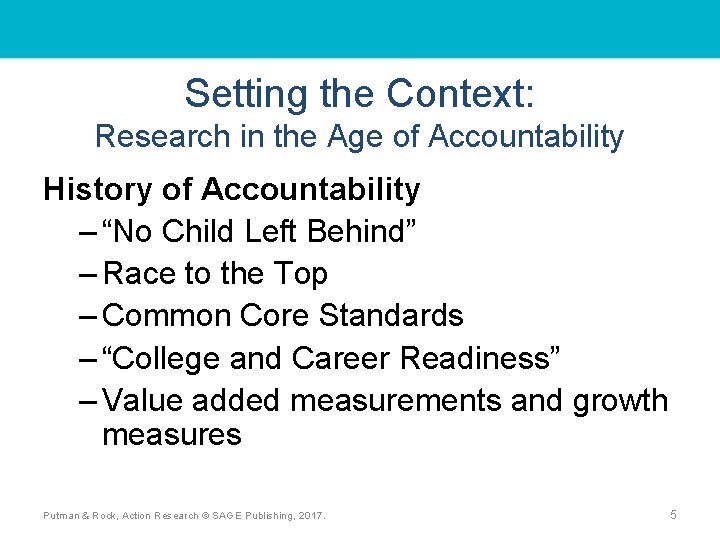
Setting the Context: Research in the Age of Accountability History of Accountability – “No Child Left Behind” – Race to the Top – Common Core Standards – “College and Career Readiness” – Value added measurements and growth measures Putman & Rock, Action Research © SAGE Publishing, 2017. 5
Why Conduct Research? Research is perceived to be statistical formulas and numerical analyses that have little impact on classroom practices. The reality is there are different kinds of research and multiple ways to collect and analyze data. Putman & Rock, Action Research © SAGE Publishing, 2017. 6
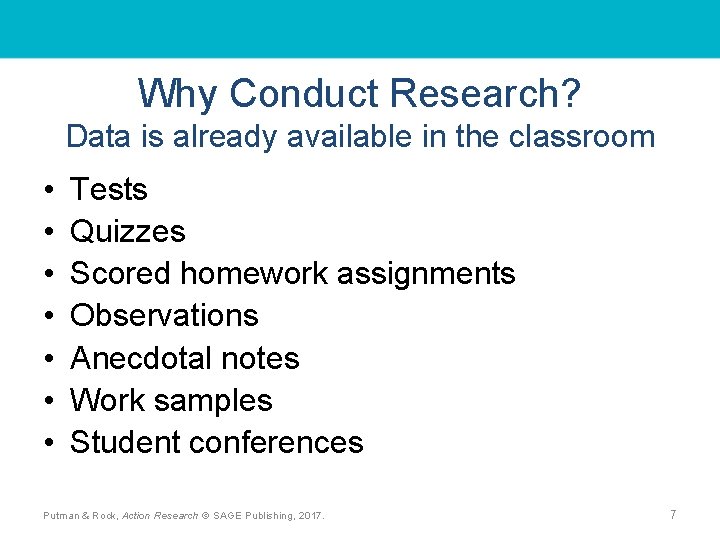
Why Conduct Research? Data is already available in the classroom • • Tests Quizzes Scored homework assignments Observations Anecdotal notes Work samples Student conferences Putman & Rock, Action Research © SAGE Publishing, 2017. 7
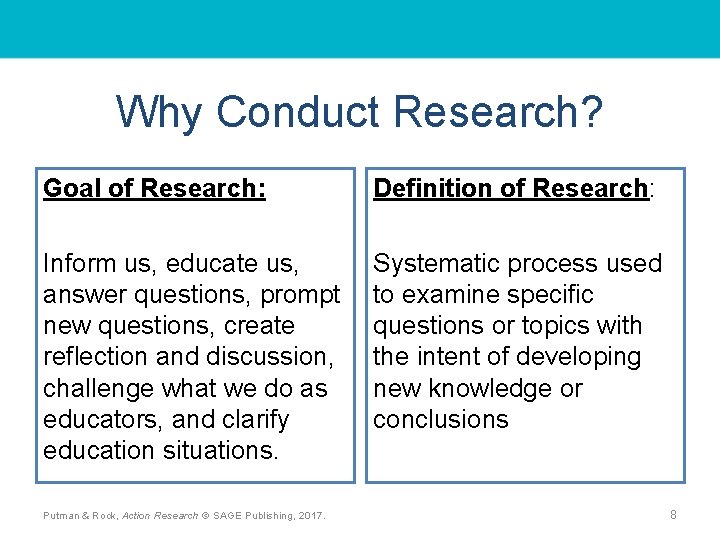
Why Conduct Research? Goal of Research: Definition of Research: Inform us, educate us, answer questions, prompt new questions, create reflection and discussion, challenge what we do as educators, and clarify education situations. Systematic process used to examine specific questions or topics with the intent of developing new knowledge or conclusions Putman & Rock, Action Research © SAGE Publishing, 2017. 8
Why Conduct Research? Teacher Characteristics That Match Researcher Traits – Teachers & researchers are problem-solvers – Teachers & researchers are deep-thinkers – Teachers & researchers are collaborators Putman & Rock, Action Research © SAGE Publishing, 2017. 9
Why Conduct Research? How Can Teachers See Themselves as Researchers? – Teachers need to shift their mindset to actively think about conducting their own research – Teachers need to develop their own conclusions and lead the narrative – Teachers need to take advantage of their data to create meaning and action Putman & Rock, Action Research © SAGE Publishing, 2017. 10
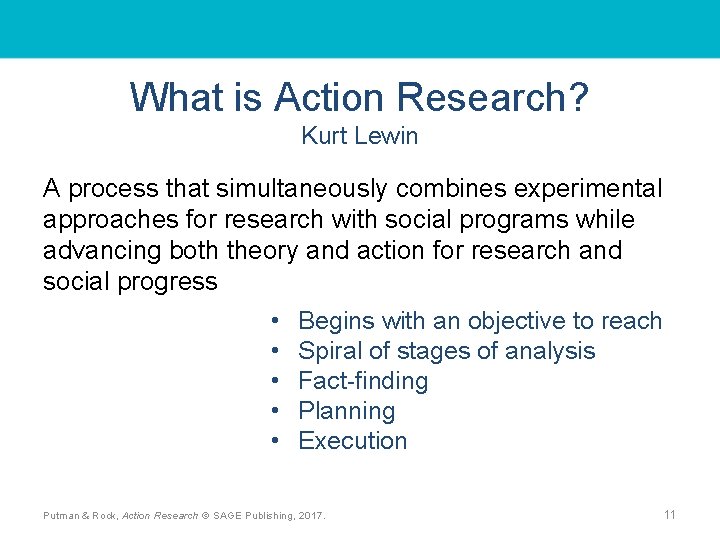
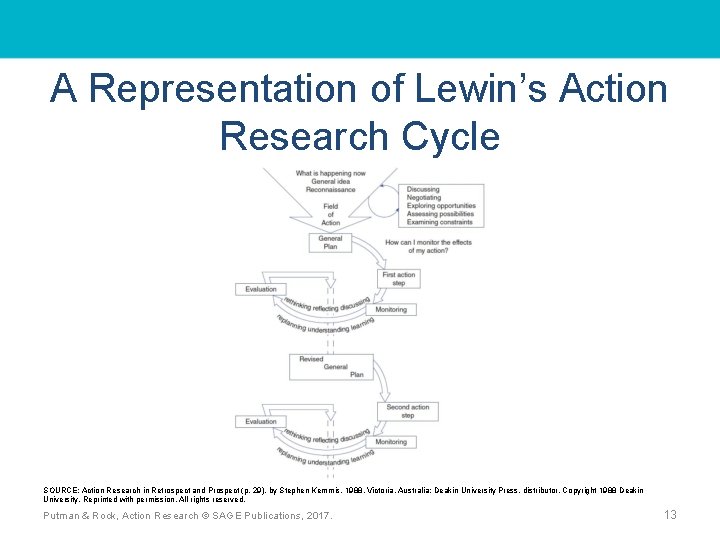
What is Action Research? Kurt Lewin A process that simultaneously combines experimental approaches for research with social programs while advancing both theory and action for research and social progress • Begins with an objective to reach • Spiral of stages of analysis • Fact-finding • Planning • Execution Putman & Rock, Action Research © SAGE Publishing, 2017. 11
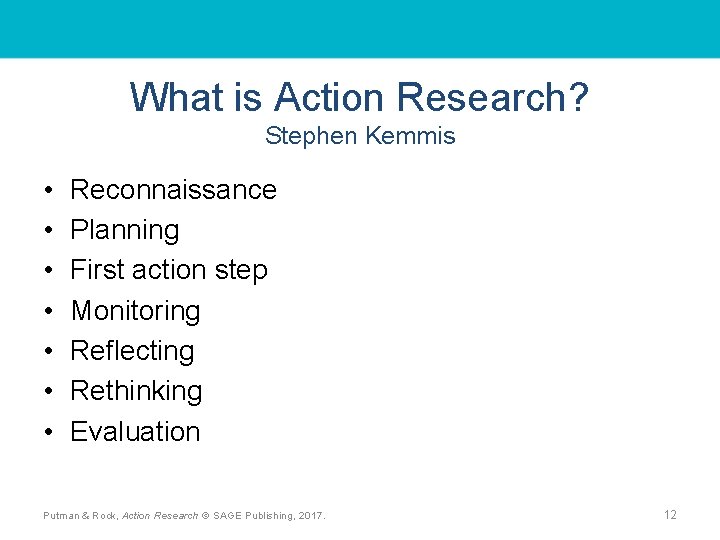
What is Action Research? Stephen Kemmis • • Reconnaissance Planning First action step Monitoring Reflecting Rethinking Evaluation Putman & Rock, Action Research © SAGE Publishing, 2017. 12
A Representation of Lewin’s Action Research Cycle SOURCE: Action Research in Retrospect and Prospect (p. 29), by Stephen Kemmis, 1988, Victoria, Australia: Deakin University Press, distributor. Copyright 1988 Deakin University. Reprinted with permission. All rights reserved. Putman & Rock, Action Research © SAGE Publications, 2017. 13
What is Action Research? Additional Tenets of Action Research • Researchers are direct participants who examine their own practice and context intending to improve them • Requires the collection of data and uses various methods to document changes • Starts small to create relevant, usable conclusions about the current state, and expands that process through active evaluation and reflection upon the results Putman & Rock, Action Research © SAGE Publishing, 2017. 14
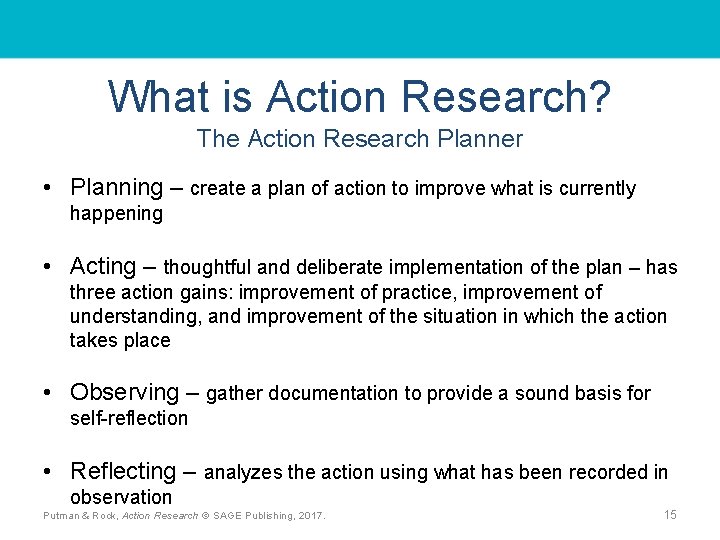
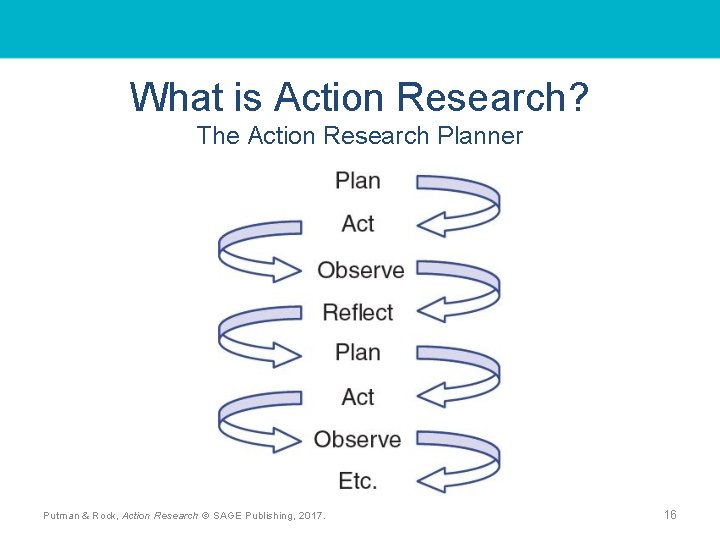
What is Action Research? The Action Research Planner • Planning – create a plan of action to improve what is currently happening • Acting – thoughtful and deliberate implementation of the plan – has three action gains: improvement of practice, improvement of understanding, and improvement of the situation in which the action takes place • Observing – gather documentation to provide a sound basis for self-reflection • Reflecting – analyzes the action using what has been recorded in observation Putman & Rock, Action Research © SAGE Publishing, 2017. 15
What is Action Research? The Action Research Planner Putman & Rock, Action Research © SAGE Publishing, 2017. 16
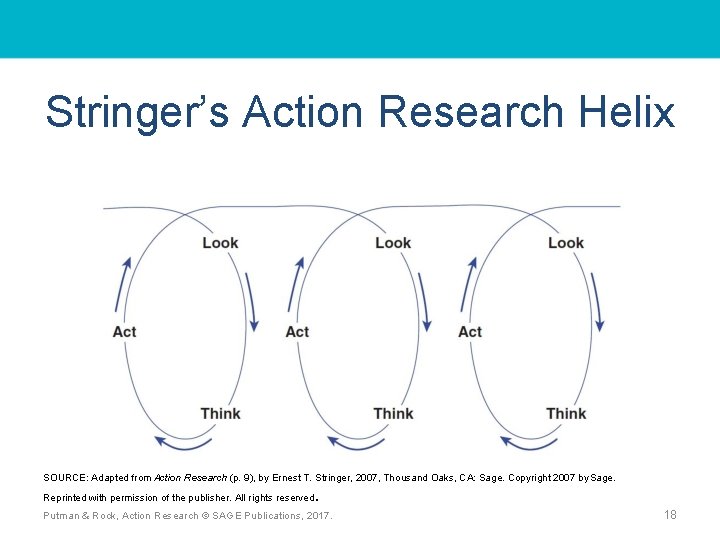
What is Action Research? Ernest Stringer – Action Research Helix • Looking • Thinking • Acting Putman & Rock, Action Research © SAGE Publishing, 2017. 17
Stringer’s Action Research Helix SOURCE: Adapted from Action Research (p. 9), by Ernest T. Stringer, 2007, Thousand Oaks, CA: Sage. Copyright 2007 by Sage. . Reprinted with permission of the publisher. All rights reserved Putman & Rock, Action Research © SAGE Publications, 2017. 18
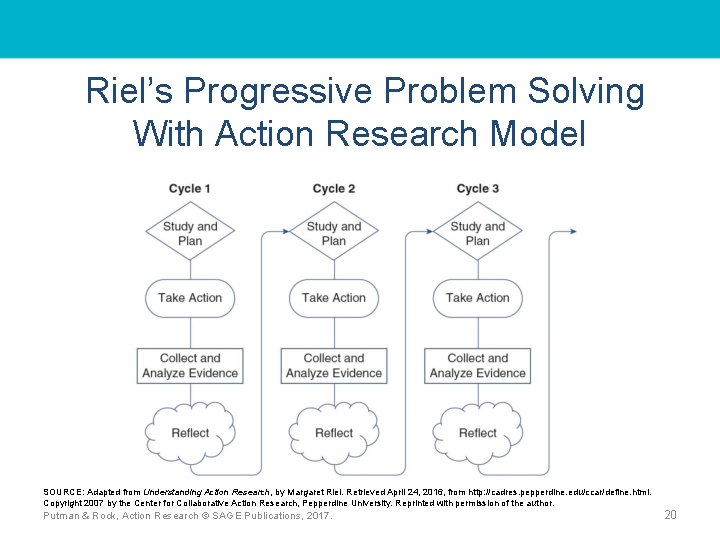
What is Action Research? Margaret Riel – Progressive Problem Solving • Planning • Taking action • Collecting evidence • Reflecting Putman & Rock, Action Research © SAGE Publishing, 2017. 19
Riel’s Progressive Problem Solving With Action Research Model SOURCE: Adapted from Understanding Action Research, by Margaret Riel. Retrieved April 24, 2016, from http: //cadres. pepperdine. edu/ccar/define. html. Copyright 2007 by the Center for Collaborative Action Research, Pepperdine University. Reprinted with permission of the author. Putman & Rock, Action Research © SAGE Publications, 2017. 20
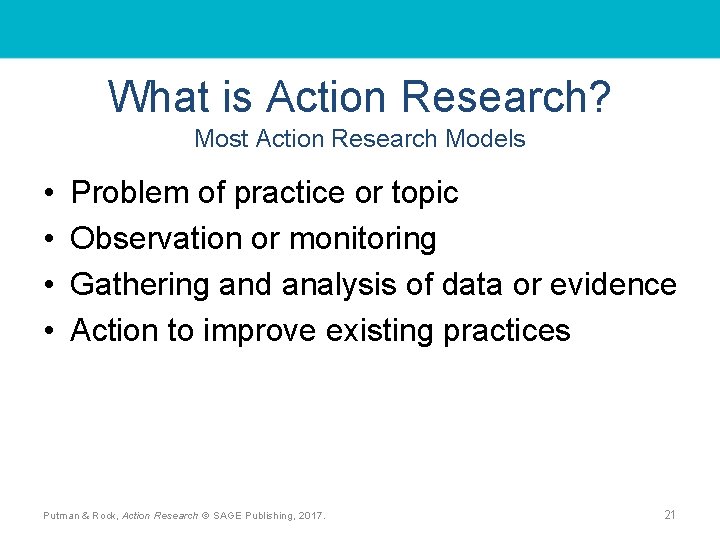
What is Action Research? Most Action Research Models • • Problem of practice or topic Observation or monitoring Gathering and analysis of data or evidence Action to improve existing practices Putman & Rock, Action Research © SAGE Publishing, 2017. 21
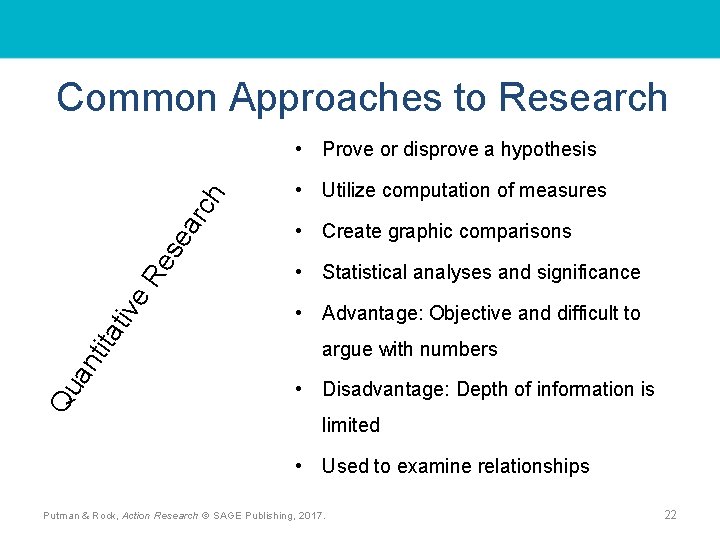
Common Approaches to Research Qu an tita tiv e. R es ea rch • Prove or disprove a hypothesis • Utilize computation of measures • Create graphic comparisons • Statistical analyses and significance • Advantage: Objective and difficult to argue with numbers • Disadvantage: Depth of information is limited • Used to examine relationships Putman & Rock, Action Research © SAGE Publishing, 2017. 22
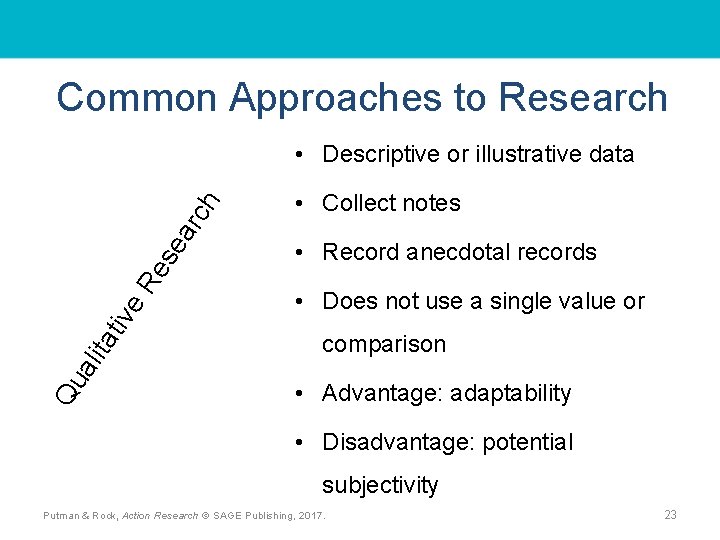
Common Approaches to Research Qu ali tat ive Re se ar ch • Descriptive or illustrative data • Collect notes • Record anecdotal records • Does not use a single value or comparison • Advantage: adaptability • Disadvantage: potential subjectivity Putman & Rock, Action Research © SAGE Publishing, 2017. 23
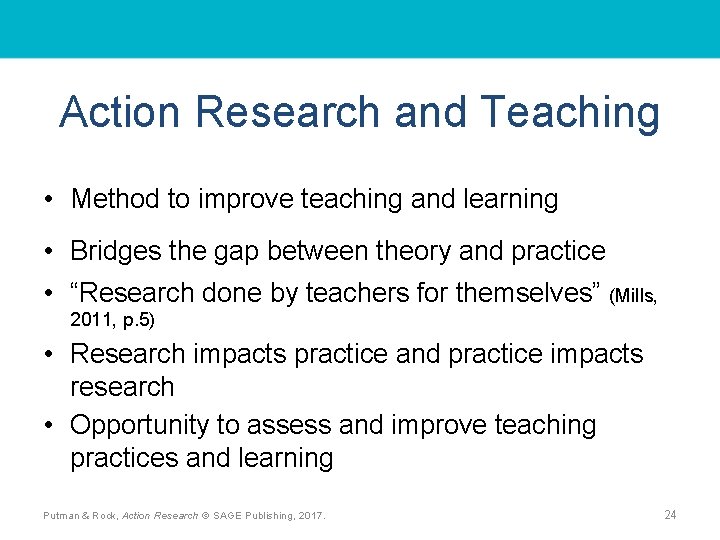
Action Research and Teaching • Method to improve teaching and learning • Bridges the gap between theory and practice • “Research done by teachers for themselves” (Mills, 2011, p. 5) • Research impacts practice and practice impacts research • Opportunity to assess and improve teaching practices and learning Putman & Rock, Action Research © SAGE Publishing, 2017. 24
Action Research and Teaching • Empowering experience • Relevant • “Systematic inquiry by teachers with the goal of improving their teaching practices” (Levin & Rock, 2003, p. 136) • “To plan, act, observe and reflect more carefully, more systematically, and more rigorously than one usually does in everyday life” (Kemmis & Mc. Taggart, 1992, p. 10) • Simultaneously improves practice and student learning Putman & Rock, Action Research © SAGE Publishing, 2017. 25
Action Research and Teaching Goals of Teacher Action Research • Help teachers make decisions about their classrooms • Improve classroom or school practice • Encourage teachers to see themselves as producers of educational knowledge • Allow teacher to clarify, elaborate, and modify theories that inform teaching • Participants reflect on a situation or practical issue, develop a plan to address the situation or issue, use data to explore the changes as well as examine and reflect upon the effectiveness (Zuber-Skerrit, 1996) Putman & Rock, Action Research © SAGE Publishing, 2017. 26
Action Research and Teaching Where Can Teacher Action Research Take Place? • Variety of settings • Anywhere there is a problem or situation that needs to be solved or examined in greater detail • Teacher’s own classroom – Situated Learning – takes place in the context of practice and is about the context Putman & Rock, Action Research © SAGE Publishing, 2017. 27
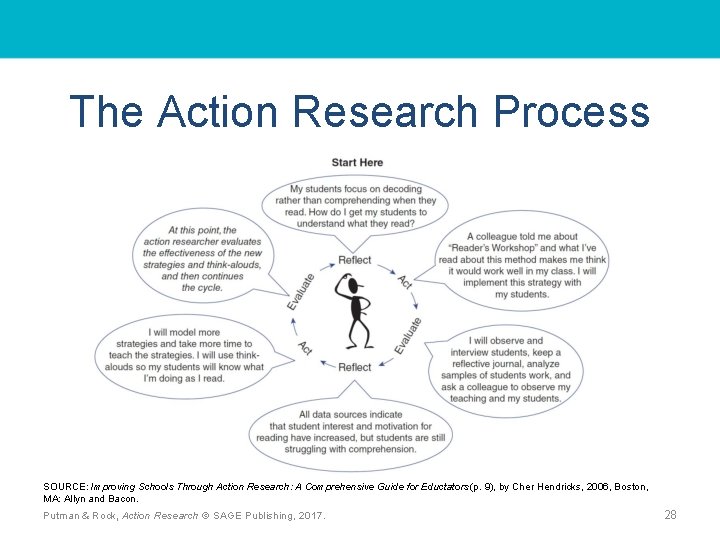
The Action Research Process SOURCE: Improving Schools Through Action Research: A Comprehensive Guide for Eductators (p. 9), by Cher Hendricks, 2006, Boston, MA: Allyn and Bacon. Putman & Rock, Action Research © SAGE Publishing, 2017. 28
Contexts for Teacher Action Research Who conducts action research? • Individual acting alone • Group of committed colleagues in a school/district • Teacher and researcher partnership Putman & Rock, Action Research © SAGE Publishing, 2017. 29
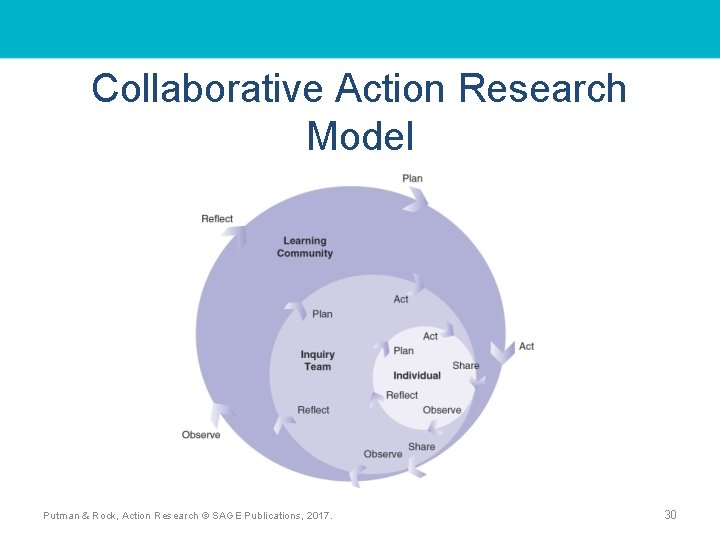
Collaborative Action Research Model Putman & Rock, Action Research © SAGE Publications, 2017. 30
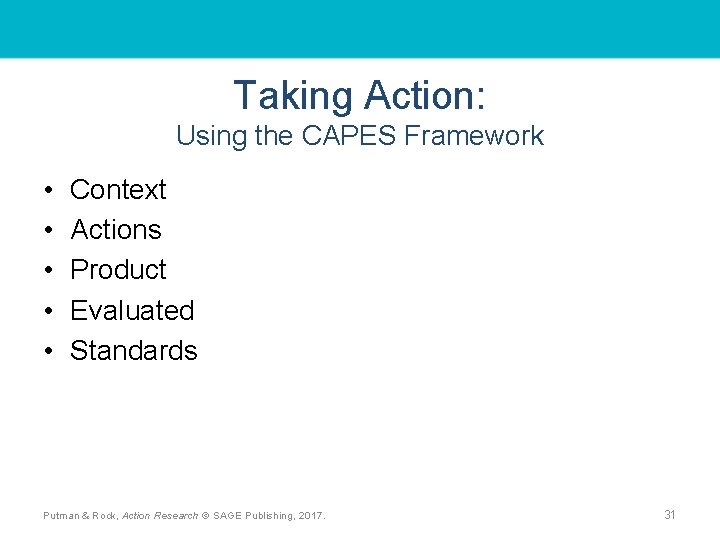
Taking Action: Using the CAPES Framework • • • Context Actions Product Evaluated Standards Putman & Rock, Action Research © SAGE Publishing, 2017. 31
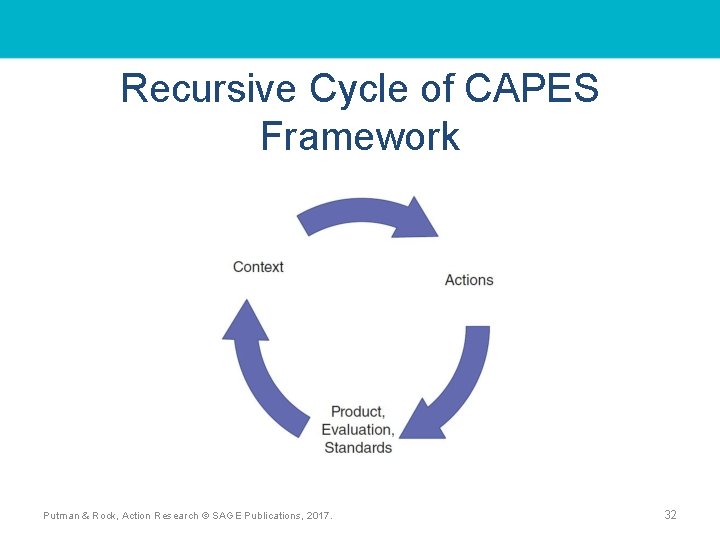
Recursive Cycle of CAPES Framework Putman & Rock, Action Research © SAGE Publications, 2017. 32
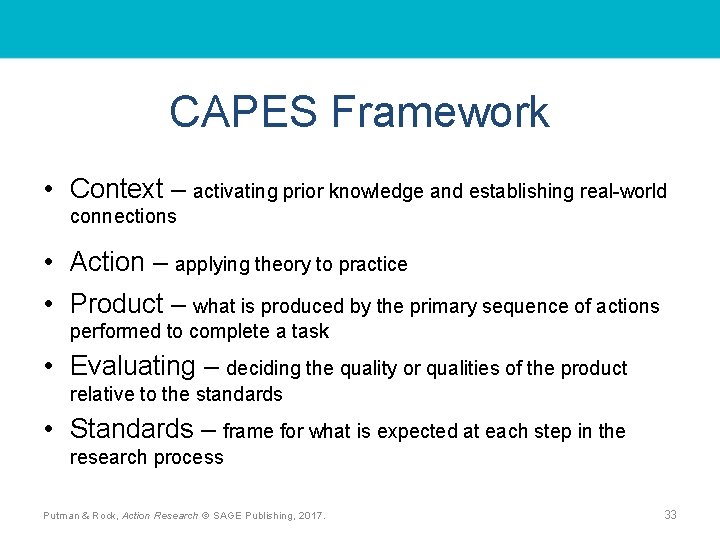
CAPES Framework • Context – activating prior knowledge and establishing real-world connections • Action – applying theory to practice • Product – what is produced by the primary sequence of actions performed to complete a task • Evaluating – deciding the quality or qualities of the product relative to the standards • Standards – frame for what is expected at each step in the research process Putman & Rock, Action Research © SAGE Publishing, 2017. 33