
Chapter 1 What Does a Historian Do Lesson
- Slides: 16
Chapter 1 What Does a Historian Do?
Lesson 1 Why Study History?
Why Study History? • • History is the study of the people and events of the past. How things change and/or stay the same How cultures change over time Historian: studies history • Explain why things are the way they are
Measuring Time • Periods of History • • Decade: 10 years Century 100 years Millennium 1000 years Eras: larger blocks of time • • Prehistory (5, 500 years ago; before writing) Ancient History (Ends close to A. D. 500 Middle Ages a. k. a. “Medieval Times” A. D. 500 – A. D. 1400 Modern History A. D. 1400 – present
Measuring Time • Calendars • Julian Calendar • • • Developed by Roman leader Julius Caesar Years counted after founding of Rome 1 year = 365. 25 days Extra day every 4 years Not precise
Measuring Time • Gregorian Calendar • Pope Gregory XIII • From birth of Jesus Christ • More than three centuries for calendar to be accepted • Dating Events • B. C. or B. C. E “Before the common era” • A. D. Latin for “Anno Domini” which means the year of the Lord • Sometimes referred to C. E. or Common Era
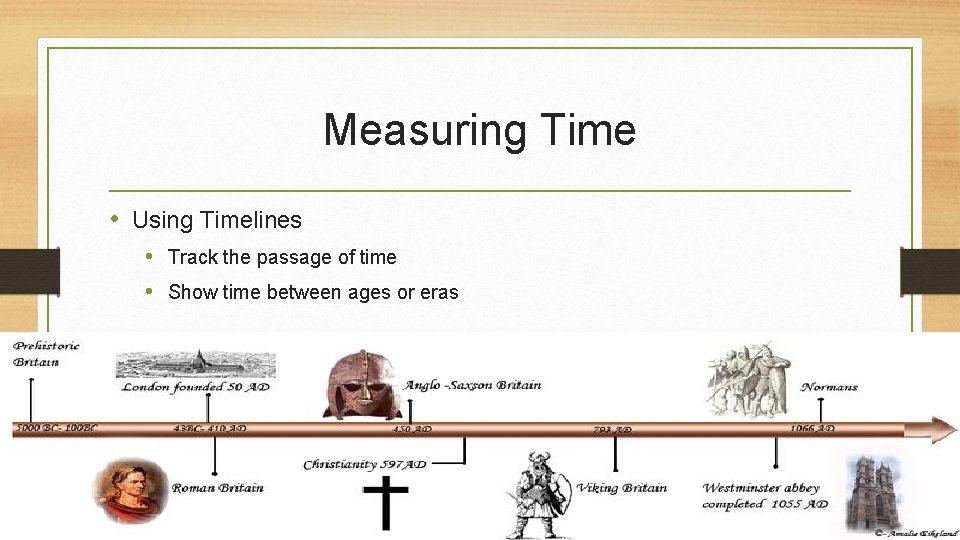
Measuring Time • Using Timelines • Track the passage of time • Show time between ages or eras
Digging up the Past • Historians use science to study the past • Archaeology: study of the past by looking at what people left behind • Artifacts • Paleontology: look at prehistoric times and use fossils • Anthropology: study of human culture and how it develops over time
Lesson 2 How Does a Historian Work?
What is Evidence? • Historians ask questions • To learn answers, they look for evidence • Evidence is proof or indication that something is true • Evidence they find in historical sources
What is Evidence? • • • Primary sources Secondary sources Reliable sources Point of view: general attitude about people or life Bias: unreasoned, emotional judgement about people and events
Writing About History • Interpret information from primary sources • Making inferences • Complex • Look both at primary and secondary sources • Become experts in their area or historical subject • Scholarly • Finite- limit their area of study • Conclusion – through reasoning • Some have different interpretations
Lesson 3 Researching History
Research • Choose a topic • Develop questions • Gather research materials • Nonfiction • Identify fact from opinion • Take Notes
Research on the Internet • Authorship • Credentials • Web URLS • . gov : government related • . edu : educational • . org : nonprofit organizations
Writing Without Bias • Plagiarism: copying someone else’s words • Violates copyright laws • To avoid plagiarism: • Put writing in your own words • If you have an opinion, use text evidence from an article or text you have read and cite • Include a reference sheet