
Chapter 1 Understanding Business Communication Understanding business communication
Chapter 1 Understanding Business Communication
Understanding business communication • • • Communicating in organizations The components of communication Verbal communication Directions of communication Barriers to communication Copyright © Houghton Mifflin Company. All rights reserved. 1|2
Quotations “I’ve discovered that the less I say, the more rumors I start. ” --Bobby Clarke Quotes “One person tells an idle story; ten thousand repeat it as truth. ” --Chinese proverb Copyright © Houghton Mifflin Company. All rights reserved. 1|3
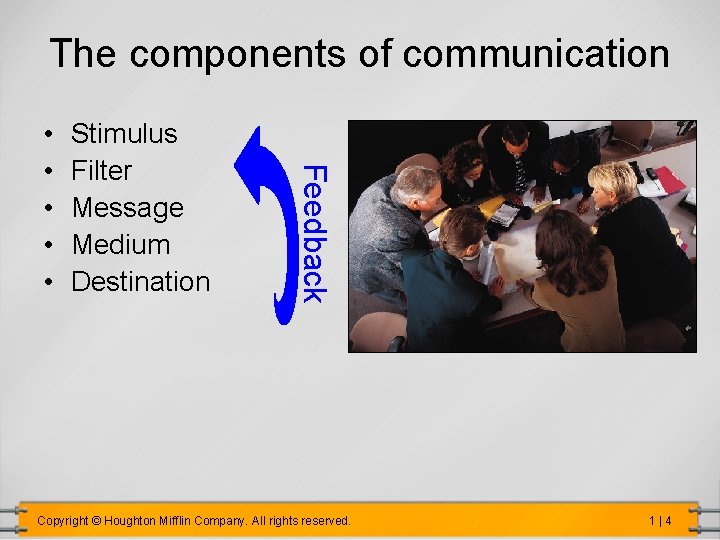
The components of communication Stimulus Filter Message Medium Destination Feedback • • • Copyright © Houghton Mifflin Company. All rights reserved. Insert photo of group discussion 1|4

Communication noise Examples of noise or interference that can enter into the communication process: • Misreading body language or tone • Noisy transmission • Power struggles • Managers and subordinates hesitating to be candid • Physical distractions Think of an example of each type of noise. Copyright © Houghton Mifflin Company. All rights reserved. 1|5
Providing feedback • Providing feedback is accomplished by restating the speaker's feelings or ideas in your own words. Your words should be saying, "This is what I understand your idea to be. Am I correct? " • Providing feedback includes both verbal and nonverbal responses. Cocking your head or dipping your eyebrows shows you don't quite understand the meaning of the last phrase. • One direct way of getting feedback is to ask the listener, “Would you repeat what I just said in your own words? ” Copyright © Houghton Mifflin Company. All rights reserved. 1|6

Organizational communication Source: Kreitner, Student Achievement Series: Foundations of Management, © 2008 by Houghton Mifflin Company. Copyright © Houghton Mifflin Company. All rights reserved. 1|7
The destination “The greatest problem in communication is the illusion that it has been accomplished. ” — George Bernard Shaw Copyright © Houghton Mifflin Company. All rights reserved. 1|8

Verbal communication Oral Written One-on-one conversations Memorandums Meetings Letters Phone calls E-Mail Presentations Reports Videoconferences Miscellaneous Copyright © Houghton Mifflin Company. All rights reserved. 1|9
Other forms of written communication in an organization • • • Employee handbook In-house magazines and journals Bulletin boards, posters Museums and exhibitions Notice boards Suggestion system Copyright © Houghton Mifflin Company. All rights reserved. 1 | 10
Forms of oral communication in an organization • • • Staff meetings Personal discussions Informal conversation Face-to-face meetings Telephone calls, teleconferences, videoconferences • Speeches, presentations Copyright © Houghton Mifflin Company. All rights reserved. 1 | 11
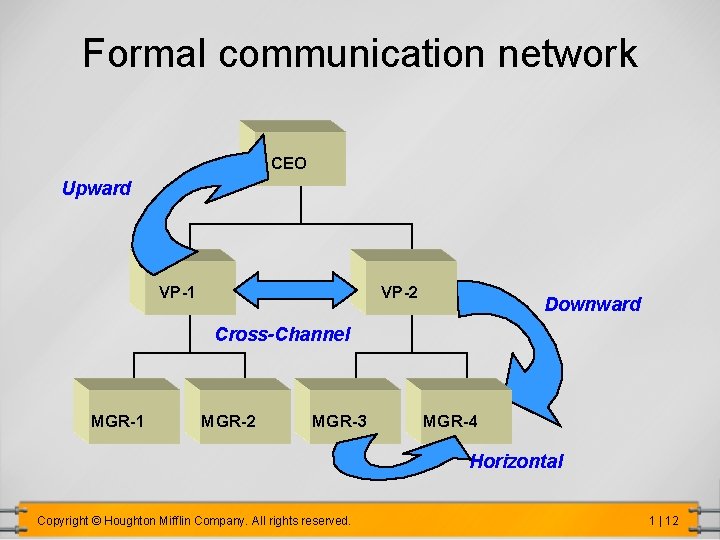
Formal communication network CEO Upward VP-1 VP-2 Downward Cross-Channel MGR-1 MGR-2 MGR-3 MGR-4 Horizontal Copyright © Houghton Mifflin Company. All rights reserved. 1 | 12
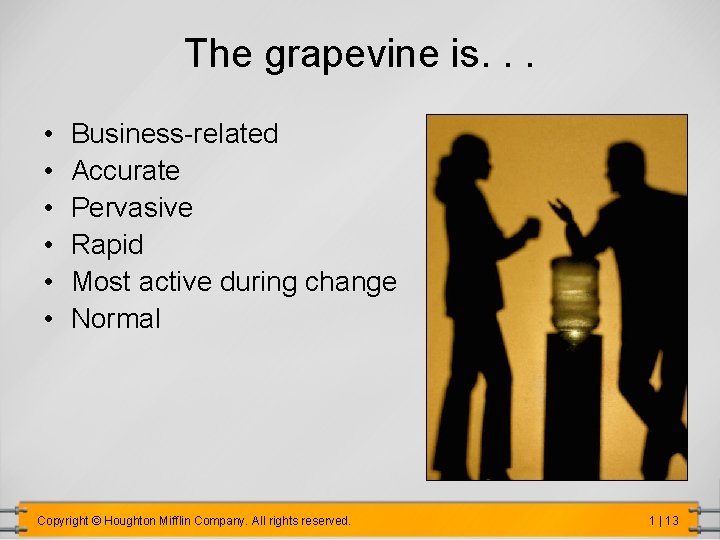
The grapevine is. . . • • • Business-related Accurate Pervasive Rapid Most active during change Normal Copyright © Houghton Mifflin Company. All rights reserved. 1 | 13
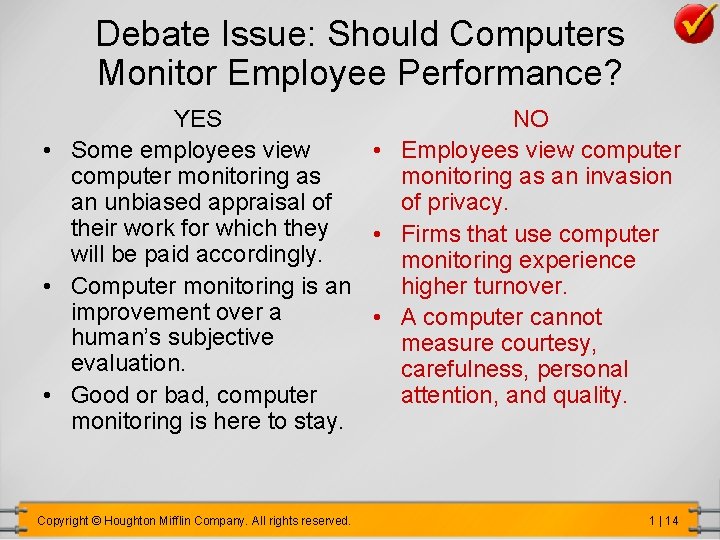
Debate Issue: Should Computers Monitor Employee Performance? YES NO • Some employees view • Employees view computer monitoring as an invasion an unbiased appraisal of of privacy. their work for which they • Firms that use computer will be paid accordingly. monitoring experience • Computer monitoring is an higher turnover. improvement over a • A computer cannot human’s subjective measure courtesy, evaluation. carefulness, personal • Good or bad, computer attention, and quality. monitoring is here to stay. Copyright © Houghton Mifflin Company. All rights reserved. 1 | 14
Verbal barriers • • • Inadequate knowledge or vocabulary Differences in interpretation Language differences Inappropriate use of expressions Over-abstraction and ambiguity Polarization Copyright © Houghton Mifflin Company. All rights reserved. 1 | 15
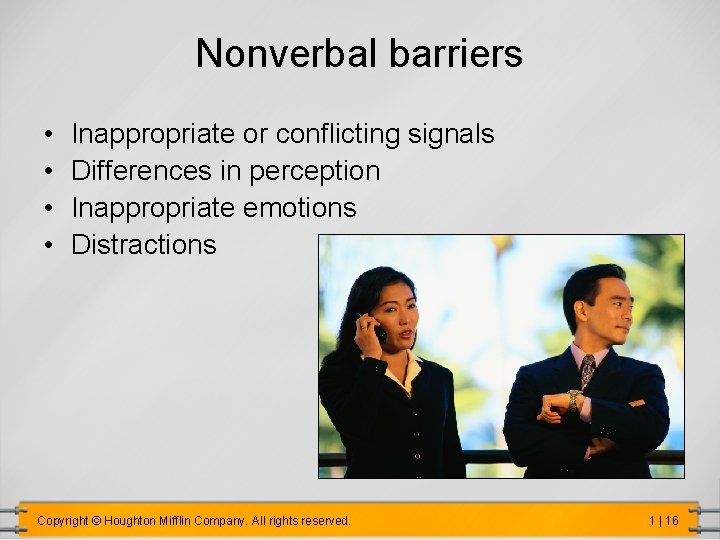
Nonverbal barriers • • Inappropriate or conflicting signals Differences in perception Inappropriate emotions Distractions Copyright © Houghton Mifflin Company. All rights reserved. 1 | 16
Apparent nonverbal barriers • Flashing or rolling eyes • Quick or slow movements • Arms crossed, legs crossed • Gestures made with exasperation • Slouching, hunching over • Poor personal care • Doodling • Staring at people or avoiding eye contact • Excessive fidgeting with materials Source: Rod Windle and Suzanne Warren, “Communication Skills, ” http: //www. directionservice. org/cadre/section 4. cfm#Verbal%20 Communication%20 Barriers , accessed 10/1/07. Copyright © Houghton Mifflin Company. All rights reserved. 1 | 17
Quotations “Nothing is so simple that it cannot be misunderstood. ” --Freeman Teague, Jr. “When you know something, say what you know. When you don't know something, say that you don't know. That is knowledge. ” --Kung Fu Tzu (Confucius) Relate one of these quotations to what you have learned about communication. Copyright © Houghton Mifflin Company. All rights reserved. 1 | 18
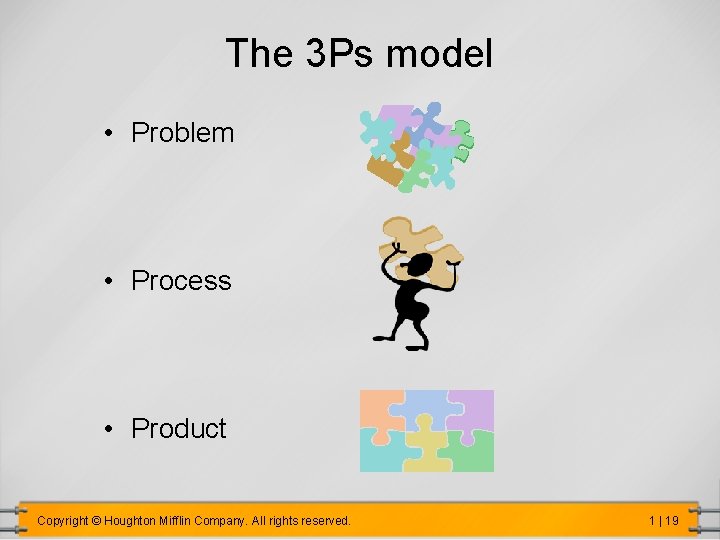
The 3 Ps model • Problem • Process • Product Copyright © Houghton Mifflin Company. All rights reserved. 1 | 19
Key terms • • abstract word audience communication concrete word connotation denotation e-mail Copyright © Houghton Mifflin Company. All rights reserved. • • euphemism feedback filter formal communication network • informal communication network 1 | 20
Key terms (cont’d) • • • jargon letter medium memorandum message noise Copyright © Houghton Mifflin Company. All rights reserved. • • • nonverbal message report slang stimulus verbal message website 1 | 21
- Slides: 21