
Chapter 1 Toward Civilization prehistory 3000 B C
Chapter 1 Toward Civilization (prehistory – 3000 B. C. ) World History/ HS
Chapter 1 Toward Civilization (prehistory – 3000 B. C. )
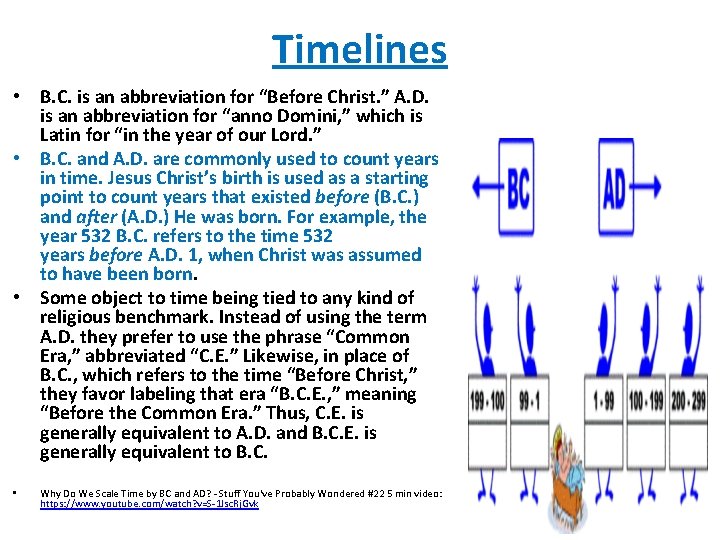
Timelines • B. C. is an abbreviation for “Before Christ. ” A. D. is an abbreviation for “anno Domini, ” which is Latin for “in the year of our Lord. ” • B. C. and A. D. are commonly used to count years in time. Jesus Christ’s birth is used as a starting point to count years that existed before (B. C. ) and after (A. D. ) He was born. For example, the year 532 B. C. refers to the time 532 years before A. D. 1, when Christ was assumed to have been born. • Some object to time being tied to any kind of religious benchmark. Instead of using the term A. D. they prefer to use the phrase “Common Era, ” abbreviated “C. E. ” Likewise, in place of B. C. , which refers to the time “Before Christ, ” they favor labeling that era “B. C. E. , ” meaning “Before the Common Era. ” Thus, C. E. is generally equivalent to A. D. and B. C. E. is generally equivalent to B. C. • Why Do We Scale Time by BC and AD? - Stuff You've Probably Wondered #22 5 min video: https: //www. youtube. com/watch? v=S-1 Isc. Rj. Gvk
Geography and History • GEOGRAPHY is the study of people and their environments and the resources available to them • Geography, in effect, determines the entire course of civilizations. It determines what foods can be grown, what livestock can be raised, whethere is sufficient water, how warm or cold it is, who people trade with, how they travel, availability of minerals metals and spices, the outcomes of war, etc.
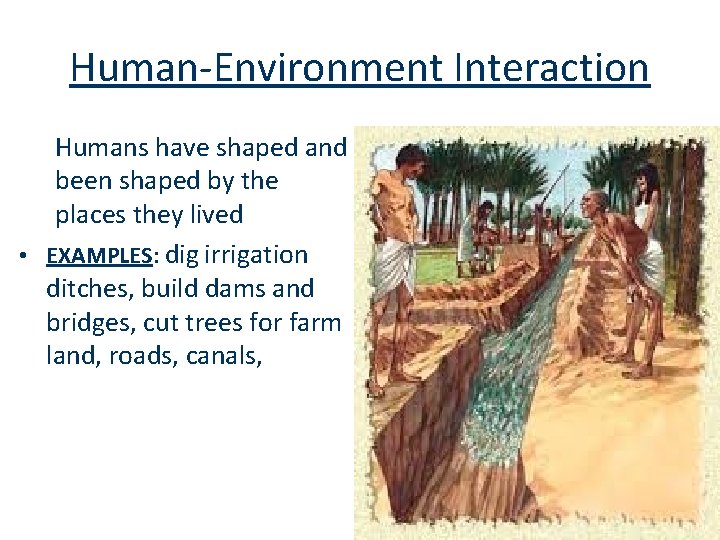
Human-Environment Interaction Humans have shaped and been shaped by the places they lived • EXAMPLES: dig irrigation ditches, build dams and bridges, cut trees for farm land, roads, canals,
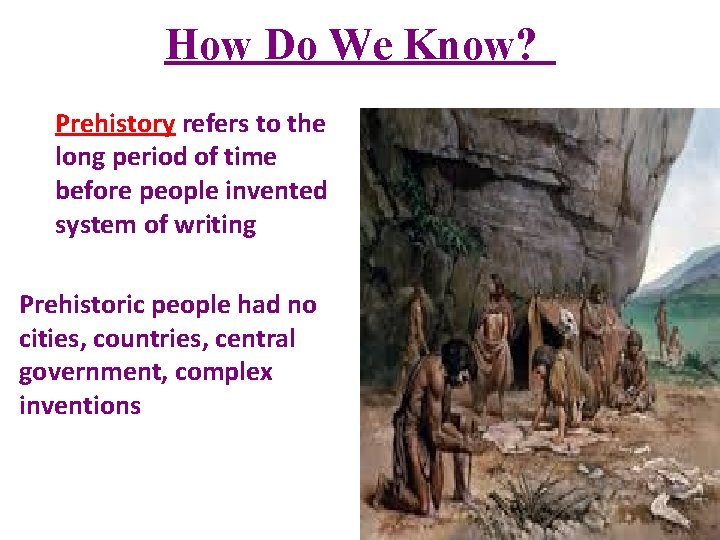
How Do We Know? Prehistory refers to the long period of time before people invented system of writing Prehistoric people had no cities, countries, central government, complex inventions
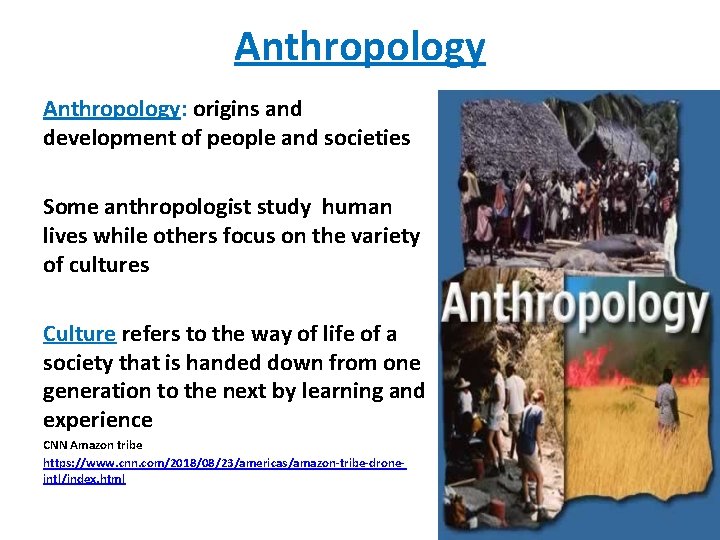
Anthropology: origins and development of people and societies Some anthropologist study human lives while others focus on the variety of cultures Culture refers to the way of life of a society that is handed down from one generation to the next by learning and experience CNN Amazon tribe https: //www. cnn. com/2018/08/23/americas/amazon-tribe-droneintl/index. html

Archeology • Archaeology is the study of past peoples and cultures • They find analyze material remains of human cultures to learn about prehistoric people and to add to the written records of historical times • They study artifacts or objects made by human beings • Examples: tools, weapons, pottery, clothing and jewelry

Archaeologist at Work – By studying artifacts, archaeologists have traced how early people developed new technologies – Technology refers to the skills and tools people use to meet their basic needs – They also make detailed maps locating every artifact they find – By doing this they can tell what went on at different locations in a site
Technology and the Past – Archaeologist use modern technology to study and interpret their findings – Computers store data or develop accurate site maps – Aerial photographs can reveal patterns of how people use the land – Radio carbon dating can help determine age of objects – Geologists or experts on earth science can help date artifacts by determining the age of near by rocks – Botanists and zoologists exerts on plants, animals study diets, bones, bloodstains etc – Experts in climates can conditions people faced --Biologists analyze human bones and bloodstains on weapons or tools
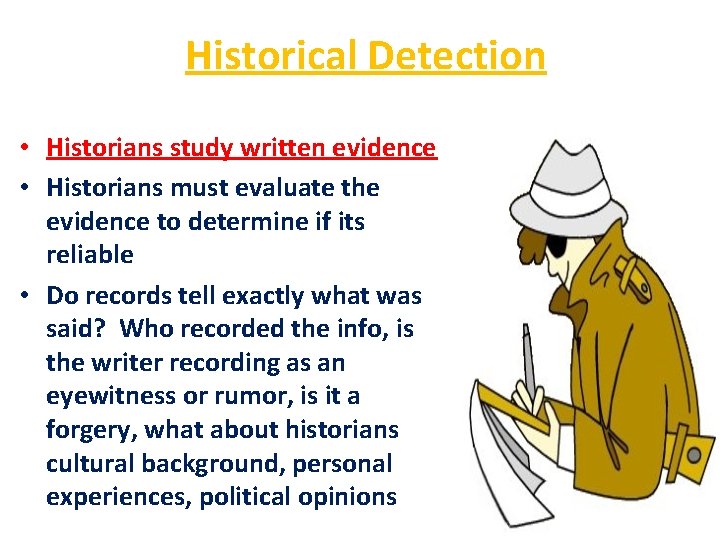
Historical Detection • Historians study written evidence • Historians must evaluate the evidence to determine if its reliable • Do records tell exactly what was said? Who recorded the info, is the writer recording as an eyewitness or rumor, is it a forgery, what about historians cultural background, personal experiences, political opinions
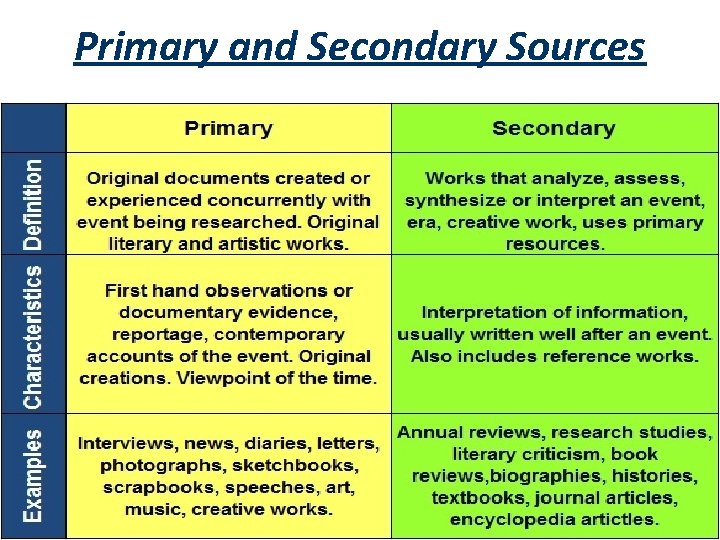
Primary and Secondary Sources
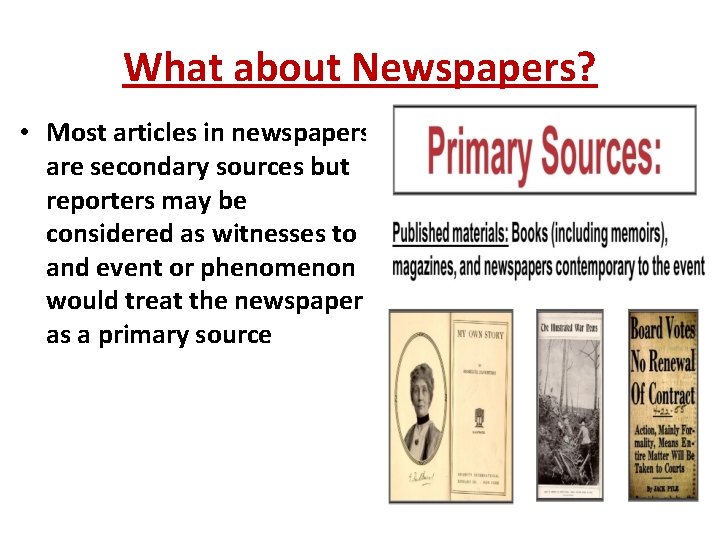
What about Newspapers? • Most articles in newspapers are secondary sources but reporters may be considered as witnesses to and event or phenomenon would treat the newspaper as a primary source
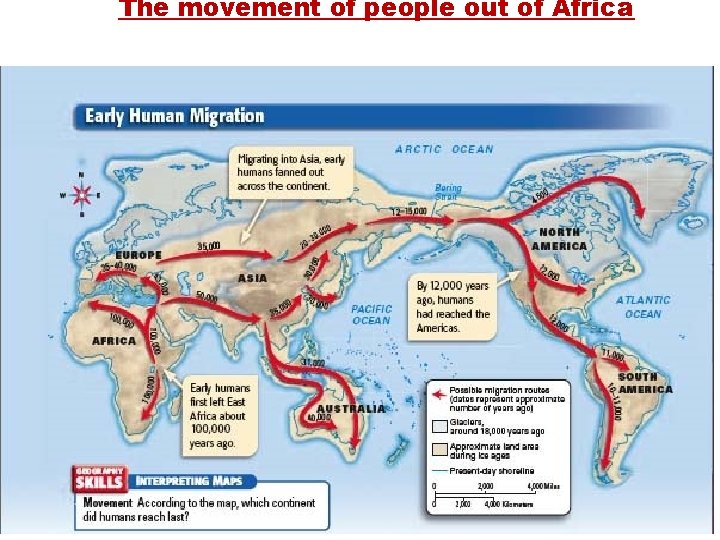
The movement of people out of Africa
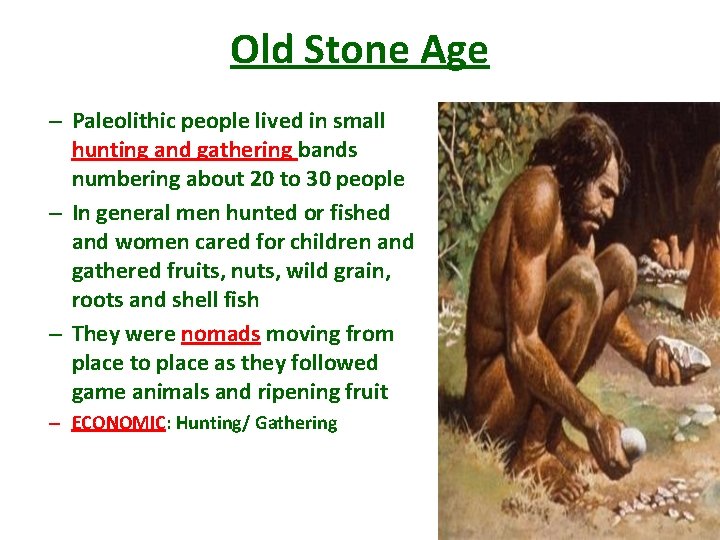
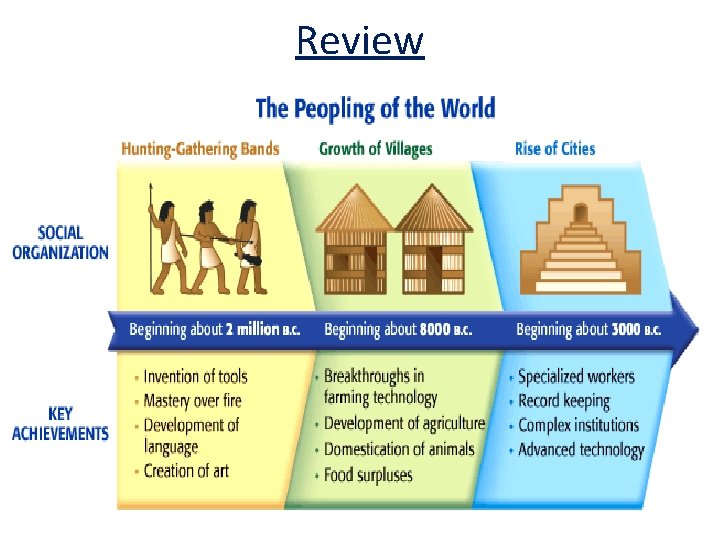
Old Stone Age – Paleolithic people lived in small hunting and gathering bands numbering about 20 to 30 people – In general men hunted or fished and women cared for children and gathered fruits, nuts, wild grain, roots and shell fish – They were nomads moving from place to place as they followed game animals and ripening fruit – ECONOMIC: Hunting/ Gathering
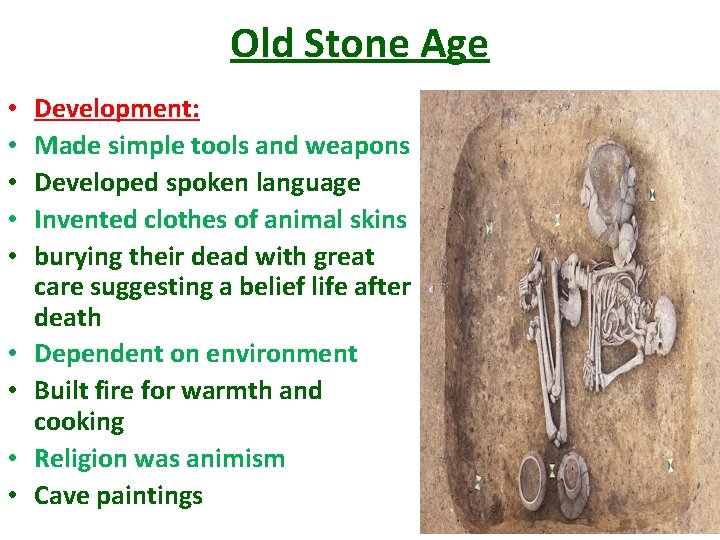
Old Stone Age • • • Development: Made simple tools and weapons Developed spoken language Invented clothes of animal skins burying their dead with great care suggesting a belief life after death Dependent on environment Built fire for warmth and cooking Religion was animism Cave paintings
New Stone Age or Neolithic Era • About 11, 000 years ago people began producing their own food and settled into permanent villages and developed tools and skills • **Neolithic or Agricultural Revolution: Man began to plant crops • Economic: • Farming • Domesticated or tamed animals • Some were Pastoralist people who ranged over a wide area keeping herds of livestock • Developments: • • • Leads to a growth in population (more food more people) More interactions among human communities Work divided by gender and age Increased status of men-Decline in the status of women Could own property and accumulate wealth New farming technologies Created the first calendars to determine when to plant and harvest Learned to weave cloth Crash Course Neolithic Revolution : https: //www. youtube. com/watch? v=Yocja_N 5 s 1 I
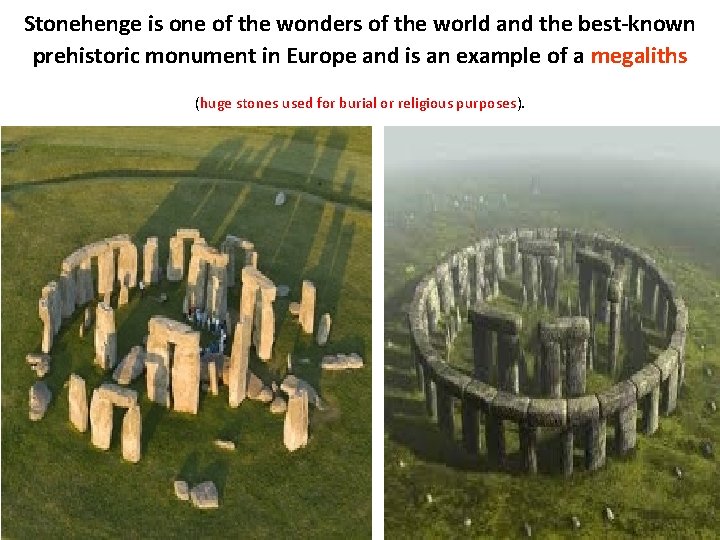
Stonehenge is one of the wonders of the world and the best-known prehistoric monument in Europe and is an example of a megaliths (huge stones used for burial or religious purposes).
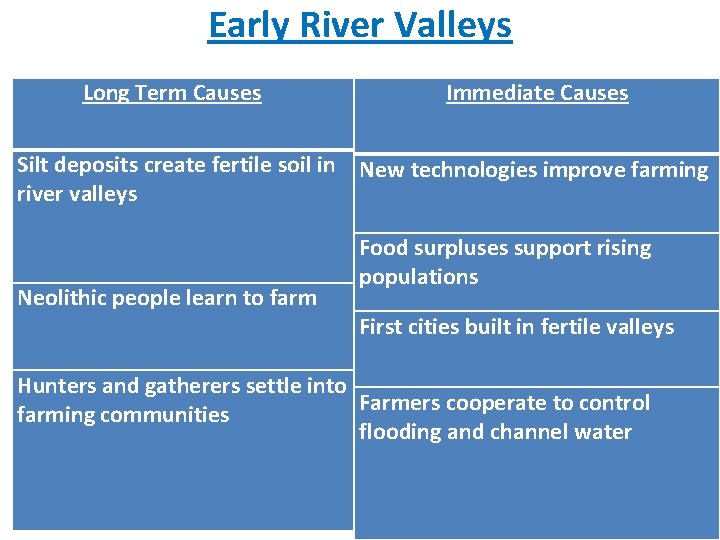
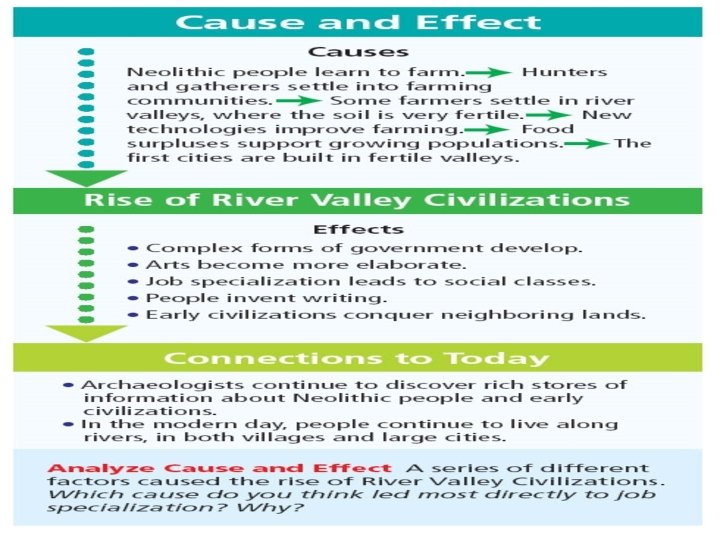
The Rise of Cities The rise in cities was the main feature of civilizations Civilization is a complex, highly organized social order Civilizations emerged after farmers began cultivating fertile lands along river valleys and producing surplus or extra food. These surpluses (extra) helped populations to expand as populations grew some villages grew into cities • Cities rose independently in the valleys of 1. Tigris / Euphrates Rivers in the Middle East 2. Nile River in Egypt 3. Indus River in India 4. Huang He or Yellow River in China
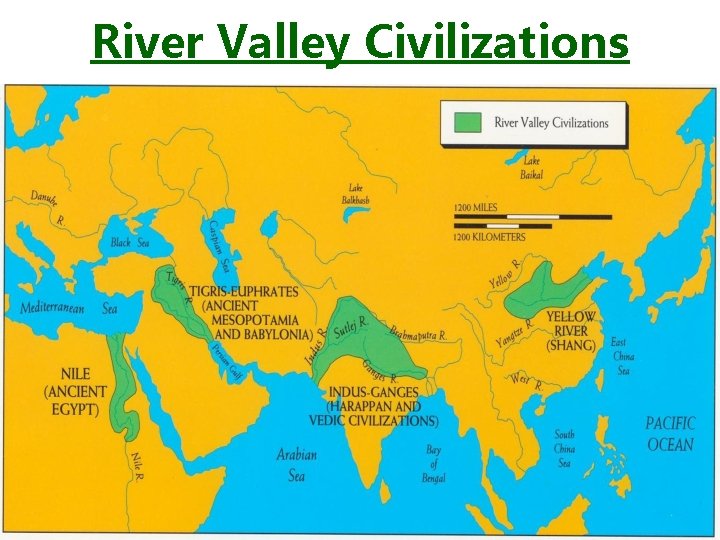
River Valley Civilizations
River Valley Civilizations Conditions in these areas favored farming • Flood waters spread silt across the valleys renewing the soil and keeping it fertile • Animals flocked to rivers to during and were another source of food • Rivers provided a regular water supply and transportation • rivers provided a source of food Challenges of rivers • to control flooding and channel water to fields • cooperation was need to meet these challenges such as building dykes, (a long wall or embankment built to prevent flooding ) canals, irrigation ditches • large scale projects required leadership • and a well organized government
The Big Eight Features of Civilization 1. cities 2. organized central government 3. complex religion 4. job specialization 5. social classes 6. arts and architecture 7. public works 8. writing
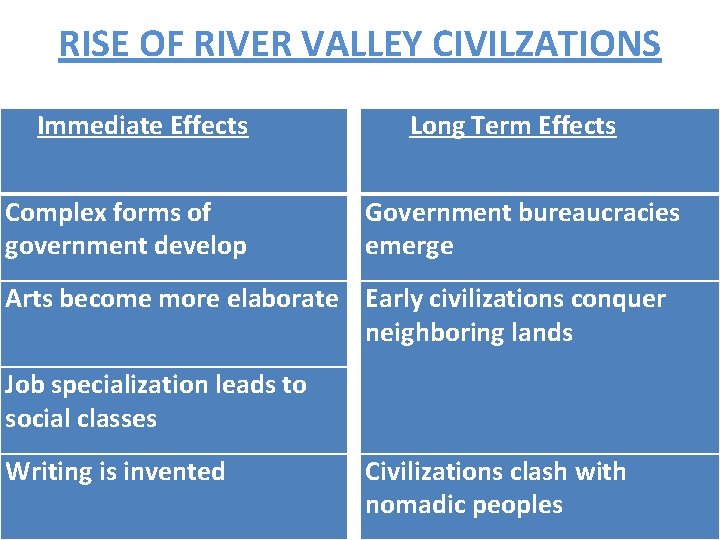
Organized Governments – As cities grew there was a need for a steady food supply – To produce large amounts of food and oversee irrigation projects new forms of government arose – Early governments: • village council of elders • Priests • warrior kings • Kings set up hereditary rule who passed power from father to son…Most rulers claimed their right to rule came from the gods – As governments became more complex rulers issued laws, collected taxes, and organized systems of defenses, had royal officials to enforce laws and later a number of duties were taken over by government departments
Complex Religions • Most ancient people were Polytheistic or believed in many gods • They believed these gods, goddesses and spirits controlled the forces of nature & human activity • Priests and worshipers sought to gain the favor of gods through complex rituals such as ceremonies, dances, prayers and hymns • To ensure divine help, people built temples, sacrificed animals, crops or other humans to the gods
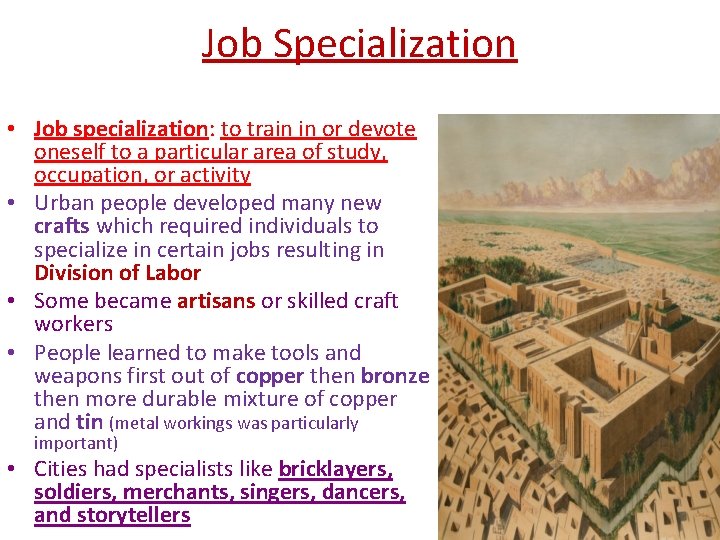
Job Specialization • Job specialization: to train in or devote oneself to a particular area of study, occupation, or activity • Urban people developed many new crafts which required individuals to specialize in certain jobs resulting in Division of Labor • Some became artisans or skilled craft workers • People learned to make tools and weapons first out of copper then bronze then more durable mixture of copper and tin (metal workings was particularly important) • Cities had specialists like bricklayers, soldiers, merchants, singers, dancers, and storytellers
Social Classes • In cities social organization became more complex • People were ranked according to their jobs which led to the growth of social classes • Levels of early social classes (top to bottom) 1. Ruler/ priests / nobles 2. wealthy merchants 3. artisans 4. peasant farmers (the majority) 5. Slaves (some sold to cover debts, prisoners of war)
Arts / Architecture / Public Works • Arts and Architecture • Temples and Palaces dominated the city • Buildings show the strength and power of their government and gods • Public Works • Public Works: Projects carried out by the government that are meant to benefit the city: the work of building such things as roads, schools, bridges, walls, and reservoirs, ensuring a food supply, protecting the city
Writing / First Empires • Important skill development • Rival leaders often battled for was writing power some conquering many cities and villages • May have began with in creating the first city states temples to keep records, to record amounts of grain • a group of states or collected, info on seasons territories controlled by one and precise rituals and ruler is an Empire prayers • Earliest writing was made up of pictograms or simple drawings that looked like of objects they represented • As writing became more complex only specially trained people called scribes learned to read and write
Factors that cause a civilization to change: 1. Environmental Influences such as the forces of nature like storms, floods, droughts, earthquakes, volcanoes, 2. Need for Resources such as metals, stone, trees, water 3. Cultural Diffusion: The spread of ideas, customs and technologies from one people to another, through trade, migration, missionaries 4. Expansion and Warfare: as civilizations grow they need more land resources. Warfare may be waged for the control of land, people and resources.
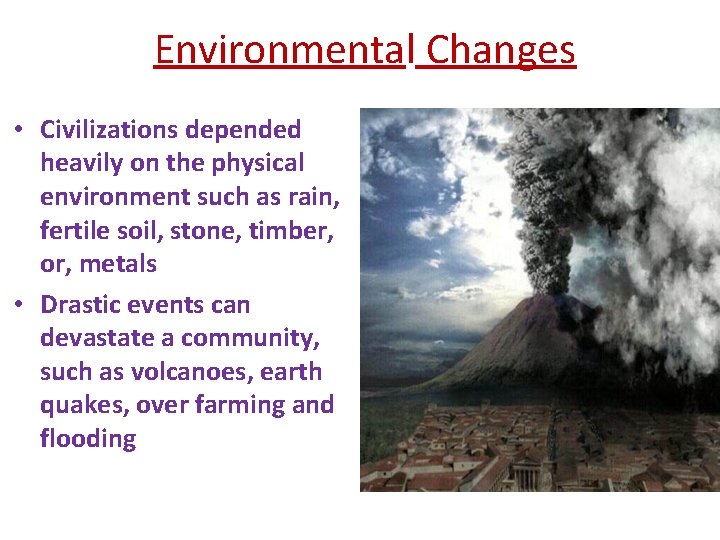
Environmental Changes • Civilizations depended heavily on the physical environment such as rain, fertile soil, stone, timber, or, metals • Drastic events can devastate a community, such as volcanoes, earth quakes, over farming and flooding
Review
Early River Valleys Long Term Causes Immediate Causes Silt deposits create fertile soil in New technologies improve farming river valleys Neolithic people learn to farm Food surpluses support rising populations First cities built in fertile valleys Hunters and gatherers settle into Farmers cooperate to control farming communities flooding and channel water
RISE OF RIVER VALLEY CIVILZATIONS Immediate Effects Long Term Effects Complex forms of government develop Government bureaucracies emerge Arts become more elaborate Early civilizations conquer neighboring lands Job specialization leads to social classes Writing is invented Civilizations clash with nomadic peoples
FYI / Videos • Mr. Betts Summary: 3: 42: https: //www. youtube. com/watch? v=q-b. CNQd 2 Cvw • (Ethnocentrism: having or based on the idea that your own group or culture is better or more . • Hip. Hughes Neolithic Revolution 10 min: https: //www. youtube. com/watch? v=d 8 AN 7 n 2 s. QOg • Crash Course Agricultural Revolution 11 min: https: //www. youtube. com/watch? v=Yocja_N 5 s 1 I • Seven Brain Hacks to improve productivity: https: //www. youtube. com/watch? v=js. FAx. AIJm. N 0 important than others
- Slides: 35