
Chapter 1 The World of Earth Science Section
- Slides: 56
Chapter 1: The World of Earth Science
Section 1: Branches of Earth Science
Geology • The study of the origin, history, and structure of the earth and the processes that shape the earth. • Geologists specialize in different aspects of earth: –Volcanologists – studies volcanoes –Seismologist – studies earthquakes –Paleontologist – studies fossils
Oceanography • Scientific study of the sea. • Special areas of Oceanography – Physical Oceanographer – Biological Oceanographer – Geological Oceanographer – Chemical Oceanographer
Special areas of Oceanography • Physical Oceanographer – studies physical features of the ocean such as waves and currents to see how they affect weather patterns and aquatic life. • Biological Oceanographer – studies plants and animals that live in the ocean.
Special areas of Oceanography • Geological Oceanographer – studies and explores the ocean floor for clues to the Earth’s history. • Chemical Oceanographer – studies amounts and distributions of natural and human made chemicals in the ocean.
Reading Check: Describe four special areas of oceanography?
Other Branches of Earth Science • Meteorology – the scientific study of the Earth’s atmosphere, especially in relation to weather and climate. • Astronomy – the study of the universe. – Astronomers study stars, asteroids, planets, and everything in space.
Reading Check: What do astronomers study?
Special Branches of Earth Science • Environmental Science • Ecology • Geochemistry • Geography • Cartography
Environmental Science • The study of how humans interact with the environment. – Task: to determine how humans affect the environment. • Environmental science relies on: geology, life science, chemistry, and physics to help preserve Earth’s resources and to teach others how to use them wisely.
Ecology • The study of the relationships between organisms and their surroundings. – Ecologist – person who studies a community of organisms and their non-living environment. – They work in fields such as – wildlife management, agriculture, forestry, and conservation.
Geochemistry • Combines the studies of geology and chemistry. –geochemists – specialize in the chemistry of rocks, minerals, and soil. – Can determine: the economic value of the materials and what the environment was like when the rocks first formed. – Also studies: the distribution and effect of chemicals added to the environment by human activity.
Geography/Cartography • Physical geographers – studies the surface features of Earth. – Educated in geology, biology, and physics • Cartographers – make maps of those features by aerial and satellite photos, and computer mapping systems.
Reading Check: What do cartographers do?
Section Review: Pg. 11 -#’s: 1 -7, 9, 11
Section 2: Scientific Methods in Earth Science
Reading Check: How do scientists learn about the natural world?
Scientific Methods • Scientific methods – are a series of steps that scientists use to answer questions and solve problems. – No set procedure, may use all steps or just some, may repeat steps, use steps in different order. – Goal of scientific methods: is to come up with reliable answers and solutions. Also used to gain insight into the problems they investigate.
Steps to Scientific Method
Ask a Question • Helps focus the purpose of an investigation. • Sample question: What kind of dinosaur did these bones come from?
Form a Hypothesis • Is a possible explanation or answer to a question that can be tested. • Sample hypothesis: based on prior knowledge, these bones came from a dinosaur not yet known to scientists.
Test the Hypothesis • EXPERIMENT. • Controlled experiment – test only one factor, or variable, at a time. – All other variables remain constant. – *If more than one variable is changed scientists cannot easily determine which variable caused the outcome. *
Test the Hypothesis • Making observations. • Collecting data and observe nature when variables cannot be controlled. • Sample tests: Took measurements of dinosaur bones, compared measurements with bones from know dinosaurs. Also visited museums and talked with other scientists.
Test the Hypothesis • Keeping accurate records. • Clear, honest, and accurate records of their experiments and observations. • Presents findings supported by scientific data. • Repeat experiments to verify findings.
Analyze the Results • Finished testing? Analyze results. • Make graphs and tables to organize and summarize data. • Sample analysis: Found that bones did not match bones of known dinosaur. Bones were either too large or too different in shape.
Reading Check: Why would scientists create graphs and tables of their data?
Draw Conclusions • Must conclude whether the results supported the hypothesis. • If hypothesis is not supported by test-may repeat investigation to check for errors. OR ask new questions and form new hypotheses. • Sample conclusion: bones were from unknown dinosaur.
Communicate Results • Share results and what was learned with others. – Writing reports for scientific journals or give lectures on results. • Others evaluate evidence-review experimental procedure, data, and reasoning behind explanations (part of scientific inquiry) • Sample of sharing: press conference and scientific journal.
Reading Check: Why is it important for the scientific community to review new evidence?
Case Closed? • Investigation may not be closed. – New evidence may become available – Scientist may change hypothesis based on new evidence – May have more questions based in original evidence • Sample questions: What specific dinosaur ate? What environment did it live in? How did it become extinct?
Section Review: Pg. 17 -#’s: 1 -6, 8, 9
Section 3: Scientific Models
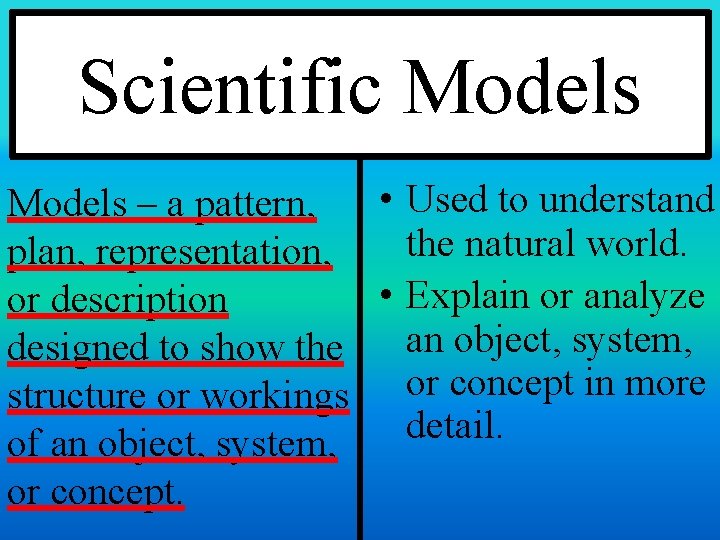
Scientific Models • Used to understand Models – a pattern, the natural world. plan, representation, • Explain or analyze or description an object, system, designed to show the or concept in more structure or workings detail. of an object, system, or concept.
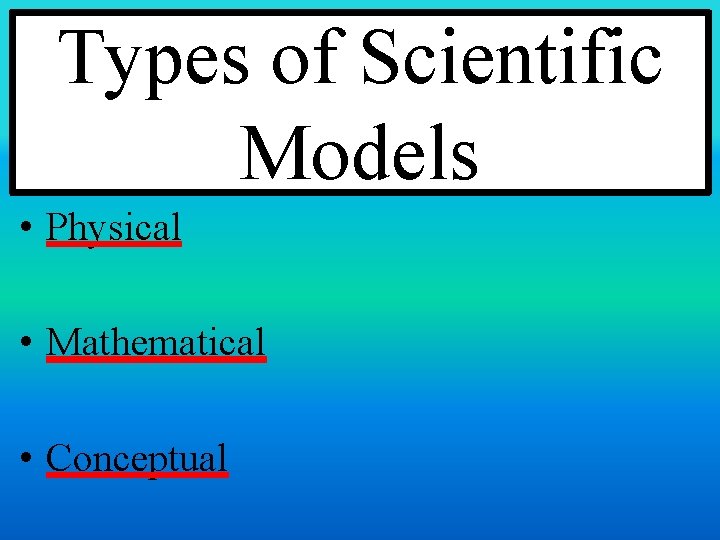
Types of Scientific Models • Physical • Mathematical • Conceptual
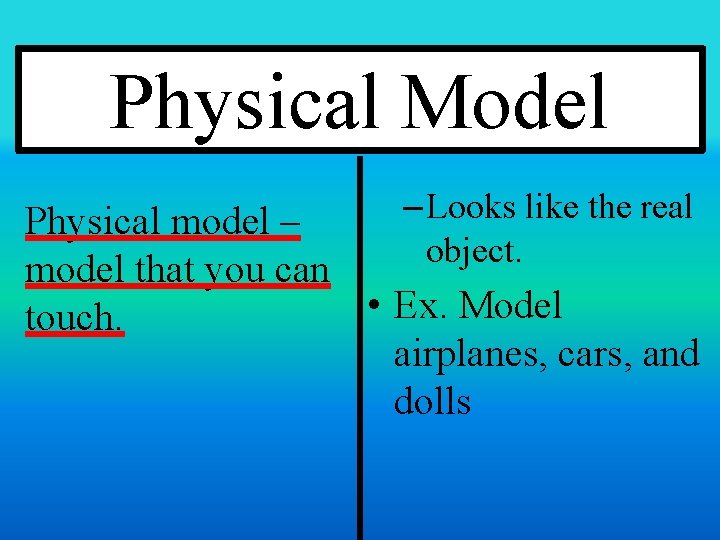
Physical Model – Looks like the real object. Physical model – model that you can • Ex. Model touch. airplanes, cars, and dolls
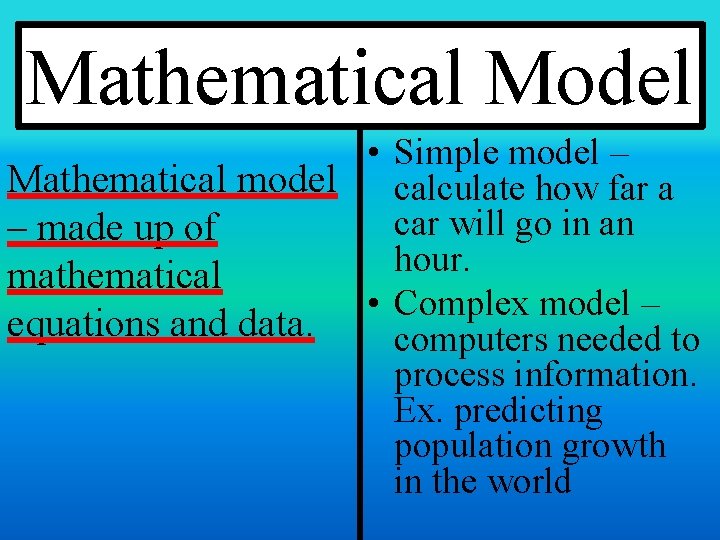
Mathematical Model • Simple model – Mathematical model calculate how far a car will go in an – made up of hour. mathematical • Complex model – equations and data. computers needed to process information. Ex. predicting population growth in the world
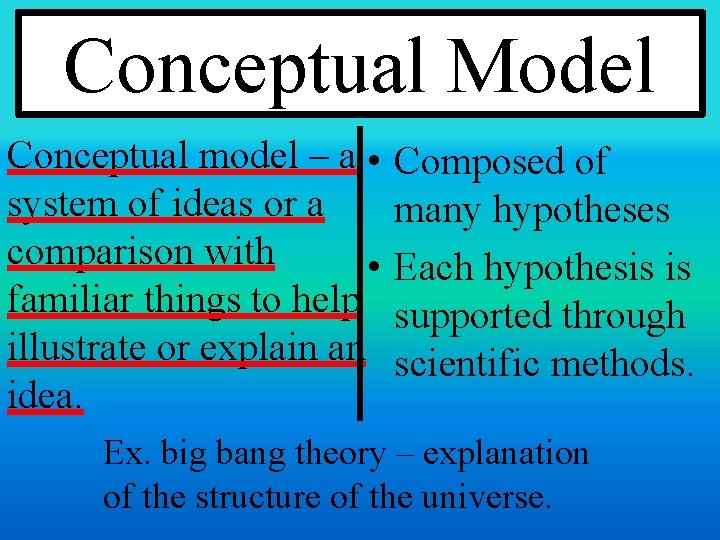
Conceptual Model Conceptual model – a • system of ideas or a comparison with • familiar things to help illustrate or explain an idea. Composed of many hypotheses Each hypothesis is supported through scientific methods. Ex. big bang theory – explanation of the structure of the universe.
Reading check: What is the big bang theory?
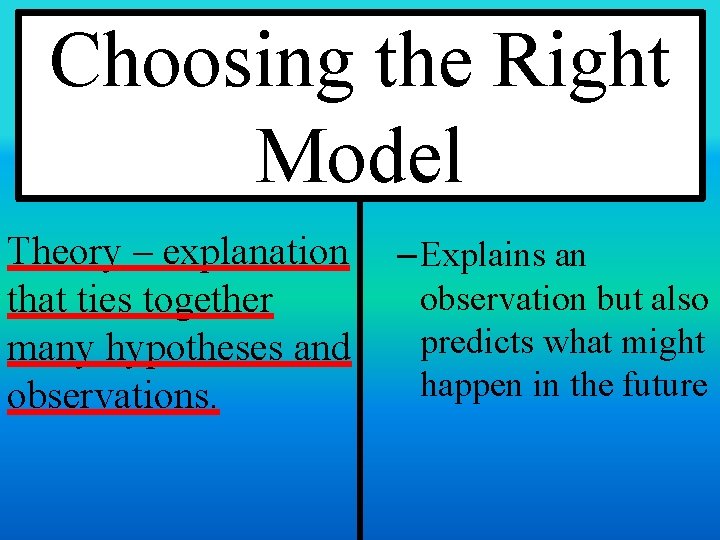
Choosing the Right Model Theory – explanation that ties together many hypotheses and observations. – Explains an observation but also predicts what might happen in the future
Climate Models Climate models – used by scientists who study Earth’s atmosphere. – This type of model is complicated because there are many variables that affect climate.
Reading check: Why is a climate model complicated?
Section Review: Pg. 21 -#’s: 1 -6, 8, 9
Section 4: Measurement and Safety
Using the International system of Units (SI) • Advantage: global measurement system created for using a standard system of measurement.
Reading Check: Why was the International System of Units developed?
Length • Meter – the basic unit of length in the SI, symbol (m). Length – scientists use meters (m) to • Ex. Divide 1 m measure length. into 100 parts, each part equals 1 cm.
Volume • Measuring volume Volume – a – Boxed-shaped object – measure of the l. Xw. Xh size of a body or – Irregularly shaped region in threeobject – measuring the dimensional space. volume of liquid that the object displaces. Liters (L) • Using a graduated cylinder
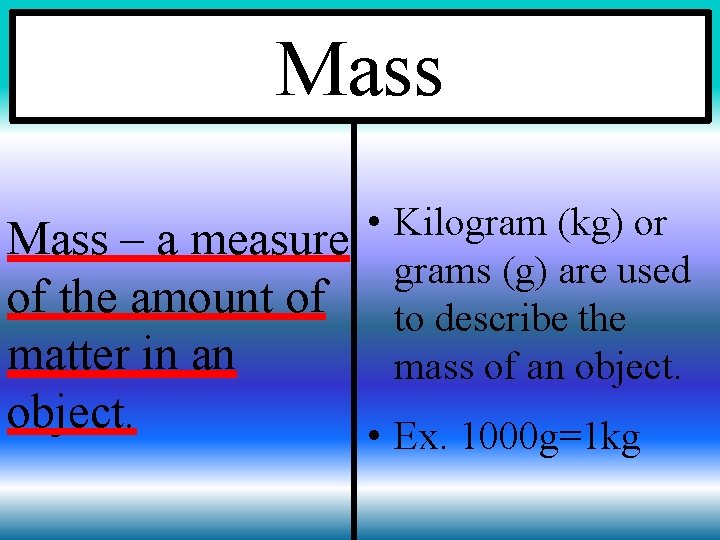
Mass • Kilogram (kg) or Mass – a measure grams (g) are used of the amount of to describe the matter in an mass of an object. • Ex. 1000 g=1 kg
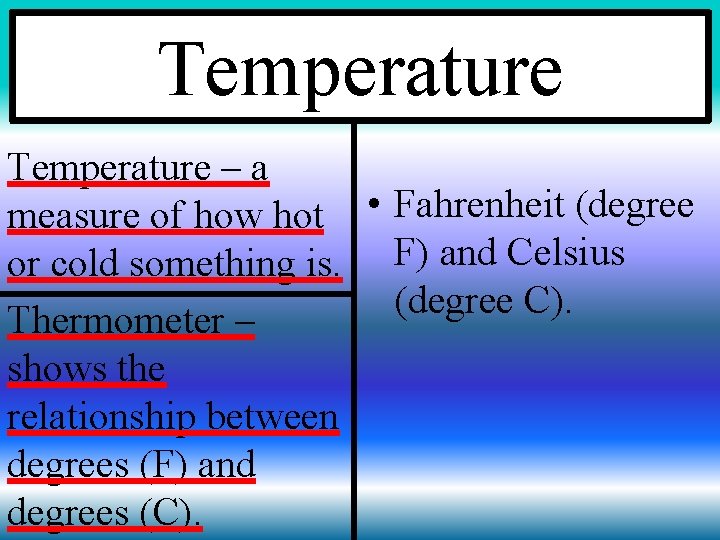
Temperature – a measure of how hot • Fahrenheit (degree or cold something is. F) and Celsius (degree C). Thermometer – shows the relationship between degrees (F) and degrees (C).
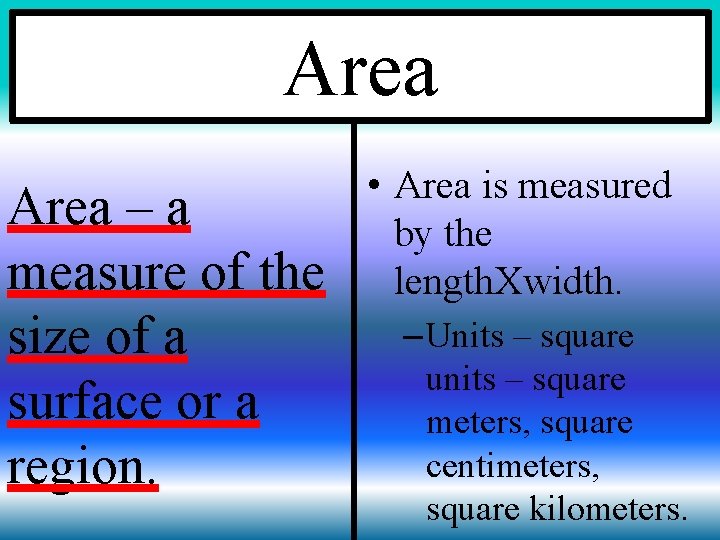
Area – a measure of the size of a surface or a region. • Area is measured by the length. Xwidth. – Units – square units – square meters, square centimeters, square kilometers.
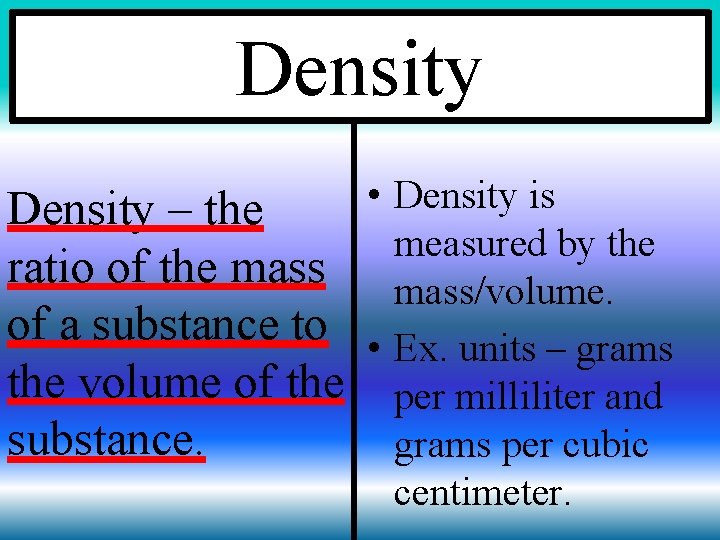
Density • Density is Density – the measured by the ratio of the mass/volume. of a substance to • Ex. units – grams the volume of the per milliliter and substance. grams per cubic centimeter.
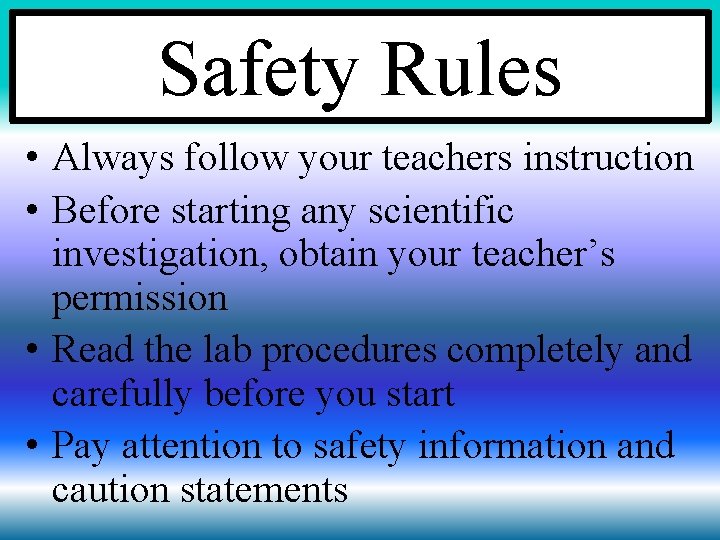
Safety Rules • Always follow your teachers instruction • Before starting any scientific investigation, obtain your teacher’s permission • Read the lab procedures completely and carefully before you start • Pay attention to safety information and caution statements
Reading Check: What should you do before you start a scientific investigation?
Section Review: Pg. 25 - #’s: 1 -6
Chapter Review: Pg. 28 - #’s: 1 -14, 16 -19