
Chapter 1 The World Before 1492 2015 Pearson

Chapter 1 The World Before 1492 © 2015 Pearson Education, Inc. All rights reserved.
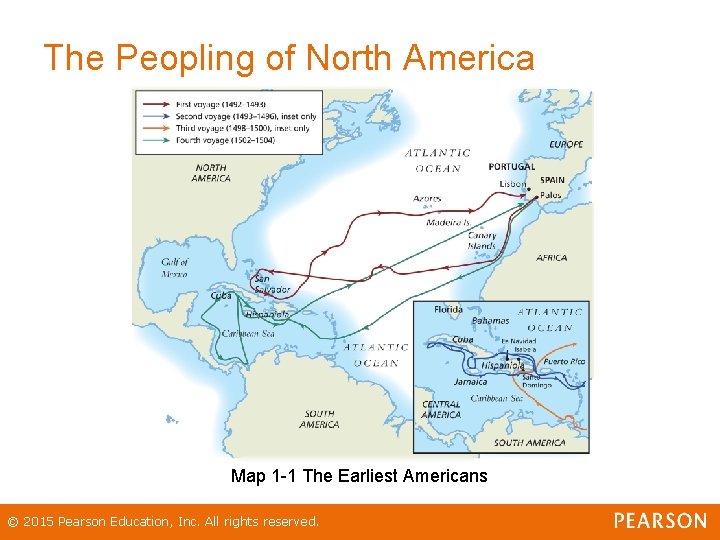
The Peopling of North America Map 1 -1 The Earliest Americans © 2015 Pearson Education, Inc. All rights reserved.
The Land Bridge, Clovis Culture, and Recent Discoveries • Bering land bridge between North America and Asia • People gradually spread into North America, Central America, and South America • The Clovis people might have come to North America around 13, 000 years ago © 2015 Pearson Education, Inc. All rights reserved.
Changing Climate and Cultures— Anasazi and Cahokia • The Anasazi, or “ancient ones, ” began building communities in New Mexico and Arizona perhaps 700 years before the arrival of Columbus. • The Cahokia people of the Mississippi Valley, also known as the Mound Builders, created a flourishing culture between 900 and 1350. © 2015 Pearson Education, Inc. All rights reserved.

The Diverse Communities of the Americas in the 1400 s Map 1 -2 North American Culture Areas, c. 1500 © 2015 Pearson Education, Inc. All rights reserved.
The Pueblo People of the Southwest • Some of the largest American Indian settlements were in the Southwest. • Taos Pueblo in northern New Mexico is still inhabited. • In the Pueblo and Hopi Southwest, an intricate maze of canals, dams, and terracing allowed agriculture to flourish in a dry climate. © 2015 Pearson Education, Inc. All rights reserved.
The Tribes of the Mississippi Valley • The most direct descendants of Cahokia, the people later known as the Creeks, Choctaws, and Chickasaws, settled on the eastern side of the Mississippi River and the southern Appalachian Mountains. • Most of these tribes lived in small communities of 500 to 2, 000 people. © 2015 Pearson Education, Inc. All rights reserved.
The Pacific Coast—From the Shasta to the California Indians • In the Pacific Northwest, the Shasta and other tribes lived primarily on the abundant salmon in their rivers. • Farther down the Pacific Coast in California, the Yokut, Miwok, Maidu, and Pomo represented one of the largest concentrations of American Indians north of Mexico. © 2015 Pearson Education, Inc. All rights reserved.
The Iroquois Confederacy and the Tribes of the Atlantic Coast • In the Northeast, the original five nations of the Iroquois—the Mohawks, Oneidas, Onondagas, Cayugas, and Senecas— developed. • On the Atlantic Coast were Algonquianspeaking tribes, the largest of which, the Powhatans, may have included 60, 000 or more people. © 2015 Pearson Education, Inc. All rights reserved.
The Aztec, Mayan, and Inca Empires • The Aztecs lived in central Mexico by 1400. • The Mayans lived on the Yucatan peninsula from 300 -900 A. D. • The Incas lived in South America in villages high in the Andes Mountains and their empire extended 2, 000 miles from north to south. © 2015 Pearson Education, Inc. All rights reserved.
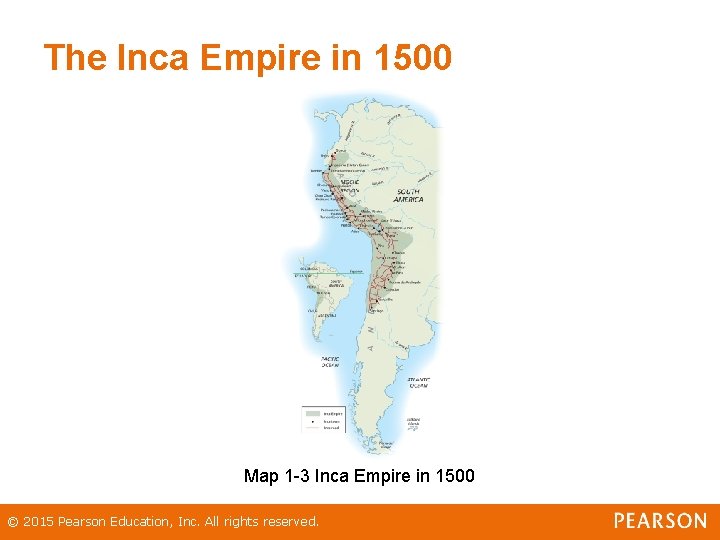
The Inca Empire in 1500 Map 1 -3 Inca Empire in 1500 © 2015 Pearson Education, Inc. All rights reserved.
American Indian Cultures, Trade, and Encounters with Europeans • Trade networks stretched from the Aztec Empire across all parts of North America • Native peoples of North and South America saw themselves as the center of their own world • Native American culture tended to understand warfare in ways radically different from most Europeans © 2015 Pearson Education, Inc. All rights reserved.
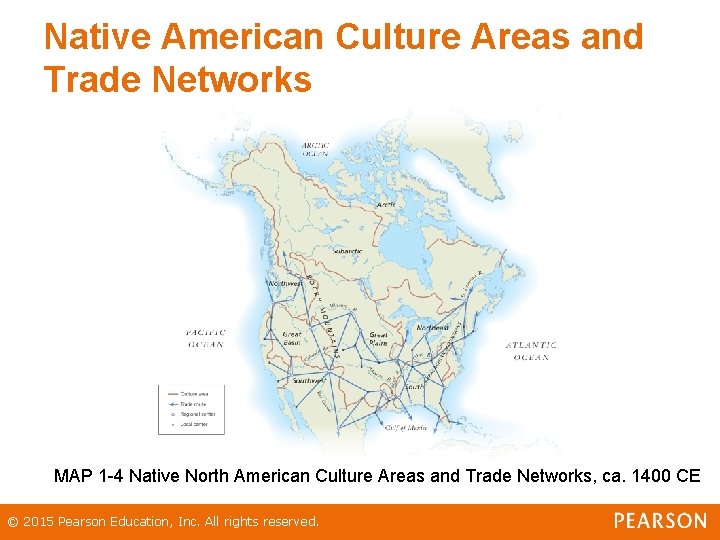
Native American Culture Areas and Trade Networks MAP 1 -4 Native North American Culture Areas and Trade Networks, ca. 1400 CE © 2015 Pearson Education, Inc. All rights reserved.
A Changing Europe in the 1400 s • The Vikings sailed the Atlantic in the 800 s • But early contact with North America was forgotten by the 1400 s • Europe was still recovering from the devastating Black Death, the bubonic plague that arrived in 1348 on rats carried by ships trading in the Black Sea. © 2015 Pearson Education, Inc. All rights reserved.
The Ottoman Empire Changes Eastern Europe • In 1453, Muslim Ottoman Turks conquered the city of Constantinople, the most important city in Eastern Europe. • Suddenly, Christian Europe was cut off from the lucrative land-based trade in spices and luxury goods with Asia that had existed since the late 1200 s. © 2015 Pearson Education, Inc. All rights reserved.
The Rise of Portuguese Exploration • Prince Henry (1394 -1460) of Portugal (“The Navigator”) set up a school of navigation. • Soon Portuguese sailors were traveling further and further down the coast of west Africa. • In addition, the Portuguese began trading in slaves. © 2015 Pearson Education, Inc. All rights reserved.
England France • France and England fought the Hundred Years’ War (1337– 1453) with each other, depleting both nations’ resources. • England was also torn by a civil war, the War of the Roses. • Despite all their troubles, England France were relatively unified kingdoms. © 2015 Pearson Education, Inc. All rights reserved.
The Unification and Rise of Spain • The political, cultural, and religious unification of Spain—known as the Reconquista, or “reconquest”—was an extraordinary development. • In January 1492, the 800 -year long Islamic presence ended in Spain. • That same year, Ferdinand Isabella expelled all Jews from Spain. © 2015 Pearson Education, Inc. All rights reserved.
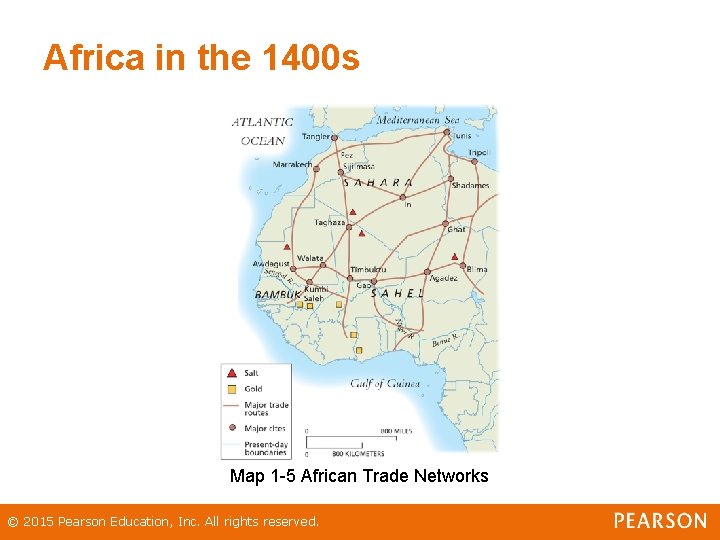
Africa in the 1400 s Map 1 -5 African Trade Networks © 2015 Pearson Education, Inc. All rights reserved.
Ancient Ties Between Africa and Europe • North Africa had been part of Mediterranean civilization for at least 3, 000 years. • As Christianity spread throughout the Roman Empire, some of the strongest Christian centers were in North Africa. • St. Augustine (354– 430) was born in what is now Algeria. © 2015 Pearson Education, Inc. All rights reserved.
The Empires of Ghana, Mali, and Songhay • Just south of the Sahara, the kingdom of Ghana governed much of West Africa for hundreds of years. • Mali slowly dominated and replaced Ghana as the leading power in the region. • Songhay grew stronger, capturing Timbuktu in 1458 just as the Portuguese were exploring the African coast. © 2015 Pearson Education, Inc. All rights reserved.
Kongo, Benin, and Central Africa • The kingdoms of Kongo, Benin, and surrounding areas had powerful governments but they were far less structured than in the empires of Mali and Songhay. • Kongo kings were Catholic. • Centralized government and the wealth generated by trade also led to military power. © 2015 Pearson Education, Inc. All rights reserved.
Slavery in Africa • Slavery was a significant part of the African economy long before the Portuguese arrived. • Most slaves were captured in war from other communities. • A more terrible form of slavery was born in the 1400 s: the slaves’ language, culture, and identity were destroyed. © 2015 Pearson Education, Inc. All rights reserved.
Asia in the 1400 s • In the 1400 s, China was united in a single empire and had been for more than 2, 000 years. • Beijing had a population that was 50 times larger than London. • For the next 200 years, China became increasingly isolated from the rest of the non-Asian world. © 2015 Pearson Education, Inc. All rights reserved.
- Slides: 24